Search This Blog

Showing posts with label Georgia. Show all posts

Friday, December 1, 2023

Meeting Mrs. Carter

Where are we?
 

This link will take anyone who wants to follow it to an old post of mine about the little town that President Jimmy Carter and his wife of 77 years, Rosalyn Carter, called home. If you choose, you can see the high school from which both Jimmy and Rosalynn graduated, and – more pointedly to my little story – Mom’s Kitchen, the restaurant in Plains. (I have included above a photo of the parking lot.) Go ahead. Take a moment to look back now at Plains….


When the Artist and I drove to Florida for a winter getaway, as we did for several years (first with our old dog, Nikki, later with puppy Sarah), we always made sure that our otherwise freeform route would put us overnight Saturday in Americus, Georgia, so that we could go to Plains for Sunday dinner the next day at Mom’s Kitchen. From there we would make another pilgrimage, out to Archery, Jimmy Carter's boyhood home. 


One year, though --. But I need to explain. Mom’s Kitchen has a large dining room with a cafeteria arrangement at one end where you line up and make your dinner choices. In the back corner past the food, another doorway leads to a second dining room. The Artist and I always sat in the main room, but when President and Mrs. Carter were there after church, their place was at the big round corner table in the back dining room. The restrooms, accessible from both dining rooms, are at the opposite end of the building from the kitchen and cafeteria line, and you turn left in the hallway coming out from the restroom, you re-enter the main dining room, while a right turn and then a left takes you to the back dining room. I’m telling all this for a reason.


See doorway at far right.

Because once when we were there, Mrs. Carter came from the restroom through the front dining room (where she probably knew everyone but us!) and stopped at our table to welcome us to Plains and exchange a few friendly sentences. She would not have had to come through the main dining room at all to rejoin her husband in the back room, and nothing obligated her to stop to welcome strangers. Nothing but exquisitely gracious manners and the sense of social obligation she no doubt felt as a former First Lady of the United States in this simple little farm town. 


As we shared a few moments, it was obvious to me that Mrs. Carter was a very reserved person, perhaps even shy, and had undoubtedly pushed herself beyond what we would now call her “comfort zone” for a lifetime. Not only, I think, because her role as a president’s wife demanded it but because she realized that she was in a position to do good in the world.


For me, that encounter was terribly moving, and as we left to continue our way south my eyes filled with tears. They fill with tears again today, thinking of that dear lady and her loving husband.


Jimmy and Rosalynn Carter, after four years in the White House, returned to Plains to live what many saw as a startlingly modest life. Whenever they were interviewed, however, their smiles and soft Southern accents could not hide the firm convictions held by both or the keen, penetrating intelligence both possessed, and they continued to make contributions to their country and to the world through Habitat for Humanity and The Carter Center


How sad that stories such as theirs are so rare in our world! But how wondrous that they lived in our world – and worked for us and beside us -- for so long!

Wednesday, February 13, 2019

Donde la tierra es roja

Agriculture in Graham County, AZ
He looked out at the red earth stretching around them. It was hard to imagine, but millions of years ago this had been the bottom of a massive inland sea. Aquatic dinosaur bones had been dug up under this soil and there were still places in the desert where mounds of fossilized seashells baked under the sun. 
- Jane Harper, The Lost Man 

Harper’s story takes place in the Australian outback, an environment even drier and more severe than Arizona. The red earth passages, though, set me to musing, first on similarities between Australia and Arizona, and then to other red earth parts of the world. Here in southeast Arizona, our pinkish-grey mountains can turn red at sunset, and there are places in Cochise and Graham County where the soil is red enough to remind me of Georgia clay. Here’s a passage from a children’s novel set in Georgia:

Then it began to rain. It rained and it rained and it rained. The yard ran in gullies, the lane was pink and slippery, and the road was deep in red mud. 

“I’m a-going to lose my mind,” Ma said, “if you all don’t stop a-tracking that old red clay into my house.” 

- Virginia H. Ormsby, Long Lonesome Train Whistle
That reminds me also (as my train of associations rolls along) that the first time I traveled in the American South, camping with my parents and sisters on our way to visit grandparents who had moved in retirement to the Gulf Coast of Florida, the red Georgia soil seemed bizarre and alien to my Midwestern eyes, whereas now, in more recent years, whether traveling through the South or spending time in Southwest, I have repeatedly been struck by the similarity of red earth in the southern U.S. to that where my “pen pal,” Kathy, lives in New South Wales, Australia, and — between here and there, if you take the Atlantic route — the red earth of South Africa, Botswana, and other countries in Africa, places I only know by reading about them. 

I asked Kathy (she’s the one who sent me the book quoted at the beginning of this post), for permission to use one of her photographs, and she not only said yes (thanks, Kathy Dowling!) but also sent another image, one I hadn’t seen before and had a little trouble deciphering at first. The first photo you won’t have a problem interpreting, but the second image below is a photograph taken during a dust storm that had engulfed my friends’ country home and B&B. This is not an altered image: the dust is this thick, bright red. Can you believe it?

Red earth around dam (pond) in New South Wales

Red dust storm, New South Wales

And now an old friend from my earliest Michigan life, married to a Brazilian, has sent me photos from their South American life — and there it is again: red earth. Jeanie Furlan writes, “The color of the earth is sandy red … in Pereira Barreto.…  Closer to São Paulo, the Ribeirão Preto earth is a deep, rusty red, and it is much more fertile.”  

Red earth in Brazil

Besides photos of the red earth, she sent an example of local architecture, saying, “This is the Aunt and Uncle’s house where I first visited in 1973  (outside Sales Oliveira). They use flooring that will match the earth and outside wall color is also the same as the earth.  It makes sense since people will track this color from boots and rain, dust and wind will blow this color around.”

Utilization of earth tones, Brazil

Of course, dwellers in the American Southwest have long used the colors of local earth in houses, walls, tiles, and decorative items. And here are a couple more red-earth images from here in Arizona, down near Pearce:


We know now that the continents of earth were not always configured as they are today, but I was in school too early to have been taught about plate tectonics, so lately I’ve been doing some catching up, marveling that the idea of continents moving at all is so recent in scientific history. In The Fossil Book: A Record of Prehistoric Life, by Carrol Lane Fenton & Mildred Adams Fenton, I turn (after lingering on the familiar Devonian examples) from compelling illustrations of fossils in rocks to passages of text that dwell on the movements of continents. There I learn that when Alfred Wegener and Alexander du Toit seriously proposed the idea in 1912, neither they nor anyone else could explain how the continents might have moved. The theory of seafloor spreading didn’t come along until H. H. Hess of Princeton put it together and published in 1962. So when I was in my high school freshman earth science class, plate tectonics theory was brand-new, a subject of scientific debate, and not the accepted working model and received knowledge it has since become. Pangea, Laurentia, Gondwana — prehistoric continents — an entirely different configuration of earth’s land and water. Fascinating!

I read novels set in other parts of the United States and the world, dwell on images sent by friends, recall soils in places I have visited, and I imagine (mind you, this is only my imagination at work!) all the red earth territories originally conjoined, and when I’m actually in red earth country, staring at the bright ground and rocks, I feel closer to other red earth parts of the world, as well as to characters in books who live in such places, as if we are still connected somehow by being on similar ground. Then I wonder this: around the world, how many different languages are spoken in red earth lands, and how many different words do human beings use to describe those places?

The “world” is at once so large and, as “earth,” a home small and contained and intimate. Or so it often seems to me.


Saturday, February 9, 2013

Georgia Road Trip, January 2003


Yes, you read that subject heading correctly: it was a full decade ago, almost five years before I started this blog, that David and I drove south with our old dog, stopping in many little towns along the way. A couple old photo CDs from that trip surfaced recently, and in response to one of my readers, Bob and Carol’s daughter (who may not even know that her mother told me she, the daughter, missed my road trip posts from other winters), I’ve decided to take one day a week for a while to revisit vacation scenes of years ago. Ready? Let’s go! The year is 2003, and we are making the first of several pilgrimages to Plains, Georgia, home of President Jimmy Carter. Plains is a pretty small town, but for part of the year it is serviced by a short line train from nearby Americus. Here is downtown Plains:

Plains, Georgia
Whenever we go to Plains (most recently in January of 2010), we plan to arrive about midday on Sunday, just in time for a big Sunday Southern dinner at Mom’s Kitchen, a no-frills, cafeteria-style restaurant with some of the best home cooking in the South. Whatever you do, do not miss the sweet potato pie!!! But then, anything you have to eat there will be good. You'll leave clean plates behind....


Mom's Kitchen, Plains, Georgia
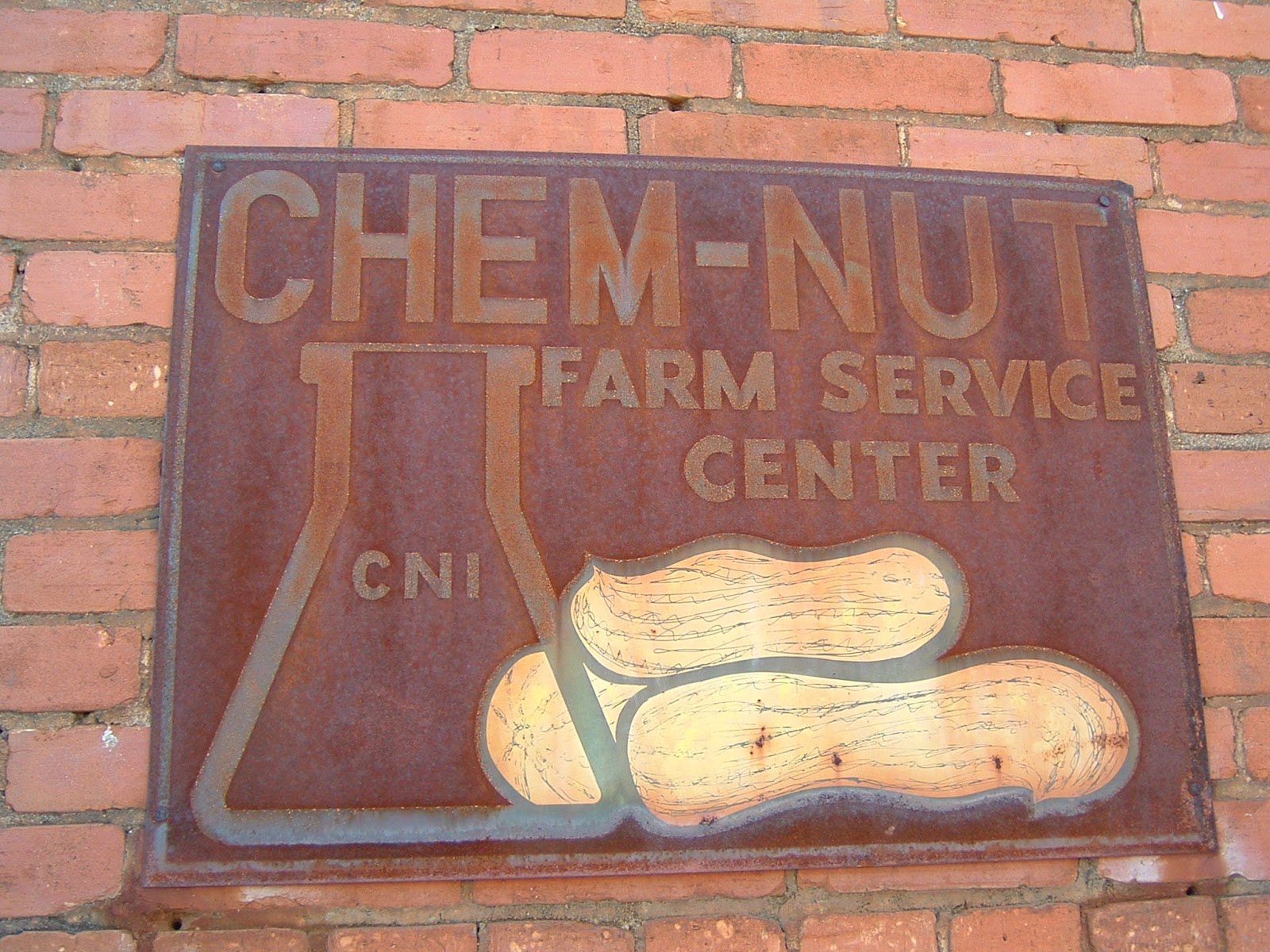
Then we visit the Plains Trading Post and walk around the old peanut warehouses. Red clay soil and red bricks—it all makes sense.

Arcade, downtown Plains

Slightly scary old warehouse sign
Nikki had a little trouble on this first trip, and we were terribly worried that she might not even make it out of Plains. What if she died and we had to bury her there? We took pictures of each other with her, and an obliging policewoman took a picture of all three of us. She was an old dog, but she recovered and lasted another four years, bless her heart!

The old pack pauses on the road
President Carter went to high school in this handsome building, now a museum. I would have loved to watch the first Obama inauguration here!

President Jimmy Carter went to high school here

Old Plains High School Auditorium
A short drive through the countryside from Plains takes us to Archery, the little community that was Jimmy Carter’s boyhood home. Here is the house, which is in my favorite Georgia architectural style.

Old Carter home, Archery
And nearby is the store that Carter’s father ran, the store young Jimmy worked in as a boy.

Old country store at Archery

Inside country store
We’re staying home again this winter, but that’s no reason not to do a little armchair traveling. And for follow-up reading, my book recommendation to go with today’s trip is Carter’s engaging memoir, An Hour Before Daylight. It’s a lovely book to read aloud to someone you love on a snowy, cold, Michigan winter night.

[This is the twelve-hundredth post on Books in Northport.]

Tuesday, July 13, 2010

Shaking My Head to Clear the Fog


We had a couple of foggy, misty mornings early last week, but it’s the mist in my brain that I troubles me some days. There is so much going on in the summer! The busy, full days race by so quickly! But it’s important to keep track of each day, and sometimes of each hour, when you’re in business rather than on vacation. My vacation time will come in another season. For now I must keep track of book orders, of author events, of out-of-town visitors, of when the gardens were last watered and how low we have gotten on clean towels and underwear (excuse me!), to mention only a few of the more important items.

But I find time to read. I need to make time to read. If I don’t read myself to sleep, the fog in my brain will start churning and roiling, and if I don’t take half an hour between dinner and bedtime to put my feet up a book in my hands, I’ll be too tired to read at bedtime. Books, whether fiction or nonfiction, easy or difficult, happy or sad, are my escape. They are my travel to other worlds. So bear with me today, because I’m just back from Georgia, and I was there in the 1970s, so it was travel through time as well as space.

There were times when the prose in Praying for Sheetrock seemed almost too literary, poetic and imaginative. Melissa Fay Greene wasn’t there, was she? Didn’t she only put the story together many years later, by interviewing people who had been there? So how does she know how everyone looked, how the place looked and smelled and sounded? Whenever these thoughts intruded on my reading, however, I would think about the book stripped of its detailed, evocative descriptions, and I could not wish it different.
Curled and perfumed teenagers arrived from the far reaches of the county, from the cabins and trailers in the woods, like moths attracted to high-wattage lights. Young men had stood burning in showers till their shoulders seemed to swell and then had worked bare-chested, draped with a towel, ironing their dress shirts on kitchen tables. Their mothers had talked while the sons had ironed and buttoned and tucked themselves in, paying their mothers no mind....

This story of many peoples’ lives is like life itself. At times a heroic note is sounded, then a tragic passage follows, and often there is dissonance. No two people have exactly the same memories or feelings. Forms of corruption are wiped out, and other, new forms appear. Meanwhile, amid the confusion and complexity, as the author notes, the ordinary, simple aspects of daily life go on.

Northerners can only ever see the South with outsiders’ eyes. The view this book gives the outsider is at least close-up and personal.

I shake my head to clear it of fog and heat and turn to focus on Friday’s launch of Al Bona’s book of poetry, Sand. Actually, my focus has already been there for several weeks, whenever the fog has lifted.

Thursday, July 8, 2010

What Are the Odds?


In the morning, I again picked up the book Praying for Sheetrock, by Melissa Fay Greene, the story about how a 50-year reign of corruption in one Georgia community was finally brought to a close by the late arrival of the Civil Rights era. I’m not very far into the book but found it absorbing from the first page.

So okay, now I reach page 68 and am introduced to the local newspaper, the Darien News. Darien is the only town in McIntosh County. I read about how the publisher of the newspaper took it upon himself to document and expose “clip joints” along Highway 17, tourist traps that enticed Yankees in with pecans, drew them into “friendly” but illegal little games of chance and relieved many of their entire vacation budget or their whole retirement savings. I think about the Georgia that has won my heart in the last ten years, the roadside pecans and boiled peanuts I’ve bought, mom-&-pop restaurants where we enjoyed good Southern cooking, and I’m glad we were traveling Highway 19 south in the first decade of the 21st century, rather than Highway 17 thirty years earlier.

But that’s not my story today. Later, at my bookstore, a woman brought in a box of books to leave for trade credit, and in the box was a 12-page booklet called “Marshes of Glynn: Sidney Lanier in Brunswick,” by Mary Miller. The cover image, a view out over a coastal salt marsh caught my eye, as it reminded me of the sawgrass Gulf coast of Florida. I opened the booklet and saw the words “Printed at The Darien News.” What is the likelihood of that, do you think? I don’t know that I’ve ever before heard of Darien, Georgia, and now two books have brought it to my attention in the same day.

The little booklet contains the text of Sidney Lanier’s poem, “The Marshes of Glynn,” illustrated with black-and-white photographs—live oaks, salt marsh and the sea—and sketches the story of “Georgia’s Greatest Poet” (as the historical marker in one photograph identifies him). Lanier lived from 1842 to 1881, dying of the tuberculosis he contracted as a prisoner during the Civil War. Though he married, wrote novels, played the flute and tried many different lines of work, “Poverty and ill health were his greatest concerns.” His poetry sounds stilted to the modern ear:
O braided dusks of the oak and woven shades of the vine,
While the riotous noon-day sun of the June-day long did shine
Ye held me fast in your heart and I held you fast in mine....

Still, he was a poet, he played the flute, he loved the coastal salt marsh, and I wouldn’t mind looking up Brunswick sometime to see if “Lanier’s oak” still stands, dripping with Spanish moss.

Here in northern Michigan, the basswood trees in our old farmyard hummed all evening long. Few of the tiny, sweet-smelling flowers are open, but the bees are already ready and eager.

Tuesday, July 6, 2010

I Can’t Help Being Excited--I Lead an Exciting Life!


First, at present, because a couple of long-anticipated bookstore events are now, at last, firmly set on the calendar. On Friday, July 16, from 4-6 p.m. we will host a book launch for Al Bona (Northport) and his new book of poems, Sand. The following week, on Thursday, July 22, also from 4-6 p.m., Anne-Marie Oomen (Empire), author of the recent American Map (as well as several other plays, books of essays and poetry) will be at Dog Ears Books with Benjamin Busch (Reed City), whose essay “Growth Rings” appeared in last fall’s Michigan Quarterly Review. That’s three outstanding Michigan writers in a single week, one a week from Friday and the other two the following Thursday, all three whose work I admire enormously. How could I not be excited?

On a much lesser note, Monday offered me a 3-hour break from the bookstore (Bruce manning the counter for me 1-4 p.m.) and a chance to get out into the lovely, foggy landscapes of a soft Leelanau day.


Third (if I need another reason), my radishes are gorgeous! Can’t you just smell that sharp, peppery taste and feel the fresh crunch?


The list could go on and on, but I”ll stop here for day.

--No, no, I can’t stop without putting in a few sentences from a book I fell into after dinner last night, Praying for Sheetrock, by Melissa Day Greene. This is early in the first chapter, as the author is describing the coast of Georgia going south from Savannah:
In Byran and Liberty County, commerce dwindled to the occasional peach or Vidalia onion stand. In midsummer, corn filled the fields and laundered sheets and overalls stiffened on clotheslines outside the sharecropper shacks. One last bit of trade before the road rolled south into the deep country that was Mama Harris, Palm Reader. Then Highway 17 dove into the great dark pine forests of McIntosh County.

Are you there? “...McIntosh County, where the forests grew, the water tasted like cold stones, and the air was clean and piney”?

Thursday, January 14, 2010

Books on the Road: Second Bookstore Visit and More Besides


Morning arrived still cold (hard frost) but bright and sunny, and we were giddy with anticipation, because Highway 19 would be our route for the whole day, and all sense of hurry had vanished. Rolling through Georgia on good road on a beautiful day--gracious pecan groves to admire, my first boiled peanuts since leaving the South last spring, visit to A Novel Experience (bookstore) in Zebulon, Georgia, light lunch at an old movie house cafe in Thomaston, visit to a nut house (!), and many, many sightings of the beautiful and very typical Georgia houses I wrote about and photographed last year.


Zebulon, county seat of Pike County, Georgia, was our first, long-anticipated destination of the day, and I practically cheered to see the bookstore, A Novel Experience, open for business as we pulled up in front at 10:15 a.m. by the courthouse clock. Chris and Susan, two of the three owners and the ones we’d met last year, were both on deck, but with Chris on her way out I had bookseller shop talk with Susan. She also encouraged me to read the novel Trinity, by Leon Uris, this winter, a book I’ve postponed reading for years. Okay, Susan, now I’m committed!


There was an exhibit of beautiful photographs called “Behind the Big House” on display at the bookstore. The photographer, Curtis Graves, has chronicled life on Evergreen Plantation, about 40 miles north of New Orleans, a place where his ancestors lived and died, both as slaves and as free men and women, for over 200 years. I wonder if a book of his work will result eventulally. As a bookseller, I can’t help hoping so. The work is certainly deserving.

Another flourishing bookstore is good news for our side!


On south to the next county seat. David and I had lunch last year at English’s Cafe in Thomaston and had a wonderful time, but today we tried a new place, the Ritz Cafe, on the very same courthouse square. It’s right next door to the old Ritz movie house, open for business and currently showing “The Bright Side.”


Display windows to the north of the theatre entrance feature old film memorabilia, and the cafe (to the south) also has an old movie theme, with posters and old reels on the wall and strips of film wound around pillars. The soups were delicious, the coffee perfection.


Books to soup to nuts kind of sums up our Georgia day’s highlights. On to the nuts--.

Coming from apple and cherry country, I’m accustomed to trees planted in rows and find beauty in the regularity of orchards but see in pecan groves, with much taller trees and more widely spaced rows, a different dimension altogether, almost that of large urban parkland. These groves look so gracious, so welcoming, similar to the gracious, welcoming charm of old Georgia houses.


Should I confess, though, that I wanted to stop at Ole Henry’s Nut House outside Camilla, Georgia, primarily to seek out mayhaw jelly?


But I did buy pecans and also local honey and something like peanut brittle but made with pecans and called crickle instead of brittle. And look at this case displaying varieties of pecans--whoever imagined there were so many ?

Or that a place called the “Nut House” would also house City Hall? Now that’s different!

Florida has been our ultimate destination all along, but it’s always bittersweet to me to cross the state line, leaving Georgia behind.

Wednesday, January 13, 2010

Books on the Road: What We Are Reading


I already confessed to two nights with Stephanie Plum in Joliet. My third night away from home (first night truly “on the road”) I took a deep breath and dove into Complications: A Surgeon’s Notes on an Imperfect Science, by Atul Gawande, while David relaxed with television. That reading gave me a lot of physical exercise—grimacing, wincing, recoiling, etc.! The operating room is not a place I want to be, in any capacity; reading about it, though, is fascinating (albeit graphic), not only for the medical details but also for Gawande’s thoughtfulness and candor, and so I wince and read on.

David and I took turns driving south yesterday, and since the beautiful prairie is (it cannot be denied) somewhat monotonous after a while, while one of us drove the other generously read aloud for many miles, David from Andrei Codrescu’s The Disappearance of the Outside and I, from the introduction, Inagua: An Island Sojourn, by Gilbert C. Klingel. From the repression of thought in Stalinist Russia to a storm-battered sailboat on the Atlantic in 1929, we took turns keeping whoever was driving in a state of high alert rather than succumbing to road fatigue.

When the book (whichever it was) was set aside, topics of conversation arose, and since it is now winter and we will soon be in Florida, the only time and place in my life where my sketchbook and pencils really come into their own, I have been thinking about drawing. As we crossed the frozen landscape, I told David that when I am using my camera—or even just thinking about taking photographs--I am concerned with line, color, light and composition, but when I think about drawing the color aspect drops out of consideration, its place taken by the solidity of objects, i.e., volume. How to show all the not-flat things of the world in their reality? David then suggested that the landscape we were traversing was excellent for thinking about perspective. I’ll say! I mentioned the lines of telephone or electric poles and wires angling off across the fields, growing smaller and smaller. Also, he pointed out, the difference between dark trees close to us and those farther away, seemingly lighter in value (is that the correct term?) across the intervening atmosphere. He described to me an exercise set for beginning drawing students. An egg is set on a table, lit from one side by a candle. The candle can be moved around the egg, lighting it from different sides, changing the look of the object to be drawn, and the candle is also burning lower all the time, effecting different changes. I pictured the egg and candle in my mind as he described the setup. Our surroundings, I should add, were far from a single-light-source exercise: cloud-covered sky and snow-covered ground made a kind of light sandwich--light being the pieces of bread, that is, not the sandwich filling. But it was the filling, too, wasn’t it? I need to reflect on this a bit more. Anyway, it's interesting the difference in concerns between photography and drawing. With drawing, one must endeavor to create an illusion rather than simply capturing a scene. With photography, on the other hand, one must be aware of what the camera is "seeing" that the eye could easily overlook, e.g., the phone pole or stop sign that could look to be growing out of a friend's head. What needs to be put in, what needs to be carefully excluded--different problems for different media.

I also read aloud to David the excellent, excellent piece by Jesse Jackson published Tuesday morning and clipped (with her permission) from my mother’s Chicago Sun-Times. Jackson has hit this one right on: it isn’t enough to bail out banks; they need to be reformed. Read the article and see if you don’t agree.


Weather has been very cold in the South this past week, and everywhere we looked in Kentucky we saw a frozen world. Small “waterfalls” we are accustomed to see spilling over limestone cuts were motionless stalactites. Ice-covered lakes and frozen creeks looked more like Michigan than Dixie, and snow on the ground continued, at least in patches, on into Tennessee.

Tonight in Georgia I saw two dandelions in bloom, as well as our first palmetto of the trip, but I’m unable to offer documentary evidence, for my camera batteries had run too low. That will be fixed by tomorrow, and we will be making our way down Hwy. 19 in a leisurely fashion. No more expressway—yea!!!

Oh, I must congratulate myself on an exemplary attitude having to do with that expressway travel business. Before we left home, I had resigned myself to the necessity of covering ground fast, minimizing meals on the road and nights in motels. (Like everyone else, we have our belts cinched tight this winter, which is part of our reason for heading to Florida in the first place.) But David knows how much I love two-lane travel and local food, and when we got off I-75 tonight and got settled in our motel, he found a fresh seafood take-out restaurant, where our catfish and shrimp—also French fries and hush puppies—were cooked while we waited. Now that’s what I call “road food”! The cases with all the different kinds of fish (whole, eyes in, and fillets), shrimp, scallops, alligator meat, etc., with fresh fruits and vegetables in boxes in front of the cases, are another scene I must leave to your imagination this evening.

Thursday, April 9, 2009

Heading Back North, Day 1


The van was all packed the day before. Sarah and I were up and out early, visiting with Ida and Weiser on the bridge at sunrise. I made coffee but not breakfast, waiting for David to be ready for that, and sat down with Kevin Jackson’s wiggy book, Invisible Forms: A Guide to Literary Curiosities, a series of essays on ‘paratexts.’ Huh? Oh, you know, written parts of a book that are not the book, per se—titles, dedications, prefaces, and the like. Pretty funny and just right for a morning before a long road trip when I didn’t think I would be able to concentrate sufficiently on the history of ideas.

As we left Aripeka, honeysuckle was blooming, Weiser and Ida lying by the side of Fiddler Lane, Carl and Mrs. Carl going into the Community Club. Bye-bye!


The sky was blue, drawing us north along Hwy. 19. In the median, some wonderfully bright, deep pink flower was blooming in blankets, but I’m not good at identifying small flowers at 55 mph. Dianthus?


Except for a brief lunch atop at Perry, Florida, we stayed on the move all day—no stopping to look at wildflowers or photograph buildings (though there was some great ones) or saunter along Main Streets or scour flea markets (none open on Wednesday)—and rolled through northern Florida and the beautiful Georgia countryside. What a great road! The only departure from it was due to a wrong turn (and honestly, I did not miss the right road on purpose!), which took us through the towns of Sasser, Dawson and Parrott before cutting cross-country on a couple of two-lane roads to get back to our divided highway. It all worked out great. The towns we saw were worth the detour (I’d like to go back to Parrott someday to explore on foot with my camera), and the roads were all smooth as silk.

It’s unusual for us to cover 400 miles in a day, but that’s what we did, stopping for the night in Thomaston, Georgia, where David headed for the showers, and I went out to forage for dinner. Jackpot! Greek take-out!

How close to a perfect road day can a person ask for? Tennessee, Kentucky, Indiana, Michigan, here we come!