Search This Blog

Showing posts with label words. Show all posts

Thursday, June 8, 2023

A Dog in a Paris Bookshop

W  O  R  D


Sometimes I play around with possible book titles. Certain words, I find, have an irresistible quality to them, bait on hooks we can hardly keep ourselves from biting. A few such are:


    light

    sun

    journey

    path

    road

    sea

    ocean

    river

    lake

    woods

    forest

    mountain(s)

    desert

    city

    village

    country

    west

    north

    south

    way


East of Eden, okay, but is ‘east’ an irresistible word? Does it have romance in it? What do you think? Anyway, you see what I mean about magic words?


Numerous new releases and fairly recent book titles feature other words that have magic for many of us, telling me I am certainly not alone in being drawn in by them. I've noticed a lot of books with these words in their titles:


    Paris*

    dog

    bookshop


Hence the title for today’s post, because – well, didn’t it draw you in? I don’t know of anyone who has used this exact title, but I offer it to anyone ready to write the book, and my plea has an addendum: You must, please, include lots of details about Paris and the bookshop and the dog, because as lovers of Paris and dogs and bookshops (please let there be used books, and let the dog be of mature years!), we your readers want a generous literary getaway and can never have too much of what we love.


(*Two of my all-time favorite books set in Paris are nonfiction, and neither one is new. Elliott Paul’s The Last Time I Saw Paris tells of his time on the tiny Rue de la Huchette in the years leading up to World War II, while Adam Gopnik’s Paris to the Moon, essays originally published in the New Yorker magazine not all long ago--in my sense of time--, introduce the reader to places and experiences that few tourists would uncover for themselves. Both these books give a quirky alien insider’s perspective on Paris insolite.) 


So once more I ask: Where, where, where is the Paris bookshop dog story? And could the dog have been Pierre’s dog in another life?


What words are irresistible magic for you in book titles? Because I know my list is only a beginning...


Practical matters: Dog Ears Books is generally open Tuesday through Saturday from 11 to 5, but will close early today (June 8, closing at 2 p.m.) and may have to fudge on a few upcoming Tuesdays, but whenever the bookstore is open, David Grath's gallery next door is also open. It's the 30th anniversary year for the bookstore and the last summer for the gallery, so please don't miss visiting.


Friday, February 10, 2023

“No, how are you, really?”


Recently I wrote, in two consecutive posts, about feeling “crabby” one morning -- the same day, written about twice, because the hours had divided themselves into a morning of outdoor adventure and afternoon of indoor reading. Now, in light of a book I devoured in two days of intense reading, I want to revisit that day briefly before getting into the book. 


Saying I’d been “crabby” when I first got up wasn’t a falsehood, but the word was not as accurate as another I could have used. Initially the word that came to mind that morning, without my having to search for it at all, was abandoned. I felt abandoned. 


But when I wrote about the day, I didn’t want to name my feeling so bluntly-- didn’t want to sound pathetic or self-pitying and discourage people from reading any further – the risk I’m taking today. After all, abandonment was, and is, hardly an objective fact of my life: I have family, friends, neighbors, dog; I see people and receive phone calls and text and e-mails and even postcards and letters in my physical mailbox down the road. To feel abandoned, then, was not a logical, rational thought. The feeling, however, was real and deep. Abandoned. Bereft. Because absence is a constant presence in my life now and can demand to be recognized when I least expect it.


Days before, I had started a very different post, a brutally honest one, thinking it the beginning of a draft for next month. “The Cruelest Month,” I titled those paragraphs, writing that the cruelest month wasn’t April for me, as the poet would have it, but March: Since my husband died last year in March (nine days after his February birthday), last year’s “cascade” of medical issues, beginning in January and ending in death, now repeats itself as a cascade of unavoidable memories, with the anniversary of the end looming ever closer.


Thus the feeling of being abandoned -- although I need to explain further that feeling abandoned does not necessarily correlate to being alone. Sometimes I am perfectly happy alone (as when reading that paper by Georges Poulet), while other times (not always!) with other people I can feel like a sad little island, abandoned in a sea of grief. Because widowhood is not all one color. Every day is not grey and rainy and dismal. 


And speaking of weather, I have always found my moods affected by weather (and used to tell the Artist, “I’m a very shallow person” for that very reason), but grief can make warm sunshine seem pointless, whereas a rainy day can give the perfect excuse to curl up alone, contentedly, and read a book. People, weather – sometimes they encourage certain feelings, and other times the feelings are completely at odds with what’s going on in the “outside” world – that is, outside one’s own head, heart, and skin.


In her new book, Bittersweet: How Sorrow and Longing Make Us Whole, Susan Cain (author of Quiet: The Power of Introverts in a World That Can’t Stop Talking) explores the tendency of some of us to what Aristotle called ‘melancholy,’ those feelings of 


…longing, poignancy, and sorrow; an acute awareness of passing time; and a curiously piercing joy at the beauty of the world. The bittersweet is also about the recognition that light and dark, birth and death –bitter and sweet – are forever paired.


From sadness, creativity, seeking unconditional human love or divine love, and the American gospel of positive thinking to grief and loss, “getting over it,” immortality, and intergenerational pain, this book goes broad and deep. There is the story, perhaps apocryphal (and maybe you’ve read it before, as I have), of Franz Kafka giving, to a little girl heartbroken after losing her favorite doll, a new doll with a letter he wrote as if the old doll had written it: “My travels have changed me.” For everyone who has ever lived, change and loss are inevitable, and when they come, life will never again be what it was. 


(Typing that last sentence, the one just above, I first typed “For anyone who has ever loved….” Has anyone ever lived without loving? Such a life would not keep one safe from change and loss. It would not be much of a life at all.)


It's too early in the year to know if Bittersweet will be the most important book I’ll read in 2023, but I know it is one I will be recommending to others and will re-read again and again myself. It is much, much more personal than Cain’s earlier work, and the pieces of memoir, which come along unexpectedly in various chapters, enrich the author’s themes. 


A couple of pages very meaningful to me personally had to do with writing when we are sad. She cites the work of Texas social psychologist James Pennebaker, who stumbled on something when he was suffering from depression and began writing down “the contents of his heart,” as Cain puts it. 


…And he noticed that the more he wrote, the better he felt. He opened up to his wife again [he had been drinking; they had been fighting], and to his work. His depression lifted.


The psychologist went on to make the phenomenon he experienced the basis for decades of study. He asked groups of people to write about their personal troubles, directing others to write about mundane facts in their lives.


Pennebaker found that the people who wrote about their troubles were markedly calmer and happier than those who described their sneakers. Even months later, they were physically healthier, with lower blood pressure and fewer doctor’s visits. They had better relationships and more success at work. 


Those who did the exercise of “expressive writing,” Cain reports from Pennebaker’s work, were not wallowing in their troubles but deriving insight from confronting and facing their pain.


P.S. 2/16/2023: Oprah picked this book! It's her 99th Book Club pick!


A couple weeks ago, before I’d even seen this book, I sat down to write a long letter. (I write letters, as well as blog posts, but letters I write by hand, on paper, with pen.) I began writing in a rather “pitiful” state of mind, going on and on about my reasons for feeling blue, somewhat as I admitted in my post the other day to feeling “crabby” but with a lot more honesty. By the last page of my letter, though, as I noted before the closing line, I had written myself into a cheerful frame of mind! I’ve noticed before, more than once when drafting blog posts, that I often sit down feeling sad and then somehow write myself into gratitude.


Writing isn’t a silver bullet or a magic potion and doesn’t always banish the blues. And they do come back. But that’s life: sometimes it’s an emotional rainy day, and then the sun shines again, and predicting how we’ll feel on any given future day is never foolproof. But if, as another friend says of me, I am a graphomaniac, I guess that’s one more thing to be thankful for in my life, because now and again writing gets me out of some dark places and back into the light.


Sunday, December 27, 2020

More Dog Tales -- and Dog Tails


At an earlier time in history in the British Isles, 


...[D]rover’s dogs and many farm dogs were referred to as ‘curs’ by reason of having their tails cut off or ‘curtailed.’ The tail docking ceased but the name remained until the beginning of this [20th] century. At one time [in England] all dogs were liable to a tax, but a shepherd’s dog was exempt if it had its tail docked, and should these dogs trespass en route or in the course of their normal duties as sheep or farm dogs the distinctive mark of the docked tail would save them from the wrath of the gamekeeper, as it was believed that docking slowed down their agility when chasing or killing game. However, this tax failed in its purpose and was abolished…. A new tax on dogs was introduced in 1796 … revised in 1878, and again the shepherd’s dog became exempt.


-      Iris Combe, Border Collies (Faber & Faber, London & Boston, 1978


Isn’t that an interesting bit of historic lore? It really puts to rest all the specious reasons given for docking tails in modern times, explanations shown up by this historic note as nothing but after-the-fact rationalizations for doing something that was done for a very specific financial purpose at one time in English history. You can still read, online and elsewhere that the tail of, for example, an Australian shepherd is at risk in the field and that docking is done to avoid injury. Ha! Why wouldn’t the tails of all dogs be at risk in the field? It never made sense to me.


I am reminded of a story. There was once a housewife who always cut off the end of the ham before she put it in the oven. When her husband asked the reason, she said her mother had always done it. Finally she asked her mother for the reason. “Oh, my roasting pan was too small for a big ham,” the mother replied. 


With a bigger roasting pan, the end of the ham need not be cut off. 


Without the general dog tax and exemption for farm dogs, there is no reason to dock dogs’ tails.


Tail docking and ear cropping has been illegal in England and Wales since 2007. In the U.S., anyway, the AKA breed standard for the border collie includes a moderately long tail, set low and sweeping upward at the end; the standard for the Australian shepherd, on the other hand, is for a tail “straight, docked or naturally bobbed, not to exceed four inches in length.”


Border collie: long, sweeping tail

Aussie: short or no tail


Both are working breeds, so why the tail distinction today between the two? Despite the old tax, it seems peculiar that any dog bred and used for farm work and driving livestock and geese would have its tail bobbed if indeed the tail were as important to the dog’s work as Iris Combe clearly considered it.


This [the tail] constitutes the extra braking and balancing power of a collie moving and stopping at speed.  … Shepherds often remark that the brains are in the tail.


Our Sarah, though I always thought of her as more Aussie, was a mix of Aussie and border collie and had what filled out to become, as she grew from puppyhood to maturity, a beautiful plumy tail. I was always glad that her tail had not been docked when she was a puppy. My sympathy is all with English law on this matter. 


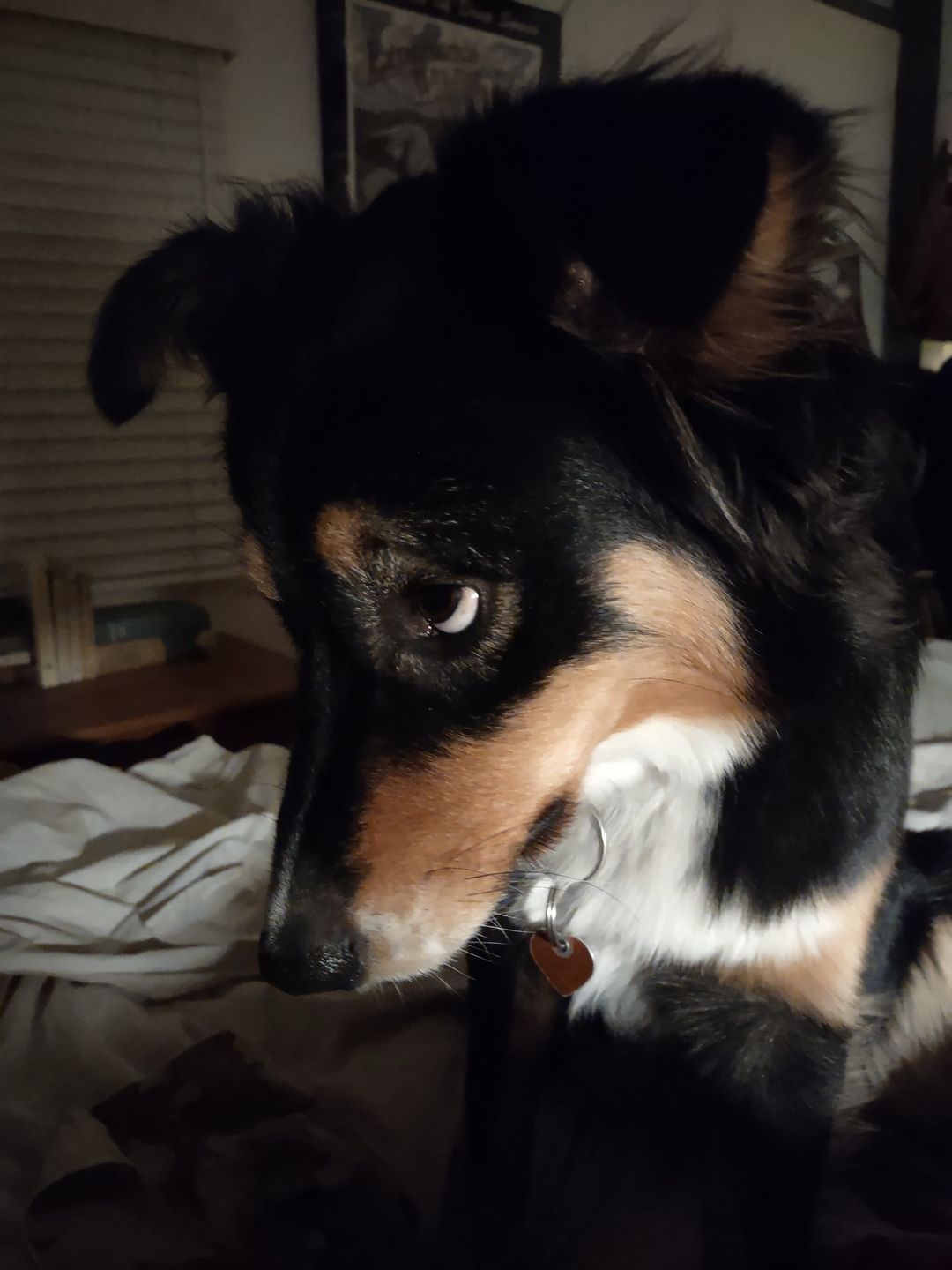
Peasy does not have much of a tail at all, but he may not have suffered having his tail docked. A naturally bobbed tail is less common in border collies than in Aussies, but sometimes there is a DNA variant in one of the genes, and that could have been the case with Peasy. Then, if he is a border collie – or more border than Aussie -- since border collies are supposed to have tails, and since breeding two dogs with the variant can be lethal to puppies in utero, little Peasy’s short, stumpy tail would have made him less desirable.


Do naturally bobtailed dogs or dogs with docked tails do less well in agility? Are they at a disadvantage when working with stock? I’ve read opinions both ways on that question. One disadvantage of tailless dogs that does seems probable, though, is the part that dogs’ tails play in doggie social signaling. Both Iris Combe and Temple Grandin make this point.


Back to the question of why breeders want to see tails in one working breed and not in another, we have to remember that “purebred” show dogs, outside of the world of livestock, are a very modern concern. At one time, every sheep-raising region in Great Britain bred its own regional strain of sheepdog. ‘Sheepdog,’ a generic term, needs no explanation, but what about ‘collie’? Here is another gem from Iris Combe:


The old Gaelic rural term for anything useful is ‘collie’ and for anything black is ‘coly.’ I refer here to the sort of Gaelic dialect as spoken among farming folk, not the true Gaelic language as found in textbooks. … So a collie dog was a useful farm dog, and in Scotland the names of many farm utensils are prefixed by the word ‘collie.’ 


Border collies are said to be wary and reserved with strangers. Peasy is certainly wary and reserved, to put it mildly, when meeting new people for the first time -- which has only happened twice so far in these strange COVID times -- and that could be another reason he was in the county facility for so long. I thought it could take days or even weeks before he would trust us. But, surprise! Peasy took to having a family the way a duck takes to water! He is inordinately cuddly, extremely affectionate, and could hardly be more eager to please. He is getting the hang of basic commands and has learned to “Wait!” for permission before going through an open door or diving into his dinner. 


It is a big responsibility, adopting and raising any dog, but especially one of the herding breeds, and Peasy is much more of a challenge than our laid-back Sarah was. Here are parting words of advice from Iris Combe:


…Your puppy was born with a certain personality which he will possess all his life, but the formation of his general character will, through training and association with you, reflect some of your personality as well. It is very true to say that some dogs are like their owners; see to it that this is a compliment in your own case. The choice and opportunity lie with you.


Saturday, January 20, 2018

The Dawns, the Cities, the Lives: Written Words and Visual Images

My only "leisurely" day in Mexico

Latent in me, I suppose, there was always the belief that writing was greater than other things, or at least would prove to be greater in the end. Call it a delusion if you like, but within me was an insistence that whatever we did, the things that were said, the dawns, the cities, the lives, all of it had to be drawn together, made into pages, or it was in danger of not existing, of never having been. There comes a time when you realize that everything is a dream, and only those things preserved in writing have any possibility of being real.

 - James Salter, Don't Save Anything: Uncollected Essays, Articles, and Profiles, Reviews

These lines clearly spoke to me, because I copied them down almost the moment I read them, quickly shared them on Facebook, and sent them in an enthusiastic e-mail to a friend. But is this my belief, that writing is "realer than other things"? 

This friend and I correspond in the form of written letters and are almost compulsive about not e-mailing each other, except on rare occasions, and as briefly as possible, to arrange a meeting or send each other photographs or quick, pithy notes. For us, writing, on paper, is very important. Escribir nos importe. But she also is a visual artist, a painter, as is my husband, and would I want to say their work, their painting, is less than writing? That feels all wrong. 

And so, in a letter to my friend (which I hope she will forgive my raiding for pieces to use here), I began to think through the question -- thinking, as I so often do, by exploring my thoughts in writing to see where they would lead.

I asked my friend (in writing, in a letter she will not yet have received) if she felt with her drawing and painting what Salter felt about writing, that her art preserves what otherwise would, in the end, lack reality, that her paintings of (for instance) Scotland draw together for her what otherwise would be in danger of not existing. In posing the question on paper, I realized that I feel that way with even the most pathetic of sketches I make on paper with pen or pencil, such as the one at the top of this page of the beach at Cancun. I also feel it to a lesser degree with photography. But I feel it most of all with writing. I am not claiming that writing is objectively "best" at drawing together and preserving reality -- only that it is the first toolkit I reach for.

"Most of all," I wrote above, using those words to emphasize that I feel I am preserving the world of my own experience (though not some objective, God's-eye world), when I write about it. Next question: Why, for me, this "most of all"?

The contrast with photography is striking, as I see it. Look at any snapshot or photograph, and how often can you tell who was holding the camera? Occasionally it's clear from the location, the time period, the subject, and the chosen framing that the photographer was, say, Eugene Atget, but in most photographs, even the best (and all the more so for amateur results such as my own), whoever clicked the shutter is absent from the image. In a family snapshot, a missing family member is obviously the photographer, but the image below of dawn over the city of Mérida could have been made by anyone.


When I compose a written "picture," on the other hand, I put myself into it. The place I write about, when I write about a place, isn't just the place by itself but a place I inhabited for some period of time, however brief. Like Kilroy, "I was here."

Where does that leave drawing and painting? I will not be so bold as to speak for painting or for painters. The Artist with whom I share a life paints from memory and imagination, not to preserve details of a particular scene, and there are as many styles and subjects of painting as there are painters. What I will say is that -- again, for me -- I find sketching intermediate between photography and writing and feel it closer to writing, for me, than it is to my photography. 

(For a couple years, I took drawing classes and tried to spend part of every day quietly looking and drawing my world. More recently I have hardly touched a sketch pad, so what you saw at the top of this post is very much what I would call a sketch rather than what I would call a drawing, but the distinction does not matter for my purposes in today's musings.) 

In writing and thinking about this subject, then, I discovered my feeling about sketching/drawing, that I feel it closer to writing than to photography is to writing, but then I had to ask again, Why? Is it because a hand guiding a pen or pencil cannot help being more personal than the instantaneous click of a camera shutter? Because the lines on the paper cannot be other than a personal, individual expression? Maybe in part, but that can't be the whole story. Or -- and this feels right to me -- is it because of the time spent making those marks on paper that I feel I have preserved a bit of the world? That feels closer to my intuition.

Living is always a journey through time. When I write about anything in my life -- or even, as today, writing about a developing train of thought -- the writing takes time, and anyone reading it must also take time. When I write about dogs in the Yucatan, during the time I spend writing I re-live my time there, and when you read, you are journeying through time with me. 

"I should tell you that there were stray dogs all over the Yucatan, and they all look pretty much alike, differing only in color — about 20-25 pounds, short-haired, with skinny tails and sticking-up or -out ears. Some were black, some tan, some bicolor, but it was almost as if we saw the same dog everywhere in a different costume. Mutts, like my dear old Nikki. Leonore couldn’t help worrying about them: were they sick? did they have worms? did they get enough to eat? As for me, I really, really liked the fact that they were tolerated everywhere and could go about their lives unmolested (I never saw a dog on a leash), as if they were people. They are very traffic-savvy, naturally, as they have to be to survive and never seemed to beg from tables, even when people dining outdoors had very good food."

My photographs of one of those same dogs tells no story at all and serves only (and not very well at that, since this was not a city dog) to illustrate my words. 


Because we had so few days and a very full schedule, there was no time for me to sketch any of the dogs I saw in Mexico, but that would have meant more to me than a camera image, because when I look at an old drawing that took me a long time to produce I feel again the whole being-there of that time. I do not appear in the drawing, any more than I appear in any of my own drawings or sketches, but I can feel myself there in a way I don't with a photograph. A drawing for me is a diary entry without words. Those below were made around my Michigan home and down in Florida years ago.


Be that as it may, though, for better or for worse, words have always been and will no doubt remain my first toolbox.

*. *. *

It was at this point in my musings that I was joined over morning coffee by the Artist, who asked what I was working on. I gave him a quick synopsis of the thoughts expressed above. Surprisingly, perhaps, he gave the written word highest priority. 

"A photograph becomes another object in the world," he began. "It shows objects but is also itself an object. A written description, on the other hand, has no representative existence except in the mind of the writer and readers."

"So what about a drawing?" I asked. "Isn't it an object, too? The way I was looking at it, a drawing is closer to writing, but the way you're looking at it, it's closer to photography."

"Yes, a drawing is also an object and exists as an object. What is written exists only in imagination."

Well, that was interesting! We would have continued our conversation, except that Sarah, the dog, had gotten tired of waiting for her morning sortie, and I had to get dressed to get her outdoors. 

Walking can be an aid to thinking, however, and so my thoughts continued, and I realized that my seeing a drawing as preserving and recreating time rested on the assumption of a first-person experience -- me, looking at one of my own drawings -- whereas another person looking at one of my drawings might as well be looking at one of my photographs. The time I spent drawing, the time that comes back to me when I look at an old drawing, is not present for another viewer. A written description -- or any kind of writing, for that matter -- is different not only because it can only be "seen" in a reader's imagination but also because the reader must take time to read the words that compose the piece. David's point about imagination is important, then, but so is my emphasis on time.

How about you? Did you follow my thoughts along this meandering path? Did you stop and argue with me or bring in examples of your own, either to confirm or refute any points made along the way? Were you walking in my shoes, or were we walking side by side, in dialogue?

Words. I cannot stop generating them. Will my written work be fiction this winter? (Michigan dreaming from the far Southwest?) Or drawing dear, scruffy Cochise County with words? The dawns, ... the lives....  

However the winter experience develops, along with studying Mexican history and the Spanish language and doing a good winter's worth of writing, as well, I want to use some of my Arizona time wordlessly, too, being-there in unhurried fashion with paper and pencil. 


Tuesday, December 19, 2017

Timely Holiday Message to All Americans

Are the geese getting fat? What’s sauce for the goose, ’tis said, is sauce for the gander, as well, and therefore every transgender bird too must get happily sauced, to be able to stomach the holiday table in our nation’s capital. If, that is, we would stick — like cliched glue, like old-fashioned loyalty, like clear-sighted honesty — to science-based evidence rather than falling back (with suicidal determination) on ignorance and superstition, falling backward like fetuses returning to the womb and from thence (in at least a few wild-eyed theories), orbiting back to the beginning of Time, as Time runs backward, and falling at last down a dense black hole, an educated populace scurrying (like a thunder of terrified rabbits) for cover, fleeing the hare-brained politicos determined to stop their mouths and paralyze their brains. 

A pox on morons and idiots! Yes, I call them out! ’Tis mincemeat they make of our merry holiday season, the scoundrels! And so ’tis mincemeat I make of a handful of figures of speech, mixing geese and rabbits and black holes, for who can do less (or more) when threatened with the loss of clear language? 

“Use your words,” parents say to their little children, encouraging direct and clear communication. In the current harsh political climate, we adults must say it to one another, every day, encouraging each other and reinforcing courage in ourselves. Courage and encourage. That is to say, take and give heart. 

Keep calm, carry on -- but keep using your words, too! Perhaps a sign on the bathroom mirror, to read as you brush your teeth each morning:

KEEP CALM.
CARRY ON.
USE YOUR WORDS!

And do not let your joy be stolen any more than you would let anyone steal your words. Keep the faith! Happy holidays!


Wednesday, December 13, 2017

To Replace or Re-Invent Myself, That Is the Question

We were all younger once.

One day this past September I received an unsolicited e-mail offer that I read with very mixed feelings. I’ll quote the bulk of it here verbatim (omitting the company name and link at the end but including a few editorial comments) so you can see what I mean:

Pamela - If you’re not 100% happy with your blog, you may want to consider trying a new writer!  

The key is to find a great writer that [sic] also has a deep understanding of your industry [!]
 

The problem is, finding these writers [now we are looking for more than one?] can be a real challenge. 
 

To solve this problem, we use our award-winning _____ platform [I omit the name here, as it is no doubt trademarked) to search over 70,000 pro [sic] writers to find a handful of writers that [sic] we think will be a good match for your specific needs. Then, we have each writer write you [awk] the same sample article (title of your choosing). 
 

This makes it super easy [ugh!] for you to see which writer you like the best.
 

If this sounds like something you might be interested in, just click below to schedule a time so we can talk.

Interesting, eh? Here’s some of what raced through my brain in response: 

Why would I not be happy with my blog? Should I be unhappy with it? Is the sender implying that the writing is substandard? There are certainly writers in the world more talented than I am, but I doubt they want to work for me without compensation! Because I can’t afford to pay a writer to write for me, and I can’t afford to hire a company to find a writer to write for me!

And let me just say that I am repelled by the term “industry” applied to the world of books! Anyone who (who, not that) would apply the term “industry” to the world of writers and publishers and booksellers would probably also refer to the books in my store as “product.” 

Finally, who among these 70,000 “pro” writers for hire knows my life and the books I read and stock and my bookstore better than I do? My blog is not about some abstract “industry,” but about my very personal world!

Lest you think, however, that I was sputtering in outrage over this e-mail, I assure you I was more amused than offended. Did a “pro” writer compose the e-mail? My inner editor (who always slumbers lightly with one eye open) would have taken “that” out of “writers that we think would be a good match” and maybe moved “that” up to the previous one-sentence paragraph, using it place of the awkward comma, and that “super easy” claim did not impress me, either. Overall, I found the entire message uninspired and uninspiring.

Okay, I understand it was a sales pitch. But the message I received (besides envisioning a writer reaching way over her head) was that the sender had not spent any time at all reading my blog before trying to sell me her (I’ll use the detested word here) product. Know thyself and know thy market!

On the other hand, I’m sympathetic, I really am. It’s a dog-eat-dog world [No offense, Sarah!], and everyone is seeking an audience, making a pitch, feeling around for a footing and a handhold — in short, trying to survive. And I’m no different. I’m just (and this is probably my Achilles heel rather than any excellence of character) not single-minded about it. My little stories and snippets, travelogues, tirades, and vignettes are all offered at the same price I am paid to write them, and if they help my Dog Ears Books business in any way, so much the better. If not, I’ve had the pleasure of the writing and the occasional pleasure of a kind and/or thoughtful word in response.

Self-invention and self-promotion are touted as what we should all be about these days, and as wages race to an ever-lower and lower global “bottom” (for those jobs not yet lost to drones and robots), there are more and more people of all ages trying to figure out their next moves. I give a lot of thought to the question myself. What next? What if I’ve nearly run out my string with this bookselling gig? 

One thing is sure. I won’t be hiring anyone else to do my writing for me. So if you’re not satisfied with what you find on Books in Northport, you'll have to look elsewhere. At least you’ll have no trouble finding (here comes another buzz word I despise) “content” all over the place. It’s a big, wide, wonderful world out there, and, in case you haven’t noticed, it’s overflowing with words.

Monday, June 26, 2017

Nature, Art, and Artifact


Last Sunday was what will have been my last Sunday away from the bookstore for the next two months. I used to begin my 7-day-a-week schedule with Memorial Day weekend, but June Sundays in Northport are quiet, (this was true even last year, when the post-Memorial Day dropoff in visitors did not occur, for the first time in my memory), and I decided I needed the time at home. Grass will not be growing as fast in July and August. 

Okay, decision taken. But on my last Sunday at home I didn’t stay home all day.

We had to attend the annual St. Wenceslaus rummage sale, for one thing, and I found several things I really needed – pint canning jars, wooden clothespins (one never has too many), and a nice, big laundry basket. I also bought five or six books, for us and for the shop. Then there were the indulgences – two (yes, two) cheese graters (sturdier than the ones I had at home), an irresistible set of four table napkins, and some other small item that escapes my mind at the moment. (Oh, a steamer basket.)


After the sale, we continued to Lake Leelanau for coffee and so I could pick up a bag of sugar at NJ’s. But then, home ... for lunch outdoors ... and to hang laundry on the line. I’d made a commitment, though, to attend the artist-in-residence lecture at 1:30 in Leland, so down the highway I went. Indoors. On a beautiful, sunny June Sunday. And I was glad to be there.

Holly Wren Spaulding is the first nonvisual artist to be awarded the artist-in-residency at Leland’s Old Art School since the program’s inception. My husband was the first artist-in-residence a decade ago, and most of those selected have been painters. But Holly Wren Spaulding is a poet. Words are her medium. Spaulding’s exhibit at the Old Art Building is a group of poems, the whole entitled “Lost Lexicon.”

Her inspiration for these poems was learning that roughly fifty words were to be cut from the Oxford Junior Dictionary, largely words having to do with nature and the outdoors, to make room for words children hear more frequently, many having to do with new technologies. It is in this context that Spaulding sees her work as a poet to be one of conservation.


The poet knew she wanted these poems done on letterpress, and initially she thought to hire someone to do the printing.
The letterpress artist (‘operator’ as a noun felt all wrong there!) contacted, however, offered instead to teach the poet her craft. And so Holly composed lines of type – actual, physical letters of poured lead – and impressed her words on sheets of handmade paper. The paper used is no longer available, the company that made it out of business. There was a display with a few lines of type and a little sign saying, “Please touch.” I did -- and felt suddenly near tears. Am I overly attached to words? To the physical world? Perhaps both, but I wouldn’t have it any other way.

Holly’s chosen words were names of plants and animals. On the walls where paintings are usually shown, small poems on sheets of handmade paper were presented to visitors. It was all (as an acquaintance said years ago when she became the mother of twins) very physical – natural objects, physical artifacts, material art.

The “Lost Lexicon” poem cycle may be available in future as a book. For now we still have Pilgrim, Spaulding’s 2014 work published by Alice Green & Co., and in that small, sweet book you will find the same poetic sensibility and feel the same gratitude at being able to hold the poet’s work in your hands, the book a physical object.