Search This Blog

Showing posts with label depression. Show all posts

Sunday, March 22, 2026

Where I've Been Lately


I’ve been under the weather.


It’s hard to keep the days straight, but a week ago Saturday I expected to be in my shop and then could not get there because I had no plow-out at home until evening. I made a brief foray out into the world on Sunday before Monday dumped two feet of new snow. 


On Tuesday evening farmer/plow guy came with big tractor and monster snow blower, which allowed me to get out Wednesday to collect mail, purchase OTC relief for a nasty cold, and renew the license plate tab for my car, but since then I’ve stayed home, lying low, sleeping as much as possible. My laptop notified me that I spent 40% less time online in the past week than the week before. Duh! I'm sick! Leave me alone!

Here are a couple things I learned, hunches I followed up with online searches when finally I had the energy to pursue information again. If these tidbits keep one or two of my blog readers from being caught off-guard, it will be worth my mentioning them.

(1) A simple illness like a bad cold can bring on, trigger—mimic, if you prefer—depression. The scientific explanation has to do with cytokines and the body’s immune response, and my science nerd friends will want to follow up on the research in this area. For me, confirmation of my hunch was all-important to “bouncing back” (which I am doing in super-slow-motion), because at my lowest ebb I had no energy at all: no energy to care, to feel grateful, to feel hopeful, no energy to feel. And not feeling, not caring for or about anything but my own misery was worse than the misery itself. Everything dear and important seemed pointless. Life itself. Why go on?

Then on Saturday, the morning after the worst day, I woke up feeling, if not exactly “better,” at least not as completely terrible, and I cannot exaggerate the effect of that slight improvement. It was a re-entry into life! Still sick, coughing, and low on energy but able once again to smile when my phone's ping! announced a text from my special someone. Love was not an illusion, a sick joke played on me by a malevolent universe, and I was not dead to its wonder! I was reborn! Hallelujah!

(2) Coughing can cause [more] coughing. This was another hunch I had that proved out, and it’s a good reason to treat the symptom, in order to break the vicious cycle. 


I was still able to read — sometimes — off and on. 

At my worst, it was much more off than on, sleep too demanding to be denied. I would often wake from hours of sleep only to drag myself through a page or two before giving up, exhausted, to pull the covers over my head again. In better hours, though, the force of the story would pull me in and along, giving me as much of a reprieve from self-pity as I could hope to achieve. (Because self-pity was the absolutely most disgusting aspect of the whole thing!)

The Lincoln Reader, edited by Paul M. Angle, published in 1947, was one of that year's Book-of-the-Month Club selections. BOMC News, in announcing the choice, declared that while Angle’s book would have been impossible without all the previous books written about Lincoln (it borrows from many of them), it duplicated none of them. Angle’s selections are grouped according to the chronology of the subject’s life, beginning with “Kentucky Childhood” and proceeding through “Youth in Indiana,” “New Salem,” etc., all the way through Lincoln’s careers in law and politics, his presidency and the Civil War, to “Death—and a People’s Grief.” Let me quote from the BOMC News flier that accompanied the volume: 

[The book] is based on all the great biographies…. It draws from the intimate narratives of Nicolay and Hay, and from the priceless reminiscences of Herndon. It gets color and variety from the homely remarks of his contemporaries, many of them little known. It uses the newspaper reports of the political battles…. It includes off-the-record stories by a great many men and women who knew more than they would tell when Lincoln was alive. 

There are also sections in Lincoln’s own words, whether speeches given or letters written.

BOMC notes of distinguished Lincoln scholar Paul Angle that he “shepherds this flock of witnesses, and cuts them in and out like sheep in a moving picture…,” and as we proceed through the chapters we meet Lincoln from a variety of perspectives, both sympathetic and critical; from a distance, on state occasions, as well as in personal surroundings, alone or with his intimates, and the overall effect is that of living alongside him, in his times, from the first to last page of the book. 

Has there ever been a more American president than this gangly, rawboned, self-educated “Westerner”? For Kentucky and what we now call the Midwest were the West then (Michigan and beyond the Northwest), the country as raw as the man—not only the frontier but the capitol itself, Washington. This is how a member of the House of Representatives, Albert G. Biddle of Ohio’s Western Reserve, described the capitol when Lincoln arrived there in 1861:

 It was then as unattractive, straggling, sodden a town, wandering up and down the left bank of the yellow Potomac, as fancy can sketch. Pennsylvania Avenue, twelve rods wide, stretched drearily over the mile between the unfinished Capitol and the unfinished Treasury building on Fifteenth Street…. Illy paved with cobblestones, it was the only paved street of the town. The other streets, ... were long stretches of mud or deserts of dust and sand…. Not a sewer blessed the town, nor off of Pennsylvania Avenue was there a paved gutter. Each house had an open drain from its rear, out across the sidewalk. 

Squalid as were his surroundings, however, and informal as his manners could sometimes be, Lincoln’s presidential statements, within Cabinet meetings or to the public at large, were marked by thoughtfulness, principle, and dignity. His entire first term of office was passed in wartime, the first shots at Fort Sumter fired on April 12, scant weeks following the new president’s March 4, 1861, inauguration. Lincoln sought and carefully weighed advice from his Cabinet and his generals. He never thought he knew more than anyone else but accepted the fact that the ultimate decisions granted him in the Constitution were his responsibility. 

During his first inaugural address, Lincoln appealed to Americans’ sense of shared history and contiguous land, reminding them, “We are not enemies, but friends.” Then, perhaps more practically, “We must not be enemies.” On March 4, 1865, the war all but concluded (Lee would surrender to Grant on April 9) and his re-election accomplished, Lincoln’s inaugural address acknowledged the price suffered by four years of bloody conflict, a longer, greater, and more awful war than either side had anticipated. His final words that day are justly famous:

With malice toward none; with charity for all; with firmness in the right, as God gives us to see the right, let us strive on to finish the work we are in; to bind up the nation’s wounds; to care for him who shall have borne the battle, and for his widow, and his orphan—to do all which may achieve and cherish a just and lasting peace among ourselves, and with all nations.

Angle’s book, in giving me a fuller picture of Lincoln the man than I ever had before, also gave me a much clearer realization of his greatness.

And now, as I slowly come back to my own ever-so-modest role in the human race, still resting a lot between short bursts of housework (not really “bursts” at my current speed, to be honest), having so enjoyed The Mill on the Floss, I am reading another novel by George Eliot, Adam Bede. At the beginning of Book Two, the author addresses her readers directly to explain her reasons for choosing the characters she does. That they are not mythic heroes or villains, she readily acknowledges, but if she chose to present only such unrealistic figures, making it obvious where readers should admire and approve and where they should condemn and hate,

[W]hat will you do then with your fellow-parishioner who opposes your husband in the vestry?—with your newly-appointed vicar, whose style of preaching you find painfully below that of his regretted predecessor?—with the honest servant who worries your soul with her one failing?—with your neighbor, Mrs. Green, who was really kind to you in your last illness, but has said several ill-natured things about you since your convalescence?—nay, with your excellent husband himself, who has other irritating habits besides that of not wiping his shoes?

She continues, without breaking her paragraph as I have done here:

These fellow-mortals, every one, must be accepted as they are, …and it is these people—amongst whom your life is passed—that it is needful you should tolerate, pity, and love: it is these more or less ugly, stupid, inconsistent people, whose movements of goodness you should be able to admire—for whom you should cherish all possible hopes, all possible patience.

Content to tell her “simple story,” the author tells us, she dreads nothing but falsity, noting that “things may be lovable that are not altogether handsome” and that she would rather reconcile us to love each other despite our faults and flaws than to be indifferent or coldly prejudiced against one another. Another author would have portrayed the character Hetty, for example, very differently. Eliot’s portrait is kindly and leads us to be more generous in our estimation:

…Hetty’s was a spring-tide beauty; it was the beauty of young frisking things, round-limbed, gambolling, circumventing you by a false air of innocence—the innocence of a young star-browed calf, for example, that, being inclined for a promenade out of bounds, leads you a severe steeple-chase over hedge and ditch, and only comes to a stand in the middle of a bog.

Yes, I think George Eliot may become one of my favorite writers.


Someone has been a spectacularly good girl!


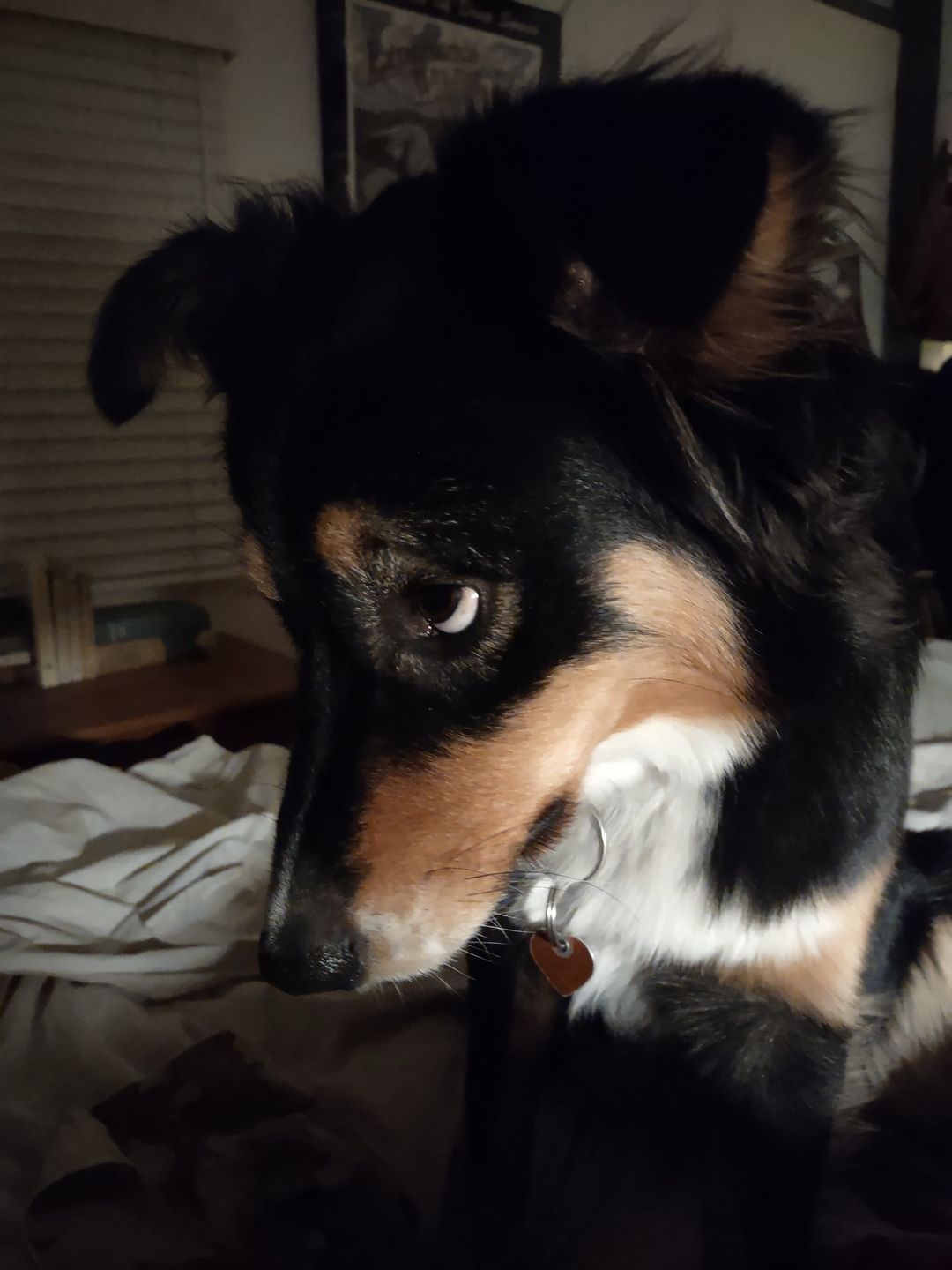
You know who I’m talking about! Sunny Juliet has been an angel dog for her momma this past dreadful week! Who walks my dog for me while I’m sick? She walks herself! I bundle up in my barn coat and sit in the porch doorway while Sunny goes out and tends to her business. She may do a little wandering around the yard and exploring, but there have been no long walkabouts: no, she has stuck close to the house and has come back without calling, sometimes so quickly that I order her back to “Run around! Run, run, run!” before we go back indoors together. I could not have asked for an easier, more compliant, easy-going companion than Sunny has been during what has to have been an incredibly boring stretch of days for her. Good dog! I am so proud of her and grateful for her presence! 

Grateful, too, for all the offers of assistance and get-well wishes by text and other means that have come my way. Thank you all for your caring concern! It means the world to me.


Friday, February 10, 2023

“No, how are you, really?”


Recently I wrote, in two consecutive posts, about feeling “crabby” one morning -- the same day, written about twice, because the hours had divided themselves into a morning of outdoor adventure and afternoon of indoor reading. Now, in light of a book I devoured in two days of intense reading, I want to revisit that day briefly before getting into the book. 


Saying I’d been “crabby” when I first got up wasn’t a falsehood, but the word was not as accurate as another I could have used. Initially the word that came to mind that morning, without my having to search for it at all, was abandoned. I felt abandoned. 


But when I wrote about the day, I didn’t want to name my feeling so bluntly-- didn’t want to sound pathetic or self-pitying and discourage people from reading any further – the risk I’m taking today. After all, abandonment was, and is, hardly an objective fact of my life: I have family, friends, neighbors, dog; I see people and receive phone calls and text and e-mails and even postcards and letters in my physical mailbox down the road. To feel abandoned, then, was not a logical, rational thought. The feeling, however, was real and deep. Abandoned. Bereft. Because absence is a constant presence in my life now and can demand to be recognized when I least expect it.


Days before, I had started a very different post, a brutally honest one, thinking it the beginning of a draft for next month. “The Cruelest Month,” I titled those paragraphs, writing that the cruelest month wasn’t April for me, as the poet would have it, but March: Since my husband died last year in March (nine days after his February birthday), last year’s “cascade” of medical issues, beginning in January and ending in death, now repeats itself as a cascade of unavoidable memories, with the anniversary of the end looming ever closer.


Thus the feeling of being abandoned -- although I need to explain further that feeling abandoned does not necessarily correlate to being alone. Sometimes I am perfectly happy alone (as when reading that paper by Georges Poulet), while other times (not always!) with other people I can feel like a sad little island, abandoned in a sea of grief. Because widowhood is not all one color. Every day is not grey and rainy and dismal. 


And speaking of weather, I have always found my moods affected by weather (and used to tell the Artist, “I’m a very shallow person” for that very reason), but grief can make warm sunshine seem pointless, whereas a rainy day can give the perfect excuse to curl up alone, contentedly, and read a book. People, weather – sometimes they encourage certain feelings, and other times the feelings are completely at odds with what’s going on in the “outside” world – that is, outside one’s own head, heart, and skin.


In her new book, Bittersweet: How Sorrow and Longing Make Us Whole, Susan Cain (author of Quiet: The Power of Introverts in a World That Can’t Stop Talking) explores the tendency of some of us to what Aristotle called ‘melancholy,’ those feelings of 


…longing, poignancy, and sorrow; an acute awareness of passing time; and a curiously piercing joy at the beauty of the world. The bittersweet is also about the recognition that light and dark, birth and death –bitter and sweet – are forever paired.


From sadness, creativity, seeking unconditional human love or divine love, and the American gospel of positive thinking to grief and loss, “getting over it,” immortality, and intergenerational pain, this book goes broad and deep. There is the story, perhaps apocryphal (and maybe you’ve read it before, as I have), of Franz Kafka giving, to a little girl heartbroken after losing her favorite doll, a new doll with a letter he wrote as if the old doll had written it: “My travels have changed me.” For everyone who has ever lived, change and loss are inevitable, and when they come, life will never again be what it was. 


(Typing that last sentence, the one just above, I first typed “For anyone who has ever loved….” Has anyone ever lived without loving? Such a life would not keep one safe from change and loss. It would not be much of a life at all.)


It's too early in the year to know if Bittersweet will be the most important book I’ll read in 2023, but I know it is one I will be recommending to others and will re-read again and again myself. It is much, much more personal than Cain’s earlier work, and the pieces of memoir, which come along unexpectedly in various chapters, enrich the author’s themes. 


A couple of pages very meaningful to me personally had to do with writing when we are sad. She cites the work of Texas social psychologist James Pennebaker, who stumbled on something when he was suffering from depression and began writing down “the contents of his heart,” as Cain puts it. 


…And he noticed that the more he wrote, the better he felt. He opened up to his wife again [he had been drinking; they had been fighting], and to his work. His depression lifted.


The psychologist went on to make the phenomenon he experienced the basis for decades of study. He asked groups of people to write about their personal troubles, directing others to write about mundane facts in their lives.


Pennebaker found that the people who wrote about their troubles were markedly calmer and happier than those who described their sneakers. Even months later, they were physically healthier, with lower blood pressure and fewer doctor’s visits. They had better relationships and more success at work. 


Those who did the exercise of “expressive writing,” Cain reports from Pennebaker’s work, were not wallowing in their troubles but deriving insight from confronting and facing their pain.


P.S. 2/16/2023: Oprah picked this book! It's her 99th Book Club pick!


A couple weeks ago, before I’d even seen this book, I sat down to write a long letter. (I write letters, as well as blog posts, but letters I write by hand, on paper, with pen.) I began writing in a rather “pitiful” state of mind, going on and on about my reasons for feeling blue, somewhat as I admitted in my post the other day to feeling “crabby” but with a lot more honesty. By the last page of my letter, though, as I noted before the closing line, I had written myself into a cheerful frame of mind! I’ve noticed before, more than once when drafting blog posts, that I often sit down feeling sad and then somehow write myself into gratitude.


Writing isn’t a silver bullet or a magic potion and doesn’t always banish the blues. And they do come back. But that’s life: sometimes it’s an emotional rainy day, and then the sun shines again, and predicting how we’ll feel on any given future day is never foolproof. But if, as another friend says of me, I am a graphomaniac, I guess that’s one more thing to be thankful for in my life, because now and again writing gets me out of some dark places and back into the light.


Monday, September 27, 2021

Changes and Dogs and Books

Summer is over vs. Fall is not over yet, OR Fall is beautiful!


Two Different Ways to Count Blessings


As my blogger/reader/dog lover friend Dawn says, right in the title of her blog, Change is Hard. As I recall, the hard change Dawn initially referred to was a transition from one job to another, and that was years ago now – she is retired now! -- but changes don’t stop coming, as long as we’re alive, and all of us been through a lot of hard changes in this country since Dawn and I connected via our blogs. There have been, of course, other kinds of changes, long anticipated and welcomed. Life just keeps coming at us, one way or another, and we do our best to adapt each day.


I absolutely love asters!


When I was young, my friends and I used to say (thinking ourselves very clever), “Someone told me to cheer up because things could be worse. I cheered up – and sure enough, things got worse.” Gallows humor, I suppose, which we could afford because we were, as I say, young and therefore, secretly felt invulnerable. What we find amusing changes as we advance in age….


Anyway, the other morning I had a little epiphany (I don’t know about your epiphanies, but most of mine are little ones), and maybe you’ve read Anne Frank’s Diary of a Young Girl and will recognize my lightbulb moment as the difference between Anne’s way of counting her blessings and her mother’s way. Her mother’s advice when Anne felt gloomy was that she should think of other people whose lives were worse. At the time, the Frank family were living in hiding from the Nazis, but their situation could have been worse -- and became tragically worse when their hiding place was discovered, with only Anne’s father surviving Auschwitz.


Anne, however, even in hiding, was young and full of hopes and dreams and looked for sources of joy rather than other people’s misery to bring herself out of spells of despair. “I don’t think of all the misery, but of the beauty that still remains,” she wrote in her diary. She could not leave the hiding place to go outdoors into nature, her favorite medicine, but she could peep out at the sky: “As long as this exists, this sunshine and this cloudless sky, and as long as I can enjoy it, how can I be sad?”


Little Pea and I love our outdoor rambles.


So how can I ever be sad, with my oh-so-fortunate life? But sometimes we all are, and we need to pull ourselves back into the light, so although what I call my little epiphany is one I’ve had repeatedly in the past and repeatedly lost sight of, I was glad to have it again the other day. 


Because I’d been despondent over the most recent appearance of the Mr. Hyde side of my dog Peasy’s personality. It’s a side of him that only flashes out briefly, never lasting even sixty seconds, and is much less frequent than when he first came to live with us, but now when he falls off the good-dog wagon in that dramatic and frightening way, even for only a moment, and after weeks of seemingly near-normal behavior, I am plunged into the Slough of Despond!  So I called to talk to a woman who has extensive experience with special needs dogs like Peasy, and I did feel not quite so horribly depressed afterward. Some of the dogs she houses, the unadoptables, are so much worse! But there, you see? That is the negative way of counting the blessing that is Peasy: to say he could be "so much worse!" Thinking of his Mr. Hyde self in that comparative way helped me to calm down, but it was no ode to joy! The return to joy took Peasy himself, his daily unquenchable curiosity about the world and his wonderful bounding energy. Whatever his unhappy earlier life, Peasy has become, over time, a mostly happy dog. He loves having a family and a home! And regardless of how he feels about meeting strangers (from nervous to terrified), he is very comfortable and affectionate with us.


New toy! Mr. Rope! Such fun! Happy boy!


Recent Reading


Our intrepid Ulysses reading circle met last week to discuss (my choice of book) Virginia Woolf’s The Waves, and we stayed on topic for two hours, everyone agreeing that it had been a brilliant, unusual, and very worthwhile novel for reading and discussion. September’s book will be Chinua Achebe’s Things Fall Apart. I'll be reading that one for the third or fourth time, but it is worth re-reading.


After rather an overload of mostly nonfiction read recently, this morning I finished a long novel, Damnation Creek, by Ash Davidson, recommended to me by my sister. The story is set in redwood country, near the town where my younger nephew presently lives (the author is from Arcata, California, and now lives in Flagstaff, Arizona), and is fairly even-handed in its treatment of the logging industry from the perspective of people who depend on it for their living. I recommend it to anyone who has read The Overstory, not because it takes the "other side” but because it is sympathetic to working people’s needs and at the same time acknowledges serious harms done. Also, it’s beautifully written. 


So here are books I’ve read since my last post:


131. Cameron, Peter. Someday This Pain Will Be Useful to You (fiction)

132. Gootwald, Linda. Once Upon a Shelter (nonfiction)

133. Davidson, Ash. Damnation Spring (fiction)


Fruits of wild roses --


Thursday, November 21, 2019

Pollyanna, Mr. Rogers, and the Trials of November

And so it began....

November so far has been a rough month, starting with the weather. Unusually early snow, unexpected in its quantity as well as its timing (calendar winter not yet arrived), was a trial to all of northern Michigan. Even the business provided to the guys who do the plowing was not an unalloyed cause for rejoicing on their part, because many of those same guys do lawn maintenance and hadn’t yet gotten up all the fall leaves. In fact, many of the leaves had not yet fallen and are even now coming down on top of the snow and making a real mess of things. 


Autumn storms also brought additional shorline erosion, not as gradual loss but overnight disappearance. 

Well, what would Pollyanna say, that character in the novel by Eleanor Porter (1868-1920)? Pollyanna was a little World War I-era orphan who pulled crutches as her gift from the Christmas barrel instead of the doll she wanted. Well, she got through the trials of her life by playing the “glad game,” finding something to be glad about in every situation. The good thing about the crutches was — she didn’t need them! So if we apply the glad game to a blizzard that kept people home from work and school on one November Monday, we see how lucky we were. Spared forest fire, hurricane, and tornado, most of us were able to take refuge in place rather than being forced to flee our homes. And while we may not have chosen to have it in early November, who doesn’t love a snow day?

And there's no denying it was beautiful.

Trial #2, the impeachment hearings, is more of a challenge to a player of the glad game. The president, of course, feels persecuted, but the whole country is suffering, and the suffering goes back to the campaign that led to the 2016 election, when partisan divisions became more than acrimonious and turned downright nasty. Also, unlike a snow day, we can’t turn the impeachment hearings into fun by baking muffins and making hot chocolate. 

Impeachment is always regrettable. Whatever anyone’s feelings and opinions about whatever president it involves, the impeachment process is an attempt to solve a worst-case scenario -- or what we have come to hope is the worst that can happen. And what if it isn’t? If things got worse? Much worse has happened in many countries around the world over the course of human history. And so even sleep provides no surefire escape: “Perchance to dream! Ay, there’s the rub!” To have the country’s leadership invade our hours of sleep seems a most egregious violation, does it not?

As a nation, though, we have suffered and survived periods of horrible political division before this. Without harking back as far as the Civil War, I think back to violent protests over desegregation in the 1950s, Vietnam in the 1960s, and the rash of nightmare assassinations then, too. Surely, in those times as well as these, lies were spread, friendships destroyed, families torn apart. 

But it does seem that lies travel faster in these times — almost at the speed of light. “Misinformation,” as it’s called, has become an industry, prolific and profitable. So it’s hard to find anything to be glad about in our present whole situation, isn’t it? 

And yet — as I must remind myself almost hourly — we can be glad that the situation is being addressed by hearings in Congress rather than by military coup; that men and women of courage and principle are willing to put their devotion to country above political expediency; and that we still have reliable sources of news and can hear testimony for ourselves rather than having it filtered and presented in Newspeak.

Overwhelmed, we have to carry on.

Well, the blizzard was regional. The hearings are national, with international implications. But of course each of us has, besides, always, our personal trials. I will not go into mine, because it’s an old story — the behemoth in the room — and I would be either preaching to the (tiny) choir or beating my head pointlessly against the wall. 

What I can be and am glad of in the current global retail situation are those individuals, both the ones who saw the writing on the wall from the start and those only belatedly seeing where present trends would take us all, if continued — that small but perhaps expanding contingent — the people who value and support real bookstoresI’m glad of every visitor to my bookstore who doesn’t waste my time with idle questions about business but asks instead about books and takes the time to browse seriously. I'm glad of the many wonderful authors I've met over the years. And I am especially glad of and thankful for every single customer, neighbor or stranger, who leaves with a purchased book (or more than one), because that’s what it means to “love bookstores.”

Strange as it may seem, then, when I take the time to dig down under what I can’t help perceiving at times as the “slings and arrows of outrageous fortune,” I’m still glad to have chosen this life in the slow, challenging, difficult lane strewn with trials and tribulations. Not giving thanks for the hardships, you understand, but grateful for the opportunity to scratch out a living without compromising my principles and extraordinarily grateful for having a coterie of loyal supporters in that endeavor. 

I’m so glad my goal is not now, never was, and never will be world domination and expansion into outer space! What could be better than our green planet? I’m glad to be able to say that I have invested instead in myself and my own small-town vision.

Now, as for that small-town angle, a couple paragraphs above I used the phrase “neighbor or stranger,” but I’ve been reading quite a bit lately (as have you, perhaps, the new Tom Hanks film getting quite a lot of press) about the late Fred Rogers, who so famously and unforgettably asked on his television show, "Won't you be my neighbor?" And reading about Mr. Rogers, I can't help looking into the way I live my life and asking myself some pretty hard questions. 

Mr. Rogers spoke directly to children, to all of their fears and confusions, and also to the confused and frightened children inside every adult. I wish I could say that I always do the same, but that wouldn't be true. More often than I want to admit, I respond too quickly (even when I attempt to hide that response) from a feeling that I have been attacked or insulted or dismissed as inconsequential when there was no such intention in the words that wounded me. 

And what if there really had been an intention to inflict pain? 

I think the possibility of intention to hurt is much rarer than our almost automatic response of self-defense, actually: my personal concerns are not the center of anyone else’s consciousness, and so what other people find important to say, whatever the context of our conversation, will seldom address my core concerns but simply express their own. But whether the words of another came from ignorance, thoughtlessness, or what looks like plain meanness do not matter at all if I think of them as the words of a child, which is how Mr. Rogers counseled us to respond to one another. 

Years ago I did substitute teaching and regular tutoring up at Northport School (one of many “side jobs” undertaken over time in order that my bookstore might survive). Teaching children wasn’t what I had been educated to do, and I quickly realized that subject matter (math or spelling or whatever) is only part of the job. Kids don’t leave their personal lives and feelings in their lockers when they come into the classroom, and sometimes they can say or even do hurtful to one another or even to their teachers. They can behave destructively. And if the behavior is not somehow checked they can be dangerous to themselves and others. 

My big take-away from those experiences was this: I never encountered a child I felt was really malicious. Bad behavior might result from frustration or hurt or embarrassment or fear or confusion, but it was always a reaction to something, never sui generis meanness. 

American society in our time has taken on a pretty mean look. Movies, “reality” television, business, politics — in all these realms, it seems that dirty tricks and name-calling are held up to us as behavior to emulate. Even “Pollyanna,” the name of the character in the old story, is generally used as a derogatory term, like Goody Two-Shoes. It’s like calling somebody “Stupid!” Kind of a dispiriting picture of twenty-first American culture, isn’t it?

A year or so ago I asked someone I don’t know all that well how she maintained her positive attitude. I really wanted to know. I needed her answer. Didn’t she sometimes feel overwhelmed by threats to free speech, truth, democracy, and the natural world (of which we’re all part, even when we forget the fact)? Didn’t she ever feel downright hopeless? I cannot quote her response exactly, but it was something like “Lead from your strength.” When speaking or writing, putting her words out in the world, she wanted those words to be encouraging and hopeful. 

We need those words.

Because we can all see the negative. What we need from each other are reminders that good things are true, too, maybe something we’ve overlooked or forgotten or just temporarily lost sight of, something good we can build on. I don’t know how many times I have sat down to write in a terrible mood but managed to find some small kernel of gratitude and hope, a kernel that grew as my sentences proliferated, and that's because I am aware of writing for a community and trying -- honestly! -- to draw and lead from my strength, although I may have to dig pretty deep some days to find it!

More than one good friend has told me in person or has written to me that they appreciate my ability to find joy in small, everyday sights and events. Whenever anyone says or writes something so complimentary, I feel compelled to tell them not to give me too much credit, because it can often be a huge effort for me to seek out those small joys, and that's true despite the fact that my life in general is really quite blessed. So if you're struggling, you're not alone. Many of us can slip all too easily into feeling overwhelmed and despondent, particularly in November. 


Even that lucky dog, Sarah, is not always wagging her tail.

But who wants or needs to hear the sob story of a fortunate person? The old Eric Berne book on transactional analysis, Games People Play, called that game “Ain’t It Awful?” Ick! Who wants to be invited to that party? Besides, commiseration even with real tragedy can be best in small doses, or it risks being counter-productive and exacerbating the misery.


And we all need the gift of light.

Pollyanna’s game was one she played to keep herself cheerful in trying situations and times. Fred Rogers went deeper, inviting everyone to be his neighbor. The two messages are different but compatible. Don’t we enjoy neighbors who bring cheer rather than gloom into our lives? And aren’t we better neighbors when we look for the good in others, wherever we meet them?

Neither path is always easy, and most of us will fall down over and over, but we can get up and try again each time. As little children must.

One word of caution to neighbors in northern Michigan: what looks like wet pavement these days can sometimes hide — yes, in plain sight! — a thin coating of ice, so step carefully! My own Wednesday morning fall on an icy sidewalk brought no terrible consequences, but not falling must be the standard for which we aim.

Namaste, as neighbor Paul says. Thanks, Paul! You are a good neighbor! And thank you, Maureen, for starting my bookstore Thursday off with your smiling face, and Karin, for the beautiful journal you made for me out of that old, falling-apart school book from Quebec, and all the rest of you who buy your books from me in Northport. And please, I urge you all, while I'm gone this winter, to take your custom down the road a piece to Leelanau Books in Leland and/or Bay Books in Suttons Bay. We will keep getting each other through, one day at a time.

Love to all,
Pamela


Sunday, January 13, 2019

Please Explain It To Me


Good morning. I've had some thoughts percolating since December and have decided today is the day —

Letter To My Conservative Friends: 

Or should I say “To Those of My Friends Who Call Themselves ‘Conservative’”? Because I’m having a hard time understanding what you believe and what you want. Maybe it will help if I tell you what I see as “conservatism,” and you tell me where I’m wrong. This is how I see it -- not a definition, by any means, but some important features:

True conservatism defends freedom. Conservatism worthy of the name would stand firm against tyrants around the world, not roll over for them, wiggling and peeing and showing a soft underbelly. I’m not talking about aggressive empire-building — going out and taking over other people’s lands — but standing against those who would do so to others. Are we on the same page here or not? If not, what am I missing?

I also see true conservatism as fiscally responsible. So conservatism would invest in and maintain a strong military but would not send them on pointless, expensive domestic maneuvers or half-heartedly pursue unwinnable, endless foreign wars, squandering public investment and digging an ever-deeper national deficit to prop up private (perhaps unwise) corporate investments. Or do you see protection of private corporate investment overseas and defense of freedom — our own and others’ — not only compatible but inextricably intertwined? Please explain. What policies would you have our country pursue, and how do you see them fall under the umbrella of conservatism?

True conservatism builds for the future. It respects precedent and draws lessons from the past but never forgets that the object of government policy is long-term stability and security and prosperity in the future. In short, a true conservative is not a gambler, and true conservatism would not take foolish risks with our national future for short-term gain, either financial or political. Perhaps this relates to my paragraph above, and one answer will serve to explain my confusion on both points.

True American conservatism stands by the Constitution and the rule of law. Thus conservatism would respect not only a partisan interpretation of the Second Amendment but the entire Constitution. Furthermore, a conservative president would respect (not demean) the office of president, as well as Congress and the judiciary, and would respect freedom of speech and freedom of the press, however violently he might disagree with opinions sometimes expressed. One-man rule would not be conservative, would it? Would it?

(“The law is no respecter of persons” does not mean disrespect: it means that no one person, even the president, is above the law.)

True conservatism is not anarchy. Does this need to be said? Apparently it does. The current Administration in Washington, D.C., would do away with government protections for ordinary citizens at every level and in every department by appointing to office the least-qualified individuals with the strongest short-term self-interest in destroying rather than fulfilling the trust those offices require for their continued operation. The only way I can understand this as part of a conservative agenda is if conservatism believes the missions of these departments is illegitimate exercise of government’s power. That these departments should never have been established. But then, where does conservative respect for precedent begin and end? Is there some historic line in the sand, before which precedents are respected, after which they are undeserving of respect? Or — as I fear — is the label ‘conservative’ merely shorthand for a party line? If your party does it, it’s good; if the other party does it, it’s bad? Respect and conserve the one, disrespect and destroy the other? Can you understand why it’s hard for me not to see what’s happening as essentially partisan?

True conservatism is honest and proud. It is not built on lies and name-calling, blaming, shouting, bullying, and whining. William F. Buckley represented a conservatism I could understand. He did not rely on urging mobs to shout three-word chants but engaged intellectually with opponents and articulated his own views with careful arguments and defense. 

This is why, as I see it, conservatism is moribund in our country today: dying if not dead. Can it be resuscitated? Only, it seems to me, if more than a brave handful of conservatives with spines will once again stand up for its principles. So where do you stand? And where do you think I fail to understand you?

A lot of political mileage has been made of the simplistic and short-sighted idea that government is at the root of every social problem. Is that what you think? Is that how you define conservatism? Think about life in this country without government. Would you really, for the sake of anarchical “freedom,” give up the rule of law and hand over your fortunes and your sacred honor to predatory, unregulated private corporations? Because — follow the money to the power — and you’ll find corporations in the driver’s seat. Where can you see any future security in that scenario? And where, in that picture, is any recognizable conservatism worthy of the name? 

Libertarianism is not conservatism. This, at least, is my opinion, based on considerable reading. Libertarians will tell you that private individuals and corporations will do the right thing because only in that way can they protect their investments and future profits. But the investments of any individual — and thus of any corporation — must be made in the short term for profits to benefit that individual (or those stockholders) directly. In the long run, after all, our generation — like all those before it — will be dead! So if governments around the world do not step into the breach to protect air and water and soil quality, woe betide future generations! Or do you see human nature and the natural human life span differently?

I really want to hear from you. Since I’m opening the conversation, though, I’ll lay my cards on the table and reveal my conclusions here at the start:

Conservatism and progressivism need not be enemy camps. One parent in a family may be stricter and the other more obviously nurturing, but that does not mean children would be better off if both parents always took the same approach or if one’s approach did not temper the other, and it certainly doesn’t mean two parents must engage in continual tug-of-war to raise their children! I’ll go further: sometimes it’s important to listen to grandparents, too, and even the children may have perspectives their elders need to take into account. 

Democracy rests on a faith that something similar is true of government, that we will be better off making decisions together, with more guiding us than the will of a king, more protecting us than the goodwill of the wealthy and powerful. We need justice, and we need understanding and mercy. We need to stand on our own, and a helping hand is sometimes necessary to get us there. 

(If a winner-take-all, Hobbesian “law of the jungle” is your view of freedom, you are an anarchist, not a conservative, as I see it.) 

In any political party, when ideological purity is demanded, ideology gets in the way of practical solutions, but “compromise” does not have to be a dirty word. It doesn’t having no principles. After all, the best way to a given goal may well be a path neither side initially envisioned on its own.

True conservatism looks to its legacy, as does true progressivism. I’m certainly not saying that conservatism and progressivism are “the same” — far from it — but neither wants to leave the country in smoking ruins! So if that isn’t a call for mutual respect and bipartisanship, I’m afraid the danger we face is not to conservatism or progressivism alone but to the very soul and future of our nation. 

We were once the light of the world. American policies were not always right, and I think we all know that. (Don’t we?) Native Americans were massacred and held in concentration camps. Black Africans were enslaved, bought, sold, and treated as less than human. The United States has intervened in the internal events of other countries, sometimes for the good, other times with terrible consequences. Citizens have been denied the right to vote or to have their votes count, and innocent people have been deprived of life and liberty. Through all these blunders and sins, our country espoused right ideals. Have Americans been nothing but hypocrites? I’m not saying that and don’t want to argue the point.

I would say, rather, that from its inception and over its history our country has made periodic and halting efforts to realize its ideals, at times making partial progress and at other times backsliding seriously — as does any human endeavor, individual or group. Acknowledging our national shortcomings is not being unpatriotic, in my book, and certainly I cannot see holding up lies and calling them truths as conservative. Can you?

The conservative may think I am too critical of our history (do you think so?), while the radical will see my picture as too rosy-hued.  The more important question I would put to you is: How does the world see us today? How does it view our national leadership and those who support it? Is a man who shows no respect for the dignity and honor of his own high office conservative? Does “respect” mean nothing more than agreeing with and applauding one man as “the greatest,” even when he forgets he is the highest-ranking servant of the peopleall the people — those who voted for him, those who voted against him, and those who didn’t vote at all; those who cheer him and those who criticize him?

My heart has been heavy for over two years now, and that heaviness weighs on me daily. This is very personal. I feel estranged from too many friends on both sides of the political divide. 

I don’t understand my polite conservative friends because I don’t understand how they can call themselves conservative and continue to see the current president (or speaker of the House, when you come right down to it) as a conservative leader. But there are also the not-so-polite ones, people I thought for years were my friends but who have now cast me into a camp they identify as “left-leaning liberal fascists.” I don’t even know what that is supposed to mean, but it doesn’t matter, because no conversation is possible against chants of “Lock her up! Lock her up! Build the wall! Build the wall!” Places that once felt welcoming and homelike no longer feel that way to me.

Both sides, I said, though, and I mean it. There are some men and women with whom I agree politically, to a large extent, some of them friends of long standing, whose company I now avoid because they operate these days on a permanent setting of high dudgeon, their rage matching that of the chanters on the other side. They follow bad news (and there’s plenty of it) minute-by-minute and eagerly pass along each latest outrageous tweet. The worst part I see in this, what breaks my heart, is the wall they, my political allies, are in the process of building against anyone on the other side of the divide. Some of these friends are politically active in productive ways, also, and that I applaud, but others seem to be doing nothing but shouting. 

Then there are those who studiously avoid any discussion of politics. You might think I would be comfortable with that, but no, that avoidance feels so false to everything I know we are all feeling that I can hardly stand it, even as I politely keep my own observations on life’s surface with strangers until and unless receiving a sign that, whatever our politics, we share present heartbreak. Otherwise, while I go about my public business with my public face, emotionally I tend to draw into my shell, my little world. So yes, I avoid, too, and I feel false when I do it, and how many of us are doing it, and how long can we keep it up? I ask not only my friends who call themselves conservative but all my friends and also anyone I’ve never met who may be reading these words. 

This is about so much more than which party won or lost some particular election or office. It goes so much deeper. It is a plague on our historical moment, played out in public but experienced also in private, in sleepless nights and silent, lonely days. 

Every new year brings fresh opportunities to reach out, to touch, to love, to give, to be grateful for the life we have. But I am untrue to myself if I pretend I’m not feeling the deep sadness that has been the emotional background for me of the past year and that now accompanies me into the present. So if you are feeling it, too, whatever your political beliefs and allegiances, please know that you are not alone. In the end (and yes, I’m finally coming to it), that may be the most important thing I can say: If you are sad, you are not alone. Many of us are hiding sadness and depression, some with angry shouting, some with light small talk, some by withdrawing into silence and isolation.

In this new year already underway (as it’s taken me weeks to decide to make these thoughts public), I wish us all calmer, brighter times, opportunities to look at one another with love and respect, and as many occasions as possible to open our hearts and minds to one another. Because we can’t leave everything to the younger, rising generation. As long as we’re here, age 20 or age 90, we have work to do. Together.