Search This Blog

Showing posts with label pets. Show all posts

Monday, January 3, 2022

The Practice of Grief


Humans and Dogs


The very next morning after we said goodbye to our beloved little Peasy, a much-beloved human friend of ours took leave of this earthly life. We knew it was going to happen and had spent as much time as possible with her during the beautiful Michigan autumn of 2021, laughing, reminiscing, and also seriously plumbing life’s deepest mysteries – in short, having the kind of conversations one has with a close friend of many years. She had been through a decade of cancer treatments and had outlived her physicians’ expectations for her threefold, but now she was ready to go, and we had to continue to be understanding and supportive and strong for her. She had been through enough. It was a cruel twist of fate that had taken her own little dog from her only two months earlier.


Melanie called our weekly meetings in the fall “our special Sundays,” and we had five of them altogether. The Artist was with us for two of them, as he and Melanie had a special friendship dating back to the year her mother was dying (and died) of cancer, and David helped listen and talk her through that hard time. Melanie and I, on the other hand, when by ourselves, talked of family and friendship matters but also spent a lot of our time together talking about dogs.


“I think it’s harder when a dog dies than when a human does,” Melanie said to me one Sunday, “but you can get over losing a dog faster.” It broke her heart to lose Lulu, but even with Stage IV cancer and two broken legs, our dear Mel was seriously considering bringing another little dog into her life. And that was pure Melanie – always looking past present pain to future joy.


The only thing that got me over losing Sarah was adopting Peasy, so I think I know what Melanie was saying. Over time, the dogs we love tend to blend together in memory to a large extent, and taking a new dog into your heart crowds out the pain of having lost the one before, whereas one never really 100% “gets over” losing a family member or close friend, and the personalities of those individuals do not blur together over time. When I think of Annie or Linda or my grandmother, it is that person I want here at my kitchen table, sitting across from me, smiling and laughing and sharing stories. Melanie!


But there she was, only weeks away from the end, telling me that she thought it was “harder when a dog dies”! If she were here with me now, Melanie would not chide me for the grief I feel over Peasy but would understand it completely. A dog, after all, is an around-the-clock, constant companion. When you share your world with a dog, you are the sun and the moon to that animal. You never have to worry that the dog might have other plans for the day. He or she is there, rain or shine, whatever your mood.


Grief Practice
 

It is a new year.

The year 2021 brought countless deep losses for many people, not only us, and, as the Artist notes, at our time of life it is in the nature of things that friends will die. Another friend, blessedly (!) still alive in her 90s, made the suggestion the other day that perhaps grief is a practice. The way I heard her suggestion was understanding grief as a kind of meditation, with its own rituals, something we go to daily, like prayer.


Julia made her suggestion about grief as a practice after I had posted on Facebook a pencil sketch I’d done of Peasy. He was a beautiful, extremely photogenic dog, and I have a lot of photographs of him to use as models for sketches. Another friend (maybe the same day) shared the idea that grief is love that has nowhere to go, and that made sense to me, too. When the ones we love are alive, our love has their physical presence as its object. Now, with my little guy’s absence confronting me everywhere I look in the physical space around me, it is some comfort not only to look at photos of him but also to try to capture as many details as possible on paper with my pencils. The visual and tactile aspects of drawing give my love “somewhere to go” so that it doesn’t paralyze me. It is grief work. Soul work. 


Talk is a big part of the practice of grief, too. The Artist and I spend countless hours remembering friends no longer with us and also recalling the dear and beautiful and humorous aspects of our departed dogs. (“What do you miss about him most?” “The snuggling.” “Yeah, that was the best part.” “And his little ears, too.” The way his little rear end would wiggle with joy, since he had no tail to wag. The way he would run so proudly from one end of the house to the other with his squeaky lion.) We tell and retell stories of times spent with friends, as a way of keeping them with us. I also go back mentally, over and over, the meal menus of the “special Sundays” with Melanie: homemade muffins from my farmhouse kitchen; Polish sausage and sauerkraut from Bunting’s Market in Cedar, Indian food from NJ’s in Lake Leelanau, that fabulous “Figgy Piggy” sandwich from the New Bohemian Café; and Indian food again. Planning each Sunday meal helped to make those afternoons celebratory. And the Artist and I go over the conversations….


Talking often leads to crying, and crying is part of the value of the talk. There is no shortcut through grief, only the painful way through it, and the talk and the tears allow the feelings to be consciously and fully felt. Does that sound paradoxical? That a person could have “feelings” without feeling them? Think denying, repressing. Not a solution.


Talking and drawing invite grief to sit down next to me. I need to let myself feel the losses fully. On the social side, however, I am also forcing myself out to spend time in the world of other people rather than immersing myself in grief fulltime. Dropping out is no solution, tempting though it can be. -- In fact, quite honestly, it tempts me again and again, and I have to overcome it over and over….


Ambiguity and Dilemmas


I’m going to try to telescope and condense as much as possible other topics I wanted to cover in this post -- ambiguous loss, moral dilemmas, and negativity bias – so as not to exhaust readers’ patience or my own mental and emotional energy. 


“Moral dilemmas,” the idea of them, is a large area of exploration and thought in the academic study of ethics in departments of philosophy. Some philosophers think moral dilemmas do not exist: there are only right and wrong choices, and if you don’t know what to do, you’re either not thinking clearly or trying to put one over on yourself. What world do these people live in? In my world, whether there are only two choices or half a dozen, sometimes there is no choice that comes without something to regret. 


“You had no choice,” people like to say, and yes, sometimes life decides for us, but other times we do indeed have to choose. “You did the right thing. You have nothing to regret.” Oh, yeah?


“Choosing under uncertainty” is also an area of study, not only in philosophy but also in economics. Well, aren’t we always? We repeatedly ask “What if?” questions. What if this or that consequence were to come about? Horrible! Need to avoid it! But what if it never would have? We cannot know.


A friend sent me an article on negativity bias (here is one article on negativity bias, though not the one my friend had copied and pasted into an e-mail to me) after I’d sent her one on ambiguous loss, and I’ll be reflecting on these ideas for quite a while. But putting them together, I wonder: can there also be ambiguous gains? I understand the idea that some losses are obvious and clear-cut, others hard to point to or recognize, but I’m wondering now if the same might not be true of gains and if it is negativity bias that gets in the way of our seeing ambiguous gains.


Deciding to end our young, happy, loving dog’s life out of concern for the safety of our human friends and family was a hard, hard call, and I would be lying if I were to say I am completely comfortable in thinking that I did “the right thing,” i.e., made the only ethical choice possible. It isn’t only that I miss Peasy dreadfully. It’s knowing how much he loved his life with us! His future was uncertain! Well, we “played it safe,” and he won’t injure anyone else in future (now that he has no future), but I can’t help the agony of second thoughts, the bleak, dark hours of wishing I had tried longer and harder and more wisely to rehabilitate him fully. Is that negativity? For me, I see it as trying to understand and to learn. 


Losing him was not an ambiguous loss. Damned obvious! What, though, about gains?


Pointing to the obvious gains of his presence in our life is easy (something about this, at least, is easy-Peasy!): the love we gave him and the love he gave us, all of it growing stronger and deeper all the time; the joy he took in being alive and in having a family and the joy we took in seeing him happy; satisfaction in being able to give shelter and security and a good life to the dear little creature. More ambiguous gains, perhaps, were the lessons we two human beings learned in being calm and patient and nonjudgmental. There were incidents of unacceptable behavior, but we never blamed our dog for what he couldn’t help. Can we carry this learning back into the world of other human beings? Should we try?


Now that he’s gone (and there is no getting him back again!), I don’t want to hear about all the horrible things that could have happened with him. None of those horrible things will happen now. It’s over. He’s gone. All I want to think about (if only I could control what comes into my mind! Because what keeps coming in are the second thoughts, the regrets!) is everything about my little dog-boy that was lovely, beautiful, cute, funny, sweet, joyful. His wonderful qualities were unambiguous.


So where am I now? Still alive, awash in ambiguity and uncertainty, gratitude and regret.


Books Read Since Last Listed


Here are the books I read in the last days of 2021:


174. Frank, Anne. The Diary of a Young Girl (nonfiction)

175. Benítez, Sandra. Bitter Grounds (fiction)

176. Charging Eagle, Tom & Ron Zeilinger. Black Hills, Sacred Hills (nonfiction)

177. Dillard, Annie. Pilgrim at Tinker Creek (nonfiction)

178. Diffenbaugh, Vanessa. The Language of Flowers (fiction)


(In case you’re wondering, 174, 177, and 178 were all re-reads for me.)


The first things I’ve read in this new year have been:


1. Into the Savage Country, by Shannon Burke (fiction); and

2. Le Coeur Simple, by Gustave Flaubert (fiction)

3. Fidelity, by Grace Paley (poetry)


I had read none of these three books before. New year, new (to me) books. Onward and upward --


P.S. I hope at least some of this makes sense. I am not at the top of my game these days.

Tuesday, October 4, 2016

What’s Best For Dogs


Margo was more certain about the dog than she was about the house, which sounded like a fairy tale. Maybe she felt as much certainty about Nightmare as Luanne felt when she packed her bags and finally left Murrayville to make a new life. Maybe it was what Joanna felt when she swore at her wedding to honor and obey her husband, to forsake all others. Maybe when Smoke headed down that hill toward the river to drown he was as certain as Margo was about this dog.
 - Bonnie Jo Campbell, Once Upon a River
Quite a while ago I read about half of a very interesting book on dog health and then managed to mislay the book for several weeks. Other reading intervened, as did some travel to other counties in Michigan. Then one day something slid off my desk, and in retrieving it I found once again my copy of Pukka’s Promise: The Quest for Longer-Lived Dogs, by Ted Kerasote, author of Merle’s Door.

Pukka’s Promise: The Quest for Longer-Lived Dogs
by Ted Kerasote
Mariner Books, paperback, 452pp with index
$15.95

As all dog-lovers are only too aware, the heartbreak of loving a dog is that their lives, in general, are much shorter than ours. This is hardly new information, but the author of Pukka’s Promise, looking into every aspect of canine longevity and the causes that hold it back and reporting primary researchers’ findings, writes that the situation is worse than we thought. Life span information generally given for specific breeds is often overly optimistic. Official life spans quoted to the public generally exceed actual averages achieved.

Dr. Kelly M. Cassidy of the Conner Vertebrate Museum at Washing State University is an important source, and Kerasote gives several examples of her findings.
Take German Shepherds. If you do an Internet search for “German Shepherd life span,” you will find many hits that push the average life span of the breed to thirteen years. But the breeder surveys that Cassidy averaged show a life span of a little under ten years. - Ted Kerasote, Pukka’s Promise
[All subsequent quotes will be from the Kerasote book.]

So, 13 years or only 10 at the outside for German Shepherds? How about American Cocker Spaniels: 12-15 years or closer to 10.7? Boston Terriers: 13-15 or more like 11? Whatever the truth and whatever the reason for any specific breed average, should dogs in the United States live longer than they do? And what can any dog owner do to extend, healthily, a beloved pet’s life?

These are Kerasote’s general concerns. His specific, personal concern, not surprisingly, is to ensure a long, healthy life for his next dog, having lost his beloved Merle at the age of 14. The new dog turns out to be Pukka, a Labrador Retriever puppy Kerasote locates in Minnesota. Looking for, finding, and bonding with Pukka is a whole story in itself, woven into a fascinating trail of factual information on general dog health.

A general chapter on animal life spans (“The Clocks of Danger”) sets the stage for later chapters, and an early chapter on breeding is instructive but not terribly surprising for anyone who has glimpsed the world of purebred dogs. Those German Shepherds in the quote above, averaging lives of under a decade, are not the German Shepherds of your grandfather’s generation. The “makeover” of the breed, beginning in the 1950s, drastically lowered the hindquarters, producing dogs with
...chronic balance problems, lower rear legs that actually touch the ground [legs, not feet, please note, are touching the ground], and an increased incidence of osteoarthritis, often caused by hip displasia....
The show standard for Pekingese and Pug dogs also underwent serious changes over time. The faces of Pugs and Pekingese were bred to become flatter and flatter, deforming the canine snout and giving rise to breathing and overheating problems. And yet the breed clubs recommend surgery to correct the problems, rather than admitting the fault to be in breed standards.

Here I will not resist a brief personal digression. When we found our mixed-breed Sarah at the Cherryland Humane Society in Traverse City, I turned to the Internet to read about Border Collies and Australian Shepherds and was incensed by one site in particular, one where anyone could pose a question, and the “best” answer was determined by responding “votes.” Someone had written in for advice on buying an Aussie-Border hybrid, and the answer voted “best” advised that no one should ever buy a hybrid puppy, because it was an indication of either careless or irresponsible breeding (or both) and would encourage puppy mills. As if purebred puppies never come out of puppy mills? As if purebred breeders would not logically outnumber professional breeders of hybrid pups? Take a look at the prices! On what fantasy planet is this Internet public living?

In Pukka’s Promise, the American Kennel Club comes in for particularly sharp criticism, and you might guess, given our Sarah’s background, that I read the following paragraph with heightened interest:
In 1991 and 1994 the AKC recognized the Australian Shepherd and then the Border Collie as official show breeds, over the objections of both breed clubs [my emphasis added]. Members of these parent clubs repeatedly told AKC leaders that Aussies and Border Collies had no need for a show-ring standard since they were herding dogs whose most salient quality was performance, not appearance [my emphasis]. Their wishes were ignored, and the AKC went so far as to pressure breeders to get its way, telling them that their dogs would be barred from competing in AKC performance events if they continued to resist the creation of a show-ring standard. The reason behind these strong-arm tactics was money—the AKC makes about half its revenues from registrations.
That’s the bad news, but there is some good news to be found in the story of the United Kennel Club, founded in 1898 in Kalamazoo, Michigan. From its inception, the UKC has emphasized fitness over looks and recently began gaining registration while AKC registrations declined, due to a 2012 announcement that the UKC was revising all breed standards in accordance with optimum dog health. Healthy dogs! Kalamazoo! That news made me cheer on two counts!

So yes, the health of purebred dogs in the last half-century or more has had a lot to do with less-than-optimal breed standards and with breeding dogs too closely within genetic lines of inheritance, but breeding, though important, is only one factor to be considered in a dog’s health and life span.

Kerasote looks deeply into the matter of diet, both quantity and quality. In one study of Labrador Retrievers, dogs were divided into two groups, with “one member of each pair ... fed 75 percent of what its sibling was given.” After fourteen years, when all the dogs in the study had died, the “dogs who ate their fill” had had a median life span of 11.2 years, the dogs on the restricted diet 13 years. The "full-diet" eaters had also developed osteoarthritis at a much higher rate: in the hips, 52 percent, as compared with 13 percent of the dogs on the restricted diet; in shoulders and elbows, a 77 percent (full diet) to 10 percent (restricted diet) difference. Overeating is bad for dogs. They are more likely to get sicker and die younger. Surprised?

What a dog should eat is another and much more complicated story. The story of corn as animal feed in the U.S., of course, is not limited to dogs. Once again, it’s a question of following the money: promotion of corn-based commercial dog food, company give-aways to veterinary schools, very limited scientific “research” conducted by commercial concerns and limited to results favorable to their market shares. More objective research points to low-carbohydrate diets as more healthy for dogs. Not only carbs but preservatives, artificial coloring, and pesticide residue are issues to consider. Raw food? What kind, and from what source? How about fresh, leafy green vegetables? The author's presentation is as long on detail as my hints here are sketchy.

One might be forgiven for assuming that regular vaccinations and neutering would have no effect one way or another on a dog’s health or how long the dog lives, but Kerasote does not make that easy assumption. (He questions everything.) Purdue University and Banfield Pet Hospital staff, looking at medical records of 1.2 million dogs, discovered a rash of adverse reactions to vaccinations, with smaller dogs and neutered dogs showing higher incidences of problems.

But who wants to take the greater risk of rabies or distemper?

Kerasote tracked down a 1959 paper by Dr. James Baker, director of Cornell University’s Veterinary Virus Research Institute:
Baker observed that about one-third of all pupples who had been vaccinated and achieved immunity subsequently lost that immunity within twelve months. Their immunity was determined by a blood test that measured antibodies and was called a “titer.”
  
Baker went on to suggest that “two procedures are possible to help prevent disease.” The first was to titer dogs every year so as “to check their level of immunity.” Those who had lost their immunity could be revaccinated. “Or,” as Baker went on to write, “an alternate procedure would be to vaccinate all dogs annually.”
Baker’s final recommendation was the second of the two alternatives he had put forth, with the result that, as Kerasote puts it, “the principle of annual vaccination became enshrined,” despite the fact that distemper vaccines generally provide immunity for 9 to 15 years, parvovirus vaccine for seven years, and rabies vaccine for seven years. [In this regard, Leelanau County dogs are better off than dogs in municipalities requiring annual vaccinations: every three years satisfies the county licensing requirement.]

Spayed and neutered dogs not only have a greater risk of adverse reactions to vaccines but may also be at greater risk for obesity and certain kinds of cancer. Vasectomies and tubal ligations would accomplish the same goal, i.e., population control, so why are these procedures so rare? Well, veterinary medicine is medicine, and medicine is a conservative field, and this seems to be the best answer available.

The author visited dog breeders and veterinarians, animal hospitals, animal cancer centers, animal shelters, and plants that recycle animal carcasses. What you have read in this post barely scratches the surface of what you will find in Ted Kerasote’s book. Every dog owner and every person considering becoming a dog owner should read Pukka’s Promise from cover to cover. Also, many issues of dog health pertain to human health, and these facts will leap out at every reader.

Finally, in recommending it, I can tell you that this book ends happily. You’ll like that, too!

Wednesday, February 17, 2016

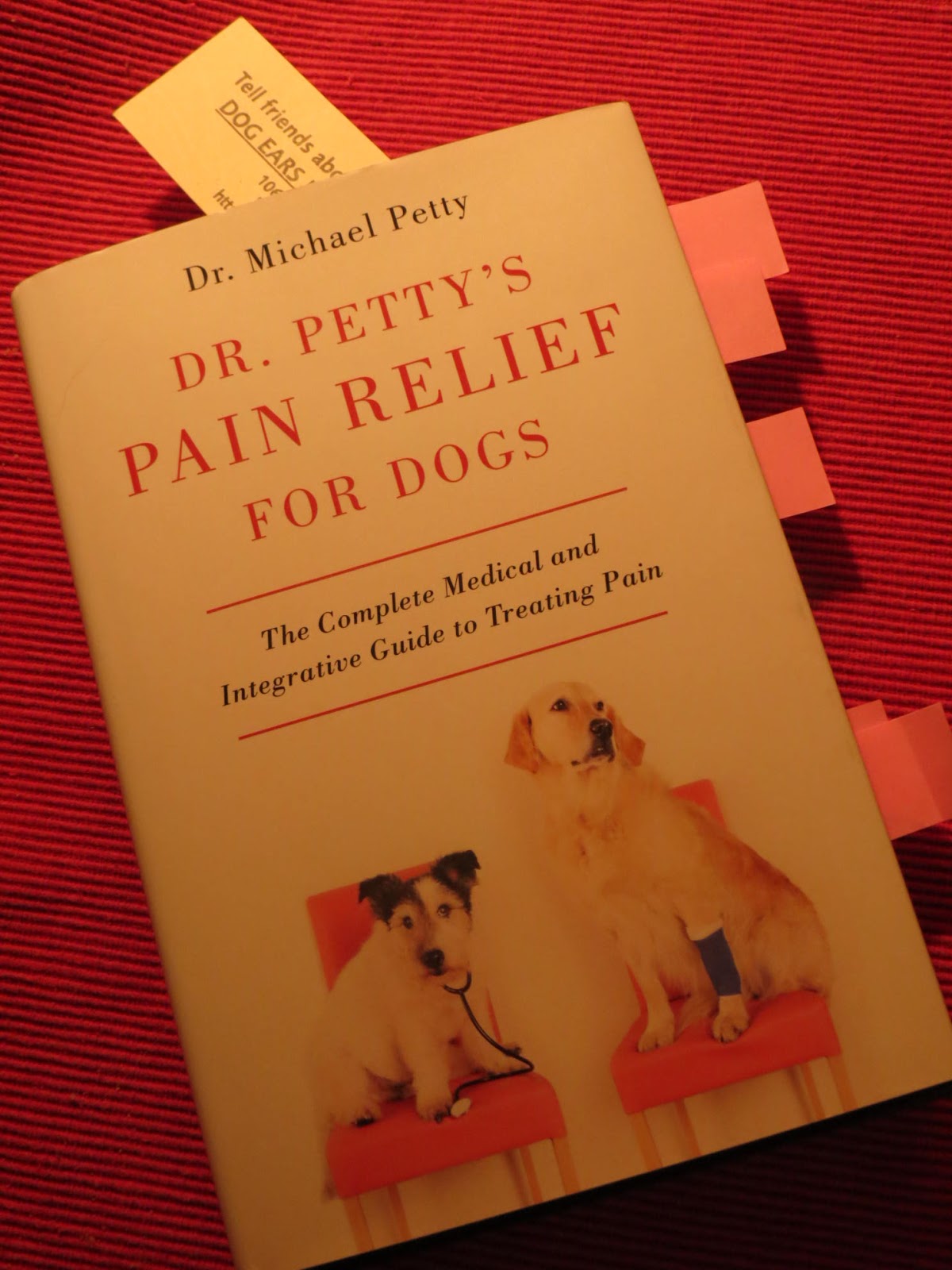
Book Review: DR. PETTY'S PAIN RELIEF FOR DOGS


Dr. Petty’s Pain Relief for Dogs: The Complete Medical and Integrative Guide to Treating Pain
by Michael Petty, D.V.M.
NY: Norton, 2016
Hardcover, $24.95

Dr. Petty’s Pain Relief for Dogs is NOT a do-it-yourself book. The author states very clearly – and more than once – that no book, even his own, is a substitute for having a dog examined and treated by a qualified veterinarian. What he offers is an informative survey of various causes of pain in dogs, treatment options professionally available, and special care owners can provide. Primarily, the author is concerned that dog owners realize: (1) that dogs do feel pain (he thinks they may feel it more than we do, and he explains why); (2) that there are usually ways that pain can be relieved; and (3), that pain treatment does not have to lead to bankruptcy.

Just as the paternalistic model of medicine has been rejected, Dr. Petty rejects paternalistic veterinary care. He believes owners can and should be informed – about causes of pain, possible treatment, and expected outcomes – in order to be partners with veterinarians in decision-making for their companion animals.

Each reader of this book will be struck by different facts not previously encountered elsewhere. One that hit me between the eyes was the reference to a 1997 Lancet article on a study of infant response to pain subsequent to neonatal circumcision. It was long believed that any pain during circumcision was minimal and brief – over, done with, not registered as memory. A 1995 study showed something very different. One group of neonates was circumcised with local anesthetic, a second group without anesthetic. At their four-month and six-month vaccinations, it was found that babies circumcised without anesthetic had an increase in pain response compared to the group circumcised with the local anesthetic cream. The name for this effect is hyperalgesia: untreated pain can be responsible for physiological changes that intensify subsequent pain. Naturally, Dr. Petty’s concern is what this finding means for treating pain in dogs, but the finding itself is fascinating and would seem to have important broad consequences.

The chapter order in the book is logical, and illustrations are helpful in clarifying text. For example, in the chapter on acute pain, illustrations show how to make an emergency muzzle (to avoid being bitten by an injured dog trying to protect itself) and how to pick up an injured dog. In the following chapter on chronic pain, we are shown (from the side) the typical stance of a pain-free dog, followed by a contrasting image of a dog suffering from hip dysplasia. The first dog stands with front feet directly under shoulders, the second with front feet farther back to ease pressure on weak hips. The difference is obvious once it is pointed out.

I particularly appreciated Dr. Petty’s discussion of acupuncture, both the general explanation of how it works (briefly, by enhancing natural pain-inhibitory signaling, but Chapter 9 gives a longer, more detailed explanation) and the author’s clear statement, “I can’t think of a single type of pain that won’t respond, at least in part, to acupuncture.” Possibly skeptical readers should know that the type of acupuncture the author advocates and practices is based on modern Western medicine-based research and has nothing “mystical” about it.

In sections on various other therapies, including botanical remedies, the author gives his own best assessment, based always on serious research rather than product claims or anecdotes from convinced customers. There is even a chapter frankly titled “Pain Relief Therapies Best Avoided,” in which the doctor pulls no punches.

Whether he is providing pharmaceutical or physiological explanations, recommending stretching exercises, or advising on the choice of dog bed or socks, Dr. Petty’s voice as it comes through his writing is authoritative caring, and conversational. As a reader and dog owner, you trust him. And then he makes you laugh. Cookie stretches! Those are great! (You have to read the book to find out.) He also includes helpful appendices, endnotes, and – hallelujah! – an index.

There was one analogy in Chapter 6 that I had some trouble getting my brain around at first. The author compares the pain pathway -- from nerve endings to the spinal cord and eventually to the brain – to a commuter returning home at the end of the day. My problem with the analogy was that it is, presumably, desirable that the commuter reach home, whereas relieving pain requires not allowing pain signals to reach the brain but instead blocking them from that natural destination. Re-reading made the point clear, but it would have been clearer from the beginning if the person in transit in the analogy had been someone the reader wanted to prevent from reaching his destination – say a terrorist or other criminal.

Also in the same section there is passing reference to “agonist action on receptors.” Readers with background in medicine, philosophy, or classics will not pause in perplexity over “agonist,” but other readers may, and a parenthetical definition would be helpful at that point.

But overall, and all in all, Dr. Petty’s Pain Relief for Dogs is highly readable and informative. I learned a lot and recommend the book highly. I know that as our Sarah ages, I'll be using some of the knowledge I gained from the good doctor.

Now here’s the surprise I’ve been saving all along: Dog Ears Books will probably have the honor of hosting Dr. Petty this summer in Northport! Maybe (depending on his book tour schedule) on Dog Parade day! I’ll put a notice on the blog as soon as we fix on a date, but contact me any time to order the book now (to read and bring with you to his event for signing) or to reserve a signed copy for purchase on the day of the event.

P.S. 5/25: Dr. Petty will be at Dog Ears Books on the day of the dog parade, Saturday, August 13, from 1 to 2:30 p.m. He will give a short presentation and take questions from the audience before signing books for customers. We're excited!!!

So start now making notes of what you want to ask he doctor. This will be a very special opportunity – and a memorable one, I’m sure -- for Dog Ears Books customers.


Wednesday, October 21, 2015

Guest Book Review: RESCUE ROAD


Bookend Dogs: Violet and Gracie

Rescue Road: One Man, Thirty Thousand Dogs and a Million Miles on the Last Hope Highway,
by Peter Zheutlin
Sourcebooks, 2015
Paper, $14.99

As the proud owner (pack leader?) of two black Lab mixes, I was intrigued by this book's title. Rescue Road: One Man, Thirty Thousand Dogs and a Million Miles on the Last Hope Highway. Thirty thousand dogs?  Really? What possessed Peter Zheutlin, a freelance journalist and author, to write a book with this title? I often wondered how dogs ended up in shelters and how far they'd traveled to get there. The only dogs anyone in my family has ever had have been rescue/shelter dogs.  I read the book hoping to find out answers to those general questions as well as the one I had about the title.

Zheutlin, the author, had caved in to his family's requests for a dog and found one online – a rescue - to adopt. He and his family found Albie through an Internet search (the way my husband and I found our girls). Albie was in a shelter in Louisiana, and Zheutlin and his family were in Massachusetts, so Albie would come north with Greg Mahle via Greg's Facebook page, "Rescue Road Trips," riding along with many other dogs awaiting better homes in northern states. Peter and his wife followed Albie's progress north on Facebook, seeing photos from stops along the way and reading updates as the trip progressed.

As Albie settled in with his new family, Peter Zheutlin continued to follow "Rescue Road Trips" on Facebook. He wanted to meet Greg Mahle in person to find out more about his service to rescue dogs and reasons for doing this work.

Eventually, over a year's time, he rode with Mahle on three rescue trips, meeting people along the way who support rescue efforts in many ways: picking up dogs from shelters, fostering dogs, meeting the road trip truck to walk dogs, and cleaning kennels on the necessary stops along the way. There are also the veterinarians who donate time and talent to bringing injured and sick dogs back to health so they can be adopted. Zheutlin learned how, for Mahle, having a dog as a young boy changed his life and inspired him to save other dogs.

The book was sometimes heartwarming and at other times heartbreaking. I cried tears of joy and tears of sadness throughout. People who care for the dogs on the road to their new homes are saving the dogs' lives, giving their time freely and going out of their way to help dogs find “forever” homes. Greg himself has often been on the verge of having to stop his efforts due to money difficulties resulting from truck repairs and fuel expenses. His wife makes sandwiches for his trips so that more money is available for the dogs. Contrast this concern with the author’s report of cultural attitudes in the South: In most of the South, dogs are considered property and live outdoors. If they are injured or can't hunt/guard the property, etc., they are abandoned and left to fend for themselves in the wild. Conditions in many shelters in the South are abysmal. They are poorly funded and have a high rate of euthanization.  This is the reason so many dogs travel from the South to the North: they will have a much better chance at a good life in the North.

People helping the dogs get from shelters to new homes say theirs is a work of love. As Zheutlin writes of one rescuer's work:  "Move this dog here today even if she doesn't know where he'll go tomorrow. If she needed to have a complete plan from the outset she might never save a dog. It's not about logic; it's about love."

All along, I knew there would be the point at which Zheutlin writes about what the rescuers call "Gotcha Day." And I knew I would cry tears of joy as dogs finally became part of waiting families. People waiting for their dogs bring welcome signs and greet the truck excitedly. Dogs are brought out one at a time by Mahle, who gives papers to the new owners and says, "Thank you. Thank you for saving a life."

I hope anyone considering getting a dog or anyone who has a dog or once had a dog will read this book and get caught up in the lives of Mahle and the rest of the helpers on his road trips and follow them on Facebook, as I now do. I hope that anyone who is thinking about getting a dog will realize how much all shelter dogs, like the dogs Greg Mahle transports, need loving homes. And I hope they adopt a rescue dog.

*   *   *

Today's guest reviewer is Bettie Komar of Joliet, Illinois. Bettie is a retired public school teacher who worked as a reading specialist in both middle school and lower elementary grades. She currently teaches as an adjunct instructor in the College of Education at Lewis University in Romeoville, Illinois -- and she is one of my two sisters!

Guest reviewer with her "girls"

Friday, May 13, 2011

A Little Northport News


Northport was full of light and color on Thursday, with these bright tulips and daffodils blooming on Nagonaba Street between Dolls and More and the little bark-covered building housing Nature Gems (both former locations of Dog Ears Books). The awnings weren’t back up yet, nor the benches out, at Barb’s Bakery, but by Friday the bright fuchsia bench had appeared in front of the Pennington Collection on Mill Street, signaling the end of winter. The renovated Willowbrook Inn looked particularly attractive in the sunshine, and later I saw proprietor Pat Busch out on the deck, visiting with a couple of friends. Does his return signal the imminent re-opening of the Kampgrounds Kreamery?


There are signs of life again at Stubb’s Sweetwater Grill, re-opened after their winter break, and Bruce Viger’s new Garage Door Bar and Grill, also on Waukazoo Street, is moving right along with inspections. Meanwhile, back on Mill Street, the former Eat Spot has become North End--


--and will, so says the new sign, be open for breakfast and lunch and pizza. Northport is gradually waking up from its sleepy winter, as it always does. I wish I'd been counting the number of people who have exclaimed, "You're back!" We were here all winter, but who noticed? Ah, well, a few staunch, stout-hearted friends and book buyers did.

In only two weeks we’ll be heading into Memorial Day weekend, with Cars in the Park as usual on Saturday the 28th, always a popular event, and I want to highlight another event scheduled for that last Saturday in May. It will be the third annual Blessing of the Pets, sponsored by Black Sheep Crossing, Marty and Cherry Scott’s nonprofit animal rescue operation. Reverend Karen Schulte of Trinity Congregational Church will officiate at the all-faiths event, pets must be on leashes or in carriers, and each pet will receive a St. Francis medal and a treat. (Sarah still wears her medal from 2009.) The blessing will take place at the Marina Park Pavilion at 11 a.m. Our pets bless our lives, so why shouldn't we return the favor?