Search This Blog

Showing posts with label competition. Show all posts

Friday, June 12, 2015

Revisiting “Affordable” in a Larger Context: Is There a “Common Good”?


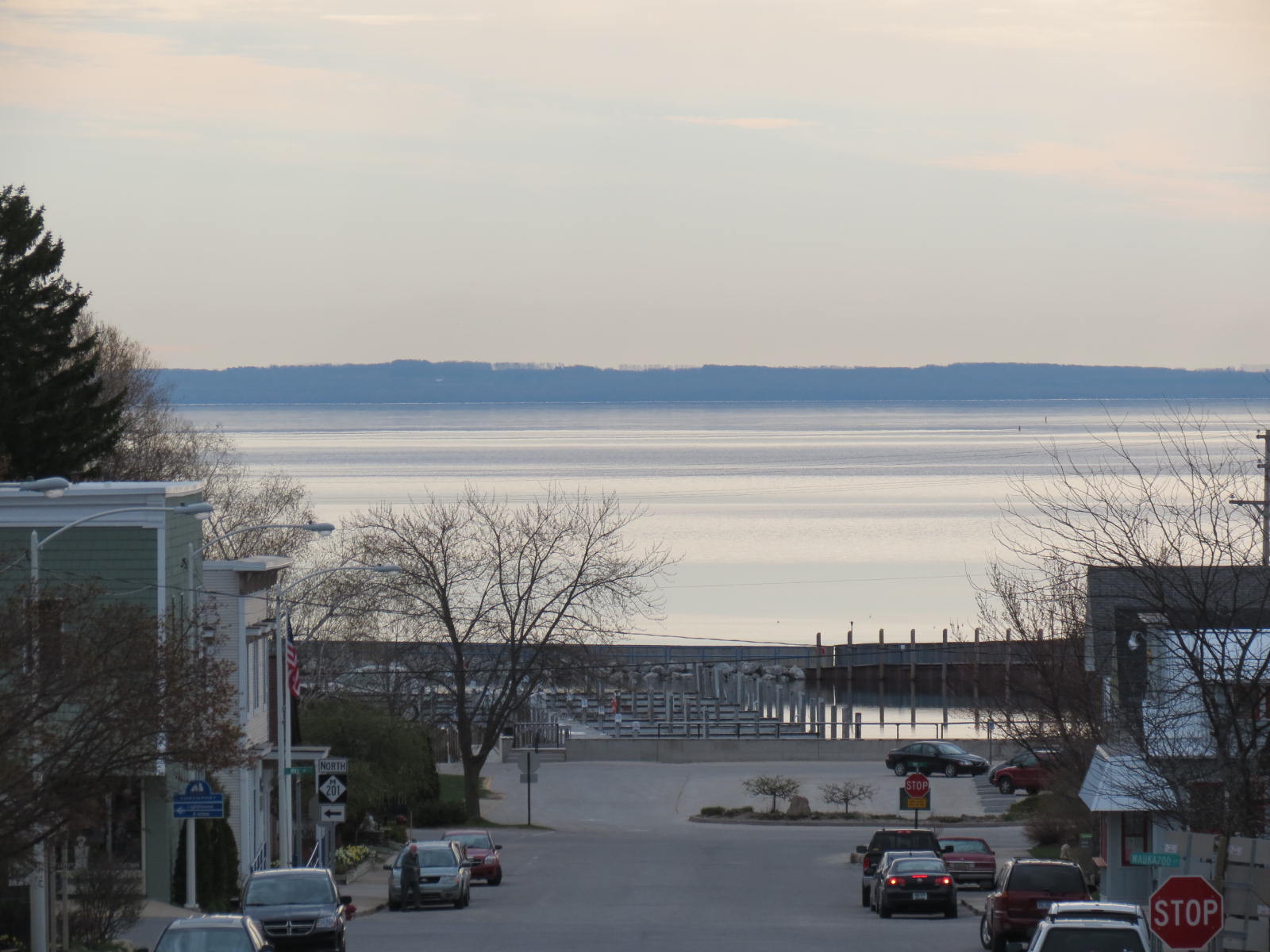
Before the leaves, before the boats


Some thoughts are like perennial itches: you can scratch and scratch away at them for years, and they never go away. One such thought, for me, is that of the common good, a venerable idea in Western philosophy but seemingly in decline in our day.

For instance, the original idea of public schools in the United States of America was that it is for the public good that all citizens of a republic be educated. Self-government demands general education for all. (The words chiseled over the proscenium of my high school auditorium were from Diogenes: “The Education of Every State is the Education of Its Youth.”) In the current American climate, parents are much more likely to see education as something they want their children to have as a competitive edge over other kids in the country. In this new discussion, I don’t hear concern for the future lives of those educated, successful children and their children in a country of increasing inequality. If this sounds like an accusation, I suppose it is, in part, but another important part is that I simply don’t understand. I don’t understand wanting that kind of world. It isn’t what I want for my kids and grandkids.

As Leelanau County tackles  the difficult and thorny issue of affordable housing (see previous post), schools are part of the discussion, but what is at stake in our little villages is not keeping poor kids out of our public schools but keeping enough kids in school to keep the schools open! What is a community without a school?

It’s probably more than coincidence  that NPR last night had a feature on a proposed affordable housing project in Marin County, California, since northern Michigan communities are far from the only ones faced with the issue. (Interesting that the headline reads “debate against [sic] affordable housing.”  A debate presents opposing arguments, not the arguments of a single side, and in fact the Californians in the story fell onto both sides of the issue, not always on the basis of who was in the boat and who was in the water.) On my way to Northport this morning, headed for my little, 23-year-old, independent bookstore, a particular word in one Marin County man’s complaint about the proposed project kept bouncing around in my head, unable to settle in a comfortable resting place. The word was sacrifices.
“I made great sacrifices to be here,” he says. “I think it's selfish to expect that someone else should be able to acquire (it) for little or next to nothing.”  
That’s only a snippet, and it doesn’t tell me much, but I can’t help wondering what the man means. I can understand parents sacrificing for their children. I can understand soldiers sacrificing for their country. But if I give up something to gain something I want more, how is that a sacrifice? Isn’t it simply a question of priorities, of knowing what is most important to me? Isn't a sacrifice something given up?

What of another household in which the homeowners’ inherited wealth enabled them to buy into the neighborhood? They could not be said to have sacrificed, could they? Do we want to say their parents made the sacrifices? Well, maybe they did, and maybe they didn’t. Who knows? And how many generations back do we want to go -- until we reach unscrupulous ancestors?

To believe that everyone with wealth earned every single penny by the sheer sweat of his or her own brow, with no help from anyone and no advantages of upbringing, and that every poor person is poor merely because he or she does not work hard is nothing but self-serving myth. No one has more than 24 hours a day in which to live, and not all those hours can be devoted to work. Sleep has to figure in. Do people with 100 times as much money work 100 times as many hours a day? I’d say not.

Back to my original thought-itch, that of the idea of the common good? What is it? A Santa Clara University site defines it as “social systems, institutions and environments on which we all depend” working in such a way as to “benefit all people,” which would surely include public safety, schools, and conservation of natural resources, at a minimum. The Santa Clara site is worth visiting for discussion of problems associated with the very idea of the common good. In a pluralistic society, individuals hold different values have different priorities. Moreover, a “common good,” by definition, is one in which everyone benefits, while some will have contributed more than others.

Some people might make an entirely different objection, not to practical problems but with the theoretical object itself. Like Socrates, questioning his friends, shredding their definitions, and deconstructing social practices to demonstrate that everything we believe is unreal (perfect “forms” existing only in some other realm), a Platonist would show you that the common good on earth is nonexistent. Have you ever seen it? Can you point to an instance of perfect benefit to all?

Some work harder, some not as hard, and some pay more dearly than others. That’s all true. It’s also true, I’d say, that all of us in this country have the advantage of certain unearned benefits, beginning with being here at all. Working toward the common good, then, toward an ideal (what else is “liberty and justice for all” but an ideal?) can be seen as making payments for what we have already received. Credit was extended to us. We need to earn, after the fact, what we received without having prepaid.

It is not individuals we are rewarding (whether “deserving” or not) but society we are paying back by ensuring its continuity. We are building a better world. And it we can only make our payments one person, one action at a time.


Monday, March 16, 2015

The Rodeo Imperative


Maybe somewhere in the West there’s someone (most likely a transplant from the Midwest) who utters the words “I wasn’t born yesterday,” but I have yet to hear our familiar Michigan phrase out here. Instead, from goofy celebrity talk show through serious political discussion to a couple of guys out on a sidewalk or standing around a pickup truck, whenever one person states the obvious or starts to give unnecessary advice or asks if the second person knows something that of course anyone around here would know, the laconic response is, invariably, “This isn’t my first rodeo.”

When we read a bare-bones announcement in the local newspaper – surprisingly, no times or schedule were given, no list of events or enticing photograph from last year – about a junior rodeo to be held March 14 and 15 out at Quail Park on the north side of Willcox, I put it on my calendar immediately.

“Don’t expect much,” David warned. The word “Junior,” to him, meant there would be no professional bull-riding, his favorite rodeo event. 

I didn’t care. “There’ll be plenty of horses,” I said confidently.

(There was to be a huge book fair in Tucson the same weekend, on the University of Arizona campus. Books in the city vs. horses in the country? I have books every day of my life! But I do have a kind of professional obligation.... Okay, a compromise: rodeo on Saturday, book fair on Sunday. My argument was that city traffic would not be as crazy on Sunday, and besides, David thought we might stay overnight near Tucson and ride up to Oracle the next day.)

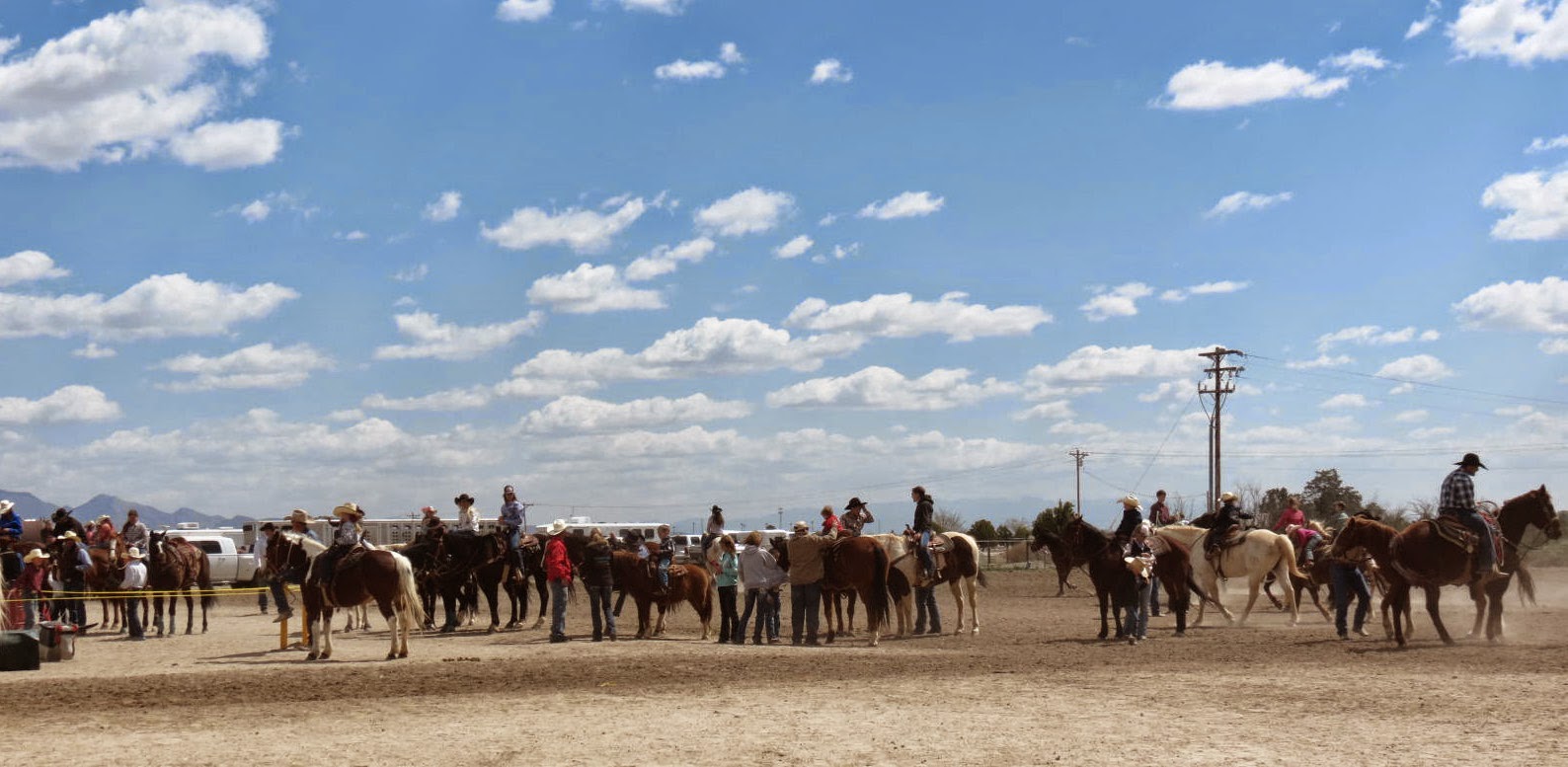
There were horses and horse trailers everywhere. Every size and color and look of horse, and every make and size and age of trailer. We were surrounded by horsiness, immersed in an equine world. Immediately, before we got out of the car, the event had already surpassed my expectations.


(Look at background: Dos Cabezas!)


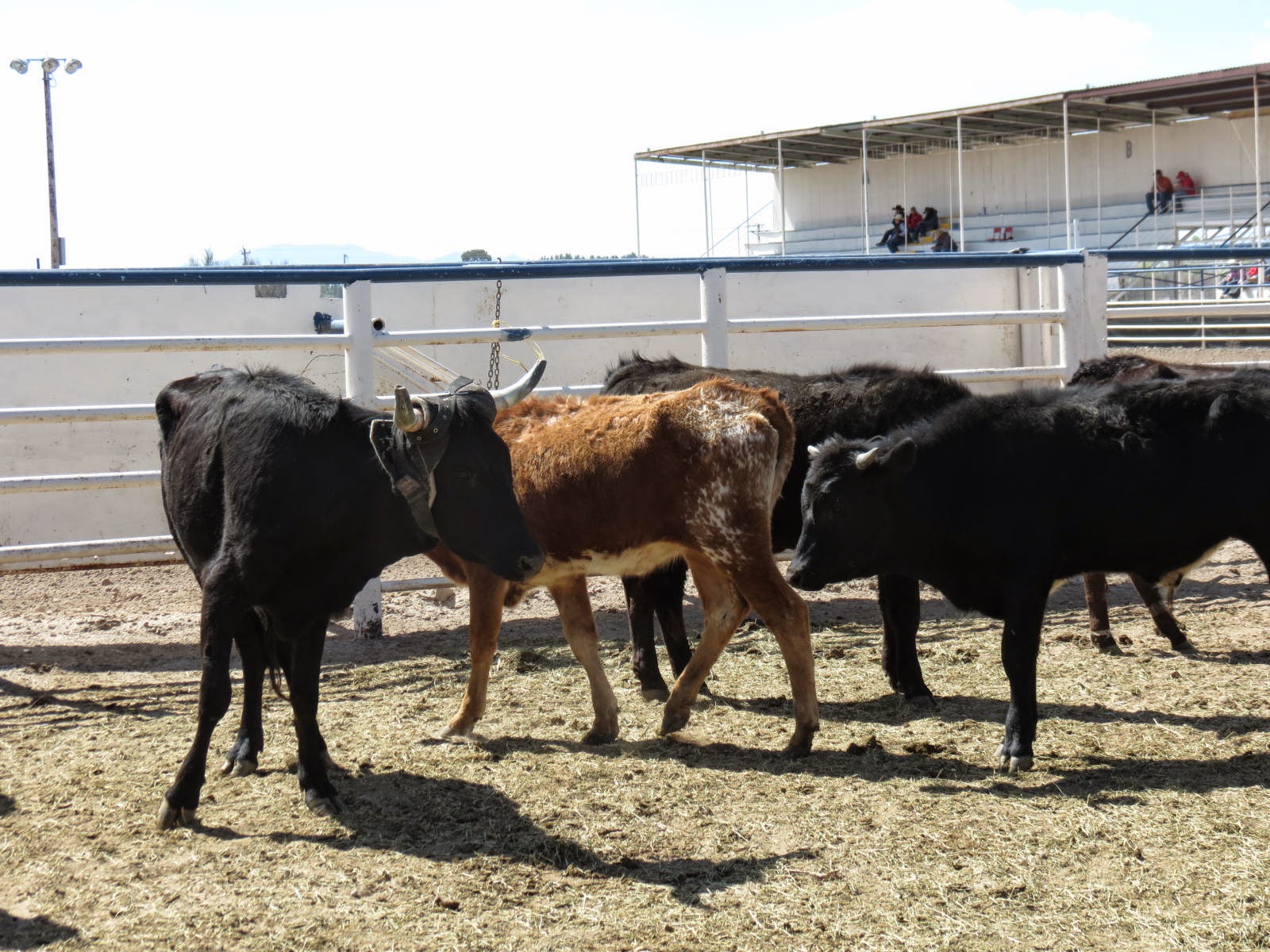
There were calves, too, ready for the roping.


There were a few dogs of appropriate cowdog appearance among the spectators, one almost as cute as Sarah. (Which one below do you think I mean?)


We arrived for the end of the “flags” event and the beginning of “poles,” the first poles competition for the “Six and under” age group, with older age groups following. I couldn’t help suspecting that for a few of the youngest competitors, this might indeed be their first rodeo.


The announcer was clear and encouraging. Here’s how she would periodically remind riders of their turns in the arena, after beginning by reading the complete lineup of competitors: “Next is So-and-So One, followed by So-and-So Two, and So-and-So Three, be thinkin’ about it.”


(Yes, there were young cowboys, too, but it was the girls who were living my girlhood dream.)

It was a very windy day -- consequently very dusty. Back behind the entrance gate, where horses stood waiting to be ridden and young cowboys and cowgirls warmed up horses for upcoming events or simply socialized on horseback, the dust was fierce, but the horsiness was intense.


We didn’t stay all day. The next morning, though, before getting on I-10 to Tucson, we stopped in again briefly for the beginning of the rodeo day. Again we were surrounded by horses, and again I heard the announcer’s voice pronouncing the names of kids I’d seen ride the day before, the same formula making the order of competition clear. “Next... followed by... and ... be thinkin’ about it.”

The rodeo imperative: “Be thinkin’ about it.” I was still thinkin’ about it halfway to Tucson.

Ride‘m, cowgirl! Live my dream!


Beautiful, beautiful, beautiful! Dare I confess that it was -- my first rodeo?!


Saturday, May 4, 2013

In Which We Learn the Agony of Defeat


"We'll wake up again."
Cold weather returned, and the pretty little spring beauties and shy trout lilies closed up their petals and went back to sleep. My dreams Friday night kept me busy setting up a straw bale garden and even refinishing old farmhouse floors, and in the morning out came the winter jacket again to keep me warm in the woods with Sarah. 

Friday was the annual spelling competition on Friday afternoon at Gilbert Lodge on (one of the) Twin Lakes west of Traverse City, and once again Marilyn Zimmerman, Trudy Carpenter and I were the the bookstore team. Is it our sixth year? Marilyn and I were by ourselves the first time, and Trudy has been with us ever since.

Well, the Dog Ears Books team did not cover itself with glory this year at the Senior Spelling Bee. Perhaps, as one member remarked, we had become overconfident and needed a little reminder from Fate. Be that as it may, we went down in Round 7 when the three of us agreed to spell ‘vendible’ (the correct spelling) with an ‘a’ in the middle syllable. WRONG! Rather than stretch out the suspense, in case you’re wondering about a rule for –able and –ible words, here and here are links to the answer. We’ll know better next year. Of course, there are many exceptions to the so-called rules....

But oh, the words that appeared when the Bee Master went to his second box! Words no one present had ever encountered in a lifetime, and recall that contestants must be 55 years of age (or is it 50?) to participate! When one team went down on ‘exsert’ (it’s the opposite of ‘insert’), there were only two teams left of the seven who had begun, and when the Bee gets down to the last two teams the rules change. 

Bee Master Michael Sheehan and last two teams
If one team then misses a word, the other team must spell that word correctly and spell a second word correctly to validate their win. If the second team misses either word, it’s on to a new round. This Bee went 35 rounds, due to words such as these: farraginous, aichmophobia, rhonchial, zymurgy, ochlesis, obvallate, oneirodynia, sagittiform, roscid, agrestic, blennoid, and sybotic. How many of those do you think my spell-checking program accepts? It’s entirely possible I’ve made a mistake or two here, but I don’t think all but two are incorrect, as the program is telling me.

Bee Master consults with judges when a challenge is issued
In the end, the father-daughter team took first place this year, and they deserved to win. Second- and third-place teams also put up good, long fights. Maybe next year my friends and I will be back in the top three (where we've always been up to now), but we had a good time despite our loss, and as one team-member whose grandchildren come to watch her spell remarked in e-mail to me this morning, “I had the chance to show my grandchildren that grownups sometimes lose, and they can still go out for ice cream.”  An important lesson, I think we can all agree.

There was irony for me in the word that toppled us, as I have been reading William Bradford’s Of Plymouth Plantation, 1620-1647, and had noticed his spelling of ‘vendible’ but had thought it must have changed since then. It hasn’t. But did you follow the links above? If you did (and even if you didn't), of the following, which spelling would you choose as correct –

COLLECTABLE
           or
COLLECTIBLE

-- and why?

Come to think of it, I probably got a much better night’s sleep refinishing floors in my dreams than going through another spelling bee. But if you take any little bit of wisdom away from today's blog post, let it be this:

“Grownups sometimes lose, and they can still go out for ice cream.” - Trudy Carpenter

Saturday morning fiddleheads

Saturday, May 5, 2012

Another Very Challenging Contest Event

Gilbert Lodge, Twin Lakes Camp, Traverse City
I took this first picture and am including it primarily for my mother, Mrs. Gilbert. Not that our family has any connection to this lovely building. Coincidence, is all. But kind of fun, eh? Gilbert Lodge is the setting for Traverse City's annual Senior Spelling Bee, sponsored by Comfort Keepers. Entrants (who must be at least 55 years of age) pay five dollars each to participate and compete on teams of two or three members. We arrived in the rain, had a wonderful time, and emerged afterward into bright sunshine.

Laurie makes sure everyone is relaxed and has a good time. She makes us all laugh, sometimes at the expense of the good-natured Bee Master, Michael Sheehan. Here's Laurie introducing everyone on Friday, May 4.

Laurie
Besides being fun for the competitors, the Bee generates spending money for the Traverse City area school spelling champion on his or her trip to the national competition in Washington, D.C. That's where those entry fees go. This year's TC area contender in Washington will be Jack Pasche from Suttons Bay, and here he is with the giant check presented to him from the event sponsor, who has spread the Senior Spelling Bee idea--with connection to the national student contest--far and wide across the country:

Headed for the Nationals
This was a very tough Bee, especially after the Bee Master decided we all needed harder words, or we would be there all day. Dipping into the "more difficult" group, he came up with some doozies. Our team had to spell 'autochthonous' in Round 12, and we were given 'vichyssoise' for Round 13. By the time we got to Round 15, where another elimination left only two remaining teams, ours deliberated so long over the spelling of 'diptych,' and I, the pronouncer, was in such a tizzy over which syllable got the 'i' and which one got the 'y' that I left out one of the consonants! Fortunately for us, the other team misspelled that word, too, so we were still in the game. 'Imbroglio' gave us pause the next time around, but we did it justice. 'Ennui' was a snap. In Round 21, we looked to  the retired lawyer on our team for the correct spelling of 'rescission' after the other team had gotten it wrong, and Marilyn didn't let us down. Our confirming word, the one we had to spell correctly to cement our win, gave us fits: 'eucrasia' was the challenge. We got it! Oh, and did I mention (no, but I will now) that another word earlier in the Bee was 'echidna,' an Australian mammal? Luckily, my teammates had seen this animal recently on the Discovery Channel! For the entire list of words in this year's Bee, see Michael Sheehan's blog post on Wordmall.

Liz, Donna, and Martha
This year's third-place winners were a team always in the top three, with whom we have traded the Bee back and forth several times. Liz Bannister, on the left, 95 years old, is a spelling champion of many years. These ladies are tough competition and great sports!

Kay and Ann
The team coming in second kept us hopping for seven rounds, back and forth, back and forth. They are crack spellers, too. This was their second Bee.

Trudy, Marilyn, sponsor, bee master, and me
And here's my Dog Ears Books team, competing for the sixth consecutive year. Trudy Carpenter, Marilyn Zimmerman and I keep each other on our toes, and we enjoy our annual expedition from Northport to Twin Lakes. There was a team all the way from Antrim County on Friday, so obviously word is getting around. Gerry, doesn't that make you want to get a team together for next year? Road trip, road trip! 

Wednesday, April 4, 2012

Competition? What Competition?

This coming week, beginning on Sunday, April 8, is National Library Week. Some people see bookstores and libraries as competitors. Libraries and bookstores both begin with books, it’s true, and the two institutions serve some overlapping needs and demands, but there are important differences. I had it in mind to write more about the differences, but somehow my inspiration fled. Lucky you!

The important points are next week’s recognition of libraries and, in Northport, a celebratory evening Wednesday, April 11, from 6 to 8 p.m. It’s a poetry and soup evening, so bring poems to share and your favorite soup mug. There’s also a special Robert Burns connection, which makes me doubly sorry I’ll be out of town and will miss the fun. I would have loved another chance to perform an interpretive reading, in Scottish dialect, of “To a Mouse,” my favorite Burns poem.

P.S. If anyone thinks I’m kidding about bookstores and libraries not being competitors, I’d like to say that our local librarian and at least three Friends of the Library members attended my recent author event and bought signed copies of the author’s book. Also, I have been working with the FOL committee to help put together this summer’s author series at the library. In a place as small as Northport, we all have to work together so that all may swim and none may sink.

P.P.S. Dog Ears Books will be closed today, Wednesday, April 4. The Leelanau Township Library opens at 3:30 p.m. on Wednesdays and is open until 8 p.m. Tomorrow both bookstore and library will be open morning and afternoon.


Tuesday, May 10, 2011

The Competitive Side of My Life, or, How Could This Possibly Happen?

“Who helped you study for a spelling bee when you were a kid? Your father or your mother?” David asked last week. Both my parents were sticklers for proper English, but it was my mother who grilled me on spelling words. (My father got stuck trying to help me with math, a very different story.) My spelling fame peaked in sixth grade, however, when I went down on the word ‘hypocrisy.' Never having heard the word, I used the word ‘democracy’ for a model and got as far as H-Y-P-O-C-R- before going down in flames. But that was after all the other sixth-graders were already down, so although I was not recognized as such, I do feel I was the All-City Sixth-Grade Spelling Champion for Joliet, Illinois. Some eighth-grader must have won the crown--I mean, title.

It was in 2007 that I heard about the Senior Spelling Bee in Traverse City, in which teams rather than individuals compete. Each team member must be at least 50 years old. It sounded like fun, and I was surprised how many people turned down my invitation in horror and fear, throwing up their hands and stepping back from the very idea of a spelling bee, until my friend Marilyn agreed to join me. The next year Trudy signed on, and we were three. And we have a good time at the Bee every year.

That’s not to say there isn’t a competitive element, however, and as the Dog Ears team has always finished in the top three, when the field had been whittled down to four teams last Friday I felt a slight quiver every time the Bee Master called, “Team 7.” My teammates are—it’s true, my friends, and you can’t deny it—more competitive than I and would not be happy to finish “out of the money” (no, there’s no money involved), and so I relaxed when the fourth team was spelled down after ten (!) error-free rounds. We’re home clean, I thought then, because whatever happens now is no big deal. We finished third in 2010, and we were fine with that.

So what happened in 2011? The third team went down, leaving us to face off against last year’s 2nd-place team. Okay. Do you know how that works? When a spelling bee gets down to the last two contestants, be they individuals or teams, the rules change. After an error is called, the competition must first correct the error and then correctly spell a second word to win. In principle, many errors might be made without ending the bee, if you can imagine how that might go. Well, in this case, when the Bee Master told the other team they had incorrectly spelled a word our team went with the only possible alternative spelling we could muster up, though it was not the first spelling two of us had come up with. We were told we were correct, and we were given another word. We spelled the next word correctly, were acclaimed winners and were congratulated by the team we had beaten. Ordinarily, this would be the end of the story.

But at home that night I looked up the word that had knocked the other team out and discovered that their spelling (the way I would have spelled it, too, had the word come to us first) had been correct! K-O-H-L-R-A-B-I. Oh, good heavens, now what? I called the Bee Master on the phone, and I think it’s fair to say he was flummoxed. (‘Flummox’ was another word in the Bee that day, one that put a team out of play.) “I think they won!” I told him, “they” being Team 1, Nancy and Cornelia. But no, said the Master, neither team had a clear win, since the winning team must (1) spell correctly a word missed by the other team and (2) spell correctly an additional word. In fine, the Bee had never finished!

And so it was that an impossible outcome came to be declared—a spelling bee ending in a tie! Any other ruling would have been a miscarriage of justice. And here they are, our fellow champions:


“Oh, well,” one of my teammates said, “our win was great while it lasted. And next year the competition will really be intense!”

I think the pressure on the judges will be intense next year, as well. All in good fun, of course.

Kathy from Australia asks me if adult spelling bees are a national phenomenon in the U.S. I don't know. If they're not, they should be. I can imagine independent bookstores starting up bees in towns where they don't exist, book clubs putting teams together--all sorts of good fun and brain calisthenics. Did I spell that word correctly?