Search This Blog

Showing posts with label Jennifer Clark. Show all posts

Wednesday, June 25, 2025

A Lot Has Been Happening Around Here

From across Waukazoo Street (in my doorway) --

If you haven’t been to Northport in a while, you’ll notice some changes the next time you visit. The “big store,” current home of the Northport Inn, the restaurant called Faro, and a stylish new antique shop that goes by the name of Pernette’s, is getting an exterior makeover. Everyone is eager to see their new look.


Back of the building houses Pernette's.

The new look at Barb’s Bakery on Mill Street is already here. Pink! Also new at Barb’s is frozen custard, a very welcome treat on some of the hot days we’ve had recently. 


Does this color make you think of ice cream? At Barb's, it's frozen custard!


The New Bohemian CafĂ© folks have expanded their hours and are now open until 5 p.m. Good news! And while artist Deborah Ebbers, one of my neighbors here at 106, is away from her studio for a few days (gone to explore further the exciting world of carving sculpture from marble), she will be back early in July, never fear. Over on Mill Street, the Wright Gallery is open for the season on Wednesday through Saturday, 10 to 5, Sundays by chance.


Reflections of window letters with painting as backdrop --

In the nearby unincorporated village of Lake Leelanau, NJ's Grocery (since 1912!) remains closed at present while owners and crew clean up after a fire. No one was injured, and they hope to be back in business in about a month. I hope so! I miss my morning trips to NJ's.


Hope NJ's can re-open before too long!


What was happening at my bookshop on Tuesday was a visit from Kalamazoo poet Jennifer Clark, and, as is always the case with Jennifer, we had a great time and a lot of laughs. Those who do not associate either poetry or saints with happy hoots need to make the acquaintance of Jennifer Clark. I had her sign extra copies of her latest collection of poems, Intercede: Saints for Concerning Occasions, and will be stocking her volume of memoir essays next week when I do another new book order. Kissing the World Goodbye might not sound like a humorous title, but I was laughing out loud reading it. What a delight!


Jennifer Clark is a wonderful bookstore guest! 

To satisfy popular demand, I have restocked Mary Kay Zuravleff’s American Ending (I wrote about it here) and also have a new Michigan novel, My Pirate Summer, by C. J. Hagstrom of Traverse City. Hagstrom’s story, from the old days of the “tall ships,” was inspired by the “nefarious activities” of Captain Seavey, a name familiar to Great Lakes history readers.


Here's more new fiction from Michigan writers:


Viola Shipman, you ask? Yes, several titles from Viola Shipman, nom de plume of Michigan writer Wade Rouse, who writes gentle romance stories under his grandmother’s name. 


If mysteries are your thing, I have books by Leelanau author Aaron Stander (he calls our home ground “Cedar County”), U.P. mysteries from Joseph Heywood and Steve Hamilton, and exciting stories featuring fictional Sheriff Jules Clement of Blue Deer, Montana, by Michigan-native-gone-to-Montana Jamie Harrison. Karen Mulvahill’s historical fiction novel, The Lost Woman, continues to leap off the table, along with Marilyn Zimmerman’s legal suspense novel, In Defense of Good Women (review here). 


Under new nonfiction offerings, This Magnetic North: Candid Conversations on a Changing Northern Michigan is guaranteed to start many more conversations since it seems that everyone wants to be here! Climate change, migration, and tourism (I would add growing world population) are affecting places Up North, as they have elsewhere. Is northern Michigan’s tourism industry “too robust”? Poet Michael Delp, co-editor emeritus of the Made in Michigan Writers Series, calls this book “essential reading for anyone who claims to love northern Michigan for its beauty.


What changes will we see in years to come?

Also for locals and visitors alike,Perfect Omena Day!: Selections from the Summer Diaries of Rebecca L. Richmond, 1907-1920 is going to be a sure-fire winner. What was daily life in Omena like over 100 years ago? Marsha Buehler, Omena's Putnam-Cloud Tower House Museum Director, calls the diary entries Christine Byron chose and transcribed gentle lessons in cultural anthropology blended with a bit of archeology. The book is also generously illustrated with old photographs and postcards  a perfect recipe for summer dreaming and time travel.


Sometimes it's comforting to look backward, isn't it?

Field guides to birds, board books for pre-readers, 100 Things to Do in Michigan [and in the Upper PeninsulaBefore You Die (always, I think, the best time to do anything), and other books you didn’t know you needed until you saw them in Dog Ears Books – all are here for your summer reading pleasure, along with, always, an ever-changing inventory of used books, some quite recent and others from very long ago.


There are always lots of pre-loved volumes on my shelves.

The summer solstice has come and gone, St. John’s Eve has come and gone, and the 4th of July is coming at us fast. Along the roadsides and in the meadows, milkweed prepares to bloom, and St. Johnswort is just getting underway. It is also the week of the strawberry – and strawberry pie – and strawberry-rhubarb pie – and maybe rhubarb chutney, if I can squeeze in that project….


Milkweed

Cinquefoil
St. Johnswort


Goatsbeard

"Can I help, momma?" (I just couldn't leave her out entirely!)


Thursday, June 19, 2025

Not Yet the Solstice, But—the Race Is On!


Reminder First, Right Up Front


Next Tuesday, June 24, at 4 p.m., Dog Ears Books in Northport will host a poetry reading featuring Jennifer Clark from Kalamazoo. Jennifer will read from her new book, Intercede: Saints for Concerning Occasions, and visit with audience members following her reading. She is the author of three previous poetry collections, author of a children’s book, and co-editor of the anthology, Immigration & Justice for Our Neighbors. She is so much fun that this is her third appearance at Dog Ears Books, so do yourself a favor and don't miss her!


Poet Jennifer Clark

Racing Season


Not a season of races, that is, but a season racing by, as summer always does. (Yes, even before it officially arrives!) Overnight, it seems, the rivers of gold that were the blooming cowslips (marsh marigolds) turn to wet-footed, narrow meadows of lacquer-yellow buttercups; sweeping white hills of woodland trillium fade and disappear; the tree canopy grows dense; and yellow-eyed white daisies (the happy days’ eyes) dance along roadsides in sun or in rain. Forget-me-nots have gone to seed for another year, and so has the first round of dandelion blossoms, but cheery little English daisies enliven otherwise monochrome green lawns, and now—coreopsis already!!!


Coreopsis here before the longest day!

Gardening


My fall bulb catalogs arrived in May, and I am determined to order early this year, because if I wait too long I will forget again … or decide not to bother … even knowing what pure delight those flowers that bloom in the spring (“tra-la!”) will give.


Meanwhile, there is always “just one more” trip to a garden center or nursery, “just one more” plant that my garden must have! Oh, yes, borage! 


Magical borage --


Books


Did you ever read this one?

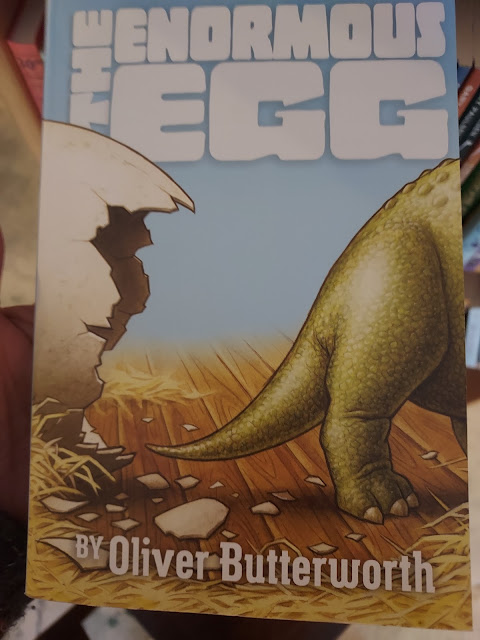
Do you remember some of your favorite books from grade school? One of mine was Oliver Butterworth’s The Enormous Egg. I was reminded of that favorite story when a little boy visited my bookshop wearing a striped t-shirt with a line of Triceratops dinosaurs marching along every other stripe. In the book, young Nate Twitchell is almost as faithful as the family hen in taking care of the unusually large, leathery egg in hopes it will hatch—and it does! But the little dinosaur does not stay little for long. 


I didn’t remember the ending, so I had to order and reread the whole book. Thus I traveled with Nate and Dr. Ziemer and Uncle Beazley (the triceratops) from New Hampshire to Washington, D.C., and then right into the halls of Congress, where a United States senator proposed legislation that would outlaw Uncle B. and have him killed and stuffed! Given the expense of housing a dinosaur over the course of its lifetime, there is support in the Senate for the bill. Uh-oh! What hope does young Nate have of saving his rapidly growing pal? Wonderful story!


A much older book that went home with me for bedtime reading was a falling-apart copy of Rudyard Kipling’s Second Jungle Book, in which we meet again Mowgli and his animal friends. 


There are also other stories in the book, including one that takes place in the high Arctic, but Mowgli and friends are the center. As captivating as the stories, once I stopped to look at them more closely, are illustrations by the author’s father, John Lockwood Kipling, the smallest seeming at first glance only decorative. But no! Each one clearly depicts something in that particular story.


John Lockwood Kipling deserves a new paragraph. Although his career was overshadowed by that of his famous son, Lockwood was an astonishingly accomplished polymathic artist in his own right, producing drawings, furniture, sculpture, pottery, and more. During his 25 years in India, as teacher and later museum curator in Lahore, he was also active in a revival of traditional Indian arts and crafts.


And let me say right here that wonderful as much of Walt Disney’s work was (and his "Jungle Book" film was the last for Walt), Disney’s Mowgli is not Kipling’s Mowgli, and people need to read the books to learn the Law of the Jungle as the man-cub learned it. 


Alongside these deep and deeper dives into the past, I read also a novel published only two years ago, inspired because the author came to Northport. Mary Kay Zuravleff gave a reading and presentation following the business portion of the annual meeting of the Friends of Leelanau Township Library (FOLTL) on Saturday, June 14. When she and local author Karen Mulvahill stopped by the bookstore ahead of her FOLTL appearance, they took a couple extra books from my stock, in case they ran short. And they would have! Note: I am ordering more and will be restocked by this Friday.


The title of Zuravleff’s novek, American Ending, comes from the fictional narrator’s mother, a Russian immigrant. When telling her children bedtime stories, she would ask, “Russian ending or American ending?” In the Russian ending of a fairy tale, the wolf eats the bride who wanted a ride on his back to her wedding, while the American ending has the groom slicing open the wolf’s belly and the bride leaping out unharmed.  But even as a child Yeleni doesn’t fully trust American endings, suspecting that good luck isn’t necessarily permanent and that life can take sorrowful turns. 


The setting is a coal-mining town in Pennsylvania, and the story opens in 1908. It is a complicated family saga, with a large cast of characters, but American-born Yeleni’s voice, steadily throughout the book, keeps us oriented. This is a world where girls are married as early as 13 years old to grooms chosen by their parents, young boys taken from school and sentenced to dangerous lives underground, and adults too often seek solace from poverty’s troubles in alcohol. Yet, for all that, it is also a life of tradition and memory and feasting and celebration. When Yeleni’s mother invites the schoolteacher to Thanksgiving dinner, the whole neighborhood contributes.


It was a miracle the way people pitched in when they weren’t even invited, and not with a shriveled turnip or the stringy end of a roast either. Here came a sturgeon turnover to fatten up the schoolteacher, poppyseed bubliks for the single men, cherries in a jar if Lethia wanted to bake pie. Lethia collected candle stubs at church and polished the table with beeswax and beef tallow, another miracle. Robert and Pa captured two wild turkeys. Really, Kostia did. The birds were always in the meadow nipping at him, and Kostia led them into a trap….


-      Mary Kay Zuravleff, American Ending


Despite being a story set in the America of over a century ago, the novel is also very much a story of today. Late in the novel, when Yeleni urges her husband to apply for U.S. citizenship, he answers, 


“I’ll need a witness willing to swear I’m not a phut.”


“English, please,” I said, “or they’ll send you back on the next boat, crook or not.” 


It was one of my fears, though Erie Russians scoffed at the idea of anyone being sent back. Who would make the town’s streetcars, engines, or boilers; their boots and buttons; their paint, paper, or pickles? Who would slaughter the meat or tan the leather if Russians were sent back?


Sound familiar? Since summer is my heaviest work season, both at home and in my bookshop, reading time is at a premium, but I still manage to squeeze it in. (Not having TV helps!) American Ending is Mary Kay Zuravleff’s fourth novel and the first of her work I have read, but it certainly will not be the last.


And then one night I turn to an old favorite, Harlan Hubbard’s Payne Hollow: Life on the Fringe of Society, a sequel to Shantyboat, the story of Harlan and Anna’s river adventure years. 


I love Harlan's sketches in the book


Returning at last to the Ohio River as to an old friend, the Hubbards settled down and built a house on the river bank (shades of Rat and Mole), put in a garden, raised goats, and continued their evening practice of reading aloud to each other and playing duets. Their “bijou riverside residence” (as the Mole called Rat’s hole in the bank) was larger than their old shantyboat but, like it, lit by fireplace and oil lamps and complete with cunning cupboards for the storage of food and a bed that slid away out of sight when morning came. Harlan and Anna kept to old, simple ways. 


…So many times have the advantages of a garden tractor or tiller been pointed ot to me that I half believe the argument myself…. My strength returns when I am alone in the garden, working with some beloved tool, the birds whistling overhead. Even on a sultry July morning, when not a breath of air stirs, when the sun’s heat is magnified by the encircling trees, and weeds are sprouting everywhere, not even then could I welcome one of those nondescript, unlovable gadgets, brightly painted and streamlined, which make an intolerable noise and smell bad. They get the work done, you say? I say they are expensive and insidiously destructive. I will get the work done in my own way. Save time? The best use of time is to enjoy it, as I do when working in peaceful silence. 


-      Harlan Hubbard, Payne Hollow


Oh, that is exactly how I feel about working outdoors! No string trimmers or leaf blowers for me, please!


How economically he captures chickadee and woodpecker!


Agility work


Sunny Juliet and I had our first session of the year with Coach Mike, who is very enthusiastic and encouraging and genuinely loves the sport and all his doggie pupils. He is an excellent teacher!


Agility work is as challenging—maybe even more so—for the human member of the team as it is for the dog. The sport was inspired by equestrian show jumpingand more and more I realize the strong parallels between work with horses (which I must admit, sadly, I know about almost exclusively from reading) and work with dogs. We humans are a talky species, and we are usually so busy talking and listening to each other and thinking about what we want to say next that we lack awareness of what our bodies are telling us and telling others. 


Anyone knows that riders “tell horses what to do” by applying reins and knee pressure, but horses also respond to much more subtle signals, whether or not the rider intends the signaling. How one sits and every little shift of the seat is information to the horse. A well-trained dog responds to voice commands, but any dog is also, and much more continually, paying attention to physical cues. 


In our agility work Sunny is aware of every little move or gesture I make, intentional or inadvertent, although I am not physically in contact with her. If I shift my shoulders slightly or vary the height of my hand from the ground or speed up or slow down or merely glance off to the side—all that is telling her something, which means that I too have to be aware of my body in order to give her the proper signals. 


And have you ever thought about the difference in peripheral vision between humans and canines? (Don’t feel bad. I never had.) We see about 180 degrees, or half of the circle of which we are the center, but dogs’ eyes are spaced more widely apart than ours, so their peripheral vision is much wider, 250 to 270 degrees (depending, I guess, on the shape of a particular dog’s head, which would vary from one breed to another), which means Sunny is still seeing me after she runs past, so if I stop and turn around, she thinks she needs to do that, too! 


It’s a lot to think about. It’s also impossible, as you can imagine, for me to get video or even still footage in the middle of our demanding work!


But now—oh, dear! Sunny has developed a limp that seems to come and go, as if maybe she pulled a muscle or something (it started with that porcupine chase), so for now my girl needs to rest from strenuous activity. She’s to be on-leash for a week, with aspirin or Tylenol twice a day, the vet says. Poor Sunshine! She thinks “taking it easy” is a great big bore!


Tenting Tonight


My birth family went on our first camping trip when I was 12 years old, five of us sleeping in a borrowed tent, a heavy canvas umbrella tent. It rained all week. And we all wanted to do it again! 


Jack and his crew

Now grandson Jack from St. Paul, Minnesota, a newly graduated art student from Kalamazoo College, is here this week, rain and/or shine, with his ten senior-year classmate/housemates, the whole crew camping in the yard and eagerly exploring Leelanau. (I know the kids would love to play Frisbee with Sunny, and ordinarily I’d have been all for it, but not right now, as she needs to rest her jumping muscles. If only she would rest her barking muscles, too!) What a happy scene the tents and hammocks and everything else make in our usually empty yard! At last it felt as if there had been a point to all that grass mowing! 


Fog rolled in, but the campers are happy.

While all of the young people are delightful, naturally grandson Jack is very special to me. When I look at a closeup of Jackson examining a camera I found for him, I see his grandfather, alive and young again.


Thursday, July 9, 2015

Making Time, Taking Time


Years ago I found a birthday card for one of my sisters that said, on the outside, “Time flies....” Inside it said, “whether you’re having fun or not.” How many times over the years have those words come unbidden to my thoughts? It’s a good reminder, though. None of us has more than twenty-four hours a day. Sleeping and working and life’s little maintenance chores take up a lot of time, and if you let them, those activities could absorb all your time.

It had been almost two weeks since I’d spent any time “hanging around with” (as David says) my fictional characters, and I was missing the Wild Man and the Dog Wife, whose story has been evolving in my novel-in-progress since last winter’s sabbatical in the Southwest, so Wednesday morning I carved out some free time, and we got together again. Bruce opened the bookstore for me, and I did not go in until almost noon. That felt good.

But it also felt good later to be at the bookstore, especially on Wednesday afternoon, when a gratifying number of people made time for poetry. 


With my helper Bruce still on duty at the sales counter, I was able to take time myself to sit in the audience and enjoy the event. Jennifer Clark read work from her published book, Necessary Clearings, as well as a couple of the 56 poems she has written on John Chapman (Johnny Appleseed) and that era of American history, but before her reading began, she was already in conversation with early arrivals over questions about poetry in general and her writing process in particular, and questions and discussion picked up again following her presentation. The questions were excellent, the conversation stimulating. Jennifer was happy, and so was I. Others were, as well. One e-mail I received this morning warmed my heart:
Pamela, I really enjoyed your event yesterday and thank you so much for presenting Jennifer Clark.  I don't know if I ever would have met her and her work without an introduction from you!  A delightful woman and a wonderful collection of poems.  I am now her fan.
Thank you, Deb, and everyone else who attended Wednesday’s event, for making time for poetry in your life this summer, and thanks from all of us to Jennifer Clark for being our lovely, lively guest! You can read more about Jennifer and her writing here


Then last night our intrepid Ulysses reading group gathered at the home of our Fearless Leader and his wife to discuss East of Eden. It isn’t easy for eight people to find room in busy summer schedules for an evening of literary conversation, but we managed it and, flushed with triumph, have agreed to meet again in August and to read Uncle Tom’s Cabin between now and then. It’s the first year we’ve tried to make time to get together between Memorial Day and Labor Day. Clearly, we all find the effort worthwhile.


This morning I took time to have my first cup of coffee outdoors, where I could sit back and enjoy my garden flowers to the accompaniment of birdsong. When I opened the front door, Sarah rushed out to chase a rabbit into tall grass but gave up the chase in less than a minute and contented herself with taking up chipmunk patrol in the shade near my lawn chair. Chipmunk patrol for Sarah is lying in the grass and watching, not obsessively but casually. Sometimes she doesn’t even bother to move when a chipmunk appears.

I think Sarah on chipmunk patrol is giving herself permission to take time out and soak up the delicious atmosphere of Michigan summer. I know that’s what I’m doing when I take the time to make the time for reading or writing or -- listening to someone else read to me. Ah-h-h! 


Sunday, July 5, 2015

What Do You Need, Really Need?


Oxygen, right? Air to breathe. Water is a baseline requirement, as is sufficient food, and you can’t live without sleep.  I’m sure we can agree on those.

The way psychologist Abraham Maslow looked at human needs, only after the basics were covered would anyone worry about needing more.  Maslow’s notion of a hierarchy of needs has been questioned by critics, but most of us have noticed that we have a hard time concentrating when we’re too hungry; as much as the spirit may want to soar above the body, the body is not going to stop making demands.

Okay, then, what about love? Or do you prefer power? Then, security – or excitement? Challenge – or comfort?

The other day one of my regular customers, with a heartfelt sigh, asked the rhetorical question, “What do people do who don’t read books?” For her, as for me, books are among life’s necessities. If I had never learned to read or had had no access to books, I would never have traveled to medieval China, never met Helen Keller, never had a horse – and that very short list of experiences I would have missed without reading books could obviously be extended to book length itself.

But that’s not my object at present. I’m sneaking up on my real question in roundabout fashion. Do we need poetry in our lives? Here is one explanation for the affirmative, not necessarily the one I would give but an interesting perspective.

Did you read poetry back in grade school and high school? Only because you had to, or did it give you something other kinds of reading, as well as other kinds of experience, could not provide? Have you continued reading, maybe even writing poetry in your adult life?

Sometimes I think the reading of poetry, for busy grownups, is like lying in the grass on a summer’s day to watch clouds. It’s easy to forget from day to day about clouds and poetry as the days succeed each other with increasingly ferocious speed until one day, startled, we realize that years have gone by.

To read a poem first thing in the morning or last thing at night, like taking half an hour on a summer afternoon to watch clouds, is to give ourselves valuable personal time off from otherwise over-organized lives. And we can do it. We can give ourselves the time, calm our spirits, and enrich our lives, too, by freshening our senses and understanding with poetry. 

Note to those who “don’t understand” poetry: Turning reading into work is not necessarily the answer to enjoying poetry. Just as we don't need to analyze clouds to lose ourselves in watching them drift by (and everyone sees something different in the shifting shapes of clouds), so with poetry. Let the sounds and rhythms pour down on you like warm, gentle rain. Let images arise in your mind as they will. Perhaps one small phrase, three or four words, will resonate meaningfully, and that will be the poem’s gift to you. You do not owe it the ordeal of analysis.

Note to writers of prose: All of us who write anything have as much to learn from reading poetry as from reading fiction or history or memoir. My customer-friend quoted at the beginning of this post told me that one Michigan fiction writer, a person with some literary authority, has declared line breaks to be the only difference left between poetry and prose – what is done with the line, that is. Well, if he’s right, all the more reason for prose writers to make a practice of reading poetry, but to me there remains a second difference: to me, a poem is a distillation, in a way a book (fiction or nonfiction) or even an essay never can be.

In the best of poems, each word is essential, because the poem’s central thought or emotion or image has been refined to its essence, all extraneous language pared away. And so the exercise of writing a poem is excellent practice for any writer, and reading poetry something no writer can neglect. Stephen King, in his book On Writing, stressed the importance of reading other people’s books every day, and more recently, when asked in an interview what his readers would be surprised to find on his shelves, he mentioned books of poetry. Yes, I was surprised by that, but on second thought it made perfect sense. The most economical and thoughtful use of language can be found in the work of poets.

I know I need poetry, not (like air and water and food and sleep) for bare survival but in order to flourish. Sometimes I forget for a while how necessary it is to me, but having a bookstore gives me plenty of reminders, as do my poet friends.

My next bookstore guest will be Jennifer Clark from Kalamazoo on Wednesday, July 8. She will be at Dog Ears Books beginning at 3 p.m. to read from her collection of poems titled Necessary Clearings.

Here is the first stanza from “Snake Wife” (great title!):

Skin so tight now,

every breath, a chore.

She is not sure how she

stepped into this skin that

once glistened and grooved.

Where will the poem go next from this beginning? Don’t you long to know? Please join us on Wednesday!