Search This Blog

Showing posts with label company. Show all posts

Wednesday, August 6, 2025

No Sunrises, No Sunsets, Lots of Changes

Deborah Wesley photograph

Wildfires are currently burning (as of Wednesday morning) in the U.S. states of Alaska, Arizona, California, Colorado, Idaho, Montana, Nevada, New Mexico, Utah, Washington, as well as in western Canadian provinces (from British Columbia to Newfoundland but mostly from western Ontario to the Pacific Ocean). Since prevailing winds blow west to east across North America, air quality in the Midwest and all the way to the eastern seaboard is affected. The only escape is indoors, but who wants to stay indoors all summer? Some people must; others of us are taking our chances, despite the occasional cough. (Don't scold, please! I won't live forever!) My two younger sisters from Illinois came for a visit, and we spent time outdoors each day. 

Three sisters -- yes, styles have changed, too.


My sister Deborah also spent considerable time spoiling Sunny Juliet—that is, tossing tennis balls out in the yard for a certain lucky dog girl to chase. When all three of us were outside, Sunny still brought her tennis balls to Auntie Deborah rather than to her dog mom. No fool, my Sunny!


I finished In the Merrimack Valley: A Farm Trilogy with a big sigh. Like The Vacation, by Carlos Fuentes, and This Magnetic North, by Tim Mulherin, Jane Brox’s book is a story of change. I guess that is the story of life, isn’t it? Change! I learned a few things in the Brox book, and one of those things is that big bluestem (Andropogon gerardi), a native prairie grass I seeded into the edge of my meadow 25 years ago—a native grass, mind you, not an invasive alien—can nevertheless outcompete other plant species. Now I’m thinking maybe that’s what happened to those purple coneflowers that failed to appear last summer after a quarter-century. The little grey-headed coneflowers are holding their own, so far, but the purple ones have vanished. 

Gone with the wind! Here they were years ago.

These are still with me...


co-existing, for now, with big bluestem.

A meadow, a forest, even a roadside changes from year to year. About three years ago I noticed a little bright yellow flower blooming on the side of M-22 just north of Fischer’s Happy Hour Tavern. Birdsfoot trefoil (Lotus corniculatus) is a nitrogen-fixing legume, but it is invasive and aggressive, forming root mats that crowd out native plant roots, and this year I am noticing it blooming all up and down M-22. Spreading rapidly! So, pretty though it is, I will not be transplanting any to my meadow, which changes just gradually enough (except for the disappearance of purple coneflowers) that I manage to accept the differences from one year to the next. 

Birdsfoot trefoil


This Saturday (already!!!) is Northport’s annual dog parade—and how many does this make? My old Nikki was in the parade back in 1997 ("Mardi Growl”) and again in 1998 (“Treasures of King Mutt”).

Memorabilia! Priceless!

Our Sarah made one parade appearance. That year (2010, and you can find Bettie and Ben and Gracie and Sarah by following this link) my sister and her husband were visiting, along with our mother and their dog, Gracie, so Ben and Bettie each had charge of a dog while I stayed near my shop, watching the parade with our mother. Mother is gone, Gracie and Sarah are gone. More changes…. But the dog parade goes on, this year as “Bone Appétit.” (Note: That final 't' is silent.)


The pretty Bernese below made her first bookstore visit—first time in any bookshop—to Dog Ears! She will have moved on from Northport before parade time, but we commemorated her inaugural bookshop visit with a photo shoot.


My own general view of change (returning to my theme) is that I can handle it better if and when it’s gradual rather than overnight. How about you? 

Please come for guest author Tim Mulherin’s talk at Dog Ears Books on Wednesday, August 13, starting at 7 p.m. The topic will be changes in our own Northern Michigan! 

The book for August 13 event

Author Tim Mulherin


Thursday, June 19, 2025

Not Yet the Solstice, But—the Race Is On!


Reminder First, Right Up Front


Next Tuesday, June 24, at 4 p.m., Dog Ears Books in Northport will host a poetry reading featuring Jennifer Clark from Kalamazoo. Jennifer will read from her new book, Intercede: Saints for Concerning Occasions, and visit with audience members following her reading. She is the author of three previous poetry collections, author of a children’s book, and co-editor of the anthology, Immigration & Justice for Our Neighbors. She is so much fun that this is her third appearance at Dog Ears Books, so do yourself a favor and don't miss her!


Poet Jennifer Clark

Racing Season


Not a season of races, that is, but a season racing by, as summer always does. (Yes, even before it officially arrives!) Overnight, it seems, the rivers of gold that were the blooming cowslips (marsh marigolds) turn to wet-footed, narrow meadows of lacquer-yellow buttercups; sweeping white hills of woodland trillium fade and disappear; the tree canopy grows dense; and yellow-eyed white daisies (the happy days’ eyes) dance along roadsides in sun or in rain. Forget-me-nots have gone to seed for another year, and so has the first round of dandelion blossoms, but cheery little English daisies enliven otherwise monochrome green lawns, and now—coreopsis already!!!


Coreopsis here before the longest day!

Gardening


My fall bulb catalogs arrived in May, and I am determined to order early this year, because if I wait too long I will forget again … or decide not to bother … even knowing what pure delight those flowers that bloom in the spring (“tra-la!”) will give.


Meanwhile, there is always “just one more” trip to a garden center or nursery, “just one more” plant that my garden must have! Oh, yes, borage! 


Magical borage --


Books


Did you ever read this one?

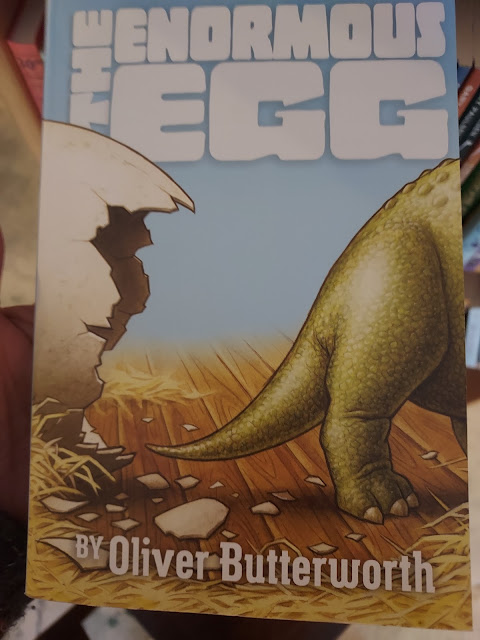
Do you remember some of your favorite books from grade school? One of mine was Oliver Butterworth’s The Enormous Egg. I was reminded of that favorite story when a little boy visited my bookshop wearing a striped t-shirt with a line of Triceratops dinosaurs marching along every other stripe. In the book, young Nate Twitchell is almost as faithful as the family hen in taking care of the unusually large, leathery egg in hopes it will hatch—and it does! But the little dinosaur does not stay little for long. 


I didn’t remember the ending, so I had to order and reread the whole book. Thus I traveled with Nate and Dr. Ziemer and Uncle Beazley (the triceratops) from New Hampshire to Washington, D.C., and then right into the halls of Congress, where a United States senator proposed legislation that would outlaw Uncle B. and have him killed and stuffed! Given the expense of housing a dinosaur over the course of its lifetime, there is support in the Senate for the bill. Uh-oh! What hope does young Nate have of saving his rapidly growing pal? Wonderful story!


A much older book that went home with me for bedtime reading was a falling-apart copy of Rudyard Kipling’s Second Jungle Book, in which we meet again Mowgli and his animal friends. 


There are also other stories in the book, including one that takes place in the high Arctic, but Mowgli and friends are the center. As captivating as the stories, once I stopped to look at them more closely, are illustrations by the author’s father, John Lockwood Kipling, the smallest seeming at first glance only decorative. But no! Each one clearly depicts something in that particular story.


John Lockwood Kipling deserves a new paragraph. Although his career was overshadowed by that of his famous son, Lockwood was an astonishingly accomplished polymathic artist in his own right, producing drawings, furniture, sculpture, pottery, and more. During his 25 years in India, as teacher and later museum curator in Lahore, he was also active in a revival of traditional Indian arts and crafts.


And let me say right here that wonderful as much of Walt Disney’s work was (and his "Jungle Book" film was the last for Walt), Disney’s Mowgli is not Kipling’s Mowgli, and people need to read the books to learn the Law of the Jungle as the man-cub learned it. 


Alongside these deep and deeper dives into the past, I read also a novel published only two years ago, inspired because the author came to Northport. Mary Kay Zuravleff gave a reading and presentation following the business portion of the annual meeting of the Friends of Leelanau Township Library (FOLTL) on Saturday, June 14. When she and local author Karen Mulvahill stopped by the bookstore ahead of her FOLTL appearance, they took a couple extra books from my stock, in case they ran short. And they would have! Note: I am ordering more and will be restocked by this Friday.


The title of Zuravleff’s novek, American Ending, comes from the fictional narrator’s mother, a Russian immigrant. When telling her children bedtime stories, she would ask, “Russian ending or American ending?” In the Russian ending of a fairy tale, the wolf eats the bride who wanted a ride on his back to her wedding, while the American ending has the groom slicing open the wolf’s belly and the bride leaping out unharmed.  But even as a child Yeleni doesn’t fully trust American endings, suspecting that good luck isn’t necessarily permanent and that life can take sorrowful turns. 


The setting is a coal-mining town in Pennsylvania, and the story opens in 1908. It is a complicated family saga, with a large cast of characters, but American-born Yeleni’s voice, steadily throughout the book, keeps us oriented. This is a world where girls are married as early as 13 years old to grooms chosen by their parents, young boys taken from school and sentenced to dangerous lives underground, and adults too often seek solace from poverty’s troubles in alcohol. Yet, for all that, it is also a life of tradition and memory and feasting and celebration. When Yeleni’s mother invites the schoolteacher to Thanksgiving dinner, the whole neighborhood contributes.


It was a miracle the way people pitched in when they weren’t even invited, and not with a shriveled turnip or the stringy end of a roast either. Here came a sturgeon turnover to fatten up the schoolteacher, poppyseed bubliks for the single men, cherries in a jar if Lethia wanted to bake pie. Lethia collected candle stubs at church and polished the table with beeswax and beef tallow, another miracle. Robert and Pa captured two wild turkeys. Really, Kostia did. The birds were always in the meadow nipping at him, and Kostia led them into a trap….


-      Mary Kay Zuravleff, American Ending


Despite being a story set in the America of over a century ago, the novel is also very much a story of today. Late in the novel, when Yeleni urges her husband to apply for U.S. citizenship, he answers, 


“I’ll need a witness willing to swear I’m not a phut.”


“English, please,” I said, “or they’ll send you back on the next boat, crook or not.” 


It was one of my fears, though Erie Russians scoffed at the idea of anyone being sent back. Who would make the town’s streetcars, engines, or boilers; their boots and buttons; their paint, paper, or pickles? Who would slaughter the meat or tan the leather if Russians were sent back?


Sound familiar? Since summer is my heaviest work season, both at home and in my bookshop, reading time is at a premium, but I still manage to squeeze it in. (Not having TV helps!) American Ending is Mary Kay Zuravleff’s fourth novel and the first of her work I have read, but it certainly will not be the last.


And then one night I turn to an old favorite, Harlan Hubbard’s Payne Hollow: Life on the Fringe of Society, a sequel to Shantyboat, the story of Harlan and Anna’s river adventure years. 


I love Harlan's sketches in the book


Returning at last to the Ohio River as to an old friend, the Hubbards settled down and built a house on the river bank (shades of Rat and Mole), put in a garden, raised goats, and continued their evening practice of reading aloud to each other and playing duets. Their “bijou riverside residence” (as the Mole called Rat’s hole in the bank) was larger than their old shantyboat but, like it, lit by fireplace and oil lamps and complete with cunning cupboards for the storage of food and a bed that slid away out of sight when morning came. Harlan and Anna kept to old, simple ways. 


…So many times have the advantages of a garden tractor or tiller been pointed ot to me that I half believe the argument myself…. My strength returns when I am alone in the garden, working with some beloved tool, the birds whistling overhead. Even on a sultry July morning, when not a breath of air stirs, when the sun’s heat is magnified by the encircling trees, and weeds are sprouting everywhere, not even then could I welcome one of those nondescript, unlovable gadgets, brightly painted and streamlined, which make an intolerable noise and smell bad. They get the work done, you say? I say they are expensive and insidiously destructive. I will get the work done in my own way. Save time? The best use of time is to enjoy it, as I do when working in peaceful silence. 


-      Harlan Hubbard, Payne Hollow


Oh, that is exactly how I feel about working outdoors! No string trimmers or leaf blowers for me, please!


How economically he captures chickadee and woodpecker!


Agility work


Sunny Juliet and I had our first session of the year with Coach Mike, who is very enthusiastic and encouraging and genuinely loves the sport and all his doggie pupils. He is an excellent teacher!


Agility work is as challenging—maybe even more so—for the human member of the team as it is for the dog. The sport was inspired by equestrian show jumpingand more and more I realize the strong parallels between work with horses (which I must admit, sadly, I know about almost exclusively from reading) and work with dogs. We humans are a talky species, and we are usually so busy talking and listening to each other and thinking about what we want to say next that we lack awareness of what our bodies are telling us and telling others. 


Anyone knows that riders “tell horses what to do” by applying reins and knee pressure, but horses also respond to much more subtle signals, whether or not the rider intends the signaling. How one sits and every little shift of the seat is information to the horse. A well-trained dog responds to voice commands, but any dog is also, and much more continually, paying attention to physical cues. 


In our agility work Sunny is aware of every little move or gesture I make, intentional or inadvertent, although I am not physically in contact with her. If I shift my shoulders slightly or vary the height of my hand from the ground or speed up or slow down or merely glance off to the side—all that is telling her something, which means that I too have to be aware of my body in order to give her the proper signals. 


And have you ever thought about the difference in peripheral vision between humans and canines? (Don’t feel bad. I never had.) We see about 180 degrees, or half of the circle of which we are the center, but dogs’ eyes are spaced more widely apart than ours, so their peripheral vision is much wider, 250 to 270 degrees (depending, I guess, on the shape of a particular dog’s head, which would vary from one breed to another), which means Sunny is still seeing me after she runs past, so if I stop and turn around, she thinks she needs to do that, too! 


It’s a lot to think about. It’s also impossible, as you can imagine, for me to get video or even still footage in the middle of our demanding work!


But now—oh, dear! Sunny has developed a limp that seems to come and go, as if maybe she pulled a muscle or something (it started with that porcupine chase), so for now my girl needs to rest from strenuous activity. She’s to be on-leash for a week, with aspirin or Tylenol twice a day, the vet says. Poor Sunshine! She thinks “taking it easy” is a great big bore!


Tenting Tonight


My birth family went on our first camping trip when I was 12 years old, five of us sleeping in a borrowed tent, a heavy canvas umbrella tent. It rained all week. And we all wanted to do it again! 


Jack and his crew

Now grandson Jack from St. Paul, Minnesota, a newly graduated art student from Kalamazoo College, is here this week, rain and/or shine, with his ten senior-year classmate/housemates, the whole crew camping in the yard and eagerly exploring Leelanau. (I know the kids would love to play Frisbee with Sunny, and ordinarily I’d have been all for it, but not right now, as she needs to rest her jumping muscles. If only she would rest her barking muscles, too!) What a happy scene the tents and hammocks and everything else make in our usually empty yard! At last it felt as if there had been a point to all that grass mowing! 


Fog rolled in, but the campers are happy.

While all of the young people are delightful, naturally grandson Jack is very special to me. When I look at a closeup of Jackson examining a camera I found for him, I see his grandfather, alive and young again.


Monday, July 26, 2021

Taking Time to Find Ourselves


A Bookish Kind of Social Life


Since last I wrote, my sisters were here from Saturday evening to Tuesday morning, which meant that on my two days off (bookstore closed Sunday-Monday) I got to play at being on vacation with them. Summer vacation! What a concept!


Sunday Bettie and Deborah and I drove almost as far north on the peninsula as it’s possible to go in order to join a group of women fiction writers at the home of one of them for an annual lunch gathering -- lunch in this case lasting until 4:30 p.m. -- and a happy gathering it was, with progress reports, mutual encouragement, tales from all aspects from the book world, and gales of laughter interrupting the conversation to punctuate moments of hilarity. I was happy and proud to be able to introduce my sisters to this aspect of my wonderful world of books: these fabulous writing women!


Monday the sibling trio went south, first to Lake Leelanau for a wine tasting on the porch of the Boathouse, overlooking the Lake Leelanau Narrows, a nice slow-down from my usual summer routine, and after wine and crackers and salmon spread  continuing south through Cedar and Maple City over to Good Harbor beach for a walk along the shore and to wade in Lake Michigan. We spotted this little frog hopping in the shade of an old log on the beach where we made our own temporary camp. My sisters enjoyed their Michigan getaway, brief though it was.


Tuesday evening the Artist and I caught up and reminisced with an old friend from Kalamazoo; Wednesday evening I mowed grass after supper; and on Thursday our reading circle (a.k.a. the intrepid Ulysses reading group) met to discuss Their Eyes Were Watching God, by Zora Neale Hurston, a novel everyone in the group loved so much that we pretty much stayed focused on it all evening without veering off onto more personal topics. We’ll take August off and reconvene in September to discuss The Waves, by Virginia Woolf, which you won’t be surprised to learn (if you read this blog regularly) was my recommendation.


Our hostess on Thursday evening shared with us, toward the end of our time together, that since the pandemic she has discovered her inner gardener for the first time. This came up in connection with what we had been discussing earlier about Janie gradually finding her voice and discovering herself. Someone speculated that Janie’s self-discovery might have been more difficult or perhaps even unattained had she had children, and that led (as I say, this was as we were wrapping up the evening) to our busy world and the importance of finding quiet time for ourselves. 


Quiet Time


My quiet time is often before sunrise, even long before the sky is light. Was it nothing more than serendipity that on Friday I picked up Anne Morrow Lindbergh’s classic little volume, A Gift From the Sea, to read with my pre-dawn morning coffee? It was certainly a delightful surprise to find the author quoting from The Waves in one of her chapters!


As calm and quiet and focused on Lindbergh’s words as I was Friday morning, though, I couldn’t help thinking of painful aspects of her life that preceded the 1955 publication of Gift From the Sea, the horrible nightmare kidnapping and murder of her first child and, following that, her famous husband’s antisemitism in the years leading up to World War II. Ann Lindbergh herself was also an isolationist and, at least early on, an admirer of Hitler. She says they were ''both very blind, especially in the beginning, to the worst evils of the Nazi system.” How horrible, to look back on having admired that! And she probably had more serious challenges in the everyday life of her marriage than her quiet meditations on shells suggest. There is a hint, when she quotes Rilke and then writes, 


This is a beautiful image, but who can achieve it in actual life? Where has one seen such a marriage except in a poet’s correspondence?  


Strange, then, to read the calm, reflective beach essay and feel the power of its quietness. Anne Morrow Lindbergh had five children after Charlie, and she lived to be 94 years old, so one wonders how many times she sought and found herself and if she found a succession of selves over the course of time.


Books Read Since Last Post


97. Hurston, Zora Neale. THEIR EYES WERE WATCHING GOD (fiction)

98. Daly, Herman E. STEADY-STATE ECONOMICS (nonfiction)

99. Lindbergh, Anne Morrow. GIFT FROM THE SEA (nonfiction)


How is Peasy-Pooh?


He still has issues, and they are not trivial. He is affectionate and sweet with us but nervous and unpredictable with strangers, especially men. We have a new rule for him, which is that he cannot be under a table where we’re eating. He is good about limits, as long as we set them clearly. 


Also on the plus side of the ledger is the way he doesn’t fight over having me handle his feet. I clipped five toenails at one sitting the other day and also clipped the long fur between his paw pads, giving him a much more respectable, cared-for look.


And Saturday morning's monsoon rain did a good job of filling up his wading pool for evening fun!


Northport Was Quiet!


Yesterday and today we have company from Brooklyn, New York, and Sao Paulo, Brazil. That is, a husband and wife who divide their year between the two places. They are staying in Northport. This is a picture of Peasy before our company came. I'll need to take some photos of the company today, I see!


Following a long, leisurely cold luncheon at our place, we two couples separated for two or three hours and reconvened back at the Artist’s gallery, and after a long visit there over art and wine we walked down to the harbor. All the bar-restaurants in town were closed! Northport Pub and Grill, the Garage Bar and Grill, the Mitten Brewing Company! Paris, France, used to be like this in August, when the entire country went on vacation, and tourists from elsewhere found themselves with few resources to sustain life. Paris finally got its act together, and now the food purveyors stagger their vacations so that every neighborhood has something to offer, even during traditional vacation times. I think that would be a good idea for Northport.


Below is my "flight" from last Monday, a mix of whites, rose, and a red. I don't have photos of Northport's empty Sunday evening streets. It was just too weird!


Tuesday, October 22, 2019

Where Is Your Head Today?

Sumac at the height of its glory
“Where’s your head at?” was once a sort of jeer, not a real question, a variation on “What were you thinking?” which, of course, implies that you were not thinking at all. What I intend here is a real question, translatable as: What’s occupying your thoughts? What perhaps are you obsessing over (and wish you weren’t)? Are you focused or feeling dreamy, or is your mind jumping from one thing to another like a grasshopper being chased by summer’s approaching end? Or maybe you’re fortunate enough to be taking in the natural world moment by moment, like a dog miraculously blessed with full color vision. How wonderful that would be, wouldn't it? To have the full range of color added to the marvelous range of olfactory sensations we humans can only dimly imagine!


It’s been a long time since I’ve written a blog post. Well, for this blog, anyway. I’ve done three new posts for my photo blog, “A Shot in the Light,” and one for my catchall blog, “Lacking a Clear Focus.” I’ve also read half a dozen books (see sidebar for titles) and hosted another signing in my bookstore. My sister and her husband visited from Illinois, and our grandson and his best buddy traveled up from Kalamazoo. (Those were good visits.) And I went on active duty for a friend for three weeks while she was in hospital and then rehab, feeding her cats and declumping their litter boxes daily. 

Historian Larry Massie from the Allegan Forest

Larry's appropriately book-themed tie
Grandson Dave! Sarah's human nephew! Sarah loves company!
And all along there has been the glory of fall color, starting with the staghorn sumac (top of post) and now encompassing maples and beeches and popples and even early-turning tamarack. This past Sunday was simply glorious, but it's recorded only in my brain's fallible memory, not on my camera's digital storage card. Camera in action again today, under grey, rainy skies.


On Monday I stirred my stumps (isn't that a hideous expression?) and got busy with long-delayed kitchen and food-related projects -- retrieved rhubarb from the freezer to turn into rhubarb chutney; picked apples from an overloaded tree (only recently I learned that apple trees can be "overpollinated"); defrosted strawberries, raspberries, and blueberries destined for jam before another day escapes. 

Home harvest
Things keep happening, though. The world doesn't hold still for a moment. So I paused to remember Bill Milliken and to say a prayer of thanksgiving and hope for full recovery for Jimmy Carter. I read newspapers, rationing each day's intake (in the interest of sanity) and wondering where the hell we are going as a nation and a world. My head was here, my head was there. Sometimes it just wanted to be under the covers, fast asleep.

Fleeing deer!
Thank heaven for books! Books on geology and history put current events in perspective, and old volumes that have survived from a century or more ago reassure me that bound, printed material has staying power and that what I do for a living is worth doing and may last beyond the current insanity. In more optimistic hours, I like to think so. But then, my head is not staying in one place very long these days.