Search This Blog

Showing posts with label cities. Show all posts

Wednesday, December 13, 2023

Everything is Different Everywhere

Wednesday morning, 12/13/23

Everything is different not only from year to year but also from day to day. Yesterday’s fierce, bitter west wind made the air feel ten degrees colder than the temperature reading. Today is still cold, but the sun is shining, and there are more smiles on the faces of even the most rushed pedestrians in Northport. I did my village errands before opening and then found contentment in adding ornaments to my little Charlie Brown tree.


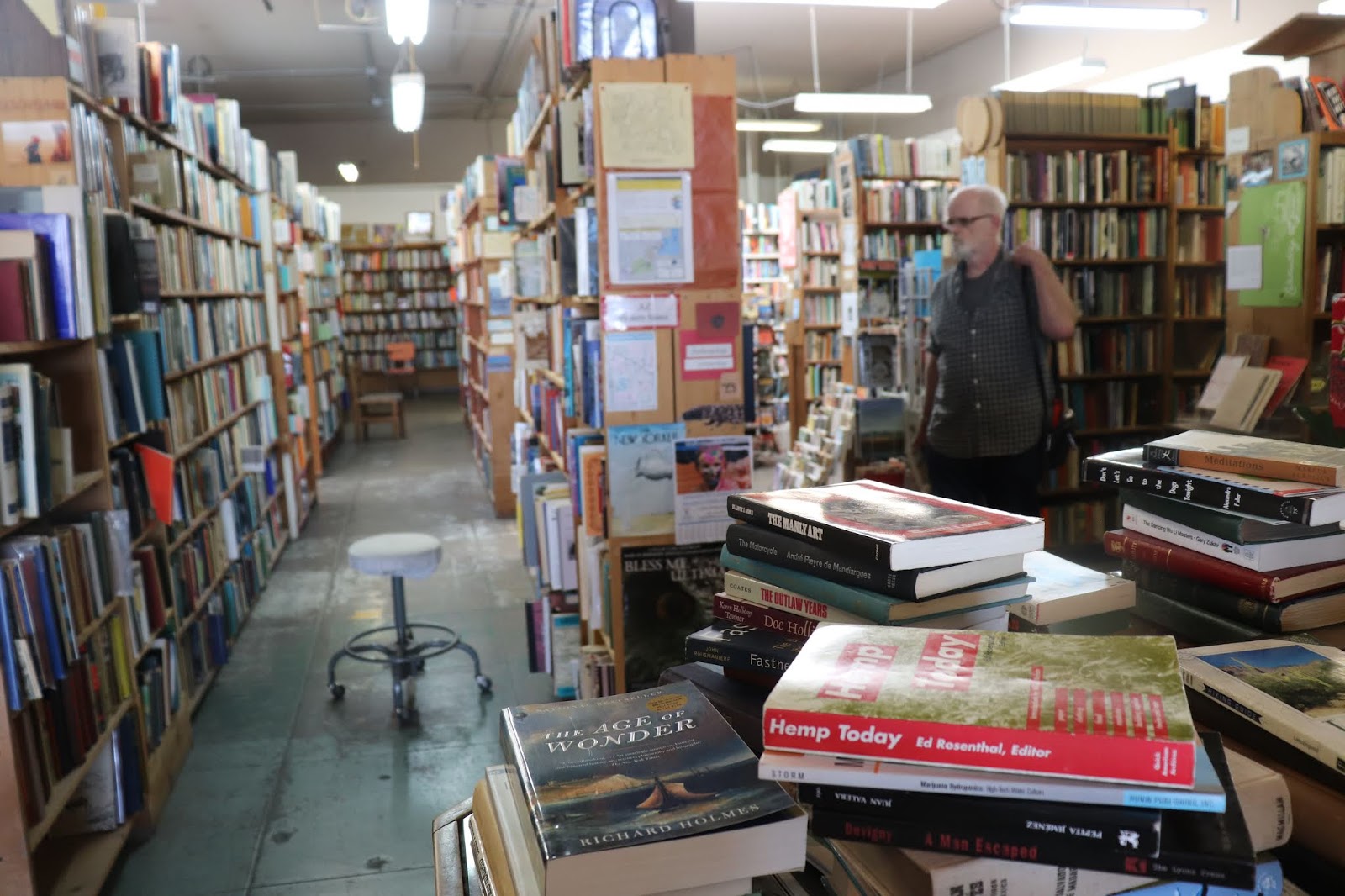
Happy in the bookstore window, sunny today


A Recent Encounter and Thoughts It Sparked


“It’s not the same town it used to be,” the salesperson muttered bitterly. I was trying on boots and had asked specifically for footwear made in the U.S. or Canada. Her remark about change in Traverse City came as a response to my request and followed her more immediate response: “You won’t find them. No one here wants to work any more. The only boots we can get from China or Vietnam or ….” I forget the third Asian country she named, but in the moment I thought instantly about the wage scale in China, where factories workers are housed in clusters of high-rise dormitories in the middle of nowhere, and so I remarked, “Well, people here don’t want to work for nothing,” but that was the wrong thing to say, because although my tone wasn’t angry, the words were argumentative. I wish it had occurred to me then (and not an hour later) to ask curiously, “Why do you say that?” Maybe we could have had a conversation. Instead, she countered quickly, “They don’t want to work at all!” I still could have asked the question, if I hadn’t let her words and demeanor put me off so completely, but next she made that remark about Traverse City not being the town it used to be, adding, “And it isn’t the same country it used to be, either.”


Of course, she was perfectly right to say that Traverse City has changed. Nothing like the small town I moved to in 1970, Traverse City now seems to exhibit growth as such a fast pace that the Artist and I were always exclaiming over new buildings whenever we made the trip to town. Big condominium complexes everywhere, multistory hotels, city traffic! Downtown is still attractive and walkable, and the sidewalks are usually filled with foot traffic (a good sign for a downtown), but the newfangled parking arrangement – meters that take credit cards instead of quarters – discourages some (I am one) from making the effort to shop downtown. Maybe it’s out-of-town visitors in the big hotels who shop Front Street boutiques these days.


Luckily, when I inspected the label on the inside of the second pair of boots the gloomy salesperson brought out (the ones I’d initially pointed to in the display), I saw that they were made in Canada. They fit. They were warm and snug and simple. No need to look further. So I got what I came for, and we ended with smiles, but the transaction as a whole left me feeling sad and discontented over a missed connection. I wish I’d had my wits about me in the moment. But going to Traverse City overwhelms me, too, most of the time….


Stores and restaurants and traffic and high rises are hardly unique in the American landscape. When I am back in Kalamazoo, there are parts of that city that I barely recognize, and the same is true of Joliet, Illinois, where one of my sisters still lives. Cities everywhere are sprawling outward. Growth in Tucson and Phoenix made those cities’ outlying areas look different from one week to the next as I traveled from ghost town to city hospitals and back in early 2022. Apartment buildings and condos are rising skyward in all American cities. Shops and restaurants have become more expensive (and more like New York) than they ever used to be.


Nothing is the way it used to be. Anywhere.


Part of this sea change is population growth. The world population, 3,695,390,336 in 1970, had grown to 8,045,311,447 by 2023, more than doubling. The population of the United States went from 203,392,031 to an estimated 339,996,563 in the same time period, not doubling but greatly increasing. How could we ever imagine that the world would not change with so many new people in it, including the babies we welcome so joyfully into our own families? 


Another aspect of changes, however, as I see it, has to do with expectations, which are much higher than those of the postwar twentieth century. Is it also a greater willingness to carry debt? Refusal to delay or do without gratification? Resignation to “just the way things are”? The average new car today costs two and a half times what my first house cost and five times what my parents paid for their first house. Not that my parents ever bought new cars, and I never have, either, and both of those first houses, I should note, had three bedrooms and a single bathroom -- but who expected more? Our family’s vacations in the 1950s consisted of two weeks in Ohio, one week with one set of grandparents, a second week with the other set – and that was a summer vacation. Winter vacations were unknown except for “jet-setters,” back when only the rich and famous flew around the world for pleasure.


Materially speaking, the growing world population on average is richer than ever. Many middle-class Americans are drowning in their own toys! (Are they happier?) However the average is calculated, though, many are left behind, as what was a gap between highest and lowest income levels threatens to become a chasm.


Somehow – and I have no basis other than intuition for saying this – I doubt that the unhappy salesperson in the shoe store and I would agree on which changes we see as the most negative or what might be done to mitigate negative effects. Of course, I don’t know that, and obviously she was having a bad day. I remember a day 28 years ago when I had to close my bookstore early, realizing that my mood was not one that walk-in customers should have to meet, and a couple years after that, during summer tourist season, annoyed by being asked the same questions over and over, I had to slap myself upside the face, metaphorically, and tell myself either to get a new attitude or find a different line of work. Attitude is what I changed.


I’ve moderated both my moods and my expectations since those early years and grown accustomed to the rhythms of the calendar. I’ll never be rich, but I manage to make a modest living doing something I love in a place where I feel comfortable and visible. A first-time visitor recently assured me that no reader need ever leave my bookstore empty-handed, as there is something for every reading taste. “Write in my guest book!” I urged him shamelessly. Everyone loves to be appreciated! I certainly appreciate my customers and am happy that so many have become my friends over the years. What more could I ask? I am a lucky human being.


Welcome!


Additions to Top Recommendations From My 2023 Reading


Added to my top fiction and top nonfiction book picks of the year are now: 


For fiction, it is, of course, The Waters, by Bonnie Jo Campbell, which I read in an advance review copy, though the release date was pushed from October to January 2024. I’ll be writing more about that novel after the first of the year and hope the author can come to Northport! 


For nonfiction, it’s Isabel Wilkerson’s Caste: The Origins of Our Discontents, published back in 2020. I read The Warmth of Other Suns earlier but only very recently Caste. Such a brilliant writer and thinker she is, and while you probably know, as I did, the basic historical events, her analysis puts them in a new, pitiless light. How did 2016 happen? Read Chapter 26. That is, read the first 25 chapters, and then Chapter 26. Every American needs to read this book. If you need more convincing, here's an article for you. 


Time Is Slipping Away!


How does it happen? One day the holidays are visible on a distant time horizon, with weeks available to plan and make ready, and then suddenly  Hanukkah is almost over, and it's less than two weeks until Christmas! Whatever the day on which these thoughts occur to us, however, we are here now. Take a deep breath. Sun or clouds, you are here now.


Friday, March 6, 2020

Report From the Field #2: Book Stop, Tucson


I'm calling this report #2 only because it never occurred to me before to label my visits to other people’s bookstores as field reports. How many posts have I written on indie bookstores, not only in Michigan but between Michigan and Florida and then from Michigan to Arizona and back, in the 12-1/2 years of Books in Northport? I’m not going to go back and count, but it’s one of the things I do during my months of “seasonal retirement” when I’m away from my own bookstore in Northport, Michigan. 

When the Artist and I go to Tucson, venturing 100 miles west on expressway from our winter rental cabin, because we do it so rarely we always have an agenda; however, we never accomplish much of the items on our list, and the most recent day trip was no exception. New exhibit at the art museum, a couple of bookstores, a new Chinese restaurant, and maybe the camera shop, if time permitted: Those were our goals. Result: We got to one bookstore. But the bookstore was all I hoped it would be, as you will see if you bear with me until we get to that part of the story. First, though, I’m very sorry not to have more photographs of the early part of the day, because after deciding to circle around more of the city and take the Speedway exit, we were seduced by one that came before, as it sounded like it would take us more quickly to 4th Avenue. It did not. We found 4th Avenue easily and enjoyed cruising north on it through South Tucson, where brightly painted buildings, murals, and colorful tiles reminded me of my trip a couple years ago to the Yucatan. So beautiful and exciting! Another time I’ll employ my camera, but sometimes it just feels more important to be in the moment, not worrying about capturing the present for future rumination. And I was loving 4th Avenue!

Just as it seemed we must be nearing our goal, however, we were unceremoniously dumped off 4th Avenue and hurried onto the new and “improved” Broadway, a wide, swooping road that will no doubt be great for high-speed traffic (for those who want that) when it’s finished. At present, however, it is not finished, so we were not only routed way off our desired path but stuck for what seemed ages in stop-and-go-and-stop traffic, which is never any fun at all.

Finally getting off the nightmare road and into what felt like a reasonable grid of streets, we somehow found ourselves caught up in the University of Arizona campus — which, in case you are not familiar with it, is an enormous campus — so that finally coming out on Speedway Boulevard, a long, busy street often avoided by locals but one that serves very well to orient us country mice, was a huge relief. From there we found the end of 4th Avenue we wanted and persevered until arriving, at long last, at the 100N block. 

At last!
Tip to other visitors to Tucson: If you’re looking for the Book Stop on 4th Avenue, or for Antigone Books (which we will visit on another field trip), take the Speedway exit. From Speedway you’ll turn south (right) and have an easy time locating the bookstores. 
[Speedway Boulevard: 1st degree of relief…  
4th Avenue North: 2nd degree of relief…  
Parking space around the corner from Book Stop: complete relief!]

My camera work inside the bookstore was hurried, at best. I wanted to look at books! But you can probably see from these quick shots that the Book Stop was exactly the kind of bookstore I had been hoping to find.


Tina, the proprietor, was quietly welcoming, friendly and helpful without being in the least overbearing or hovering. Like her bookstore, she was just right. I found five books to buy that day, took a few pictures, shared with Tina my own bookstore connection, and received information from her about the store’s buying and trade policies. I also told her how much effort had gone into our getting to her store, and it was she who recommended the Speedway exit (so you have it from a local and don’t have to take my word alone for it).


Thank you, Tina!
In its own way, 4th Avenue North is as colorful as the stretch south of Broadway, but in a different way. It has no dominant ethnic tone but more of a 1960s hippie dream quality, as perhaps you can see from these photos I snapped from the car window. 


We will be returning to Tucson next week, when I will attend the mammoth Festival of Books on the UA campus with a friend. The plan is that her husband will drop us off for the day. Hooray! We won’t have to drive or park -- or dodge around bicycles and streetcars! 


Streetcars, really, on 4th Avenue!
So that will be another travel adventure and field report from the world of books, Southwest style, coming up soon.


Saturday, February 22, 2020

Life Does Not Provide “Time Off”


A different sunrise
I don’t mean by today's headline that every day is workin’ in a coal mine. No doubt it is, in some parts of the world, but not for someone like me, fortunate enough to have five months’ seasonal retirement in southern Arizona. No, I mean only that life’s challenges and delights, the calm stretches and dramatic ups and downs, are all high-speed miles on a nonstop journey, as sunrises and sunsets and unexpected news bulletins, personal and national, constantly remind us. This morning, however, distracted as I am by news from friends and family (as well as by what comes to us over the radio waves), before too much time goes by with Tucson in my rear-view mirror I’ll sketch in something of our three days there last week. 

The sunrise at the top of today’s post is not my usual Dos Cabezas view but one a hundred miles away, in the Santa Catalina foothills north of Tucson, looking back to the east from the patio garden of a condo we were invited to use while our friends made a quick trip to Florida. We drove over from Cochise County to Pima County and up Sabino Canyon on Saturday afternoon, and the first order of business upon arrival was a patio hose bath for Sarah, who had become a very dusty ghost town dog in two short months. That always wears me out (bathing Sarah), and the Artist had done all the driving (I am navigator), so our evening’s adventure took us only as far as the nearest grocery store and deli. Also, remember, it is still winter, and the dark of night still comes early. 

Dark skies, twinkling city lights
Then comes morning again

But I am, as you know, una madrugadora, an early riser, and the quiet of morning is one of my most cherished luxuries, wherever it finds me, so imagine the sybaritic feelings of your seasonally retired bookseller in the mountain foothills, soaking in the morning sun, with nearby birds singing and humming, book and breakfast on the table beside me, dog at my feet — or dog popping up to look over the wall at the great world beyond! Bless that little Sarah! 

Curious dog girl!

After one night with the pack together in a new place, our dog was comfortable enough that we could leave her by herself for a while, sparing her hours in a parked car and sparing ourselves the worry. Our main Sunday destination was the Tucson Museum of Art downtown, which we found with no trouble at all. Traffic was surprisingly, delightfully light. I did not take my camera into the museum, but we toured all the galleries open that day and will return in the spring when the main gallery and its new exhibit can be viewed. A pause to refresh in the museum cafe followed.

Door to temptation!
We took a detour and then a different route for the return to the foothills, cruising the famous (or infamous) Speedway Boulevard for miles, much to the Artist’s satisfaction. He is convinced that anything one could possibly want can be found on Speedway Boulevard! One stop we did make on the boulevard Sunday was at a branch of Bookmans, a wonderful book of stores selling used books, music, musical instruments, and heaven knows what-all else, because — yes! — we do shop indie wherever we find ourselves. 

Books bought at Bookmans

Another day coming....
Another morning, another day, and further explorations. Monday took us to thrift shops and antique malls. Speedway Antique Mall was almost more excitement than we could bear! We wandered, dazed, through maybe a third of the store, by which time my arms were full of as many books as I could carry. Finally I told the Artist, “I can’t look any more!” and he replied, “Neither can I.” 

Only part of my haul from Speedway Antique Mall

I found only a single book to purchase at the Goodwill down the pike, but it was a nice one, and the cashier thought it was "cool" that I could read French. Wish I could read Spanish as well as I read French.... 

thrift shop find
Then — silly me! I neglected to check their days and hours! — we drove all the way down to Monument Camera, only to find that it is closed on Sundays, Mondays, and Tuesdays, but the good news is that by then we were acquiring a pretty good mental overview of the skeletal grid of Tucson city streets and finding our way around like old-timers. Somewhere along the line that day we had lunch at a little hole-in-the-wall Thai restaurant, and somewhere else I found three more books, but we were ready to get back to Sarah and the relaxing patio well before dark. 

Santa Catalina Mountains in background
On the recommendation of several friends, we had thought to visit the 10-acre Ted deGrazia gallery and historic site on Tuesday morning before leaving town but ultimately decided to save it for another visit. There are so many things on our list for future visits — the Arizona-Sonora Desert Museum, the Golden Goose thrift shop, Mount Lemmon, St. Xavier, to name only a handful — and we’ll be wanting to revisit the art museum and Bookmans, as it probably goes without saying, but the big item for March, for me, will be the Tucson Festival of Books. 

Spring is coming in Tucson
Cities are exciting, full of energy. Tucson’s setting is beautiful. There is no end of things to see and do, and we are grateful to our friends for their invitations — friends who might be forgiven for thinking I’d be reluctant to return to our simple cabin in the wilderness. But the truth is that I really like life in the slow lane and am happy in the little nest I’ve been feathering during our winters here, adding to my Western library and batterie de cuisine. I value our neighbors here and am happy in my two volunteer mornings in Willcox. And that big city with all its myriad charms, as I have to keep reminding the Artist, is after all only 100 miles away.

nesting comforts

Saturday, February 20, 2016

The Place of Place: “Do I Stay, or Do I Go?”


regionalism. Emphasis on regional locale and characteristics in art or literature. Regionalism was a significant movement in Canadian literature early in the 20th century. Other national literatures also had periods in which regionalism was emphasized. 

Midwestern Regionalism. American literary movement of the late 19th century that is characterized by the realistic depiction of Midwestern small-town and rural life. The movement was an early stage in the development of American realistic writing.
  
- Merriam Webster’s Encyclopedia of Literature, 1995

[Don’t ask me why the EOL capitalizes Midwestern Regionalism and not regionalism. I have no idea.]

In the last couple of decades, the term sense of place has become ubiquitous in American discourse; whether the topic is fiction or the visual arts, sense of place is often highlighted and extolled. It is a sensibility that has come to pass over and against an earlier aesthetic, in which historical period dictated what was considered important or beautiful. And yet, oddly, while sense of place has become a dominant theme, the label “regional” tends to limit the audience for arts or books. Why this disconnect? Given the definitions above, situating regionalism in the historical past, the view from the critic’s chair is clearer.

But where does that leave us? The sense of place aesthetic is at odds with postmodern criticisms that locates regionalism in the been-there, done-that category. We live in a “global” world, we’re told. Is our fascination with sense of place, then, nothing more than nostalgia?

I’m not setting out today to advocate for or against regionalism but to explore what this sense of place discourse means to us, as Americans, and what place place holds in our individual life stories. What is the place of place in your consciousness or mine? In the arc of our personal narratives?

Re-reading some of Jim Harrison’s essays from over two decades ago, I am struck not only by the way he responds to various places – to Leelanau County, the U.P., New York, France, Montana, and Arizona – but also by a general question he poses as it relates to food, a question that could also, easily, relate to geography – or anything else: Is it more desirable to climb a hundred mountains in a lifetime or to climb one mountain a hundred times? Being a man, Jim naturally sees a parallel in the question of marriage vs. the life of a libertine. Surely he has also thought about the parallel question of where one makes a home, where one spends one’s life, given that his own life has been lived in multiple places but also, in each of those places, on terms of intimate knowledge of each place.

As I reflect on that, already I am seeing “100 mountains” or “one mountain 100 times,” even as an analogy, to be a false dilemma. I’m seeing a wide and fertile middle ground. But I don’t want to assume it from the outset and have not yet explored far enough to have made a case for its existence.

For many writers, one particular part of the world or of their native country remains home for all their lives, whether they remain in that place or leave it and never return, and all of their important writing lives there, in that place where it is at home. For Sarah Orne Jewett, “the country of the pointed firs,” rural New England seacoast whose name she gave to her most important writing, was that place. For Ernest Gaines, home is Louisiana, the part where country people live. Eudora Welty’s world was Mississippi. Ivan Bunin’s fiction is set in the Russia of his childhood. We associate so many writers with New York City that the list would take more room than I want to give to it – but for some reason, fiction set in New York and infused with its streets and sights and smells and patterns of speech is not considered provincial. Why not? Surely the locale and characteristics of the city are vital to many New York stories. Well, I’ve always wondered but don’t want to follow that side road today.

One of my favorite writers who has chosen to climb the same mountain over and over is Wendell Berry. His poetry and essays and fiction are unimaginable apart from his life as a Kentucky farmer, and in choosing that life he also advocates for it.
And the world cannot be discovered by a journey of miles, no matter how long, but only by a spiritual journey, a journey of one inch, very arduous and humbling and joyful, by which we arrive at the ground at our own feet, and learn to be at home.
― Wendell Berry, The Unforeseen Wilderness: Kentucky's Red River Gorge
This past week I read a book that came to my attention because the author is from Kalamazoo, Michigan, where I lived for many years. In fact, before my years in Leelanau County accumulated, I had lived longer in Kalamazoo than anywhere else, from South Dakota to Illinois to Michigan and beyond. So, not surprisingly, here is the passage that struck me on Thursday evening:
Evolutionary cul-de-sac. That was how I thought of the streets of Kalamazoo. There were a lot of good things about Kalamazoo, and even some great things, like my family. But I’d already lived 19 years of my life there, which was too long to spend in any one place. And when I went to the grocery store or to work, I ran into people who’d known me since I was a kid, and most of them still applied their old knowledge of me. Even though everything was different now, it was hard to escape the powerful orbit of history, the inertia of the past. 

-               Joelle Renstrom, Closing the Book: Travels in Life, Loss, and Literature

Wendell Berry finds a meaningful life only in returning and staying in the country where he grew up, the country of his family history, whereas Joelle Renstrom’s return, initially necessitated by her father’s fatal illness, becomes problematic after his death. As she puts it, “I needed to continue evolving.” She sees staying in Kalamazoo as the end of her personal growth.

This is where I need to address the question of my own life, if only because my life is the reason the question arises for me at all.

Wendell Berry has his answer: his part of rural Kentucky is his place in the world. He belongs there, his life and work and art inseparable from the place. Joelle Renstrom’s answer, insofar as she has formulated it at this stage of her life, seems to be that each place she lives has a certain expiration date. Vancouver was home for a while, and then its time was over. She had a New York era. She came back to Kalamazoo but needed to move on.

I have a dream life akin to Wendell Berry’s, but my actual life has been much more like that of Joelle Renstrom. There were 17 adult years for me in Kalamazoo (I arrived at age 22), and there have now been 24 years in Leelanau County, but I grew up in neither place, and no earlier generation of my family called either place home. And what to say of two years in Cincinnati? Repeated returns to Paris, France? Or winters on Florida’s Gulf Coast, or, more recently, last winter in the high desert of southeast Arizona? Is northern Michigan less important to my life because I have loved other places? Is loving more than one place some kind of disloyalty? And if I say no, have I begged the question from the start, doing nothing other than try to justify my own life?

Some ways of life have little to do with the place in which they are conducted. Someone can move to a strange city and spend all day at work or (if a student) in classroom and library, go home after a few beers, and collapse in an apartment. I knew people who lived like that in graduate school, but it was not my way. On foot, on public transportation, in a borrowed car, I ranged as far afield as possible – other parts of town, public parks, surrounding countryside, and beyond. Those habits had been strengthened by a month alone in Paris the preceding spring, but even in Kalamazoo, my long-time home previous to graduate school, I never tired of exploring. Back in Michigan now for a long time now, out in the woods with my dog is one of my favorite places to be, but the truth is that many roads continue to becon.

Here I go back to Jim Harrison. No one who knows Jim or his work could deny that he has always had both a very active life of the mind and an insatiable appetite for the outdoors. When Jim lived in Michigan, he was connected to Michigan, engaged with it, eager learn all he could about it by intimate acquaintance. Later he approached Arizona and Montana the same way. He would probably be the first to admit he will never know the mountains or the desert as does someone who has lived an entire lifetime in mountains or desert and nowhere else. But as for those multiple places, truly being, as fully as possible, where he was when he was there – that has been his way of life.

Down on the Illinois prairie, post-Cincinnati, my yearning for the woods and waters of Michigan practically made me ill with longing. “In the abstract, then, you could be happy living in Wisconsin,” someone told me. In the abstract? Home is not an abstract question! Place is not abstract space! Nothing against Wisconsin, you understand, but my overflowing treasure chest of northern memories is full of time in Michigan.

On the other hand (and back and forth I swing!), my love of place is not singular but is, rather, a love of places. There must be, as I mused earlier, a middle ground between commitment to one place and promiscuous serial residences without attachment. A place can be a beloved lifetime friend without being a spouse. It cannot be disloyalty to love more than one place, can it?

What of Renstrom’s question of personal growth or evolution?

Here too I must insist upon more than one answer and say the answer will vary from one person to another. Born in South Dakota, which I only recall from a family vacation there years later, I could not wait to leave Joliet, Illinois, at the age of 18 and could never imagine living there again, yet my youngest sister has made a very full and rich and satisfying life and career without ever leaving the town in which she was born. The third sister has a life history of cities: New York, New Orleans, Chicago. “San Francisco,” she told me once when there on a business trip, “is your kind of place!” But I’ve never seen California.

In Leelanau County and its small villages, clear labels are given to differentiate “natives,” “locals,” “summer people,” and “tourists.” Those who move here from somewhere else are questioned closely about where they grew up and just how many years they have been here (or, for summer people, “coming up here”). It would be hard to find someone here who doesn’t love this place, but who is entitled to claim it as home? Home, here in the county, often seems a vigorously contested category.

Some people live entire lifetimes in one place. Others return later to childhood homes. Still others lead ex-patriate lives until they die, perhaps in one place, perhaps in a series of places. But how can anyone think the quality of a life is determined by the number of places one lives?

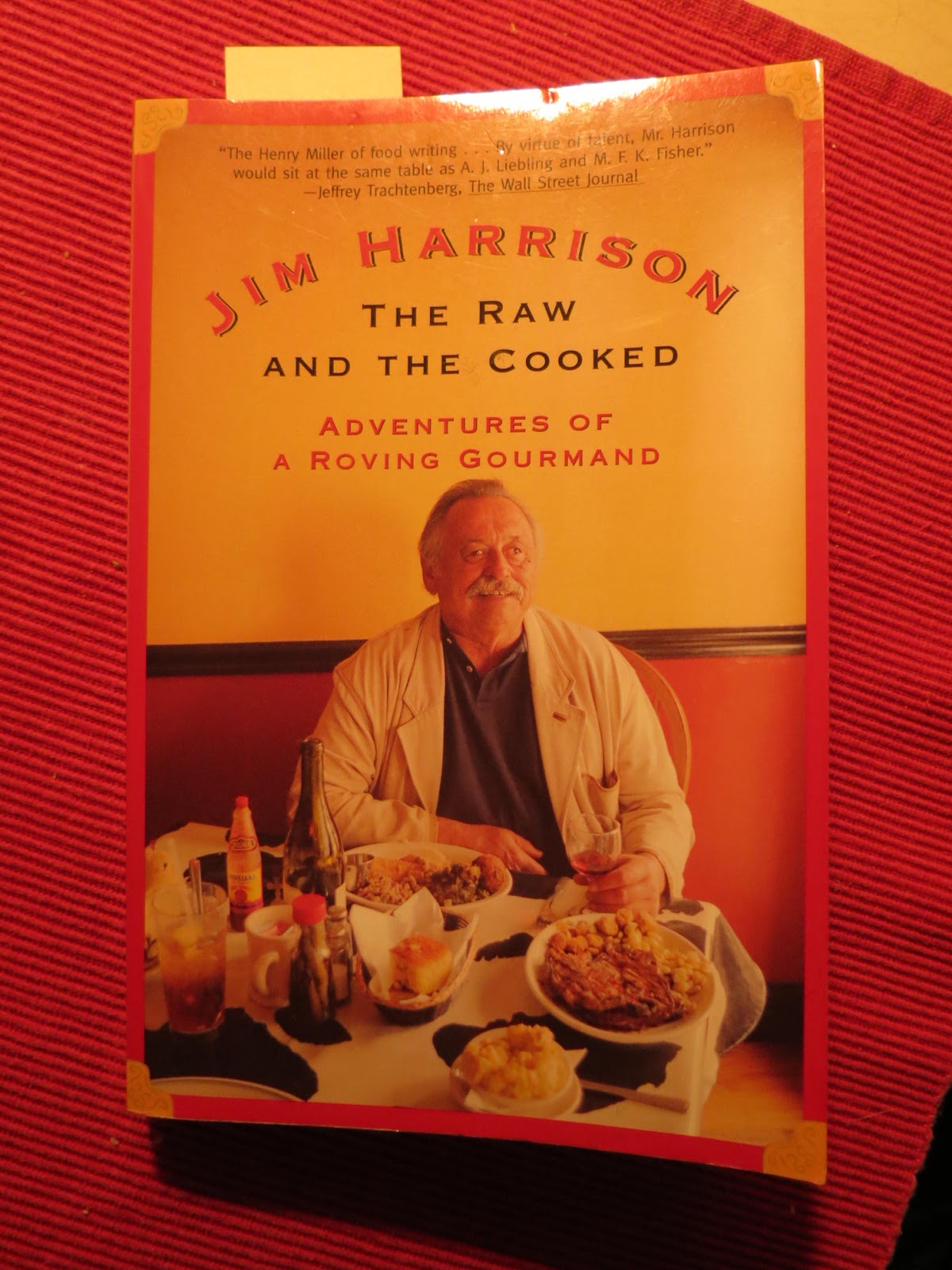
-- Serendipity has come to my rescue once again! Searching back through pages of The Raw and the Cooked, looking for the essay in which Harrison put forth the mountain/mountains dilemma, I happened on this:
The wilderness does not make you forget your normal life so much as it removes the distractions for proper remembering. -               “Just Before Dark,” 1991

It’s worth taking time to read that sentence more than once and to think about it for a while. It took me several readings to think about the part played by the difference of the urban world and the natural world in the place or places we choose to call home.

One of the most jarring things about returning to a city or town where one grew up or lived long ago – for me, Joliet, Lansing, or Cincinnati would be examples -- is the disorientation brought about by changes in the landscape. An old city hall is gone, along with the old movie theatre and bowling alley. An entire neighborhood was demolished for a freeway. One’s memories have been erased from the material world. And it’s no better out in the suburbs, where subdivisions and malls have replaced farms. What has become of one’s old landmarks? They are all gone. And so, while the city is full of ghosts from your past, many of them waft about unanchored. All these changes, along with busy traffic, distract from “proper remembering.”

True, deeply rural landscapes change, too, of course, but usually not so abruptly, and even where there is abrupt change it somehow feels different. You drive an old logging trail in the U.P. and see where forest fire swept through the year before, a fire you heard about on the news. Now you see miles of charred trees. It’s shocking, yes, but somehow it makes sense in a way that miles and miles of big new houses where you used to build tree forts with childhood playmates can never make sense.


Climbing one mountain over and over, whether for years (as Wendell Berry has done) or only for a matter of weeks (as I did on each visit to Paris or as David and I did every day we drove from our high desert ghost town to the little cow town 14 miles away), if one is living in a place and paying attention to it, brings the realization that it is never the same mountain two days in a row. You cannot step into the same river twice? Neither can you visit any natural setting more than once, because the woods, the lakeshore, mountains and desert, the playa – all are different every day. And because they are, they compel attention and at the same time leave room for “proper remembering” of one’s “normal life.” In the wild, we are able to look at our own life as another part of nature, rather than seeing it – no, feeling it -- as the center of the universe.

This post is far too long. I doubt I have held a single reader through every paragraph from the long-ago beginning to the (blessedly) now-approaching end.

I cannot see either staying forever or forever moving on as contrary and exclusive possibilities for personal growth. We can surely stay and stagnate, but it is closing down or failing to move forward, not staying, that determines stagnation. Just so, I’m sure that moving on can be either embrace of adventure or flight from self, thus growth or the inhibition of growth. Or, in both cases, I suspect (staying or moving), something in between. Periods of growth and periods of stasis. Life’s rhythms.

“Oh, the places you’ll see!” promised Dr. Seuss. We will none of us see them all. What counts, I do believe, is not flitting from one to another and vying to have the longest list but being as completely as possible in whatever place you find yourself in, at least long enough to know if it can be home for you or if you need to move on.

No one else can make the decision for you. And you yourself will make it over and over again, as long as you live.


Tuesday, March 29, 2011

The Late Great State of Michigan

Maybe this story has passed you by, but if you live in Michigan, you need to get up to speed. Folks in other states, you should also take heed, because you could be next.

Except for Rachel Maddow, most reporters have either ignored this nightmare or focused only on parts of it, such as the threat to collective bargaining, leaving basic issues untouched. Finally, however, a voice of reason from Traverse City has called the new law by its rightful name, so if you’re anywhere in northern Michigan, pick up the current copy of Northern Express and read Stephen Tuttle’s take on Michigan’s newest and possible worst law in history. Bless Steve’s heart! Tuttle gets to the heart of the matter. This is indeed, as he calls it, a coup d’état, taking power away not only from voting, taxpaying, law-abiding citizens but also from their local elected officials. Government is not a corporation, should not be run like a corporation, and should not be run by corporations, but the people of Michigan may be waking up too late on this one.

The hostile take-over didn’t happen overnight. The question is, can it be turned around? And if so, how? Our State Supreme Court has long been on the side of monied interests, and I don’t look to them to see the unconstitutionality of this law. The problem with Michigan’s Supreme Court go way beyond which party is in power, too. Partisanship and favor-owing are the problem.

If you can’t get your hands on an Express, here’s another quick overview of the story on the new Michigan law. And for those with time and interest, here’s the Michigan House bill passed February 23 that led to the new law.

(My attempts to access Public Acts 4 and 7, created by these house bills, “did not return a result.” The search engine speculates that the act may be too new to have been added into the database as yet. What do you suppose is the holdup?)

When is your local government in trouble with the state? Read Section 12 carefully, noting that only one (1) of the triggering difficulties need be present for the state to review. The diagnosis is then “probable financial stress,” and if you’re stressed, obviously someone else needs to step in. Forget elections, forget self-governance. What are the powers of the Emergency Manager? See Section 19.

So far, most of the reporting on Michigan’s new law has focused on the danger to collective bargaining rights. There’s a hell of a lot more at stake. Is it “paranoia” to be worried?

(1) “He doesn’t mean us. He means Detroit.” Law is law, friends. It doesn’t name names, and it applies across the board. No exceptions. If we wait to worry until the review lands on our doorstep, we deserve what we get.

(2) “He just wants to motivate towns and school districts to get their acts together, and if they do that they don’t need to worry.” Budget cuts at the state level will have effects at the local level. A town or school district may not be financially stressed at the moment, but—look out! The floor could drop out from under us tomorrow.

(3) “Crisis calls for crisis management.” When a crisis is over, the law will still be in place, and the governor’s budget priorities will still have a great deal to do with who the sacrificial lambs will be. Getting rid of an Emergency Financial Manager once one has been put in place may turn out to be next to impossible

(4) “He only wants what’s best for Michigan.” So you would trust to the benevolence of someone with dictatorial powers, trust that person to be “on your side”? How many people in Third World countries have tried that?

We're supposed to govern ourselves. Or is that too hard? Would we rather close our eyes and be led backwards? Just so it would be clear where to point the finger of blame?