Search This Blog

Wednesday, March 6, 2019

No Adventures, Mom?


Sarah looks and waits and hopes! Yes, Sarah is ready for another day of adventures. See her mooning at the back door, hoping for the appearance of cows! But alas, they are far away at present....


So let's do something else for a while. I will, anyway.


We've been homebound. I made a drawing (above) of an old dead mesquite by the end of the wash and added pen to the pencil a day or two later. If we were homebound more often, I would probably do more drawing, although, honestly, having the alternator on my car grow old and senile was not a decision we made. In any case, we had four days on a short leash, and so, time being too precious to waste, I got out my neglected pencils. There had been a couple of earlier attempts, one of them a quick sketch of Sarah on Valentine’s Day. Because she is our darling valentine every day of the year, after all.


Then there was an afternoon before the car got stubborn when we took our folding chairs out to Bonita Creek for a while, but as the breeze quickly cooled, our standstill came to an abrupt end. I have not gone back to finish this drawing, but at least it’s a start. The bark of the alligator juniper, like the weathered branches of old mesquite, seem actively to invite the picking-up of drawing tools. 


Back home. Three days in a row. So I thought I’d try something new, prompted by a friend’s comment on one of my blind profile sketches. Why not use that style for another purpose? Why not caricature? Faces in magazines are fodder for that mill, so here’s a cowboy caricature (with 'caricature' spelled wrong on the page -- my mind was elsewhere).


I would love to draw cows, but most of the time they refuse to hold still for even a minute.


Of course, a lot of what could be drawing time is occupied with reading — and it isn’t as if I “don’t have time,” after all. I’ve been enjoying seasonal retirement since December! But while no one has more than 24 hours a day, some of spent of necessity in sleep. And then different priorities lead us to make different decisions about how to spend our waking hours, and sometimes priorities conflict. 

Reading has always been important to me and probably always will be. I’ve already more than mention recent books I read by John McPhee and John C. Van Dyke

Another work of nonfiction absorbing me these days is Cowgirls: Women of the American West, an Oral History, by Teresa Jordan. Jordan interviewed and introduces “cowgirls” from many Western states, some of them ranching with husbands, some alone, others working rodeo — some having grown up on ranches and others who are transplants from the East. What they have in common is a love for working with animals, determined can-do attitudes, and strong attachment to their home ground. Cowgirls is a library book, so I’ll have to finish and return it soon. Meanwhile, I am living vicariously in each woman’s story Jordan has given me.

Halfway through now the Icelandic classic, Independent People, the book it was my New Year’s resolution to read this winter, I pick it up only at night, either before falling asleep or when I wake up in the middle of the night, but it’s definitely worthy to be considered a classic and has more than sustained my interest. I’m glad I finally got around to it. I found and purchased Independent People at the Friendly Bookstore in Willcox — not that I don’t have it back at my own bookstore in Northport, but I hadn’t brought that copy with me. It will be waiting for a spring customer, and I’ll be able to give a personal recommendation at last!

And then, on a recent visit to the library bookstore in Benson, I almost passed up a big paperback book on geology in the “FREE” box on the bench outside because it looked like a textbook, and most textbooks on geology seem written for someone other than me. I find them, as a rule, incredibly dry, full of unfamiliar technical terms, and telling me too much, too fast, too soon. They are not written in language meaningful to me. (Also, they are general rather than specific to a certain region, but that’s a general rather than a specific problem, even for me.) So the Artist and I went on inside, and each of us found treasures to carry home, as usual, but on the way out, I said, “Oh, all right!” and picked up Physical Geology, 6th edition, by Charles C. Plummer & McGeary,  am I glad I brought that home! 

(The only books to be regretted are the ones you consider and do not pick up. Anything you decide you don't want, one of your friends will.)

This geology book is not written for experts or even, it seems, for those aspiring to be professionals in the field but rather for the curious nongeologist eager to learn — and that is me! There are many excellent illustrations that work with the text (usually on the same page) to clarify each point the authors make. And they follow up their verbal and illustrated points with additional helpful analogies. For instance, in a discussion of general geological principles we come to “cross-cutting relationships,” and that principle is given as follows: 
The principle of cross-cutting relationships states that a disrupted pattern is older than the cause of disruption. A layer cake (the pattern) has to be baked (established) before it can be sliced (the disruption). 
Plummer, Charles C. & David McGeary, Physical Geology, 6th edition

I’ll admit that I read the first of the two sentences in the passage quoted above three times, puzzling over it. How could a result precede a cause? Then I read the second sentence, and all became clear. Of course the pattern before the disruption comes before the disruption itself. Now I get it. Maybe I shouldn’t have needed the layer cake analogy, but it made all the difference, vastly cutting short my confusion. My mind works best with analogies, and Plummer and McGeary use good ones.

They also have true scientific minds, reminding readers that even geology, an apparently rock-solid body of knowledge, generates different views among its practitioners. 
We should emphasize that the picture we have presented [of igneous processes] is not an observation but a plausible interpretation of available data. 
Even plate tectonics theory doesn't make all geologists happy. 
No single process can satisfactorily account for all igneous rocks. Several hypotheses adequately explain some igneous rocks…

The theory of plate tectonics incorporates parts of previous theories…

Not in a class, I won’t be reading Physical Geology cover to cover. My more casual approach to a book like this (as to a field guide) is to turn to a section, study the illustrations and read the captions, dig into the accompanying text — and then try to relate it to what I see all around me here in Cochise County, AZ.


We also used our Sunday at home to move all the furniture and mop and scrub the cabin floor, then taking the scrubwater out to slosh onto the back porch to mop that down (it needed it), but how exciting can I make an account of spring cleaning, satisfying as it is on a sunny, warm day? But we always keep an eye on the cows, whenever we're at home in the cabin. 


Several of them visited quite close to our back door on Monday morning, and later on it made me happy to see one cow lying in the sunshine down in the warm sand of the wash, soaking up the light and heat the same way I do — well, similar to my way: I don’t lie down in the wash. (If only it had been closer so I could have used it for a drawing subject! Finally, a cow staying in one place and one position for a while!) I rather hoped the cow would go into labor so I could call the rancher and witness a calf being born, but no such luck.

But whether it’s a nursing calf, a line of cows in a stately, single-file parade, or one old girl taking a sunbath in the wash, the cattle fascinate me, and I never get tired of watching them. In my winter world, they are a priority in and of themselves.


Thus each day passes too quickly, even days not filled with touring the countryside for miles around. And it was good for us to spend three consecutive days without driving anywhere. We would never have gotten our spring cleaning done otherwise!


Monday, March 4, 2019

Between the Eternities


After a day in the high desert, surrounded by mountain ranges wherever we go, as darkness falls once again I turn to books about desert and mountains. Far from seeking escape in my winter reading, what I desire above all is immersion.

The reds are always salmon-colored, terra-cotta, or Indian red; the greens are olive-hued, plum-colored, sage-green; the yellows are as pallid as the leaves of yellow roses. Fresh breaks in the wall of rock may show bright colors that have not yet been weather-worn…. A mountain wall may be dark red within, but it is weather-stained and lichen-covered without. Long-reaching shafts of granite that loom upward from a peak may be yellow at heart but they are silver-gray on the surface. The colors have undergone years of ‘toning down’ until they blend and run together like the faded tints of an Eastern rug.  

- John C. Van Dyke, THE DESERT: FURTHER STUDIES IN NATURAL APPEARANCES (1901)

John C. Van Dyke (1856-1932) was an American art historian and critic, and his books all have to do with art. THE DESERT is no exception. Geologic formation, factors of climate then and now, flora and fauna, and human plans for alteration of the land all find their way into THE DESERT, but it is first and foremost with an eye tuned to art that he examines effects of light and atmosphere, clouds, mirages, and every other aspect of what is to be seen in the desert and its mountains. A few of his details — over a hundred years after this book was written — are by now outdated, but in essence it remains truthful to the land, to his experience, and it wonderfully captures the ways in which such a severe landscape can penetrate and capture a human heart. I read my own experience in his, mine not of artist or art critic but only a seasonally retired bookseller and philosophe fauve, when I read sentences such as the following:
How silently, even swiftly, the days glide by out in the desert, in the waste, in the wilderness! How ‘the morning and the evening make up the day’ and the purple shadow slips in between with a midnight all stars! And how day by day the interest grows in the long overlooked commonplace things of nature! In a few weeks we are studying bushes, bowlders, stones, sand-drifts — things we never thought of looking at in any other country.
In my case those last eleven words do not apply, I think immediately, because wherever I am “bushes, bowlders, stones, sand-drifts,” along with insects, lizards, birds, mammals, tracks on the ground, clouds in the sky, running water or indications of water has run, still water, trees, habitations of human beings and other life — all this I look at and drink in hungrily. I suspect the difference for Van Dyke was one of familiarity vs. unfamiliarity, because in the West he did not find what he “knew so well when [he was] a child by a New England mill-stream.” And yet, something tells me that back in his New England boyhood he must already have been doing much more looking than overlooking, that he must have been noticing and forming impressions and making mental notes about everything he saw around him. Because being open to nature is generally a lifelong habit, and in the contrast of long-ago and recent experiences, after all, both are sharpened. 

For example --

The state bird of Illinois is the cardinal, a bird also common in Michigan, both in summer and winter. Against dense green summer foliage, the brilliant scarlet of the male cardinal commands attention, while seen on a background of winter snow, the white a blank page behind its startling color, it is no less impressive. Amid the dusty hues of a desert wash, to someone from the East or Midwest, the cardinal is more than impressive and attention-grabbing: it is downright improbable, verging on miraculous. 


Arizona’s "silver cardinal," the pyruhlloxia, unfamiliar and new to someone new to the West, is no more wonderful than the familiar cardinal, unfamiliar again in its “new” setting. Both give a lift to the heart and put a smile on the face.

Trail through new snow after April storm in Michigan

In Leelanau County, Michigan, Up North winter brings opportunities for noticing comings and goings of life that otherwise proceeds invisibly all around, as tracks in the snow tell stories. (Follow link to see more Michigan tracks. There was another, more extensive post of tracks in the woods, but I can't find it.) In spring, when the snow is gone, my dog still gets the news with her nose; I, on the other hand, dependent on vision, have the olfactory equivalent of near-blindness in grass and woods and must await dirt roads or wet shoreline sand to see what she detects on and near the ground. Here in the desert there is more bare earth, thus more signs accessible to sight. On dirt roads, in dusty washes, across the desert itself, there are more tracks and trails for me to see than back in Michigan after snowmelt, but whether here or there, looking for signs and paying attention to them is just as natural to me.


Cow tracks on road

Cow path through mesquite

Michigan
And everyone who lives near or visits Lake Michigan, the native of a lifetime or tourist of a single day, carries home stones. Desert and mountain rocks are fascinating and very different from smooth, rounded, water-polished beach stones, but to say I would “never thought of looking at” rocks or stones back home in the Midwest would be utterly false.

Michigan
Arizona

Enough, however, of this caviling. I did not set out with the intention of arguing with Mr. Van Dyke. On the contrary, I love his writing and especially love his love of nature. Was it the art criticism of his time that hailed “art for art’s sake,” rather than for conveying and imparting spiritual or political values? He does not insist on “meaning” in art, I’m guessing (not having read any of his other books), any more than he looks for it in nature, where he finds beauty “in itself."
Line and tint do not always require significance to be beautiful. There is no tale or text or testimony to be tortured out of the blue sky. It is a splendid body of color; no more.
Michigan blue

Arizona blue

Mountain blue

And there I am absolutely on the same page with this writer of over a century ago. It is not “sermons in stone” that I look for or find in mountains; nor do I find the absence of sermons something that mountains lack. In themselves, both as they are now and as they became over millenia, along with the changes they continue to undergo, mountains with no addition of sermonizing are endlessly fascinating and awe-inspiring. They are enough. No, more than enough. Monumental and overwhelming — and at the same time engaging, welcoming, beloved.

At the same time…. 

At the same time, neither Van Dyke’s prose nor his sensibility are those of our age but belong instead to the nineteenth century, a period that had closed — on the calendar, at least — only very shortly before this book appeared. While he refrains from passing judgment on nature, stylistically he is given not only to rhetorical questions and flowery exclamations, but also to the personification of nature and to teleological thinking, writing of nature’s designs and purposes, mysterious as the latter must always remain. 
Those first twenty years of our life we were allowed to sap blood and strength from our surroundings; the last twenty years of our life our surroundings are allowed to sap blood and strength from us. It is Nature’s plan and it is carried out without any feeling. With the same indifferent spirit that she planted in us an eye to see or an ear to hear, she afterward plants a microbe to breed and a cancer to eat. She in herself is both growth and decay. The virile and healthy things of the earth are hers; and so, too, are disease, dissolution, and death. The flower and the grass spring up, they fade, they wither; and Nature neither rejoices in the life nor sorrows in the death. She is neither good nor evil; she is only a great law of change that passeth understanding. The gorgeous pageantry of the earth with all its beauty, the life thereon with its hopes and fears and struggles, and we a part of the universal whole, are brought up from the dust to dance on the green in the sunlight for an hour; and then the procession that comes after us turns the sod and we creep back to Mother Earth. All, all to dust again; and no man to this day knoweth the why thereof.
Over and over he reminds us that the individual is of no concern to nature. Only in his closing pages does he finally conclude, somewhat shockingly, that nature is equally indifferent to species, and, probably, even to life on earth itself. Shocking? Surprising, certainly, and yet the conclusion is of a piece with all that came before. Nature is not benevolent, he has said all along. Nature is indifferent. So why would nature care about the survival of a planet?
Individual, type, and species, all shall pass away; and the globe itself become as desert sand blown hither and yon through space.

Van Dyke acknowledges that such a “destiny,” as he calls it, seems “harsh” to us, but he sees purpose even in the eventual destruction of our planet, as he sees it in the “waste” of the arid desert — 
…not because they develop character …, but simply because they are beautiful in themselves and good to look upon whether they be life or death.

Would I use those words? Destiny? Purpose? Destinies and purposes seem at odds with indifference, and I can’t help wondering how a mountain would remain beautiful with no one to behold it. — Of course, without senses and minds to apprehend and appreciate desert and mountains, the question of beauty would never arise. So here we are. 

Yes! Here we are, me here and you wherever you are! And aren’t we the lucky ones, though, to be alive at all, “to dance on the green in the sunlight for an hour” on our transit “from the sweetgrass to the packinghouse”? 


Saturday, March 2, 2019

What Is Little? What Is Big?

Big beautiful bird!
Our winter life in Cochise County, Arizona, is not all adventures through mountains on primitive roads, as recent posts may seem to suggest. Many days are more quietly spent — at the library, doing laundry, or staying home reading. We still enjoy mountain views (the familiar ones here in the ghost town) but in relaxed, domestic surroundings, maybe fortified by a freshly baked apricot muffin or two. And as much as I thrill to the exciting times, I find contentment in the quiet hours, too. 


Some of the little things that give me pleasure are so small it’s almost embarrassing to mention them at all. For instance, there are my brightly colored plastic measuring cups from the dollar store, a necessary addition to the winter kitchen. Their happy colors please me, as does the aroma of muffins just coming out of the oven, the first cup of morning coffee, and the moment the sun breaks over the mountain horizon and floods the little ghost town with light. Making yogurt with fresh whole milk from Jersey cows or apricot muffins with fresh duck eggs — none of it feels ordinary or boring.


Following Tuesday’s very thrilling drive as far into the Dragoon Mountains as the frequently flood road that day permitted, our expedition on the following day was more modest in nature. A drive over to Benson took us once more to the peaceful monastery south of St. David, for a picnic beside the bird sanctuary pond and a visit to the little thrift shop. We have seen the peacocks on the grounds before, but Wednesday was the first day we saw a peacock fly up into a tree — and then, using its enormous, prehistoric, dinosaur-like feet the way a monkey would use its hands, climb up higher and higher into the branches. Quite the sight!


A different peacock (I’ve mentioned before that these are not shy birds) approached, clearly begging, and as we happened to have the last few nuts and scraps of our trail mix left, the Artist boldly overcame his aviphobia to feed a peacock! Historic moment! Not small at all!

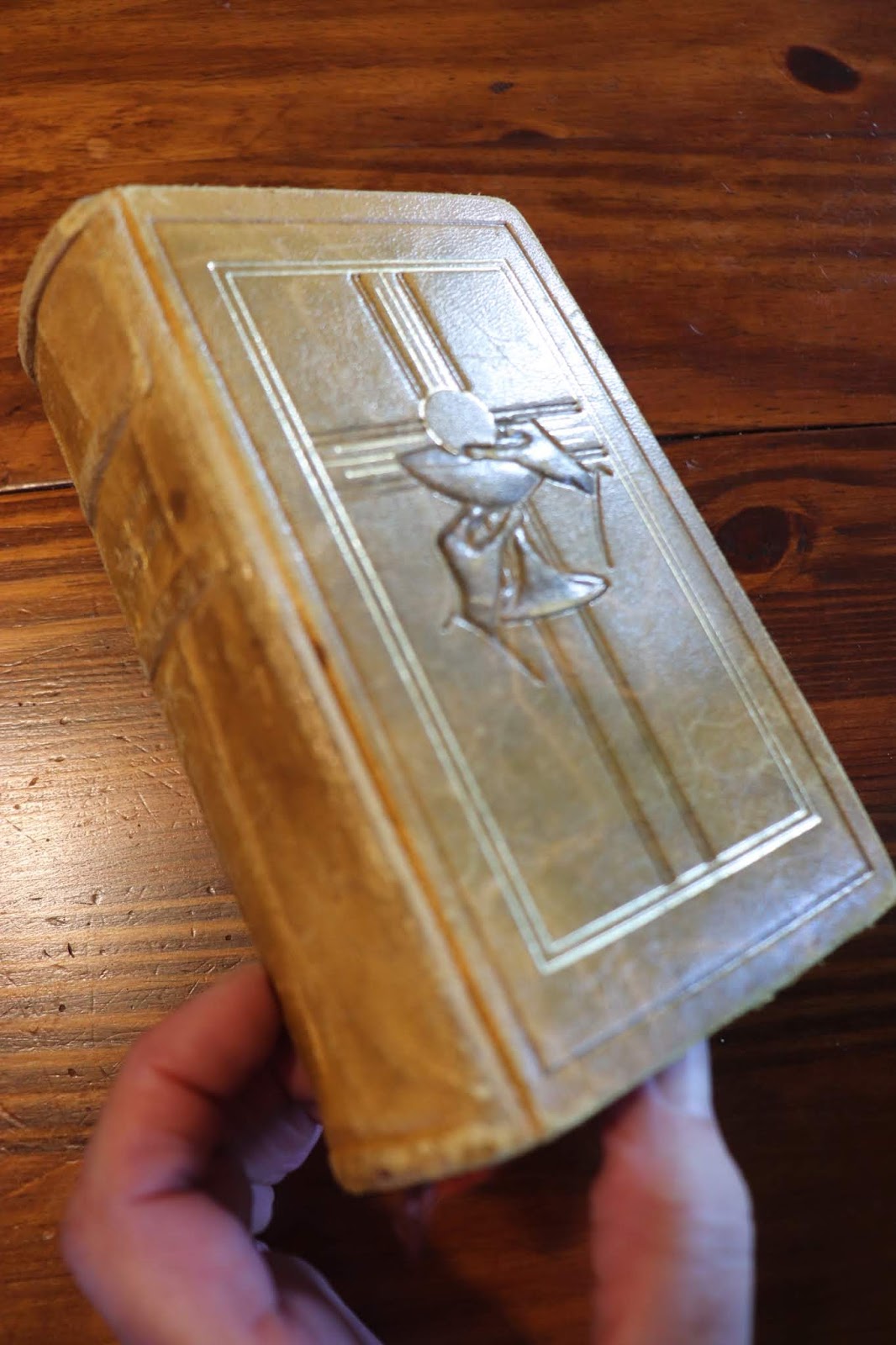
I found two little things in the thrift shop that day that added to my happiness. The first was a small but not tiny clay pot. It seems easy to find tiny clay pots or enormous clay pots, but intermediate sizes are more elusive, so I was pleased. And the other little thing was even more surprising and delightful.


Here it is. It’s a Catholic missal in French, a sweet little leatherbound volume printed in Paris, and inscribed in French by the giver, someone’s Uncle Bernard (or at least someone who was known to the recipient as Tonton Bernard), in memory of Bernard’s visit to a couple ("vous deus," but unnamed) in Arizona in 2011. Bernard himself originally received the missal for holy communion in 1953, and a small sticker inside the back cover tells us that it came from the bookstore of the widow of Charles Morin in Sarrebourg

Little clues. Tantalizing scraps of a story. Is or was Bernard himself a monk? Did he visit the monastery? Did his Arizona host couple pass away since 2011? If the answer to these questions is no, how did the missal come to be in the monastery thrift shop where I found it?


Cows, now, are not little animals. They are quite large. And yet, their presence does not loom as large on the excitement scale as does that of horses (for me) or a mountain lion (excitement I don’t need in the yard). Still, I like coming home to cows … hearing their voices nearby in the morning … meeting them on the road on my way to the mailbox. It’s a little thing, an encounter with neighborhood cows, but it always makes me smile. 

Sunny morning. Cow down the driveway. Silver cardinal on the television antenna. Even laundry day begins with reasons to smile.


Wednesday, February 27, 2019

Almost There!


…The Dragoons’ rocky mid-section was a seasonal campsite of the great warrior Cochise. His bones rest somewhere on the east side of the mountains.  

It was Cochise who endowed the Dragoons with an almost mythical quality. 
Mines, Camps, Ranches, and Characters of the Dragoon Mountains, by Lynn R. Bailey

As had been the case with our expedition to old Fort Bowie, the road to Cochise Stronghold far exceeded our expectations. We had anticipated the straight road west from 191 to end at a parking lot near a trailhead. Nothing more, but, once again, our expectations fell so far short of reality that as we made our way back to Dos Cabezas later in the afternoon we were still distracted by what we had seen, mentally reeling, and hardly able to think about anything else.

For a while, though, it looked as if the adventure would be put off for another day. Having forgotten to look at the gas gauge before reaching Sunsites, the horridly named rural subdivision on the outskirts of the ghost town of Pearce (the name it uses for its post office), we discovered that the Sunsites community has no gas station. A former gas station and convenience store back the road a piece was closed up, out of business. So, back to Willcox or on to “The Thing,” a combination food/gas/souvenir stop on I-10? I voted for “The Thing” but wanted to take Dragoon Road only as far as North Johnson Road, even knowing the latter to be unpaved. And so it was, not only unpaved but, in many stretches, washboard — not the Artist’s road surface of preference; however, we both appreciated the absence of fences and the scenery in general, and my longstanding curiosity about Johnson Road was finally appeased. So if we saved the Stronghold for another day, this day’s drive for me had still been worthwhile. But though we took I-10 back east from “The Thing,” we took the first exit south, 191 again toward Sunsites and the road to Cochise Stronghold.

… [B]ut now the air is so clear that one can see the breaks in the rocky face of the mountain range, though it is fully twenty miles away. It may be further. Who of the desert has not spent his day riding at a mountain and never even reaching its base? This is a land of illusions and thin air. The vision is so cleared at times that the truth itself is deceptive.  
- The Desert, by John C. Van Dyke


A mountain ahead is always impressive. Also, while one continues to move toward it, one also has the paradoxical impression that one will never arrive. Closer and closer, larger and more impressive, more detailed and multifaceted, the Cochise Stronghold section of the Dragoon Mountains is no exception to this experiential rule. But even this much — being still a distance from the mountains, on a more or less straight road — takes one’s breath away. All the more so, then, when pavement comes to an end, and a red dirt road stretches ahead to disappear as it turns south into rocks and trees. Full of anticipation, then, but not at all impatient, because each moment was already perfect, we advanced slowly, feasting with hearts and eyes.


And then our road turned and began to wind above a rushing mountain creek, brimming with snowmelt, with lovely trees around each curve. “I didn’t expect this!” “Neither did I!” Oaks! Manzanita! Running water!

“Winding about among the foothills, we at last struck the bed of a crooked stream, and following it back, up a moderate ascent, through a narrow pass, rock bound on either hand, we entered a gradually broadening valley in the very heart of the mountains…. 

“As we looked back on our trail, we saw that our entrance had been through a narrow canyon; at the further end, was another canyon similarly protected.”
- Captain Joseph Alton Sladen, 1872, his journal edited by Edwin R. Sweeney and published as Making Peace With Cochise 

We came to a temporarily stranded motorist, driver sitting in the driver’s seat, hood up on his old sedan. “Just givin’ ‘er a chance to dry out a bit,” he said, in response to our inquiry. “That last one was pretty deep. But my car’s older than yours. You should be okay if you keep to the right.” 


Reconnoitering on foot around the next curve, I found water, deep and wide, flowing over the road. As the other driver had explained, though, it was shallower on the downstream side, and if we kept just to the edge of the pebbles (right side of photo below) we should be able to ford safely. And so we did, and on we went, enchanted.


The next bit of water over the road was every bit as wide but did not seem as deep. More confident after one success, on we went. I should note that the Artist was at the wheel. I had been driving when we turned onto Ironwood Road, but he offered to change places so I would be free to deploy my camera more readily.


Have you ever noticed how excitement sharpens appetite? And that excitement itself is most pleasurable when taken in alternation with spells of rest? So we felt, anyway, when a parking area off the side of our road beckoned. The sign said “VEHICLES WITH HORSE TRAILERS ONLY,” but there were no horse trailers in sight that day, so we “deplaned,” as it were, long enough, first, to stagger around and exclaim at the beauty of the spot, and second, to sit on a bench and refresh ourselves with water and sandwiches and trail mix. To have horses in such surroundings! Heaven on earth! And did someone live here once? What is the story of this old stone building?


Surprisingly to us, there are bits of private property along the access road to the campground and hiking trails, and here and there a house. One perched dockside above the rushing mountain stream. Which site would be preferable, one on the mountain itself or one some little distance back with a view of the mountain? The Artist, naturally, voted for a view site. I don't know. I like the hidden-away aspect of the mountainside.


Eventually we came to a sign telling us we were within half a mile of the official campground, but soon destiny decreed that we would reach no farther that day. After four successful fords, we agreed that this last water crossing looked problematic. Not to put too fine a point on it, deeply problematic. And the mountain would be here another day, when the water across the road would be much shallower if there at all. Ten million years from now, the mountain may not be there in its present configuration, but it is there now, and we, though not here forever, are here now