Search This Blog

Wednesday, March 14, 2018

And Yet Another Place of Ghosts


[This is another one that's been "in the can" for a while. I'll have something new soon.]

Dos Cabezas and Pearce are not the only former townsites in southeast Arizona now gone sleepy. Much, much sleepier is a dusty T intersection on the back roads from Willcox, in Cochise County, to Safford in Graham County to the north. Astonishingly, there is a modern elementary school at Bonita (which I always want to call “Bonita Junction), but little else other than cows and wildlife.

Coming down from the mountains, Bonita Creek cuts across the east-west road and takes a shortcut southwest to cross the north-south road south of the intersection and school. The path of the creek is easy to follow with the eye. Like the course of the San Pedro River over on the other side of the Dragoon Mountains, the creekbed here, too, is lined with cottonwoods, and now, as they begin to come into leaf, their soft grey-green crowns winding across the land tell where water flows.


No matter how many times we pass this way, I am fascinated by the old store at Bonita, the only remaining once-commercial establishment of the former town. Other fans of the noir Western “Red Rock West” may recognize the building, but it isn’t a cameo appearance in a film that stops me to look again and again at the old store. (We first came this way before I had ever seen the Nicholas Cage movie.) The building itself, with its straight, true lines and faded paint, has a presence and obviously holds innumerable stories and secrets.

Arizona Place Names, by Will C. Barnes (and revised and enlarged by Byrd H. Granger), gives a hint of what some of Bonita’s secrets might involve. 

When Fort Grant was in its heyday Bonita was a town just outside the military reservation where the soldiers poured in every payday…. There were then about one thousand people living in Bonita….  

Payday for the soldiers occurred three times a year. Approximately one thousand soldiers descended on the town. Added to this were the girls who flocked in from Willcox. The eight or ten saloons did a rush business, as did the girls.
 

Today Bonita is a quiet and sleep spot. 

Indeed it is! Where would the “eight or ten saloons” have stood? Where were the houses for the 1,000 inhabitants, and how could over 2,000 people have made this place “roar,” as the author says they did three times a year? It truly boggles the mind.

I position my camera to shoot through the chainlink fence (keeping nosy parkers like me from getting too close to the old building) and zoom in, hoping to investigate the interior, but all I can see are reflections on the store windows of the empty land behind me. 


How long has the store at Bonita stood closed to the public? What was sold there back in Bonita’s “heyday”? In less distant years, what children made this little foot-powered merry-go-round spin?


We sigh and turn out sights toward the mountains, anticipating our climb to the pass and perhaps a stop among junipers and oaks along the way, and as we cross Bonita Creek once more, we muse about the lives of those who settled here (post office established 1884), undoubtedly attracted by the running water that still, when flowing, helps supply the town of Safford.


Sunday, March 11, 2018

Don’t Wait For Cymbals and Fireworks!

This won’t be about books or travel adventures or horses or dogs, but it’s important information for everyone. 

In the movies, you know a character is having a heart attack when he staggers and clutches his chest. If he’s standing, he falls to the floor; if seated, he slumps forward onto his desk. And I’m saying “he” because I don’t recall ever seeing a female character in a movie have a heart attack, though real women do.

My question is, how do you know when a real person is having a heart attack? The first thing you need to realize is that it might not be at all dramatic. Take a look at this list of symptoms of non-ST segment elevation heart attack:

Chest pain or a feeling of pressure in the chest.
Discomfort in the upper back or in the area between the shoulder blades.
Upper back pain.
Tingling in the hands and arms.
Shortness of breath.
Heartburn or indigestion.
Sudden cold sweats.
Unexplained sweating.
Sudden lightheadedness.
Unexplained feelings of nervousness or anxiety.
Feeling of tiredness, or not feeling well.

The symptoms in boldface are the ones my husband had for two days before we went to the ER. He blamed the altitude here in SE Arizona on the shortness of breath and tiredness, and he thought maybe had strained some muscles (chest and back) somehow, though he couldn’t think how. He never had what he called pain. But the “not feeling well” persisted, and that’s what finally sent us to the hospital. 

At the ER, blood tests showed cardiac enzymes in the blood. “You’re having a heart attack,” the doctor told him, saying also that “because you waited so long to come in,” they couldn’t do more to treat him in Willcox and he would have to be flown by helicopter to Tucson.

Everything is okay. He spent two nights in Tucson Medical Center, was stabilized, and finally released to return home, with new medications and follow-up visits scheduled with various care providers. I’m posting this so everyone who reads it will realize that a heart attack may be very subtle.

No one wants to have a heart attack, any more than anyone wants other life-threatening events or diseases, and it’s tempting to look for ways to explain away the symptoms — “I’m just tired,” “I must have sprained a muscle,” “I’m not used to this altitude,” or whatever applies in your particular case — but if you or someone you know is having these symptoms, pay attention!
“There are so many ways a heart attack can present itself, and only the classic one is stored in people’s minds.” 

That’s what one friend wrote to me in an e-mail when she got the news, and that’s when I decided I needed to share what we have learned with others. “The classic” is not the only presentation. Others are less dramatic, much more subtle. Don’t think “It can’t be a heart attack” just because there’s no sensation of being stabbed in the chest. 

Be well, stay well!


End of lecture.

Thursday, March 8, 2018

Mountain Morning, Desert Day


First morning light
[This post has been waiting "in the can" and is getting its turn today.]

Our bed is snug and warm, air in the cabin cool when morning comes, until the Artist gets up in the dark to start the propane stove to take away the chill. First signs of dawn in the east come before six o’clock, but we do not usually hurry to get up and begin our day — time enough for that when the cabin is once again a comfortable temperature. Nights, after all, are cold in the high desert: at our ghost town elevation, winter nighttime temperatures have generally been below freezing and occasionally well down into the 20s. Now, in early March, low 30s are the overnight norm, with days as warm as high 60s.


Sunrise is most often simple and uncomplicated, but it can also be as variable and colorful as sunset, depending on the morning. Whatever the sky, whether clear or streaked with clouds, the mountaintops and high slopes receive the sun before the sun has cleared what we see as the eastern horizon. Mountains are like lakes and oceans and islands. Like lakes and oceans, they never appear the same two days or even two hours in a row, and like islands seen from shore they seem to move around in the landscape, even though we, the viewers, know very well that it is our position, not theirs, that is changing as we go from place to place. 

The landscape of my ghost town can look dead and empty in winter. Where are the leaves, flowers, animals, and birds? Is there no sign of life whatsoever?


You must go out into it on foot, unhurried. Soon you hear a bird and look for it in a nearby stunted tree. It rarely works to chase after birds. The surest way to see them is to choose a spot, a shady spot if you can find one, and stand still as a statue, watching the sky and branches and ground around you. The birds soon appear. Brightest these mornings is the cardinal, a reliable visitor. More exciting to me, because we have them not in Michigan, is the pyrrhuloxia, Arizona’s “silver cardinal.” 

cardinal

pyrrhuloxia


mockingbird
Most beautiful singer, of course, is the mockingbird. Most numerous birds are sparrows, but not every dull-brownish bird is a sparrow, and morning may bring others close enough to photograph and subsequently identify with the help of good field guides. See below a cactus wren in two different settings, followed by a less-than-optimal shot of a curved-bill thrasher, identifiable not only by his bill but also by the golden eye visible between two twigs.

cactus wren

cactus wren

curved-bill thrasher

A rabbit frequently appears around the cabin in the morning, but I have not caught him or her on camera, though I keep trying. We also have yet to see other notable backyard visitors of 2015, a rock squirrel and a Western fence lizard, the latter flashing his brilliant blue throat in the sunlight. I will be watching for lizard and squirrel as winter gradually warms into spring.


Meanwhile, from the window over the sink, I see a cow and calf ambling down the dirt road behind the cabin, as nonchalant as early morning flaneurs on the Champs Elysées, leading their lives without reference to any human watcher.
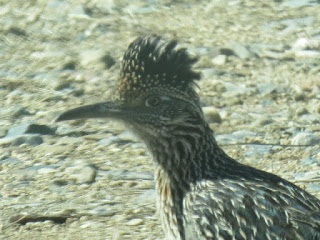


On the way to town on morning errands, we see roadrunners, sometimes as near as our own driveway. Surely the roadrunner is the drollest bird in Arizona! People must have found them amusing long before the cartoon character’s invention, the cartoon an effect rather than a cause. When a single day may bring as many as five of them to our attention, the Artist thinks I should start taking them for granted, but I cannot. Not yet. They surprise and delight me every time. Well, except for a dead one on the highway one morning. I could hardly believe my eyes, seeing a roadrunner, unlike his cartoon doppelgänger, reduced to permanent squashed immobility. I wanted him to jump up, pop back into his former, rounded, quick-footed self, and go hurrying off to new adventures.


At a certain mile marker on our road between Dos Cabezas and Willcox, I always begin looking for hawks. Wires close to utility poles are productive sites, but a tall mesquite or occasional small tree can also hold a hawk, and it’s a rare day that we don’t see at least one. I would like, eventually, to be able to tell each species from a distance, either at rest or in flight. That, however, is a long-term goal.

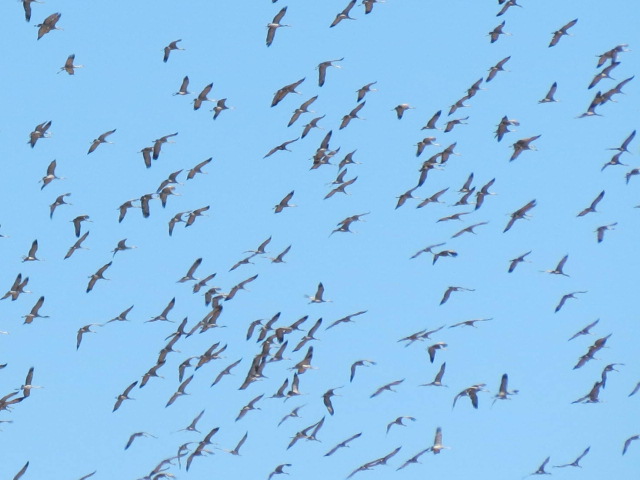
So far we have been able to watch sandhill cranes only in flight formation, high above our heads. Their voices may first alert us to their presence, and we scan the air overhead, trying to see them, but other times, long before we hear them, I spot in the distance something that looks like a faint, drifting scarf of dark smoke. No, it doesn’t move like smoke: it is, once again, a shifting, graceful, phantasmagoric cloud of cranes. 


At closer range, the flock in the sky — and often several smaller flocks gradually come together, the aggregate number gradually increasing into the hundreds or maybe thousands — has the appearance of an enormous school of ocean fish, changing direction like a single animal, wheeling and swirling and changing shape like ink dissolving in water, except that the birds do not vanish in the air. Instead we see a thousand small black marks in motion, and then, as they wheel in the sun, all at once the school flashes shining silver. I notice that long before they are low enough to be seen as individual birds, and even without hearing their voices, we know at our first distant glance that this distant aerial dance school is one of sandhills. This is because while geese or ducks are directional in their flight, clearly going somewhere, sandhill cranes seem to join together and fly for the thrill of flying and the joy of each other’s company. I'm sorry my little still snapshots fall so fall short of the experience of watching cranes in flight.


“WATCH FOR ANIMALS NEXT 21 MILES” reads a typical sign along Southwest roadways. “I do little else,” I commented to the Artist as we passed one such sign, and he laughed at the truth of my remark.  Always I am hoping to see one of the high desert’s larger mammals, perhaps the coyotes we hear at might, a herd of mule or white-tailed deer, or another family of javelina — this time when I’m ready with a camera, please! But the large animals are wary, and rightly so. One day I wanted to stop to inspect a road-killed deer to determine which species it was, but we were on a curve, with another car right behind us, and by the next morning the deer carcass was gone. A dead skunk, now — that can lie on the shoulder of the road for two weeks. And it has, too. Even scavengers are passing it by. “A dead skunk is a hard sell,” the Artist observed.

Of course, I am always scanning fenced enclosures for horses, and there are never enough horses to see and never a horse not worth closer inspection. In the least glamorous herd, there will always be at least one with a beautiful face. And now, having been reading a book on reining horses, we look at conformation with more specific points in mind. Would this horse be good at reining events? Does it exhibit the correct, symmetrical trapezoid form? Would we be able to tell?

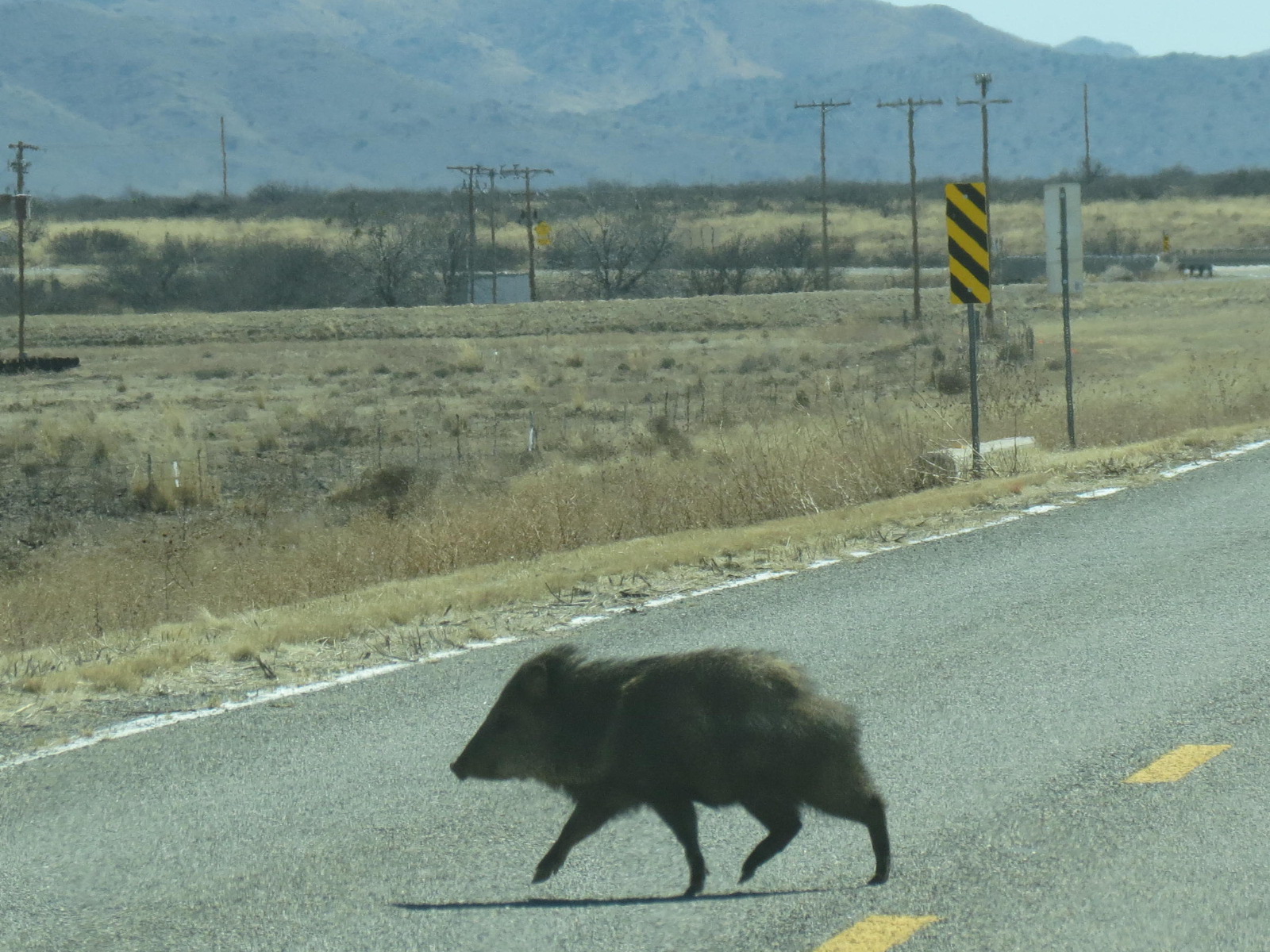
The Artist was at the wheel on the day we were once again on our way to the Stockton Pass through the Pinaleno Mountains when I spotted a javelina ahead in the road. Luckily there were no other vehicles in sight in either direction. “Slow down, slow down!” Quick, the camera! Yes! Success! My day is made!


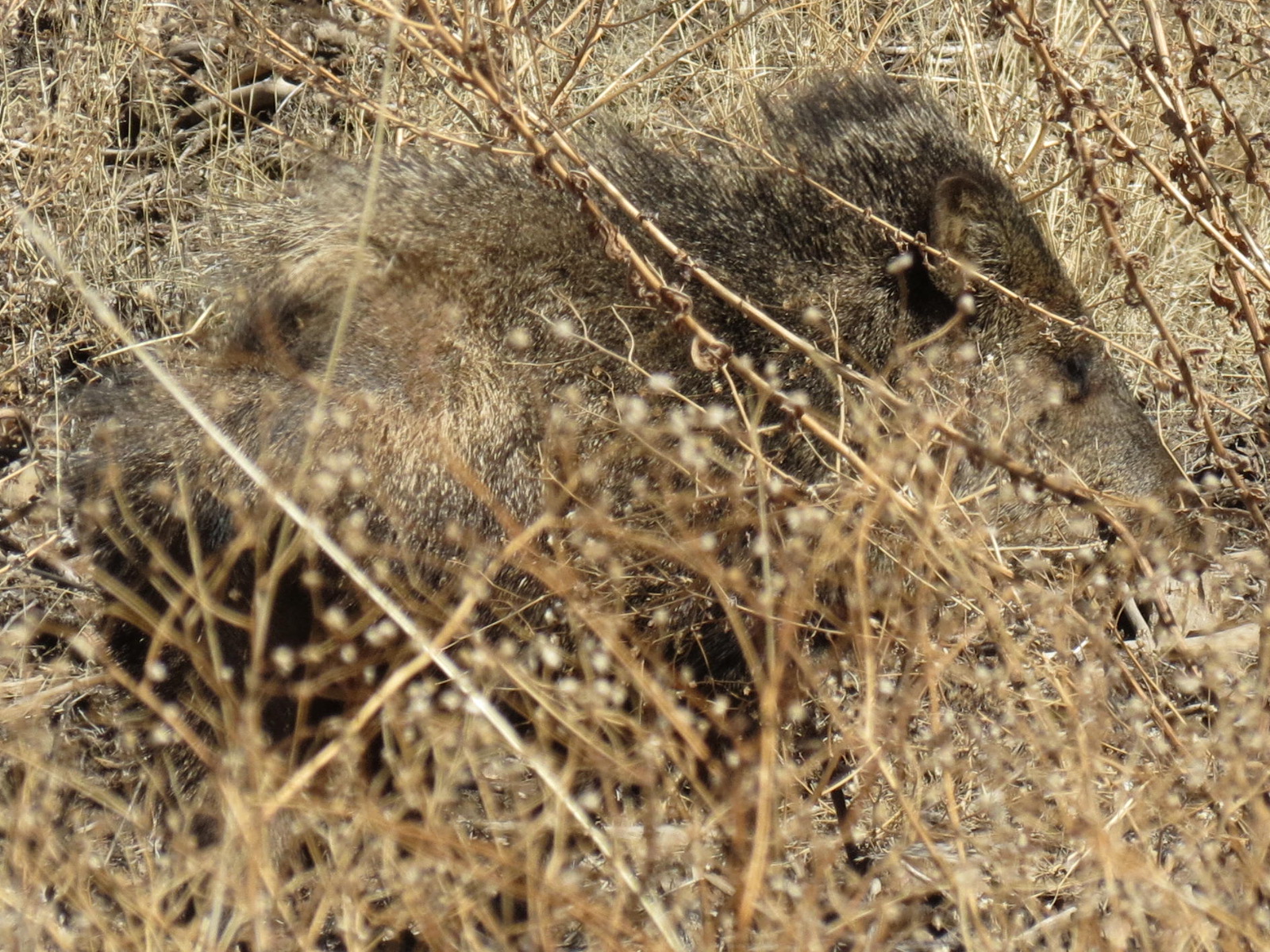
The javelina is locally called “wild pig,” or, more derisively, just “Pig!” Its Latin name is Tayassu tajacu, its proper English name collared peccary, and because it is largely nocturnal, it is more often heard at night than seen during the day. It has that in common with coyotes, though we are accustomed to coyotes around our northern Michigan home, and their sounds at night are nowhere near as nerve-wracking as that of a herd of marauding javelina. Javelina generally travel in groups, looking for trouble, as it were — breaking down fences, raiding gardens, getting into garbage, and generally annoying homeowners — and so this solitary soul near the Coronado National Forest was a mystery, but as it lost no time in hurrying across the road and down into heavy brush that camouflaged it very effectively, I wondered if perhaps its family members were not far away. Would you, driving by, have spotted the hidden javelina? I certainly would not have suspected its presence. And then one naturally wonders, how many animals are around us here all the time, in this “empty”-looking landscape, blending into the monochromatic winter scenery right before our unsuspecting eyes?


Monday, March 5, 2018

Towards a Book Review: MEETING BY ACCIDENT


Some readers of “Books in Northport” may recall my review of Julia Miler’s Books Will Speak Plain: A Handbook for Identifying and Describing Historical Bindings, published in 2010, a book as beautiful and important as its subject, thrilling to hold and read and feast upon with eyes and mind. What more could a bibliophile ask? The answer is, of course, another Julia Miller book, and we have that now with the 2018 publication of Meeting by Accident: Selected Historical Bindings, a continued exploration of the subject introduced to us in Books Will Speak Plain. 

The title of Miller’s new book is taken from Emily Dickinson —

Meeting by Accident,we hovered by design.

— and every bibliophile will understand the attraction of those lines and their meaning for the author as she explains it in her preface.

These first two lines sum up, for me, the exact experience I have had so often, finding interesting books mostly by accident and the examination and research (the hovering) that follows.

Miller’s examination and research is guided by a lifetime of expert and intimate knowledge of her subject that few possess, but all who love books have experienced serendipitous findings and subsequent, loving “hovering.”

Meeting by Accident is a book the author did not expect to write. She felt that she had done her work in Books Will Speak Plain and laid groundwork there for future researchers. That first book, though highly technical, was a general introduction to her topic, however, and Miller found herself with much more to say about specific types of historical bindings of particular interest to her. Only someone with knowledge and expertise comparable to hers could do justice to either work, and clearly I am light years away from such ability. My only “qualifications,” if I can even dignify them with the term, for daring to bring this book to your attention are my own general and deep love of books and the honor of annual visits to my northern Michigan bookshop by the author. Also, if you did not learn of Meeting by Accident from “Books in Northport,” you might not have the happy accident of encountering the book at all, and I cannot take that chance.

Meeting by Accident, at least for the non-expert, is a book best appreciated by savoring its content in brief, intense sessions — “brief,” because the amount of information on any single page can be overwhelming and takes time to absorb; “intense,” because I cannot imagine a bibliophile for whom the reading of this book, turning the lovely, smooth, acid-free pages, and dwelling on the beautifully reproduced illustrations could be otherwise than intense. My words are not to be taken as warning, however, merely as advice, which is merely to say that Meeting by Accident is a work to be studied, not skimmed. It is also, I note, written with a clarity that will reward any reader who cares enough to take time with it. 

Time, not surprisingly, is a recurring theme for Julia Miller as she studies historical bindings. She notes in her introduction that
…the book has been a sort of material storage unit through the age … [and] fragmented books have served in turn by being used to complete a less damaged or more important copy. Sometimes text material was used to line covers, or spines, or laminated boards….
My own non-expert “meeting by accident” with such an old book, parts of it built up from bits of an earlier and completely unrelated volume, opened my eyes to the mongrel history a single physical book might possess. As when one stumbles upon an old, partially obliterated two-track road deep in the woods, the non-expert inspecting a thrillingly old book is led on by questions, guesses, surmises, while a scholar such as Julia Miller is led by deep knowledge to her further informed investigations. Her researches are our good fortune. 

In Meeting by Accident, Miller pursues five specific kinds of historical bindings that she finds particularly interesting: bindings decorated by staining; canvas bindings; over covers; books for scholars; and wrapping up with a special report, co-authored with Pamela Spitzmuller, on the Nag Hammadi Codices. I will say only a bit about the chapter on overcovers, since, as a bookseller, I have daily contact and close acquaintance with their modern descendants. Miller herself notes this relationship over time: 
Our protective enclosures also echo practices of the past when we add some sort of jacket to a book that has sustained cover and/or structural damage, or simply to protect a primary (initial) cover from further wear. 
Collectors of modern first editions will recognize themselves here. “Protecting adds value,” Miller writes in a footnote, “and to a degree, restores value….”


In previous centuries, an overcover (and these took various forms described in Miller’s survey) might be an entire second binding over the first, but often the protective second covering took somewhat crude form, its purpose purely practical (that of holding together a book that would otherwise be in danger of falling apart) and its application undertaken by an owner rather than a professional bookbinder. These protective additions evidence the value placed on the objects — and probably also explain the intrigue overcovers hold for me personally.

Miller’s sixth and final chapter in Meeting by Accident is a collection of images and descriptions of models she herself has made in imitation of historical bookbinding examples. Readers experienced in the practice of bookbinding will be inspired by this chapter. Most of the author’s models illustrated are now housed in the Special Collections section of the University of Michigan library under the name The Julia Miller Collection of Bookbinding Models (JMCBM), which reminds me to note that Miller’s extensive collection of historical bindings used to illustrate Books Will Speak Plain is now also part of the UM library’s Special Collections as The Julia Miller Collection of Historical Bindings (JMCHB). 

It will surprise no bibliophile to learn that Miller has already begun a new private collection. Those of us who love books love reading, yes, and love literature, but we also love owning and handling these material objects so evocative of other human lives and work.

Obviously, I have but lightly touched the surface of the wealth presented in this new book, hardly given a complete “review,” but I hope I have said enough to indicate the treasure given us by Julia Miller’s continued scholarly work. 

Meeting by Accident: Selected Historical Bindings
by Julia Miller
Ann Arbor, MI: The Legacy Press, 2018
Hardcover, 696pp., illus., index
$125


Friday, March 2, 2018

The Expected, the Unexpected, and the Big Surprise

Snow in foreground, mountaintop hidden by cloud

Yes, today is the first of March, and we did have a full moon last night, and — still moving backward in time — yesterday was a day of snow here in southeastern Arizona, the day before a quiet one of R&R (reading and relaxing) in the ghost town, but I want to begin all the way back with Monday, because that is when we at last came to the banks of a flowing river.

The first day’s stop along the road Monday, however, was for this hawk. We look for him every day, and this time he sat still for the camera, so that I at last could identify him as a red-tailed hawk, as common in Arizona (if not more so) than it is in Michigan. On average, one red-tailed hawk can be found every four miles of highway in this part of the country. Not a rare sighting, in other words. But I don’t mind identifying common birds, especially one with as many different and perplexing color morphs as occur in this species, and I’m calling this a Fuertes’s morph until someone tells me I’ve got it wrong: light buff breast with barely visible horizontal bar markings. Lovely! On our way back later in the day, he was at a meaty afternoon meal, standing on the meal, in fact, and tearing strips of muscle upward with his short, curved beak.
This is the little bar inside. Patio seating outdoors by fountain.

We had morning coffee in town (cabin coffee comes earlier in the morning) at a charming Mexican restaurant, La Unica, where we went for my birthday lunch three years ago. La Unica features the best tortilla chips I’ve had in my entire life, made in-house and available for sale by the bag in the little store area up front, and on this last Monday of February, a big bean and cheese burro fueled me for another day of adventure.

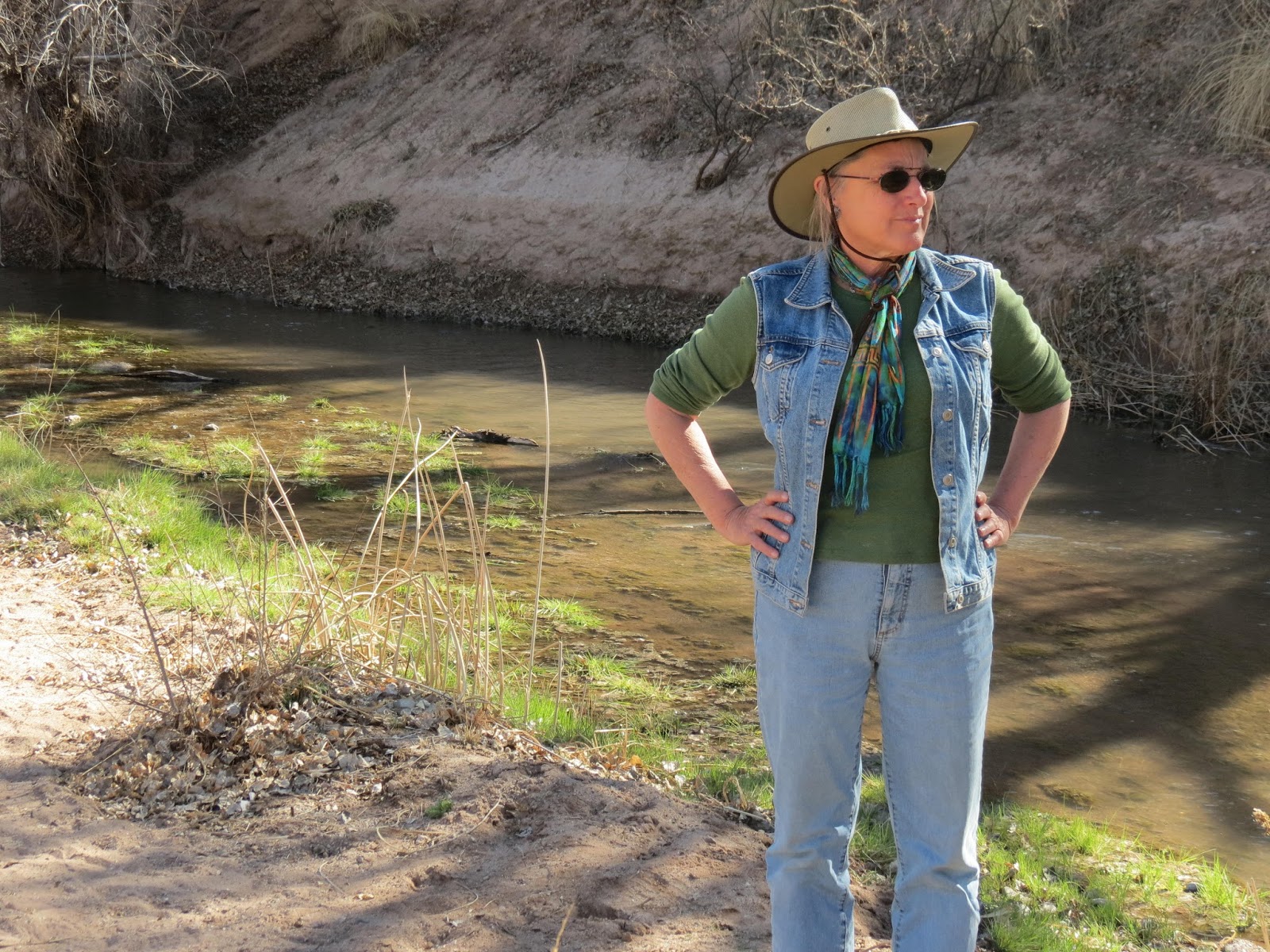
We’d been to Benson several times already this winter, where seeing what should be the Rio San Pedro as a wide, dusty, dry wash hurt my Michigan heart each time. Monday’s adventure, however, took us to a very different stretch of the river, where to our great joy we found flowing water at last. As you can see, the river between Tombstone and Sierra Vista, when in full flow, would boast two or three different streams. While most of the exposed bed was dry on Monday, one held streaming water, sparkling in the sun. Water! Life itself!
Dry side...
Water!
Sparkling!


A section of deep-cut bank shows the power the river can have and has had many times in the past, probably after summer thunderstorms, although for now its flow is gentle and quiet, with little erosionary force. There was still the mystery of the dry bed at Benson — geographically north but, I’m pretty sure, downstream, since the San Pedro is a tributary of the Gila. Is all the water being drawn off for homes and farms? A couple days later another thought came to me, as I remembered the little no-name creek by our Michigan farmhouse and how in one extremely dry summer the flowing water ducked underground for a long stretch, reappearing farther along its course. Perhaps that’s what the San Pedro is doing. I do hope so.
The Artist called me "Trail Boss" that day.


That was Monday. 

Two days later, on Wednesday, we awoke to the scene at the top of this post. Actually, we woke earlier, at first dim morning light, to heavy fog, and after a while the snow began, falling steadily and more and more steadily for a couple of hours. Our little world was completely transformed, and it was as if we had been transported to another world. 


Expecting the snow to vanish by noon, we set out for our daily Willcox errands, marveling at how different our familiar mountains looked with snow. Willcox greeted us with hail and rain, but that let up after a while, and we resolved on another drive over to Benson, this time to explore further down the river corridor. On the expressway, we encountered driving snow. Not only the Chiricahuas and Pinalenos were snow-capped on Wednesday, but the Dos Cabezas and Dragoons, also, and the snow extended far down their slopes. As it turned out, the day was so cold that those slopes remained snowy late into the afternoon, and there was still a bit of snow on the ground behind the cabin, too, when we got home again.

There were many more opportunities to employ a camera throughout the day, including our visit to a Benedictine monastery outside the town of St. David, monastery grounds guarded by a large flock of strutting peacocks — but unfortunately both camera batteries, mine and the Artist’s, ran out of power. Bad luck! We will have to go back another day. 

And then February, our first month in the ghost town, came to an end, with a full moon and clear, glowing sky promising sun the following day.