Search This Blog

Friday, March 20, 2015

More Horses and Another Book


Here we are in the parking lot of the Willcox Livestock Auction on Thursday, seeking the perfect setting to showcase my new cap, an early birthday present from my sister.

A cowgirl over by the auction pens "lent" me her horse for a couple of shots.


Then we went to the corrals where working horses were waiting their turns to be ridden, where this one immediately took my eye. 


A beauty, no? Now here's a fact about horses: many (thought not all) of them are extremely curious, so approaching a horse is often best done by not approaching it at all. Instead, let the horse come to you. This morning (day after horse photo shoot) I reached the chapter in Jane Smiley's book, A Day at the Races, called "Five Senses and More." In this wonderful chapter of a book that has transported me more than once since David and I started reading it, Smiley comes up with four pairs of personality adjectives for horses, parallel to the four pairs of personality adjectives in the Meyer-Briggs test. This beautiful horse was friendly (rather than aloof) and curious (rather than fearful), to peg him to only two of the eight possible adjective choices. 

In the photo directly below, I am facing away from the horse, seeming not to pay it any attention. 


In the next frame, note that while I have not yet turned around to look at or touch the horse, he has come over to investigate me. Can you see that soft nose touching me, smelling me? I felt it, so gently sniffing and snuffling, like little nose kisses on the back of my hand. Hence my happy smile. 


I really think we made a connection. I would have been in complete horse love in five more minutes, and I like to think that in less than half an hour the horse would have returned my love. 
For doubters and true believers both among my readers, I highly recommend the Smiley book.

P.S. If you missed the junior rodeo post, catch it here. Great little riders!!!

Monday, March 16, 2015

The Rodeo Imperative


Maybe somewhere in the West there’s someone (most likely a transplant from the Midwest) who utters the words “I wasn’t born yesterday,” but I have yet to hear our familiar Michigan phrase out here. Instead, from goofy celebrity talk show through serious political discussion to a couple of guys out on a sidewalk or standing around a pickup truck, whenever one person states the obvious or starts to give unnecessary advice or asks if the second person knows something that of course anyone around here would know, the laconic response is, invariably, “This isn’t my first rodeo.”

When we read a bare-bones announcement in the local newspaper – surprisingly, no times or schedule were given, no list of events or enticing photograph from last year – about a junior rodeo to be held March 14 and 15 out at Quail Park on the north side of Willcox, I put it on my calendar immediately.

“Don’t expect much,” David warned. The word “Junior,” to him, meant there would be no professional bull-riding, his favorite rodeo event. 

I didn’t care. “There’ll be plenty of horses,” I said confidently.

(There was to be a huge book fair in Tucson the same weekend, on the University of Arizona campus. Books in the city vs. horses in the country? I have books every day of my life! But I do have a kind of professional obligation.... Okay, a compromise: rodeo on Saturday, book fair on Sunday. My argument was that city traffic would not be as crazy on Sunday, and besides, David thought we might stay overnight near Tucson and ride up to Oracle the next day.)

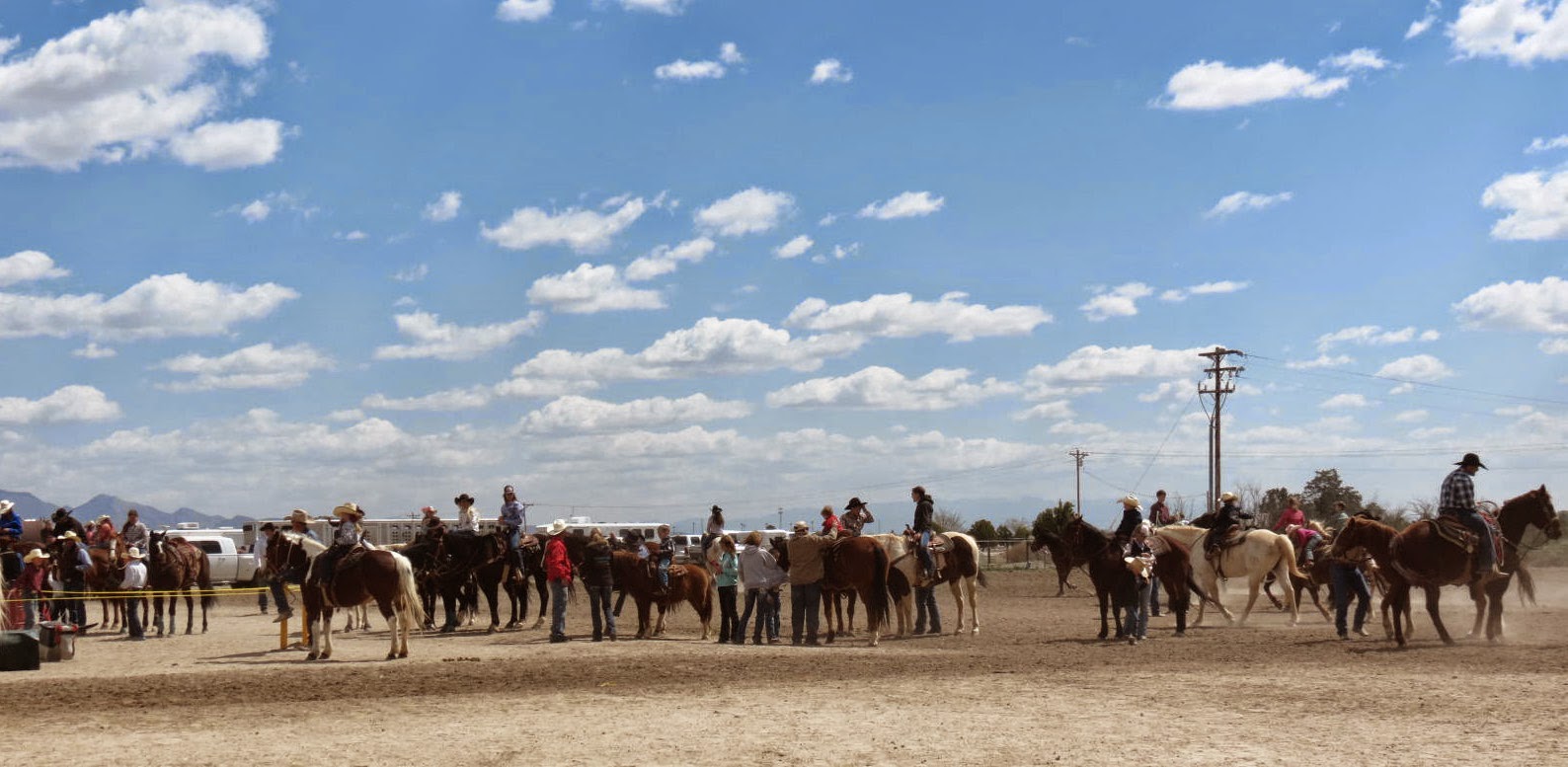
There were horses and horse trailers everywhere. Every size and color and look of horse, and every make and size and age of trailer. We were surrounded by horsiness, immersed in an equine world. Immediately, before we got out of the car, the event had already surpassed my expectations.


(Look at background: Dos Cabezas!)


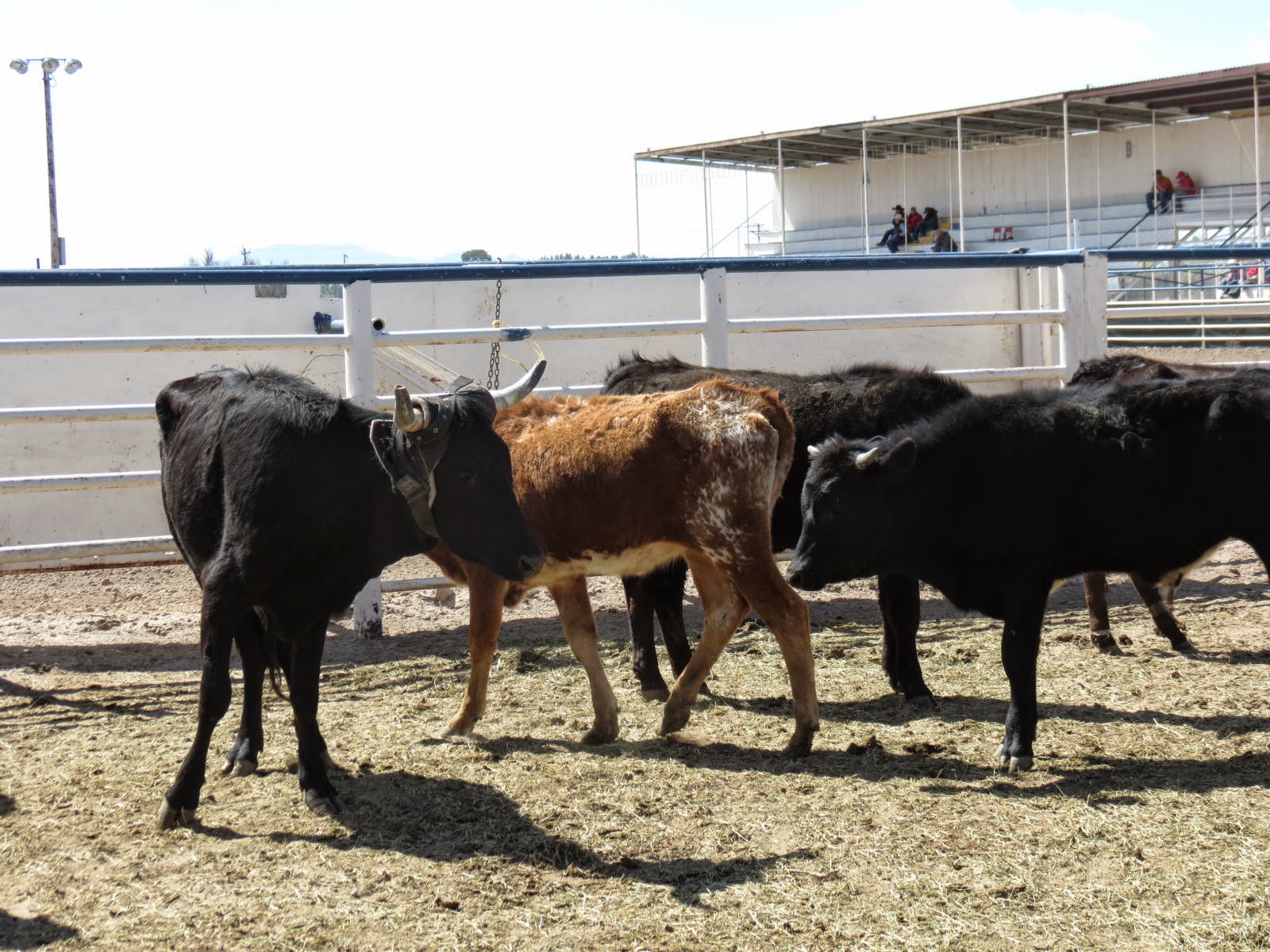
There were calves, too, ready for the roping.


There were a few dogs of appropriate cowdog appearance among the spectators, one almost as cute as Sarah. (Which one below do you think I mean?)


We arrived for the end of the “flags” event and the beginning of “poles,” the first poles competition for the “Six and under” age group, with older age groups following. I couldn’t help suspecting that for a few of the youngest competitors, this might indeed be their first rodeo.


The announcer was clear and encouraging. Here’s how she would periodically remind riders of their turns in the arena, after beginning by reading the complete lineup of competitors: “Next is So-and-So One, followed by So-and-So Two, and So-and-So Three, be thinkin’ about it.”


(Yes, there were young cowboys, too, but it was the girls who were living my girlhood dream.)

It was a very windy day -- consequently very dusty. Back behind the entrance gate, where horses stood waiting to be ridden and young cowboys and cowgirls warmed up horses for upcoming events or simply socialized on horseback, the dust was fierce, but the horsiness was intense.


We didn’t stay all day. The next morning, though, before getting on I-10 to Tucson, we stopped in again briefly for the beginning of the rodeo day. Again we were surrounded by horses, and again I heard the announcer’s voice pronouncing the names of kids I’d seen ride the day before, the same formula making the order of competition clear. “Next... followed by... and ... be thinkin’ about it.”

The rodeo imperative: “Be thinkin’ about it.” I was still thinkin’ about it halfway to Tucson.

Ride‘m, cowgirl! Live my dream!


Beautiful, beautiful, beautiful! Dare I confess that it was -- my first rodeo?!


Saturday, March 14, 2015

Dr. Seuss and Other Desert Lilies


Agave (left) & sotol
When we first arrived here, the plant life had me completely bewildered. There was almost nothing in the Southwest that I could recognize from my life in the Midwest. About the only thing I could look at and name was prickly pear cactus, but no, that’s not a lily. The lilies I’m talking about are plants consisting basically of big rosettes of leaves on the ground -- some then rising up like trees, others not; some with flower stalks, some without; some with fleshier leaves than others – all plants we sped by along the highway while I tried to make rudimentary sketches to aid memory until I could get my hands on a book.

Now, two months later, their differences seem so obvious that it’s hard to remember how clueless I was at first. What I thought were four different plants are in fact only three, and they no longer confuse me at all.

Soaptree yucca

Yucca with last year's flower stalk
Soaptree yucca is very common in the area around Dos Cabezas. It’s the one I thought was at least a couple of different plants, because the young ones are just ground height, older ones more like trees, and some that are tree-height also branch. Soaptree yucca is the one I call the Dr. Seuss plant. Doesn’t it look like one of his drawings? Like tumbleweed, like roadrunners – both frantically animated in a herky-jerky cartoon manner – soaptree yucca strikes me as very droll. Seeing it always makes me smile, and so I’m usually smiling as we roll along, because soaptree yucca is ubiquitous in Cochise County.


Yucca branched like a tree
Agave
Less common near us, but even showier, and considerably slower to grow to its climactic flowering stage, is the century plant. My friend Helen had one outside her living room in Carefree. Friend Clare over outside Benson used a dry flower stalk for a spectacular Christmas tree. Century plant is agave, grown commercially in Mexico for the production of tequila. There are a few young plants near the cabin, but will they even flower in my lifetime? It doesn’t really take a complete century (just as a centipede doesn’t really have a hundred legs), but it’s a long wait for the blossoms. Even after the flower stalk begins to emerge, years into the plant’s lifetime, it takes weeks and weeks. (Right, Helen?) And then, after it flowers and scatters its seeds, it dies.


Agave stalk
Does the agave stalk above look like a giant asparagus spear to you? Did you follow the link in the last sentence? Are you astonished? I was.

Sotol

The third plant I originally confused with soaptree yucca and century plant is the sotol (above). How could I ever have mixed them up? The shape of the sotol’s flower head, even in its dry winter form, is completely distinctive! It looks like a spear or a flame. There are lots of sotol over to the west of us, in Texas Canyon and beyond, and there’s a colony a few miles east, on the way to Chiricahua, but of the three, it’s the plant I see least often. All three, however, are frequent along the I-10 corridor.

Can you believe these plants are all members of the lily family? Lilies? Isn’t ours an amazing world?


Yucca


Sunday, March 8, 2015

Reading the Western News


No doubt it is possible to buy The New York Times in Tucson or Phoenix, but no one sells it here – and by “here” I mean Willcox, our nearest real town, not little ghost town Dos Cabezas, where there has been no store of any kind for many years. One can read the Times online at the library, but I say, why bother? “The News Hour” with Gwen Ifill gives me as much national and world news as I can handle. And besides, I’m keeping my online time to a minimum, averaging well under 30 minutes a day on the Internet, most of which time is spent downloading and reading e-mail, updating one or two of my blogs, and briefly checking Facebook to make sure I’m not missing an important message from anyone (though I’ve tried to get across to friends that e-mail is my preferred contact).

Anyway, in general, I like to be where I am. By that I mean that for me the point of being somewhere other than home is immersing myself in that different place. And so, here in southeasternmost Arizona for the winter, it is Cochise County news that really captures my attention. The big Arizona newspaper comes, of course, from Phoenix, but news of where we are is most thoroughly covered by the Arizona Range News, published in Willcox, Arizona, since 1882. The office on Haskell Avenue isn't in a fancy building, and it may look at first like there's not much happening there, but sit and watch a while, and you'll see people coming and going. And every week the paper comes out.


The Range News (like our own Leelanau Enterprise back home) is a weekly newspaper, generally two sections, and it covers news in the communities of Willcox, San Simon, Sunsites, Bowie, Cochise, and Dragoon, which is pretty much the whole Sulphur Springs Valley. There are feature news articles, obituaries, columns, editorials and letters, public announcements, and advertisements. When we first arrived in the area, I couldn’t get enough of the obituaries and loved the one about a woman who was a lifetime rancher and whose favorite activities were knitting, quilting, and “working cows.” Reading a local newspaper is a good way to begin getting acquainted with a community.

Is this week’s Range News particularly interesting, or am I just paying closer and closer attention, the longer we’re here? The following stories pulled me in:

1) Feeding the hungry: “Distribution center to help area hungry,” reads the headline of the story of a $1.2 million donation from the Howard G. Buffett Foundation for what will be called the Willcox Food Distribution Center and will serve Cochise, Graham and Greenlee Counties: The HGB Foundation, I learned from this article, advocates for those who are “food insecure,” not only in third-world countries but right here at home. Howard Buffett (son of Warren Buffett) was born in Illinois, and his foundation owns farmland in Illinois, Nebraska, and Arizona – most interestingly to me, this winter, a research farm right down the pike from us on the Kansas Settlement Road – and his foundation’s threefold mission is to improve lives worldwide through food security, water security, and conflict resolution. I am most interested to learn more about HGB projects, especially as they are being tested so close to Dos Cabezas.

2) Gould’s wild turkey: Have you ever heard of it? I had not, until now, but a long piece in the Range News informs me that a wildlife project in the nearby Pinaleño Mountains (north of Cochise County, in Graham County) has received national awards for habitat restoration and re-establishment of Gould’s wild turkey, the largest wild turkey in the U.S., and found only in southeastern Arizona, southwestern New Mexico, and Mexico. A partnership between the U.S. Forest Service and the National Wild Turkey Federation is “part of a broader effort to restore habitat for Gould’s Wild Turkeys in southeastern Arizona’s ‘Sky Islands,’ 12 mountain ranges primarily managed by the Coronado National Forest.” The article calls the birds “spectacular” and their comeback “incredible,” their population in SE Arizona now standing at an estimated 15,000 birds.


3) Copper mining: The brief boom that brought Dos Cabezos into its most populous era was based on copper, and it was copper and iron that fueled the mining industry in Michigan’s Upper Peninsula, so of course a headline reading “Opposition organizes for copper mine” would get my attention. I also know from what I’ve read of mining in the Dakotas (SD my birthplace) that modern mining leaves more than holes in the ground. The news is that Excelsior Mining, having “recently completed a drilling program” in the Dragoon area, is now preparing applications for permits “to inject sulfuric acid deep underground to release copper and pump the pregnant solution back out to retrieve the copper....” Concerns are about “the use of groundwater in an area where supplies are limited” and possible contamination of groundwater. Like fracking, this process bears close scrutiny and “faces a long period of review,” according to the paper. Present-day alchemists take note: there are plenty of metals besides gold and silver much needed by modern technology! Being able to manufacture (rather than mine) copper or a good substitute could solve a lot of world problems and make the successful inventor very, very rich!


4) Auctioneer recognized: Hooray for Paul Ramirez of Tucson, auctioneer extraordinaire of the Willcox Livestock Auction Market! At the Greater Midwest Livestock Auctioneers Championship in Motley, Minnesota, Ramirez carried off the Reserve Championship. We have seen and heard him at work and were very impressed, so we’re happy to see that he holds his own in competition. Good work!

5) Film Festival: This is the next big event coming to the Willcox Historic Theatre, the same little movie house where we were fortunate and privileged to see the Paris Opera not long ago. It’s only the second year of the festival, but it looks like great fun, with 20 regional independent films in competition. Expect to hear more of this in the near future.

6) Junior Rodeo: Expect to hear more of this, too! Admission is free for the two-day junior rodeo, with food concessions operated by the 4-H. “Don’t expect much,” David warned, and I told him, “Don’t expect to keep me away!” Will there be calf roping? Barrel racing? I can hardly wait to find out!

There was more in this week’s newspaper – a community service award for the Sulphur Springs Valley Electric Cooperative; results of the spelling bee in San Simon District; Willcox Middle School Honor Roll; a call to host an exchange student; local team sports news; the usual (but always unique and fascinating) obituaries and letters; and ads, display and classified, just one of which I’ll share. Under HELP WANTED is this notice:
TEMPORARY Open Range Livestock workers needed for Legacy Land & Livestock, Roswell, NM, from 2/15/15 – 11/15/15. Workers will be required to be “On Call 24/7,” perform a variety of duties related to the production of cattle and sheep; feed and water livestock; herd livestock to pasture for grazing and into corrals and stalls; distribute feed to animals; assist with calving, lambing and shearing....
Well, I can’t go on. Yes, there is castration and branding and spraying with insecticide involved, as well as cleaning stalls and pens (not as bad as castration and insecticide and branding). Oh, no, I can’t stop yet. How about this?
Must be able to find and maintain bearings to grazing areas. [Check!] Must be willing and able to occasionally live and work independently or in small groups of workers in isolated areas for extended periods of time. [Check!] Worker must be able to lift and carry items weighing up to 100 pounds. ...
Uh, okay, that’s enough. Hard outdoor work. Much as I love to work outdoors, sadly I think I’m past my cowgirlin’ prime.


Monday, March 2, 2015

Being Here Is More Than a Vacation


Earlier this winter, when I announced here in “Books on Northport” that David and I would be taking a sabbatical, one of my readers (and you know who you are, BB!) asked about the difference between a vacation and a sabbatical. Actually, before he raised the issue he’d done a little homework and looked up a definition of sabbatical. Basically, a sabbatical involves some kind of professional creative work and time to “recharge the batteries,” often in a setting away from home. The away-from-setting may be chosen for its research possibilities, but that’s not always a necessary consideration.

But wait – isn’t an ordinary vacation supposed to “recharge the batteries,” too?

In the academic world, faculty members long for time to do what each calls “my own work.” Teaching, of course, is the primary job of most college and university professors, but they are also expected to (and usually want very much to) produce their original work – scientific research, creative writing, works of art, inventions, or whatever – and that can be hard to do simultaneously with the demands of preparing classes, teaching, grading, and advising students. Hence the sabbatical.


In our regular Michigan lives, I have a bookstore, which in summer is open seven days a week. The schedule isn’t quite as rigorous the rest of the year, but business is still a constant presence in my head, the first thing there when I wake up each morning.

David is not quite so tied to his gallery -- since the bookstore is right next door, he can come and go more freely, knowing I’ll keep an eye on things -- but he, too, although he produces more painting in his gallery than I get writing done in my bookstore, feels the pressure of business concerns on a daily basis. And naturally our days off are consumed with personal, household, and business errands.

Four years ago, down in Aripeka, Florida, I wrote ten short stories, and David made between 20 and 30 new paintings. It was an extremely productive winter for both of us. But that was four years ago, and while he has been productive since then, I have felt stagnant. So when the opportunity came along to rent this little cabin in southeast Arizona, even before we left Michigan my mind started recharging! I began a novel. I looked back at an unfinished short story. And then we started driving across the country....

my corner

Now here we are. I have finished the short story, and I written eleven chapters of the novel. It feels good.


David is having second thoughts about writing he’d planned to do and isn’t pushing himself to write, but that’s all right. He bought some new brushes and has the beginning of some new work underway, both drawing and painting. I’ve not been as diligent at my drawing as I’d anticipated but am not pushing myself in that direction. Getting as much writing done as I have been is the main thing; for me, drawing is meditation, not “my own work.”

The vastness of the Western landscape had us both overwhelmed for the first few weeks. It is so BIG! The effect gained by being here depends on being surrounded by the desert and mountains. But just being here, driving around and looking, sitting and looking, soaking it in, looking, looking, looking – all that is energizing, all of it refilling the wells of creativity.

It’s that kind of recharging, I realize – not electric, as with an engine or batteries, but more profound, as with an aquifer.


We’re reading a lot. David was thoroughly absorbed in Huffington’s biography of Picasso and read every word of it hungrily. He and I both read a fabulous book on coyotes and are now sharing a book on horses and racing by Jane Smiley. If you want to know what else I’ve read since our arrival, just look over at my “Books Read 2015” list, but my point is this: We read and discuss; we look at everything and talk about what we see; we pay a lot of attention to cloud formations, as if we are children again, lying on our backs in the summer grass. My short story was set in Scotland, and my novel is set in Michigan. Some of David’s drawing is figurative, nothing to do with landscape at all. That doesn’t matter. We’re working, and it feels good.

MANY books added since this photo taken!
Having a home base is important. During the day we are free to go out exploring, and then we come home to the cabin every night -- nesting, building our sabbatical libraries, and organizing and reorganizing our work spaces, secure in the knowledge that we have weeks in which to spread out and concentrate on work that is very personal to us and involves no one other than ourselves. 

Not everyone has the luxury of taking months away from work. I realize that. At the same time, since neither of us has a regular job or a position with benefits, we cannot look forward to ordinary retirement, either. Instead of the retirement other people have, we have this -- unpaid sabbatical time we have arranged to give ourselves and each other.

I wouldn’t have it any other way.