Search This Blog

Showing posts with label lies. Show all posts

Thursday, October 23, 2025

Turn, Turn, Turn

Not AI-generated! Completely unedited!


Peak Autumn Color


People kept asking if the turning fall leaves had reached peak color, and I kept saying, day after day, no, not quite yet. There was still a lot of green left. Late Saturday afternoon’s sunshine, though, invited me for a little drive after work, and Sunday’s rain, because it put the kibosh on dog park fun, tempted me farther afield in the car. You can see more of those Saturday and Sunday scenes on my photo blog, and take a look at the Lake Leelanau Narrows on Wednesday morning, while you’re there.


When did we turn the color corner? In Leelanau Township, I’d say it was overnight from Sunday to Monday. Monday! What a perfect fall day! On Tuesday came the rain and wind. Black walnuts thumped and clattered to ground, windblown leaves tossed restlessly, yellow popples shimmered and gleamed.


My stepdaughter (Artist’s oldest child) and her husband came up on Monday, and Tuesday evening we went to the Happy Hour for dinner. I kept saying that Tuesday felt like Saturday and asking why. “Because we’re here,” she said, “so it feels like a weekend.” Also, we agreed, because it just seems that peak color should land on a weekend for all those travelers and visitors hoping to catch it.


Re-reading


At least a couple times a month I pull an old favorite book off the shelf. As October races past, after having read for the first time Le premier homme, by Albert Camus, and Medicine Walk, by Richard Waganese, I turned once more to Elliot Paul’s The Last Time I Saw Paris, the closeup portrait of a Parisian neighborhood and its denizens and how they are storm-tossed by events in the larger world.


The years Paul lived in Paris were the fraught years between the two world wars when the wounds of France and Germany were still festering, both between the two countries and within their borders. My many readings of this book have made almost personal to me the anguish of that time, as the author shows growing tensions of people living on one small street of shops and residences in central Paris, but with every reading, also, something jumps out at me that hadn’t jumped out before. Elliot Paul’s portrayal of his years in France does not spare the corruption or “backwardness” of French politics or society, but he is also put to the test to explain his own country to the French, and never more so than when Sacco and Vanzetti are put to death, news that set off demonstrations across Paris by workers sympathetic to the condemned. 


It was no new thing to the French to have undesirables railroaded and executed on one flimsy pretext or another. But, somehow, they had hoped it was different in America, and so, in my innocence, had I.


-      Elliot Paul, The Last Time I Saw Paris (1942)


His neighbors, Paul reports, were kind to him on the sad occasion and did not hold him accountable for what they saw as his country’s miscarriage of justice.


Nicola Sacco, a shoemaker, age 32, and Bartolomeo Vanzetti, a fish peddler, age 29, were immigrants from Italy and avowed anarchists. That much is fact. In 1921 they were tried and convicted of armed robbery and murder, numerous requests for appeal were refused, and they were put to death by electrocution on August 23, 1927, continuing to insist on their innocence.


Were Sacco and Vanzetti guilty? The court said they were. Some believed Sacco was guilty, Vanzetti innocent. In 1925, another prisoner in the same prison as Sacco, Celestino Madeiros, member of the Morelli gang of robbers, claimed in writing that it was he, not Sacco, who was guilty of the armed robbery and murder of the two payroll guards, and in 1927 Felix Frankfurter, later to become a Supreme Court justice, wrote that “every reasonable probability” pointed  to the Morelli gang and away from Sacco and Vanzetti. History, while not taking a definite stand on guilt or innocence, agrees that the defendants did not receive a fair trial, that they were condemned for their beliefs and their status as immigrants rather than for anything they had done or not done.


Another Four-Letter English Word


To HATE: to dislike intensely, passionately; to feel aversion or hostility toward. 


Most of us growing up in the U.S. in my generation were told as children that hating is wrong. We were even told often that we were mistaken about our own feeling. “You don’t hate your baby sister,” a parent would say patiently, if we were lucky. No, we were jealous, worried that the baby would take all our parents’ attention, etc. That wasn't hate. Later, did another child at school hate me? Or was that child jealous (for some reason) or even, if a member of the opposite sex, attracted but confused?


In the Christian Gospel of Matthew, Jesus counsels against hate and sets a high bar for those claiming to follow a God of love: 


You have heard that it was said, ‘Love your neighbor’ and hate your enemy.’ But I tell you, love your enemies and pray for those who persecute you, that you may be children of your Father in heaven.


Last Saturday across the United States of America protestors demonstrated against the current administration in joyful, high-spirited pro-democracy rallies. The president and his Cabinet members insisted ahead of time and continued, in the face of all evidence to the contrary, to claim that these were “hate America” rallies, peopled by Marxists and other extremists, including “Antifa” (which the president thinks is an organization). It was also claimed, entirely without evidence—because it was a false claim—that George Soros and other “leftist billionaires” had funded the demonstrations, paying people to attend.


HA! They would like that to be true, but it is not.


I know those demonstrators, not only in Traverse City, but in Grand Rapids, Kalamazoo, Marquette, Chicago, Joliet, Seattle, New York, Washington, D.C., and elsewhere. They were my friends and neighbors. They were my bookstore customers. They were my family. They carried hand-made signs. And yes, some of them made negative observations on the president, because “No Kings” was the theme of the day, everyone having decided ahead of time not to fragment the message with a variety of issues, because the bottom line is we do not want anyone in power running roughshod over freedoms guaranteed us in the U.S. Constitution.


Demonstrators were out on Saturday because they love this country! There were many American flags. The protests were peaceful. Counter-protestors were safe, too.


Republicans (I do not call them “conservatives” because they are not) who decry “hate” coming from the president’s opposition would be well advised to look to the president himself. “I hate my opponent! And I don’t want the best for them!” Words from the president of the United States. As for his king-in-the-plane social media cartoon, enough has been said about that. The image spoke for itself. 


Hate pours down from the top, coming from the same source since the campaign of 2016. It takes a lot of resolve not to respond to his words and actions with reciprocal hate but with determination and hope and resolve for a better future. Because there is, too, the image of the East Wing of the White House under demolition, after the president’s earlier assurances that the structural integrity of the building would be preserved. Now, it turns out, he never thought “much” of the building. It was “very small,” he says, way too small. Not the first time he’s promised one thing and done the opposite. All presidents have made changes, you say? Redecorating and even remodeling are not demolition. The demolition image is a metaphor, a friend said. Sadly, yes.


I attended Saturday’s rallies all over the country in spirit. In my bookstore, my colors were on display for everyone to see. 


Hostility, aversion, passionate dislike? Yes, I feel it. What do I hate? 


I hate the militarization of American cities, the setting aside of due process, the attempts to gag the free press and allow only government propaganda as “news.” I hate the storm trooper actions, under orders from the administration, that tear men, women, and children out of their beds and zip-tie them for hours before deciding that some of them have done nothing wrong and can be allowed to return to their ransacked apartments. 


I hate the lies. 


I hate the desecration of the White House, the attempted destruction of unions, and the executive demolition of long-established social safety nets and environmental protections. I hate the killing, by my country and therefore in my name, of unknown people from other countries in open waters with no evidence presented against them and no trial to determine guilt of any kind. I hate having my own government violating the First Amendment here at home.


I hate the lies. 


I hate the way Americans have been encouraged by a would-be dictator (“Vote for me, and you’ll never have to vote again”) to turn against each other and see their own neighbors and family members as enemies.


I hate the lies.


He would never have been put in the White House if he had told the truth all along. No one can support the current administration and the rule of law. To support one demands opposing the other. 


Did you mark your calendar yet?


The date is November 12. It’s a Wednesday. The time is 4 p.m., so it won’t interfere with any evening meetings or keep anyone away from dinner or up too late at night. We will have a special guest speaker, with a new book, in the gallery next to Dog Ears Books. I’ll tell you all about it when November arrives.... 


But first, Halloween!


A couple of young moms in Northport have been going around town to get those of us in the central part of the village on board for trick-or-treating. I’m on board. Whether or not I’ll be in costume is an open question, but I’ll be there at the bookstore door from 4:30 to 7:30 p.m. on Friday, October 31, and I hope Halloween 2025 will be as much fun as past Halloweens on Nagonaba Street years ago. Here are some trick-or-treaters from 2004. Yes, 21 years ago in Northport!


Wednesday, January 20, 2021

“Where Do You Get Your Ideas?”


It’s a question that can freeze the heart of a creative person, but specific questions can get worse. To the writer of a novel about a dysfunctional family: “Were your parents really that crazy?” To the painter of landscapes that blend reality and dream: “Where were you standing when you painted that?” (Or, “Is that painted from a photograph?”) I’m sure sculptors and poets and clothing designers could easily give the typical question that they are asked over and over, but I’m also sure that all creative people must be asked the general question, “Where do you get your ideas?” 


Whether an answer is given graciously or irritably or not at all – whether the artist questioned knows where his or her ideas come from or not! – will vary. As a sometime writer of occasional poetry (almost all unpublished), fiction (all unpublished), and nonfiction (some traditionally published, much self-published here), I can only say that for me ideas come, unbidden, in strange, wondrous, and puzzling forms. A stranger glimpsed one day may be a character in my mind when I wake the next morning, or an unforgettable image germinates after weeks or years as the core of a situation. Sometimes the seed is neither character nor image but simply a phrase that won’t leave my thoughts. Jot it down on a paper napkin and carry it around, and maybe it will generate further phrases – and maybe it won’t;


I do not give myself as an example because I am some kind of great writer to be worshipped and studied! It’s just that my own process is the only one I know intimately. Other writers have told their stories in their own books and interviews, but probably none of them can tell the whole story, any more than I can. There is a lot of mystery to it. 


What turns an idea into a work is the more important question and much easier to answer. As a writer, you sit your butt down in a chair and see where sentences on paper or a screen take you. A painter or sculptor or dress designer gets to work with her or his given tools. Work never gets dreamed into being. That’s why it’s called work. It has to be done.


***


Other kinds of ideas and beliefs motivate life choices we make every day. We are not cameras or digital recorders making copies of the world beyond our own skins. Our senses do not simply send copies to our brains to be filed. All our prior personal experience, however limited (and there is no one on earth whose experience is unlimited), comes into play, interpreting what we see and hear and read. I remember sitting in the same room years ago with my then-brother-in-law as we watched a political debate, televised live. Same screen, same faces, same words presented to us both. I actually felt sorry for one of the debaters, who seemed to my mind to make a pitiful showing, but at the end my brother-in-law turned to me and said, “Well, he [the one I felt sorry for] really came out on top, didn’t he?” It was as if we had been in two different rooms, watching two completely different events. 


Even on-the-scene eyewitnesses can “see” what isn’t there or miss what is, as many experiments have shown. We see for the most part what we expect to see. We also see what we look for. That’s the bad news. The good news is that we can become aware of our prejudices – pre-judgments – and work to develop more accurate perceptions.


***


Originally I thought that this post on creative work and perception/misperception involved a leap from one idea (creating) to another (perceiving), but I see now – and there is an example of what we can learn for and from ourselves when we start working, which in this case for me is writing – that both come from the same place: being open to the world. Being open to seeing something new.


Today is Inauguration Day, and while I would like to feel celebratory, my feelings can better be described as a mix of anxiety and weariness. Don’t get me wrong: I voted for Biden and Harris and am grateful for a change of course in Washington, D.C. My anxiety comes from the events of January 6, my weariness from conversations with those who see a different America from the one I see. --Which leads me to the questions I was asking people yesterday, questions that I hoped would give me some clarity on their perceptions and opinions (so different from my own), questions that gave me the idea for today’s topic on Books in Northport. The questions did kickstart this blog post, but I gained no clarity on views held by those who disagree with me.


Where do you get your news? Over and over for months I have been hearing and reading jeers of “Fake news!” Some monolith identified as “mainstream media” is accused of spreading lies. What I have tried to ask in the past two days is, What news sources do you distrust, and, more to the point, what sources do you trust? Because the people who disagree with me – so vehemently! – are getting their beliefs in reality from somewhere, and if I knew where, if I could look in that direction, maybe it would help me understand why our perspectives are so completely far apart that even a Venn diagram of them hardly yields common ground. But there must be some common ground, and we sure as hell need to find it if we’re going to reunite this country! 


Here is one important truth I have managed to uncover recently. It is that across the divide we opponents have many shared values. We don’t share all values, by a long shot, but we share many of the most basic, and that is not trivial. We disagree in many places on translating values into action. Well, ‘twas ever thus, and that’s what makes politics. The much, much larger and deeper and more intransigeant problem is that we disagree on facts, on truth.


And that brings me back to my question: Where do you get your news? What sources do you trust?


I wish I could report that I received even one concrete answer to that question, but I did not. I was told from more than one person that s/he relied on multiple unnamed sources. “Then I turn it off.” (What do you turn off?) Or, “Honestly, I don’t know what to believe.” Yet the people who "don't know what to believe" have beliefs. Where do they come from?


Over seventy percent of Republicans still believe that Donald Trump won the 2020 election! Where did this come from, and why do they believe it? 


County clerks around the country, many of them Republicans, scrupulously distributed ballots and counted votes. State governors, both Democrat and Republican, certified election results from their states. There were recountsCourts upheld the results and dismissed lawsuits claiming fraud as baseless. “Mainstream media” did not invent these results. The election results come from all across grassroots America.


“People have concerns about the legitimacy of the election,” we have heard over and over. Yet all of those concerns, wherever they have been voiced, wherever they have been reported, can be traced to one source, one man: the outgoing president. What must be so painful and difficult for his supporters to acknowledge is that the person to whom they gave their vote and pledged their faith is lying to them. The “concerns” about election fraud come from the same man who started the rumor that Barack Obama was not born in the United States, the man who flogged that falsehood for months and then, finally, after making as much political hay from it as possible, took credit for revealing it as falsehood, as if that made him some kind of saint.


I went to my township office and picked up my absentee ballot in person from the township clerk and delivered it back in person. She is someone whose integrity I trust. For me, it really comes down to that. Nor rumors or conspiracies or “alternate facts” or one corporate news source over another but trust


I can understand feeling disappointed in election results. (I have felt that more than once in my life.) What I cannot understand is taking the word of a compulsive serial liar and his enablers over people whose business is truth. And while I can forgive the misled, I find it hard to forgive the misleaders, who have taken cruel advantage of many good hearts and set brother against brother, neighbor against neighbor, parent against child, for nothing but an illusion.


Postscript 1/21/2021: So many dates long awaited have come and gone without banishing my nightmares, but last night at last I slept well and awakened today calm and hopeful. We listened to the inauguration on the radio, and I found it dignified, sincere, meaningful, and moving. There will be so much work yet to do -- and so many Americans yet to convince that the sky has not fallen -- but I find my heart renewed for tasks ahead.

Saturday, March 30, 2019

You Probably Think He Was On YOUR Side, Don't You?


It will never be possible to get a completely accurate and unbiased account of the Barcelona fighting, because the necessary records do not exist. Future historians will have nothing to go upon except a mass of accusations and party propaganda. I myself have little data beyond what I saw with my own eyes and what I have learned from other eye-witnesses whom I believe to be reliable . . .  

This kind of thing is frightening to me, because it often gives me the feeling that the very concept of objective truth is fading out of the world. After all, the chances are that those lies, or at any rate similar lies, will pass into history . . . The implied objective of this line of thought is a nightmare world in which the Leader, or some ruling clique, controls not only the future but the past. If the Leader says of such and such, “It never happened” — well, it never happened. If he says that two and two are five — well, two and two are five.
 
George Orwell, Homage to Catalonia, quoted in Why Orwell Matters, by Christopher Hitchens
Christopher Hitchens says of Orwell’s Homage to Catalonia that it remained “an obscure collector’s item of a book throughout Orwell’s lifetime.” Not, in other words, a bestseller or anywhere close. Why would this be so? The answer given by Hitchens, one that makes complete sense to me, is that both the official and the popular views of the war in Spain relied on what I call a “two sides” formula. You know, the way we are told and so often tell each other that it’s so important to hear both sides of any issue or story? As if there are only two versions, the two clearly distinct from each other? That’s certainly the way the war in Spain was framed — as a conflict between conservatives (Catholic Nationalists, they called themselves; others called them Fascists) and communists (although some were grassroots socialists and others Stalin’s forces). Given the frame, which side any particular person saw as good and which as bad depended on that person’s ideological commitments rather than on more complicated facts, let alone whole truth. 

One must close one’s eyes to the virtues of one’s opposition in order to construct an inhuman enemy. 

Orwell was on the ground in Spain, an active fighter on the Left but also a man who saw clearly, first-hand, the way the anti-fascist revolution was betrayed by Stalin’s ruthless subversion of forces fighting for Catalonian independence. What were his options when he realized what was really going on? Stay with a local, independent Left and be tortured, even murdered by Stalinists for not being a loyal Communist? That happened to others he knew. Go with the Stalinists, the internationally recognized Communists, and betray the revolution or switch sides and become a Fascist? Neither of those would have been Eric Arthur Blair, a.k.a. George Orwell.

He chose to escape and tell the story, but it fell on deaf ears. The world had chosen sides, each one saying, “With us or against us!” Thus, one could only be seen — by the “other side” — as Fascist or Communist.

Sound familiar? 

Here’s an irony for you: not only did Orwell back then have those on both the Left and Right who hated him — he also has admirers on both sides today. Today’s liberals are sure he was warning against the dangers of fascism, now imminent, while today’s conservatives say he warned against socialism, their especial bugaboo. Everyone wants to think Orwell was singing their song. Hitchens takes a chapter each show that both groups are wrong and can only turn Orwell into their saint by cherry-picking their quotes, but that’s all more than I am going to try to summarize here. You’ll have to read Why Orwell Matters for yourself— and then go back and read Animal Farm and 1984 again. One thing is certain: Orwell was warning the world about future dystopian possibilities.

One of several things that frustrates me about debate, in general (consequently, also about the adversarial American justice system), is the usually unquestioned assumption that there are always and only two sides to a question and that one one of them — and only one — is true, thus the other false. From the assumption, it follows that positions taken must possess the form of affirmation/negation: I’m right, you’re wrong. To acknowledge that there is anything to be said for one’s opposition is seen as weakening one’s own case, giving “comfort to the enemy. 

Recognizing a much more complicated truth, Orwell in his day was caught in the crossfire. The same thing happens today in our country to many politicians who don’t adhere to a strict party line. Determined to vilify those with whom they disagree, Americans seem willing to give up truth. Why?

"Power is not a means; it is an end. 
"… The object of power is power." 
- George Orwell, 1984
I once had lively discussions on ethics and politics with a graduate school friend who had been the first woman in Ethiopia to graduate from university with a B.A. in philosophy. Our very different undergraduate educations, as well as wildly divergent life experiences, inevitably resulted in very different views at the opening of each discussion. But it was, each time I looked back afterward on the course of our conversation, energizing and delightful to realize what had taken place as we argued. I cannot remember a single time when one of us claimed victory and the other admitted defeat. Instead, by the time we had hashed through our subject for several hours, we always came to a more nuanced understanding of the issue at hand, an acknowledgement that black-and-white could not contain it at all, with the result that the two of us, together, now agreed on and occupied a new, third position not envisioned in our initial disagreement. Such a result would fall far outside the parameters of the rules of debate. It would not have made, for either of us, a big splash in professional academic philosophy circles, either. But we felt satisfied that we had both advanced toward truth in those discussions, as well as finding common ground. While it should not be impossible, in principle, to achieve similar results in the halls of Congress — if Congress were actually functional and all members focused on getting work done — it seems to have become nearly so in recent years. 

Future historians will have nothing to go upon except a mass of accusations and party propaganda.  
- George Orwell, Homage to Catalonia

As far as I’m concerned, that single sentence from the passage that Hitchens quotes is sufficient to establish that Orwell still matters today. His is a warning we would do well to understand and heed.


Monday, May 11, 2015

Read This Book!


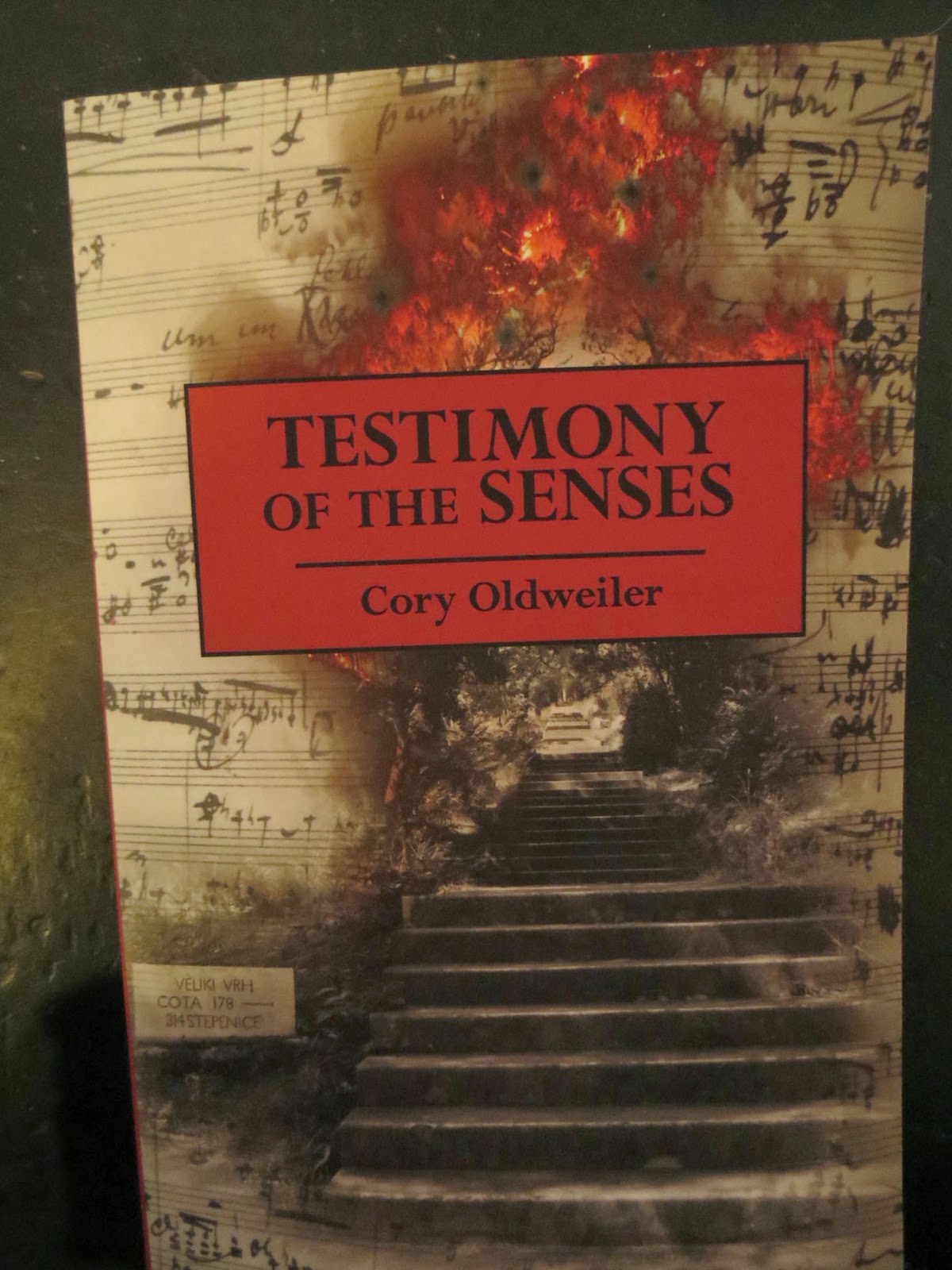
Cory Oldweiler of Leland, Michigan, has written and self-published a magnificent debut novel. (He also designed the striking book cover.) Beautifully and powerfully written, this tragic story of a young man’s search for truth and for a place in the world is compelling and transporting.

The novel begins with the first-person narrator near the end of his story, looking back over the path that led him to the cafe in Croatia where he is searching both paper maps and his own memory. As he recalls images from the past, he tells us that his entire life’s structure was prefigured years before his birth in Gustav Mahler’s Symphony No. 7 in E Minor, and so the symphony provides the novel’s structure, beginning with the Adagio of earliest memories and proceeding to the Rondo-Finale at an allegro tempo accelerating mercilessly in the book’s last pages.

Emilio is an only child who grew up in a neighborhood of Italian immigrants in Corona, Queens, New York. Told from earliest childhood that his father was killed by a hit-and-run driver five months before his own birth, Emilo -- later to become Milo and eventually Miles -- made no close friends during his years in school. He and his mother had an apartment, but it was more dormitory than home, while his paternal grandparents’ bakery and their apartment upstairs formed the early emotional limits of the boy’s fatherless world.
For the first six and a half years of my life, Mamma and I were never physically far apart. Most mornings began before dawn when she would gently shake awake Caro Emilio, mio carino and moments later carry him (me), still benighted, somewhere between swaddled and smothered in nightshirt and sweatpants, feet stuck hastily into socks and boots, down the stairs and out onto the still slumbering streets. Once outside she would set me down and, in a somnolent haze huddled beneath the folds of her heavy woolen cloak, one arm wrapped tightly around her leg, I would blindly make the four-block walk to Due G’s, the bakery....
While helping out in the bakery, Milo makes the acquaintance of Jerzi, an older man, a symphony violinist with a passion for opera. For a time Jerzi becomes for the boy a strong and important father figure and dispenser of wisdom. It is Jerzi who introduces Milo to the language of music, where notes can name feelings too deep for words. But eventually Milo discovers Jerzi in a series of falsehoods he cannot forgive.

Following what he perceives as a terrible betrayal by his mentor, on his seventeenth birthday Milo learns that his father is alive. He was not killed: that was all a lie, too. With the shock of discovering he has been deceived by everyone he trusted, Milo erupts in rage. His rage propels him out into the world, first as an aimless and desperate runaway and later on a somewhat random, haphazard but very emotionally focused search for the runaway father who abandoned him before he was born.

The author’s knowledge and deep love of music permeates Testimony of the Senses. Another kind of structure is provided by classic literature, specifically Ovid’s Metamorphoses, when the narrator discovers a two-volume bilingual Loeb Classics edition that had accompanied his father to the battlefields of Europe. The father, Carlo, was seventeen when a member of the U.S. 163rd Signal Photographic Corps during the Second World War, and he tucked into the pages of Ovid a series of photographs bearing written descriptions testifying to the horrors of war.
Most of the notes are inscribed on the backs of photos, mainly black-and-white four-by-fives taken with his Speed Graphic, although several smaller prints made with another camera or taken by another photographer are included as well. The pictures are filed throughout the compact hardcovers, whose pages are not much larger than the photos themselves, usually at specific spots that Carlo felt were relevant to what he wanted to say, either in his shot or in his words or in the combination of the two. The volumes are robust and, despite the added thickness, only bulge slightly, as if they have adapted to the task of telling Carlo’s tale. 
There is also a neatly pressed dead lizard midway through Book V, where various words are covered with what, to my untrained eye, appears to be blood....
By coming to know the photographer’s point of view through the photographs and notations and passages from Ovid, Milo learns to recognize his father’s continuing journalistic work in contemporary newspaper stories that provide clues to where in the world his father might be found.

No synopsis or selection of excerpts can ever do complete justice to a book, but I feel the inadequacy more than ever in the case of this stunning novel. It is original and erudite and at the same time lyrical and passionate. Strong background in music history or opera or Latin classics will add layers of appreciation, but readers with none of that background will still be spellbound by the characters and their stories.

All I really want to say is – Buy it! Read it! Then tell me if you think I have praised it too highly. I’ll be amazed if anyone does.


Thursday, May 15, 2014

Facts, Truth, Lies, and Fiction: THE ORPHAN MASTER’S SON


The surest evidence that the woman in the photo was Jun Do’s mother was the unrelenting way the Orphan Master singled him out for punishment. It could only mean that in Jun Do’s face, the Orphan Master saw the woman in the picture, a daily reminder of the eternal hurt he felt from losing her. Only a father in that kind of pain could take a boy’s shoes in winter. Only a true father, flesh and bone, could burn a son with the smoking end of a coal shovel. - Adam Johnson, The Orphan Master's Son
The Orphan Master’s Son is like no other novel I know. It has been compared to George Orwell’s Nineteen Eighty-Four and Aldous Huxley’s Brave New World, but the author has not created a future dystopia: the world of this fictional work is a country that really exists in our own time. 

“How much did you know about North Korea before reading The Orphan Master’s Son?” asks the first question in the “Questions and Topics for Discussion” section following the novel’s end. My answer would be “Very little.” That Communist North Korea lost its battle for reunification with South Korea and that its people live under a repressive regime. Little more, except that recently I saw a photograph of a newly opened, antiseptic-looking North Korean bookstore (check it out in this issue of “Shelf Awareness”), with very little offered for sale on its shelves other than various editions of the Collected Works of Kim Jong Il and a paltry handful of translated foreign titles.

The book hadn’t been on my agenda or radar, but it was recommended to me by a friend whose opinion on books I trust. Looking at the last few titles on my “Books Read” list, I saw it was also time for a modern novel, so home with me went the book.

Johnson’s tale, enriched by research into the actual country, opens with two pages of imagined propaganda from the North Korean government, arriving by loudspeaker in every home. Various unrelated statements are made and rumors denied. “What are you going to believe, citizens?” the loudspeaker asks. “Rumors and lies, or your very own eyes?” Immediately I wondered what I was going to believe in this story, where rumors and lies play such an important part and the fiction imagined is based on facts. Knowing full well that I was reading a novel, I quickly gave myself over to belief in Johnson's convincing fictional world.

The protagonist, Jun Do, who grew up in the orphanage administered by his father, was not technically an orphan, but like the other boys he was given an orphan’s name, a name that also echoes for American readers the name John Doe, and he is the North Korean Everyman. He does what he must to survive, whether that means sending other orphans to work in fatally toxic environments, enduring combat duty in completely dark tunnels under the DMZ, or participating in kidnapping expeditions to Japanese shores. “Then the kidnappings ended, as suddenly as they’d begin,” and Jun do is sent to school to learn English. Next he is assigned to intercept and translate American radio transmissions from a North Korean fishing vessel.

Out at sea the young man’s life begins to open up for the first time. He has a taste of freedom in the water and sky surrounding him and gradually learns about family from the captain and crew, while in the dark night, he is given glimpses of another world in the person of the Girl Rower and the manned space station whose location eludes him for so long. Jun Do cannot plan his future, nor can he predict a single one of his “long tomorrows.” He can only hope to keep himself and his friends the fishing crew and captain safe, as each astonishing, improbable turn of events tests his ability to lie convincingly and to suffer torture without recanting his false testimony.

Improbable, yes. How likely is it that just this particular motherless not-an-orphan, also a kidnapper, tunnel soldier, and radio operator, would be chosen as the official translator on a mission to Abilene, Texas, for some “talks before the talks,” an informal meeting with an American senator who will later visit North Korea to make a serious exchange? In an interview at the end of the book, the author addresses the question of what is “real” and what is “invented” in his novel.
If literature is a fiction that tells a deeper truth, I feel my book is a very accurate portrayal of how the tenets of totalitarianism eat away at the things that make us human: freedom, art, choice, identity, expression, love. And because few things about North Korea are verifiable ... this seems to be a realm in which the imaginative reach of literary fiction is our best tool to discover the human dimension of such an elusive a society. But I know what you’re asking.... I have a rationale for every artistic decision I made in the book, but suffice it to say that most of the shocking aspects in my book are sourced from the real world.... What’s fiction is that one person might serve in all these capacities, as my character Jun Do does. But in this case I valued the larger portrait of North Korean society over the plausibility that one person would have such a range of positions.
Stop now and take a deep breath before you read what he says next.
I felt I actually had to tone down much of the real darkness of North Korea, as in the kwan li so gulags, the reports of which were so harrowing—forced abortions, amputations, communal executions—that I invented the blood harvesting as a less savage stand-in, one that was simple and visceral, for the ways that the Kim regime stole every drop of life from citizens it had sentenced to an eternity of slave labor.
To give any kind of adequate review of this book, I would have to discuss Jun Do’s transformation into General Ga and his love affair with the film actress Sun Moon (General Ga’s wife), and I would have to mention her children, too, and his relationship with them. I would also have to discuss the nameless figure of the interrogator, a man who works only at night, whose own parents fear him, who takes pride in his team being different from, more “scientific” than, the Pubyok torturers. What will become of them all? The author says in his interview, “The people there are just as human as we are, driven by the same needs and motivations.” Some of Johnson’s characters become harder as the story unfolds, while in others their humanity cannot help reaching for the light.

But all I really want to do is urge you to read this heartbreaking, horrifying, mesmerizing, and beautifully written, book. Deserving recipient of the 2013 Pulitzer Prize, The Orphan Master's Son has prompted different people to ask: Is it magical realism? A political thriller? Love story and/or a tragedy? Coming-of-age tale? I say that the best of novels, whatever labels critics attach to them, transcend genre boundaries, and Johnson has gone transcendence one better: his novel blends and unites genre categories, and transcends them all.

Reading the first few pages, I wondered if I would be able to “get into” this book; now I think that no one could read very far into it without becoming obsessed by the characters and compelled to continue the voyage. If I were to put together a “Top 100 Novels of My Lifetime,” this would surely be on the list.
Returning the Dear Leader’s gaze, Ga felt no fear looking into the eyes of the man who would get the last word. In fact, Ga was oddly carefree. I’d have felt this my whole life, Ga thought, if you had never existed.
Tragic, yes, but not a tragedy. The central character is not a great man brought low by a tragic flaw but an Everyman who discovers his purpose and finds strength and resolution to fulfill it.