Search This Blog

Showing posts with label morning. Show all posts

Monday, February 6, 2023

She Took No Books!


On Sunday I woke up crabby. The heater had gone off in the middle of the night, and the house was cold. Getting up to deal with that, I remembered another reason to be crabby: my coffee house in Willcox is closed. Not “on vacation,” but closed, its future dim with mystery. Source of Coffee, my David place in Willcox! The name, Source of Coffee, soon had me thinking about the Marcel Pagnol character Jean de Florette and his back-breaking and ultimately fatal trials in  Provence [movie review here but note an error in the telling: Ugolin is not Papet's son but his nephew]: When conniving neighbors block up his spring and all his farming efforts fail, he rages against God. It was, after all, the livelihood of his family, he had struggled manfully to succeed, and then, to be deprived of his source (spring)! All right, I know, I know – his deprivation and mine are hardly equal, but it was not yet 5 a.m., and I’ve already admitted to crabbiness.


With heat back on and fresh, home-brewed coffee in mug in hand, my livelihood not facing any new or unusual threats during seasonal retirement (just for the winter: I’ll be back at work in late spring), I felt better when I took Sunny Juliet out on her leash in the dark and saw a perfect moon preparing to set in the west and heard, at the same time, a mockingbird singing in the dark, not even waiting for sunrise to begin rejoicing in the day. 


It was early. I was up. But not in a reading mood. Scanned through a few Facebook posts, listened to a little news on the radio. I was probably as impatient as Sunny on Saturday to get outdoors for our morning walk, so once the sun was up, we started out east on the range. East from the cabin means uphill, then down into what I call Peasy’s Gulch. Then we usually go north to the wash and follow it east. 


It’s a fine walk, one that can stretch to an hour easily, what with investigations along the way (mine mostly visual, SJ’s mostly with her nose). But I was in the mood for a change of scenery, and Sunny is always amenable to a change of plan, as long as we’re still having a good time.


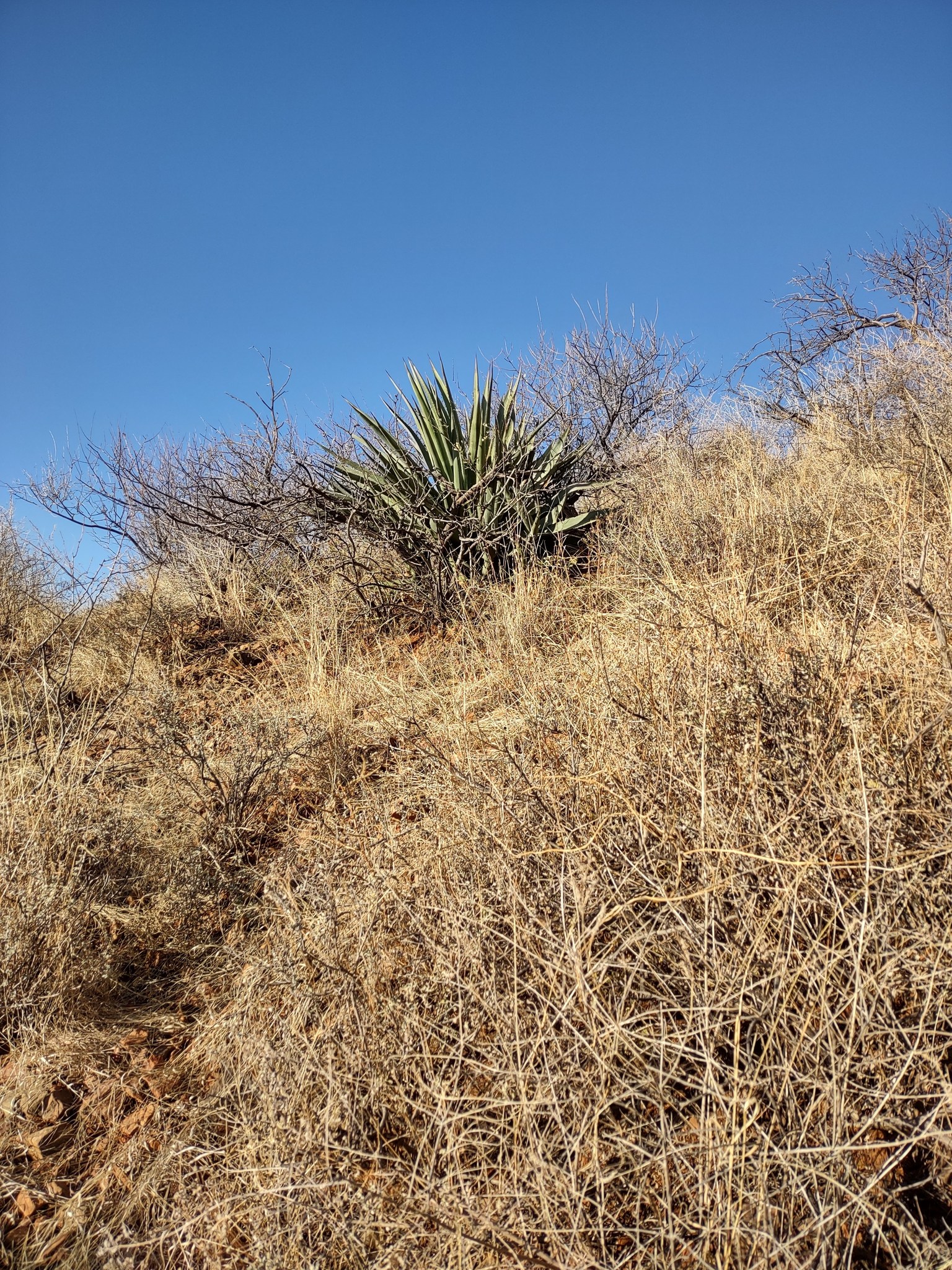
See the arrow in the image above, pointing to a little tree on the distant slope? Doesn’t look very high, does it? Not much of a challenge? Actually, there is no simple and direct path, and while the tree is much higher than it looks from afar, I’d always had it in mind as a destination “someday.” This, I decided, would be the day. 


My morning preparations for the walk had been nothing more than the usual list: leash, treats, water, keys, phone, hat. That’s it. I added gloves, since it had been chilly when we started out, but camera stayed home, as did all field guides. No books on hikes! One thing I learned about field guides when I hiked the Dragoons years ago with a friend is that they become increasingly heavy with every step. I can’t live without field guides – don’t get me wrong – but I’ve learned to photograph whatever I want to identify and look it up in my guides afterwards. Sometimes I carry a camera, as on New Year’s Eve for the Town Hill climb; otherwise, my phone has to serve camera duty.


In Dos Cabezas, in the mountains, foothills, and the ghost town itself, everything (as my hiking partner noted one day as we were driving the straight, flat Kansas Settlement Road) is “up and down.” In summer, when monsoon rains come to the Southwest, water floods the washes and carries downstream rocks, trees, and anything (or anyone) else that it catches up in its torrential flow. On lower ground, the washes in winter are broad, sandy, and relatively clear of obstacles, as if designed for walking, whereas on higher ground and steep slopes, the story is vastly different. There a wash originates as a gully, and there will be several gullies to every slope. Moreover, there is loose rock everywhere, along with shrubs with thorns and spines. -- And I'm coming back to add that there are also gopher holes, holes made by rooting "pigs" (javelina), and now, another neighbor warns me, abandoned mine shafts!


My destination that small dark tree to the northwest


Dark shade is first gully, from the destination side.


Having gone farther east than necessary before making the decision to climb, I had two major gullies to clamber down into and up out of on my way to that tree. Sunny negotiated them easily, but then, she has four legs and four feet and is only a year old. The second gully, in particular, gave me pause. (No, not paws! Please!) Could I do it? Without falling? I put on the gloves I’d taken off when feeling too warm in order to be able to grab handy branches along the way. On the upside of the gully, there was a cow path (quite surprising how good cows are at climbing steep slopes), and I made cautious use of their bovine wisdom. 


For reference: cows on a different hillside on a different day

For scale: same cows as above without the magic of zoom


On Saturday: my cowpath, up out of the second gully
 

My report, in brief: The climb, la montée, ça en valait la peine! Definitely worth the effort! The view of my little ghost town down there in the distance – even, between two local hills, a view out across the playa to the Dragoon Mountains and Cochise Stronghold – was worth every cautious, foot-dragging step that got me there, and it was very satisfying to stand under a tree I’d been looking at from my winter back door and imagining meeting “in person” since 2015.


View attained.

Tree up close.


From my new, lofty vantage point, I could see an easier route to take down than the one I’d used coming up. I’ll remember that for the next time I climb to the tree. I have also installed an altimeter on my new phone now, so when I make the climb again I’ll know exactly how much higher the tree is than the cabin down below, which stands at a mere 5,030 feet above sea level. – Not quite a mile high, the cabin, but that almost explains our freezing temperatures during these winter nights. 


Yes, a very satisfying adventure – and I rationed the water supply carefully so that a certain energetic little doggie would not have to go thirsty, either. We had a terrific time!


Friday, April 26, 2019

Future of America -- For the Birds?


Before 6 a.m. in late April, southern Arizona’s outdoor air temperature is perfect: a refreshing predawn cool after the previous day’s blinding light and baking heat. There is no harsh wind, only the slightest of gentle breezes that barely stirs new leaves on honey mesquite, their sweet, light green like the world’s first leaves. A mockingbird near the cabin competes with rooster and peacocks across the road, far back from the highway, to call the sun up, and a cardinal joins eagerly in the morning chorus.

Sunrise has moved considerably south since December. In winter, it is a front-of-cabin thing, welcome for the light it brings to strike directly on windows and the warmth it gradually contributes to our indoor space. Post-equinox sunrise, by contrast, is best watched from behind the cabin and outdoors, and east-facing blinds remain closed. Bright light stripes windows, nonetheless, but our object now is not to add to indoor warmth but to keep it at a minimum. 


A green mantle spreads over the hills. A distant dove calls. Shadows grow long in the mountains as the sun rises in harsh magnificence. And now the cactus wren, Arizona’s state bird, launches into his rough-edged, repetitive “song,” somehow cheery without being in any way what one might call beautiful. Some birds give us beauty, others awe or smiles or even laughter, according to their effect on us.

I have been reading An Empire Wilderness: Travels Into America’s Future, by Robert Kaplan, published in 1998, and was nearing the end this morning, having begun with Chapter 13 and after that skipping back and forth from section to section, finally going back to start at the beginning and then leapfrogging over sections read earlier to make my way through the final sections. This is not the way I usually read a book. The reason I approached this particular book in such an odd way is that my time in Arizona (for this year, anyway) is drawing to a close, and consequently my initial interest was in the part of the author’s travels that took him from Mexico to Tucson. Alas, no mention was made of Cochise County. Kaplan crossed the border at Nogales, from the state of Sonora into the Arizona county of Santa Cruz. 

But the book begins at Fort Leavenworth, Kansas, coincidentally the place my father, one year long ago, did his annual summer officers’ training (Command and General Staff School, a requirement for keeping his rank in the Army Reserve) while my mother and sisters and I visited friends in Wisconsin. Kaplan calls Leavenworth “the last redoubt of the nation state,” which makes sense as one reads on. In fact, I found some justification for not reading his chapters in order, since the order of the chapters itself does not represent the temporal order of the author’s continuous travels. Rather, the organization of the book is thematic, intended to illustrate his gradually unfolding thesis about what the future may hold for our country, based on what he finds along the way.

I had to keep reminding myself that the book was written two decades ago. Where Kaplan sees strollers in an American city, for instance, and only one of them is speaking into a “cellular” phone, I should not expect the same scene today. Population numbers and demographic percentages would have to be revised now, also. Much of what he describes I have seen for myself, however, and so it is a familiar America — but I have never thought to anticipate the future he predicts, and so An Empire Wilderness gives me food for thought.  

In general, Kaplan foresees a diminished role for federal government and more local control, but in the form of “city-states” rather than cities and in cooperative geographical regions, with natural geographical boundaries, rather than exercised by state government. His example of Montana, a state where east and west have little in common, could be applied also to the Dakotas or to Michigan with its two peninsulas. (How much understanding for its place in the great scheme of things can Houghton expect from Lansing?) All of this I was taking in with a “Hmmm. We’ll see” attitude, alternately nodding and pausing, until the author threw in an idea that hit me like a bucket of cold water thrown in the face, such a shock it was -- . 

He writes that Canada, our neighbor to the north, is too large and unwieldy to hold together and is likely to break apart into separate regional pieces, Quebec joining Maine, British Columbia forming a region with the American Pacific Northwest, and so on. Two features of this idea were especially striking: one was that other people, some of them Canadians, apparently shared Kaplan’s view and did not find it alarming or even surprising; another was the inevitability they all saw in this imagined future. Kaplan does not write “if this were to happen” but that 
"…the character and timing of Canada’s dissolution will [my emphasis added] affect America’s own future in unpredictable ways."
As the United States also reverts to regionalism, why would the U.S. not also be expected to dissolve as a unified country? Because of our louder presence on the world stage and a more widespread and dispersed national population (without the enormous empty expanses of northern Canada)? The prediction, you see, is that while regionalism will be more and more important in the future of the United States, our federal government will continue its basic function of protection, while Canada’s future regionalism will mean that country completely disintegrates. 

Well, this idea makes me think about death! -- and why it is a negative though unavoidable prospect. Not only will it be the end of sense experience — no more sunrise! no more birdsong! — but also, when it comes to each of us, individually, it brings down the curtain on the play at large. What happens next? We don’t get to find out! No wonder literature and drama and film are so satisfying, where we get to see “THE END,” at least as as the writer and director conceived a conclusion, although we often wonder even so “What happened next”” in the lives of the characters. 


I did reach the end of An Empire Wilderness, however, and sooner than I expected, not having realized that remaining pages held not another chapter but a long selected bibliography preceding an index. And so the author envisions democracy slipping away, “silently replaced by the power of corporations and other great concentrations of wealth.” Ugh! Most of us see that scenario already underway. (For years I have shaken my head in bafflement over Americans who express fear of government interference in their lives and shrug indifferently at growing interference in their lives by commercial interests.) And yet, somehow, Kaplan holds out hope — hope for a global increase of human rights, backed by American military might, and the eventual emergence of an “authentic planetary civil society.” 

I wonder…. Does Kaplan’s scenario for the world’s future — diminishing importance, if not outright disintegration, of nation-states; increasing geographical regionalism; eventual global unity of values — contain its own impossible contradictions? What does the future hold for any little geographical region of the planet? For the arid American Southwest, the water-blessed Great Lakes states, old Rust Belt cities, gated enclaves of wealth in every state, family farms and ranches — our land, water, air, and all living things who share the earth with us?

Another morning dawns. The birds begin another day of concentration on staying alive and still find time to sing. We can do worse than to follow their example and take time to be grateful for another day of light and color and song before our time upon the stage is ended.


Thursday, June 22, 2017

Mornings on the Porch


Awake before sunrise (when clouds permit its eventual witness), I pad barefoot to the front porch for a novel left unfinished the evening before. But first there must be fresh coffee made, and while it brews I step outside to scatter yesterday’s grounds on rain-damp soil around iris and feverfew. One of the very satisfying aspects of late June is this effortless passing from indoors to enclosed porch to outdoors, as if all were one continuous living space.

Then, window open to birdsong, first cup of hot coffee at hand, dog at my feet, I settle in happily with my book, and when the last page has been reached (or what my dad always called “a good stopping place”), the dog and I go out for our first walk of the day. She takes careful inventory of new aromas on dewy grass, and I collect a handful of wildflowers, a.k.a. weeds – purple vetch, white bladder campion, yellow cinquefoil – for a little glass pitcher on the porch table. It is not a flower arrangement, only a higgledy-piggledy gathering.


From an old bookcase newly installed at the reading end of the porch (one end is for reading, one for dining, and both for sociable conversation, as the hour and occasion suggest) I pull the June 2010 issue of Poetry magazine but must confess it was letters to the editor that first capture my attention. Each letter presents its writer’s personality so clearly, with an entire range of attitudes and values, that I can almost see the men and women who were moved to write to the editor.

Work break: Load up the washing machine.

Now with a second cup of coffee, a thick volume of essays by Isaiah Berlin comes to hand, and I am wide awake, brain buzzing. Berlin is such a congenial thinker – congenial to my way of thought, of course that is. I’ve read that he was a lively and fascinating dinner companion, too. Much like David Hume, perhaps? (Le bon David, the latter was called.) It is lovely to be lost in philosophical debate and communing with a brilliant mind as morning light filters through the leaves outside the window.

Porch time does not last forever, of course. When silence from the laundry room tells me that the moment has come to hang wash out on the line, I rise from my couch of leisure. The sun is fully up.

But what is that, out on the hill? The dog and I spy something from the porch door and freeze, as does a lovely doe, big ears horizontal and wary. Sarah gives a faint, low woof, and the doe leaps away, tiny fawn close behind. And in the backyard, while I am busy with wet laundry and clothespins, Sarah sniffs around in the rhubarb where surely a bunny must be hiding. She is enjoying her morning, too.

Another morning, sometime after my 5 a.m. rising, a thunderstorm bursts out, and rain pours down on the porch roof. Not only am I cozy inside with today’s pre-dawn book (Parnassus on Wheels, by Christopher Morley), but weather precludes laundry, which is good because I have extra-early errands today in Suttons Bay.


And so, soon my dog and I will be on our way, first to do errands and then for a day in the bookstore, and we will enjoy our hours in the public world, too. But oh, the morning on the porch! How it fuels my spirit!


"When do you find time to read?" This is part of my answer.


Sunday, June 8, 2014

Stealing Time to Garden and to Read – and to Think About Horses


Morning light and dew
Stealing Away to the Woods, Too

My gardening time on Friday morning was not really stolen: I earned it by getting up and outdoors at 6 a.m. Digging, planting, watering, mulching, weeding – everything that seemed like overwhelming burdens to my morning-wakeful-in-bed mind turned out to be leisurely, rewarding, meditative activities out in the soft June morning air. “Morning has broken/like the first morning” is the beginning of a song that often comes to my mind on these occasions. It restoreth my soul.

Gardening and reading could be combined, I suppose, if one were to wear a headset and listen to a recorded book, but when I’m outdoors in the morning I want to hear the birds, just as when I read I want to hold and feel the book. There was no time to steal for reading during most of the day at the bookstore. Time to sell books, yes, and time for conversations with friends old and new, messages to leave and retrieve, even a few sallies out into the sunshine, on errands, while David sat in the bookstore, but it wasn’t until after 4:30 on Friday that I had a chance to pick up a book, and I chose was Search Party: Stories of Rescue, by Valerie Trueblood. 

Quite honestly, I began reading “The Mouse” because it was one of the shorter stories in the book, something I thought I might be able to finish before closing time if not interrupted. Naturally, I was interrupted (and that was fine, too, because it’s what I’m here for), but I knew I had my own copy of the book at home and could get back to the story later. In “The Mouse” we meet aging literary critic Lindenbaum and his much younger wife, Sofya, a poet of Russian emigre parents whose own personality or childhood experiences or a combination of the two made her a “difficult” adult. Lindenbaum’s household includes
...pets, birds as well as dogs, and even white mice for a number of years until the short life span of the mouse began to wear on him.
A single mouse appears on the following page. In a flashback to her childhood, we see the girl Sofya locked in a closet by her parents, when on the other side, visible to the child through the crack beneath the door
...a mouse appeared on the red wool and sat up to stroke its whispers, not briskly as a mouse normally does but feebly and dreamily. She felt a rush of pity for it. But was it more than pity? Was it love? The feeling swelled past the mouse – past the fir on its chest made pink by the sun on the rug, the flimsy hands curved, even without a thumb, in the ballet position arrondi, as she knew from forced months at the barre – and on, to things a mouse must know, must live for, passageways, smells, and its own kind, and from there to things unknown to it because it had to be a mouse, a world of things going on somewhere, everywhere with nothing to rule them.
Being plunged so thoroughly into a mouse’s world and just as suddenly pulled out of it again is dizzying. This is not the central incident, but now, re-reading this story I am wondering about its connection to Sofya’s relationship to the convicted accomplice in the assault that resulted in Lindenbaum’s death. Whether or not there is a connection is not for me to say. I will say that this story, slightly over eight pages long, is perfect.

Friday evening David and I were both too tired for yard work, and things were looking orderly enough that we gave ourselves the evening off. I was happy to stretch out on the front porch, by an open window, birds singing to me from the background as I read about John Quincy Adams’ sad presidency.


Corner of snow fence
On Saturday morning I rose an hour earlier -- at this time of year, at the 45th parallel, the sky at five o’clock in the morning is already lightening to the northeast, and in this morning’s stillness the soft gurgle of our little no-name creek filtered through the willows – and worked on a brief writing project I’ve delayed starting for years, turning next to read the opening chapters of a novel by Maritta Wolff, before going outdoors with Sarah again at six to water gardens and sit quietly with sketchbook, pen and pencils. Crows and chickadees were calling by then, soon joined by robins, then a catbird and an oriole hidden in high foliage in silver maple and popple.

Tomato plants
My gardening this year is so haphazard it hardly merits the name. Tomato plants went into holes dug right in the sod, flakes of last year’s old, spoiled straw snuggled tight up against them, while I found room for squash plants in what used to be a flower garden before being overtaken by grass (plenty of newspaper under more moldy straw flakes put down to give the squash a lead in the competition with the grass) and planted melons in an old wooden box. When the melon vines manifest, I’ll guide them into the squash garden rather than out onto the grass – and hope they cooperate. Hope is the negligent gardener’s most important tool. I should say too that I was inspired this year by Patricia Lanza’s Lasagna Gardening, the latest twist (with many new variations) on Ruth Stout’s old no-work method. Found room for a couple of collard plants at the end of the rhubarb, cutting the latter back to make space.


All day Saturday, though, my mind kept turning to New York, where California Chrome would be racing for the last jewel in the Triple Crown, his owners hoping he would be the first horse to win all three races since Affirmed did it 36 years ago. No filly has ever won the Triple Crown, and only three have won the Kentucky Derby, but something tells me that the fabulous Australian horse, Black Caviar, could have taken the Crown. And I hope you followed the link to see how gorgeous she is!

But – then came Saturday evening, with all cameras and attention on one horse in a field of eleven, and that horse did not win, place, or show. Yes, it was disappointing. I was disappointed. Tonalist was my #2 pick, however, and a beautiful colt, with a story all his own, and he ran a great race to win.

More than California Chrome’s loss, I was deeply disappointed in his co-owner’s inappropriate remarks after the race and disappointed in the press for following up Coburn’s angry, unsportsmanlike jabs at other owners for taking what he called “the coward’s way out,” i.e., running horses in the Belmont Stakes that had not had Chrome’s recent grueling campaign in Derby and Preakness. (I'm not putting in a link to that intemperate outburst.) Coburn knew, taking his horse into the Belmont, that other horses in the field would be fresher. If he thought that made it an unfair race, he shouldn’t have had his horse in it. The Derby and Preakness have never been prerequisites for Belmont Stakes entry, but suddenly one angry, disappointed owner thinks they should be, and in my opinion he’s just wrong. It's easy to be gracious in the winner's circle; a sore loser casts a pall over the whole event. Tonalist missed the Derby because of a lung infection – that’s no reason to disqualify him from the Belmont. Each of the three Triple Crown races has always been a stand-alone event. 

Then, with Tonalist’s owner in the winner’s circle, a time and place for joy and congratulations, an interviewer asked Tonalist’s owner, Robert Evans, what he thought of Coburn’s “coward’s way out” accusation. Again, inappropriate! Not the time or place! Evans had no comment. Good for him!

Was it irony or poetic justice? Call it what you will, but the Evans family owned Pleasant Colony, the Kentucky Derby and Preakness winner that (I always want to say “who” for horses and dogs!) came in third in the 1981 Belmont Stakes, failing to capture the Triple Crown that year. “When Pleasant Colony lost [the 1981 Belmont], silence fell over his famiily’s [Evans] box.” Silence, disappointment, tears, grief are all appropriate. Calling the winner a coward is not. It’s always been very, very difficult for a horse to win the Triple Crown. That’s why it’s such a big deal.

Owners and journalists interested in “saving racing” need to give the winner his due. Trainer Christophe Clement and jockey Joel Rosario deserve congratulations, too.

Gorgeous horse, French trainer, Dominican jockey, owner whose family was disappointed by their horse's finish in the Belmont 34 years ago -- the Tonalist story deserves attention. 

I was so thrown off my feed by the sour-grapes aftermath of the Belmont that I woke in the middle of the night and couldn't get back to sleep. Before going to bed I'd read several chapters of a disappointing self-published novel but didn't need more disappointment in one day, so in the wee, dark hours I again turned to The Adams Family. Picking up the story of John Quincy Adams after what I called earlier his "sad presidency," I was happy to learn (maybe some of you already know this, but I'd forgotten if I ever did know) that JQA did, over his son's objections, follow his single term as president with almost two decades in the House of Representatives, and those years turned out to be much more productive and satisfying to him and more important also to the country. He served from 1831 to his death in 1848, and after anti-slavery petitions had so angered Southern representatives that they instituted a "gag" rule, he fought tirelessly for the Constitutional right of any citizen to petition the government

I'm glad Tonalist's owner ran him in the Belmont even after illness kept him out of the Kentucky Derby, glad John Quincy Adams set aside his son's opinion that the House of Representatives would be a come-down for a former President, and glad too that I decided to plant some vegetables, after all, even without the time to prepare a proper bed for them. Not, you understand, that I'm comparing myself to either JQA or Tonalist! Just sayin'.


Tuesday, January 15, 2013

Up Early to Write Myself


I wake in the night--or what my mother calls “the wee hours of the morning”--and find myself writing a blog post in my head. The blog has become my confessional, although there is so much that I never say in it. It has become an obsession. It is photo album, memory book, diary, reading record, a place to think through ideas and issues. Through it I escape the bounds of time and space. In it I am free. Mine will never be a “blog of note,” with thousands of readers, but even so it has more daily readers than my bookstore has customers, and so I turn from the anxiety of bookselling to the comforts of the blogging.

Other times I wake with fictional characters in my head. Perhaps they are thinking silent thoughts (I hear them) or talking to each other (I hear them), or maybe they’re going about their working lives, striving and stumbling along the way (I see them and feel for them). In my imagining mind they are very real. I can only see a few minutes ahead in their lives until I sit down and begin writing, and then those lives unroll. Their struggles are real to me, but they are not my struggles, and so with them, writing their lives, I am free.

Too often I come awake in a wash of pointless worry, swamped before dawn with awareness of crises, personal and global, present and impending. David beside me, Sarah at our feet, I am not even there in the warm refuge of bed but scrabbling to keep my hold on some cold, treacherous mountainside, my feet slipping and rocks tumbling all about me, or on Linda Ronstadt’s “heart like a wheel,” that little “boat out on mid-ocean,” about to capsize in a storm.

Is it too early to get up and turn on lights and make coffee and pull out lines of visible words from the chaos and confusion in my head?