Search This Blog

Showing posts with label local authors. Show all posts

Thursday, June 12, 2025

Stop-Action Moments

Sunny Juliet takes a play break.


I always say in the fall, when people ask, “How was your summer?” that it was a blur—and so it seems as it races by. There are, however, moments to stop and take a deep breath and look around in gratitude and appreciation, and I’ve had a lot of those already.


We had launch!


My dear friend Marilyn Zimmerman’s book launch was one such stop-action moment for me. All who could attend (and in the summer it is impossible to avoid every schedule conflict) were delighted to be together to celebrate the release of Marilyn’s novel. After the author described the setting and background of her story and read a passage from the book, questions and observations from the audience and further conversation while she signed copies kept our guest author too busy to have a piece of her own congratulatory cake until it was almost time to leave. Verdict: Success!


Author Karen Mulvahill was in the audience and had to leave early, but what a joy for me to hear from Marilyn and Karen the next day that they were avidly reading each other’s books! Northern Michigan writers I know are such generous souls, celebrating each other’s successes joyfully. That’s yet another lovely aspect of my wonderful world of books, and I am especially proud of the achievements of these two Northport writers.


Of course, Zimmerman and Mulvahill’s novels are available at Dog Ears Books. In Defense of Good Women is being marketed as a legal thriller, The Lost Woman as historical fiction, but I will tell you that both are much more than a single genre tag can capture. They have in common page-turning suspense; beyond that, however, Mulvahill’s novel lays bare the ways in which cruel authoritarianism divides a society, while Zimmerman’s explores hidden and complicated motivations and relationships.


In Defense of Good Women, by Marilyn Zimmerman. Paper, 302pp, $17.99


The Lost Woman, by Karen Mulvahill. Paper, 280pp, 18.95


We had a summer reunion!


Omigod, is it really 18 years since our first lunch? The number has fluctuated from year to year, depending on who-all is available when Dorene makes her annual pilgrimage to northern Michigan, but here is our original tiny core from all those years ago. Back then Marilyn Zimmerman and Trudy Carpenter were taking writing classes together and writing short stories, so when writer Dorene O’Brien came up from the Detroit area the four of us got together for lunch to talk about the writing life. And here we four are all those years later! 


Left to right: Marilyn Zimmerman, Trudy Carpenter, Dorene O'Brien, et moi

A prior year with Elizabeth Buzzelli, Barbara Stark-Nemon, and Sarah Shoemaker


I had company!


My sister and brother-in-law came to visit for three days and nights last week. Breakfasts and dinners on the porch, one restaurant excursion, much relaxing outdoors—and Sunny got a lot of attention from my dog-indulgent sister! Somehow I guess we were too intent on conversation and food and relaxation to take photographs of each other. Even on Sunday morning when Sunny triggered a temporary crisis mode by encountering a porcupine at close quarters, there was no pause for camera work. Those quills had to be pulled out right away! After her ordeal, Sunny retreated to the other end of the porch to recover in solitude, not sitting next to the table as usual while we humans had our breakfast. She had completely gotten over the shock to her dignity and independence by afternoon, however, and meanwhile her momma had squeezed in a nap following the departure of beloved company.


I found a photo! This one of Deboran and Bob is at Nittolo's in Lake Leelanau.


We all had sun and rain.


Soft, gentle rain from the sky always seems better for young growing things than cold water from a hose. My gardens have had some of both so far this season. Little seedlings are emerging in the vegetable beds, and flowering plants are flourishing in the borders and fields. 


My apple trees, I report sadly, look as if they are not going to bear at all this year. Just when I thought I was on top of my game! I got the pruning done, and I was ready with my homemade codling moth traps after last year’s maddening discovery of a worm hole at the blossom end and core rot inside almost every piece of fruit! So what could go wrong? How about a failure to blossom and set fruit? Very disappointing! It seems my trees have definitely slipped into a biennial fruiting pattern, and all I can do now is to be ready again next year and hope for a good harvest in 2026.


Pretty tree, no fruit


We have plans --


Sunny Juliet and I will be having more company soon, and we will getting back to our agility work with Coach Mike next week if the weather permits. 


On June 24, Dog Ears Books will host another poetry reading, this time with Jennifer Clark from Kalamazoo. She will be our featured guest for the third time with her third collection of poetry, Intercede: Saints for Concerning Occasions, which is not, she says, your grandmother’s book of saints.


So if you can’t relate to sanitized, stained glass perfection, come and meet Jennifer Clark’s cast of helpers—cranky, insecure, doubting, and hilarious—saints maybe “for the rest of us”? Because we who don’t fully have our spiritual acts together certainly need guides who aren’t afraid to get their hands dirty by interceding in our screwy, complicated lives!


That reading will be Tuesday, June 24, beginning at 4 p.m.


Poet Jennifer Clark


And then, the ongoing—what to call it?


I cannot see-no-evil, hear-no-evil, speak-no-evil like those three little monkeys. Sorry! I cannot pretend that all is well in our society and our world these days. 


We have in the White House a president who “promised” he would be a dictator on “Day One,” seeming to imply that his dictatorship would only “need” to last a single day—and excuse me for all the scare quotes, but this is scary stuff, and whoever thought that any dictator would step down after 24 hours? This one sure hasn’t. And the most frightening part of it all is that his supporters, military and laypeople, continue to cheer his overturning of the Constitution and the rule of law that Americans have always considered guarantees of our country’s bedrock freedoms. 


Why all the arrests and deportations? It isn't about protecting us from crime. Undocumented workers doing their jobs, paying taxes, and taking care of their families are no threat to the rest of us. 


Think about it. 


He promised to bring down consumer prices “on Day One” and was unable to do so. Prices have not come down. He promised to end wars in Gaza and Ukraine “on Day One” and was unable to do so. The wars go on, as do the deaths. But deportations? That’s one area he’s been able to get some results, so by God he’s going to keep deporting! 


And never mind that he’s not singling out criminals but terrorizing and tearing apart families who have lived in and contributed to their communities for years! He’s a “tough guy,” right? Don’t you see it? Having gotten rid of many people in authority who took seriously their oaths of office, he is now able to command troops and appoint program "czars" to terrorize and also, often, try to quell protests against his bullying tactics. 


The man himself is a pitiful figure. He and his minions steal from the poor and give to the wealthiest, while they dismantle protections for civil rights, health, and our natural environment because it is much faster to destroy than to build. Destroyers make themselves feel big and powerful by tearing down or blasting apart, and that’s the name of the game.


This weak, whining blamer-in-chief would be less than nothing if there weren’t still many Americans who either look past his rhetoric of hate and blame and buy his pie-in-the-sky lies or actually feel their own impoverished spirits fueled by hate and blame. You hurt? Must be someone else's fault. Find a scapegoat to punish.


For a long time I wanted to believe that the people I know who support him must have, somehow, good intentions in their hearts, that they simply were not aware of what he was actually saying and doing. They couldn’t know what he really was and be okay with him, I told myself. They were good people, right? I wanted to believe they must be living in information silos, hearing only partisan propaganda and seeing only happy, smiling photos of him. 


But such total ignorance of reality is impossible, and I have to face reality. He has his own social media platform and spews his blame and hatred there daily, so his supporters cannot be ignorant of what he is. I have to face the fact that they themselves, apparently, have no loyalty to the U.S. Constitution or to the rule of law. I have to face the fact that “liberty and justice for all” is to them a meaningless phrase. “Justice” to them means “We win!” and everyone else loses. 


What does what's happening mean to you? To put party above country, loyalty above principle, might above right? Is this the United States of America your parents and grandparents fought to preserve? Is it the one you want to leave to your children and grandchildren?


Well, for now we go on with our lives. Those of us who write, write; those who join public protest demonstrations, demonstrate; those who lie awake night after night try to get enough sleep to face another day. We go to work, we care for our families and homes, and we treasure our friends—because life is essentially a beautiful gift, and it would be wrong not to be grateful and to appreciate what we still have. 


When my husband died, I learned that grief and gratitude are not mutually exclusive. They can and do coexist in the most meaningful experiences of our lives. And so I continue to be deeply grateful for all this country of mine has given me, even as I grieve these nightmare times and hope that we can still come out the other side into the sunshine of lawful liberty again. 


Hope. Community. Justice for our neighbors as well as for ourselves. Because there is no true justice that is not justice for all.


“We're all travelers in this world. From the sweet grass to the packing house. Birth 'til death. We travel between the eternities.” 


That was the simple funeral speech actor Robert Duvall gave in “Broken Trail,” and I think of it often. We are here on earth for such a short time. We have such a short time in which to be worthy of our lives!


Lives were given for our freedom.


Thursday, August 10, 2023

My Bookish Life and the Great Outdoors


On the shelf? Answer to question below?

Where Do We Belong?


When I posted a couple of photos of my yard and gardens, and a similarly inclined friend commented, I replied to her comment, “Isn’t our real life outdoors?” and she replied, “It’s where we belong.” Ah, but this friend also has a bookstore, so this morning I was thinking, But our books belong indoors – most of the time, at least, except when we’re reading one under a tree or by the edge of the lake or something. It's a booklover’s/outdoor woman's conundrum! And then there is bedtime reading and winter reading, cozy indoors. But right now it’s still summer….


Library Friends: FOLTL and Me, 2023


The last two events of the Friends of the Leelanau Township Library Summer Author Series kept up the standard set by earlier presenters, Dave Dempsey, author of Great Lakes for Sale,* and Jacob Wheeler, author of Angel of the Garbage Dump. Sarah Shoemaker and Soon-young Yoon enlightened and educated their assembled audiences as they entertained. Discussion following was deep in both cases, history with Sarah, policy with Soon-Young.


Below, from left to right, are (first) Sarah Shoemaker, author of Children of the Catastrophe; Silvia Gans, FOLTL president; and Suzanne Landes, past president. In the second photo, again left to right, are Soon-young Yoon, author of Citizen of the World; Beth Verhey, her interviewer for the evening; Julie Alpers-Preneta, Leelanau Township Librarian; and Pamela Grath of Dog Ears Books. Mimi and Joel Heberlein provided the venue this summer, the Willowbrook Mill on Mill Street.


FOLTL is Friends of the Leelanau Township Library. After losing my long-time volunteer to retirement this year, as well as the more global and permanent loss of my husband last year, I have not hosted author events in the bookstore/gallery myself, content to promote and attend FOLTL events and offer those authors’ books for sale following their presentations. I do, however, have two poets scheduled for the day of Leelanau UnCaged, last Saturday in September – scheduled on the day, that is, with reading time not yet set. Fleda Brown and Michael Delp will be here that Saturday, and you won’t want to miss them.


Bookish Temptations


I have not yet let myself even open Horse, by Geraldine Brooks, because if I do, I won’t be able to stop reading, and all the books I’m halfway through will feel justifiably slighted. That’s what happened when I picked up The Hearts of Horses, by Molly Gloss, a book I highly recommend. I mean, horses!!! But also, her writing so impressed me that I not only ordered paperback copies of that title but two others of hers, as well, confident that they will also be wonderful. 


Wonderful also is Marguerite Yourcenar’s Memoirs of Hadrian, which I had never attempted until recently and am now about halfway through. She published that literary tour de force (historical fiction) in France at the age of 48 but had been writing it off and on for a decade. Never having been a great reader of historical fiction in general or an amateur of the Roman Empire, I am surprised at how involved I have become in the life and times of Hadrian, fictionally imagined by a 20th-century woman. Yourcenar was admitted to the Académie française in 1980, the first woman to receive that honor. She deserved it!


My Nonliterate Sidekick


Sunny Juliet has no interest whatsoever in books but is excelling at agility. This week she did not only jumps and tunnels but teeter-totter (“Teeter!”) and the bridge (“Walk it!”). By summer’s end she will probably be introduced to the weave poles, though proficiency at weaving is the most difficult agility challenge, as it’s nothing dogs would have any reason to do ordinarily. But I can't photograph her at work because we are working the course together....


Don't let the sleepy act fool you. She is ready to go on a moment's notice!


I asked our instructor (Sunny and I work as a team, and I have as much to learn as she does) if the idea of the dog agility course came from equestrian events, and he said one trainer he worked with started out as a horse trainer but found over the years that he had fewer and fewer students, so when he observed that everyone has dogs, he turned his attention to working with people and their canine companions. 


Ready!


What’s in a Phrase? “It's the Berries!”


\

Black raspberries were so plentiful this year that they threatened to bury me alive. (They are winding down now at last.) Sunny liked to “pick” them right off the canes with her dog lips, and I encouraged the help. Get those low berries, girl, so the momma won’t have to! Recently I noticed blackberry canes at one end of one of my raspberry patches, and that’s encouraging, because the main wild blackberry patch – enormous in extent, prolific in fruiting – is too close to orchard trees for me to risk gathering sprayed fruit. Even closer to the house red raspberries and red gooseberries are appearing, and I’ve been ridding them of competition in hopes they will multiply. 


“It’s the berries” is slang that was outdated when I was young, along with “the cat’s meow” or "the bee's knees," but really, don’t those expressions sound kinder and gentler than saying something is “the bomb” or that so-and-so “killed it” with a performance? And then, of course, there is the song. Take a listen: it will make you smile.


No books here -- what gives?

Recent Bookish Losses 


One “old Leland” friend who died recently was Barb Nowinsky, the first Leelanau County librarian I ever knew by name and could call a friend. That made me sad. 


*Another loss was Bob Giles, former editor and publisher of the Detroit News, a journalist many of my friends knew as a beloved boss, and the author (most recently) of When Truth Mattered: The Kent State Shootings 50 Years Later, published in 2020 and very much still worth reading. Bob was in Northport only five weeks ago, when he interviewed Dave Dempsey, author of Great Lakes for Sale, in the first of four FOLTL Summer Author Series events and one Bob dedicated to his late wife, Nancy, a strong library supporter. His body was failing, but his mind was strong and sharp. I'm glad that my last memory of him will be that one.


Another Point of View on Death and Loss


My experience of encountering memories along every mile of every county road is hardly unique to me. Sometimes it breaks my heart, other times I find it comforting. A friend reported another friend’s young child observing the phenomenon thusly: “First you’re here, then you’re everywhere.” I like that thought. For me, Leelanau County is crowded with friends, some still living, others departed but not gone from my memory. I'm glad they are still "everywhere," though no longer here at my side.


Wednesday, September 14, 2022

5 September Books Not to Miss!


Everyone has a list – newspapers, publishers, book bloggers – but mine is directed straight at you, northern Michigan, and especially you, Leelanau County, because the talented writers in our region are unstoppable. Here are five new September releases (alphabetized by authors’ last names for the sake of objectivity, because I love all these authors), and you won't want to miss a single one.


Harrison, JimThe Search for the Genuine: Nonfiction, 1970-2015 brings together classic Harrison essays and some never before published. With a deeply moving introduction by Luis Alberto Urrea, who describes the late Harrison as “a big river in flood,” and a jacket photograph by Dennis Grippentrog of Jim in leaning in his granary/writing studio doorway, this is a book no fan of Jim Harrison and his writing will want to live without. As for the delightful and insightful contents, you'll have to read the book yourself, but I say, Thank heaven for written words and their power to live beyond the grave! 


Hardcover, $28


Oomen, Anne-Marie. All you have to do, if you have any previous acquaintance with this author’s work, is read the title, As Long as I Know You: The Mom Book, and you know you’re in for an unforgettable ride. Who dares to tell the truth – that mothers and daughters are not always best friends? Anne-Marie doesn’t stop there, however, but goes on with a compelling tale of compassion, big decisions, and the loss that is, eventually, part of all love, somehow (as she always magically does) making you laugh -- and, yes, cry -- along the way.


Paper, $19.95


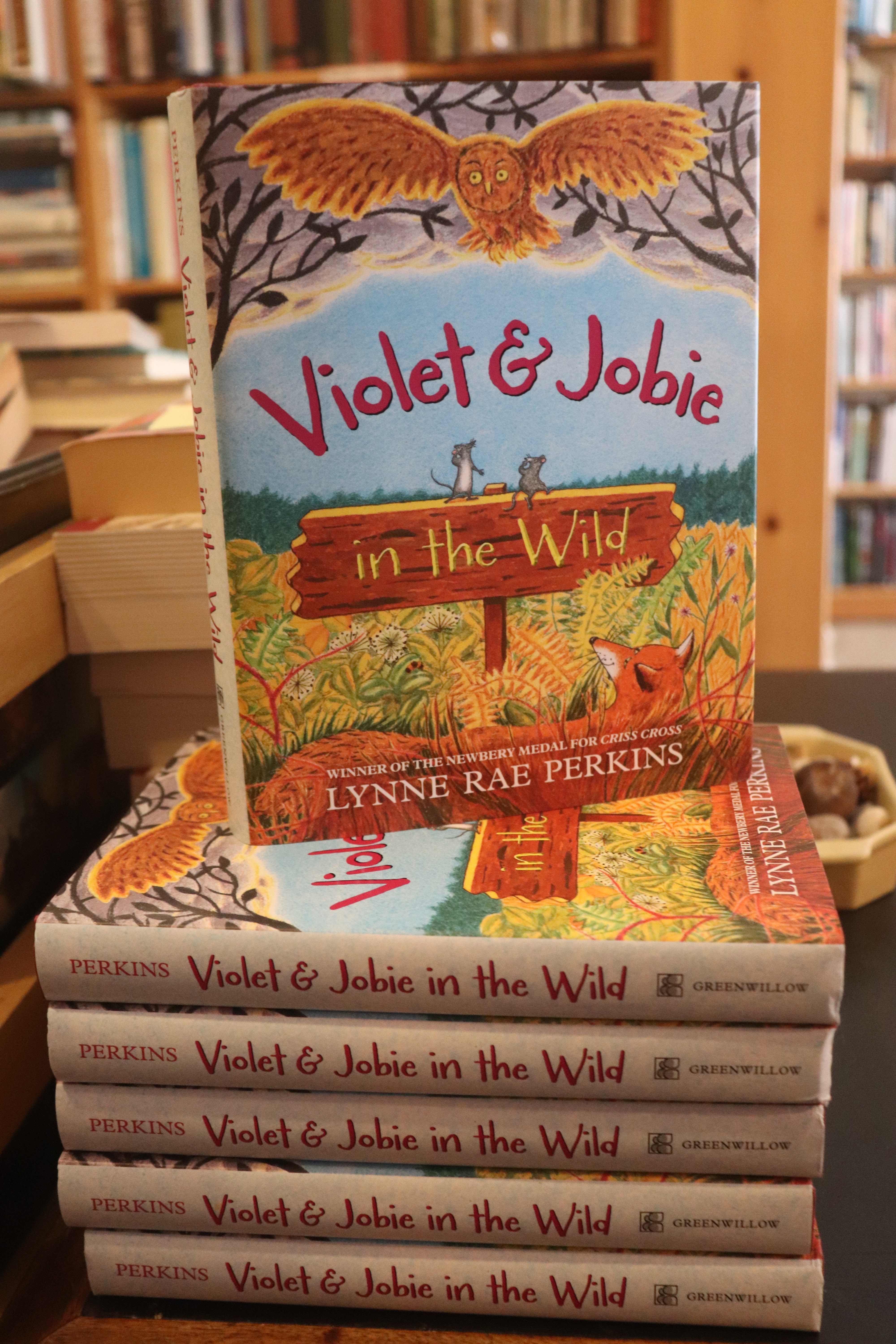
Perkins, Lynne Rae. Our own Leelanau County Newbery author brings us this month another charmingly written and illustrated children’s books, Violet & Jobie in the Wild. A mouse story! Mice, rather. And a chapter book, on the order of her marvelous Nuts to You! (Remember those squirrel adventures?) And lucky me, lucky us, because Lynne Rae will be at Dog Ears Books on Saturday, October 1, to sign books for customers. So mark your calendars now and watch my blog and Facebook posts for coming details. 


Hardcover, $16.99


Shoemaker, Sarah. By now you’ve been hearing a lot about Sarah’s historical novel, Children of the Catastrophe, but if you didn’t make it to the book launch party on September 6, never fear. I have more signed paperback copies and have restocked hardcovers (after selling out of those at the launch) that I'm sure Sarah will sign soon. Children of the Catastrophe is this year’s “Leelanau Reads” choice by our county librarians, and other book clubs will want to include it in their lists for the coming winter, too. It's both historical and timely reading -- and an engrossing family story.


Hardcover, $28.99; Paper, $17


Wheeler, Jacob. Angel of the Garbage Dump: How Hanley Denning Changed the World, One Child at a Time is nonfiction and a story that was very important for the publisher of the Glen Arbor News to tell. Hanley Denning, a former track star and the “angel” of the title, couldn’t turn away from children she saw picking through garbage in a dump in Guatemala City, hoping to find enough to eat to stay alive, and the nonprofit she set up, Camino Seguro (Safe Passage), continues to save the lives of Guatemalan children, although Hanley was tragically killed (in a road accident) in 2007. One person can make an enormous difference. 


Paper, $17.95


Dog Ears Books is open Tuesday through Saturday, 11 - 4, from now until the end of October. 

Monday, September 23, 2019

Other People's Lives

A local friend who is now a new author will be signing her new book in my shop next Saturday (9/28, 1-3 p.m.), and Nancy brought me an early copy of her memoir this past Saturday. My husband and her late husband were friends. Patrick and David appreciated one another’s minds and enjoyed sharing conversation and occasional short road expeditions close to home. David and I were not altogether blind to the fact that Nancy and Patrick’s marriage had problems (whose doesn’t?), and they in turn were aware that we had been through plenty of drama ourselves. When I began reading the first few pages of Nancy’s book aloud to the Artist, however, we were blindsided by its revelations.

Nancy’s Peterson’s memoir, Dear Husband: Letters to an Addict, opened our eyes to a personal world that we had never suspected about this attractive couple we saw regularly around the village and once in a while (although only a couple of times in each other’s homes) on social occasions. We thought we knew them. It turns out we knew only the merest fraction of their personal, marital, and family world. 

Others knew more, as is apparent in some of Peterson’s “letters,” which are in fact ongoing journal entries she began addressing to her husband in September of 2009 and continued until after his death in October 2016. What is also apparent, though, is that even close friends, knowing of the husband’s alcohol and drug addictions, had trouble understanding why Nancy chose to remain in the marriage. 

But that’s just it. We only see other people’s lives from the outside. Others may confide in us, but we have only their reports, never their experience. We never know anyone else’s family from the inside — or even our own family from the experience of the other members of it!  And the same is true for other people’s marriages. Going deeper, Nancy Peterson’s memoir reminds us that within the marriage itself, between two people who may love each other deeply and passionately, ignorance and mystery always remain. And ignorance and mystery contribute to a world of misunderstanding and pain — though perhaps in other ways they shore up and make possible continued commitment and recurring delight. 

From a mood of resentment, the spouse appears in one guise; from a mood of desire, quite another; in a spirit of generous appreciation, something else again, and so on. Where in these various, varying perceptions is reality

No one is simple. Everyone is a mystery. 

Someone I know felt impatience for years with friends suffering from depression until she experienced depression herself during pregnancy. It was beyond her control, and that alone was a striking lesson. Now when she is in a grocery store and witnesses a young child having a screaming meltdown, instead of blaming the mother for bad parenting, she tells herself the child may be autistic, and both child and mother may be doing the best they can.

We are all mysteries, even to ourselves.

Once, long ago, an acquaintance asked me if I thought a third person we both knew might have mental health problems. “I’m not a good judge of what’s normal,” I replied. Growing up the oldest daughter of an alcoholic father also diagnosed with bipolar disorder, I had not found in eighteen years of  family life a solid baseline reading of normality to apply in later life. During spells of darkness, I questioned my own mental health.

My father found his manic-depressive illness an endless source of fascination and loved to talk about it. He would also periodically abuse his prescription medication to maintain the “high” that inspired him to do things such as book a flight from Chicago to Los Angeles on a whim or buy drinks for everyone in a strange bar or, or, or…. He denied his alcoholism for years (if he ever admitted it, I was not informed), aided by convenient misreading of a brochure he was given during one of his periodic hospitalizations, a brochure containing a checklist of maybe a dozen warning signs of alcoholism, taking the form “Do you ever do such-and-such?” My father’s interpretation of the questions was that only someone who answered yes to every item was an alcoholic. He never hid bottles, so could answer no to one of the questions; therefore, he was not an alcoholic and had no problem.

At my mother’s insistence, she and my father once legally separated, but before the waiting period was up that would have granted a divorce, her minister persuaded my mother to forgive and try again to save the marriage, and my parents remained together until my father’s death. In time, advancing age brought a leveling-off of drama. As time went by, my father could no longer drive and so could not disappear for hours or days on end. As he declined in strength, too, he watched more television and drank less and less. Toward the end, the addition of a pair of kittens to the household gave their last years together a new, entertaining, and joyful focus, distracting them from each other’s often annoying ways and irritating habits. 

What I appreciate most in Nancy Peterson’s story is the way she depicts not only the repeated disappointments, frustrations, and what feel like downright betrayals involved in life with an addicted family member but also the happy occasions and wonderful adventures she and Patrick had as a couple and with their three children. Also, the deep love and appreciation they felt for what was best in each other. Because all of it was real — the joy and the pain —. And because Nancy chose, again and again, to remain with Patrick despite the pain, all five members of the family had opportunities that would otherwise have been lost to face their own individual and mutual demons and to build loving memories of their years together. 

The addict and alcoholic are part of him, but not only him. This man, my choices, our lives together, and the life we built and nurtured in so many ways, are not black and white. They are complicated, intertwined, laden with deep feeling and regard, as well as a shared history. 
- Nancy Peterson, Dear Husband: Letters to an Addict

It’s easy to say, from the outside, that someone else should or should not have stayed in a marriage, but what someone sees from the outside can never be a complete picture. Either way, something’s lost, and something’s gained, and there’s no crystal ball in which to read ultimate outcomes.

Next Saturday will be a lively, busy day in Northport, with streets closed to traffic and art and music and dance and food and craft vendors throughout the village. So come on down, and anytime between 1 and 3 p.m., stop by Dog Ears Books to visit with Nancy Peterson, who will be glad to autograph a book for you. 

Dear Husband: Letters to an Addict could have been a bitter, tragic story. Instead, it is an ultimately celebratory account of one marriage and the adventurous, strong, successful family created by two imperfect human beings.

And, friends, aren’t we all imperfect, every single one of us?

Patrick and Nancy, together

P.S. 10/1/2019 - You can see photos of Nancy at her signing here, as well as more about a fabulous Saturday in Northport. 

Thursday, January 17, 2019

Reading in Place


The roadrunner has a rather drab dress of indiscriminate pattern. The feathers are dark brown laced with white, and the tail has a greenish tinge. His wings are stubby, their principal function being to increase the speed of his running should he be in a hurry. His eyes are encircled with rings of an orange color. When he pauses to look at you, he opens his mouth, the crest atop his head rises; the impression is left that the sight of you has brought upon him a condition of great astonishment and shock. Then, recovering quickly from his near collapse, he will go jauntily on his way. -  
- Herbert V. Young, Water By the Inch: Adventures of a Pioneer Family on an Arizona Homestead

Despite several excellent books begun and not yet begun, recommended and picked up on impulse, it is books having to do with the Southwest that take priority right now. I vowed to get back to The Frontier in American History, waiting for me on the little table between our two reading chairs (finally finished that book, begun many weeks before in 2018, two weeks into 2019), and then was seduced at the library by Water By the Inch, with its memories of the desert around Phoenix before urban and suburban development, tales of moving cattle on horseback, digging and falling down wells, close calls with rattlesnakes, and a happy family with five children living in a two-room shanty without running water. Before that there was Voice of the Borderlands, poetry sometimes sweet, sometimes harsh, but always evocative, vignettes narrating the lives of cowboys and horses, rodeos, cattle drives, drug runners, desert deaths, and the dying of old ways. My gratitude for the sun’s warmth I found contained in the Mexican description of “el sobre de los pobres,” the overcoat of the poor,, and I alternated my reading of Drum Hadley’s soul-searing poetic narratives with a novel by Phyllis de la Garza, Railroad Avenue, set on the familiar streets of Willcox, long before those streets were paved. One of the winter’s first temptations, however, had come with My Heart Lies South, irresistible to me not only for its Mexican setting but also for the author’s signature on the inside front cover, along with an indication that one of the book’s previous owners had been Helen Riggs, from an important ranching family down Chiricahua way. You’ll see that book listed in my 2018 Books Read list.


And now, continuing my latest Arizona desert reading, I am deeply grateful to have discovered the nature writing — and much more — of Ken Lamberton. 

I look to the stars for confirmation that I’m not stuck in one place. From one hour to the next I can tell by marking the counterclockwise motion of Ursa Major that the earth moves beneath my feet. I’m spinning with it at 700 miles an hour. From season to season I can feel the earth coursing against a backdrop of constellations, summer’s Scorpio and winter’s Orion. I’m circling the sun at 66,000 miles an hour, a million and a half miles a day. I am not in prison; I am a traveler. I am a galactic tourist, visiting the sun and moon and gas giants. I watch the universe pass by from the window of this fenced plot of ground. I should have motion sickness.  
- Ken Lamberton, Time of Grace: Thoughts on Nature, Family, and the Politics of Crime and Punishment (2007)

In fact, Ken Lamberton was in prison, serving a 12-year sentence as a convicted sex criminal. In his late twenties, a veteran five-year teacher and married father of two (with a third on the way), he had fallen for one of his eighth-grade students and run away with her, presumably to “start a new life,” according to fantasies governing the relationship — on both sides — at that time. Lamberton coped with prison by continuing to read, write, and teach. He was remorseful and desiring of forgiveness but understood that his remorse could never change the past and that forgiveness might never come, especially from his wife, the person he had hurt the most and by whom he most desired to be forgiven. 

In the pages of this, his third book written and published during his incarceration, it seems almost as if his wife, Karen, suffers more from being married to a convicted sex criminal than Ken does from being in prison. Karen also found productive ways to cope with the consequences of her husband’s betrayal, going back to school and earning a paralegal degree, as well as a B.A. in political science. She was hired by a Tucson law firm. She sued the Department of Economic Security and won not only her initial class action lawsuit but prevailing over the six years of appeals against her by the State of Arizona. She visited her husband regularly, bringing their daughters as often as possible. His relationships with the girls seem good, despite the odds. 

And yet, prison exacts a grievous toll on the marriage. 

Readers new to Lamberton’s work, as I was, may be surprised by how much of his life in prison focuses on nature and wildlife, though it was nothing new for him. His book Wilderness and Razor Wire was awarded the John Burroughs Medal for outstanding nature writing in 2002. In Time of Grace, he notes carefully and almost compulsively the annual visitations of various courting and migrating birds and insects and the blooming and leafing-out of trees, emergence of ground plants, sightings of tadpoles (after the rains), a brooding mother duck, many bats, and once, excitingly, a ringtail. Snakes, butterflies, even flies or a broken eggshell — nothing in the natural world is beneath his notice, and everything in his walks around the perimeter of the yard contributes to his sanity.

…I adjust my calendar to the metronome transgressions of birds. For now, they cue me to after summer’s ebb: shorter days as the desert gradually cools and dries. Grasses beyond the perimeter fence bleach and go to seed under scattered cholla cacti, tiaras of light caught among their blond spines. 

But Lamberton is no disembodied angel behind the razor wire. Acutely aware of his own sins, he is no less blind to the sins of others, whether they be wardens, prison guards, wealthy and politically powerful unpunished criminals, or American society at large. It would be difficult to read this book and not be angry at the widespread injustice Lamberton recounts. Not, I add, that he feels his sentence was unjust. No, he says he deserved it. But he sees that the system is not geared basically toward justice at all. In his “Author’s Note” at the book’s beginning, he writes:

Like many people, I believed the justice system was a vehicle for truth. I discovered that truth is irrelevant and politics is not, that our adversarial system favors the affluent, that judges have become redundant, that a plea bargain is not a compromise but a surrender. That justice is a contest with winners and losers…. I also discovered that prison is a society  with a caste system based on the types of crimes committed and those ranked a the top — murderers, drug offenders, gang members — prey on those at the bottom . . . and I was at the bottom. 

And yet, as important as the revelations of injustice — is it wrong of me to see it this way? — are the author’s views of the natural world around him and the beautiful language in which they are expressed. So whether your interest is in law, prison reform, natural science, or literature, this book will command your attention from the first page to the last. I’ll go further and say that this would be an excellent choice for a book club, particularly if members of the group come to discussion with some diversity of experience.