Search This Blog

Showing posts with label old books. Show all posts

Friday, September 4, 2026

Here Now and Looking Ahead


Goldenrod, coneflowers, giant bluestem grass

September has come.


After the freshness of May and June, with all that new life springing greenly forth, September comes in as another of my favorite months, but I can’t even rank-order them, as each is my favorite when it’s upon me, just as each flower of garden and woods and meadow is my favorite when it’s in bloom. Life for the non-retired country dweller, of course, has chores in every season, and the transition from summer to fall is no exception. As business slows down and takes a deep breath, nuts and berries and seeds and all manner of fruits ripen and demand attention, but it’s all good on the home front, busy as we are.

My apples look good this year.


Another new morning --

Tree Guy has been at work!

I had wakened at a little after 1 a.m. on Wednesday and gone out to read on the porch so my reading light would not disturb Tree Guy’s well-earned sleep. Naturally, I fell asleep over Chinese Lives and woke again at 6 a.m. with 45 minutes of leisure to make coffee and read the first chapter of Adam Gopnik’s Paris to the Moon collection before it was time to drive garbage out to the highway for pickup. Oh, Adam Gopnik, you wonderful writer! How jealous I am of a friend’s sister who can count you among her friends!

Someone I knew years ago said of the French that they had an “ambivalent attitude” toward capitalism. Well, like most European countries, the French have a mixed economy, part-capitalism, part-socialism. Gopnik notes an interesting attitude—is it only American, or do the French share this illusion?

We surf the waves of capitalism, from crest to trough and back again, but the funny thing is that no matter how often we ride the wave, nobody notices that it’s wet. When we are on the crest, we believe that we have climbed a mountain through our own virtuous efforts, and when we are in the trough, we believe that we have fallen into a pit through our own vice. 

    - Adam Gopnik, Paris to the Moon 


Economics aside, like Gopnik, I had visions of Paris in my head for years before I ever reached the real earthly city. My father had been there in 1945, following the Liberation, and had seen and heard Piaf in a little club and there, also, over drinks, had discussed Racine with Frenchmen, relying on his high school French, and I later learned French phrases from my father long before studying the language myself in high school, so, as Gopnik puts it:

My head was filled with pictures of Paris, mostly black and white, and I wanted to be in them.

And so on Wednesday morning, driving out to the highway to place two bags of garbage carefully at the side of the road for pickup (two because I hadn’t put out any for three or four weeks), I smiled both at the crowing of the rooster across the road (remembering a rooster across the street when we lived in Leland in the 1990s and the same sound at my maternal grandparents’ Ohio country home in the 1950s) and at the thought, as the pre-sunrise sky painted itself gold and vividly coral and crimson, that it was already afternoon in Paris. I was happy, smiling at the crowing of a rooster and the beautiful predawn sky and my memories of being in Paris and my good fortune, now, of living where I live, with a man who suits me so well and a dog, as the man notes, “even luckier than we are,” with absolutely no worries and “two people who adore her!” 

The pensive look is just her patient face.


The promised new book has arrived!

I have both hardcover and paperback copies of Beyond the National Parks In All 50 States, by Ren Brabanec and Joel Anderson, a production of the Anderson Design Group. Ren, the son of Leelanau’s own organic orchardists John and Julia Brabanec (both now gone and very much missed) came by the shop to show me a copy of the book, and I've been eager to have it here for my customers. Copies arrived on Tuesday, the first day of September. What a good way to begin one of my favorite months!

hardcover or paperback are equally beautiful.

Beyond the National Parks introduces readers to parks that may have been under their radar before. Here in Leelanau we all know about Sleeping Bear National Lakeshore (doesn’t the whole country know about it by now, with all the publicity it has gotten from coast to coast?), but if you’ve not yet been to Michigan’s Upper Peninsula you might not know about the Pictured Rocks National Lakeshore or the Keweenaw National Historical Park. And how about southeast Michigan’s River Raisin National Battlefield Park? I didn't know about that one.


(The River Raisin mention makes me wonder yet again why neither the Raisin nor the St. Joseph River were included in the justly famous “Rivers of America” series, which includes no Michigan rivers! But I digress….)

The cover of the new book notes that it includes “original poster art by Anderson Design Group,” and I must say the art is nothing short of spectacular. Full-page color illustrations introducing each state’s featured parks, reminiscent of classic 1930s travel poster style, are gorgeous! So come in, pick up a copy for your cottage or downstate (or even out-of-state) home, and fuel your travel dreams.


Showcasing a few older books, too --

Possibly "new" to you, eh?

Usually I have only new books on the front tables but decided on Wednesday to give the round table over to used books for a change. After all, previously owned and loved titles are still the bulk of my inventory, and they deserve a turn up front. 

One life is not enough! We can read others!

The cart by the front window also holds used books, from Cat-Who and Alexander McCall Smith cozy mysteries to lots of rock-’n’-roll from the Sixties forward.

Cart of gently used books


Film crew in bookshop!

Thursday, September 3, was a little different at Dog Ears Books. A crew arrived and set up to film a short scene for an independent film being made largely in Leelanau County. One of the producers is the son of an author friend, which is how my shop became a small part of the larger project. 


It was fascinating to watch the process—to see how many people were involved, how much equipment, how much time, for what I judged to be less than a minute of footage! The same crew was at the farmers market this morning, and people have mentioned spotting them along the Lake Michigan shoreline. Here are a few more of my amateur shots of the scene on Waukazoo Street.

Setting up

In process

The wrap


Losses noted this week

Wendell Berry of Port Royal, Kentucky
Gloria Steinem of New York, New York
Hugh Willey of Northport, Michigan

Rest in peace. You will be sorely missed!


Longer break coming up --

I’ll be gone next week, heading north again for—how long? Not more than a week, I’m guessing, and to make up in advance for being gone at all, I’ll be open most of Labor Day Monday, for those pausing on their way home or arriving to begin their September vacation.

"But you're already up north!" "I go farther north!"

Saturday, August 31, 2024

August Got Away From Me


Winter will come!

First, Books (Because, After All....)


For one thing, I purchased a very large collection of books and have been busy boxing and unboxing, boxing and unboxing, repricing, shelving when and where possible, exclaiming over treasures, and generally doing what dealers in old books do from time to time. Today’s illustrations for the first section of my post, in fact, are from a somewhat shabby but intriguing volume called The American Boys’ and Girls’ Annual: A Christmas and New Year’s Present for Young People. This particular annual (assuming that one came out every year) was published in 1861 and so appeared for the first Christmas of the Civil War. I imagine it as a book Louisa May Alcott would have known, don’t you? Little did our country realize on that Christmas of 1861 that the war would last through three more brutal winters and only come to a close in the spring of 1865.
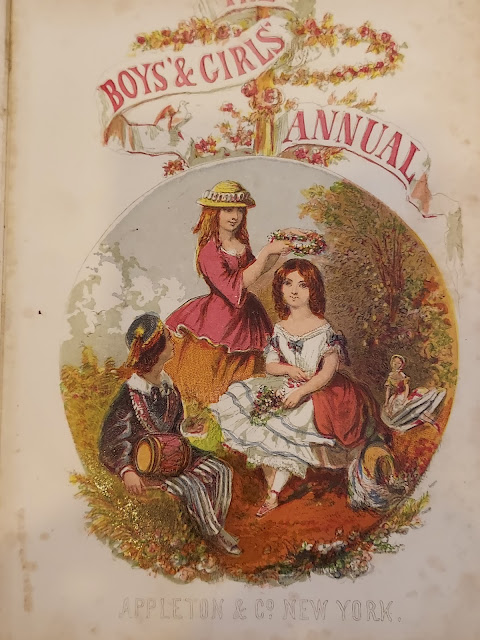

Imagine the March girls, all dressed up.

Partly as a result of the recent private library purchase, though also (at least initially) as an escape from present concerns and worries, I read a lot of books from past American centuries during August. The first several on my “Books Read” list do not reflect that direction, but remember, I always have several books going at once. Anyway – or ennaway, as the Norwegian farmers say -- here they are:


Books Read August 2024


117.        Justice, Damaged. The Devil You Know (fiction). This book is the first in a fan fiction trilogy. If you are not familiar with fan fiction (I was not), here is my take on it: The writer begins with characters and a universe already established by another writer or writers, either in book form or (often) in a television series. The Devil You Know brings together characters from two different series, “Dexter” and “Buffy the Vampire Slayer.” Dexter Morgan, a serial killer of serial killers, enters the world of vampires, other demons, and their Slayers, thanks to his talented stepdaughter. Dexter’s sister, Deb, a foul-mouthed cop, gets in on the action, too – and there is plenty of action, but also a lot of emotion, along with the questioning of emotions and perceptions, all vividly written to keep the reader turning pages until late in the night. As far as Damaged Justice (a pen name) knows, I am the first reader of The Devil You Know who came to it with no background in either Dexter or Buffy, and it still worked for me, as I was able to pick up the characters’ backgrounds as their story moved along. If you would like to read this book online, here is the link. 


118.        Taleb, Nassim Nicholas. The Black Swan: The Impact of the Highly Improbable (nonfiction). When something unpredictable occurs, some event that carries a huge impact, we make up narratives after the fact to explain it, as if we should have seen it coming. This denial of the randomness of the universe is itself universal, Taleb writes, but we can learn to inoculate ourselves against the effects of black swans while positioning ourselves to benefit from them when they appear. Fascinating ideas from a highly original thinker.


119.        Trevor, Douglas. Girls I Know (fiction). Walt has dropped out of his graduate program at Harvard and now works half-heartedly but contentedly at a couple of low-level jobs that allow him to stay in Boston, his only life ambition to stay in Boston and have breakfast every day at the Early Bird Café, where everyone knows him. Maybe he will ask the waitress out on a date. Calm, ordinary life is shattered when a shooter enters the café and kills the owners and waitress. The shooter’s gun jams, however, when he tries to pull the trigger on Walt, who must then stagger on with the rest of his life. Becoming friends with a rich, hyperactive undergraduate girl obsessed with a nonfiction book project challenges both Walt and Ginger in their assumptions about life. And then there is Mercedes, the child of the dead restaurant owners, who hasn’t spoken a word since her mother and father were killed. Can Walt really help her? The city of Boston is a major character in this book of ordinary people making their way through trauma and confusion.


120.        Rives, Hallie Erminie (Mrs. Post Wheeler). The Magic Man (fiction). I did not intend to read this novel. It had the look and the opening chapters of hundreds of other 1920s novels, all set on the East Coast and featuring beautiful rich girls. Surprise! Something much more interesting entered the story, as the rich girl’s scientist father sets up an experiment with an amnesiac would-be burgler to prove to one of his European colleagues that environment makes all the difference in the production of criminals vs. successful, honest adults!


121.        Olson, Jim. People of the Dune (fiction). One review of Jim Olson’s book, his first novel, called it a parable, and that seems fair. It’s also very clear from the beginning where Olson’s sympathies lie: European immigrants are the “Invading People,” and the mining company moves its equipment in “like vultures circling their prey.” For me, though, the book came alive with the judge’s change of heart, over 100 pages into the book.

"With the pressing collapse of earth’s viability (e.g., the water cycle, biological diversity, climate, and so much more), it may be that the punishing expectations and entitlement of the law of private property can no longer be tolerated. The earth’s viability for supporting life is in the crosshairs. How did the right of private property get to the point where it leads to the death of nature’s web on which all life, even the right to property and profits, depends?"

Good questions. Important questions. Where will we go from here? I remember a couple of precedents for this story from the late 20th century, a “Save the Dunes” that fought Bethelemen Steel in Indiana in the Sixties and another in the late 1970s focused on shoreline in southwest Michigan. See https://www.burnsharbor-in.gov/203/Local-History and https://www.casemine.com/judgement/us/591489d1add7b049345087cd

 Whatever your sympathies or intuitions about property before you come to Olson’s book, you will find yourself challenged. Clearly, the author himself has wrestled with these ideas for years, and so this is an important book, with everything in our world at stake in the legal outcomes of cases, large and small, such as the fictional one described, in our country’s court system. 


122.        Skinner, Cornelia Otis & Emily Kimbrough. Our Hearts Were Young and Gay (nonfiction). After the well-deserved success of this notable bestseller, Emily Kimbrough went on to write other humorous travel books, all of which I devoured with glee in my younger years. Now I am rediscovering the innocent times of those two young women, traveling “independently” (with letters of credit from their parents, although they had worked and saved to pay their ocean passage themselves). Cornelia and Emily were traveling in the 1920s – 100 years ago! – so naturally the work is dated, and yet, how much does human nature change from one generation to another? And when did I last laugh so hard, unable to stop even when my confused dog jumped up to cover my face with kisses? Good medicine to counteract a surfeit of news and work!


123.         Woolson, Constance Fenimore. Anne (fiction). Drawn by the promise of a Mackinac Island setting, I have long wanted to read this novel, and finally a copy came my way. Anne, a novel often identified as feminist fiction, opens with the eponymous young woman’s life on the island, her mother and stepmother both having died and her father having faded into a dreamlike, unremunerative idleness. Still in her teens, Anne has charge of a household that includes four little half-siblings, three boys and a strange, fey little girl. When the father also dies and Anne learns for the first time how perilous is the family’s financial situation, she realizes also that she must prepare herself to make a living, and so, several chapters into the story, she enrolls in a private Eastern school for girls. I won’t spoil the story by detailing all the twists and turns the plot takes (there are many surprises), but know that at last Anne returns to Mackinac Island, her soul’s home. 


124.   Aldrich, Bess Streeter. A Lantern in Her Hand (fiction). Probably the best-known of this Nebraska author’s works, Lantern tells the life of Abbie from girlhood dreams through motherhood on the prairie to her peaceful death, alone with her memories. This novel is historical in that it depicts in detail a period long ago. The characters, however, are ordinary people, not generals or presidents or princesses, and probably we enter more wholeheartedly into their lives because of that. An American story of honest, hard-working, 19th-century Midwesterners. I loved it.


125.   Brooks, Geraldine. Dames and Daughters of Colonial Days (nonfiction). Short biographies of girls and women beginning with Anne Hutchinson, this was a book I ordered by mistake. A happy mistake, as it turned out. Very enjoyable reading.


126.   Dwight, Margaret Van Horn. A Journey to Ohio in 1810 (nonfiction). Better to read about than to endure this journey of wagons mired in mud, wagoneers rude and blasphemous, horses beaten, the young woman keeping the journal forced to walk miles on end and often sleep on floors in roadside inns. Very interesting window, however, into weeks and weeks of uncomfortable and sometimes dangerous travel from the Eastern seaboard through the wilds of Pennsylvania to Ohio, seen by a young woman who recounts her adventures mile by mile in a journal destined to be sent, when the destination is finally reached, to her best friend back home. 


127.   Sitwell, Osbert. The Scarlet Tree (nonfiction). Have I been the only person in the U.S. falling asleep over Osbert Sitwell’s memoirs after a luscious, sybaritic session of bedtime reading? His long, lovely sentences, his sensuous descriptions of flowers and music I found completely delightful and soothing. The schoolboy bullying he endured was not a comfort. How could his family pretend not to notice those black eyes? In the end, however, even the mean boys turned out okay, it seems. Or so he says.


128.   Gallagher, Nora. Changing Light (fiction). Sent to me by a dear friend, this novel is set in New Mexico during the very secret development of the atomic bomb. A woman from New York has bought land and built a small house where she can paint, far from her artist husband’s jealous criticism. A Czech physicist, working on the “gadget,” has come to see the danger to the world presented by the bomb and wants to prevent its use. And a Catholic priest finds himself in the middle and unsure what he should do. The plot was complicated by possible spies, but for me the ambience of the setting was the novel’s strongest feature.


129. Marron, Dylan. Conversations with People Who Hate Me: 12 Things I Learned from Talking to Internet Strangers (nonfiction). Okay, so he was a "digital content creator," and he lived online. As an openly gay liberal male with strong opinions, Marron quickly found himself the target of hateful comments. After trying a variety of ways to deal with the hurt, he came up with the idea of looking up the haters for conversation -- and that's where things get not only interesting but heart-opening and mind-opening. You need to read it for yourself.


Weather Notes


Our weather has been dry for way too long. We’ll get a stretch of hot (for northern Michigan), muggy weather and clouds, even forecasts for rain, but where are those promised showers? We were supposed to have thunderstorms off and on all day Friday, but only the barest of sprinkles did we see and feel. My farmer friends are hoping not only for rain soon but also for a cold winter with lots of snow, unlike our last winter that almost wasn't.


Garden Notes


At home, my tomatoes are showing a little color at last, jalapeno peppers are shaping up nicely, daisies and phlox are almost ready to give way to anemones and chrysanthemums – and I want to shout, “No, no! It’s too early for 'mums!” Happy about those nightshades, though, by which I mean the peppers and tomatoes. 


Though mention of nightshades reminds me to mention and show wild fungi that have appeared in my yard and near neighborhood recently. I let the puffball grow a few days before harvesting it for my kitchen. 


Boletes, on the other hand, I am collecting only with my phone camera. They are too numerous and, for me, too confusing to try to identify as edible or poisonous. And yet they are fascinating! I don’t remember seeing them before. Ever since our last mild winter, 2024 has been an unusual year….


Dog Notes


While I look forward to another visit soon from our Arizona hiking buddies, Little Miss Oblivious, a.k.a. Sunny Juliet, makes do with her dog momma’s company. She is starting to catch onto Frisbee, with the indestructible version known as “Hyper-Pet.” Of course we still have tennis ball play and agility practice, and she still has (kept outdoors) her treasured old raggedy boot, found in the orchard when she was only a puppy.


Bookstore Notes


Today, though, I can’t close with dog notes, because last Thursday Dog Ears Books had a very special visitor, the senior U.S. senator from Illinois, Dick Durbin. It was Senator Durbin’s second visit to my bookstore, and this time, while I forgot to ask him to write in the guestbook, I did remember to get photos. Thank you, Senator Durbin, not only for your visit and your book purchase, but for all you have done in service to our country!


Sunday, January 14, 2024

Snowbound!

Early Saturday afternoon, 1/13/24

Winter has finally arrived in northern Michigan. Almost halfway through January, we are having the weather that many years has landed on us as early as November – cold winds, snow squalls, heavy accumulation and blowing and drifting. Lots of horizontal snowing, Friday from the south, Saturday from the north, Sunday morning from the west, as far as I can tell. Everyone, in villages and countryside, is praying we don’t lose electrical power. The power company was busy clearing trees away this past fall, but those of us in the country, on wells and without generators, took the precaution ahead of the storm of filling large containers with water, because this is not our first rodeo.

Snowy Juliet

Sunny Juliet loves the snow and doesn’t seem to mind the cold wind. She will often put her nose and paws to work to unearth (unsnow?) hidden treasure, which could be – and has been more than once -- a mouse nest or a deer leg. I’m relieved when it’s only a windfall apple.

What's under here?

An apple!

You might guess that, besides water, I am prepared with plenty of books for a snowbound siege. On the serious end of things, I’m halfway through Angus Deaton’s Economics in America and should finish it soon, though it isn’t the book I expected. Rather than a unified treatise on how the American economy is put together and how it works overall, the book is a compilation of various shorter pieces written by the Scottish author (who is at now Princeton now and has lived in the U.S. for a couple of decades) over a long period of time, updated and introduced for this volume. There is a lot in it about economic inequality (as well as what he calls “relational” inequality), with closer looks at American health care costs and retirement finances, all of which he is able to contrast with those overseas, usually in the U.K. and Europe. So far my favorite observation is this one: 


Chicago economics gave us a healthy respect for markets, as well as a previously underdeveloped skepticism about the idea that government can do better, but it left economics with too little regard for the defects of markets and what they can and cannot do. Not everything should be traded. The profession bought too far into the idea that money is everything and that everything can be measured in money. Philosophers have never accepted that money is the sole measure of good, or that only individuals matter and society does not, and economists have spent too little time reading and listening to them.


It isn’t often that anyone outside academic philosophy thinks that philosophers deserve a listen, so thank you, Angus! Here’s another bit in the discussion of Chicago economics and Milton Friedman that I found thought-provoking: 


Friedman dismissed much of inequality as natural; some people like to work hard and get rich, while others prefer to enjoy their leisure. Some like to save and build up fortunes for their heirs, while others are more concerned with their own immediate enjoyment. Any attempt to diminish this sort of inequality would penalize virtue and reward vice. 


A couple of thoughts come to mind here. 


Hard work does not necessarily lead to riches. My maternal grandparents were some of the hardest-working people I’ve ever known, and I know people today, younger than I am, who labor intensively for hours no rich person would ever consider and who will never be rich. Sometimes their hard work is a choice, while other times it is not choice but necessity. There are plenty of people who work hard, do not get rich, and have little leisure. Friedman’s dismissal (if Deaton has summarized it fairly, and I have no reason to think otherwise) is an oversimplified false dilemma. Life is not that either/or.


For those among the not-rich, whether hard workers or otherwise, if they have chosen a way of life that does not involve hard work and are content with not being wealthy, why should this be seen as “vice”? And why is working to accumulate wealth, apart from other life goals, to be considered “virtuous”?


Economics fascinates me. I have never understood people who hold strong political views, many of them based on economic policies, who have never themselves explored the subject of economics but rest content with a chosen ideology.


My snowbound reading, however, is not all so serious. My own home bookshelves turned up a children’s book I don’t remember ever reading, The Trolley Car Family, by Eleanor Clymer and illustrated by Ursula Koering. Published by David McKay, with a copyright date by the author of 1947, The Trolley Car Family opens with Mr. Jefferson, grouchy next-door neighbor of the Parker family. Mr. Jefferson has to hitch up his horse and wagon in the middle of the night to deliver milk while the rest of the neighborhood is still asleep, and when he comes home to try to sleep, the Parker children are always making noise. 


Mr. Parker is a motorman on a street car, and (unlike Mr. Jefferson) he loves his job. Complications arise when the trolley company decides it is going to transition from trolleys to buses. Buses! 


“Always hated the durned things,” said Mr. Parker. “They won’t stay on a track. You never know what they’ll do, careening all over the street. Now with a street car, you know where you are. But with these buses, the cars are all the time swooping in and out around you. I don’t like it.”


“I don’t blame him,” said Mrs. Parker. “I never did like to see a man do something he didn’t like.” 


Things take what looks like a temporary turn for the better. When Mr. Parker is able to buy his old street car and rent a piece of land five miles from town, and Mr. Jefferson offers the use of his horse and wagon to get the street car from the end of the line to the rented land. The Parkers invite Mr. Jefferson to come along, and he obtains vacation time to do so.


Everyone is happy except for reminders that this summer idyll is not a permanent solution. Sally, the oldest Parker child, reads the writing on the wall.


…The boys could hardly wait to be grown up. They were going to do such wonderful things! But Sally had a feeling that it wasn’t going to be so easy. When you were little, you thought that grownups could do whatever they liked. But lying there in the twilight, listening to their voices, she knew that they couldn’t.


Pa and Mr. Jefferson just wanted to stay out here, milking the cows, or weeding the garden. But Mr. Jefferson had to go back to his job, and Pa would have to find a job soon, and they would all have to go back to town and leave this nice place. And Ma knew that Pa liked farming, and felt sorry that he would have to stop. But they couldn’t do as they liked. They had to think of the children. The children had to go to school, and have meals and clothes. So the grownups had to work.


Sally felt like waking the boys up and telling them what she had discovered. But she knew it wouldn’t be any use. They were too young. 


Of course, this is a book for children, a mostly happy book, where all ends charmingly for everyone, so I managed to enjoy it without thinking too much about Earl Butz coming along with his “Get big or get out!” policy for small farmers, but what a coincidence that a bit of this mid-century children’s book should echo some of my thoughts while reading Angus Deaton on economics….


I have also started Eagle Drums, by Nasugraq Rainey Hopson, and want to get back to Henry Van Dyke’s Little Rivers, and then there is a beautiful little antique volume I received as a Christmas present, Le marquis de Grignan, a book about Madame de Sévigne’s grandson by Frédéric Masson. 

– Oh, oh, oh!!! And it’s about time I start re-reading Bonnie Jo Campbell’s The Waters, too! Plenty to occupy me for as long as this winter storm lasts!

Watching from indoors...

...with my girl by my side.