Search This Blog

Showing posts with label age. Show all posts

Friday, January 29, 2021

Falling Behind and, In Doing So, Making an Accidental Discovery


Snow-covered mountain


With so few demands on my time, I am still falling behind, because -- well, so few demands, yes, but those so very demanding! You know the name of one of them without my mentioning it!


Mountain, raven, dog


What I’m falling behind on, besides my Silas project, is writing on this blog about books I’m reading. It’s all been dogs, dogs, dogs and mountains, desert, snow on the blog for quite a while now. Not that I’ve heard any complaints, of course. After all, so many of you are stuck indoors with your own reading and movies and baking and knitting and whatnot that I realize the allure of vicarious outdoor adventures.


Be assured, however, that today’s indoor bookish adventure will not be a long, dry discourse on economics or history. In fact, the book I want to write about is one I picked up to “take a break” from more serious reading, a book that aided me in falling behind with book reviews I have in mind to write and post. A beat-up paperback (I taped it back together) from the outdoor 10-cent table at the Friendly Bookstore in Willcox. A murder mystery. By an author whose name faintly rang a bell in memory but whose work I did not recall ever reading before. 


Here it is,


and how could I resist the title, after our little reading circle back in Michigan initially came together years ago precisely in order to read together Ulysses, by James Joyce? The tempting volume, small in size, light in import, also seemed a perfect car book. Do you have those? The Artist and I always have one or two books apiece in the car, so one of us can read while the other is running an errand or so we’ll both have something to read on the porch at Source of Coffee -- although we generally end up in conversation on that porch instead, at least with each other when not also with a friend or two.


But I digress (digression being the prerogative of a blogger without an editor). 


In The James Joyce Murder, by Amanda Cross, protagonist Kate Fansler, professor of Victorian literature, is ensconsed in a country house in western Massachusetts, working (at the request of the heir, a cloistered nun) to determine the contents and bring order to a collection of literary letters and papers left behind by a late friend of her family. She also has the care of a young nephew for the summer. Two graduate students complete the household, one working on the collection, the other tutor and companion to the boy, and rural neighbors and academic friends fill out the cast of characters, with cameo appearances by various policemen, a car mechanic, and a publisher in New York.


Confession: I did not find the story completely engrossing. The language put me off, for one thing. “The conversation is like something in an English drawing room comedy,” I complained to the Artist. A paragraph from the protagonist’s mouth in the first chapter will serve. 


“Familial connections are always difficult to explain, and impossible to sever. Not that one really wants to, I suppose. However trying one’s family, there is some call of blood to blood which one is somehow impelled to answer. I have nothing in common with any member of my family, and yet in crisis, personal or national, one always rallies round.”

-Amanda Cross, The James Joyce Murder 


In the paragraph above, Kate is talking to a close friend, but doesn’t it sound as if she’s speaking lines in a stage play? And everyone talks that way in the novel, page after page. Too witty for belief! My credulity was strained. But the reading required no great effort, dialogue makes a story go faster, and the whole book wasn’t that long, so I kept at it, a few pages at a time. 


It took a long time before anyone turned up dead. When the corpse was discovered, it was hardly a surprise, as it was someone whose death no one seemed to mourn. Certainly her husband did not, nor any of her neighbors. (The children did not appear and so were not asked in the pages of the book.) From the first introduction of the poor, doomed character, obviously marked for an early grave, I felt the author and everyone else judged her far too harshly. She was annoying, but is that a sin, and shouldn’t people with serious, rewarding careers and the good fortune to pass their summer in idyllic surroundings have better things to obsess about than a neighbor they don’t find congenial? Still I persevered and discovered, at last, who done it.


A far more interesting story came to light when I read a brief biographical sketch of the author at the end of the book and found that Amanda Cross (some of you undoubtedly know this already) was a pseudonym for Carolyn G. Heilbrun, author of fourteen nonfiction books under her own name, the first woman to earn tenure in the English Department at Columbia (her specialty was British modern literature), Avalon Foundation Professor in the Humanities at Columbia University, MLA president in 1984, and outspoken feminist. When she “discovered” feminism in 1968, she felt she had been “born a feminist.” Married to economist James Heilbrun after they met in college, she was the mother of three children when she went on to graduate school herself. A “nontraditional” student: I could relate to that. Her strong views on feminism were matched by strong views on other subjects, as well, particularly her desire not to live beyond her usefulness, and she planned initially to commit suicide at age 70 but lived until age 77, when she took her own life without any preceding fanfare or crisis.


Heilbrun frequently skewered academics under her pen name, but The James Joyce Murder was published almost two decades before the biggest controversy in her own life, a tempest that arose when she accused (in an interview) her own English Department at Columbia of discrimination against women. To my ear, the charge hardly seems controversial by now. How, I wonder, could anyone doubt discrimination in 20th century academia? Was there any college or university department in the country that had not discriminated against women, as well as against candidates and department members of color?


Kate Fansler may have been the pseudonymous author’s alter ego, but when reading of Heilbrun’s life I saw her retrospectively in a minor character, also, that of Grace Knole, retired professor of medieval literature, and my retrospective look back at a book I just finished reading is also a look ahead to the older age of an author who published the book when she was only 41 years old. Here, anyway, is Grace Knole speaking to Kate Fansler, urging her to accept the presidency of her college. Kate has suggested that Grace should be president instead.


“I agree with you, actually. …But people these days want their college presidents young. To be frank, I can’t imagine why. It seems to me that college presidents, like popes, out to be old when appointed: they can then afford to take risks, and they can’t live on too long and get set in their ways. That, however, is not the American way.”


For 26 years prior to her suicide, Carolyn Heilbrun had gone for a daily walk with her friend, art historian Mary Ann Caws. During their last walk and conversation, amidst talk ranging from Darwin and Manet to women’s poetry and the state of the world, Heilbrun commented that she “felt sad.” “About what?” her friend asked. “The universe.” Apparently Caws did not attach particular significance to that brief exchange and confidently anticipated their regular walk the following day.


Carolyn Heilbrun had a good life – happy marriage (her husband “read every word she wrote”) and children combined with independence, friends, and a successful career – but it sounds as if she had grown tired. 


Mountain sunset


Soon I want to read one of Heilbrun’s nonfiction books, The Last Gift of Time: Life Beyond Sixty. The title sounds so familiar that I wonder if I may have read it already, but it would have an added dimension now that I know more about the author’s life – and as I move on beyond 70 myself, kept lively by a most lively-minded human partner and, for now, a more-than-lively young border collie.


Peasy!

Monday, March 18, 2019

Happy Mountain Trails: I Passed the Test!


Reading, Beforehand the Challenge

Back in spring of 2015, my hiking guide from the Dragoon Mountains adventure and I set out to explore the old Fort Bowie road, planning to hike in from the road to the ruins of the fort. Sadly, a flat tire and a long wait for road service (a “donut” tire would not have gone far in the mountains!) ate up much of the morning, and as she was no longer confident on the unpaved, washboard road, full of sharp rocks, we went back to the highway and continued southeast to Chiricahua National Monument. The biggest error of that day, though, was taking Sarah along. Let me say only: dogs on leashes — not good for hiking in mountains! 

So this year, when my neighborhood dog-walking companion and I made a date to hike in Chiricahua, we agreed: no dogs! This was one adventure Therese and I would have without Buddy and Mollie and Sarah.

I was up before the sun on St. Patrick’s Day Sunday morning, with absolutely the perfect pre-hike reading, a copy of Range Roaming: A Birdwatcher’s 65-Plus Year Love Affair with the Chiricahua Mountains, by Betty Jones, published by the family after the authors death. I’d left off reading the night before at the end of the chapter just preceding the one on the Chiricahua National Monument, and so with my pre-dawn, pre-hike morning coffee I read about Betty’s camping and hiking and birding in the Monument itself (the Monument being only a small part of the entire mountain range), continuing after the sun had risen to the next chapter, on birding in Patagonia, where friends of ours wintered for years and where we visited them in their last year of life. That brought a few sighs, I must say, as I inspected the map closely to locate Jim and Linda’s house with respect to the creek we had forded to get there on our first visit back in the 1990s….

Range Roaming isn’t the easiest book to read or navigate, for a couple of reasons. One confusing feature is that the sketchy maps — and don’t get me wrong: I’m glad to have even sketchy maps — are not all presented in the conventional manner with North at the top of the page. In the various maps throughout the book, North can appear at the top, at the bottom, on the side; in other words, it might be anywhere. I kept turning the book around in my hands to put North at the top — but that meant trying to read the names of identified features (roads, paths, peaks, etc.) upside-down or sideways. As I say, not easy.

Another problem — for me — is that it’s obvious the manuscript preparation was not professionally done, and my inner editor and proofreader were working their fool heads off practically nonstop as I read. But that’s a personal comment, not a harsh complaint, because I am very happy to have this book, which is nothing like anything else I’ve seen on the area. It’s worth its cover price, even if the possessive its and the contraction it’s, among other little niceties of grammar and punctuation, failed to get sorted out before publication. 

Many of the hikes Jones took are no longer possible, and neither can people still camp everywhere she did, as land open to her in the 1960s and 1970s is now off-limits to the public, but other trails and campgrounds are still available, and her descriptions of the wildflowers, birds, and butterflies a visitor might hope to encounter are enough to whet the appetite of the least-educated amateur naturalist. (In fact, I can’t help regretting in advance that I will not be able to explore Chiricahua in the summer, during the exciting thunderstorms and when the bright red flowers and the various species of hummingbird that feed on them will be on full display.) I also appreciate the history of the Monument lands included with the author’s boots-on-the-ground adventures. Reading of work accomplished by the Civilian Conservation Corps, for example, I think proudly of our older Minnesota grandson and his summer work along those same lines. And while I knew the Buffalo Soldiers had played a large role in the history of southeast Arizona, I did not realize before reading it in this book that they “briefly occupied the grounds on what is now the Faraway Ranch Historic District.” This is the kind of history that means the most to me — very local history of specific individuals and groups, such that I can picture a place I know and imagine the people working there over the years.

One distracting but delightful surprise to interrupt my reading was a roadrunner on the railing outside the front door! That was a first! They come in the yard, but I’ve never seen one on a railing before. Of course, my camera was not near my reading chair, and the roadrunner fluttered down and ran down the driveway before I could try to capture the moment.

And Afterward!!!!!

Entering the Monument: Mule deer grazing
Words cannot do it justice, and photographs cannot hope to get across the wonder of Chiricahua, but words and photographs are all I have. 


The map above comes from William Ascarza’s book, Chiricahua Mountains: History and Nature, an excellent general introduction to the mountains, though without the personal tone and on-the-ground detail of the Betty Jones book. As you no doubt are thinking, the Echo Loop trail (just to the left of Massai Point) as it appears on the map doesn’t look like much of a challenge. It seems to take in a very small area of the Monument, which is itself only a small portion of the Chiricahua Mountains. A mere three miles? That’s the official distance given for the trail. A walk in the park, you say? Ah, but the first half of the hike is all descent into the canyon, the second half a return up-mountain to the parking lot, with absolutely no possibility of cutting the mountain goat hike short once you have committed to its entirety by reaching the lowest elevation. There are no roads down there, and the only way back is up, on foot.


Hikers who have commented online occasionally dispute the 3-mile official distance. One measured the Echo Loop hike as 4.1 miles, another as 4.3, and Therese warned me it would feel like at least four miles. I thought it felt more like eight — but then, I am in my eighth decade of life, and that probably makes a difference. 

Ah, difference! Difference in elevation is what really makes the challenge, and that you don’t see on the trail map. Officially, again, the change in elevation from top to bottom is given as 554’, but again, at least one hiker’s family was sure they had descended and reascended 750’ on the Loop. But I should add that Echo Loop is the Monument’s most popular trail, and no one who left a comment online failed to note its beauty and grandeur, i.e., no one was complaining! And I’m not, either, just kind of bragging, I guess, though younger, sturdier, most experienced outdoor adventure people don’t see this hike as bragging material.


Horses were here...
Okay, here’s a bit of what it’s like. The trail is narrow for almost its entire length, with dizzying drop-offs to the side. A few stretches have stone steps built in, others are loose rock and scree, while occasionally dirt or mud (there was a lot of precipitation this past winter) registered prints of horses’ feet. The evidence of horses on the trail amazed me, all the more the farther we went. The horses had done the entire trail, stopping to refresh themselves at the creek near the end. I kept thinking of the horse named Whiskey in the movie “Lonely Are the Brave” and told Therese she has to see that movie.

...on this very narrow trail!
(What would it be like to travel Echo Loop on horseback? It is difficult enough to take in all the scenery. A hiker has to watch his or her footing pretty continually, for starters, but one wants to inspect closely the beautiful lichens and weathered dead trees close at hand, as well as — of course! — looking up at the magnificent hoodoos and out across the long vistas that are sometimes all rock, sometimes forested slopes, occasionally a glimpse back down into the Sulphur Springs Valley. If, in addition to these desires, were I on horseback I would also have the distraction of wanting to pay attention to and praising and encouraging my brave, wonderful horse. It might be too much for me.) 


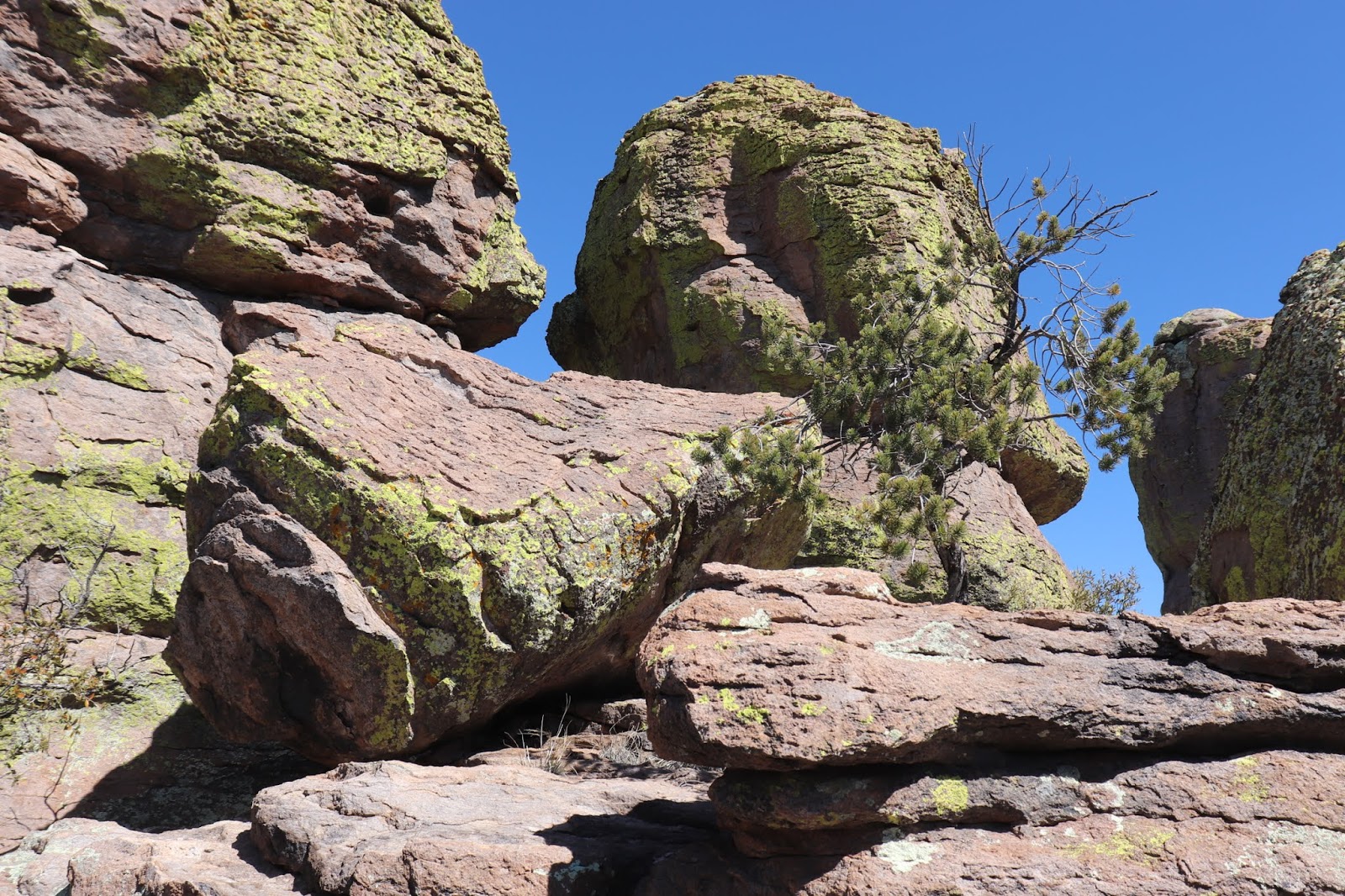
The “standing-up” rocks defy comprehension -- but so do the ordinary lying-down rocks. Thoughts of their origins and great age, the erosion that has created their present form over millenia, and the knowledge that millions more years will change them utterly from what they are today — all these things deepen the appreciation of anyone viewing their magnificence. What stories the trees could tell! Little lizards scooting about and sunning themselves probably think nothing of earth’s history, only of what they will eat next and how good the sun’s warmth feels.


There were parts of the trail where the wind was cold and biting, other parts, later, farther on, where we shed our jackets and basked in the sun like lizards. We enjoyed our lunch, for instance, in sunshine, and I never did put my jacket back on, as carrying it on my backpack, while burdensome, was the lesser uncomfortable choice. When my camera battery gave out before the halfway mark, I had to resort to my phone for photographs but took fewer even of those as we neared the elusive end of the trail. Luckily, the camera was still working when we saw before us this adventurous young woman on top of a high perched rock.

I could never attempt such a feat! Could I even make it all the way around the Loop? There is no alternative! Therese and I gave each other sour looks as a young jogger passed us on the trail. Show-off! “He’s only in his twenties,” Therese said to comfort me, as I insisted on yet another stop to rest and take in water. My hiking guide and companion, who knows the trail very well from years of experience on it, was very patient with someone old enough to be her mother. She was very happy that my enthusiasm, if not my energy, matched her own.

The rocks!


"Balanced" rock


Obligatory classic goofy pose
There were also cool, dark places, very welcome once the sun had warmed up the day. 


I was glad we did go all the way to the bottom of the trail, even though it meant having to go all the way back up, because thanks to all the rain and snow this past winter the creeks were running cold and fresh. This section of stream with a series of pools and miniature waterfalls was worth all the effort it took to reach it. 


The fact is, there were many people on the trail that day. It was a Sunday and spring break, and the weather could not have been more beautiful, so we let many parties of younger people go around us. One unexpected encounter with a couple from Quebec (while I was resting yet again) gave me a chance to speak French, always a spirit-lifter. But really, the scenery was spirit-lifting the entire time we were on the trail. We heard someone telling another person that the trail could be done in two hours. That annoyed Therese, who thought the estimate short of reality — and reality for us, because she had me with her, slowing her down, was that we were on the trail over four hours on Sunday.

Oh, the combinations of trees and rocks, each one more enchanting than the one before!


The farther along the trail, however, the more frequent my need to stop and rest, drink water and inspect every miniature landscape within sight, along with taking the long views outward. The last two-tenths of a mile, for me, seemed endless — or, at least I thought that was the longest, most difficult stretch, climbing ever upward (or should I say trudging?), until we were within sight of the parking lot again — and then I thought the last 200 yards were the longest distance I had traveled in my lifetime. 

Miniature landscape
But this old lady made it! She was not voted off the mountain but staggered on until the very end!

Of all the glorious and truly awesome views I took in that day, one that speaks volumes to me is this simple image of a manzanita sprawling and blooming on a large flat rock on the edge of the mountain. Its aesthetic Japanese, it is an entire landscape in itself and illustrates beautifully the plant’s tenacious perseverance, dogged survival, and adaptation to environment. 

One more thing I have to say. I kept thinking of Cochise and the other Chiricahua Apaches and how their homeland was stolen from them and they banished to, of all places, Florida. How could any people who called this place home ever be happy anywhere else? 


But also -- one more thing -- my hat is off to Betty Jones and all her miles and years of hiking and learning in the Chiricahua Mountains. Good job, Betty! I have a tiny idea now of the great lifetime you accomplished.


Wednesday, September 13, 2017

I Am Ten Years Old

I'll explain at the end.
Ten! Not my bookstore. Dog Ears Books is (only!) 24 years old. And not me personally (and never mind about that number). No, it’s “Books in Northport” that is officially ten years old today, September 13, 2017, marking a complete decade since my first blog post.

Who would ever have imagined it a decade ago? David and I did not even have Sarah yet! It’s possible her actual birth occurred on this very day, though I use September 10 as her birthday, since when we found her at the Cherryland Humane Society and adopted her on January 10 we were told she was four months old. But the blogging bug had bitten me earlier, back at the beginning of the autumn of 2007.

In September 2007 I set out on an experiment. Looking back now, I’m glad to have taken advantage of this modest form of self-expression because, thanks to a decade of entries, I can look back not only at words but also at images from my life, from random sights I would otherwise have easily forgotten to carefully planned personal or community events. My “Books Read” lists, visiting authors and family, friends old and new, vacations, rambles (mental and physical), and more than a few rants (though belatedly I set up “Lacking a Clear Focus” for the least bookish of my opinions and other life flotsam) – all these form the log book of my journey over the past ten years. I did not, in 2007, imagine ten years of blogging. But neither did I foresee, in 1993, 24 years of bookselling. “I always wondered,” someone said to me once on a very different subject, “how it happens. And now I see. It happens one day at a time.”

A notion that fascinates me is a little pop meme going around, to the effect that each of us has a “true age” that captures our essence. You’ve heard it said of a toddler or a puppy, “She’s an ‘old spirit.’” Certain individuals seem to be born wise beyond their years – or prematurely middle-aged – while others of us retain a certain childishness (not to put too fine a point on it) clear into old age. No doubt there are self-tests one can take to determine one’s “true age,” but as soon as David and I understood the idea, we needed no tests to know that he is 14 years old and I am 10.


Ten years old. Fourth grade, crazy over Walter Farley’s The Black Stallion, suffering the pangs of transition from child to pre-adolescent. Socially awkward, physically immature, intellectually curious, and quivering with secret fears and dreams, at the age of ten I was more comfortable exploring the natural world of the world of books on my own than venturing into “society.” This has not changed, but I have come to recognize shyness and uncertainty in others, and when they enter my bookstore world I try to make them feel welcome and comfortable.


And now “Books in Northport” is as old as I am (or as my soul is). Back in the mid-20th century when I was born mankind knew only handwritten diaries, but guess what: these very words that you are reading now in Bookman Old Style font on your lighted screen first came into the world on the yellow pages of a legal pad, scrawled in pen, in the pre-dawn hours of a cool August morning (I was planning ahead), as a ten-year-old girl disguised as an aging woman sat on a porch light near an open window, dog by her side.


Will I ever grow up? Doubtful. Will I live forever? Impossible. But we are here now, you and I, on this beautiful, crazy, cruel, and miraculous planet, and I am glad for your company. Thank you for your company on my journey.

That horse up there at the top of the post? Well, you know, I am stillcowgirl in my dreams!


And for those who like counting, this is post #1721.

Monday, May 20, 2013

This Blog Is a Lie


Not entirely, because I do love my life, and I am grateful for it and take joy in it. All that is true. So my blog isn’t a complete lie, but neither is it the “whole” truth, because the pain is as real as the pleasure.

Between me and the road to the woods, a new row of cherry trees
Orchard advances on our old farmhouse, on leased land around us, like an encircling army, coming closer every year. NO ENTRE signs warn of pesticides, and our freedom of movement on all sides is more and more limited – with each passing week, it seems. Our neighbors’ dogs and our Sarah can no longer be allowed to run on the hill between their house and ours, as rows of trees now march up and down that hillside. Of course, the dogs don’t understand. 

When our grandson and his friends visit, they like to explore a certain path to Lake Michigan that has been part of grandson David’s world up here for all his life, as it used to be part of our own before so many big, new houses were built along that stretch of shoreline. The last time the kids were up, I heard from a friend who lives in one of the big houses that “young people – strangers” had been seen on the beach! On private property! This same friend was upset a few years back when a new house was planned on property adjoining that which she and her husband own. “It will be lost to us!” she cried. I told her it had been lost to the rest of us a long time ago. Our grandson, a young man of boundless goodwill and no troublemaker, has not yet accepted the loss.

My husband used to have a house down in the woods in what is now part of Sleeping Bear National Lakeshore. We love the Lakeshore and are happy it is public land rather than condos, though it still feels like home to us, very personal. But all visitors are equal under the law, and our dog cannot run off-leash in the old meadow, even under our supervision. I feel as much on the leash as my dog and chafe at the restriction. It’s “the Meadow,” our special place! No one cares.

A few years ago I discovered a lovely wooded ridge with a new road down below and a foot trail along the ridgetop. There were wildflowers in the spring and berries in late summer and early fall. Only once did Sarah and I meet anyone else there, and it was another woman with her dog, and we enjoyed the company. I knew all along, though, that it was only a matter of time before houses would be built there, as the land had already been divided into lots, the road brought in, utilities provided. Last year the first house appeared, halfway down road. No more ridge path exploring.

Another semi-wild spot closer to Northport, old orchard land, was handy for short, quick off-leash expeditions. A golf course is going in there now. Orderly recreation. Lots of people will enjoy it.

More and more I understand the father of the protagonist in Conrad Richter’s The Awakening Land trilogy, who dragged his family from the Pennsylvania woods to the Ohio Territory because Pennsylvania had become too “crowded.” We are fortunate in Leelanau County to have lovely nature trails. I know this. I appreciate the trails. But following a trail, staying on a path, with other walkers and hikers ahead and behind, is not the same as being alone in the woods, and it isn’t anything at all like exploring.


Then there is another, more universal aspect to loss, which is that each passing year brings advancing age and, with it, hovering clouds of future physical limitation. Two or three years ago, for the first time, when I was out hiking wooded hills with my dog, the footing somewhat treacherous, the thought occurred to me: I won’t always be able to do this. Once it occurred, that thought never left. The good part of that is being constantly aware of precious moments and hours while I’m living them; the sad part is picturing their eventual end. 

A chaque âge ses plaisirs, my old friend Hélène used to say. I hope it’s true, but right now I’m not at all interested in finding substitute pleasures. I’m not ready to give up the hikes alone with my dog or the exploring of wild nature or my gardens or my dream of chickens or any other part of my off-road, back-of-beyond country life. And so, sometimes, in the middle of the night or even in the bright light of afternoon, my heart is pierced with sadness. 

No one needs to tell me how lucky I have been for so long. I've been spoiled -- not by wealth (never had it; never will have it) but by freedom of movement. I know that. I'm grateful. Don't often complain. Still....


Monday, February 18, 2013

A Mouse a Cookie, a Book a Chance


Does the first half of today’s subject heading ring a bell? My nephews had the book, Give a Mouse a Cookie, or I might not have caught the reference in a movie David and I watched not long ago. He didn’t catch it. (I had to explain.) I don’t remember the movie or even if it was any good, but I was intrigued that the theme of a children’s book from the 1980s would be deemed a well-known cultural reference for film-goers. Obviously, the movie must have been aimed at 20-somethings.

This morning I was also wondering how much of a chance other people give books before deciding they don’t want to read further. Does a book have to grab you on the very first page? Some do that, others don’t. I enjoy being hooked at the start but am willing to give a book more of a chance than that. One of my favorite novels, The Amazing Adventures of Kavalier and Clay, by Michael Chabon, started off slowly, with a lot of expository background. Toni Morrison’s Beloved was one that confused me for many pages before I found my way into it. Both of those books were enormously worth reading! If I’d stopped at the first page, how much I would have missed!

Someone told me once about the “Rule of 50,” which I’ve never forgotten. This rule owes its existence to Nancy Pearl. Here’s how it works: Until you are 50 years old, you should read at least 50 pages of a book before deciding against going on. After age 50, you are allowed to subtract one page per year from the required minimum, so that at age 51 you only need to read 49 pages before quitting, etc. At the age of 100 you need only glance at the cover and are then allowed to say, “No, thanks, not for me.” Yes, I can see that centenarians have earned the right of dismissal.

As for how many pages the Rule of 50 mandates for me this year, NOYB! How many pages I actually read before setting aside varies with the book, anyway. With a nonfiction book, I may jump around and try other chapters. Only very, very rarely—almost never!—do I skip to the end. Do you ever read the end of a book first? A few people have told me they do that, and I can’t imagine it as a regular practice. If we could fast-forward through life, and then hit ‘reverse,’ would you?