Search This Blog

Wednesday, February 13, 2019

Donde la tierra es roja

Agriculture in Graham County, AZ
He looked out at the red earth stretching around them. It was hard to imagine, but millions of years ago this had been the bottom of a massive inland sea. Aquatic dinosaur bones had been dug up under this soil and there were still places in the desert where mounds of fossilized seashells baked under the sun. 
- Jane Harper, The Lost Man 

Harper’s story takes place in the Australian outback, an environment even drier and more severe than Arizona. The red earth passages, though, set me to musing, first on similarities between Australia and Arizona, and then to other red earth parts of the world. Here in southeast Arizona, our pinkish-grey mountains can turn red at sunset, and there are places in Cochise and Graham County where the soil is red enough to remind me of Georgia clay. Here’s a passage from a children’s novel set in Georgia:

Then it began to rain. It rained and it rained and it rained. The yard ran in gullies, the lane was pink and slippery, and the road was deep in red mud. 

“I’m a-going to lose my mind,” Ma said, “if you all don’t stop a-tracking that old red clay into my house.” 

- Virginia H. Ormsby, Long Lonesome Train Whistle
That reminds me also (as my train of associations rolls along) that the first time I traveled in the American South, camping with my parents and sisters on our way to visit grandparents who had moved in retirement to the Gulf Coast of Florida, the red Georgia soil seemed bizarre and alien to my Midwestern eyes, whereas now, in more recent years, whether traveling through the South or spending time in Southwest, I have repeatedly been struck by the similarity of red earth in the southern U.S. to that where my “pen pal,” Kathy, lives in New South Wales, Australia, and — between here and there, if you take the Atlantic route — the red earth of South Africa, Botswana, and other countries in Africa, places I only know by reading about them. 

I asked Kathy (she’s the one who sent me the book quoted at the beginning of this post), for permission to use one of her photographs, and she not only said yes (thanks, Kathy Dowling!) but also sent another image, one I hadn’t seen before and had a little trouble deciphering at first. The first photo you won’t have a problem interpreting, but the second image below is a photograph taken during a dust storm that had engulfed my friends’ country home and B&B. This is not an altered image: the dust is this thick, bright red. Can you believe it?

Red earth around dam (pond) in New South Wales

Red dust storm, New South Wales

And now an old friend from my earliest Michigan life, married to a Brazilian, has sent me photos from their South American life — and there it is again: red earth. Jeanie Furlan writes, “The color of the earth is sandy red … in Pereira Barreto.…  Closer to São Paulo, the Ribeirão Preto earth is a deep, rusty red, and it is much more fertile.”  

Red earth in Brazil

Besides photos of the red earth, she sent an example of local architecture, saying, “This is the Aunt and Uncle’s house where I first visited in 1973  (outside Sales Oliveira). They use flooring that will match the earth and outside wall color is also the same as the earth.  It makes sense since people will track this color from boots and rain, dust and wind will blow this color around.”

Utilization of earth tones, Brazil

Of course, dwellers in the American Southwest have long used the colors of local earth in houses, walls, tiles, and decorative items. And here are a couple more red-earth images from here in Arizona, down near Pearce:


We know now that the continents of earth were not always configured as they are today, but I was in school too early to have been taught about plate tectonics, so lately I’ve been doing some catching up, marveling that the idea of continents moving at all is so recent in scientific history. In The Fossil Book: A Record of Prehistoric Life, by Carrol Lane Fenton & Mildred Adams Fenton, I turn (after lingering on the familiar Devonian examples) from compelling illustrations of fossils in rocks to passages of text that dwell on the movements of continents. There I learn that when Alfred Wegener and Alexander du Toit seriously proposed the idea in 1912, neither they nor anyone else could explain how the continents might have moved. The theory of seafloor spreading didn’t come along until H. H. Hess of Princeton put it together and published in 1962. So when I was in my high school freshman earth science class, plate tectonics theory was brand-new, a subject of scientific debate, and not the accepted working model and received knowledge it has since become. Pangea, Laurentia, Gondwana — prehistoric continents — an entirely different configuration of earth’s land and water. Fascinating!

I read novels set in other parts of the United States and the world, dwell on images sent by friends, recall soils in places I have visited, and I imagine (mind you, this is only my imagination at work!) all the red earth territories originally conjoined, and when I’m actually in red earth country, staring at the bright ground and rocks, I feel closer to other red earth parts of the world, as well as to characters in books who live in such places, as if we are still connected somehow by being on similar ground. Then I wonder this: around the world, how many different languages are spoken in red earth lands, and how many different words do human beings use to describe those places?

The “world” is at once so large and, as “earth,” a home small and contained and intimate. Or so it often seems to me.


Sunday, February 10, 2019

Adventure Called -- We Answered

The Artist and the dog and I do not bang and zoom around the countryside on fat-tired machinery, but we enjoy less-traveled roads and opportunities to get out of the car and explore. Friday began with another visit from the flock of mountain bluebirds featured in my last post, an event exciting enough that I would have been content to shop for groceries in Willcox and come home and clean the house. But when the Artist says, “How about…?” and his idea promises a good time, I rarely say no. After all, housework won’t disappear if it doesn’t get done on any particular afternoon.


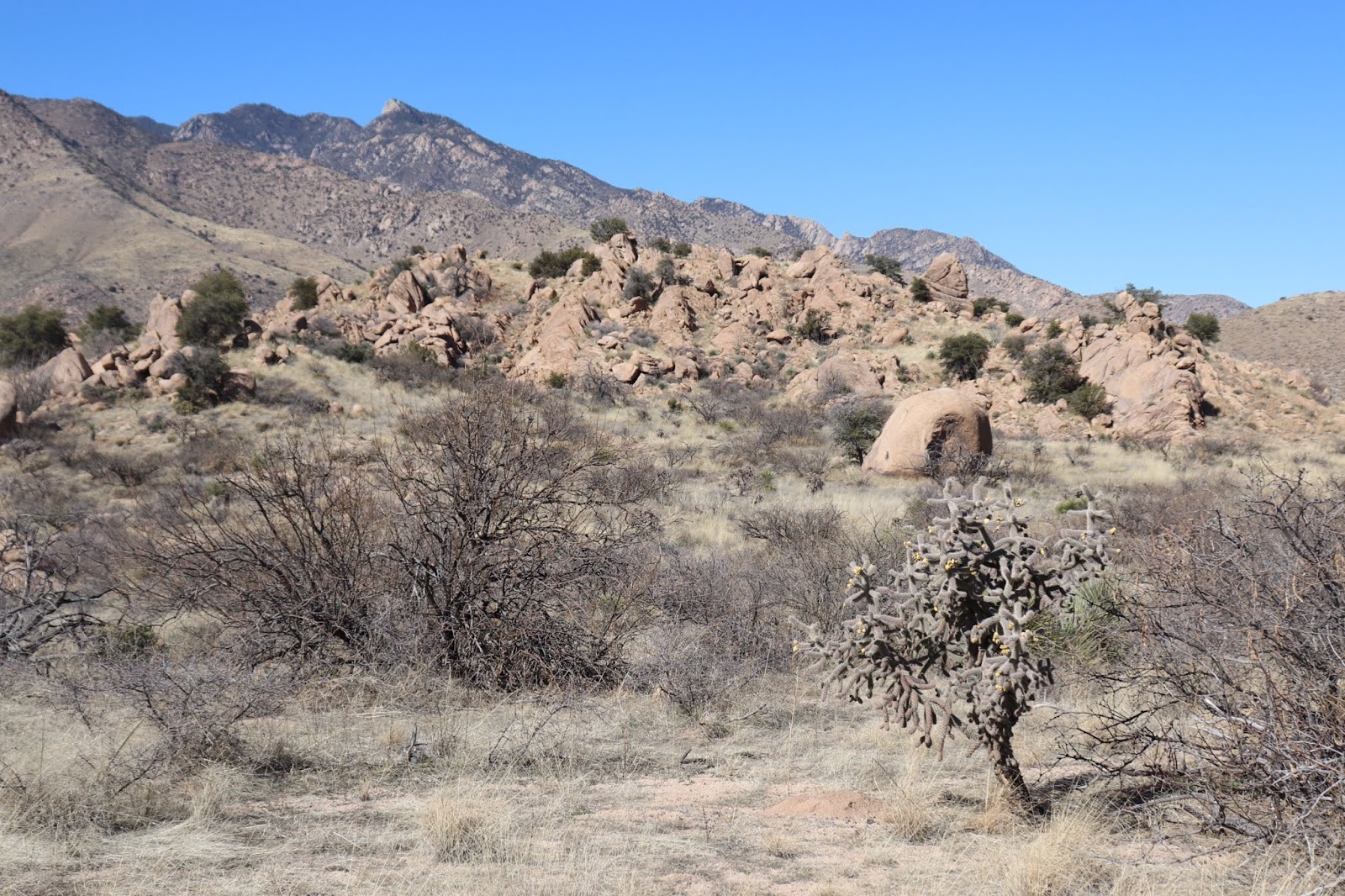
We had noticed a certain tempting “primitive road” before but had not, as the Artist says, “stuck our noses down it” on other days. Now, however, the sun was shining, and we were ready to say yes to the road’s invitation. Oh, the rocks! Like the fabulous rocks in Texas Canyon, but far from expressway traffic.


Oh, the views! Close up and off into the distance, every aspect was enchanting. We felt we were in the kind of environment and having the kind of experience that people travel halfway around the world to find, and no one had “managed” it for us with guideposts and rest areas.


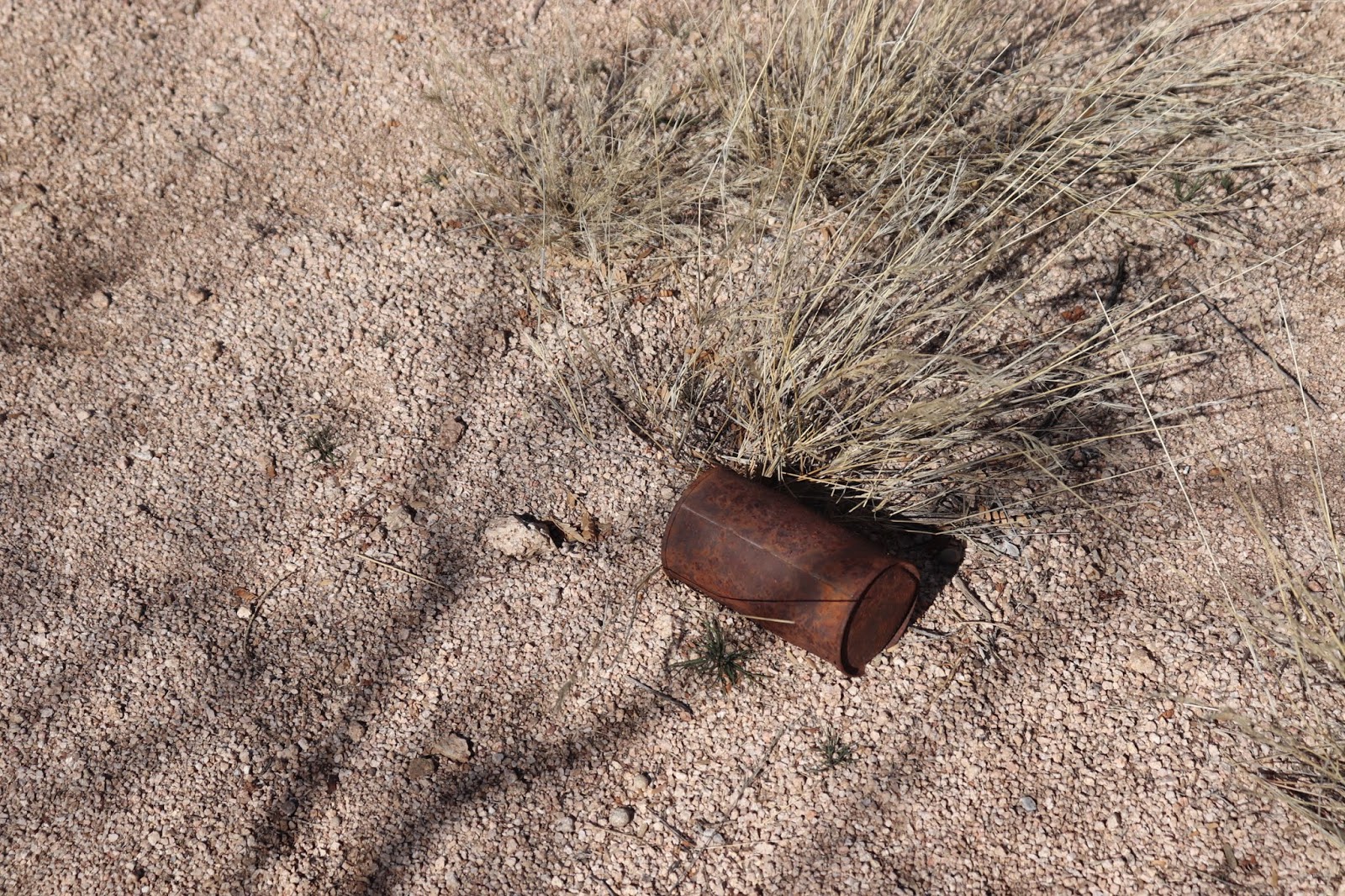
Recent rain had brought out the season’s first bajada lupines (not pictured here), the largest ones along this road no more than two inches across (and no flowers yet, of course), but I was equally pleased by a beautiful clump of grass and its shadow. Even an old rusty can had a story to tell, of cowboys eating beans while taking a break from moving cattle.


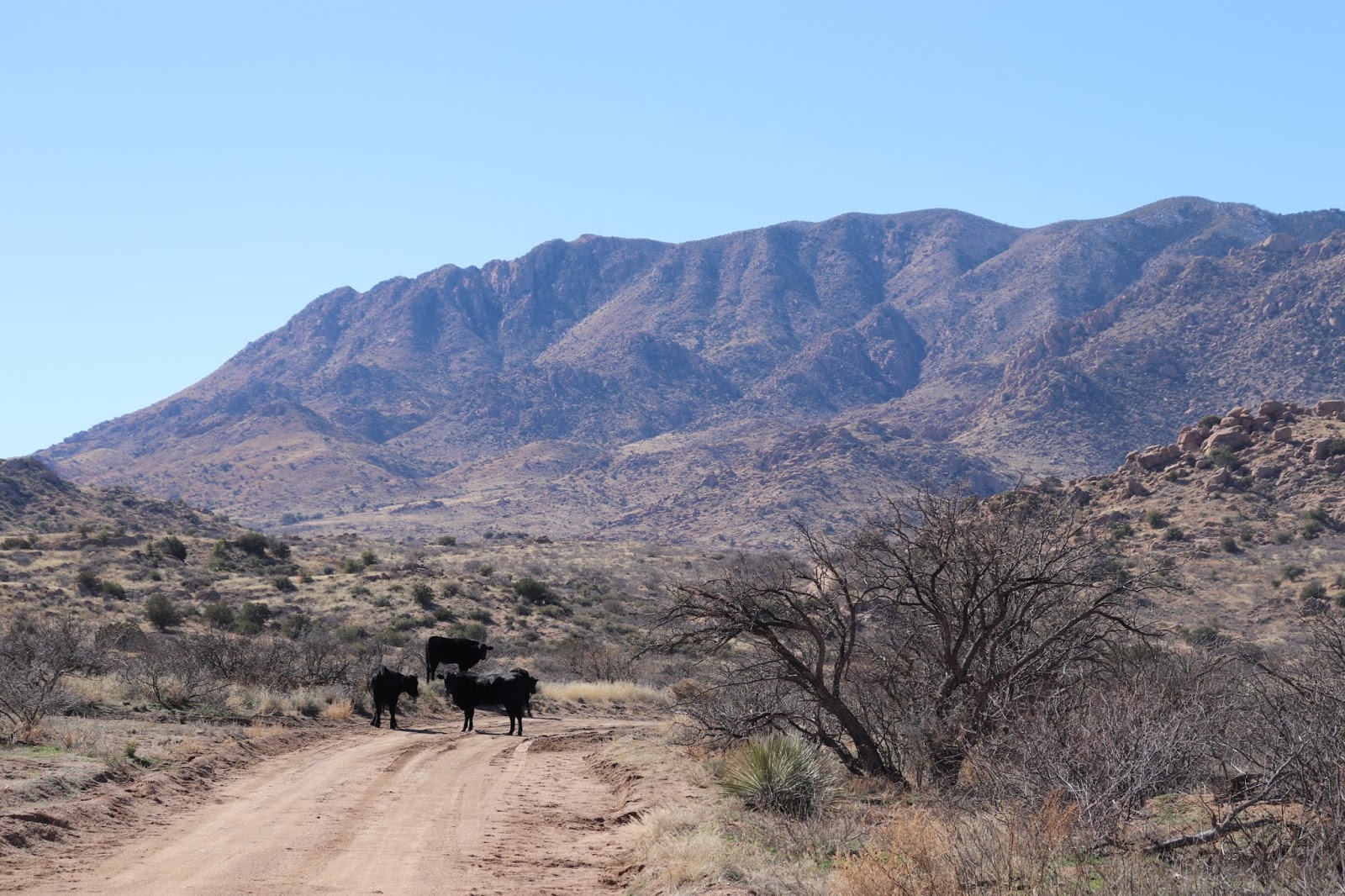
Because we did encounter cattle. No bighorn sheep or mountain lions, but gorgeous black steers with coats so rich and glossy in the sunlight and mountain air that they pleased us as much as wildlife would have done. We drove a prudent distance from the cattle before letting Sarah out to stretch her legs and apply her busy nose to the ground. What a good dog she is!

Lovely old oaks, oddball cholla (my name for it) and the ubiquitous soaptree yucca, so familiar to me now that it rarely brings Dr. Seuss to my mind any more — 


More rocks, more long mountain views — 


On another day, when we go back again, I would love to take along a picnic lunch. We had water, of course, but not so much as a granola bar or a peanut to snack on, and the fact that we lingered in the wilds so long, despite hunger, is an indication of how enthralled we were by the terrain. I’ll want my large sketchbook and pencils with me next time, too. But these “lacks” were hardly flaws in our Friday adventure. No, despite the lack of planning, our day was completely satisfying. It even provided a couple of especially unexpected and delightful additions to an expedition that would already have been perfect without them.

At our winter cabin in Dos Cabezas, a cactus wren comes to visit every morning. We’ve come to recognize his call, but never before had we seen a cactus wren nest, so finding not one but two in the mountains was another bit of excitement. Later I consulted my guides and found that Birds of Southeastern Arizona, by Richard Cachor Taylor, has this to say: 
Large, straw-colored, oven-shaped [“front-loading,” that is, rather than “top-loading”] nests are woven from fine materials and usually placed in a thorny cactus or spiny tree. Males may build up to five extra “dummy” nests, which can be used as roosts, as well as to discourage would-be predators.

Had we stumbled upon nests from last year, or were these “dummy” nests, the real home in which eggs would be laid and young raised somewhere else? How would one know? Another interesting fact about the cactus wren is that it gets all the it needs in the way of water from its solid food diet of insects and cactus fruits. Mountain bluebirds and robins, along with sparrows of all kinds, appreciate the clay saucer of water I set out behind the cabin, but the cactus wren doesn’t need me at all. And here is another description from Taylor that not only identifies the song we’ve come to recognize but sticks in this reader’s mind so the song cannot be forgotten: 
Chugging song, a  lengthy series of krr krr krr notes, suggests someone cranking the motor on a older car, trying to get it started. Loud and often heard, for many the song of the Cactus Wren evokes the Arizona desert.
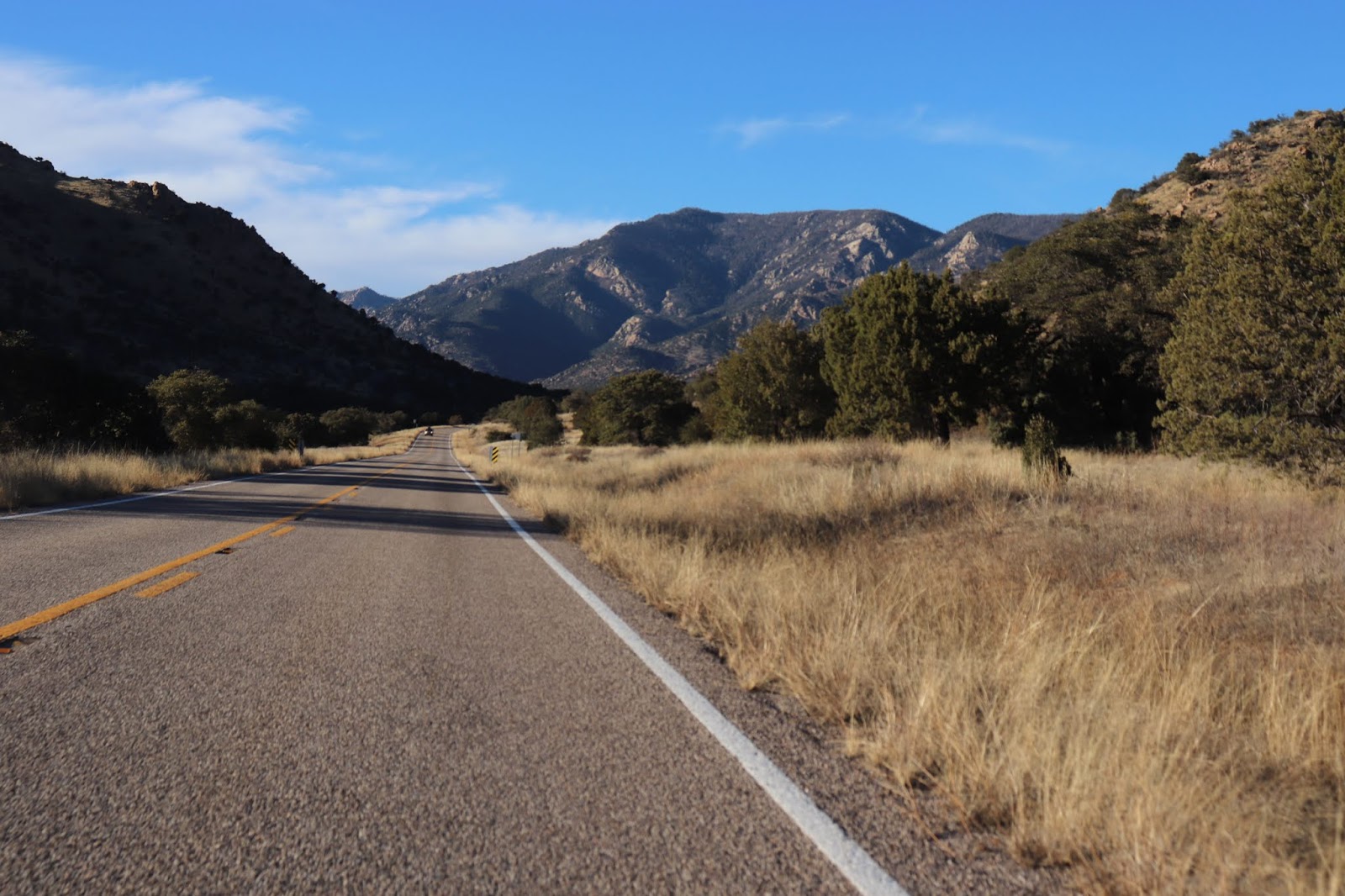
All in all, our spirits were high and hearts full as we resumed the paved road. And yet we had not yet reached the end of the day’s surprises, for there along the roadside, weeks before I would have begun to look for them, Mexican poppies were blooming! My Audubon Society Guide to North American Wildflowers, Western Region, gives the Spanish name, along with the Latin for this bright, cheerful roadside flower, and so we learn that the very formal-sounding Eschscholtzia mexicana is more familiarly known as Amapola del Campo, or the “poppy of the countryside.” (I like that sweet, peasant-sounding name.) Audubon, or in this case Richard Spellenberg of New Mexico State University, identifies the plant’s habitat as “open gravelly desert slopes” and notes that “When there have been ample winter rains, this Poppy sometimes grows in dense patches.” Dense, bright, and beautiful, I would say, though the patches are more extensive along 191 going straight north to Safford. 


Well, it was a very full day, and Sarah had a pretty good time, too, which always adds to our happiness.


Monday, February 4, 2019

Where Do Bluebirds Go When It Rains?


It isn't always necessary to leave home to have a memorable adventure. Saturday’s morning clouds gave way to afternoon sun, although the temperature remained chilly by Arizona standards, and we were having a quiet day at home. As I was puttering about the kitchen area, starting yeast for a session of bread-baking and washing up the few odd cups and saucers, I glanced up and out the window over the sink. Oh, my goodness, be still, my heart! Blue angels — not the warrior type but truly angelic forms — were fluttering and swooping and landing on the black rainwater tank and flying up again, their brilliant azure color making it seem an aerial ballet was in progress in our backyard. 


A window screen frustrated my camera efforts, so I exited by the front door and circled around to the back of the cabin, but the wary bluebirds vanished into the wash. I am capable of great patience, however, and so I settled into the driver’s seat of the car with window down with a good book and waited, and when they returned — because they did return, within the half-hour — I was as ready as an amateur camerawoman without a telephoto lens can be. 


Ah, yes, the lack of a telephoto lens! I had one with my previous camera and was able to satisfy myself (if not National Geographic) with the bird photos I was able to achieve in 2015 and 2018, but when I bought a new camera and a few extras it seemed a sensible line had to be drawn somewhere. Well, clearly, I see now, I drew that line in the wrong place. (It would have been much wiser to do without the camera case.) And so, my images here do not even begin to capture the magic that came to Dos Cabooses on Saturday afternoon! 

I also failed to capture the whole flock in a single shot. (There were about two dozen birds, males and females.) What I did manage to record, however, was enough for me to be fairly certain — with various guide books and the magic of post-production zoom — that my visitors had been, in fact, mountain bluebirds. Roger Tory Peterson’s Western Birds calls the color of the mountain bluebird (and the italics are his):
Turquoise blue, paler below, belly whitish. No rusty. [This distinguishes the mountain from the western bluebird, which sports a rusty breast.] Female: Dull brownish, with a touch of blue on rump, tail, and wings. 
The habitat for this bird is listed as “Open country with some trees; in winter, also treeless terrain.” Those italics are mine. Because while we are not entirely without trees in Dos Cabezas — there are some conifers and chinaberry trees around a few of the houses, and in and near the wash there are numerous netleaf hackberry trees — “mesquite and arid brush” would be a fair description of this land not noted for trees. We are, however, in the winter season, and the color descriptions in Peterson match the birds I saw.


While I would at least equally thrilled to have indigo buntings visit, bunting and bluebird have very differently shaped beaks, and that reminds me of an idea I had for a different kind of bird guide, perhaps not an all-inclusive guide to include water birds and hawks and such, but a guide to the passerine species, i.e., those that perch. My guide would simply group and identify each bird by the size and shape of its beak. 

Think about it. How often, after all, do you see a feathered creature only in profile, against a bright sun, when you cannot discern the color, much less identifying marks? Falling in love with birds, though, one learns early on that seed eaters and insect eaters have different beaks; that thrashers’ and thrushes’ beaks differ from those of finches; etc. My guide, therefore, would simply take the beak as the basic identifying clue. It would, of course, be used in conjunction with other guides — but then, whoever could be content with only one bird guide in the first place? Some present photographs, others illustrations, a few helpful silhouettes; one guide groups by color, another by family and genus. 

As for my photographing of the Saturday visitors, I have to acknowledge disappointment, but that disappointment was trivial next to the thrill of the birds themselves. I saw them! We saw them! A single bluebird would have been exciting, but two dozen of them all at once?! And — they came back on Sunday! Only once, and I only tried through the kitchen window/screen, but they were really there. See them, both perching and flying?


They refreshed themselves again at the rainwater tank, and when they wandered away I went out to refill the clay saucer for their added convenience. A few sprinkling drops of rain in the air had not kept them away, but after I replenished the saucer the rain increased in volume until it was pounding on the metal roof of the cabin. It rained for the rest of the day, the bluebirds did not return, and it occurred to me to wonder —

Where do bluebirds go in the rain? I have no idea! But water? Now that certainly brings the birds. A friendly neighbor about a mile down the road reported 20 robins at her feeding and watering station. Ghost town excitement galore on a rainy day....

Note: Excitement has clearly triumphed over literary style in this post, but I offer no apology. To be visited by angels, of any color at all, is not something that happens every day. And blue angels? So many of them? I rest my case.


Monday, January 28, 2019

How Can I Make It New -- For You?


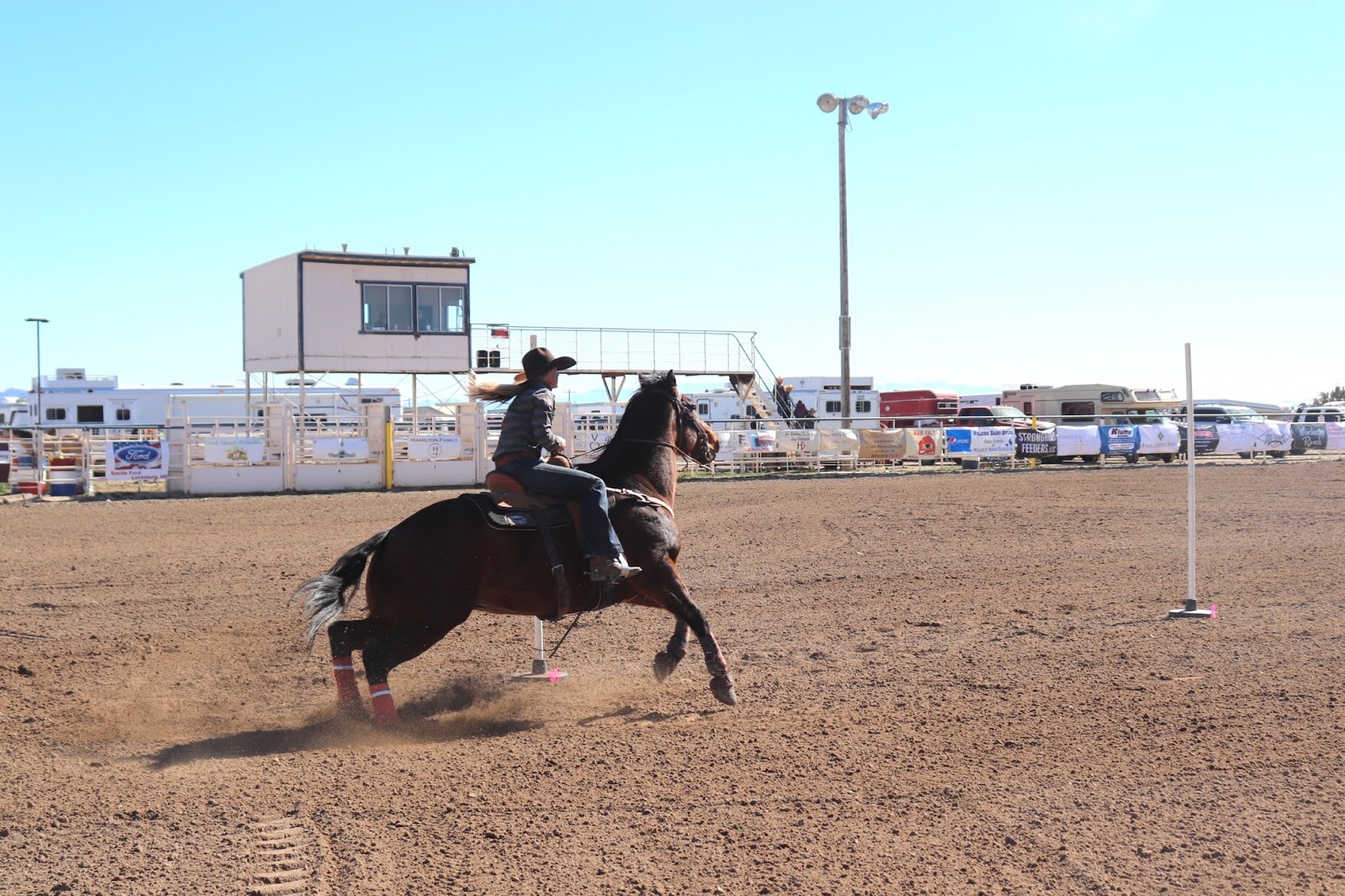
This is my third (nonconsecutive) southern Arizona winter, once again in the Sulphur Springs Valley of Cochise County, in our little ghost town cabin between Cochise Stronghold in the Dragoon Mountains and Apache Pass in the Chiricahuas, and once again the Artist and I find ourselves making expeditions through rocky, jaw-dropping Texas Canyon to the west or up north through the equally beautiful and blessedly much longer Stockton Pass. The winter’s Junior Rodeo season took place over the past weekend, again giving me opportunities to relive childhood dreams as I identified with young cowgirls weaving between poles on horseback and thundering back to the finish line. But in this third winter, sharing scenes that have now become familiar, how can I hope that what I continue to find so thrilling will evoke the faintest echo of first-time glamor for you who read Books in Northport? How can I make it new for you, these events and sights that never grow old for me?


Because, for the Artist as well as for me, it never does get old, the daily drive from Dos Cabezas past the playa to Willcox. Every day is different — different light and shadows, variations in atmosphere and in our sightings of wildlife and livestock along the way — and so, too, the trips through the mountains and down among neighboring sky island ranges. A year ago, we were only arriving for the winter in Dos Cabezas on the first of February. This time around, as January nears its end, we are beginning our seventh week here. Would five months feel too long? I wondered. Well, it doesn’t seem too long at all. I look forward to spring’s new leaves in the wash and blooms along the roadside but am not at all impatient for the weeks to pass: for now I bundle up each morning for the first dog walk of the day and shed layers as the sun climbs into the sky. The cactus wren’s morning greeting is nothing new, but that little bird makes me smile every day. And how could a sunset ever grow old?


The ordinary, the everyday, is a joy to me here, as it is back in Michigan. To take my breath away and make my heart leap, I have never needed the Grand Canyon. Back in Leelanau County, Michigan, too, the daily scenes are ever new, and we are grateful for each day we are there. “We live in a beautiful place,” the Artist often remarks. He knows I haven’t forgotten. We don’t remind each other of beauty around us because we think the other has stopped noticing it but simply to bring a moment into focus and share it more consciously. 


Right now we are here, and here is a good place to be. As the days and years race by, we make frequent stops to look around and appreciate being alive. We’re here now. It’s good. Can you see it, too?

Thursday, January 24, 2019

Disloyal — or Accommodating?

Oak tree, Arizona
The extreme contrast between the two centers and the two influences became itself a blessing: it rendered flagrant the limitations and the contingency of both. …In each of these places there was a maximum of air, of space, of suggestion; in each there was a minimum of deceptiveness and of the power to enslave. - George Santayana, Persons and Places: The Background of My Life

The passage above introduces the chapter called “Avila,” the center and influence of Santayana’s life in Spain, as it contrasted with his American life in Boston. He describes Avila as an ancient country town, dependent for its sustenance on the surrounding agricultural lands, which it can never shut out or forget.

The town walls, for all their massiveness, do not shut out the country from the eye. At every turn, through one of the city gates, or over some bastion, the broad valley remains visible with its checker-board of sloughed fields and straggling poplars lining the straight roads, or clustered along the shallow pools by the river; and at night, in the not too distant mountains, the shepherds’ fires twinkle like nether stars. Or if the townspeople are too busy and nearsighted to remember the country, the country every Friday morning invades the town, and fills the market place with rustics and rustic wares. At dawn they ride in from their villages in groups, on their trembling little donkeys….

As a confirmed country mouse, I am most enchanted by Santayana’s descriptions of his home in Spain and his walks taken from the town out into the countryside. The world of Boston, even the limited world of Harvard, one can find in so many other books of the period, and, in any case, it is not the world that attracts me. Similarly, I lose myself in the first volume of Proust, wandering with him through the countryside surrounding Combray, but lose interest in the second volume, with the country left far behind and all focus placed instead on human relationships in a limited social stratum, where the actors have little to do but obsess on one another’s words and looks and gestures. Yes, of course, human psychology is endlessly fascinating, but so is the rest of the world, and “society,” for me, without a wider focus in which to view it in natural and historical perspective, fast becomes suffocating.

Michigan field and trees
Give me open spaces! I have, however, found enchantment in Proust’s final volume, where he “refinds" the past living on, but that is another story.

Like my winter base in Dos Cabezas, Arizona, my Michigan home in Leelanau County is blessed with “a maximum of air, of space….” Suggestion? Yes, that, too, I suppose. Also, in Northport (as Santayana observes in Avila), one can never forget the fruit orchards or Lake Michigan, while here, in like manner, whatever Cochise County town one visits the range is never shut out but always visible on the streets. In Northport in summer, tractors and cherry shakers make their slow way through town traffic, followed in turn, in their own time, by heavy trucks hauling cherries to the processor, a sequence replaced in fall by the apple harvest parade. Here in Arizona, besides the weekly livestock auction in Willcox, there  are on every road and in every town livestock trailers hauling cattle (and often saddled horses), along with pickup trucks carrying bales of hay and huge bulk water containers. 
Cattle on open range

Dandelions in cherry orchard

But reminders of country sustenance are not the only outside reality always present in the towns. Beyond what human beings bring into being and provide for one another, there is what nature has long ago formed, remaining into the present. So always, every day, on all sides, except during hours of snow or fog or blowing dust that temporarily obscures their outlines, the mountains are present to the eye and soul. They are to this part of the country, to my winter eye and heart, what lakes are to Michigan.

“We’re surrounded by mountains,” the Artist observes on one morning drive from ghost town to cow town.

“Like Shangri-La,” I hint mischievously, for the night before we had watched watched the old movie “Lost Horizon,” based on the James Hilton novel.

The Artist snorts. He finds my comparison absurd, and yet I am prepared to argue (“You would argue with St. Peter himself!” my mother used to say in exasperation) that Dos Cabezas is better than Shangri-La in many ways. For one thing, Dos Cabezas is a real place, and we’re here. It isn’t a book or movie that’s going to come to an end and dump me back in someplace I don’t want to be. And — how many of you have seen the movie? Do you remember that there is no jealousy in Shangri-La, because the men are so “generous” that they willingly share “their” women with anyone who desires them? Believe me, that did not escape my notice! The women seem to have nothing to say in the matter, and it is not they who are “generous,” but the men! Shangri-La? No, thank you!

Desert view, Cochise County

Water view, Leelanau County

Well, nothing on earth is perfect, and no one on earth is perfect, but we human beings (like other animals) make homes for ourselves, and over the course of time most of us develop feelings for the places we live, even if they are not places into which we were born. One of my friends, born in Rhode Island, has been married for decades to a Brazilian, with the consequence that they divide their lives between the eastern U.S. and Sao Paulo. (Sorry, Jeanie, this program lacks many of the accent marks I would otherwise employ.) Another friend lives half the year (winter) in northern Michigan and the other half (their winter) in southern Australia, while still another maintains dual U.S.-Irish citizenship. As for me, I have few if any memories of my infant and baby life in South Dakota, only snapshots and ephemera carefully saved by my mother.

Northern Michigan and southeast Arizona. I love them both. Is a divided loyalty a lesser loyalty? What do you say? 

I used to think so, but now I think“divided” is not the right adjective at all. It is a dual loyalty that people with two home places feel. And if that is not possible, how would it ever be possible to love equally more than one child?

At home in Michigan

One road home in Arizona