Search This Blog

Wednesday, November 10, 2010

Post #800: The Fat Lady Has Not Yet Sung


No, my friends both near and far away, it is not yet winter in northern Michigan. That season may well be right around the corner, but for now fall lingers on. In some ways lately, it seems that even summer has not completely left us.


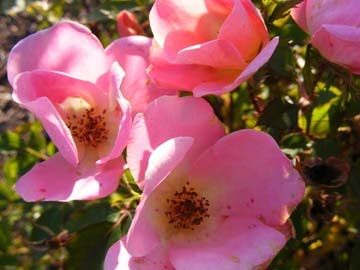
Not only are roses still blooming, but Dog Ears Books on Waukazoo Street is still open. Yes, the lights are on Tuesday through Saturday, 10 a.m. to 4 p.m. Sometimes Mondays, too, but that’s iffier. Special orders still welcome, as always.


After all those Wendell Berry poems read at John Brabanec’s memorial service, I had to replenish Berry titles in the shop and found, to my great delight, that his only children’s book, Whitefoot, is once again available. Who can resist a mouse story? David was captivated. The illustrations are charming, too.

I must confess that I can’t hear the question “Is the bookstore still open?” without having to suppress a very heavy sigh. If it came by e-mail or telephone from someone in another state, I would understand, but Northporters? People who leave their homes to meet for coffee on Mill Street? Don’t they ever drive down Waukazoo and see that OPEN flag waving in the breeze at 106?

No, friends [SIGH!], the bookstore year ends with the calendar year and not before. Dog Ears will be open through the holidays, as always. The bookstore has never closed for the winter before January, and I fully expect to re-open in April—again, as usual.

Autumn won’t last forever, and Dog Ears Books is hardly immortal. Someday, sooner or later, the Fat Lady sings for each of us. But not yet, friends. Not yet, not yet, though the sun kiss the horizon an hour earlier now and November darkness fall without pity on readers, writers and booksellers!


Tuesday, November 9, 2010

What’s Happening In and Around Town and Country, Indoors and Out?


As mentioned in yesterday’s postscript, Sarah and I went to Peterson Park on Monday afternoon. The images today are from my time on the beach. I’ll intersperse them with unrelated text, if you don’t mind.

I’m reading (devouring!) Marry or Burn, having set aside Deeply Rooted to dive into the long-awaited (by me and others) Valerie Trueblood story collection. I’ll have a lot to say about both of these books in the near future, but I was so confident about Trueblood’s work, after Seven Loves, that I chose her for this week’s recommendation before even opening to the first page, something I’ve never done before. I can say now, several stories in, that my confidence was fully warranted. More on this later. And more on the various books related to agriculture I’ve been reading. Another that might go into the to-read-soon pile is Sacred Trusts: Essays on Stewardship and Responsibility, ed. by Michael Katakis, with illustrations by Russell Chatham.

Pictures immediately below:
Petoskey stones come in rock size, too.
Land and water forms join.
Other rocks present alluring colors.


We finally got to set our clocks back on Sunday, and Northerners now have another hour of sunlight in the mornings. I suppose Southerners do, too, but can it possibly mean as much to them as it does to us? I love having a wider window of opportunity for morning dog walk/runs. (I walk, she runs.) Some people are grumpy about losing light in the evenings, but the home fireplace takes the pain out of dark evenings for me, and it’s a good excuse to stop yard work and come into the house, too.


With the sun so low, the shadows of even tiny creatures stretch to great lengths.

Bless my neglected garden! Yesterday I wanted carrots for soup but didn’t want California carrots (Sorry, California, we have plenty of carrots in Michigan!), so the grocery store in Northport wasn’t going to help me, but riding through the countryside with Sarah after our expedition to Lake Michigan I remembered that I hadn’t dug the carrots from my garden yet. Went home. Got out the spading fork. Sure enough, beautiful and fresh and crisp and sweet! There are enough for a few more diggings, too. Very satisfying!

Here is a plant from the beach, kinnikinnick, or bearberry, Arctostaphylos uva-ursi. Not much from a distance, but up close the berries are bright, cheery red.


My calendar has suddenly spouted another exciting holiday event. Well, the date isn’t certain yet, but I’ll keep everyone posted and add it to the calendar as soon as possible. Marjorie Farrell, whose mother-in-law lives here in Northport, will be visiting from Woodstock, New York, in December and will be bringing her new line of beautiful, stylish, reusable, eco-friendly wrapping cloths. They are perfect for books (I love how easy books are to wrap, anyway), and lucky recipients can use the wrappings afterward as scarves, small table covers, art for the wall—or as wrapping for gifts to pass along to friends. “The medium is the message”? In this case, “The wrapping is [part of] the gift”! We’ll have a party at Dog Ears Books, with refreshments, Marjorie will give a demonstration, and we will banish the winter blues, if anyone already has them in December, which I hope will not be the case.

For now, anyway, it's still November with balmy October weather.


P.S. Please take time to read Sharon Astyk's post today on the "love economy."

Sunday, November 7, 2010

Walking on Beach, Soaking Up Sun, Seeing Dead Birds


Sorry about dead birds below, but they were there. Actually, there were many more that looked much worse.


Still, Lake Michigan can hardly look bad, can it? Especially on a sunny, brisk day in fall.


Monday evening postscript: The pictures in this post were taken on Sunday afternoon. Today Sarah and I visited the beach at Peterson Park, and it too was littered with dead birds. We did not walk as far south on the beach as Barb Livingston, whom we met on her way back. She had found a very freshly dead loon. Very sad. What gives?

November Visit to Wisconsin

Two Rivers, Wisconsin, with a population of 13,000 was hit hard by the economic downturn. A “stop on the way to Door County,” what does the town has to offer that is uniquely its own, besides their claim to be the original home of the ice cream sundae? Well, there is the Hamilton Wood Type Museum, housed in the old factory building that manufactured wood type for so long, and it’s the only wood type museum in the entire world.

Five years ago, returning through Wisconsin to Michigan after my father’s funeral in Illinois, David and I stopped overnight in Two Rivers. It was late, we had dinner at a Chinese restaurant, and in the morning, poking around the older parts of town, we happened on the Wood Type Museum. Never having heard of it before, I was enthralled by the very idea, but it was Sunday, and the museum wouldn’t be open for several hours, and we had many miles to travel.

Thus I must admit that my visit this November (2010) was made via a DVD called “Typeface,” brought back by friends who made the trip and did not miss the museum. It isn’t the same as being there and having an opportunity to run my hands over the carved blocks, but it’s better than nothing.

Wood type was the first Hamilton product, and it was their only product for the first ten years. With a quality product and a lower price than anyone else in the business, Hamilton was able to put its largest competitors in New York and Chicago out of business (and then, naturally, doubled their own prices). In the hey-day of letterpress printing, big posters and billboards demanded wood type, as very large letters could not be cast in metal. It was a marriage of machine work and handcraft.

Then in the 1960s came offset lithography, and out went letterpress printing. Mountains of type must have been discarded all over the world. What was it good for? Who needed it? And then came computer graphics and printing.

Now letterpress printing is making a comeback for the same reasons that other “outdated” crafts and ways of doing things are returning. There is something beautiful and real about it that can’t be duplicated by a computer. The Hamilton Wood Type Museum offers workshops year-round by print artists from all over the world. Poetry and letterpress are a heavenly partnership made right here on earth. Letterpress books and letterpress wedding invitations carry high value and cachet in niche markets.

It’s strange, really, that this way of printing, which has little to do with the majority of books, should fascinate me so. It’s stranger still that I learned what goes on in the museum and elsewhere in the letterpress world by watching a DVD on my computer. I would rather have been there. I’d like to go back to Two Rivers and spend time in that museum. I’d like to visit that Chinese restaurant again, too, and spend more time along the old docks and check out the farm museum and have an ice cream sundae. Can’t believe how much I missed in that little town the only time I was there....

Saturday, November 6, 2010

En cherchant Neige en Chine

Blogs come and blogs go. There’s nothing strange or worrisome in that, generally speaking. But when a friend vanishes without a trace, c'est inquiètant. It’s disturbing. So no, it isn’t snow-capped mountains I want to see in China, it’s the smiling face of a blogger whose life I used to follow on a daily basis, not the abstract “snows of yesterday” I seek but a young Chinese woman, a teacher of French, thoughtful, lively, outspoken, sensitive to earth’s beauties and literature’s mysteries. She blogged under the name Neige.

The first blog Neige wrote was blocked by the Chinese government shortly before the anniversary of the 1989 demonstrations in Tiananmen Square. All access to Blogger sites were blocked, presumably because the government feared discussion of the historic event. Undaunted, the intrepid blogger (and it seems strange to describe her that way, as her blog was, in general, not at all political in nature but much more a personal vision of her everyday world) moved to another site. But you see what happens when you attempt to access the more recent blog: “La page demandée n’existe pas.” The page you asked for does not exist. Et alors? Où est-elle, la jeune femme charmante?

Neige blogged in French, I in English. When we commented on each other’s blogs, we used sometimes one language, sometimes the other. The other evening, watching a documentary on China, the sight of a canal through a Chinese town brought Neige to mind. She had completed her master’s in French, and the town where she had gone to teach had canals. I don’t remember its name. I don’t know hers. I do know that she had regular readers in France, in Canada and in the United States. I know that her birthday is December 25. I know that her smile brightened our days and that the images of her daily life were windows for us into another world. It brought that world to us as a friendly, inviting, neighborly kind of place.

Neige, I miss you. This post is a message in a bottle, flung into Lake Michigan in hopes it will find its way to the ocean and around the world to wherever you are. David sends greetings, too. Tu nous manques.

Friday, November 5, 2010

Of Cabbages and Bookstores

Which way to go today on the blog? A discussion of varieties of power or yet another heartfelt attempt to explain the realities of bookselling? Two unappealing alternatives—and a false dilemma, to boot? Some other, cheerier direction?

Okay, how about this? We had our first stick-to-the-ground snow this morning, the only kind of snow I count as the first of the season. The snow has not yet covered up the winter cress, however, and I was able to harvest a bit yesterday afternoon to liven up a salad of tofu and snow peas. Winter cress, also known as yellow rocket, is a member of the mustard family, Cruciferae, which falls under the order Papaverales. The order includes poppies and capers, but it is in the crucifer family that we find most of the tasty bits—mustards, rockets, cresses and, in the kitchen garden, radishes, cabbages, broccoli and cauliflower. Crucifers are strong in flavor. Those little flowers on the long stalks of the radishes you didn’t get pulled early in the season don’t have to go to waste, either: their peppery taste will pep up a salad beautifully. That’s a tip from a forager and negligent gardener.


Gleason’s Illustrated Flora of the Northeastern United States and Adjacent Canada (1952, three volumes, and yes, I have it in stock) looks at crucifers differently.
No family of flowering plants is more easily recognized than the Cruciferae and no other offers so many difficulties in the classification of species into genera or the arrangement of genera according to their relationship....

For satisfactory identification, mustards should be collected late in their blooming season when flowers are still present and the older fruits are full-sized. [That would be now in northern Michigan.]

Why is it that I so often fall in love with plants that defy classification? I’m no botanist so am handicapped to begin with. Hawthorns are another enigma, hybridizing so wildly that experts given leaves from different parts of the same plant may classify them differently. If there are any poisonous crucifers, though, I haven’t heard of them, and so I gather my bouquets happily and add them to our meals with confidence.

There, that should be enough of a discussion to establish that I have a range of interest beyond pecuniary matters. But about this bookselling business? My daily “Shelf Awareness” newsletter (it arrives by e-mail) led off yesterday with a quote by an author about how bookstores would always be around because people like to hang out in them, drinking coffee and fooling around on their laptops. I was not the only bookseller who shook her head over this professional writer’s naive view of what it takes to keep a bookstore open. Kris Kleindienst of Left Bank Books in St. Louis, Missouri, wrote:
I'm not sure people realize what it takes to have charming bookstores/gathering places for readings and socializing. It takes only one thing: people buying books from bookstores. That's it. That's all we need to be "absolutely, positively, completely alive."

There you have it, folks. That all it takes. That is the necessary condition for our survival. That’s what “supporting your local bookstore” means, and without that support, in the words of Bob Dylan, "a hard rain's a'gonna fall" on a lot of cozy gathering places.

Thursday, November 4, 2010

Thoughts Without a Theme


My mind is as steady and directed as the leaves that blow in the wind, and I’ve decided to take a break from sharp focus, not even trying to gather today’s images into a single subject. This is how my world looks these days. This is where my thoughts have been wandering, too.


Without yet writing a post on David R. Montgomery’s enlightening Dirt: The Erosion of Civilizations, I’m already halfway through another book on agriculture, Deeply Rooted: Unconventional Farmers in the Age of Agribusiness, by Lisa M. Hamilton. Recently David and I watched a documentary film called “The Future of Food,” and we’re planning to see “Colony” this coming Monday at the State Theatre in Traverse City. Conservation of topsoil, the kind of farming that provides decent lives for both farmers and livestock, continued existence of viable seeds that can be saved from one harvest to plan the following year, and the survival of bees to pollinate green plants, wild and domestic alike, are issues that will decide the future of the human race. My soapbox statement of the day: Agriculture, like economics, is a subject that should concern everyone.

Because someone heard about it on NPR and wanted to read the book, I ordered The 48 Laws of Power, by Robert Greene. Touted as this age’s version of Machiavelli, the laws are about what you would expect—hide your feelings, get others to do the work while you take the credit, keep others dependent, don’t trust anyone, etc. Last night as we were watching the second and third episodes of “The Jewel in the Crown,” a film version of Paul Scott’s first novel in The Raj Quartet, it struck me that the police officer, Ronald Merrick, was a practitioner of the laws of power. Sad, sad man! (So far—will he change in the months and years ahead? We’ll see.) I understand that psychopaths follow these rules naturally, without having to read about them, but it baffles me that a normal human being would make the choice to live his or her one life on earth in this manner. And how heart-breaking it would be to have a parent or a spouse or a child who lived life in this manner!

Here’s another question that’s always baffled me. It’s not directly related to my wonderings about power, but then, I’ve already admitted that I have no central theme today, so here goes: Why, if someone finds life meaningless because it ends in death, would that person have any reason to see meaning in eternal life (immortality)? If you think that mortal life is meaningless, why wouldn’t you see immortality as endless meaninglessness? I’m not arguing here that there is or is not eternal life, you understand. All I want to know is why anyone would think that life’s meaning would be tied to immortality. There’s a seriously huge missing premise there....


We may get snow today, mixed with the predicted rain. There were snowflakes in the air one day not long ago, but white stuff on the grass has so far been limited to frost. Along with the named creeks, I love the little no-name streams of our riverless township. Little jewels they are, hidden from view most of the year, now peeking out at the sky.


“If we don’t go to Florida this winter, can we get chickens?” I asked David, after showing him the beautiful black Australorps a friend has down by Cedar. My heart leaped up when he said yes! But what are the odds? Someone at a party last Saturday brought up the subject of planning (“planning ahead” is really redundant, isn’t it?), and I said I can only look forward one month at a time. Sufficient unto the next day are the worries attached! I woke up in the dark this morning fretting about foxes and coyotes killing the chickens I don’t yet have! But how ya gonna guard against the worst-case scenario if ya don’t imagine it first?

But January is still two months away. So far this month (the month I’ve been planning, the month I’m living in) I’m committed to having a children’s Story Hour at Dog Ears Books on Saturday, November 27 (Thanksgiving weekend), from 2:30 to 3:30. That’s the day the Christmas tree lights will go on in Northport, so various other celebratory observances are also being planned, and so maybe I’ll plan to put up my tree in the bookstore that Friday. Yes, that’s a good plan.

The following Saturday is the “Best for Kids” bake sale at the Willowbrook, with arts and crafts and other goods also on sale. I’ll be there with books. Twenty percent of sales dollars from vendors will be going to the Children’s Center. The difficulty for me is that I don’t want to have my bookstore closed that day, but perhaps if I ask David very sweetly....

Sorry, can’t chat longer. Need to work on book order list for holidays. Special orders always welcome, too, but don’t wait until the last minute. At the last minute, your selection will be potluck! And I’ll probably have the do-it-yourself gift wrapping table set up, too. But that’s not until December, and I really can’t think (or worry) that far ahead.

Wednesday, November 3, 2010

Book Review: THE CRYING TREE

Part I, Chapter 1 of The Crying Tree, by Naseem Rakha, begins on October 1, 2004, as prison superintendent Tab Mason learns that an execution date has been set for one of his death row inmates. Daniel Robbin has been on death row for 19 years-- half his life--convicted of the May 1985 murder of 15-year-old Shep Stanley, son of Nate and Irene Stanley, but now Robbin has stopped appealing his sentence, and Mason will have to arrange for and preside over his first execution.

Chapter 2 takes us back in time to September 20, 1983, the day Irene Stanley’s husband, Nate, came home to announce that he wanted to pull up their family’s southern Illinois stakes for a move to Oregon. Irene protests. The farmhouse the family lives in was built by her great-grandfather, and Irene grew up in it. She and Nate graduated went to school in this community and were married in her family church. Everyone they know is here. But Nate’s mind is made up. He wants a change.

From these two different starting points, the two tracks of the story move forward, each in turn, though we know, from Chapter 1, even before meeting the Stanley family in Chapter 2, that Shep died a violent death two years later. Daniel Robbin, the prisoner on death row, seems a cool, unemotional man. He shows no fear of his own death and expresses no regrets for Shep’s. The omniscient narrator, however, is only putting a couple of cards at a time on the table.

Irene Stanley and Tab Mason are the two main characters, and we see most of the story through their eyes, share their feelings through most of the novel’s chapters. Slowly, gradually, their secrets are laid open. Irene and Tab are not the only ones who have secrets, however, and the story’s tempo accelerates as more and more secrets are revealed. There is no one, it seems, who has nothing to hide.

If The Crying Tree were a thriller, secrets and revelations would carry the weight of the story and serve as its focus. Instead they are—not merely incidental, because they reveal some of the deepest aspects of the characters concerned--but certainly secondary to the more important questions of this novel: Can terrible psychic trauma be forgotten if starved of attention? What of forgiveness? Is it a human possibility, or are some acts unforgivable? Can one “move on” without forgiving? Is it possible to find “closure” for the murder of one’s child, and what would make that possible?

This story covers the years 1983-2004. I cannot imagine any shorter period of time would have sufficed for the journey made by Nate, Irene and Bliss (Shep’s sister) Stanley, Daniel Robbin and Tab Mason. Even if you read this book in two days, as I did, you will feel time’s cruelty and the family’s sense of the horror of continuing injustice, year after year. Mason’s failed marriage and the daughter he has all but lost, along with the enigma of Daniel Robbin, present different kinds of scar tissue. Everyone is wounded and struggling to carry on.

As the date draws near for the execution, the first in Oregon in many years, the press is hungry for answers. They want precise details of the procedure. They ask if the prisoner will feel any pain.
Mason wanted to say, Of course there’s pain, you assholes. There’s always pain. The pain of knowing, the pain of waiting, the pain of anticipation. And then there’s that other pain. The pain of planning out an execution. ... A job governors, kings, and heads of state have given to lesser men throughout time. Men never meant to sit with society—the pariahs, the recluses, the ones with the hoods, who either found a way to separate themselves from the results of their work or died from it, one execution at a time. That guy who’d done fifty executions in Florida had quit. Just up and quit one day. Told Mason that he couldn’t get the eyes out of his head. Fifty sets of them, staring.

There were tolls, Mason wanted to say. Tolls both sides of the road. But the press hadn’t asked about that. And if they had, what would he have said?

What Mason has to say to the press is carefully scripted: Stick to the cold, dry facts. Use official terminology. Refer to the execution as “the procedure.”

I believe that how it deals with violent criminals is one of the severest tests of any society. I also feel strongly (I know it is true for me) that forgiveness, whether for great betrayals or minor offenses, is one of the greatest spiritual challenges that human beings face. Another is asking for forgiveness.

The questions at the end of my paperback copy of The Crying Tree were formulated by the author. She introduces them by giving her own background to this story:
In 1996 I was assigned to cover Oregon’s first execution in over thirty years. At the time I had never given much thought to the death penalty and what it would take for the state to plan out, prepare, and then kill a man. After the assignment, I wanted to learn more so I began to interview death-row inmates, the people they had harmed, and the men and women we entrust to carry out our nation’s most severe sentence. During the time I heard many stories, some of them abhorrent and some heartbreaking, but by far the most compelling were those told by the people who had come to terms with the murder of a loved one and no longer felt it necessary to seek retribution. This arc, from the most desperate kind of anguish to reconciliation and even love, stunned me....

The questions that follow are thought-provoking and would add greatly to a discussion of the book, but I want to pose different questions, though they too can only be considered by readers who have first read the entire novel. Realizing that this book is fiction, then, and the details of its story not those of any particular capital case:

How did you feel during the last scene? Had Shep been a different person, had Daniel been different, and this scene therefore not possible, what feelings might you have had at the end of the story? Suppose Shep’s father had not come home while Daniel was in the house? Would Irene’s forgiveness of Daniel make as much sense if the facts of Shep’s death had been different? (Remember when Irene comes to the point of forgiveness and how much she knows then.) How far are the lessons learned by this fictional family over the 19-year period of the novel generalizable to other human beings suffering similar losses? If you think that the novel is "not realistic," which parts of the story do not ring true to you? In your own life, have there been lesser traumatic events which you still struggle to put behind you?

I ask these questions because I have taught classes in applied ethics and, knowing that no one comes to the issue of capital punishment without a strong opinion, I’m sure there will be those who would dismiss The Crying Tree as “only a novel,” “not real life,” “nothing like most murders,” etc. The first hurdle to a fair assessment, therefore, will be to enter as fully as possible into the world of the novel. The second will be to accept its possibilities while wrestling with the questions posed by our everyday reality.

This is a very challenging novel, well worth taking the time to read and reflect upon. I would suggest that reading groups follow up with a true-life memoir, Dreams From the Monster Factory, because these issues are not going to fade away in our lifetime.

Tuesday, November 2, 2010

One Day’s Surprises (Each Day Brings Its Own)


Yes, today is Election Day, and we have no way of knowing how the end of the day will tally up, but I thought a very brief post on another subject might be welcome. After all, politics—don’t you need a break once in a while? Especially after the weeks of robo-calls and slick mini-posters in your mail?

Life in a bookstore is always full of surprises, and I feel lucky to have a “job” that is like that, rather than one in which every day is like every other. On any given day, I don’t know who will walk in the door, what books will be selected, what conversations will take place. Also—and I say this not to solicit more but simply because it’s a fact—a small-town bookseller collects a certain amount of booty. That’s “booty” as in pirate talk, not as in shake-your.

On Saturday last, for example, a friend from Cedar, just back from a four-week vacation in Poland, stopped by to share stories of his trip and brought back a couple of delightful and surprising gifts. One of the towns he had visited was Torun, and one of the gifts Tom brought was a little jar of rose honey. Rose petals are visible, and the honey, he says, is supposed to taste of roses.

I wasn’t familiar with the name Torun but quickly learned that it has more than one claim to fame. Two of those claims are held in the second gift, a gingerbread cookie in the shape of a portrait of Copernicus. Torun is both the birthplace of Copernicus and the gingerbread capital of Europe.


Somewhere in my dim memory banks is an association of Poland with cherries. I wonder if the orchards in Poland look anything like ours at this time of year. Maybe not. I think Tom said it was very cold there already. He might even have had snow while he was there.

What will Election Day bring to Northport and to Dog Ears Books? As David likes to say, “Who will be there, who will we see there, what’ll be the big surprise?”

Monday, November 1, 2010

This Passing Time Leaves Gifts Behind


In a week, we’ll set our clocks back. What’s 8:30 a.m. now will then be 7:30 a.m., so we will have more light in the mornings, if I’m working this out correctly. (When these matters come into the conversation, David pleads dyslexia. What’s my excuse?) I do know that this morning’s sunrise made my heart sing. The blinding light, the long shadows, and the blessed, blessed lack of wind all seemed like gifts on this first day of November.


The main item of our day today was a memorial service for friend and neighbor John Brabanec. David has always called John and Julia “the Helen and Scott Nearing of Leelanau County.” According to John’s obituary published in the Leelanau Enterprise,
John and Julia spent their honeymoon in Northport in July of 1948, returning many times to their Land of Delight before settling here permanently in 1975. Together they planted an orchard of 1100 apple and peach trees, became certified in organic practices and were the first to sell quality organic table fruit in Michigan.

It always meant a lot to me to see bushel baskets of their fruit at Oryana Food Co-op in Traverse City. Today, just inside the front doors of Trinity Congregational Church sat two of those familiar “Brabanec” baskets below a hand-lettered sign inviting everyone to “enjoy John’s apples.” Following the service, outdoors on the sidewalk, there were groups of people doing just that, biting into crisp, sweet fruit, the season’s bounty, as they continued their remembrances. I didn't take my camera to the church but brought my apple back to the bookstore to photograph before eating.


It was a long service but would have lasted all day if everyone who had something to say had had a chance. Wisely, the family chose from their own number and from a circle of close friends those who would speak. The stories were wonderful, some bringing tears, others laughter, many tears and laughter mixed together. Many speakers also read poems, most by Wendell Berry, novelist, essayist, farmer, and John’s favorite poet.

The prayers were wonderful, some from the Christian tradition, others Native American.

The music was wonderful, from the Celtic harp to the hymn “Amazing Grace” to the solo “Blue-Green Hills of Earth” to selections from John’s favorite musical, “Mary Poppins,” with the congregation invited to sing along with “Feed the Birds” and “A Spoonful of Sugar,” that second number a tribute to John’s devotion to hard physical labor and his insistence that his children learn its joys. Then Lennon and McCartney's "Let It Be."

John was a gift to everyone whose life he touched. His trees will live on, as will the example of his life. The epitaph chosen from Wendell Berry says it all:
Having lived long in time,
he lives now in timelessness
without sorrow, made perfect
by our compassion and forgiveness,
and by his happiness in receiving
these gifts we give. Here in time
we are added to one another forever.