Search This Blog

Showing posts with label evolution. Show all posts

Tuesday, April 18, 2023

Getting "Out in Nature” (Kind of a Book Review)

Sunny and I get out every morning, and the desert is greening up now.
 

Strange beings, human beings, aren’t we? So often we forget that we are not separate from nature but natural creatures ourselves, which means that we are always “in,” as in “part of” nature. At the same time, we also know the difference between indoors and outdoors, the difference between houses and shopping malls and office buildings and classrooms as opposed to parks and woods, beaches, mountains, and campgrounds, and so, in a way, the scientific “news” in Florence Williams’s book, The Nature Fix: Why Nature Makes Us Happier, Healthier, and More Creative (NY: W. W. Norton & Co., 2017, paper, $15.95) didn’t seem like news to me at all. 


Reading indoors, but with doors and windows open, birdsong audible in the background


When I worked office jobs, back in the 1970s and 1980s, I often felt like a captive, so tethered to my telephone and typewriter (these were the old days) for hours, on such a short leash, that even going down the hall to the restroom meant being jerked back by a ringing phone. But was that just me -- or me and people like me but not everyone? What about those who say, “I’m not an outdoor person”?


Ah, but that’s where it gets interesting! Because some of the researchers looking at all the ways the outdoors benefits us felt no personal desire themselves to leave their computers and laboratories and were skeptical of other researchers’ work that found huge gains in physical and mental health among test populations. Some even work on developing “virtual nature,” an oxymoron if I ever heard one but quite a lively field, apparently. (Go figure!) 


One such skeptic was Frances Kuo, director of the Landscape and Human Health Laboratory at the University of Illinois, Urbana-Champaign, whose research focused on urban environments, comparing public housing apartment complexes with various sorts of courtyards: (1) those with no greenery whatsoever, (2) those with both greenery and concrete, and (3) those with grass and trees. Over a two-year period, her study found the buildings in the middle group had 42% fewer crimes compared to the concrete-only group, and the buildings with the greenest surroundings had, compared to the non-green courtyard buildings, 48% fewer property crimes and 56% fewer violent crimes.


“I am not historically a nature lover,” Kuo told me. “I had no personal intuition when I started that these findings would come out the way they have. But twenty years later, I have convinced myself.” 


So to the question, “Do we really need to study this to know that nature is necessary to human beings?” the answer is yes, because in modern Western civilization Western science is such a driving force in our lives that until scientists are convinced, natural needs can be and usually are downplayed or outright ignored.


The Finns got into the research game early, for economic reasons, wanting to lower health care costs. Their studies would also, they believed, provide data for city planners, depending on conclusions those studies might reach, and for them subjects do more than take a walk in the park. Data is key. Questionnaires, blood pressure samples, heart rate measurements, even saliva samples taken before and after a half-hour walk, for example. The bottom line for the Finns was that five hours a month in natural settings was the minimum for the biggest health gains.


And then there was Roger Ulrich, not a skeptic but simply a curious scientist.


A young psychologist named Roger Ulrich was curious why so many Michigan drivers chose to go out of their way to take a tree-lined roadway to the mall. 


So first he had a group of volunteers in the 1980s view slides of nature scenes, while the another group saw “utilitarian urban buildings.” Okay, good. Next he subjected volunteers first to stress, by showing them “bloody accidents in a woodworking shop” (No, thank you!), and then showed them either scenes of either nature or city to see how long it would take them to recover from the stress. EEG readings of what Williams calls the “brains-on-nature” viewers returned to baseline within five minutes, while the urban viewers continued to exhibit stress ten minutes later. 


These studies, Williams tells us, were considered “soft science” at the time, and the field did not really grow for decades, but Ulrich kept at it. He followed the records of hospital patients following gallbladder surgery, those whose rooms had a window view of trees and those who could see only a brick wall from their beds. 


He found that the patients with the green views needed fewer postoperative days in the hospital, requested less pain medication and were described in nurses’ notes as having better attitudes. Published in Science in 1984, the study made a splash and has been cited by thousands of researchers. If you’ve ever noticed a nature photograph on the ceiling or walls of your dentist’s exam room, you have Ulrich to thank. 


Another name that appears over and over in The Nature Fix is that of data-seeker David Strayer. He’s the cognitive psychology researcher from the University of Utah who discovered what has been called (one of his friends coined the term) the “3-day effect” (explained in the Williams book without the popular term being used), a key to which is being in the wilderness unplugged – no cell phone, smart watch, or anything like that. Because the clever adaptations we make in our artificial environments are often not consistent with the way our brains work, our brains need restoration from time to time. 


I mean, can you believe that 36% of people [Americans only?] check their cell phones during sex?! No citation appears for this claim, made by one of Strayer’s academic wilderness companion researchers. Strayer himself made the statement that the “average person looks at their phone 150 times a day,” which I can quite easily believe.


Science, then, has found the following gains from time outdoors “in nature”: less stress, lowered anxiety, lowered aggression, heightened optimism, increased sense of well-being, and increased feelings of connection not only to “nature” but also to other human beings. 


(Obviously all this has surprised a lot of people. Do they forget how and where our species evolved? We are, first and foremost, earthlings! Yet I notice that the big money man behind the world’s arguably most experimental car, who is eager to send human beings to Mars, has yet to put himself into orbit. He sent a car instead. And then, see The Starship and the Canoe, by Kenneth Brower, a book I highly recommend, about physicist Freeman Dyson and his son, George Dyson. The physicist, obsessed with space travel, was for a time a regular reviewer for the New York Review of Books, a highly respected academic, but his son, living in a treehouse, was seen as an eccentric dreamer. As to which man can claim a firmer grasp of the human condition, its strengths and its limitations, you can pretty much guess where I come down -- not that I expect everyone to agree with me….)


Here's what some other countries are doing to meet their citizens' need for time in nature:


➡️ Sweden recognizes “horticulture therapy.” 


➡️ Singapore, the third-densest country on earth, intentionally increased its percentage of green space from 36% to 47%, even as its population grew by over two million people.


➡️ Japan has a long cultural history of attention to nature, and the country has developed 48 official “Forest Therapy” trails. Japanese medicine also recognizes “forest medicine” as a specialty.


Can it be that we human beings are finally waking up and paying attention to what we are and where we live? (Earthlings, earth.)


Recommendations From the Author


Williams draws her recommendations from various scientific sources, and one she particularly likes is the “nature pyramid” concept promoted by Tom Beatley of the Biophilic Cities Project at the University of Virginia. (Remember the food pyramid, you old folks?) The base of the nature pyramid is “daily interactions with nearby nature that help us destress, find focus and lighten our mental fatigue." (When I was working those office jobs, at least I walked an hour to work through my neighborhood and a campus with plenty of greenery and past a couple of ponds.) The next level up is weekly outings, followed by monthly excursions – each level also being more immersive – and finally reaching, at the summit, “rare but essential doses of wilderness.” Like this --


Yes, I made this pyramid just for YOU!


If you live in the country or in an urban environment with plenty of parks, you are lucky. (Stepkids and grandkids take note: Top city on the “ParkScore” index is Minneapolis.) Yet for myself, for all the time I spend outdoors, both in the Arizona winter and my Michigan summer, I have to admit I rarely if ever reach the pinnacle, retreating for at least three days into wilderness. Do you think exceeding the minimum on the other levels can make up for not reaching the top? That's something for scientists to check out, don't you think?


Desert thorn in bloom, Cochise County, AZ

Here I am (below) with my new "cousins" from the Phoenix area. When they came to visit, we hiked part of the Echo Canyon Loop in the Chiricahua National Monument. We loved our outdoor time together!


Me with Jim

Carol and me


Where can you walk in other countries


Hold onto your heartstrings! The answers are interesting. Finland has the concept of “everyman’s right,” which means there is no such thing as “trespassing” in privately owned forests. Anyone can walk and pick berries and mushrooms. The only forbidden activities on private land are cutting timber and hunting game. Scotland has similar “right-to-roam” laws. There you are prohibited from hunting, sheep-stealing, and digging up plants, but you can roam to your heart’s desire. 


America: Land of the Free?


One minor criticism 


This book could really have used an index! But imperfection is – well, an opportunity to embrace wabi sabi, right? The Artist loved that whole idea, and it's pretty much the way we two imperfect beings lived together….
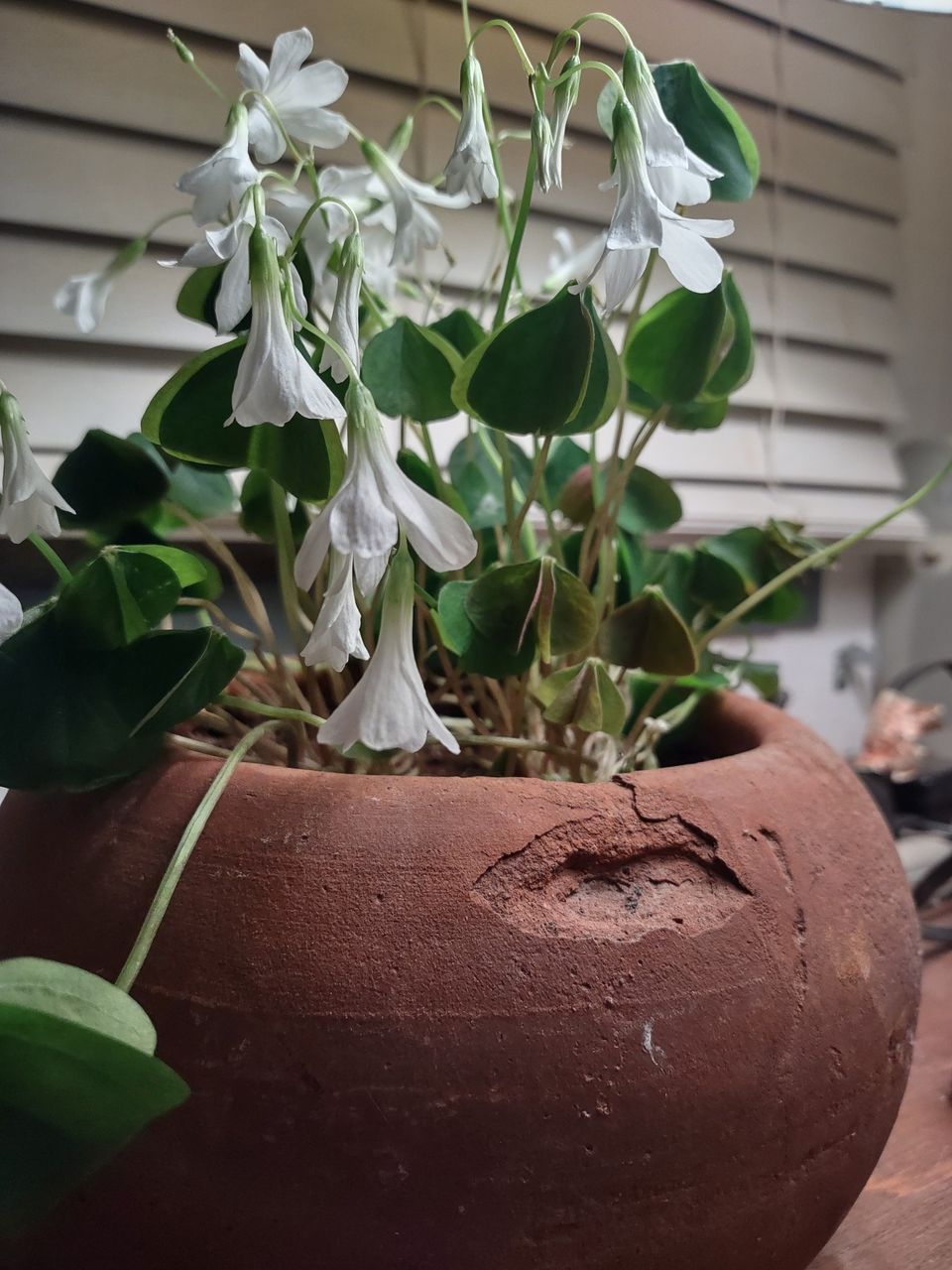
 

Dear imperfection of a perfectly shaped clay pot!


If you think you don't need to go outdoors, you need to read this book, and if you love going outdoors, you can read it to feel even better about your fresh air time. The author tells us at the beginning that she is wrestling with a move from the Great West to Washington, D.C., looking for more and better ways to enjoy nature in her new urban environment. As one interviewee points out, parks are free, and more Americans need to get out in them. 

Florence Williams has done us all a service by putting her own experiences together with research reports. Well done! Recommended!


Monday, February 10, 2020

Song of the Curve-Billed Thrasher

(Photo from last spring)
Often, as the Artist and I are riding along in the car, a question arises that neither of us can immediately answer. The question may concern the geology of the passing scene, some plant or animal species, a question of history, or a writer or actor’s name temporarily just beyond our combined memories’ reach, to mention only a handful of examples out of the infinite number of inquiries that arise between us in conversation on the road. Either of us could, of course, “look it up” instantly (whatever “it” is) on one of our phones, and once in a while we do that — but more often we simply continue our conversation, speculating, critiquing each other’s speculations, and continuing to question each other and, when pertinent, our surroundings. Many would find these conversations of ours pointless and annoying. Well, that’s why we are with each other and neither of us with anyone else.

There are times when we are laughably wrong and only discover our error much, much later. I’m going to confess a truly idiotic belief we came to hold — and held for far too long — because it’s quite funny in retrospect. It has to do with the Kansas Settlement Gin Company, south of our winter home highway on the historically-and-oh-so-evocatively named Kansas Settlement Road.


During the early explorations of our first Cochise County winter, we were surprised to see the gin company there in the middle of the Sulphur Springs Valley. There didn’t seem to be much activity around it then, so we weren’t sure it was still in operation, but the question of operation was secondary. Gin? A company here in southeast Arizona distilling gin? When a visiting Michigan friend inquired, as we three were on our way down to Bisbee that day, we shrugged and told him, well, there are juniper trees in nearby mountains. Which is true….


Was it only this past December that we saw at last how wrong we’d been, or did light dawn in our addled brains the year before? Cotton is grown on land along the Kansas Settlement Road! The company is not distilling alcohol but ginning cotton! I think it was the name that led us astray: Kansas Settlement Cotton Gin would have been clearer. Please note, however, that we finally figured out the right answer all by our previously ignorant selves, chagrined over our earlier leap to a false conclusion but very satisfied to have landed, finally, on what is obviously the real story. And yes, we could have had the solution instantly, back in 2015 … but then we wouldn’t have had to think at all … and we certainly wouldn’t have had the satisfaction of solving the mystery ourselves … and I wouldn’t have any kind of story to tell you, either.

Here’s another example: Just the other day, in an interchange with a Mexican woman in a parking lot, my very rudimentary Spanish fled in the first moment of the encounter, leaving me blank and tongue-tied. The woman and a partner were selling tamales, and I wanted to ask how much they cost, but, as so often happens to me, the first language other than English that came to mind was French, and I grabbed at it desperately, trying to pronounce Combien with a Mexican accent. To me, it sounded good and made sense. But a blank, astonished look came over the woman’s face, and I knew I’d put my foot in my mouth. A language app on my phone would have eliminated any hesitation, but, except for weather and identifying plants, I don’t do apps. Then it came to me: Cuanto! I tried it, and it worked. All right! Embarrassing as my first attempt had been, I felt good about hitting on the right word on my second try. I think embarrassment can be part of a learning experience and does not have to be an occasion of shame. Next time I’m sure I will remember the right word immediately, prompted by my memory of the occasion of not remembering.

The first example, the gin company, is one of two people beginning in ignorance and thinking something through over time. The second has to do with my own memory. (I have a lot more Spanish words and phrases in memory than I can instantly recall, recognition being a much easier task than recall.) What the two  examples have in common is exercising brains instead of looking to a device for an instant answer. Many people prefer the instant answers. I prefer mental exercise.

Then there is the song of the curved-bill thrasher. Winter after winter we have been hearing a beautiful avian songster outside the cabin and trying to spot the bird to identify it. I kept wanting to say it must be a mockingbird. What else could sing so melodiously, produce that lovely, liquid song? And yet, complicated as the song was, it didn’t have the repetitions of a mockingbird. Finally, sitting out behind the cabin and watching birds in a scruffy little netleaf hackberry tree where I’ve hung a couple of suet feeders, I recognized once again the beautiful, mysterious song and could see the singer clearly. It was not the house finch and certainly not the ladderback woodpecker. It was the curved-bill thrasher! There he was, and the song was coming from him! 

Again, a birdsong app would have given me an instant answer, but, even with as long as it took me to connect bird and song, I have no regrets over lost time. What I gained, I feel, is the personal experience that will lock the identification much more solidly in my memory than the instant answer would have done. And time spent sitting and watching birds, like time spent sketching trees, is never “lost time.” It is all about being there, being taken out of myself and merging for a timeless while with bird or tree. And as I say, I do think I will remember the curved-bill thrasher’s song better and longer because I was sitting still, mountains off in peripheral vision, and seeing and hearing together so that everything around me formed a seamless and unitary context. 

The morning I began drafting this post, non-news came from the Iowa caucus: A reporting app had had issues, and the results that (some) people stayed up late to hear (glad we did not) were still not in the next morning. “We wanna know right away,” said one commentator, adding that the very desire for immediate results often drives failure or error. “We’d rather wait and have accurate results,” he said. 

Let me shift the scene here—

A mobility invention designed as an alternative, for some, to a wheelchair has been taken up by fully able-bodied persons using it for recreation. One stands on a platform and leans this way and that to propel oneself forward on a flat surface without having to walk. Why people who can walk want to avoid walking baffles me. They do not rejoice in their bodies’ movement? Don’t want to exercise physical independence and prolong it as long as possible? I don’t understand. But — sigh! — once again, “I am not the target audience.” 

There is a book on artificial intelligence (so-called) that I need to read. Human Compatible, by Stuart Russell (co-author of Artificial Intelligence: A Modern Approach), argues that AI and how (if?) we control it in the future may be the most important question facing the human race. The author is concerned that AI would give governments unlimited surveillance and control capability. (What about corporations? I ask, but maybe that’s in the book, too.) If AI can come to match or surpass human intelligence, what will become of human freedom? 

But now— now I want to take all the ideas above and put them together, adding into the mix young people (not all, but too many) who exercise no muscles other than their thumbs (to text and post on social media). Will our body parts atrophy if we no longer need to use them? That’s one question, but I want to stretch to a further question: Will our very brains atrophy if we stop exercising them to think for ourselves, to sharpen and rely on memory? 

Recently I was trying to find (via online search) something about the split-second delay between any sensory impression and the brain’s receiving that impression, a margin that aids us in decision (or so I vaguely remember reading years ago), actually making choice and decision possible at all. I welcome anyone who can refer me to a helpful citation on the subject, but what alarmed me in my search was that, using the phrase “reaction time,” all I got were results calling fast reaction time good, slow reaction time bad, with lots of suggestions for improving, i.e., speeding up, reaction times. 

Of course, there are plenty of occasions where fast reaction time is crucial. Avoiding a road accident is an obvious example, and Malcolm Gladwell’s Blink: The Power of Thinking Without Thinking gives many other examples. But quick reaction time plus lack of experience can lead to bad results, even in this simple case: To avoid a deer in the road, a driver quickly swerves and hits another vehicle, a tree, or turns over in a ditch. 

Take another example: A stranger knocks on a door, and the person opening the door and seeing a stranger, perhaps someone from a different ethnic group than his own, feels threatened and draws a weapon, killing the stranger — who, let’s say, only wanted directions. Fast reaction time leaves no time to think, to reflect, to question, or to examine a broader context. Experience helps, but what kinds of experience? Experience driving in different conditions is one thing; a human being living in a confusing, complex, and ever-changing world needs a much broader array of experiences to keep trigger-fast reactions from causing tragedy. 

What does reaction time have to do with thinking for ourselves, with working through problems and situations, with exercising memory? You tell me. Think about it. Or not. No one can force you.


Tuesday, December 20, 2016

They Light Our Way Along the Arc


Photograph by Marjorie Farrell


An essay's conclusion, writes William Dereshewicz, is not something we refer to as a fact but rather as wisdom. He allows that the ideas in an essay are “often openly impressionistic and provisional, colored by feeling, memory and mood,” going on to say,
But the essay draws its strength not from separating reason and imagination but from putting them in conversation. A good essay moves fluidly between thought and feeling. It subjects the personal to the rigors of the intellect and the discipline of external reality. The truths it finds are more than just emotional. – William Dereshewicz, “In Defense of Facts,” The Atlantic, January-February 2017
Not every reader is as fascinated by the essay form and its history as I am, but anyone who has been awake this past year realizes that there have been bloody assaults on truth and facts, and many of us find that cause for concern.

Although my new Atlantic arrived last Friday, it wasn’t until Sunday afternoon that I got around to Dereshewicz. I’d started the morning with the longest piece in the issue, “My President Was Black,” by Ta-Nehisi Coates. Mine, too, I want to tell Coates, and I have a lot more to say about that, but I’ll save it for another time. For now let me just say that all my readers who don’t subscribe to The Atlantic should go right out and buy the current issue, because the Coates article alone is worth the cover price. After you read the whole issue, you’ll probably want to subscribe. I hope so.

Here are a few lines from the editorial in the current issue:
Obama is not an unalloyed idealist. He has complicated feelings about the nature of humanity, and harbors few illusions, in particular, about the moral systems that govern many other countries. But he has always seemed sincere in his belief that America is a place that possesses a unique capacity to become better, and then better again. “The arc of the moral universe is long [my emphasis added], but it bends toward justice,” he often said, quoting Martin Luther King, Jr., but he really meant that America’s arc bends toward justice.
That stopped me in my tracks. Light dawned, belatedly, in one bookseller’s brain! The title of Kathleen Stocking’s book: The Long Arc of the Universe – that was her reference!

Originally I didn’t care for the title. It seemed vague and having little to do with the content of the essays – but only because I had completely missed the allusion! When I’d shared my initial misgivings about the title with the author, she kindly refrained from pointing out my ignorance. I wish now she had not been so careful of my feelings!

Because now it makes perfect sense. It captures perfectly Stocking’s optimism in the future, a clear-eyed optimism she shares with President Obama, despite hard truths both have faced in this world.

Neither Obama nor Stocking is optimistic because they live in ivory tower isolation. Both have served – Obama in Chicago activism, the Illinois Senate, and the White House; Stocking in country schools, California prisons, and in the Peace Corps – in ways and places demanding a pragmatic, hands-on, the-buck-stops-here approach to problem-solving. Neither can say that the problems they tackled are now only historical footnotes. That should go without saying. Problems persist. The world is hard on people, and it’s harder on some than on others. But, like President Obama, Kathleen Stocking continues to have faith in the human capacity to become better and to make the world better. And both can say they put themselves on the line, personally, to do something toward that end.

Obama is quoted in the Coates article as saying, elaborating on the statement of Martin Luther King, Jr.,
To be optimistic about the long-term trends ... doesn’t mean everything is going to go in a smooth, direct, straight line....
Well, if optimism had to mean that, there couldn’t be an optimist anywhere in the world, could there? Kathleen Stocking wrote me in an e-mail, following the November election:
Ruth Gruber died today. She was 105. She was in Germany hearing Hitler's rants in 1932 and sounded the alarm, but no one heard. She photographed the people in the camps, the boats of refugees turned away by the British warships from Palestine, and so on. It can happen again. And it can happen here. There's no doubt at all in my mind about that. But I also believe, with Obama (that whippersnapper, that youngster) that history is not a straight line. Our species is evolving toward greater and greater consciousness, but there is backsliding, detours, and the process is slow, in any event. Julian of Norwich had to pretend she couldn't read and write and that everything was coming from heaven and had to be translated. Because any woman who could read or write was in league with the devil. As we all know.
But as she writes in her most recent book of personal essays, The Long Arc of the Universe: Travels Beyond the Pale:
The hard thing about living anywhere, I decide, and traveling in general, is that one can never live long enough or see enough of the world to fully understand the long arc of the universe and make sense of it. Little bits are all we get, and it’s never enough to see the big picture.

Holiday decorations by Kathleen Stocking

I do not call myself a pessimist. At the same time, I often find it hard to be optimistic about “the big picture.” Little corners, yes. Pockets. Certain stretches of time here and there. But it’s true that none of us gets to see “the big picture,” the “long arc.” Kathleen Stocking and President Obama, however, remain optimistic in their long views, and they have seen much more than I can claim to have seen, so I’m taking their words seriously.

The philosopher of my heart is Henri Bergson, who lived in France from 1859 to 1941. In his heyday, he had been the equivalent of a rock star. The public swarmed his lecture hall at the Sorbonne – it was the place to be! – and finally a section of seats had to be cordoned off and reserved for students, because socialites had started coming in to the lecture preceding Bergson’s to assure themselves seats for the star.

Never a novelist, always a philosopher and teacher, he was nevertheless awarded the Nobel Prize in Literature in 1927, but by 1940 his star had faded, and he lived quietly, out of the limelight. Then came the Occupation. Bergson’s earlier glory was not forgotten by those who had assumed power. Eager to piggy-back on his reputation, they offered him blandishments, their recognition – which apparently they thought would be an irresistible inducement. Bergson said no.

The immediate cause of his death during the Nazi occupation of Paris was bronchitis, but I have always suspected heartbreak. Ill for many years with crippling arthritis, on the arm of a caregiver he left his sickbed to register as a Jew, despite Nazi assurances that he was “exempt” from the new, odious racial laws. Again, he could have sold out, but he didn’t.

Bergson died on the fourth of January, 1941, and I have always imagined him on a cold winter day, in the city he loved, arriving home exhausted to die of a broken heart – in part because he had been a most optimistic philosopher, sure that the human spirit was evolving in something higher and finer -- and whenever I have told the life story of Bergson to someone unfamiliar with his name, it has been hard for me to keep tears from my eyes at the end. But the truth is that I wasn’t there. I did not know him. And the day he died was probably not, as it has always been in my imagination, the same day he stood in line to register for his yellow star.

Undoubtedly he felt deep, wrenching sorrow for what had come to Europe in his own last days, and I cannot imagine that his heart did not ache, terribly -- for the Jews, for France, and for the world. But that he chose to show solidarity with the persecuted, though he had never practiced the religion, was a choice entirely in line with his philosophy and his entire life. By his own definition of freedom, that is, arrived at as early as his 1889 doctoral dissertation (Essai sur les données immédiates de la conscience), his was a free act in 1941, neither mechanical reflex nor directed from anything exterior to his own soul. It came out of everything he was, out of his entire life leading up to that moment.

And exercising his freedom would have been, necessarily, for him, an affirmation and demonstration of the possibility of freedom. Would he also have been able to maintain, amidst the horrors of that time in history, his faith in the evolution of the spirit?


Ready now for holidays
Richard Leakey of Kenya, when entering political life, was asked by an interviewer, “Are you willing to give your life for this country?” Leakey is a white man whose home is a black African country, and the subtext of the question was that in running for office he might risk death. His answer, however, spoke not to the risk of death but to commitment: “What else does any of us have to give?”

It is not for us to question life, Viktor Frankl wrote. Life questions us. How will we answer? An amazing, inspiring person! He saw the absolute worst of the twentieth century and somehow kept faith in humanity.

How do these people do it? How do they maintain faith and optimism, despite all they see first-hand that could drive them to despair?

There will always be those in the moral universe who blatantly steal and rob from others, as there will always be the less obvious free riders, who simply manage not to pay their legitimate dues. But at the same time there will also be, besides the mass of responsible dues-payers, those who not only pay their own dues but who move mankind forward (or at least keep us from being forever lost in the abyss) by being extraordinary, by doing more than their share, by achieving wisdom and by serving as models for the rest of us.

Moral progress, if there is such a thing, is not a smooth, direct line. Okay. There will be backsliding. All right. But does it exist at all, this moral progress? Is the human spirit evolving into something better? Was Henri Bergson able to believe that still as he closed his eyes for the last time?

Martin Luther -- not my favorite guy! -- thought faith a matter of grace: You are given the gift, or you’re not. But what if faith, like any virtue in the Aristotelian sense, is a matter of practice? You get up every day, regardless of circumstances, despite difficulties, and you do what you can. You’re as frightened as the next person, but you choose not to let fear paralyze you. And doing what you can, one day at a time, despite fear, strengthens your faith in the future and in your fellow human beings. Do you think it might work that way?

It’s the only way I can make sense of it – moral progress not as a matter of inevitability, not operating blind like the evolution of the physical universe, but as something created by human choices and actions. Because if the long arc of the universe is to bend toward justice, is it not up to each of us to do our part, though all we can see is our little bit of here and now?

Warmest holiday wishes, my friends. Keep the faith! And thank you for being in my life!

P.S. 12/23/2016 - Here is a very inspiring essay. My sister Bettie sent me the link. Merry Christmas, Happy Hanukkah, all!


Photograph by Marjorie Farrell

Wednesday, January 2, 2013

R&R on the Rocky U.K. Coasts


On New Year’s Eve, our physical selves, David’s and mine, stayed home, while our hearts and minds traveled across the Atlantic Ocean, with more of the same on New Year’s Day. In my case, it was travel to multiple destinations, involving both books and DVDs.

It began when bookstore customers and friends Walter and Marjorie learned a month ago that David would welcome movies during his post-surgical recovery. They kindly loaned us two boxed BBC series, and we are now over halfway through the six-series Irish story, “Ballykissangel,” thoroughly immersed in the life of the little rural village and its inhabitants. Here’s part of what Wikipedia has to say:
The name of the fictional village in which the show was set is derived from Ballykissane, a townland near Killorglin in County Kerry, where the show's creator, Kieran Prendiville, holidayed with his family as a child. The village's name in Irish is shown as "Baile Coisc Aingeal", which means "The town of the fallen angel" on the sign outside the post office.[1] 
The show was filmed in Avoca and Enniskerry in County Wicklow.
Quite by coincidence, two different novels also transported me to stretches of rocky United Kingdom coastline. The new M. J. Rose novel, Seduction, is set on the Isle of Jersey in the English Channel (an advance reading copy came my way just before Christmas), while Meg Rosoff’s What I Was features the landscape of East Anglia, so what with going back and forth between these books and the Irish DVDs, I spent a very restful New Year’s Day on dangerous cliffs and in frightening caves, on rock-strewn beaches and tidal marshes (ever watchful for tides), and amid ruins of earlier cultures near the edge of the sea.

The third book claiming bits of my attention from time to time—short bits because each paragraph is so dense with information—was, of all things, a textbook. But what a textbook! First, the marvelous title (which I associated at first glance with Chinese history): Five Kingdoms. This introductory work by Lynn Margulis and Karlene V. Schwartz is subtitled An Illustrated Guide to the Phyla of Life on Earth and has a foreword by no less than Stephen Jay Gould, one of my science heroes. Does anyone remember my shock a few winters ago when I stumbled on what was “news” to me, namely that life on earth is no longer divided into two simple kingdoms? Whether the field of biology will eventually settle on three or five still seems up for grabs, but at least I’m starting to catch up in my very amateur way. The biggest kingdom is that of bacteria. A bacteria cell is without a nucleus. As for viruses, they are left out altogether, on the grounds that they lack cells and can only “live” (feed, grow, & reproduce) by hijacking living cells. Besides bacteria, then, the remaining kingdoms are those of Protoctista, Animalia, Fungi, and Plantae. Each chapter is illustrated with photographs and line drawings, and many pages hold a sort of illustrated frieze along the top-right page that shows the habitat in which the lives under consideration are to be found.

Gould’s foreword gives justification for the book's purpose, to anyone who feels the need to have it justified:
Some people dismiss taxonomies and their revisions as mere exercises in abstract ordering—a kind of glorified stamp collecting of no scientific merit and fit only for small minds who need to categorize their results. No view could be more false and more inappropriately arrogant. Taxonomies are reflections of human thought; they express our most fundamental concepts about the objects of our universe. Each taxonomy is a theory about the creatures that it classifies.
Margulis and Schwartz base their evolutionary theory partly on the timing of branching of life forms as shown in the fossil record. You see? Back we come again to rocks and oceans and geological discoveries, and once more we find ourselves peacefully visiting prehistoric earth through the comfortable lens of distant time.

Caught up as I was in my own reading, I can’t say what literature David enjoyed on New Year’s Day. I can attest to the fact that he also spent time with books, but the other special treat of the holiday for me was that from morning coffee through after-dinner treats, and including dinner for Sarah, David took it all on himself. A third unusual feature was that when we were not actively listening to the radio or watching a DVD, the house was quiet. No background noise or chatter. I cannot remember having a day that completely relaxing in the whole of 2012. It was sybaritic, it was voluptuous, it was almost unreal luxury. I did not miss being "out in the world” at all.


Friday, October 12, 2012

An Unusual Book


Don't judge me by my cover
Not all old books are valuable, any more than all old violins with the name Stradivarius were made by the master, and while some old, valuable books wear their worth on their covers, others lie quietly in nondescript bindings, awaiting discovery. Would this book catch your eye? Something about its size made me pick it up. I looked at the title, laid it down, picked it up again, and finally, thought, Botany--well, that's always interesting--without ever looking inside. It was a sale. The books were cheap. What could I lose? And so I came to own The Evolution and Distribution of Flowering Plants, by John Muirhead MacFarlane, published in Philadelphia in 1933.

Days later, unloading my box of "new" old books, I opened this unprepossessing volume and, to my delight, found an inscription by the author:

Author's inscription
An author's signature always makes a book more interesting. Looking further, I found two foldout sheets showing (separately--one shown below) the branching evolution of the plant families treated in the work. 


Diagram of plant family
More and more intrigued, I poked around on the Internet for information about MacFarlane. According to a source lacking citations or references. he was born in 1855 in Scotland, near the Firth of Forth, educated in Scotland, and taught at the University of Edinburgh before emigrating in 1893. At the University of Pennsylvania he taught botany and played a key role in establishing the botanical garden. He died in 1943. About Mr. Katsumi I have been able thus far to learn nothing, having little to go on beyond his family name. Presumably he was at least interested in botany. 

But here is the icing on the bibliocake, as it were:


Author's hope

On the book's title page, in the same ink and same hand as the inscription, the author added a note of clarification. The present volume covers only two families in the plant kingdom, and thus MacFarlane calls it "Volume I." He was 78 years of age when this volume was published. Did he hope to complete the work or that other botanists would take it up and pursue it to conclusion? In his preface, he calls this book a "set of preliminary studies."

The fashion for tracing evolution of species from sample plants had its heyday in the nineteenth century. (Another of MacFarlane's works in evolution and distribution has to do with "fishes" and is much easier to find than this book on plants.) In our own time, interest has shifted to the cellular level and below, with scientists relying on DNA samples to pinpoint biological origins and migratory paths around the globe. And yet, how painstaking and laborious must have been this author's work, how passionate his devotion, and how fond the hopes he cherished!


Tuesday, August 14, 2012

Two Recurring and Interwoven Strains

The first link for me in a recent chain of reading coincidence was David McCullough’s The Greater Journey, a fascinating look at American visitors to Paris in the nineteenth century, but it required a second book for a chain to begin to be forged, and that second book was Jacques Barzun’s Darwin Marx Wagner, presenting the same century in very different perspective, European rather than American and critical rather than reportorial. Then Steve asked his question: Is nature evolving intentionally, with some purpose? Put another way, is evolution making progress to a goal? I recommended the Barzun to him and went on my merry way, but, as it happened (a happy coincidence), I had in my bookshop a book giving all possible permutations of the answer to Steve’s question, as formulated by all the big names in science. That book is Evolution Extended: Biological Debates on the Meaning of Life, edited by Connie Barlow.

Of the arguments presented in favor of progress, I could not help favoring those of Julian Huxley, who made a strong case for his side, in my opinion (and, in my opinion, a more complex and persuasive argument than E. O. Wilson’s case for progress based solely on biological diversity). But was I persuaded, in the end?  Stephen Jay Gould’s nay-saying argument is not given at length, but even so his statement that “luck” rather than intention accounts for the appearance and present dominance of our species is hard to refute. Maybe Steve needs to read this whole book! All the big-name scientists are included.

(What it comes down to for me is not an ax to grind either way, for or against progress, but I do want to point out that an ax has two sides—relevant to me because it brings us back to my personal philosophy of life, Everything is a double-edged sword. You win some, you lose some. Or, as Joanie Mitchell so memorably put it, “I’ve looked at life from both sides now/from win and lose, and still somehow/it’s life’s illusions I recall/I really don’t know life at all.” Know it, as in understand its secrets? Hardly. But I am deeply grateful for all its wonders, large and small, and my “Thank you, thank you, thank you!” prayer still bursts out spontaneously on many lovely days.)

But well, so now I find myself thoroughly absorbed in a book that could win the prize for “Most Boring Title” and one whose delights I’m afraid many people miss (as I did until recently) on that account, The Education of Henry Adams. Adams writes of his life in the third person, telling the story of Henry’s education broadly understood, beginning with school but including parents and their friends and his own boyhood friends, going on to Harvard (which gave him no real lessons at all), then to Washington, DC, to Germany, Italy, and England, where life educated him pitilessly. As if he is examining a tiny insect under a microscope at different stages of its life, Adams looks back and reveals his own follies and shortcomings in bemusement from as objective a point of view as possible. And the language! The charm, quiet humor, and grace of his sentences!
The bearing of the two seasons on the education of Henry Adams was no fancy; it was the most decisive force he ever knew; it ran through life, and made the division between its perplexing, warring, irreconcilable problems, irreducible opposites, with growing emphasis to the last year of study. From earliest childhood the boy was accustomed to feel that, for him, life was double. Winter and summer, town and country, law and liberty, were hostile, and the man who pretended they were not, was in his eyes a schoolmaster—that is, a man employed to tell lies to little boys. – “Quincy (1838-1848)”  
Sometimes in after life, Adams debated whether in fact [education] had not ruined him and most of his companions, but, disappointment apart, Harvard College was probably less hurtful than any other university then in existence. It taught little, and that little ill, but it left the mind open, free from bias, ignorant of facts, but docile. The graduate had few strong prejudices. He knew little, but his mind remained supple, ready to receive knowledge. – “Harvard College (1852-1858)"
Here I was in the nineteenth century again, with names familiar from the McCullough book popping up one after another—and then, suddenly, in Rome, where Henry Adams came face to face with the century’s big question, that of evolution! Rome, much as he loved it—overwhelming, sensual, drenched in history and saturated with sin—was to the eyes of young Adams the living refutation of the nineteenth century’s beloved theory of progress. 
...The month of May, 1860, was divine. No doubt other young men, and occasionally young women, have passed the month of May in Rome since then, and conceive that the charm continues to exist. Possibly it does—in them—but in 1860 the lights and shadows were still mediaeval, and mediaeval Rome was alive; the shadows breathed and glowed, full of soft forms felt by lost senses. No sand-blast of science had yet skinned off the epidermis of history, thought, and feeling. The pictures were uncleaned, the churches unrestored, the ruins unexcavated. Mediaeval Rome was sorcery. Rome was the worst spot on earth to teach nineteenth-century youth what to do with a twentieth-century world. One’s emotions in Rome were one’s private affair, like one’s glass of absinthe before dinner in the Palais-Royal; they must be hurtful, else they could not be so intense; and they were surely immoral, for no one, priest or politician, could honestly read in the ruins of Rome any other certain lesson than that they were evidence of the just judgments of an outraged God against all the doings of man. This moral unfitted young men for every sort of useful activity; it made Rome a gospel of anarchy and vice.... – “Rome (1858-1860)“
Succession no more equals progress than correlation equals cause and effect, and the lesson Adams draws from the vision of Rome with its layers of bloody past and present is this: “No law of progress applies to it.” He goes on to say that “not even time-sequences” apply! Moreover, the immorality of Roman history “was going to be America.” This is a strong statement!

Before his two years of desultory study in Germany and his time as a tourist in Italy, Adams had seen enough ot his own nation’s capital to have any illusions of grandeur shattered. Friendship, he had learned there, went under the threshing bar when a political was at stake. Taking this lesson to Europe with him, it is no wonder he reads into the American future the downfall of the glory that was Rome, and that interpretation of the march of history clearly refuted any idea of moral progress.
The great word Evolution had not yet, in 1860, made a new religion of history, but the old religion had preached the same doctrine for a thousand years without finding in the entire history of Rome anything but flat contradiction.
Somewhere Adams reflects that in the nineteenth century every civilized person was either a banker or an anarchist. (I can’t find the page for this citation.) Presumably he was thinking that “bankers” were prepared to take advantage of the great disorders of society, while “anarchists” wanted to do away with corruption and start all over again.

If Evolution was the “great word” of the nineteenth century, it is hardly surprising that someone writing of that period would dwell on the idea. The coincidence is only that I picked up McCullough, Barzun, and Adams in such rapid succession, with no historical reading plan in mind, as somehow the 1800s and their burning scientific and social question would not leave me alone. I cannot say the same of the Barlow anthology. No, that book I opened deliberately, intentionally pursuing Steve’s question. 

But now, could evolution be a similar mix of chance (75%) and intention (25%)? Could the course of my reading (I won’t call it progress) be an example of microevolution, mirroring the Big Picture? Who is ready to see more than coincidence in the recurring and interwoven strains of my unplanned reading?