Search This Blog

Showing posts with label Detroit. Show all posts

Saturday, April 18, 2020

Book Review: THE NARCISSISM OF SMALL DIFFERENCES

The Narcissism of Small Differences
by Michael Zadoorian
Brooklyn, NY: Akashic Books
Hardcover, 304pp, $28.95
Paper, 330pp, $16.95
E-book, $16.99

What did it mean to be turning 40 in 2009 Ferndale, Michigan, to be in a committed15-year-long relationship frustrating to two sets of parents because it involved neither wedding nor, more to the point, children? Joe resists selling out to a “real,” i.e., full-time job paying real money, while Ana supports them both as a creative worker in a Detroit advertising agency. She enjoys solving creative problems but is beginning to wonder if she and Joe are weird. — Or does she fear they are not? 
She didn't used to worry about being weird. Weird used to be a good thing, something she aspired to but never really achieved.

Joe’s response to Ana's stated worry is that they are a “disgustingly normal” couple. What he doesn't say to her is that in addition to being monogamous, they no longer stay out all night, rarely have sex any more, and spend much more time on work than fun. But isn’t that what normal is?

While Joe and Ana live in Ferndale, it is Detroit that takes center stage, both in the novel and in the identity of the two main characters. The couple takes pride in not living in “the affluent suburbs,” but in an “inner-ring city,” as Ana somewhat defensively describes it. The author describes Ferndale is an 

...in-between, an interzone amalgam of white and black, gay and straight, blue collar and no collar, that had enjoyed a brief period of gentrification a few years earlier, but was not suffering along with the rest of the state after the collapse of the auto industry.

Ana’s job is for a Detroit advertising agency, one fortunate enough not to have been dependent on the auto industry and thus still financially viable, while Joe concentrates on freelance work, which mostly means writing snarky capsule reviews (or “any writing job they would give him, no matter how shitty”) for the Detroit Independent as his dreams of finding recognition as a fiction writer fall by the wayside. His dream died after three literary reviews in a row folded after accepting stories from him. 

He considered writing a novel, but then thought about all the people who would be left unemployed and homeless if he happened to put down a major publisher. That was what he told himself, at least.

And that very reason Joe gives himself for not attempting a novel sets the tone for the youthful urban society Zadoorian holds up for our scrutiny. It is a society ruled by irony. As he begins to realize he’s aging out of the reigning ironic worldview and having a harder time catching the tone, Joe begins to think of it “dog-whistle irony.” But the same coffee house waiter’s comment that a job waiting tables keeps his “head straight” while he hopes for success in the music world, his real love, is an example of one of the things Joe loves about Detroit. 

It was that twisted Midwestern work ethic, the factory rat DNA that threaded through Detroiters, embedded by generation after generation of immigrants who put their heads down and ground it out in a loud, grimy, windowless place for thirty or forty years, because that was just what you did.

Does he, though, love that working-class DNA unironically? Grinding it out year after year in a factory is not, after all, what Joe does. He has been riding along on his girlfriend’s salary, as his dreams of living by journalism, let alone literature, grow ever dimmer. Finally, at one point in the story, he goes to the editor of the independent newspaper that has bought occasional pieces from him, with the slim hope that he might be hired on a full-time basis.

Once Tim stopped laughing, he filled Joe in on the realities of the situation. … “We love your work, but I can’t offer you shit. There’s only one person in editorial with a full-tie position, and that’s amazing in itself. I fear they’re trying to figure out how they can get freelancers to do my job.” 
“So there’s nothing?” 
Another deep drag on the cig. “Joe, this is an alternative newspaper. Part of ‘alternative’ refers to finding alternatives to actually paying people money."

Part of Joe’s education in the ways of the 21st century involves learning that the “independent” newspaper he loves is now owned by a giant conglomerate. Jobs are hard to come by these days in the former Motor City. 

Not too many years before 2009, Joe had written an article on “Detroit’s burgeoning underground tiki culture,” and readers familiar with Zadoorian’s previously published work will immediately recall his haunting collection of short stories, The Lost Tiki Palaces of Detroit. Why, Joe wonders about himself, is he still going to tiki parties when other people his age are at PTA meetings? The tiki theme, further developed later in the novel, harks back to a particular moment of Detroit's past, as well as reflecting on a character and a city having difficulty moving forward.

On an out-of-town ad shoot in Chicago, the line producer for the production company asks Ana,

“Isn’t it nice to get out of Detroit?” 
Maybe he didn’t mean to imply that Detroit was a hellhole and anyone in their right mind would want to escape, but that’s sure how it sounded to Ana. Even though it often was nice to get out of Detroit, considering the perennially dire situation there, she certainly wasn’t going to admit it to him. 
“Actually, I miss it,” she said. And she truly meant it. 
“Really?” 
“Yes. And there’s no need to be so surprised,” she said, not bothering to hide the anger rising in her voice. “I love where I live.” 

Zadoorian's comedy of manners gently and lovingly mocks and ridicules a generation that has grown up on irony, men and women who don’t see themselves as selling out even when they do it, as if their irony proves to them that they aren’t taking themselves seriously enough to be accused of selling out. Joe thinks of the people he has met in the advertising world -- excluding Ana, of course -- in this way:

It was as if they were saying, We are not like the people to whom we sell things. Often they didn’t seem anywhere near as evolved as they fancied themselves. Sometimes they were just people with bigger paychecks, bigger egos, better clothes, and too much cynicism for their own good.

Zadoorian’s writer’s heart, however, is too true to reduce his characters to caricatures. At their cruelest and most smart-alecky, their creator never loses sight — nor does he allow his reader to lose sight — of their essential humanity and the tender vulnerability lying beneath the shiny surface. A promotion for Ana and a full-time job for Joe move the story forward with an apparent solution to the couple’s financial problems and promises of greater opportunity for creative fulfillment in their careers. Ironically (and really, one cannot resist the word in the context of this novel), the solution creates its own problems, both personal and professional, and pushes the main characters to a cliff edge of decision.

As one reviewer said of a previous Zadoorian book, you don’t have to be from Detroit to enjoy this novel. But as well as offering entertainment, The Narcissism of Small Differences also serves, in its way, as a social time capsule for one particular part of one particular generation in one very particular Midwestern American city, Detroit, Michigan. You should visit! It's a good time for time travel right now.


*  *  *  *  *

Note: While the publication dates for many books due out this season have been pushed back, in light of the COVID-19 pandemic, the official release date for The Narcissism of Small Differences is still officially May 5, 2020. If that changes, I'll let you know. 

[Note: For my photos, with fewer or no words, go here.]

Monday, February 25, 2013

Essay Islands


The phrase ‘oak openings’ is saturated with romance, its meaning not on the surface of the words but hidden in history, evoking a landscape long ago erased by settlers and farmers. If you visit today what was once the tall grass prairie, you will see only flat, cultivated fields laid out in squares and rectangles, bounded by straight country roads. Before the white man came? It was a sea of grass, grass as tall as a man, a sea extended as far as the eye could reach. The wind played on its rippling, swaying surface as wind plays on the waters of the ocean. Only movement in the grass gave away the presence of animals making their secret ways beneath the surface. And the oak openings were not clearings in a forest but occasional islands of tall trees interrupting the otherwise featureless expanse of grass. The ground stood higher there. The trees soared. The ‘opening,’ reached by myriad secret paths worn by paw and moccasin through the tall grass, provided shelter for many different varieties of prairie life.

Sometimes in a longer book, one of fiction or memoir, islands of essays stand out. This is famously true of Melville’s Moby-Dick, and it is true of Alexis de Tocqueville’s Journey to America. The latter work boasts two essay islands rising up following pages of notebook entries alphabetic and nonalphabetic, de Tocqueville’s various American experience told and retold in different forms according to the focus the author was bringing to it at that time. The notebooks are fascinating and well written but workmanlike and repetitious. And then come the very brief “Journey to Lake Oneida” and the longer “A Fortnight in the Wilds,” standing out from the rest and calling unforgettably.

“Journey to Lake Oneida” shows de Tocqueville and Beaumont at the height of their youthful romantic dreams. Years before Alexis had come upon a book called Journey to Lake Oneida, the story of a young French couple who fled early revolution to take refuge on a remote island in America.
There, cut off from the whole world, far from the storms of Europe and rejected by the society that saw them born, these two unfortunates lived for one another, each consoling the other for their unlucky fate.
“The book,” de Tocqueville wrote, “left a deep and lasting impression on my mind.” The story makes a deep impression on readers’ minds--not only the story of the young French couple but the effect it had on Alexis and Gustave who searched for their traces years later. Before they made their journey the two dreamed of searching for this couple on their island.
We often talked about it, and always ended by saying, sometimes laughing, sometimes sadly, ‘The only happiness in the world is on the shores of Lake Oneida.’
It was a place they felt they had known long before they ever saw it.

If “Journey to Lake Oneida” is a romantic island in de Tocqueville’s book of numbered and dated notebook entries, “A Fortnight in the Wilderness” is much, much more. The essay was begun on the first of August, 1831, written in its entirety on the steamboat The Superior, and concerns not the tall grass prairie of lower Michigan but the stands of virgin forest that covered its eastern and northern parts and the native populations of these lands. He notes in beginning that “the further we got to the northwest, the further did the end of our journey seem to flee before us.” Valleys and rivers bore Indian names, and they were told in one place that there had been Indians there ten years before, five years before in another place, but the forest had been felled before their arrival, the Indians disappeared.
Man gets accustomed to everything. To death on the field of battle; to death in hospital; to kill and to suffer. He gets used to every sight. An ancient people, the first and legitimate master of the American continent, is vanishing daily like the snow in sunshine.... In the same spots and in its place another race is increasing.... It fells the forests and drains the marshes.... The wilds become villages, and the villages towns. The American [settler], the daily witness of such wonders, does not see anything astonishing in all this. This incredible destruction, this even more surprising growth, seem to him the usual progress of things in the world. He gets accustomed to it as to the unalterable order of nature.
Searching and wondering, following the forested shores of Lake Erie, Beaumont and de Tocqueville come at last by steamer to bustling Detroit.
So nothing is harder than to find anyone able to understand what you want. You want to see forests, our hosts said smiling, go straight ahead and you will find what you want. They are there all right around the new roads and well-trod paths.
When I expressed my own impossible wish to see the southern Michigan prairie, meaning to see it as it had been, an endless sea of grass punctuated by isolated oak openings, I was told to drive south of Kalamazoo, and there it was. No, that wasn’t what I wanted to see. The two Frenchmen were more fortunate in their wish. When they mention wanting to visit Saginaw, the response tells them they are on the right track, much to their host’s incredulity. Uninhabited wilds! Woods full of Indians! Meant as warnings, the words fall like promises on the ears of the Frenchmen.

Finally the real journey is at last underway, travel into the heart of wild America. At Flint Rock, “fifteen leagues” from Saginaw, the Europeans on horseback entrust themselves to a pair of teenage Indian guides for a sum of two dollars, and now they learn what it is to be utterly dependent on others for their survival. The Indians were at home in the forest, a white man “incapable not only of being his own guide . . . but even of finding the means to sustain life.” The forests too were utterly unlike anything in Europe. Here dead trees were never cleared away, and among the fallen, often half-rotted limbs and trunks all manner of other plants pushed and climbed and twined. “Life and death meet here face to face as if they wished to mingle and confuse their labours.” At midday, when the wind and birds fell silent, the absence of sound filled the immensity, filling the Europeans with a “sense of isolation and of abandonment.” They had at last found the elusive American wilderness.

Reaching Saginaw the next day, they find Indians, French, English, Americans and mixed-blood residents, and de Tocqueville notes that, even in a settlement numbering only thirty souls,
Colour of skin, poverty or affluence, ignorance or enlightenment have already built up indestructible classifications among them; national prejudices, and prejudices of education and birth divide and isolate them.
In separate paragraphs he adds and details the divisions made by religious differences.

The romance of “Journey to Lake Oneida” was certainly touched with tragedy and melancholy, but it was quieter and more remote, more imaginary, existing in the minds of the foreign visitors who knew only the merest outlines of the story. “A Fortnight in the Wilds” tells of more immediate experience, of tragedy unfolding and growing alongside happy and confident progress in what was for Europeans the “New World.” Like another son of civilization, historian Bruce Catton, de Tocqueville sees back into the past and forward into the future to realize the tragic losses that are the cost of progress. Even as he is privileged to see with his own young eyes some of Michigan’s still-trackless forests, he is every moment aware that they will soon be gone.
The facts are as certain as if they had already occurred. In but few years these impenetrable forests will have fallen. The noise of civilisation and of industry will break the silence of the Saginaw. Its echo will be silent. Embankments will imprison its sides, and its waters which today flow unknown and quiet through nameless wilds, will be thrown back in their flow by the prows of ships. . . .
 It is this consciousness of destruction, this arrière-pensée of quick and inevitable change that gives, we feel, so peculiar a character and such a touching beauty to the solitudes of America. One sees them with a melancholy pleasure; one is in some sort of a hurry to admire them. Thoughts of the savage, natural grandeur that is going to come to an end, become mingled with splendid anticipations of the triumphant march of civilisation. One feels proud to be a man, and yet at the same time one experiences I cannot say what bitter regret at the power that God has granted us over nature.
“I cannot say what bitter regret”—these are the words of a sensitive nature combined with piercing vision and range of comprehension.

In my Faber and Faber edition of Journey to America (London, 1959), “A Fortnight in the Wilds” is less than fifty pages long. By itself it would be a small book, but I have long wished that someone would publish it on its own, perhaps with an artist’s illustrations. Nothing else I have read gives such a picture of Michigan’s forests before the days of large-scale lumbering, and nothing else gives, either, the “mixed blessing” sense of civilization come to the wilderness.

We cannot travel today to the tall grass prairie or to the virgin forested expanses of our home state, except in books and imagination, so with this post you must make the pictures in your mind.


Wednesday, March 2, 2011

Winter Wednesday Postcard Promenade #4: Detroit in the Old Days


Today I invite citizens of the Dominion of Canada to cross the Ambassador Bridge, seen here from the Detroit side. We’ll tour the old town as it looked from 1910 to sometime after the invention of postal zip codes, though not in strict chronological order.

First come two views of “the Heart of Detroit,” one seen from a motorist’s view and then from an airplane pilot’s point of view.


An old monochrome postcard (seen below) showing Capitol Square was printed in Germany. When I asked David if he knew this fountain, he said it was a “truant officers’ trap,” someplace he would never go when he was playing hookey. He stayed away from the toy department in Hudson’s, too. The Oriental rug department, on the other hand, was perfectly safe.


Next, look at these old automobiles in front of the Detroiter Hotel. Calling them mere “cars” seems sacrilege.


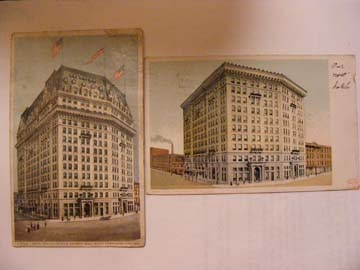
We’ve backtracked from the automobile era for this view of the Ponchartrain Hotel and Hammond Building, judging from the horse-drawn vehicles and trolley cars. But wait—how can those be trolley cars without tracks of wires?


Now another fountain, in bright color, identified as the Edison Memorial Fountain at Grand Circus Park, Detroit.


So many tall buildings! Where is Superman?


Two more cards show the beautiful Ponchartrain Hotel. On one of them, a young woman writing to her uncle in Cleveland scrawled in the margin of the picture “Our new hotel.” David tells me that their restaurant, the Ponchartrain Wine Cellars, was “the height of everything.”


I like this image of the Pantlind—oops! Grand Rapids! Sorry! Wrong city! Never mind....


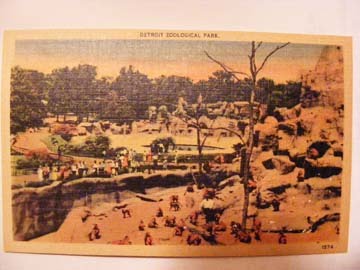
Back to Detroit, I was happy to find a postcard showing the monkey island at the zoo, a view which looks as if it was taken from the island.


Besides the zoo, other notable Detroit landmarks include Woodmere Cemetery,


the Detroit Institute of Arts,


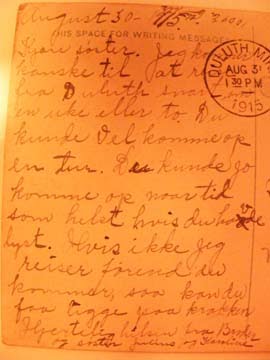
and Children’s Hospital. The hospital postcard is written in what I’m guessing is Dutch and is addressed to a sister of the writer in Minneapolis.


Finally, how could we time-travel to 20th-century Detroit without a visit to Belle Isle? The bridge, the casino, the boat club—that last looking like something from Venice, Italy--


Canoeing the various canals—


Diving into the cool light of the aquarium--


A glossy image of the bus terminal and Post House Cafeteria comes from later in the century.


Finally, from the postal zip code era, we’ll close this week’s promenade with a night skyline view.