Search This Blog

Thursday, March 25, 2021

Excuse Me, I Have Been Distracted – and Focused


There is always time for reading, it seems. I’ve heard people who don’t find it so, but they have demanding fulltime jobs or immaculate homes with nothing out of place. Their concern for career or housekeeping translates, in my case, to a jealous guarding of my reading time. Much else, though, has fallen by the wayside in my life in recent months. Writing, drawing, new recipes, exercise (other than walking)....


Writing, primarily: sadly neglected! I manage to get a blog post together now and then and to write letters to friends, but my Silas project, part of each morning, has been on the back burner now for – how long? Here is the last time I wrote anything related to Silas, this chapter of mine the first with not a word transcribed from Silas’s diary:


Chapter Seventeen

A Week Without Silas


2/5/2021, 10:20 a.m.


Reading now The Great Hunger, Cecil Woodham-Smith’s history of the Irish famine, a book that did not come into my hands purely by accident. When we learned that the Friends of the Library bookstore over in Sunsites (Pearce) was open to the public on Monday, though the library itself was offering only curbside service, we made that our destination and spent $25 between us on books, worth much more to us than the bargain prices we paid. 


It was a couple of Silas’s throwaway lines in January and the first of February that sent me looking for material on mid-century Ireland. His remark about being “tickled” when the Irishman was disappointed to find American equality more myth than reality was the first nudge. The second was his choice of the Know-Nothings as a topic in his newly formed debate society. 


The 19th-century movement called the Know-Nothings began as a secret organization (any member asked about it was instructed to say, “I know nothing”), their anti-immigration and virulently anti-Catholic position a response of fear and resentment to the flood of 1840s immigrants from Ireland and Italy. Is it any surprise that the foremost leader and first martyr of this cause also found women’s suffrage an abhorrent and unnatural idea? The Know-Nothings’ nativism found plenty of support among elected officials as well as among a white working class, and what began in secret as the Order of the Star Spangled Banner (OSSB, formed in 1849) soon morphed into the very public – and briefly very successful -- American Party, the first serious third-party challenge in American politics. Between 1852 and 1854 they won elections at every level. The party split soon afterward, however, over the issue of slavery, a matter even more incendiary than immigration.


The situation in 1840s Ireland had been unlike anything every known in the United States, starving Irish sheltering as best they could in muddy ditches after being evicted from cottages they themselves had often built, improving the land they rented to the profit of their landlords. Many in England believed reports of the potato famine to be a “false alarm,” the “invention of agitators” – in other words, what our recent former president would have called “a hoax” and “fake news.” 


It was no hoax. Since deaths went unrecorded, with uncounted numbers literally dying of starvation in the open, there is no way to arrive at a precise figure for the tragedy, but population numbers between 1841 and 1851 show a drop of two and a half million. Allowing for the roughly one million Irish who emigrated during the years 1846-51, this puts the death toll from starvation at approximately a million and a half. At first there were attempts at public relief, as well as a long effort made by the Society of Friends (Quakers) to save lives, but in the third and fourth year of the famine soup kitchens were closed, government work projects stopped, and the government in London held to a strictly laissez-faire policy, saying the Irish must help themselves. They were told to collect taxes -- in a land of bankruptcy and financial ruin, where no one any longer had the ability to pay taxes – and to provide locally for the relief of the destitute. 


Nor was starvation the only plague on Ireland during those years. Typhus and cholera contributed to the tragedy, spread all the more rapidly in workhouses, soup kitchens -- and on ships. As there looked to be no future for the Irish in their own land, those who were able sought to leave by any means possible. Passage to Canada was cheaper (some sold all they had; others had fares paid by landlords eager to be rid of them) than passage to the United States and entry into Canada easier, but most Irish had no wish to remain any longer under the flag of England, and so the vast majority who landed in Canada and survived crossed the border to the United States as soon as possible.


Such was the background in Ireland that led to the most massive emigration ever from any European country – and the entry into the young United States of vast numbers of desperate, unskilled immigrants, eager and willing to work for almost any wage offered. Such was the wave of a population movement that created fears triggering the rise of nativism and unsurprising political opportunism, much like what we have seen again in recent years a century and a half later. 


So now, as you see, it has been over a month for me without Silas, a month that has flown by. The nineteenth century, recently so immediate in my thoughts, has receded to a far and misty horizon. 


Last Saturday a group I call “ghost town ladies,” a group the Artist refers to as “your coven” and the ladies self-reference as “the riff-raff” met for lunch for the first time in well over a year. A red-letter day, long awaited! The following Monday the Artist and I drove to Benson to rendez-vous with Leelanau friends currently spending a couple of months in Tucson. Another lunch date! In both cases, all had had their double doses of vaccine. But I cannot blame those welcome distractions for my neglect of Silas.


No, it’s all the darn little dog, little Peasy, that stray from the pound, whose training and domestication has so absorbed my daily attention and focus. He has come such a long way! Given a full year…. But I don’t have a full year, only another couple of months, at most, and little Pea, while madly in love with me and tentatively fond of the Artist, is still afraid of almost everyone else. A bookstore future for this dog is the most unlikely scenario. 


What is his likeliest future? I’m still working on figuring that out, but while he is in my care I work daily on lessons to civilize the little love-bug.


Silas is long dead, and Peasy is very much alive. No one other than me cares if Silas’s diary is every transcribed, and hordes of more qualified writers than I have written of 19th century America. But Peasy was ignored and passed over for three months in the pound in Safford. And – he loves me. He cares!


While Peasy distracts me from writing and much else, though, he also focuses my immediate attention and gives purpose to my days. The progress we have made together gives me a sense of accomplishment and deep satisfaction. Besides that, he is my daily companion in rambles over the range, out in the sun and the wind and the dust. 


“How was it?” the Artist asks when the dog and I return to the cabin, tired and thirsty and happy. 


“It was great!” 


We’re here now. That has been my mantra for years, wherever I am: we’re here now. And I don’t want to miss being here.


Tuesday, March 23, 2021

Books in the Car

On the trail, looking up --

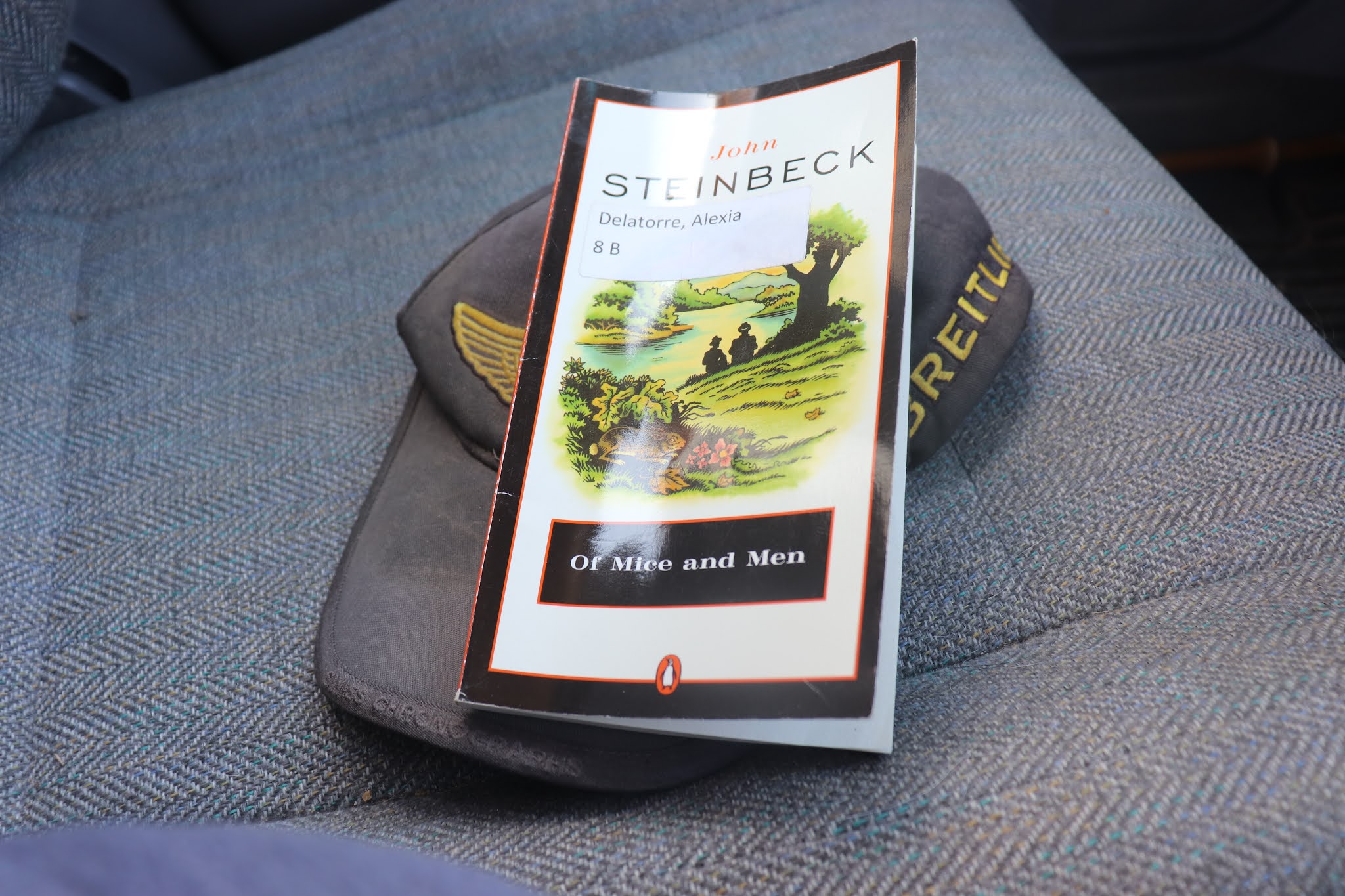
Over the weekend, although we traveled no farther from the than Willcox (14 miles north-northwest), the Artist and I had, as always, books in the car. I set out Saturday morning with The Animal Dialogues: Uncommon Encounters in the Wild, by Craig Childs, only a few pages left unread. The Artist had two or three books with him, but having begun Steinbeck’s Of Mice and Men (not for the first time but for the first time in many years), he stuck to it faithfully from beginning to end, knowing that his other car reading selections, books that could be picked up at any time and opened anywhere, would wait patiently as long as necessary.


Already, however, I have so far glossed over the “books in the car” story as it unfolded on Saturday. 


You see, I was picked up by a neighbor and carried my book with me in a bag, while the Artist drove to town separately to be about his own business while I was meeting with a group of “ghost town ladies” (my name for the group; they refer to themselves as “the riff-raff”) for lunch, our first gathering in over a year. What fun! It didn’t matter that our orders took a while to arrive, because we had plenty to ask of and say to one another, and when a call came on my phone from the Artist as we were lingering over our checks, there was still no hurry, but it was agreed that Edna would eventually drop me off at the Friendly Bookstore, where David and I would rendez-vous and ride home together.


Full disclosureThere was a big book sale going on at the Friendly!Although prices were dirt cheap, we exercised massive self-restraint -- and only filled a single box to load into the back of the car! One slim paperback I kept out of the box, a book to follow that of Craig Childs (so soon to be finished), was Wendell Berry’s Life Is a Miracle


Berry’s subtitle to this small volume, published in the year 2000 and still pertinent and not widely enough read today, is An Essay Against Modern Superstition. Perhaps (and I say this in full recognition of the fact that making a big splash is not Wendell Berry’s way of being in the world) the book would have made a bigger splash, garnered more media attention, had the subtitle read: An Essay Against E. O. Wilson’s ‘Consilience’ – because while Wilson is not the only target of Berry’s criticism, Wilson’s notion of what he calls ‘consilience’ and his advocacy for it give a sharp focus to Berry’s larger criticisms of a materialist culture that values market efficiency over all else. And that’s fine with me, both the general and the more specific “against” targets, as I find arguments for materialism self-defeating and have always found Wilson’s know-it-all posturing annoying in the extreme.


Wilson’s book, Consilience: The Unity of Knowledge, makes an argument. In roughly 150 pages, Berry carefully analyzes the argument to lay bare its contradictions and basic incoherence. Wilson knows a lot about ants, but he falls dismally short as a philosopher (shoemaker should have stuck to his last), and I confess to a devilish delight at Berry’s skewering of Wilson’s straw man argument: 


In his chapter on “Ethics and Religion,” he has “constructed a debate” between “the transcendentalist” (a straw man) and “the empiricist” (a stuffed shirt).

- Wendell Berry on E.O. Wilson in Life Is a Miracle 


Touche! Berry’s well-aimed arrow here is only an opening salvo in his lengthy and detailed critique, which I will not review in its entirety but urge you to read for yourself in Life Is a Miracle, particularly if you consider yourself an admirer of or apostle for E.O. Wilson’s “unity of knowledge.” 


My delight in other pages was more generous, delight not only in Berry's ideas and statements, but recognizing that he and I share admiration for other writers. Encountering a quotation from Stephanie Mills, a writer from back home in Leelanau County, Michigan, someone we know personally, made me happy, as did a paragraph on the work of Jean-Henri Fabre, “the Homer of the insects” -- and one of my favorite nature writers.


Maybe you would have preferred a photograph or two of the new stacks of books that made their way from sale tables to back of car to shelves and stacks in our ghost town cabin? I’m sure one or two of them will find their way into this blog in future posts. One, I’ll just hint, was about horses….


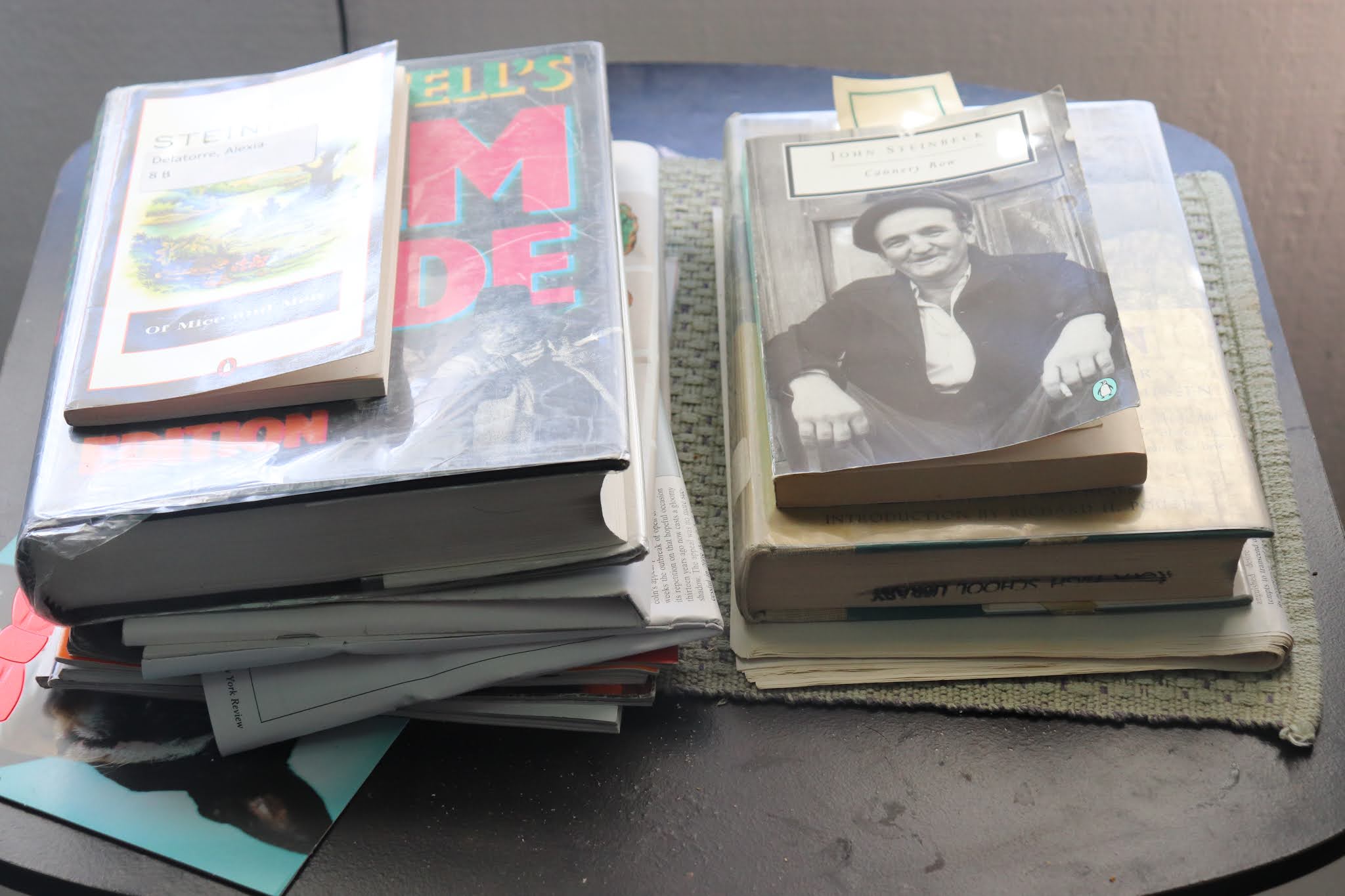
For now, as the Artist has read the last page of his Steinbeck, closing the book with a great sigh of satisfaction, I’m wondering -- will one of his next car books be Cannery Row? I’ll leave that one on top of the stack on the little table between our reading chairs and see if it gets picked up and carried along in the next day or two.


Friday, March 19, 2021

We Never Have “Too Many Books”

Artist reading Hemingway's A MOVEABLE FEAST


Some people (I’ve heard them say these words) have a concept they call “too many books.” In my birth family, and in the household the Artist and I share, that concept has never been recognized, even here in our rented winter cabin that is basically one large single room. Yes, we sometimes run out of shelf space. And we don’t always want to keep every book we read forever. In the latter case, we pass books along to friends and family (I just shipped off a box this morning), donate (or re-donate) to thrift shops, or take to bookstores for trade credit, if we can get to such a place easily. (In the past year of COVID, getting to those Tucson bookstores has not been easy.) But there are many books we want to hold onto. “I need another bookcase,” the Artist says to me. Oh, how quickly they fill up!


The dog and I share a library and R&R corner, where my Western, Spanish, and French books are in one case, miscellaneous books in another, nature field guides now moved to the desk.


My books

My books

My books


The Artist also has two bookcases, but, as you see, books are also piling up on the tops.


His, his, his, his


Then there is the little table between our respective reading chairs: each with a different book, we often interrupt the other’s reading to share aloud something from our own.


Neutral territory


And my shelf of cookbooks, of course. Can’t forget those.


Cookbooks


And the books on my bedside table, some for reading aloud and some for reading myself to sleep. Will I ever get around to those other Jack Kerouac novels? There are a few waiting for me here:


Bedtime reading


We always have between two and half a dozen books in the car with us, also, and I’m not showing you the big, heavy box of books in the closet or the stacks of books on top of that box (enough to fill another carton). I make no excuses. We are not wealthy people, but we have what feels to us like a very rich life, and books are a big part of our satisfaction.

Monday, March 15, 2021

Book Review: TIN CAMP ROAD


If someone recommended a novel about a young single mother living in poverty, making a precarious living by cleaning motel rooms, dressing herself and her daughter in used clothing bought in thrift stores, their lives suddenly threatened by eviction and homelessness, what else would you expect of the story? Would you anticipate a “gritty” urban setting? Characters living on fast food burgers and fries? A mother ground down by the hopelessness of her situation? I’m betting you wouldn’t anticipate a rabbit hunt or a beach fire with marshmallows under the Perseid meteor showers on a Lake Superior beach. Author Ellen Airgood’s novels, however, are full of the quietly unusual and unanticipated.


Airgood's first novel, South of Superior, was published by Riverhead Books in 2011, followed by two middle-grade novels, Prairie Evers and The Education of Ivy Blake. Like many of Airgood’s fans, I have read all three more than once, and while I enjoyed the fiction for young people (the stories about Prairie and her friend Ivy), at the same time I longed for another novel set in the Upper Peninsula of Michigan featuring adult characters. Now we have that second U.P. novel at last. Tin Camp Road is scheduled for release in August of this year, and those who loved South of Superior will not be disappointed by Tin Camp Road.


All of Airgood’s fiction, whether for adults or young people, shares a committed attention to the "messy" (her word) lives of ordinary people. That human beings must deal with the unexpected is not Airgood’s exclusive discovery, of course, but her particular presentation of “the plans of mice and men gang aft a-gley” is all her own. 


Whether you realize it or not, you probably know someone with experiences similar to those of the character Laurel Hill. Maybe you’ve been there yourself. So much of our lives' confusion and its complications is hidden from public view, if hiding is possible. In this novel, we see secrets not revealed in shocking cinematic flashbacks or tidy Freudian explanations, just as simple facts of life.


Publishers, however, are no doubt reluctant to describe any book as “quiet,” afraid that potential buyers will interpret that to mean boring. Thus the publisher’s blurb on the back cover of the advance reader’s copy of Tin Camp Road describes Laurel’s relation with her daughter by saying they are “each other’s everything,” with subsequent phrases such as include “dangerous incident,” “hardscrabble life,” and “embrace the wild.” In my opinion, the publisher’s description makes the story sound more melodramatic and less satisfyingly real than it is. I am grateful to Riverhead Books for publishing Airgood’s novels, and I understand the motivation behind the hyped-up description: fiction is fiction, and advertising is advertising, and the latter can never deliver what only reading a novel can offer. Still….


Can any parent and child be “everything” to one another? Before the unplanned pregnancy that brought Skye into her life, Laurel’s chief passion was running. When we meet her at the beginning of the novel, she has not indulged that passion for years. In the hands of most fiction writers, a passion long given up and eventually reclaimed by a main character would be showcased as the story's heart. Similarly, certain troubling behavior her teacher sees in Skye when her life is disrupted would usually be presented in more heightened emotional terms as another seemingly unconquerable crisis. But melodrama is not Airgood’s way. Quietly and simply, she surprises us again and again.


As a friend of mine who grew up in a northern Michigan small town put it admiringly after reading South of Superior, “She knows the life!” 


Yes, this author knows the intimate familiarity of small towns, the unremitting struggle for survival, the deep love for these rural “flyover” places, and she gives it to us in its equally stark beauty and challenges, in the ordinary hues and tones of passing days and seasons. At several points in the novel, we think we know where Laurel will jump next, but we are usually wrong. Nothing feels inevitable in Tin Camp Road. Laurel Hill’s life does not get tied up in a neat bow on the last page, laid out once and for all. If you want a fast-paced, tightly plotted story with lots of action involving glamorous characters, look elsewhere. Airgood gives us something much richer. She gives us real life, characters we see and feel as real people, people we care about, with possibilities and choices that might have been, as Jane Kenyon’s wonderful poem tells us, otherwise. But in this case, they were not otherwise. They are as they are.


At a certain point in my own life, I remember realizing that I was not traveling some clear path to a distant goal but making things up as I went along. “It’s the ‘revisable life,’” I wrote to a friend. That, I think, is the life most of us live. It is Laurel Hill’s life in Tin Camp Road, and I am eager to turn back to the first page and read her story over again, beginning today.


Tin Camp Road

by Ellen Airgood

NY: Riverhead Books

Release date: August 3, 2021

ISBN 978-0-399-16336-4

Hardcover, 304pp, $27


Saturday, March 13, 2021

Winter and Spring Collide on Saturday Morning in March

Stormy skies threaten --


Morning begins with Peasy. Although he and I are early risers, one of my daily objectives is to have a couple cups of coffee without an exuberant young dog tearing around the cabin with a noisy squeaky toy, and to this end I line up little treats at the edge of the table where I’m sitting and give Pease the command to lie down and stay. Sometimes he cooperates right away, and other times he doesn’t feel like it and tests me, popping up again and again. He was a popper-up this morning. So I took him outdoors on the leash and we ran through a series of commands in the cold wind. Back inside after the lesson, he was ready to settle down quietly at my feet, bribed by a treat every ten minutes or so. Good enough.

You've come a long way, baby!


This little dog has learned a lot in a few weeks. He knew nothing when we brought him home, other than to charge his meal dish the minute it touched the floor. Now he will sit, lie down, stay, and wait – whatever I tell him to do – and as I walk around the room to give him extra time for reflection, his eyes are on me, not on his food, as he looks to me for permission to go to the dish. 


After my coffee and Peasy’s breakfast, all of this stretched out over an hour or more, I walked down to the mailboxes on the highway with Peasy on a leash. He was a good boy and didn’t pull. Back in our yard, I wanted him to run through a few more commands while on-leash, but he didn’t feel like it, and I had to insist. When I didn’t give in to his naughtiness, he bowed to the inevitable, doing a very nice lie-down-and-stay (leash attached to collar but lying loose on the ground) until I called him to me from a distance, whereupon he came directly to sit in front of me and wait for whatever was going to come next. Good dog! After I told him how good he was and showered him with affection, I took off the leash and had him sit politely one last time – then gave him permission to run!


It was a good dog morning. I wish Peasy were as comfortable in public as he is with me in private, but that may not be within his power or mine.


Return of winter or spring snow?


Before we were back in the cabin, the first snowflakes were in the air, and the snow came thicker and heavier for quite some time. I am concerned for flowering fruit trees in my neighbors’ yards. Moisture for the land is good, though. In fact, as long as we were going to have cold winds and snow, I wouldn’t have minded a lot more snow. My own little garden is portable, and I’ve been bringing it in every night. Today it will probably be spending the whole day indoors.


The Artist has his coffee now and is listening to NPR. The dog has settled down to think about what he did right this morning and where he has room for improvement. (Yeah, right!) My lettuce and cilantro seedlings are safe from killing cold, and I have leisure to clear away clutter and reorganize the books in my private Arizona library (ARCs on desk).


Impossible for a book person to rearrange books on shelves and not open one to dip into its pages! 


…This is the other side of the coin from the rest of my life, from doors and walls and movie screens. This is the place that does not belong to humans. Animals have scuffed the ground, shat upon it, cleared twigs out of the way, folded down grass in their sleeping. They are talking, leaving messages written in scents on leaves and tree bark, whistling to one another, hearing voices in the distance. 


-      Craig Childs, The Animal Dialogues: Uncommon Encounters in the Wild


Books are essential to my life, but so is the freedom to ramble outdoors on a daily basis. A book like The Animal Dialogues pleases me because it takes me, in memory and imagination, back outdoors where I was so recently and will be again. 


Saturday, February 27, 2021

How I’m Coping Without My Bookstore


My old girl, Sarah, in her younger days

“It’s only temporary!” Loretta (played by Cher) yells at her father when he asks to see her engagement ring and she shows him (as he points out) what is obviously a pinkie ring. 


Everything is temporary”! he yells back.


“Moonstruck” is one of my favorite movies, one of those rare films with nary a clinker. Every scene and line is perfect. I think of it as I write this post today because, as you know, my bookstore in northern Michigan is closed while I take my annual seasonal (winter) retirement.


The daily “Shelf Awareness” newsletter has had a regularly occurring feature since sometime in 2020, inspired by the COVID-19 pandemic, called “How Bookstores Are Coping.” The feature tells stories from all over the United States about how supportive customers have been, online orders being received on store websites, tales of curbside delivery; etc. And every day when I read those stories, I feel like a deserter from the front lines, although Dog Ears Books is not closed for the winter because of the pandemic, but only so this aged bookseller can have a respite before taking a deep breath and plunging into another busy season as one of the “working aged” (as another of my still-working friends informs me we are identified). 


Resting on her laurels in old age


Open for business only four months last year when stay-at-home restrictions were eased, I was full of trepidation beforehand, but after another still-working friend helped me out with a professional deep cleaning and I got all my pandemic precautions in place, things went fine. In four months, only two people complained about. having to wear masks (one of them told how to wear it correctly, up over his nose, made a fast exit, and that was okay, too -- his choice). Everyone else was cheerful, and more than one person thanked me for requiring masks and hand sanitizing at the door. 


Sarah with me for her last bookstore season


Bookstore people! They are the best!


Out here in Arizona in the early winter of 2019-2020, I was happy to arrange a couple of very parttime volunteer gigs for myself. On Monday mornings, at the Friendly Bookstore in Willcox, a venture of the Friends of the Elsie S. Hogan Community Library, and on Wednesday mornings in a program that paired older volunteers with at-risk children in early grades at the local public school, reading with them and having them write stories. I loved that git – the first volunteer job of my life! The children were darling, and naturally I felt right at home in a bookstore. 


Then came the stay-at-home order, and everything came to a sliding stop – which is much faster than it sounds. No more reading with little kids at school. No more selling books and honey. No socializing with neighbors, either. 


Well, you all know. We were “all in it together,” we were told over and over. Now, almost a year later, we hope the end is in sight, but life is still not back to normal, and the stories of “coping” continue.


The first winter the Artist and I came out West, there were three independent bookstores in Benson, just 30-odd miles down the pike from Willcox. The one we frequented most often and always found stacks of books to buy closed when the bookseller decided 25 years in business was long enough. The second, which we belatedly discovered on a back street, was gone without explanation last year. And the owner of the third, way out in the country, on a ranch with donkeys (and yes, a little dog, too), died in late 2020 at the age of 90, after 46 years as a bookseller. 


From three indies to none in five years. 


So now, unless we want to drive down to Bisbee or all the way to Tucson (where I had discovered the wonderful Book Stop not long before shelter-in-place order hit), neither of which we’ve done so far this season, we’re thrown back on the pot luck of thrift shops and FOL bookstores, which are better than nothing -- and some very nice and friendly and COVID-aware -- but nothing like the curated collection of an indie. And the FOL place in Benson has been closed since the first of the year. 


I miss the indies and supporting my fellow indie booksellers, my colleagues. Who knows? Maybe before we leave for Michigan this spring we’ll make it back over to the Book Stop neighborhood in Tucson or down to Meridian Books in Bisbee. I hope so. Because I have not yet abandoned the front lines myself, and it’s important to me to support with my purchases – support that really counts -- others who are out there in this always-risky, always changing business called bookselling. 


We indie booksellers all need to make money to stay in business, but we didn’t go into this particular business to get rich. You know why we do it! You wouldn’t be reading “Books in Northport” if you didn’t love books!


Not there now, but I shall return!


Postscript Update, 3/13/2021: The Friends of the Library bookstore in Benson, closed January and February, re-opened March 3, and we made our first visit of the year on March 12. I was delighted to find the volunteer in charge none other than Lenore, retired from the the former Benson bookstore we visited so many times. She was able to tell us that Mary Ann, another of Benson’s booksellers, moved her shop to Apache Junction to be nearer her son. (Mary Ann's and Lenore's former Benson bookshops appear in this old post.) Also, that the heirs of the late Win Bundy, bookseller at Singing Winds bookstore (the one with the donkeys), are trying to figure out how they might re-open. That would be fantastic, as Win's inventory of books on the Southwest was nothing short of mind-boggling.


Tuesday, February 23, 2021

Baudelaire for Breakfast


Having a new young dog that needs exercise and training is a little bit like having a new baby in the house, in that my mornings are not at all my own. Quiet writing time? Ha! I’m lucky to get a paragraph or two written in my journal, and as far as reading goes, many mornings it’s crazy to try to get very far in a book before Peasy has been outdoors for a good run. 


The other day the Artist and I (dog in backseat, of course) went over to visit the very nice, very clean and well-organized little FOL bookstore over in Sunsites, a.k.a., for postal purposes, Pearce. Pearce itself, like Dos Cabezas, is an old mining ghost town where only a few people live; a few miles to the north is the large subdivision of Sunsites, where the post office and library bearing the name Pearce are now located. I hoped maybe to find a good book in French, and in the poetry section, what to my wondering eyes should appear but a little bilingual paperback edition of Twenty Prose Poems, by Charles Baudelaire! 


So this morning, after Mr. P. and I had a good, rousing, morning outdoor adventure, when it was warm enough (with jacket) to sit out in the sun and read a little Baudelaire while Peasy gave his beautiful white puppy teeth a workout on an old cow bone, the short pieces in the Baudelaire book seemed like something I would be able to absorb despite distractions of dog and birds. (The Western bluebirds made another appearance at my birdbath ths morning!) I was more than a little shocked, however, to find a mistranslation in the very first prose poem in the book. The phrase was not at all tricky, either. An old woman, enchanted by a pretty child, approaches the little one with a smile: 


Et elle s’approcha de lui, voulant lui faire des risettes et des mines agréables.


That is the French. The English is given as:


And she approached the child, wishing to smile at it and make faces pleasantly. 


“Make faces pleasantly”? No, make pleasant faces. The French uses an adjective, not an adverb. Moreover, “making faces pleasantly” (in my opinion) hardly makes sense. Is it good English? What do you think? Anyway, that's as far as I got this morning. 


Later, toward midday, when the three of us were all settled down, the Artist and I in our reading chairs and Peasy fully engaged in tearing apart a new dog toy his Aunt Deborah had sent him, I was able to finish an entire short book, After the Fire, a book of poems and annotations consisting of background biographical information by the mystery writer I’m so hooked on these days, J. A. Jance. The author wrote the poems secretly, early in her first marriage, and hid them from her alcoholic husband, who had made it quite clear to her that there was to be “only one writer in the family.” (In the end, he remained a wannabe, she became the writer.) Only after his death, which occurred a year and a half after their divorce, did she rediscover the poems, hidden away in the box containing family birth, marriage, and divorce documents. 


My critical response is that Jance serves her readers better with her fiction than had she determined to continue writing poetry. Even so, the work is fascinating for its honest revelations. When writing the poems, Jance thought of herself as creating “art,” if only for herself, not engaging in self-analysis or exploration of issues in her married life. 


The artifice of “art” allowed me to maintain emotional distance. I could look at what was happening without ever having to come to terms with what was going on in my marriage. It spared me the harsh reality and hard work of actually doing something to change our disaster-bound direction. Looking at my poetry with the benefit of hindsight, I see how, even as early as 1968, a part of me understood that my marriage was doomed….


-      J. A. Jance, After the Fire


But her secret poems, not intend as anything else when she wrote them, later served her as a kind of journal of those earlier years, each one bringing back memories of the time of its creation and her surroundings on that day. To read more of Jance’s present life, see here.


Another book of poetry, Bone Rosary: New and Selected Poems, by dedicated poet Thomas Lynch, I’m reading much more slowly and will tell you about at length, in a separate post, when I come to the last page and collect my thoughts on what I’ve read, and I’ll do the same with my current serious nonfiction book, Against Civility: The Hidden Racism in Our Obsession with Civility, by Alex Zamalin. 


My bedtime reading is not singular this week. The after-movie, read-aloud book is The Motorcycle Diaries: Notes on a Latin American Journey, by Ernesto “Che” Guevara. I try to stop each evening at a cliff-hanger point in the story, which isn’t hard, considering the kinds of roads Che and his friend, Alberto, are traveling on and the instability of their motorcycle, resulting at one point in nine crashes in a single day. Then I turn from the excitement of a motorcycle-buddy road trip, before turning out my bedside light, and read silently to myself a few pages from a YA novel, You May Already Be a Winner, by Ann Dee Ellis, and I’m already anticipating two more bedside books awaiting me. 


And I cannot close today’s post without noting the passing of poet, publisher, and bookseller Lawrence Ferlenghetti, whose poems I discovered back in East Lansing in 1967. (The book was A Coney Island of the Mind.) Ferlenghetti lived to the ripe old age of 101, and his City Lights Bookstore in San Francisco, also the home of City Lights Books, has been as well the home of the nonprofit City Lights Foundation since 1953. The bookstore received historic landmark status in 2001. Finally, let me note that the Baudelaire volume I had in hand several times today was published by City Lights Books. 


Thank you, Mr. Ferlenghetti, for getting your good work for literature done in the world for so long.