Search This Blog

Monday, April 13, 2020

Which Side Are You On?

When I went to work in my fields [following his marriage], I worked with more alacrity and sprightliness. I felt that I did not work for myself alone, and this encouraged me much. My wife would often come with her knitting in her hand, and sit under the shady tree, praising the straightness of my furrows and the docility of my horses. This swelled my heart and made every thing light and pleasant, and I regretted that I had not married before. I felt myself happy in my new situation, and where is that station which can confer a more substantial system of felicity than that of an American farmer…? 
-  J. Hector St. John de Crevecoeur, Letters from an American Farmer

Crevecoeur, an Anglicized Frenchman (born Michel-Guillaume-Jean de Crevecoeur -- and I apologize for not having the proper accent mark available to me on the program I'm using), initially began his New World life in Canada, fighting under General Montcalm until the defeat of the French on the Plains of Abraham. Then, resigning his commission, he traveled through New York, Pennsylvania, and Connecticut. In New York he was naturalized as a British subject and also adopted into the Oneida tribe as an honorary member. He married Mehitabel Tippett in 1769 and spent the following seven years happily farming and raising a family at home, Pine Hill, cultivating friends among his Hudson Valley neighbors, and traveling. 

But his very name — “broken heart” — perhaps presaged what was to come in the author’s life. Count seven years ahead from 1769. Crevecoeur felt himself thoroughly “American,” but to him that meant being a loyal subject of the English king. 

Susan Manning, who edited and wrote the very scholarly introduction to the Oxford World’s Classics edition of Letters from an American Farmer, calls the work “a book about identity — specifically American identity — struggling into being.” 

The book that took shape in the years before and during the American Revolution embodies the personal crisis induced by momentous political events. It is at once the fullest literary expression of America’s coming into being … and a moving exploration of the meaning of ‘revolution’ in the personality of any previously established self. 
- Susan Manning

It is easy for us to see the march of history exclusively in broad strokes: migrations, social change, important primary source documents (e.g., in this case, the Declaration of Independence), battles, treaties, etc. What gives Letters from an American Farmer its importance is not only that it was written at all and widely published but that it is a record of one man’s emotions, passions, and responses to the larger events which engulfed his life. We occasionally ask ourselves what we would have done in such-and-such a place in such-and-such a time period. More often we judge the actions of individuals in the past, forgetting to imagine ourselves in their shoes. But there is no possibility of forgetting the man and his family as we read Crevecoeur’s Letters, an epistolary-literary account of real people caught up in world-changing events beyond their control. 

So the Letters constitute a much-neglected American classic, but reading it now, during the COVID-19 crisis, when not only the United States of America but the entire world is struggling and looking for ways to maintain a semblance of normal life and find a way forward while also doing everything possible to avoid contagion in the present and “flatten the curve” (the rising curve of numbers of people infected with the virus), a year that is also an important election year in the U.S., I find added resonance in Crevecoeur’s cries of anguish.


Throughout the early Letters, the author idealizes the American experience and work ethic, particularly that of English and Scottish colonists. (Irish, not so much.) Farmers work hard and bring forth the land’s bounty, while fisherman on Nantucket and Cape Code brave the ocean to harvest subsistence and, for some, even wealth. He is full of admiration for the modest Quaker way of life but paints a picture of religious tolerance, with families of diverse faiths living side by side without acrimony. He admires also the Native Americans, calling their manners “respectable,” in sharp contrast to some of the rude European pioneers along the frontier, who live in “sloth and inactivity.” Those “back-settlers,” he remarks reprovingly, are much more in need of conversion than the Indians. But in general, he presents life along the Eastern Seaboard, on its farms and in its towns and villages, as a veritable pastoral idyll, a dream come true for the poor who fled the nobility-crushed and heavily-taxed Old World, where they had no hope of advancement.

From pastoral idyll, however, Crevecoeur descends into nightmare when he travels in the South and learns firsthand the horrors of slavery. In Charleston and in the countryside, the stories he hears and one particularly gruesome sight he sees stand in such sharp contrast with the threadbare arguments presented to him in defense of the “peculiar institution” that his very belief in God’s beneficence is shaken to the core, and he cries out from his heart —

Is there then no superintending power who conducts the moral operations of the world as well as the physical? The same sublime hand, which guides the planets round the sun with so much exactness, which preserves the arrangement of the whole with such exalted wisdom and paternal care, and prevents the vast system from falling into confusion, doth it mankind to all the errors, the follies, and the miseries, which their most frantic rage, and their most dangerous vices and passions can produce? 

As he looked about him and saw “crimes of the most heinous nature, committed from one end of the world to the other,” he could not help doubting in the existence of wise deity guiding history and ensuring progress. 

Loudly though his every feeling cried out against the evils of slavery, however, Crevecoeur himself was in no immediate personal danger as he traveled through the colonies. He was a white man, after all, an educated man, with apparently sufficient income to leave his farm in other capable hands for long periods while he traveled. A visit farther south, to self-taught botanist John Bertram in Florida, soothed for a while the agitated feelings aroused by his painful encounters in South Carolina. 

But Time is marching on, inexorably, and both Crevecoeur’s scholarly social visits and his peaceful life at home will soon be violently interrupted. The Revolution is at hand! What hope is there now for a loyal subject of the king? 

Now danger has become personal and immediate — as it was already for the slaves on those Southern plantations — and the writer now fears for the lives of his wife and children, as well as himself. Though he declares himself ready to sacrifice his own life for that of his family, staying home on the farm and helplessly waiting “the end of this catastrophe” becomes more and more unbearable. And once again the feelings that agitate his soul find expression in larger questions about the human condition.

It is for the sake of the great leaders, on both sides, that so much blood must be spilt; that of the people is counted as nothing. Great events are not achieved for us, though it is by us that they are principally accomplished; by the arms, the sweat, the lives, of the people.

Resenting historical convulsions that disrupt and even destroy ordinary, peaceful lives, at the same time he knows that he must decide

What must I do? … Shall I discard all my antient [sic] principles, shall I renounce that name, that nation, which I once held so respectable? … Must I be called a parricide, a traitor, a villain; lose the esteem of all those whom I love to preserve my own; be shunned like a rattle-snake, or be pointed at like a bear? 

As much as he loves England, he also sees “the powerful attraction” of the call to revolution, and he cannot help blaming the king for pursuing a course that will guarantee the shedding of so much innocent blood. He is a man caught in the middle. 

I cannot count the multitude of orphans this war has made, nor ascertain the immensity of blood we have lost. Some have asked whether it was a crime to resist, to repel, some parts of this evil. Others have asserted, that a resistance so general makes pardon unattainable and repentance useless…. What one party calls meritorious, the other denominates flagitious [criminal]. … What can an insignificant man do in the midst of these jarring contradictions…?

It is, after all, not only coronavirus that hovers outside our doors these days. There is also the unsettling and continuing political discord and paranoia, amazingly and alarming not set aside in the midst of a life-threatening pandemic. If anything, it is exacerbated. And what one side calls necessary, another calls criminal, while millions of ordinary Americans, who want only to work and live in peace within their families and communities, are caught in the crossfire. 

What will Crevecoeur do as the clamor of strife comes nearer? Will he be a “traitor” to the king or a “traitor” to the revolution? Of course, his future then is now long past, so what was his ultimate fate and that of his family? 

Don’t look for spoilers here. If we are going to learn anything from history, it is important that we hear not only competing interpretations but also individual voices of real human beings, as they lived through and experienced those distant times. We are not that different from those colonists — or those slaves — in eighteenth-century America. As did they, we work and love and hope, feel joy and fear, and the questions we ask of ourselves and of the universe have been asked by every generation that came before us.


Thursday, April 9, 2020

How Long Will It Last?


How long will what last? The pandemic, the staying at home, the anxiety, fear, worry, anger? The arrival of sudden, piercing stabs of fear in the middle of a sleepless night? 

Household food supplies???


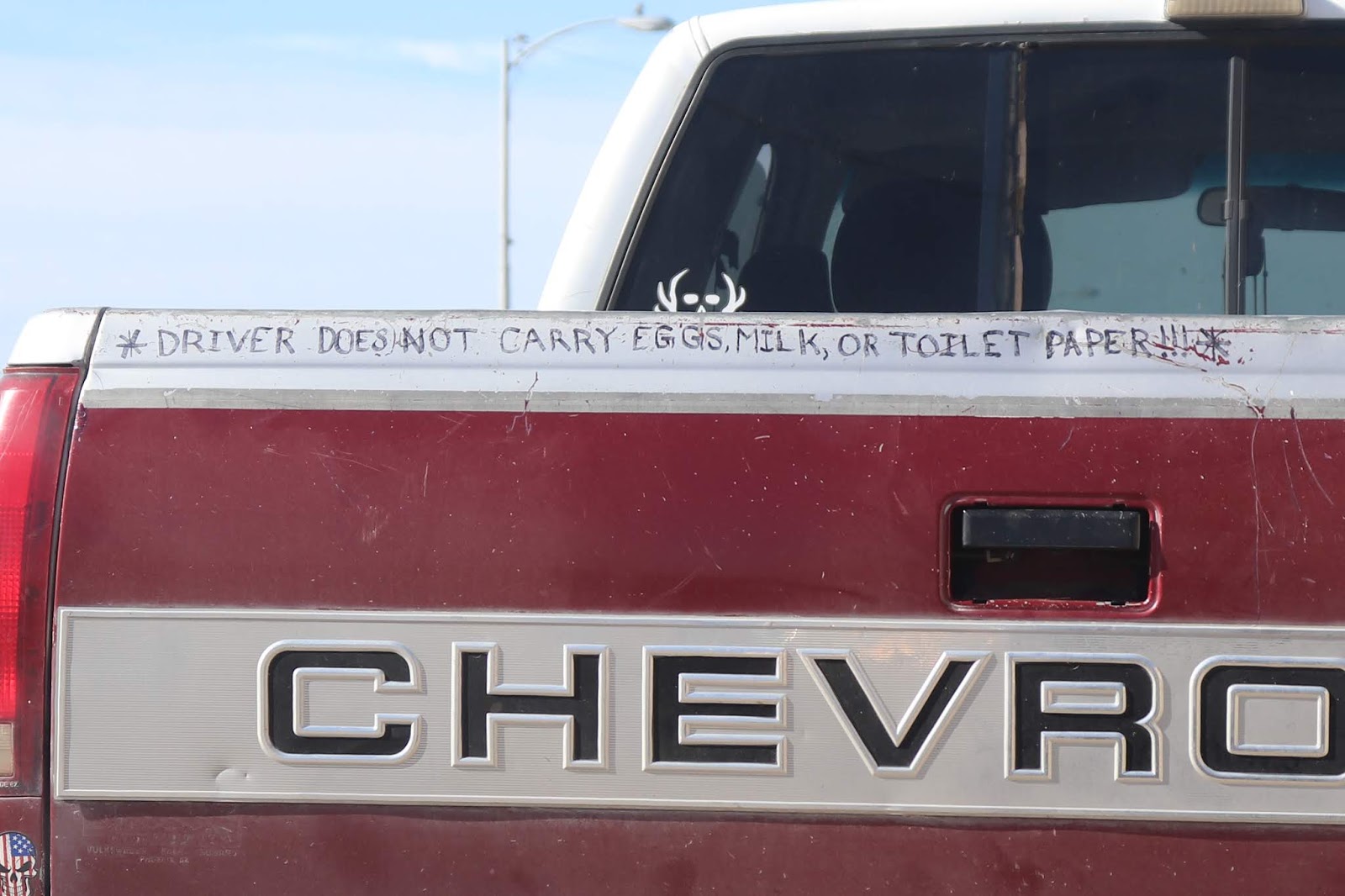
Long before the stay-at-home order came to Arizona (where we remain until confident of a safe return to northern Michigan), even before the nationwide toilet paper panic and frenzy, wise and forward-thinking authorities recommended that every household have a minimum of two weeks of food and necessities on hand, in case quarantine became necessary. So I shopped then and found everything we needed and felt we were well supplied. I even bought a two-pack of giant-size containers of antiseptic wipes, wondering if we could ever possibly need that many. Was I overreacting? Flour, yeast, canned tomatoes, pasta, canned milk, onions, soap, yada-yada-yada — all the things you’d need if you couldn’t get out of the house for two weeks. 

But hand sanitizer? I never buy that stuff, just soap. So when I returned to the store for hand sanitizer a week or two later, while other shoppers were panicking over shelves stripped bare of toilet paper and paper towels [actually, no one looked panicked at the Safeway in Willcox: that was literary hyperbole], I was stunned at the sight of an empty aisle where hand sanitizer and other such products used to be. On my next and I hope last trip, there was still none to be had. We are told to keep in the car and use it constantly, but the Artist and I are using those antiseptic wipes I thought I might not need. Not the kind made for hands, but the harsher cleaners intended for household use. Now even those are nowhere to be found for sale! How long will what we have left last?

I chickened out of going to the grocery store again last Friday, as planned, and made a new plan for Tuesday, when the dairy and egg supply would be restocked. And yes, on Tuesday the store had eggs, and I bought another container of yogurt so I’ll have starter to get back to making my own with raw milk from the feed store, but once again there was no hand sanitizer, no antiseptic wipes, and no yeast. I almost wept. I'd been so nervous about going at all, and then these empty, gaping shelves! I think of certain friends in Northport who have for years found it amusing to refer to our grocery store there, especially in winter when the summer people with their big bucks are not in residence, as "Moscow Market." Ha! Eat your words, guys! We always had everything we needed, didn't we?

Catching wild yeast from their air, on the other hand, is something I think I can manage, so before we run out of yeast, I will finally attempt to make sourdough starter. Old dog, new trick. I have read up on it and feel confident. 

But aren't these strange times when a trip to the grocery store or laundromat feels dangerous? How long will these feelings last?

We went to a different laundromat this week, a less frequented washateria with cheaper washers than our usual but busier, more crowded place (hence our avoidance) — sadly, also with dryers that have an insatiable appetite for quarters. But never mind! All I wanted to do was wash the clothes and get back to the cabin and hang them on our new clothesline. Finding almost all the machines in use when we arrived — very unusual! — and four people inside, we made ourselves comfortable in the car with books and cold water and snacks, in a quiet, shady spot, with a nice breeze filtering through the new leaves of a velvet ash tree, waiting for the coast to clear, as it eventually did. So it all worked out.

Still, we were relieved to be home again, even though a single clothesline and limited supply of clothespins meant that I spent the remainder of the day hanging up as many items at once as possible and whenever a few were dry, pulling those dry items off the line to make way for more. It really did take all afternoon, too, despite sun and a stiff breeze, and the last towels were still on the line when meatballs for dinner went into 
the oven.


Funny how one's perceptions change with changed circumstances. Familiar sights evoke new thoughts. These days when I’m out walking and see dried cow dung, I think, fuel. When we’re driving, wild rhubarb along the roadside says to me, food. Prickly pear still poses a question: how does one harvest and prepare that to eat? So far, however, we have not retreated that far back into the past.


I’m not exactly living the life of my grandmother’s, she who had to pump water to heat on the stove to do her laundry outdoors in washtubs. (One of those washtubs was my first “swimming pool” when I was a toddler.) She also milked her own cow and slaughtered her own chickens, and my grandfather had an enormous vegetable garden, huge raspberry patch, and their entire backyard was given over to growing fruit.


My mother on her parents' country "farmette"
My parents' first home in South Dakota
My mother, with indoor plumbing, had a wringer washer in the basement and lines both in the backyard (for summer) and in the basement (for winter). When my sisters and I were young, we had three apple trees, one pear tree, and a raspberry patch (that last, thanks to our grandfather who brought the canes from Ohio for us). My mother baked her own bread, put up homemade jam, and made her own perfect piecrust from scratch, so these days I’m kind of living my mother’s life — without the little children, but it’s still amazing how cooking and baking and cleaning have expanded to fill the days, now that we are staying at home.


And I ask myself, how long will these new habits last? As long as the pandemic or longer? When these times are “over,” and we can return to something resembling “normal life,” will we continue to bake our own bread and hang our laundry out in the sun?

Well, I routinely hang laundry on the line back in Michigan, though I do not bake bread in the busy months when I'm running a business fulltime and doing my share of keeping grass mowed around our old farmhouse and barns. Anyway, truthfully, I wonder more about other changes in our lives these days, too, the way we are considering and treating one another, not only within our households but in our communities and across the country and beyond. 

How long will we continue communicating with loved ones on our present, new, more frequent basis and, in addition, find time to reconnect with friends forgotten or neglected for years? How long will we keep up the habit of thanking family members, friends, and strangers for each kindness, large and small? How long will we remember to give thanks, each and every day, for each and every day we’re alive?


Tuesday, April 7, 2020

Spring Turned Upside-Down


We had a full moon over the high desert and mountains last night, and it was lovely. Days are longer now than nights here in the northern hemisphere. As I think about that, and about how it is autumn, not spring, in the southern hemisphere (which always seems so strange to me), and as I hope every morning to have word from dear friends “down under,” I can’t help reflecting that the world has been turned upside-down for all of us this spring, life in both of earth’s hemispheres topsy-turvy and unfamiliar in ways we’ve never known before.

I read that domestic abuse rates in general are up, with all this mandated staying at home and sheltering in place. Young families must be feeling a lot of stress: that time of life is stressful enough in ordinary times, and many marriages founder on rocky shoals. Bless them all, keep them safe, and give them strength! 

For this particular old couple, the Artist and me, sheltering in place in a small rental cabin in an Arizona ghost town far from our beloved old northern Michigan farmhouse, somewhat surprisingly our tolerance levels for annoyance with each other have risen rather than plummeting. Little things we might have found maddening in each other a month ago we shrug off now with a smile. Door slammed? --Who cares? Crumbs on the counter? --What does it matter? Sometimes one of us reaches for the other’s hand — not for any special big reason — and then tears come to my eyes, because, whatever happens, we are together now.


The desert is greening up. The first few flowering plants are blossoming, while others — ocotillo higher in the mountains, a cactus in front of a neighbor’s house, penstemon in the wash — are, thrillingly, right on the verge. Early yesterday morning I saw a lithe red fox running across another neighbor’s fenced yard. Every day brings gifts. But every day also I wonder about the days and weeks to come. 


Once in the kitchen, with a blanket wrapped about her waist, Mma Ramotswe switched on Radio Botswana in time for the opening chorus of the national anthem and the recording of cattle bells with which the radio started the day. This was a constant in her life, something that she remembered from her childhood, listening to the radio from her sleeping mat while the woman who looked after her started the fire that would cook breakfast for Precious and her father, Obed Ramotswe. It was one of the cherished things of her childhood, that memory, as as the mental picture that she had of Mochudi as it then was, of the view from the National School up on the hill, of the paths that would through the bush this way and that but which had a destination known only to the small, scurrying animals that used them. These were things that would stay with her forever, she thought, and which would always be there, no matter how bustling and thriving Gaborone might become. This was the soul of her country, somewhere there, in that land of red earth of green acacia, of cattle bells, was the soul of her country. 
- Alexander McCall Smith, The Good Husband of Zebra Drive

Where will we be, the Artist and I, on May 7th, when the moon comes round and full again? For now we are here, in what has become a second home to me, and it is a good place. But I had been, I admit, mourning the absence of any of Smith’s Botswana novels on my shelves. I needed Mma Ramotswe. Then I found The Good Husband of Zebra Drive in my book corner! What a comfort! Dear Mma Ramotswe and her loving reflections always calm my own soul. That fictional character is a gift in my life today.


Sunday, April 5, 2020

Adventures Close to Home: Physical and Spiritual Hills and Valleys

Humans keep safe distance; Sarah eagerly leads the way

Saturday morning’s walk with my neighbor and our dogs would have been better had I not opened a bottle of wine the night before. It was wine I’d been saving for company, and then Friday night I thought, well, that isn’t going to happen! And I yielded to temptation, with the result that I woke up only 15 minutes before Therese and her dogs (“Puppies are restless,” she texted) were ready to hit the trail. As we set out on the dirt road that leads to the old mine in the mountains (we never go that far), Therese noted, “You don’t seem to have your usual zip.” No, I did not. It was a short walk yesterday morning. Lesson learned.

We don’t go as far as the mine, much higher in the mountains, but we do regularly visit some of the “ruins” of old mining structures. The walls in the image here, I thought, had quite a presence in the early morning light. But Therese teases me for lugging a camera along on these walks and directs remarks at Sarah, such as, “Hold still, Sarah. Your mom wants another picture of you!” It’s true. I do photograph my dog a lot. Although she is probably carrying a few extra pounds these days in dust alone, she is always beautiful in my eyes.

My friend is mocking me!
Beautiful girl!

We humans keep a safe distance not only from one another (life in the time of coronavirus) but also from at least one select spot along the way, and we encourage our dogs to stay away from this one, too. Javelinas live in that cave! We do not need any close-up encounters with javelinas! 

Plant life is safer. Cactus spines can be avoided by keeping a safe distance (and we are all about safe distance these days, aren’t we?), while other vegetation can be safely touched and examined. Look! Netleaf hackberry is putting out new spring leaves! What a cheery sight! And here a primrose, there a primrose — nice!


Later:

From the valley of a hangover to a peak of joy in the natural world, the walk with dogs was only one part of my day, the beginning, but it’s the only part for which I have visual images to share with you. Incidents after that, good and bad, were either not camera-friendly or not camera-worthy. I could have photographed the popovers that failed to “pop,” but why advertise such an abysmal failure?

One very bright spot of the day was e-mail from the friend who owns the building where the Artist and I have our studio/gallery (his) and bookstore (mine) back in Northport, dear Clare proposing a financial accommodation that lifted a big load of worry off our minds. We had been discussing the situation and wondering how much we could ask of her — and then she initiated a solution with terms more generous than we had considered requesting. Relief!

And you might think that would set me up for the rest of the day, but a couple of Facebook exchanges managed to plunge me into another dark valley. By this morning I finally came to a decision and posted the following on my status: 
There was a piece on NPR yesterday about Internet outrage. People post stories about happenings that outrage them, and then other people chime in with their outrage, and everyone’s outrage builds, and everyone feels as if they’ve done something, but they have done nothing. The postings do not reach the people whose actions outrage them — and if they did, they certainly wouldn’t change any minds with ringing contempt and death wishes! 
I understand the outrage some of my friends express. It comes from fear. I’m afraid, too. And I don’t mind criticizing government officials: after all, they are in positions of responsibility, and being criticized, even criticized harshly, comes with those positions. But I cannot join a chorus of disdain and contempt and hatred for ordinary Americans, whatever they are saying and doing, however misguided I find their views, however dangerous I find their actions. I certainly cannot wish death upon them! And reading posts filled with contempt and hatred and death wishes contributes nothing but agitation to my already troubled mind. 
There were bright spots in my day yesterday, but a cloud hung over all, brought on solely by a couple of Facebook exchanges. So I am going to be looking less, reading less, and joining in certain comment threads not at all, for the sake of my own mental health. Yes, everyone is “entitled” to their feelings and their free expression of those feelings. I am, likewise, “entitled” to express my disapproval of their expressions. Freedom of speech is a two-way street. But I’m not changing any minds, either. I’m not convincing anyone to refrain from rants. 
So right now I need to withdraw, even to pull away from certain of my friends. These times are hard enough for all of us. We all have our worries and fears already. And I do not find expressions of hatred helping me or anyone else, so if you want to engage in them, fine, but I’m turning you off. It’s what I need to do right now. And you won’t even miss me, I guarantee it. 

That, at least, was my draft. [I have now broken it into paragraphs, here and on Fb, at a friend's request.] Pasting it into Facebook meant losing the italics — and you know I am addicted to italics! (Note to self: try to wean yourself away from italics. Good, strong writing does not need italics! Or underlining....) By posting that paragraph in blue above to Facebook this morning, I was able to climb back up to higher mental health ground, though my spiritual feet still slip from time to time — on the loose gravel, as it were — due to not having heard from an old friend since she last e-mailed a week ago to tell me her husband was hospitalized for coronavirus. 

Ups and downs, joy and fear, gladness and anger. Deep breaths, deep breaths. I know you know what I mean. It is our world today.

Thank heaven for our old girl!


Friday, April 3, 2020

“Last Times,” Free-Floating Anger, and Short Attention Span (a temporary condition, I hope)

Little sunshines on the ground....
Read the small print
As consequences of the pandemic spread along with the virus, and as days at home lengthen for everyone, all over the world, we’re all feeling the pinch and looking for ways to adapt to this new, albeit temporary, “normal.” For those of us with homes and plenty to eat, self-indulgence and gratitude exist side by side. 


Our dear, aging puppy!
Phone conversations with my son, texting with my sisters, and this morning’s messaging back and forth with a grandson — all of them back in the Midwest — are all bright spots in my days. I am sheltering in place with my husband and our dog. We have plenty of books. We have a working radio and a television with a roof antenna that brings in more stations than the two we regularly watch. Still, we ration our pleasures. We don’t eat all the cookies or muffins the same day they come out of the oven, and while we have movies on DVD we don’t binge-watch the flat screen all day.


Muffin "flower," sisters!
It is not a time to take anything for granted. A day of sunshine — thank you! Distance visit from a neighbor (we sat out in the driveway, chairs a safe distance apart, enduring wind that was really too strong for pleasure) — thank you! Letters and cards in the mail from distant friends — thank you! Our precious, precious, aging puppy — thank you! Cardinal at the feeder, bagels that turned out delicious, a forgotten box of facial tissue that turned up in the cupboard — thank you, thank you, thank you! Surprise phone call from the friend with whom I share a birthday, day, month, and year -- thank you, darling Helen!!! 

We really are very fortunate, and when I think of other parts of the world where life was hard before this, my imagination recoils in horror. 


Birthday flowers! Thank you, Cheryl!
Still, we fortunate ones feel sadness, too. These days are days of grief -- even "anticipatory grief" -- alongside gratitude.

When we made our last trip over to Tucson, we had no idea it would be the last. We were then planning to visit friends there a week later. Another Tucson friend and I were looking forward, maybe in Benson and at the monastery south of St. David, where we enjoyed spending time the past two years. And now, only as recently as Monday — hours before the governor of Arizona issued a stringent stay-at-home order — the Artist and I had driven over the monastery by way of one of our favorite back roads, only to find the gates closed upon our arrival. 

"Closed" -- sign of the times

On that recent trip, I was happy to jump out of the car over and over again, photographing the magnificent scenery, but it might be the last time I’ll see it this year. 


The last time we had visited the monastery, we didn’t know it would be the last time. More recently, driving a favorite beautiful road, we could not keep the thought at bay. And now the stale peanuts we would have fed to the peacocks are going to wildlife here in Dos Cabezas: I’m in hopes the little rock squirrel will show itself soon; meanwhile, we watch birds at our suet feeder, and I try to lure hummingbirds by hanging orange sections in a red net bag.


I have plenty of time to conduct experiments

Beautiful blue
But my Pollyanna attitude is learned, not genetic. I came to it late in life and still have to work at it. And I admit that there are gaps in my positive thinking, especially in these days of uncertainty, because uncertainty is really the worst of it for me. It is impossible for me now to plan more than one day ahead, and that’s pretty hard for someone far from home, someone whose small business has survived for over a quarter-century in a small village with a seasonal economy and who had counted on her “seasonal retirement” lasting only five months, December through April, before she put herself back in harness, like a farmer, to earn another year’s harvest. Others in our home village in Michigan have already decided their season is lost to them this year — I am hardly alone. Still I wake in the middle of the night, eyes wide open or squeezed shut in the surrounding dark, and what I feel is fear and anger, and I feel it not for myself only (though quite a bit for myself, of course!) but for all of us. 


Is it wrong to escape into baking?

You’ve heard of free-floating anxiety. I’m thinking that what I experience in the middle of the night is free-floating fear -- stronger than anxiety, though I wouldn't say I am not anxious; who isn't? -- and anger. Because the future is so uncertain, what I fear has no definite shape, and because the threat comes from a virus, something completely impersonal, the anger has no clear target, either. Oh, there are times when a certain face and voice on TV elicits from me a string of profanity. I’ve also noticed friends’ Facebook posts veering into anger and profanity, even when what they’re posting has to do with basically simple suggestions about staying home right now, for everyone’s safety. And when we’re fearful and angry — fear fueling the anger — it’s all too easy to look for targets. 


To escape into pruning mesquite?

One friend whose blog I have followed for years took her dog to the park the other day before she realized there were too many people there -- and that none of them should have been there! They had all now made themselves targets of other people angry at those not staying home. So Dawn felt guilty. And she realized it was her last expedition to the park for the duration. Guilt — another feeling that can accompany our “last times.”


Go home!

Kathy, another long-time blogging friend whom I “met” on her first blog, “Opening the Door, Walking Outside,”  back in 2007, posted something today that all of us probably need as we deal with all the emotions churning within us, alternately emerging and being suppressed. Kathy’s advice is that we need to let ourselves feel all our feelings rather than trying so hard to escape them. I’ll work on that, Kathy. Thanks. The journal I’ve been keeping, the one that didn’t start out to be a plague journal, is my primary safe space to explore all those feelings without inflicting them on anyone else.

We were never in control
My reading has suffered lately from a shortened attention span, a condition I hope will prove in future to be acute rather than chronic. Typically these days I read a few pages, and then my mind jumps to something else, and then I jump up, physically, and turn to a different activity, now cooking, now cleaning, now taking the dog out for another walk or checking the birds’ water tray outside once more. Sit out in the sun? I can do it for a while but then need to get up and do something. The Artist joked the other day that the bathroom was so clean after one of my flurries of scrubbing and sanitizing that he wondered if he could have his lunch in there! No, I had cleaned the table, too.

One cure for my lapses in reading attention is reading aloud, and fortunately the Artist is more than willing to listen, so we both benefit. Reading aloud is another way for us to share the world, too. So yesterday, out in the sunshine, dog lying nearby in the shade, birds flitting to and from the feeder, we enjoyed another chapter of Emita Hill’s Northern Harvest: Twenty Michigan Women in Food and Farming. In yesterday’s chapter, we heard the voice of our Leelanau friend Anne Hoyt, talking (these are oral histories Emita has put together) about the cheese she and John have been making now for a quarter of a century. I just love Anne’s mind and her solid values!
In a perfect world it would be local and organic and at a good price. What a dream! At a price we can all afford. Because we are feeding people. And we need to keep that in consideration. We are not only feeding the rich people. … Everybody is telling us to raise our price, but my goal is to actually sell the cheese we make. I’m not going to keep it in my cellar forever and take care of it. I want to make it and sell it. I want people to enjoy it. That’s very important to me. 
I remember Anne showing me their cheese cellar years ago (and I remember the procedures we went through to make sure we were not bringing germs into the cellar, too) and saying to me as we looked at rows of cheeses aging on the shelves, “These are my children!” The Artist refers to his paintings the same way. And it is always the intention that these beloved “children” eventually go out into the world and bring joy to others.


Artist David Grath's Northport, MI, gallery

Last night I was going to read myself to sleep with Wild Horse Country, by David Philipps, an often very depressing book about the fate of mustangs in the American West, a penetrating examination of the story of mustangs from their origin, through a series of American myths … chased down by helicopters, crammed into stock trailers, canned for dog food, “saved” by public protest … then through a bureaucratic maze, starving on overpopulated lands and finally warehoused far from home by the thousands, no longer wild at all, and with no wild future. It is not comforting bedtime reading, by a long shot. But I was close to the end of the book and wanted to finish it. The last chapter I’d read told of people managing wild herds by darting mares with birth control drugs — not a “wild” solution, but more upbeat than previous chapters. 

The Artist wanted me to read aloud for a while, so I read from the chapter I had reached, that of certain geographically isolated wild horse herds whose population is held in check by mountain lions. The lions, unable to run down adult horses on flat land, prey seasonally on spring foals born in the mountains, subsisting the rest of the year on deer and smaller mammals. Mountain lions here in southeast Arizona are as elusive and legendary as they are in northern Michigan, so I had my listener’s full attention, and my mind did not wander from the text, either. 

So there you have it — our lives in the time of coronavirus. We read. We listen to the radio. We watch television and movies. I cook and bake and clean. The Artist spends time in his makeshift studio, and I write letters and random journal entries. We walk and sit in the sun. We are grateful for everything we have, nervous about the future, cautious in the present, and there are times when I give in and shout angrily at the TV news. 


Where does our road lead?
The future has never been “ours to see,” but we used to live as if we could see it. Now we’re all on hold. And sometimes the mental wheels spin, going nowhere. That’s our world today.

But the birds go on singing --