Search This Blog

Tuesday, March 17, 2020

“You Never Know.” No, We Really Don’t.


My volunteer tutoring job having been suspended by concerns over the coronavirus pandemic and subsequent school closing, I looked forward all the more to Monday morning at the Friendly Bookstore, my remaining volunteer gig — at least for now. Run by the Friends of the Library (that’s the Elsie S. Hogan Community Library in Willcox, the Friendly is the only bookstore in Willcox, and so it has been a big part of our winters here since 2015. But should I go to work at all? Bearing in mind the current recommended six-foot social distance rule, I felt safe enough behind the bookstore counter to enjoy my three-hour stretch.


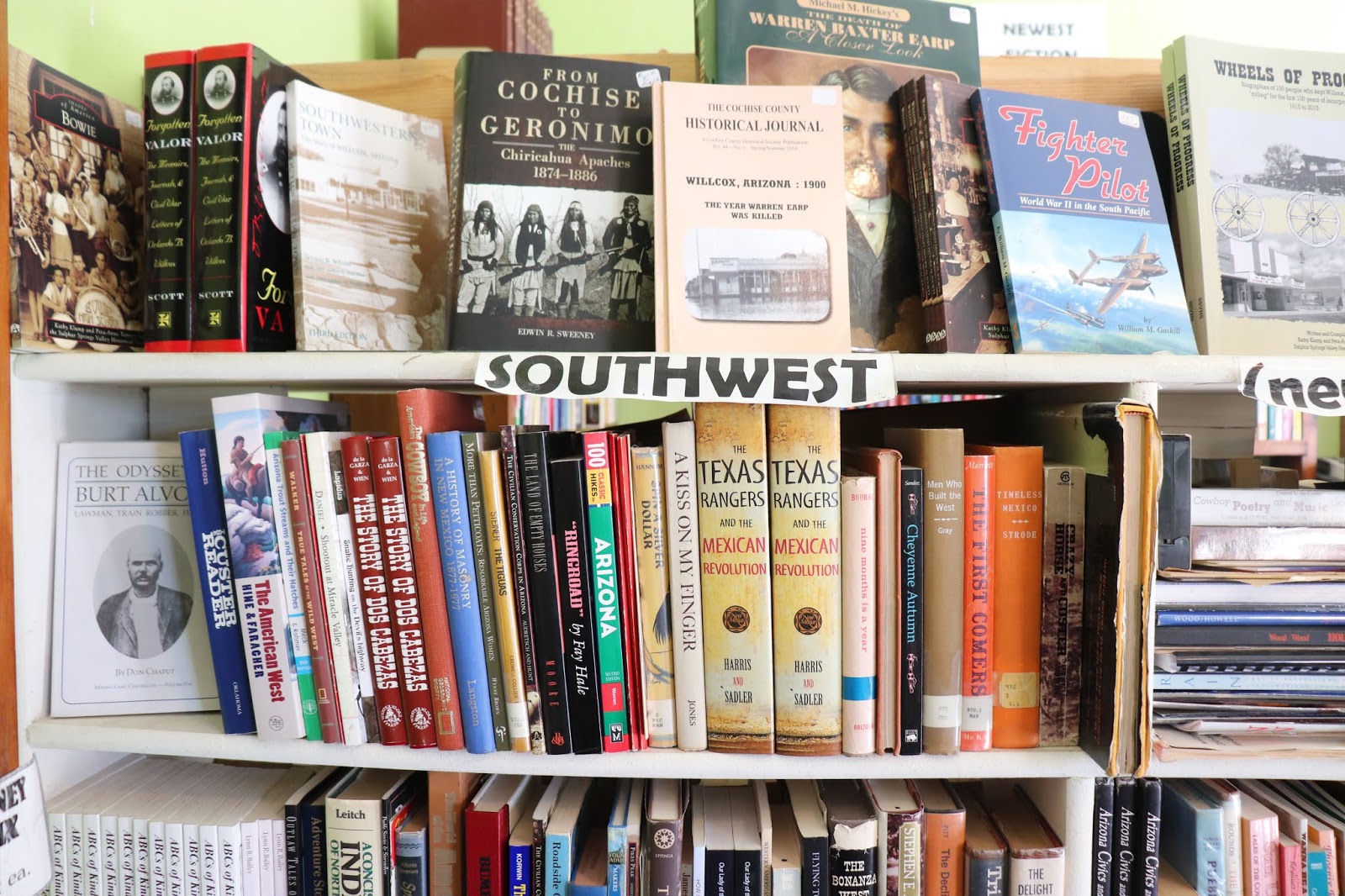
How many times over the years have I remarked that a bookstore could exist if it offered only history and mystery? The Friendly is very oriented toward both, and especially toward Arizona and Southwest history. Plus a very large selection of children's books -- and it's important to keep those kids both entertained and learning during all the school closings right now. We also offer honey, supplied to us by a beekeeper down in the southern part of Cochise County, and people come quite a distance to buy it. In fact, some days I sell more honey than books.


When the Artist and I are back at work in northern Michigan and getting ready for another day in bookstore and gallery in the village of Northport, we often wonder who will come into our establishments that day and what kind of conversations we will have. There is no predicting what any particular day will bring, and part of our pleasure at the end of each summer day is sharing stories of our respective encounters, as well as the occasional unexpected big sale. We meet so many interesting people!

I haven’t spent enough time working at the Friendly (this is my first season) to recognize a lot of repeat bookstore customers, but one man who has been in three or four times on Monday mornings is a reader of history, and there was a five-volume of Toynbee I would have liked to sell him, but he already had that work at home — and anyway, he felt Toynbee’s history was too whitewashed, too official, or, as he put it, “high school history, when what you want is college history.” That led me to ask (because staring at me over the counter, on shelves opposite, were several volumes of Bruce Catton’s Civil War series) if he had ever read Bruce Catton. He had not. I said Catton was probably best known for his work on the Civil War but had also written a very readable and not at all “whitewashed” history of the state of Michigan. Another man walked in about then and perked up at the reference to Michigan, saying he was from Michigan himself.


The Artist was on hand, and from Bruce Catton the conversation quickly moved on to where the new browser was from in Michigan. Well, he lived in two places, downstate and the Upper Peninsula, and he had an orchard in the U.P. Oh, where? West of Newberry. He grows apples, pears, and cherries, and his is the northernmost cherry orchard in Michigan. Yes, we know that area well. We have spent a lot of time in Grand Marais. Were we familiar with Jim Harrison? Yes, he was a friend of ours. Well, this man had attended a memorial gathering in Tucson for Jim, and a couple years before that he had attended a memorial gathering for Charles Bowden, at which Jim was the first speaker. Talk veered back to the U.P., via the life of Jim Harrison and his love of good food, and there we were, the three of us, mentally traveling old M-28, which prompted the Artist to ask the Yooper orchardist if he remembered Rashid’s grocery on the south side of M-28 between Newberry and Seney. Of course he did! His orchard is only about a mile from there! And as if all that weren’t enough, Jerry Bishop also speaks French and has travelled in the south of France!

There had been no way to anticipate this Friendly meeting, and it reminded me of what we say so often in the summer back in Michigan, marveling at the unexpected individuals who show up at our places of business in Northport: “You never know!” What will a day bring? We never know. We certainly would have been unable to predict on Monday morning, leaving our winter cabin for Willcox, that we would meet someone familiar with Rashid’s Grocery on M-28 and who had heard Jim Harrison speak at Charles Bowden’s memorial and who had also traveled in France and was himself a French speaker!

At the present historical juncture, the phrase “You never know” sounds a more sombre note, not only for us but for the whole world, but we do have our own personal and specific concerns. Will we be able to return to Northport as planned in May? What will be happening across the country by then? Questions closer at hand arise, too, one of them being, Will the Friendly Bookstore be open next week? Yes, we have a good supply of reading material at home (much of it from the Friendly, in fact), but if this volunteer job vanishes, also, I will miss my encounters with local and visiting readers in Willcox, just as I already miss my Wednesday morning tutoring sessions with little readers at the elementary school.

The truth is, though, that we never know, in the best of times, in the most ordinary of circumstances, what will happen in our lives from one day to the next. There is no guarantee that the future will be like the past. All the more reason, I suppose, that I am enjoying so much one of my Monday purchases from the little bookstore where I worked for three hours that day: How to Catch a Frog, by Heather Ross. And when I’ve finished reading that book and have wrapped it up to mail to my sister, who will love it, too, I’ll get back to Barbara Kingsolver’s High Tide in Tucson, and Wild Horse Country, by David Philipps, and after our evening movie, the Artist and I will snuggle down under the covers and I’ll read aloud another chapter of Chiang Lee’s The Silent Traveller in Paris, and we’ll be grateful to have had one more day together, this one under the Arizona sun, in Friendly surroundings, regardless of what the future brings.


Postscript to the nervous: We have ordered another propane delivery, gassed up the car, and have plenty of groceries and paper products, as well as paper, pens, stamps, and books in the house. We are prepared to do a lot of staying home, and you can see my first "home ground" adventure (with Sarah) here

Saturday, March 14, 2020

We All Have Our Worries

Storm gathers
When I learned last Monday that the Tucson Festival of Books had been cancelled, following the pull-out of a hundred rationally (at this time) flight-phobic authors who were to have been featured guests, I was disappointed. The Artist was relieved. He was worried about my presence in those big crowds, even though the book fair is an outdoor event. That was Monday. On Friday I got word that my part-time job as a volunteer reading tutor at Willcox Elementary School had also been suspended. School is on spring break this week, but even if the students go back next week we tutors won’t be there, and I’ll miss the little kids, but given the age of our tutor pool and added vulnerabilities of some of us, I have to admit that precautions are only sensible.

Note that I don’t ask if my readers have kept abreast of developments in the coronavirus story, since there is little else on the news these days as the number of reported cases and the number of countries with cases continues to rise. Events cancelled, schools closed or closing, everyone avoiding crowds, until it becomes difficult to imagine anyone, sick or not, who will remain unaffected financially. Not everyone — not even all office workers — can work from home. Many will not be needed if their places of employment are closed. Retail and restaurant employees, bus and cab and Uber drivers, actors and musicians (Broadway dark!), and domestic service workers. For many people, not working means no income.

Suddenly we have a whole new vocabulary, and self-quarantine is a star in that list, with Americans admonished not to panic, not to hoard, but to make sure they have enough food and other supplies on hand to get through two weeks of isolation, if need be. Paper products, hand sanitizer, and soap are vanishing from store shelves.

But why do I write these things that everyone who’s not in a coma has heard hundreds of times a day by now? Young or old, working or not, there is no one in the world without a corona virus-related worry list. Will it bring us together in resolve and commonsense, or will it fuel fear of the Other? I wonder.  

Although I’m more than one decade (never mind how many) older than I can quite believe, it did not occur to me immediately that I was part of a “vulnerable” group, simply by virtue of my age. Then there is what one doctor diagnosed as “cold asthma,” an affliction that had become terrible during Michigan winters but something I am able to forget (and then gratefully realize I have been forgetting) out here in the Arizona sun. Besides that, the younger and stronger, even if I were among that group, are in danger themselves — the danger of transmitting the virus to older and weaker friends, relatives, and strangers.

Darkness moves in
Even when neighbors gather, there are no “large crowds” in a ghost town, but people here still have their worries. Surgeries postponed, ongoing cancer treatments, auto-immune issues, necessary travel, falling stock values, lost earned income. No one is untouched.

For myself, I admit the worries were slow in coming, but they have arrived now. Will we be able to leave the ghost town on our scheduled departure date and reach Michigan again safely? What will virus statistics look like a month and a half from now? Will I be able to re-open my bookstore on schedule? Proceed with my Thursday Evening Author events? Will I have any customers — any income — at all? In time, of course, the crisis will pass, but how much time? Every independent bookstore exists on a narrow margin, hanging on, when possible at all, by its metaphorical fingernails through seasons and years of financial drought, and an artist’s earnings are similarly uncertain.

One ray of hope comes more as optimistic speculation than confident prediction, and that’s the idea that as spring proceeds and warmer weather arrives, the virus will die down. In childhood, when I begged my mother for something I desperately wanted (say, a kitten or a puppy), the parental reply I most dreaded was “We’ll see.” There was cause for joy in “Yes,” and “No” could be argued against, but the dreaded “We’ll see” left me hanging in limbo, especially when my mother added, as she usually did, “Keep pestering me about it, and the answer will be no!” Hope with no certainty: that was the torment of “We’ll see.” But “We’ll see,” I’ve learned as an adult, is the human condition.


Should worst come to worst in the high desert, should the Artist and I be compelled to remain within the confines of our rented cabin walls and the immediate outdoors surrounding, we will be able to stretch our food supply to the requisite two weeks. Maybe, however, ordering another delivery of propane would be prudent. One thing is certain: we have enough reading material to last out a quarantine period. We’ll never exhaust books-not-yet-read, and if we did, we are both happy re-readers of our favorites. 


The other night, in fact, for some reason I pulled from the shelf Barbara Kingsolver’s book of essays entitled High Tide in Tucson, and re-reading those essays last night and this morning has been sheer delight. May I say, very good medicine -- something we all need right now. 
What a stroke of luck. What a singular brute feat of outrageous fortune: to be born to citizenship in the Animal Kingdom. 
Indeed. For all the slings and arrows life aims at us, who would be anything else than living and choose anywhere in the Universe to live other than on this brown, green, tan, black, red, yellow, blue, and beautiful earth? The worries of the present historical moment, however, are very real. If you have friends or family members working in health care in areas that the virus has reached, you know it's worse than what we hear on the news. So please, be very careful out there, friends. I won't tell you what measures you take. You already know.

Tuesday, March 10, 2020

Book Review: MORNINGSIDE HEIGHTS


…It wasn't that she missed her parents, though late at night, listening to her sleeping roommates, she would think of her family back in Ohio and grow teary-eyed….
She was no longer forced to keep kosher, but to her surprise, she continued to…. 
She was again dating an older man….

This is the Pru we meet in the opening chapter of Joshua Henkin’s new novel, Morningside Heights: Keeping family close to her heart, surprised by her own commitment to her religion, dating an older man. Pru remains basically herself as the years pass: she marries a different older man, keeps kosher almost as a reflex, and is lives devoted not only to her husband and daughter but also to her husband’s son from an earlier marriage. Life, however, throws her a lot of curve balls, and Pru and other characters must reassess their values and beliefs over and over.

Pru Steiner, graduate student, and Spence (born Shulem) Robin, her professor of English literature, will marry. Before they do, though, we learn of Spence’s son, Arlo (Zackheim), and Linda Zackheim, briefly his wife. In the sanctuary of their own marriage, Pru and Spence’s daughter is born, and we follow Sarah, also, to adulthood, as we follow Pru and Spence, Arlo and Linda, switching tracks frequently, the tracks sometimes coinciding, sometimes diverging, sometimes reversing. In time we come to know Ginny and Rafe, who become essential to Spence and Pru, and much later Walter appears. Growing in complexity — and in confusion for some — the family has overflowed blood boundaries.

As has become more the rule than the exception for novels in our time, Morningside Heights does not proceed in strict chronological order. We are introduced to Pru and Spence at their first meeting, but not long after that find ourselves spending as much time in the past as in the novel’s ongoing present — a structure that must have once been revolutionary and confusing to readers of fiction (as well as to movie-goers), but one now so standard that it excites little if any dismay. We follow the characters easily back and forth in nonlinear time, as authors use this structural device to reveal events that shaped relationships as well as each individual and his or her place in the dynamics of an ensemble. 

It might be said that Morningside Heights is a New York novel, and certainly the city remains the center of the universe for its characters, even when they find themselves in Washington, D.C., or as far away as Los Angeles or Portland. Thus the streets, parks, and boroughs will play a role for any reader who has ever called New York home. But familiarity with the city — or with Jewish traditions — is not at all necessary to immersion in the story, since it is basically the story of a marriage and a family. Just don’t expect to find a family you can label “happy” or “unhappy,” “successful” or “dysfunctional.” Henkin is too alive to the limitations and inevitable confusions of human beings, as well as to life’s complexities, surprises, and unintended consequences, to oversimplify or categorize the Robin-Steiner-Zackheim family. 

In the early chapters, I almost had the feeling I was reading something from the mid-20th century, perhaps a book written by Herman Wouk (which is not necessarily a negative for me, as I recall vividly the story of Marjorie Morningstar and its effect on me when I read it in the 1960s), and perhaps there is something of Wouk’s influence in Henkin’s style, but the structure and contemporary issues keep Morningside Heights from feeling “retro” for long. The character of the professor, writing his lectures out longhand for his secretary to transcribe, is as true to our time as the dyslexic digital startup success or his half-sister the medical student who shepherds their father and her mother through a drug trial everyone hopes will reverse the professor’s Alzheimer’s disease. 

While the author takes Pru’s point of view perhaps more often than he does that of any other character, father-son, brother-sister, and wife-caregiver relationships are all sensitively explored. And Henkin deftly avoids giving any character the “upper hand” for long — or ever the “last word” on right and wrong. No, as much as several of them, individually and  more than once, feel they are showing up at least one perhaps-temporary opponent, all are necessarily making their decisions, as we all must, on partial knowledge of the past and present and near-complete ignorance of the future.

Henkin seduced me gently into his created world, so gently that I was in over my head before I knew it and sorry, eventually, to arrive at the last page. 

Marriage, parenthood, growing older — none of it is ever “what we signed up for.” We jump or are thrown in, and what we make of it all is up to us. A novel like Morningside Heights reminds us that we’re all in the same boat, and that can help us feel less alone.

Morningside Heights
by Joshua Henkin
NY: Pantheon Books
304pp
$27.95 hardcover
Change of publication date: Due to the COVID-19 pandemic, Morningside Heights will not be released until June of 2021, when we all hope the world will be in better shape.


Friday, March 6, 2020

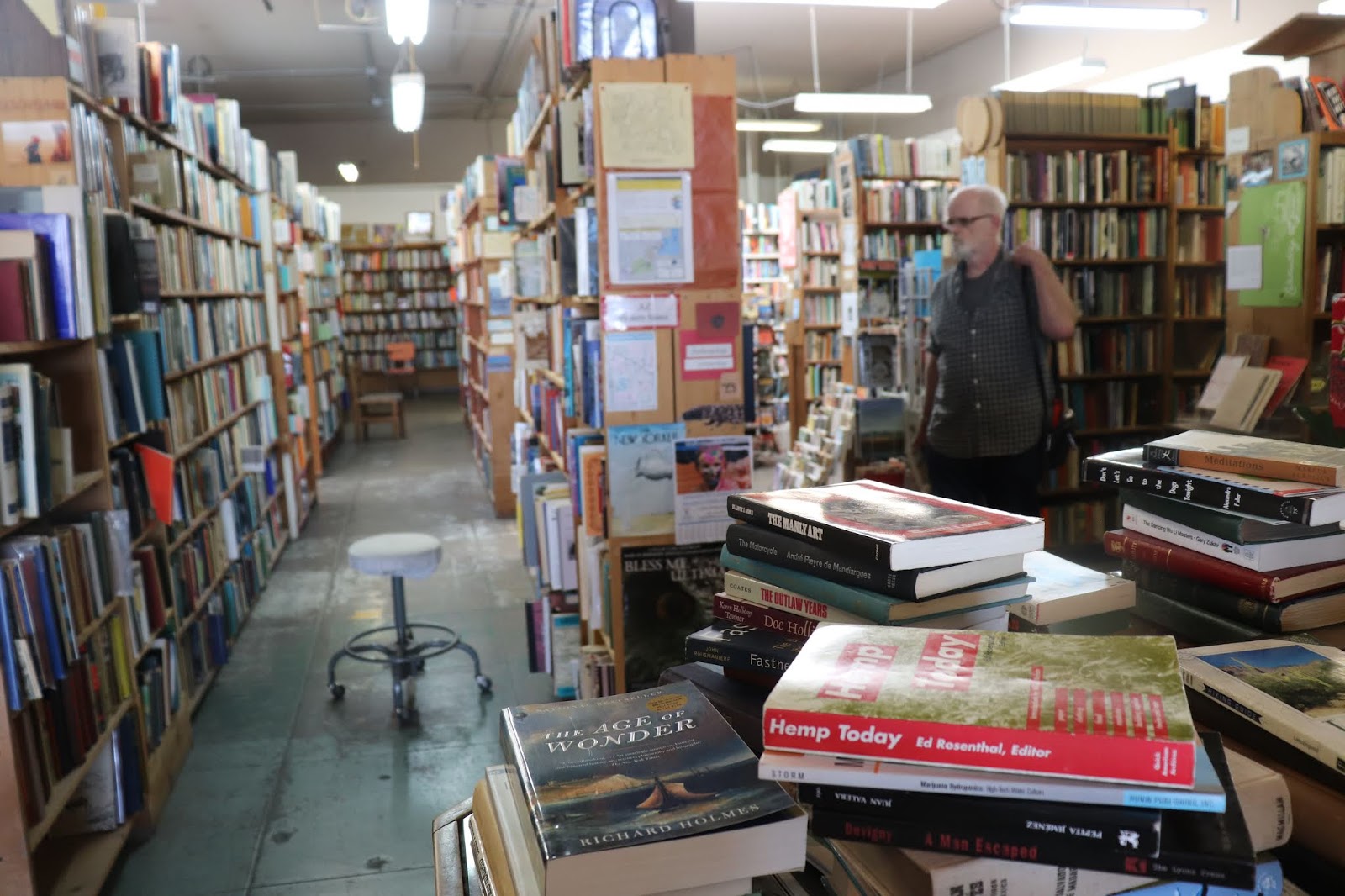
Report From the Field #2: Book Stop, Tucson


I'm calling this report #2 only because it never occurred to me before to label my visits to other people’s bookstores as field reports. How many posts have I written on indie bookstores, not only in Michigan but between Michigan and Florida and then from Michigan to Arizona and back, in the 12-1/2 years of Books in Northport? I’m not going to go back and count, but it’s one of the things I do during my months of “seasonal retirement” when I’m away from my own bookstore in Northport, Michigan. 

When the Artist and I go to Tucson, venturing 100 miles west on expressway from our winter rental cabin, because we do it so rarely we always have an agenda; however, we never accomplish much of the items on our list, and the most recent day trip was no exception. New exhibit at the art museum, a couple of bookstores, a new Chinese restaurant, and maybe the camera shop, if time permitted: Those were our goals. Result: We got to one bookstore. But the bookstore was all I hoped it would be, as you will see if you bear with me until we get to that part of the story. First, though, I’m very sorry not to have more photographs of the early part of the day, because after deciding to circle around more of the city and take the Speedway exit, we were seduced by one that came before, as it sounded like it would take us more quickly to 4th Avenue. It did not. We found 4th Avenue easily and enjoyed cruising north on it through South Tucson, where brightly painted buildings, murals, and colorful tiles reminded me of my trip a couple years ago to the Yucatan. So beautiful and exciting! Another time I’ll employ my camera, but sometimes it just feels more important to be in the moment, not worrying about capturing the present for future rumination. And I was loving 4th Avenue!

Just as it seemed we must be nearing our goal, however, we were unceremoniously dumped off 4th Avenue and hurried onto the new and “improved” Broadway, a wide, swooping road that will no doubt be great for high-speed traffic (for those who want that) when it’s finished. At present, however, it is not finished, so we were not only routed way off our desired path but stuck for what seemed ages in stop-and-go-and-stop traffic, which is never any fun at all.

Finally getting off the nightmare road and into what felt like a reasonable grid of streets, we somehow found ourselves caught up in the University of Arizona campus — which, in case you are not familiar with it, is an enormous campus — so that finally coming out on Speedway Boulevard, a long, busy street often avoided by locals but one that serves very well to orient us country mice, was a huge relief. From there we found the end of 4th Avenue we wanted and persevered until arriving, at long last, at the 100N block. 

At last!
Tip to other visitors to Tucson: If you’re looking for the Book Stop on 4th Avenue, or for Antigone Books (which we will visit on another field trip), take the Speedway exit. From Speedway you’ll turn south (right) and have an easy time locating the bookstores. 
[Speedway Boulevard: 1st degree of relief…  
4th Avenue North: 2nd degree of relief…  
Parking space around the corner from Book Stop: complete relief!]

My camera work inside the bookstore was hurried, at best. I wanted to look at books! But you can probably see from these quick shots that the Book Stop was exactly the kind of bookstore I had been hoping to find.


Tina, the proprietor, was quietly welcoming, friendly and helpful without being in the least overbearing or hovering. Like her bookstore, she was just right. I found five books to buy that day, took a few pictures, shared with Tina my own bookstore connection, and received information from her about the store’s buying and trade policies. I also told her how much effort had gone into our getting to her store, and it was she who recommended the Speedway exit (so you have it from a local and don’t have to take my word alone for it).


Thank you, Tina!
In its own way, 4th Avenue North is as colorful as the stretch south of Broadway, but in a different way. It has no dominant ethnic tone but more of a 1960s hippie dream quality, as perhaps you can see from these photos I snapped from the car window. 


We will be returning to Tucson next week, when I will attend the mammoth Festival of Books on the UA campus with a friend. The plan is that her husband will drop us off for the day. Hooray! We won’t have to drive or park -- or dodge around bicycles and streetcars! 


Streetcars, really, on 4th Avenue!
So that will be another travel adventure and field report from the world of books, Southwest style, coming up soon.


Wednesday, March 4, 2020

Of Rocks and Time and Little Knowledge


It is hardly an accident that the city of Tucson, Arizona, is home to the largest gem and mineral show in the world. The West in general is a geologist’s dream. Everywhere, earth’s bones confront the eye or lie hidden a mere scratch below the thin, poor soil. But don’t ask me much about such matters, because the little I know of Arizona’s plant and animal life is a wealth of knowledge when set against my geologic ignorance. 

There are simple, basic divisions — sedimentary, igneous, metamorphic — and the at-least-theoretical “rock cycle,” hardly as obvious or observable or dependable as the hydrologic cycle but providing an intellectual template for making some sense of stretches of time otherwise boggling to the human mind, eternities in which humans appear a few seconds before midnight on the clock of All Time. So while I read about plates and faults, veins and dikes, when I look up from my books to the mountains themselves I feel as awed by them as Moses must have been when spoken to by the burning bush. Except that the mountains are silent and still.

Rockhounds focus on smaller, transportable pieces of the mystery, on miniatures, rocks and stones rather than whole mountains, but even these small, mysterious bits baffle me. Gordon S. Fay suggests the following minimal equipment: magnifying glass, knife, penny (copper), file, small piece of quartz, small piece of unglazed porcelain, and small bottle of hydrochloric acid (The Rockhound’s Manual, 1972). Well, I have the penny! Then there are hammers and chisels, goggles and gloves, picks, rakes, shovels, and screens. Too much! I am never going to become even a rockhound, let alone a geologist.

I do, however, enjoy casual reading about geology and, to a lesser extent, about rocks, and am occasionally driven to reference books on my shelves when a different-looking rock presents itself to me out in “the field,” as it were, i.e., in my case this winter, the dusty high desert and washes outside our cabin door. Quartz is everywhere, and I hear again the words of a young geologist who remarked drily that amateurs pick up “pretty” rocks, while geologists use more demanding criteria. Well, I appreciate the “interesting” as well as the “pretty” but have nothing like the discerning eye of a geologist. 


To identify a rock, geologic engineer Fay writes, one must study its “mineral habit” and the form of its crystal (latter most often invisible to the naked eye). The phrase “mineral habit” is charming, is it not? I think right away of plants. A plant may be upright or branching or creeping or dwarf or whatever, and those adjectives describe the particular plant’s habit. Similarly, the habit of a mineral applies to its typical form.
If a particular mineral is found to occur time after time in the form of, say, a radiating cluster of needle-like crystals, we say that this is the habit of this particular mineral. If another mineral typically occurs as a kidney-shaped mass, this is the habit of that particular mineral. Thus we have mineral habit, an extremely important aid in the identification of many minerals, especially when the crystal system of a specimen found in the field cannot be determined by inspection. 

“Mineral habit” is a nice general concept, the kind of thing that should stick in my mind when whatever specifics I briefly encounter have fallen away.

Not aspiring even to amateur standing, though, I come in from my desert walk, newly found tiny rock in hand, and reach first for the National Audubon Society Field Guide to North American Rocks and Minerals because, like Audubon field guides for birds or wildflowers, this one presents photographed specimens organized by color. Is it possible I have found a bit of turquoise? Wouldn’t that be exciting? Turquoise, the Audubon tells me, 
…can be distinguished from variscite only on the basis of blowpipe tests; chrysocolla is softer. 
Okay, thanks for that variscite tip, but I won’t be doing any blowpipe tests! How about chrysocolla? A minor ore of copper, it has been found all over Cochise County, I learn, and it was chiefly copper that was mined here in Dos Cabezas back during the town’s short-lived glory days. Fay confirms, “found in copper deposits,” and gives me a test I can try with no equipment whatsoever: 
Chrysocolla usually sticks to the tongue, and this is perhaps its best known distinguishing characteristic.
How sticky counts as sticky? All I can do is try another rock and compare the two.... Okay, yes, I’d say that, compared to something else, this small blue rock does seem to stick to the tongue. And I like that kind of test -- so much less destructive to a sample than dropping chemicals on it or hitting it with a hammer to watch it shatter and fly apart. 

When attempting to identify a tree or bird or wildflower, something common to the area is much more likely than a rare bird. I would have liked my little find to have been turquoise, but here in the copper-bearing mountains of Cochise County, I’m going to bet that a blue rock that sticks to my tongue, however lightly, is chrysocolla. And since I’ve never even heard of such a rock before today, it’s been a memorable occasion for learning, just as common, weedy little corydalis, blooming now in the wash, was an exciting for me five years ago. I’m satisfied. Once again, my books have helped.

Online searches reveal other ideas. Here, for instance, I learn that chrysocolla is a "supportive goddess energy stone" that will aid me in finding the "right words to speak to aid emotional healing in others." Who would have imagined so much power in such a tiny stone picked up at random in the dusty desert?


Sunday, March 1, 2020

Report From the Field

I will be back at this desk come mid-May
During our seasonal retirement travels to and around the Southwest, the Artist and I find ourselves continually drawn to museums, galleries, and bookstores. It is not surprising, then, that we have made two visits to a large bricks-and-mortar(the phrase used to distinguish what I call “real” bookstores from exclusively online sellers) store selling used books in Tucson, an initial exploratory expedition and a follow-up day trip with the store as destination. 

Frankly, the sheer size of the place and the number of book aisles had me overstimulated the first time around, and I couldn’t take it all in. I found three books to buy and left vowing to return often. My second visit, however, dampened my enthusiasm somewhat but in ways that may speak more to my particular interests and values than to the general world of retail. 

Curated collections. Here’s the thing. In indie used shops like mine and those I love to discover (and revisit) along the way when traveling — First Edition Too in Michigan’s Upper Peninsula, Landmark Books in Traverse City, Prairie Archives in Springfield, Illinois, Readers’ Cove in Deming, New Mexico — each owner takes pride in assembling, maintaining, and offering to the public a curated collection of used, rare, and out-of-print books. That’s our basic business model. We spent money, when we must, to make discriminating buys; for more easily found, contemporary works issued in large editions and going through multiple printings, I generally offer trade credit rather than cash. Maybe twice as many romance books would sell faster than some of my 19th-century works on agriculture, but for me a bookstore, like a library, needs breadth and depth.

Book buying and trade credit at Dog Ears Books. If I accept a book for trade credit that I’m going to price at $10, my customer receives $5 credit, and with that credit plus another $5 the customer can purchase from me another book I’ve priced at $10. In other words, my trade credit operates only as a 50% discount on other used books but is calculated on a generous basis. If a book brought to me is one I price at $100, the customer receives $50 worth of trade credit, which for many people works well, because when buying outright, unless the book is very rare and something I can’t resist, I cannot afford to pay out in cash 50% of what I hope to get for a book that another customer may purchase with trade credit, thus paying 50% of my listed price. I’d never be able to buy groceries at that rate.

Personal indie atmosphere. Just as all of us with small indie shops put our own personalities into our collections, most of us also make an effort to make anyone who wanders in feel welcome. “It was personal to me,” the Meg Ryan character said in the movie “You’ve Got Mail,” after the Tom Hanks character who has put her out of business tells her it wasn’t personal, just business. Don’t get me wrong. We are in business. We have to make a profit to stay in business. But, for us, our business is also personal, and the best thing that happens in business like ours is that customers very often become friends, inside and outside the bookstore.


Contrast. The three foregoing paragraphs are my background, which I give to explain (1) my disappointment at not receiving a single smile from any of the half-dozen employees at either the buying or the sales ends of the counter in the book Tucson store and (2) my shock at the offer I received for three bags of very good, very carefully chosen books I’d taken in on my last visit, books I estimate I would have priced in my own shop for a total of between $150 and $175. I didn’t expect paring down my Arizona collection to make room for future purchases to be a get-rich-quick scheme, but I did think I might get $20 cash and somewhat more, maybe twice that, in trade credit. 

These were good books, in very good condition! I wish I’d photographed the lot of them before carrying them down the road for our last good-by. You would see what I mean. I mean, I’m a bookseller and a frequent buyer, and I know what is worth buying. Bottom line? I was told $13.50 in trade or $2.50 cash. Two dollars and fifty cents cash, or about a dime a book, whether hard- or softcover, classic reprint or out-of-print and rare. Wow.

I asked if there were any particular kinds of books they liked to see come in more than others and received a laconic and generic suppply-demand-condition reply. “I know,” I told the young man, adding, “I have a bookstore in Michigan.” Did his eyes light up? Did the ghost of a smile cross his face? No, no acknowledgement whatsoever. We were done.

Well, I found two books I wanted, their combined prices totaling $13, and left the store with fifty cents left to my credit and a set of nagging, unsettled questions in my head. Not only the lack of discrimination in valuing but also the lack of warmth and welcome and, beyond that, the small offerings in certain sections of the store. In my much, much more limited floor space, I probably have twice as much used poetry (I have a section of new poetry, as well) and three times as many foreign language books. And yet — in fairness, I must say — the Tucson store has been full of people both times I was there. It is a popular, lively place, and obviously people love it. A friend of mine who lives in Tucson says she and her husband have “date night” there on a regular basis!

A different business model. Finally the next day it came to me. The Tucson store is not at all about offering a curated collection. It is all about — its business model is — moving product. And move product they do. Books are always coming in (I myself contributed three paper grocery bags full), and books are always going out. The pennies paid for books translate to dollars available for staff, and the staff is large. I doubt job applicants are asked to take a literary quiz, as is the case at the Strand Bookstore in Manhattan, and I don’t know how much employees are paid or what the turnover is, but the business is clearly providing local employment. So their business model is working. I couldn’t operate that way, but I recognize that mine is not the only way of selling used books in a bricks-and-mortar store.

I did not see any special rare books or first editions sections. It’s possible those sections exist, and I simply didn’t find them. The store does have aisle after aisle of contemporary popular fiction, and obviously they do a lot of business with that alone. I’ve always said one could open a store, “History and Mystery,” selling used books in only those two categories, and probably 80% of the people who wandered into the store would leave satisfied. The store in Tucson offers more varied subjects, but my point is that their inventory is geared to most popular tastes, thus what was to me a disappointing number of foreign language and poetry titles.

One employee on the floor who asked if I needed help and pointed out a section I’d been seeking stood out from the otherwise stone-faced staff. This one young man smiled! He made me feel like a “valued customer” (as the junk mailers always assure us we all are), rather than an annoying intruder, but maybe, it occurred to me as I was mulling over the differences in book business models, maybe the contemporary American public, inured to impersonal online buying, expects no more from a face-to-face transaction. Perhaps this public would see a warm smile as something dangerous or suspicious? I don’t know. I live in a very different book world.

There were books at the Tucson store worth going back for and “new” titles are always being added to shelved inventory, so I will go back, but my quest now is to find a small but wonderful shop, filled with a curated collection of used books, and run by a stubbornly independent, book-loving, perhaps mildly eccentric bookseller but one who will recognize me as a kindred spirit. Is there any business like that in the greater Tucson area?