Search This Blog

Wednesday, December 18, 2019

Train Times, Book Times


The Southwest is still very much train country. The photograph above shows an engine (pulling a long line of freight cars) crossing Ocotillo Avenue in Benson, Arizona. There is a passenger train that stops in Benson, also, but while it races through Willcox, it does not stop there. I wish it did.

When I was growing up, ours was very much a train family. My grandfather was a “hogger” (engine driver) on the Pennsylvania Railroad, first with a steam engine, later with diesel. Two of his brothers were conductors. After World War II, my father’s first job, with his bachelor of science in civil engineering, was as head of a survey crew for the Milwaukee Road. That explains why I was born in Aberdeen, South Dakota. 

Before my third birthday, my father took a job with the Elgin, Joliet, & Eastern Railway in Joliet, Illinois. The EJ&E ran only freight, no passenger trains, but for some reason EJ&E employees had discounts on passenger lines — 50% off for adults and children over 12, with children under 12 riding free. That was coach, of course, so we could either sleep sitting up in our seats or pay full price for private space — “roomettes,” or whatever. And we paid full price for our meals in the dining car, too.

(I am old enough to remember — this is a scary realization! tell me you can’t believe it! — one trip where we rode in one of those old sleeper cars you see in movies, with top and bottom bunk beds on either side of a center aisle and only curtains for privacy. We changed into pj’s behind the curtains. Really!) 

Recently I picked up two books written for young people. Rod’s Dog, by Jean Bailey, published in 1954, begins with twelve-year-old Rodney Colwill (who hates being called Rodney) riding a train from Chicago to Kansas to live with his uncle and aunt for a year while his mother and engineer father are away on a job his father has in South America. Rod is unhappy about leaving his friends, his “gang,” in the city, so unhappy he can’t even respond to the conductor’s friendliness or enjoy the view from the train windows.

I Am Lavina Cummings, by Susan Lowell, is a historical novel. It is 1905, and Lavina, ten years old, has grown up on a ranch in southern Arizona. Lavina loves the ranch. Being Lavina of the Bosque Ranch is her identity. But her mother has died, and her father feels she is more likely to learn to be a “lady” if raised by her aunt in Santa Cruz, California, rather growing up wild on the ranch with her father and three brothers. She is adept at working cows on her pony, Chum, and is not afraid of rattlesnakes. But once on the train, she is excited by the passing scenery and sights.

In each story, the child is traveling by train alone. (In a story set today, the child would undoubtedly be traveling by air.) Rod is going from city to country (in the middle of the 20th century), Lavina from country to city (at the dawn of the 20th century). My sympathies at first were all with Lavina. I mean, she had to leave her pony! Heartbreak! But Lavina was brave and excited and curious about what lay ahead. I am not very far into the story yet....

It took Rod much longer (I finished his story this morning) to adapt to the changes in his life. Eventually, however, he made peace with country life. What helped enormously — and here my sympathy was all with him — was a little black dog! And that certainly makes sense!

(dog story, not train story)
Neither of these is really a train story, though, and that makes me wonder just how many books there are with stories that stay right on the train. Right away I think of Agatha Christie’s Murder on the Orient Express, of course. Then there is Paul Theroux’s The Great Railway Bazaar; The Old Patagonian Express; and Riding the Iron Rooster, a wonderful travel book about train travel through China. Also, last year I read what has been so far my favorite book of Mexican history, with history incorporated into what is also a travel book, the marvelous Yesterday’s Train: A Rail Odyssey Through Mexican History, by Terry Pindell, with Lourdes Ramirez Mallis. There must be more fiction set on trains, though, no? Can anyone think of novels with train settings, either passenger trains or hobos riding boxcars? I do not count The Boxcar Children, because their boxcar was no longer attached to a train when they moved into it.

Here is a sweet little something in the back of the hardcover copy of Rod’s Dog that other bibliophiles and amateurs (lovers) of old books will recognize. The tiny, unobtrusive bookstore sticker tells where this book was originally purchased new. Lancaster, Pennsylvania! And somehow it found its way to Willcox, Arizona! Seeing it, my bookselling idea for today is that it may be time for independent bookstores to bring back these stickers. I’m thinking that with growing enthusiasm for indies (the personal and local experience over the impersonal, online purchase), bookstore customers might appreciate a reminder of where they had found each of their books and which bookstores they  had supported with their custom. The visibility of the bookstores themselves would last longer in memory, too.

It’s a small idea, and I am not a marketing consultant, but I wonder if other booksellers think this could catch on.


Saturday, December 14, 2019

Just Call Me a Greedy Little Kid

ruins of old hotel in Dos Cabezas
Just as it never had a church, it’s probably a good bet that, even at the height of the copper mining rush, Dos Cabezas never had a public library. No doubt the mine owner had a few books in the lodge where he entertained potential investors. (I'll have to ask Dorothy.) Surely he would have maps. But the height of the Dos Cabezas population was long ago.

modern library in Willcox
These days there is a good little public library in Willcox, however, the major town back up the highway about 15 miles, and the Friends of the Library group runs a little shop selling donated used books near the area museums. The Artist and I patronize both the library and Friendly Bookstore on a regular basis during our winters here. 


little bookstore in Willcox
But we have always, since long before we met, needed our own private collections of books, too.

My background in books: 

I grew up in a modest and frugal household. My parents were both readers and lovers of poetry and opera, but they were also budget- and savings-minded, and while we did not want for necessities, luxury played no part in our life. Summer vacations, until I was 12 years old and we borrowed an old canvas umbrella tent and began camping in Michigan, were two weeks of visits to grandparents back in Ohio, one week with my father’s father and stepmother, the other with my mother’s mother and stepfather. So as you might guess, the books we read were, for the most part, library books.

When I was in grade school, my class visited our tiny school library on Tuesdays and the bookmobile on Thursdays. Saturday was the big day of the week: a family visit to the grand public library downtown, where decades later I was able to give my husband a complete tour of the holdings of the now-empty former children’s book room, guiding him around the floor as if shelves and books were still in place, telling him, “This is where the Doctor Seuss books were. I discovered them for myself…. Back in this corner were the horse books [Justin Morgan Had a Horse]…. Over in this corner were biographies [Helen Keller’s was the autobiography I read with interest], and here … was Parents Keep Out, by Ogden Nash!”

My sisters and I were permitted to order a few inexpensive paperback Scholastic books when school presented that opportunity, but otherwise, and for beautiful, coveted hardcover books, we had to wait for Christmas and birthdays. On those special occasions, we might hope for one special book apiece. I still remember the year I found Marguerite Henry’s Black Gold under the tree. Santa’s presents to us were as modest as those from family members, but I have never forgotten the sight of that beautiful book waiting for me on Christmas morning.

Why did we only know new books and library books? Had I grown up in Chicago, no doubt I would have discovered used books earlier in life, but I don’t think we knew any shops in Will County that sold used books. Even garage sales were unknown in our edge-of-town 1950s neighborhood (although vacant lots we had aplenty, and what do children do without vacant lots?) Anyway, we were not shopping children. Penny candy and five-cent candy bars exhausted our tiny allowances, and climbing trees, digging holes, and building “forts” with old cardboard refrigerator boxes were more our speed than stores full of merchandise. The first shopping mall lay yet in the future. 

— But books! There were never enough in our house! And we only had a single bathroom for five people! My father called it “the library,” and a frequent plaintive cry from the other side of the door was, “Are you reading in there?”

As a teenaged babysitter, I was dismayed by the lack of books in the neighborhood homes that employed me. One house had only TV Guide for reading material, nothing more! I learned quickly that if I wanted the pleasure of reading after my charges went to sleep, I would have to take my own library books on those babysitting jobs. 

Eventually I did discover — in Urbana, Illinois; East Lansing, Michigan; Kalamazoo, Michigan; etc. — bookshops specializing in used books, and that allowed me to begin assembling a (still modest) private library, an eclectic collection of books that has transformed many times in size and content over the decades, sometimes shrinking (with a move), usually growing, and always taking new turns with new interests. 


My books waited for me!

Bookcase #2
So now, though we are only in a small rented cabin for the winter, with space at a premium, it would not feel like home without our own books in it. Happily, shelves of books accumulated over the past two winters greeted us upon arrival this month, and so it did feel like home when we walked in the door. The waiting books welcomed us (as books do) and even seemed to welcome the new additions we had picked up along the road.


Nature reference
Southwestern history and life
A few cookbooks
Yippee!

On our third evening here in the ghost town, when dark descended early, I suggested to the Artist that I could read aloud to him before we went to bed. We often read aloud to each in bed, but it’s easy then for the listener to fall asleep, so we agreed to try it sitting up in our daytime reading chairs. The first book we tried, despite an intriguing title, didn’t work out too well (“You lost me in the first paragraph”), but our happy second mutual choice was Julia Child’s My Life in France. What enchanting, contagious enthusiasm that Julia had, even in her nineties, looking back on the best time of her life! As Paris is also the magic world city for us, and we could picture clearly the scenes described in the book, it was the perfect book for a dark high desert evening’s dreaming.

It feels luxurious to have choices and variety at hand when we want a change of focus, and as a kid who grew up in a house where we had enough of what we needed but never a lot of what we loved, I love my little ghost town private library! It makes me feel that I live here, that I'm part of the place, and it makes me feel rich. You know all those commercials you hear about "growing" your "wealth"? This is mine.

Sarah likes the book corner, too. The photo here is from 2018, but she is gravitating to the library again this year.


Wednesday, December 11, 2019

The Twisting Road of History

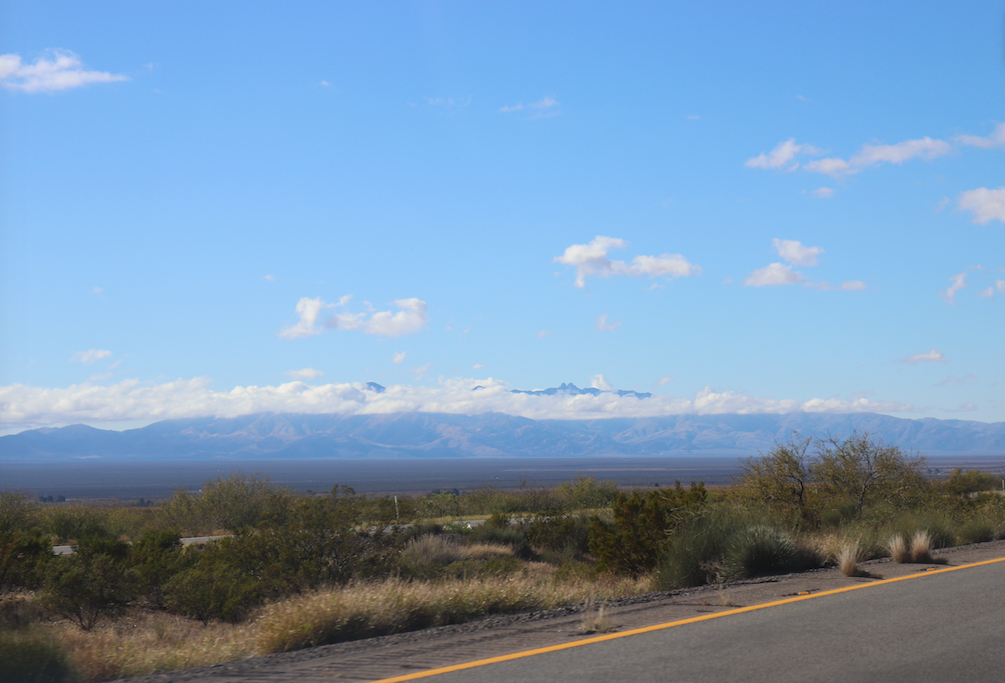
Peaks of Dos Cabezas seen from New Mexico state line
We have arrived at last! We were six days on the road, rather than the usual five, owing to an unexpected, migraine-motivated, two-night stay in Alamagordo, New Mexico. (We had also stayed two nights in Springfield, Illinois, but that was planned and enjoyable.) We were able to make the last leg of our cross-country journey on Tuesday, however, and it was an easy drive on a clear, sunny day. My heart leaped up when I spotted the twin peaks of Dos Cabezas as we crossed the state line from New Mexico into Arizona, and later on, everything in the car dragged into the cabin, as we prepared to hit the road once again, briefly to stock up at the grocery store in Willcox, we were both thrilled to see the moon rising gloriously over the mountains. 


For me, the drive from central Illinois to southeast Arizona presents not only challenges of the road and beautiful scenery and whatever surprises we encounter in towns we visit along the way — it’s also puts front and center in my mind the history of our country. For instance: we see enormous bales of cotton (size and shape of the large round hay bales sometimes seen back in Michigan), and I wonder how it was that the growing of cotton moved west to Kansas and Oklahoma and Texas and even as far as Arizona and how much of that crop’s westward migration story is tied to the larger story of slavery and the Civil War and the migrations of Southerners to the West and Southwest and when the growing of cotton on former buffalo lands came about and how it affected the lives of the Plains Indians. A bit of searching on my phone delivers a fact that surprises me: that the Choctaw began planting cotton in 1825. Unsurprisingly, cotton's history in the second half of the nineteenth century was complicated, to put it mildly. If you're interested, the link is there to follow and read more.


But every mile of the road is saturated with history and the effects of history’s unrolling on the present. Cities are booming, in the Great Plains as elsewhere (we avoided cities as much as possible so as not to deal with the traffic), but across the country the pain of nearly forgotten small towns is palpable. On the two-lane roads we travel -- sometimes detouring a bit off the road to find what is called hopefully a business district -- we see towns where beautiful old buildings stand empty of commerce, wide streets empty of traffic, towns with not a soul on the sidewalks. The scene is the town correlate of the abandoned and derelict farmhouse, an empty house falling into ruins among sheltering trees as cattle graze up to the edge of the front porch, farms having grown larger and larger although country cemeteries tell of larger populations in times past.

Intersection of brick streets, Medicine Lodge, KS


We detoured off the road Saturday morning to explore one formerly prosperous Kansas town and admired beautiful brick streets and buildings in our search for breakfast but were unable to find a single place open for business. We fared better down the road in Medicine Lodge, another town of brick streets. The “Welcome” sign on Frosty’s Donut Shop was contradicted by a “Closed” sign on the same door, but down the block a few doors we found an open cafe. (I neglected to photograph the front of the business but think I recall its name as Latte-Da.) Fancy European coffees have penetrated the heartland! We stuck with straight American brew, fresh and dark and delicious. The sweet white china cups were so much more luxurious than mugs and light years better than gas station styrofoam! Avocado toast, my menu choice, came to the table topped with cheese and a fried egg and was a breakfast worth the wait and the search that had led us to Medicine Lodge. 


Medicine Lodge calls hard on history for recognition. Along with being the one-time home of temperance agitator Carrie Nation (there is an oxymoron for you: temperance agitator), it was also the scene of 1867 Medicine Lodge Treaty between the U.S. government and “more than 5,000 representatives of the Kiowa, Comanche, Arapaho and Kiowa-Apache nations,” joined soon by members of the Southern Cheyenne. The town of Medicine Lodge celebrates the colorful treaty gathering annually, despite its short-lived success. 
…[C]ontinual attempts to renege on the 1867 Medicine Lodge Treaty came to a head in 1903 in the landmark Lone Wolf v. Hitchcock case, in which a member of the Kiowa nation filed charges against the Secretary of the Interior. The Supreme Court ruled that Congress had the right to break or rewrite treaties between the United States and Native American tribes however the lawmakers saw fit [my emphasis added], essentially stripping the treaties of their power.
Read more at this site from which my quote is drawn. 

Visual support for the local high school team on one store window aroused my curiosity, and I looked up the town on City Data, an online site that helps me see beneath appearances, where the report (this would be from the 2010 census) told me that the Native American population of Medicine Lodge, Kansas, is 0.00%. But history is what the town has, and it’s clear they are struggling to hold onto some kind of identity.  When a young woman with a hauntingly plaintive country voice sang “I’ll Be Home for Christmas” in the little cafe, our feelings for the place and its people were warm, and we wished everyone well as we said goodby. I remember struggling years in Northport, Michigan, and can’t help being sympathetic to other small towns fighting an Interstate highway system, flight to cities, and online shopping. As for the burden of history, it is one none of us can escape. All we can choose is how we will go on from where we are.


I won't try to give a day-by-day or mile-by-mile or even road-by-road account of this year’s trip west but will skip now from Kansas to New Mexico, where our last stop on our last day of travel was in the town of Deming. Remembering a very pleasant visit to a little bookstore called Readers' Cove in December 2018, I had been looking forward to stopping there again this year. First, however, we sought out a downtown cafe — and again, as in Medicine Lodge, fortune smiled on us. “Rise and Shine” was drawing in others besides ourselves for their gourmet coffee, but we took a table and made it a lunch stop, as well. Then on to Readers' Cove. 


Margaret was still there, the little dog, the cat (I was told there is more than one cat on the premises), and again I found enough books to carry off a little stack, although we did not tarry as long this year, eager as we were to reach our ghost town destination. 


… And then there it was, finally coming into sight a bit farther down the road (I-10 now), the twin peaks of Dos Cabezas visible from the New Mexico/Arizona state line. (See back to my top photo of today's post, if you've forgotten.) I was so happy to see my mountains again! We took the first of the three exits to Willcox, so as to enter past the livestock auction grounds and the old town along the railroad. Later, having unpacked at the cabin and returned to Willcox for the shopping expedition, we saw the old town strip after dark, beautifully lit up for the holidays — a photo op that must wait for another evening, however, as road weariness was overcoming us. And so, home and to bed, with a short spell of reading aloud, and then to sleep, at last, in our winter ghost town stomping grounds.

Until a high desert dawn brought another day, much calmer and more relaxed than the week past has been. I note today the birthday of Michigan, Montana, and Arizona writer and our good friend, the late Jim Harrison. Here's to you, Jim! You got your work and paid your rent in the universe!

Ghost town dawn

Sunday, December 1, 2019

Wandering Through the Canadian Wilderness

Last week: false spring in Leelanau in November
Cinnamon! She opened the little glass jar of powder, held it to her nose, and breathed in the deep, almost ecclesiastical perfume. She was suddenly in her father’s house, in the kitchen, following the old cook around while she worked, sitting on the counter by the sink licking a spatula thinly covered in gingerbread batter. She remembered flour sifted into a wide ceramic bowl in perfect peaks, salt and sugar denting the summit, and finally a tiny spoonful of cinnamon dropped in, a small thrill among the whiteness. 
- Gil Adamson, The Outlander
A reader is many chapters into The Outlander before learning Mary’s name, long after learning — though all this not immediately revealed, either — that she has killed her husband, lost an infant, and is being tracked through forests and over mountains by her husband’s twin brothers. Functionally illiterate but raised in a genteel household with servants, Mary could not have found life easy in her husband’s dark, windowless, isolated log cabin, far off in the Canadian wilderness, away from everything she had ever known. But her grandmother’s object was achieved by the marriage of the young, motherless girl to an older man: the girl was spared the horrors of "spinsterhood."

With a well-worn, familiar Bible but no money and no change of clothes, Mary is running away, seeking to cross a river by ferry, pursued by a pair of red-headed identical twins when first we meet her. She is wearing an oddly put-together costume of black supposed to serve as mourning. Only now that I am halfway through the book, after chapters of the protagonist's stumbling through snowy woods and almost dying of starvation, has she find refuge with a widowed minister in a mining camp. She has a real bed to sleep in again at last.

It looked like March last week, after an early, January-type storm

Along the way, however, she had already been rescued three times, first by an old lady famous for taking in needy strays. When "the widow," as Mary is simply called in the early chapters, flees the old lady’s house, she makes off with a horse, an elaborate pipe, and enough good tobacco to last a while.

New snow a week later, a new storm and new snow

Her second rescuer in the mountains is called by authorities the Ridgerunner. The Ridgerunner is a man who lives by his wits and by stealing food and whatever else he needed from Forest Service cabins. Captured, tried, and acquitted once in a court of law, he returned to his old life and tells Mary with a laugh, “They probably think I’m dead by now.” With William, she discovers laughter and passion, but the Ridgerunner has been alone too long to take her on as a permanent companion, and one day he simply vanishes, taking all his gear with him. The widow is once more on her own.

The third person (second man) who comes to her assistance is Henry, a Crow Indian, and it is Henry who delivers her to the Reverend. Henry’s wife warns Mary that the Reverend Bonnycastle is the only man in the mining camp she should trust, and Mary finds the minister's character to be everything promised. But the red-haired twins have hired a tracker and are close on her heels. 

-- What will happen next? I was happy to reach the pleasant, cozy cinnamon-in-kitchen interlude on Sunday morning at home while enjoying my first cup of coffee with delicious cinnamon bread baked by a friend. Outside a new blizzard raged. We would not be taking to the road as planned....

The calm after earlier wild gusting and blowing

Early chapters of The Outlander, as I’ve indicated, were all set outdoors, and the author’s attention to sensual detail is beautiful and vivid on every page.

She left her belongings and wandered aimlessly. Spider webs brushed her face and she did not wipe them away but let spiders climb to her and ride a while and drop away. The sun came down in beams and shafts, and once, when she looked up, she saw the moon hung high and pale in the blue morning. Tricky thing, pretending to be gone when it wasn’t. She was reduced to an idiot child lost in the woods. It was with an idiot’s glee, then, that she came across the tracks of her horse, and bent to see the deep, scored prints where the animal had run and dodged and dodged again. Other horses had run with it and diverged through the trees, hounded by dogs. Not dogs, she reminded herself. Many wolves, harrying the horses.  
The widow followed the tracks and came across a carcass. It was a big mule deer. The body lay with its hooves toward her. From ten yards away she could see blood pooling in paw prints in the mud, the throat and belly torn away, intestines dragged over the ground. One leg askew.

Hungry wolves want that deer meat, but so does the hungry young woman alone on the mountain!


When a friend and I discussed Moon of the Crusted Snow the other day, she expressed disappointment that the story was so short on detail and left so much to the imagination. I had rather appreciated the author’s spare, light touch, but I understood what my friend was saying, especially when she told me she wanted to know, “What were the women doing?” Ah, yes, good question! The first scene in the Rice novel shows us an Anishnaabe hunter who tracks, kills, and butchers his moose, and he has learned from his father how to tan hides, but we do not see how women transform hides into clothing or harvest rice together or do any of the work that would have been so crucial to survival after the power grid goes dark. Their contributions are referred to only in passing. 

In The Outlander (I’m not sure yet that the title refers to the protagonist; that remains to be seen), we see everything that the woman does. She is the character in focus, and as the year is 1903 and she is fleeing alone on foot through mountain wilderness, survival is of paramount importance in this novel, as well. But “the widow” has no survival skills and would have been dead several times over were it not for the rescuers she meets along her way, so while there is much detail given of her travails and much of the beautiful country she passes through, Mary is hardly a model for ancient knowledge, and this lone white woman is also very much without community.

I enjoyed Moon of the Crusted Snow — devoured it! — and am also fascinated by the Gil Adamson’s Canadian story, The Outlander. I think of how Bonnie Jo Campbell’s Once Upon a River was compared by many reviewers to Huckleberry Finn, Campbell offering a female version of running away downriver. 

Frozen wild grapes

What my friend wants, though, is something different from all of these books, if I have her criticisms right (and maybe she will tell me if I don’t): She wants a story of Anishnaabe post-apocalyptic survival that stresses community aspects and particularly the contributions made by women in the group. What kinds of traditional knowledge of nature would be crucial if the lights went out and there were no more grocery stores? How would clothing be replaced, food prepared, sicknesses treated? Knowing how these aspects of life were carried on in the traditional past would be part of survival into a future if one truly had to live off the land. 

If a novel telling such a story were to come out of Peshawbestown, I would read it eagerly! For today, I'm content to be snowed in again, preparing for eventual departure in leisurely fashion. The Artist and I needed a day of rest before beginning our travels.


Tuesday, November 26, 2019

The Book Review That Never Was


I read Lauren Markham's nonfiction work The Far Away Brothers: Two Young Migrants and the Making of an American Life in 2018 but can’t find that I ever wrote much about it on Books in Northport beyond a passing mention. While I can hardly construct a review at this late date, I ran across the draft of a set of discussion questions I'd put together, in the event that a group could be persuaded to take on the topic. Here are the questions, out in plain sight, so I won’t risk losing track of them altogether -- such is the digital filing “system” of a an organizationally challenged philosopher-bookseller (who is better with books on shelves). Maybe some book club somewhere who is reading the book currently can use these for a springboard.

Discussion Questions:

Do you believe the death threat against Ernesto endangered the life of his identical twin brother Raul, or did Raul simply not want to be left behind? What other factors might have influenced Raul’s decision?

Do you think young people fleeing gang violence in other countries increase the level of violence to the U.S.? Explain. (What about already-American families moving to suburbs to escape gang violence in cities? )

Did you have any idea while reading early chapters what traumatic event Ernesto had experienced on his way north? Did learning what it was surprise you? What did it help explain?

If you have ever lived in a house with unrelated residents in addition to family, what was the situation, and why were you part of it? How were disputes resolved?

What aspects of poverty experienced by the Flores family, both in El Salvador and in the U.S., similar to poverty in general? What aspects were unique to their situations? Do you have any personal experience of poverty?

Did this book help you gain clarity on what a reasonable solution to immigration, legal and illegal, might look like? Having read the book, in what ways is your perspective now more or less clear, and has your view changed (if so, how?) or does it remain unchanged? What other books, if any, have you read on the subject of immigration, and how does this book’s coverage of the subject compare to that of others? Would you recommend this book to others interested in the subject?

If you were a parent in a town like La Colonia, El Salvador, would you try to keep your children “down on the farm” or send them “north”? How would you make decisions for their future? How could family life there be different? What is within their power and what beyond their control?


Sunday, November 24, 2019

You don’t have to read between the lines.

Anyone can be a book critic. All you have to do is read each word, each sentence, each paragraph carefully, generously but analytically, and then weigh the author's overall vision as well as the book's details against your wealth of background cultural knowledge. And the way to read a review is just the same. So in today’s post I invite you to come along with me for the reading of a book review and the questions and reflections it prompted in me. I don't imagine we will be a large party, but we happy few can enjoy ourselves.

Saturday morning, having come to the last page of a book I'd been reading, I picked up a New York Review of Books, the Nov. 21 issue, and found in it a stunning review by Robert Kuttner of Patrick Deneen’s Why Liberalism Failed. Having thoroughly appreciated Kuttner’s Everything For Sale: The Virtues and Limits of Markets, I was eager to read what he had to say about Deneen’s book, which was published last year to wide acclaim and has already been issued in an expanded paperback edition.

A careful reader and astute reviewer, Kuttner wastes no time in accusing Deneen of setting up a straw man argument. 
Liberalism is not and never was merely, as caricatured by Deneen, ‘the greatest possible freedom from external constraints.’ Rather, it is fundamentally about limiting abuses of public and private power and creating space for free inquiry. 

What Kuttner calls the 'liberal project,’ then … “included the rule of law, limits on inherited privilege, constraints on arbitrary power, freedom of conscience and speech, and reliance on liberty to develop a natural aristocracy of talent” — all features we might hope to find flourishing in a democratic society. It was not about encouraging individual excess or magically freeing mankind from constraints imposed by nature, as Deneen would have us believe. Thus Deneen's cartoon version has little relation to either the origins or historical development of true liberalism.

Of course, the point of setting up a straw man is to have an easy target, so it is probably not surprising that Deneen goes on to blame his cartoon 'liberalism’ for every woe of modern society. He conveniently ignores the fact, Kuttner points out, that much of today’s so-called ‘conservatism’ [so-called is my addition] takes its starting point with libertarianism, not classical liberalism, and it is this hybrid libertarian ‘conservatism,’ not liberalism, that has led to such modern ills as 
...the commercialization of health care, the commodification of education, the sale of private data, the outsourcing of employment, and the economic collapse of entire regions….
Even given the easy target he has created, Deneen still resorts to cherry-picking quotes, according to Kuttner, thus misconstruing and misrepresenting Locke, Toqueville, and others.

I have read enough of Locke and Tocqueville to side easily with Kuttner on the cherry-picking question. Also, having taught as well as studied logic, I am alert to the trickery of a straw man argument. Finally, as a one-time though not long-term follower and advocate of libertarianism (I got over it), it didn’t take Kuttner to open my eyes to fairly recent radical changes in American so-called conservatism and in today's Republican party. (My father would not recognize his party today.) What today’s Republicans call conservatism, religious avowals aside, is “based on a common embrace of corporate capitalism,” an ideal in which [here I extrapolate] privatization, i.e., having "everything for sale” — banking, education, health care — is the only legitimate goal.

Perhaps Kuttner’s most serious criticism, though, is the one he makes on pragmatic grounds -- and here, as a self-described romantic pragmatist, I perk up my ears. This will be the payoff! Deneen, he tells us, having indicted what he calls liberalism, offers no idea whatsoever about what would support democracy better. Surely it would not be the “Benedict Option,” that  option that counsels forming groups to retreat from secular society. Such orthodox religious communities, guided only by religion precepts and without liberal, secular safeguards to rights, would hardly be immune to autocrats and would-be dictators. And here I note that the position of women in such communities is almost always subservient, submissive, and silent. Deneen has already decried the emancipation of women, so now any remaining doubts I may have had are dispelled.

"Democracy does not work perfectly," Kuttner admits, but what system of government ever has? Before the state was overrun by the market, democracy worked better than it's working today, but whatever form it takes, Kuttner does not see -- and Deneen does not offer -- a viable alternative. 
...All of the alternatives are even more corrosive of human dignity and personal virtue. Liberal democracy may indeed be under siege; but if we are to constrain the tyranny of dictators on one flank and the rule of overweening global corporation on the other, democracy is all we have.  
- Robert Kuttner, "Blaming Liberalism," The New York Review of Books, November 21, 2019 
The book Kuttner reviewed was Why Liberalism Failed, by Patrick J. Deneen (Yale University Press, 2019).

Disclaimer: Some readers might consider that, as an emancipated woman, I am biased in favor of liberalism, and they would be correct. I would say, however, that my bias is the result of being persuaded by facts, logic, and experience, not an undisciplined outgrowth of ignorance or brainwashing.

But that's not all I think.

So now, my take

The more I survey this whole messy political stew, the more I mistrust both socialists on the far left and libertarians on the far right, and I mistrust them on pragmatic grounds; therefore, insofar as socialist ideology has saturated progressive movements and libertarian ideology has certainly taken over and cannibalized what used to be conservatism, the more and more I mistrust all ideologies and ideologues. To say either that government intervention and regulation is always (socialist) or never (libertarian) the correct prescription to social problems — the extreme opposing ideological positions — strikes me as so short-sighted as to be downright blind to reality. 

Kuttner’s own view is more nuanced, but I wonder if even his prescriptions have the flexibility I see as absolutely necessary. It’s been a while since I’ve read Everything For Sale, so I cannot say with certainty that he would put whole domains under government oversight and leave other entire domains completely free-wheeling. Banking, education, and health care are, as I recall, fields in which he advocates government regulation, and while I have no quarrel here in general, I would still not have the federal government regulating every aspect of banking, education, and health care in every state of the union. Neither would I leave domains on the free market side of things absolutely free. Think about it. How can the two domains possibly be completely separate, when manufacturing necessarily affects health, commerce necessarily involves banking, and the education of youth comes before entrance into any section of the workplace?

What makes more sense to me is to have general federal safeguards enforced and leave the fine-tuning of details to the local level (regional, state, town -- whatever is appropriate), since conditions on the ground vary so widely from one part of the country to another. Imagine, for instance, a hospital and its procedures for admittance, care, and billing. Doesn’t it make sense that the situation in Los Angeles will be vastly different from that in a farm town in North Dakota or an isolated mountain community in eastern Kentucky or a university teaching institution in Illinois? A procedure that works in one place may be very ill-suited in another. The mix of public and private funding and control, therefore, will also vary, and we should expect that variation.  There must be room for variation to meet local needs. 

It is foolish, when advocating social policy, to ignore variations of climate, physical geography, culture, history, and demographics across a country as large as the United States — almost as foolish as believing that some populations of the nation can be governed and protected by law while others can operate as gangsters.

Pragmatism, as a social philosophy, does not say that whatever course of action gets me the most is the right thing for me to do. That is a perverted view sometimes attributed to so-called “pragmatic” individuals in business. Pragmatism is not egoism ("what’s best for me is best”). Rather, pragmatism tells us that we should look for policies that work to achieve community goals, local or state or national. Sometimes but not always a government hands-off approach will be best. Sometimes but not always a government program will solve a particular problem. What I am advocating, you see, is attention to particularity. What approach is best for a particular community problem? Can we set up a small test and see how it works out? Which aspects of the results will then be applicable to some other community, and which ones do not travel well? It is exactly this kind of experimentation that is the justification for a federal system.

All too often politicians and Americans and, I suppose, human beings in general want a “hammer mechanic” solution: I’ve got a hammer, and I’ll just pound until this thing is fixed! Not generally the best approach, I’m saying, whether you hammer from the far left or the far right. An ideological hammer will generally create as much mess as it tries to eliminate, leaving you no further ahead. 

Surgery is not always the best answer. Neither is avoiding surgery always the best answer. 

That’s my two cents’ worth, anyway.