Search This Blog

Saturday, March 2, 2019

What Is Little? What Is Big?

Big beautiful bird!
Our winter life in Cochise County, Arizona, is not all adventures through mountains on primitive roads, as recent posts may seem to suggest. Many days are more quietly spent — at the library, doing laundry, or staying home reading. We still enjoy mountain views (the familiar ones here in the ghost town) but in relaxed, domestic surroundings, maybe fortified by a freshly baked apricot muffin or two. And as much as I thrill to the exciting times, I find contentment in the quiet hours, too. 


Some of the little things that give me pleasure are so small it’s almost embarrassing to mention them at all. For instance, there are my brightly colored plastic measuring cups from the dollar store, a necessary addition to the winter kitchen. Their happy colors please me, as does the aroma of muffins just coming out of the oven, the first cup of morning coffee, and the moment the sun breaks over the mountain horizon and floods the little ghost town with light. Making yogurt with fresh whole milk from Jersey cows or apricot muffins with fresh duck eggs — none of it feels ordinary or boring.


Following Tuesday’s very thrilling drive as far into the Dragoon Mountains as the frequently flood road that day permitted, our expedition on the following day was more modest in nature. A drive over to Benson took us once more to the peaceful monastery south of St. David, for a picnic beside the bird sanctuary pond and a visit to the little thrift shop. We have seen the peacocks on the grounds before, but Wednesday was the first day we saw a peacock fly up into a tree — and then, using its enormous, prehistoric, dinosaur-like feet the way a monkey would use its hands, climb up higher and higher into the branches. Quite the sight!


A different peacock (I’ve mentioned before that these are not shy birds) approached, clearly begging, and as we happened to have the last few nuts and scraps of our trail mix left, the Artist boldly overcame his aviphobia to feed a peacock! Historic moment! Not small at all!

I found two little things in the thrift shop that day that added to my happiness. The first was a small but not tiny clay pot. It seems easy to find tiny clay pots or enormous clay pots, but intermediate sizes are more elusive, so I was pleased. And the other little thing was even more surprising and delightful.
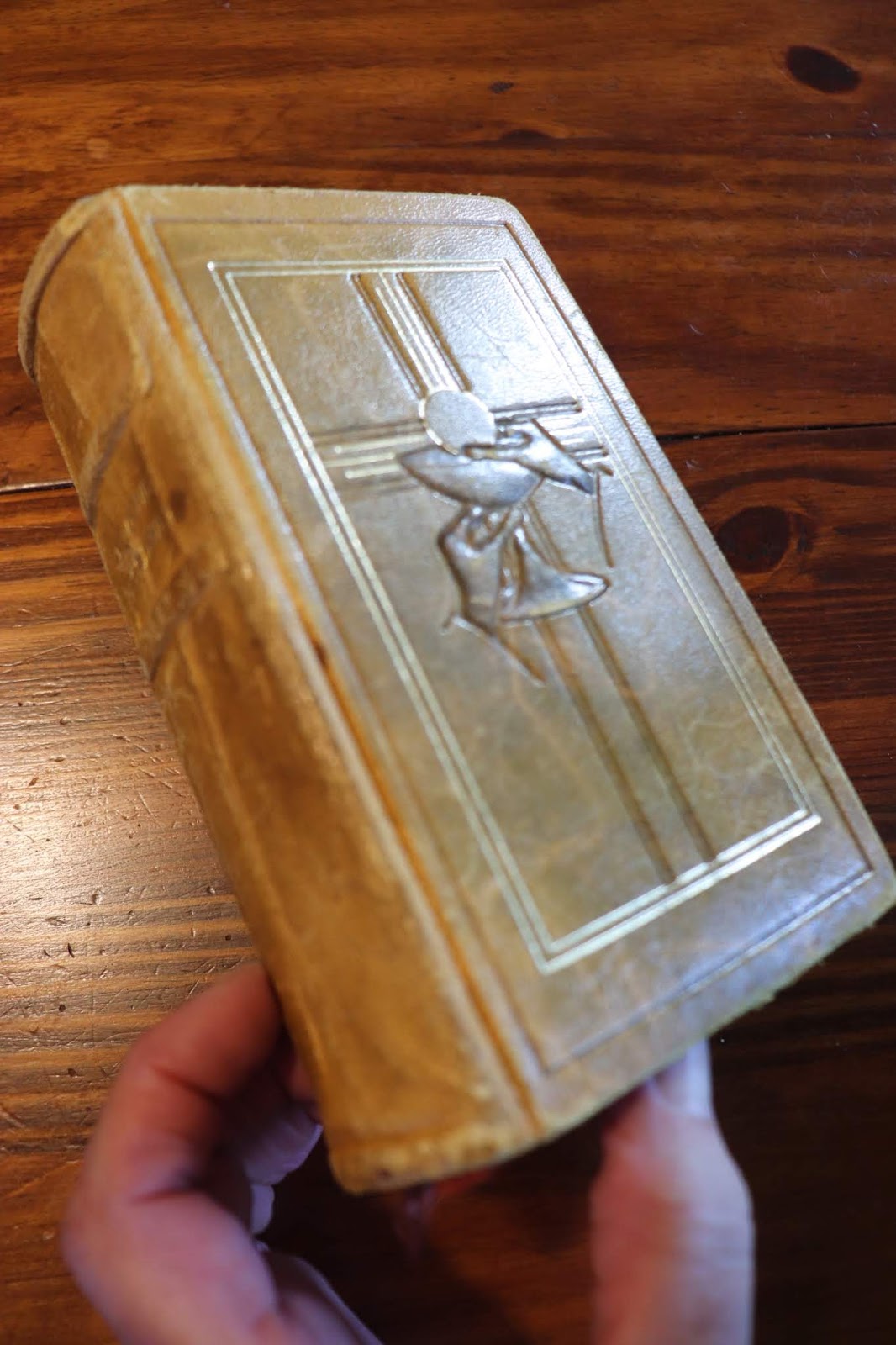


Here it is. It’s a Catholic missal in French, a sweet little leatherbound volume printed in Paris, and inscribed in French by the giver, someone’s Uncle Bernard (or at least someone who was known to the recipient as Tonton Bernard), in memory of Bernard’s visit to a couple ("vous deus," but unnamed) in Arizona in 2011. Bernard himself originally received the missal for holy communion in 1953, and a small sticker inside the back cover tells us that it came from the bookstore of the widow of Charles Morin in Sarrebourg. 

Little clues. Tantalizing scraps of a story. Is or was Bernard himself a monk? Did he visit the monastery? Did his Arizona host couple pass away since 2011? If the answer to these questions is no, how did the missal come to be in the monastery thrift shop where I found it?


Cows, now, are not little animals. They are quite large. And yet, their presence does not loom as large on the excitement scale as does that of horses (for me) or a mountain lion (excitement I don’t need in the yard). Still, I like coming home to cows … hearing their voices nearby in the morning … meeting them on the road on my way to the mailbox. It’s a little thing, an encounter with neighborhood cows, but it always makes me smile. 

Sunny morning. Cow down the driveway. Silver cardinal on the television antenna. Even laundry day begins with reasons to smile.


Wednesday, February 27, 2019

Almost There!


…The Dragoons’ rocky mid-section was a seasonal campsite of the great warrior Cochise. His bones rest somewhere on the east side of the mountains.  

It was Cochise who endowed the Dragoons with an almost mythical quality. 
- Mines, Camps, Ranches, and Characters of the Dragoon Mountains, by Lynn R. Bailey

As had been the case with our expedition to old Fort Bowie, the road to Cochise Stronghold far exceeded our expectations. We had anticipated the straight road west from 191 to end at a parking lot near a trailhead. Nothing more, but, once again, our expectations fell so far short of reality that as we made our way back to Dos Cabezas later in the afternoon we were still distracted by what we had seen, mentally reeling, and hardly able to think about anything else.

For a while, though, it looked as if the adventure would be put off for another day. Having forgotten to look at the gas gauge before reaching Sunsites, the horridly named rural subdivision on the outskirts of the ghost town of Pearce (the name it uses for its post office), we discovered that the Sunsites community has no gas station. A former gas station and convenience store back the road a piece was closed up, out of business. So, back to Willcox or on to “The Thing,” a combination food/gas/souvenir stop on I-10? I voted for “The Thing” but wanted to take Dragoon Road only as far as North Johnson Road, even knowing the latter to be unpaved. And so it was, not only unpaved but, in many stretches, washboard — not the Artist’s road surface of preference; however, we both appreciated the absence of fences and the scenery in general, and my longstanding curiosity about Johnson Road was finally appeased. So if we saved the Stronghold for another day, this day’s drive for me had still been worthwhile. But though we took I-10 back east from “The Thing,” we took the first exit south, 191 again toward Sunsites and the road to Cochise Stronghold.

… [B]ut now the air is so clear that one can see the breaks in the rocky face of the mountain range, though it is fully twenty miles away. It may be further. Who of the desert has not spent his day riding at a mountain and never even reaching its base? This is a land of illusions and thin air. The vision is so cleared at times that the truth itself is deceptive.  
- The Desert, by John C. Van Dyke


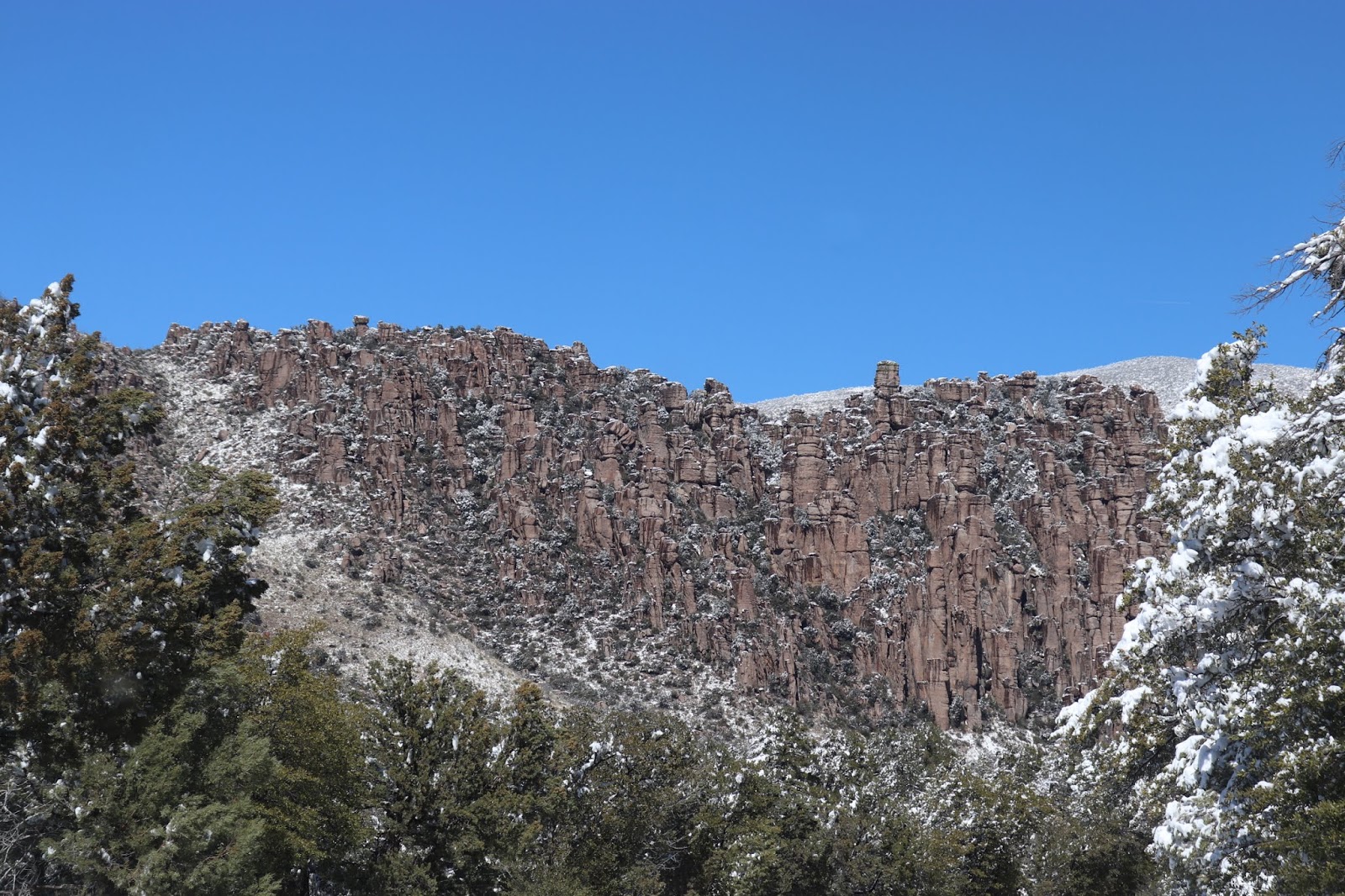
A mountain ahead is always impressive. Also, while one continues to move toward it, one also has the paradoxical impression that one will never arrive. Closer and closer, larger and more impressive, more detailed and multifaceted, the Cochise Stronghold section of the Dragoon Mountains is no exception to this experiential rule. But even this much — being still a distance from the mountains, on a more or less straight road — takes one’s breath away. All the more so, then, when pavement comes to an end, and a red dirt road stretches ahead to disappear as it turns south into rocks and trees. Full of anticipation, then, but not at all impatient, because each moment was already perfect, we advanced slowly, feasting with hearts and eyes.


And then our road turned and began to wind above a rushing mountain creek, brimming with snowmelt, with lovely trees around each curve. “I didn’t expect this!” “Neither did I!” Oaks! Manzanita! Running water!
“Winding about among the foothills, we at last struck the bed of a crooked stream, and following it back, up a moderate ascent, through a narrow pass, rock bound on either hand, we entered a gradually broadening valley in the very heart of the mountains…. 

“As we looked back on our trail, we saw that our entrance had been through a narrow canyon; at the further end, was another canyon similarly protected.”
- Captain Joseph Alton Sladen, 1872, his journal edited by Edwin R. Sweeney and published as Making Peace With Cochise 

We came to a temporarily stranded motorist, driver sitting in the driver’s seat, hood up on his old sedan. “Just givin’ ‘er a chance to dry out a bit,” he said, in response to our inquiry. “That last one was pretty deep. But my car’s older than yours. You should be okay if you keep to the right.” 


Reconnoitering on foot around the next curve, I found water, deep and wide, flowing over the road. As the other driver had explained, though, it was shallower on the downstream side, and if we kept just to the edge of the pebbles (right side of photo below) we should be able to ford safely. And so we did, and on we went, enchanted.


The next bit of water over the road was every bit as wide but did not seem as deep. More confident after one success, on we went. I should note that the Artist was at the wheel. I had been driving when we turned onto Ironwood Road, but he offered to change places so I would be free to deploy my camera more readily.


Have you ever noticed how excitement sharpens appetite? And that excitement itself is most pleasurable when taken in alternation with spells of rest? So we felt, anyway, when a parking area off the side of our road beckoned. The sign said “VEHICLES WITH HORSE TRAILERS ONLY,” but there were no horse trailers in sight that day, so we “deplaned,” as it were, long enough, first, to stagger around and exclaim at the beauty of the spot, and second, to sit on a bench and refresh ourselves with water and sandwiches and trail mix. To have horses in such surroundings! Heaven on earth! And did someone live here once? What is the story of this old stone building?


Surprisingly to us, there are bits of private property along the access road to the campground and hiking trails, and here and there a house. One perched dockside above the rushing mountain stream. Which site would be preferable, one on the mountain itself or one some little distance back with a view of the mountain? The Artist, naturally, voted for a view site. I don't know. I like the hidden-away aspect of the mountainside.


Eventually we came to a sign telling us we were within half a mile of the official campground, but soon destiny decreed that we would reach no farther that day. After four successful fords, we agreed that this last water crossing looked problematic. Not to put too fine a point on it, deeply problematic. And the mountain would be here another day, when the water across the road would be much shallower if there at all. Ten million years from now, the mountain may not be there in its present configuration, but it is there now, and we, though not here forever, are here now. 


Sunday, February 24, 2019

“This Changes Everything!”


Snow, that is. We’re from Michigan and have seen lots of snow, and we’ve seen snow before in Arizona, too, both in the winters of 2015 and 2018 and now again in 2018-19. But when the forecast for last Friday promised “severe weather,” with possible accumulations of up to 22” at our elevation, that out of the ordinary. So when I got up Friday morning, then, after a night of wind and rain, I’ll admit I was disappointed to see not a snowflake in sight. The temperature was dropping, however — not what temperature generally does here between 6 and 8 a.m., but drop it did — and by 8:30 the rain at last turned to snow, and the white stuff came down nonstop all day. Well, down and sideways and sometimes even up. 

Wash behind cabin on Friday morning
We didn’t even walk down to the mailbox that day, let alone start the car and drive to town. Instead,  except for meals and a couple of dog sorties, we had quiet hours of reading and conversation — also lots of looking out the windows, on my part.

Saturday brought another blue sky morning, with bright sun shining down not only on snowy peaks but also on white mountainsides and snow-filled washes, every branch and twig of mesquite bearing its tracery of snow. I don’t know how long I stood gazing, mesmerized, at the south-facing cabeza, the one we see from the cabin, watching it disappear into and reappear from the clouds, changing moment by beautiful moment. 


The gentler rises, the ones without dramatic rocky peaks, were transformed by snow, as well, their basic structures, contours, and stegosaurian ridges made more readily visible and obvious by the contrast of dark and light.


Mountain folds were softened, shadow effects made sharper. Overwhelmed on our drive to meet a friend in Willcox, and knowing the snow effects to be ephemeral, I couldn’t turn my head quickly enough to take it all in.

Then, the Artist and I couldn’t help but think: if mountains we knew as everyday neighbors were so breathtakingly and dramatically changed by snow, what would the always dramatic Chiricahuas be like on such a day? And how many opportunities would we have to answer that question for ourselves? Would there ever be such another winter snow in southern Arizona for us? Maybe not. And so we set out down the road toward the Chiricahua National Monument, a road that never fails to please and even to thrill on the most ordinary of days, which this was decidedly not.


Oh, those ancient, majestic sycamores! What must it be like, ranching in such grandeur?


I was not disappointed that the road up to Massai Point was closed. The excitement of narrow, shoulderless, icy mountain roads I do not require. Anyway, we still had loveliness to encounter, by taking the road south from the monument to “go around the block,” the long way home, stopping to admire trees sparkling with snow in the washes. 


I’ve altered my final image for the day, a shot of Dos Cabezas as we neared home again, taking out the color to leave only black and white and shades of gray. The result, I think, emphasizes what snow does to highlight mountain contours. By late afternoon when this shot was taken, the snow had melted on the lower slopes. There was not a cloud in the sky, but see how the mountain makes its own shadows with a little help from the sun? Sufficient unto itself.

One more thing: I am currently reading John McPhee’s Rising From the Plains, which tells the story (among others) of the formation of Wyoming’s Rawlins Uplift and the formation of the Medicine Bow and Snowy Mountains, and not for the first time I am frustrated at not having the complete story of the origin of the Dos Cabezas Mountains. The Grand Canyon story is well told and widely available. The Rocky Mountains garner plenty of attention. The Chiricahua National Monument has brochures and books explaining the volcanic beginnings of that range of southeast Arizona “sky islands.” But more and more I realize that one story does not explain all mountain ranges, that every range has its unique history not duplicated exactly anywhere else on earth. And I want to know the history of my mountains, as well as that of others in the neighborhood. It occurs to me that if I were obscenely rich, I would commission a whole staff of geologists to research and publish the history of every mountain range in Arizona. What a project that would be! The first installment, though, would have to be the Dos Cabezas Mountains, because I am not living in the scale of geologic time and can’t wait ten million years. 

…The Teton landscape contained not one the most complete geologic history in North America but also the most complex. …After half a century with the story assembling in his mind, he [geologist David Love] can roll it like a Roman scroll. From the Precambrian beginnings, he can watch the landscape change, see it move, grow, collapse, and shuffle itself in an intricate, imbricate manner, not in spatial chaos but by cause and effect through time. He can see it in motion now, in several ways responsively moving in the present—its appearance indebted to the paradox that while the region generally appears to have been rising the valley has collapsed.  - John McPhee, Rising From the Plains


This is what I want for the Dos Cabezas Mountains: a temporal scroll of its entire geologic history, the picture of its changes, as they unfolded, over all of time.