Search This Blog

Showing posts with label racism. Show all posts

Tuesday, May 31, 2022

Book Review: THE EDUCATION OF BETSEY STOCKTON: AN ODYSSEY OF SLAVERY AND FREEDOM


As was true of his biography of John James Audubon, Gregory Nobles, in his new book, The Education of Betsey Stockton: An Odyssey of Slavery and Freedom, gives readers broad and deep insights into the time period of his subject and those parts of the United States in which she lived and worked. In a way, this approach was more necessary in writing of Stockton than of Audubon, since information about Stockton's life and work is fragmentary, and most of what survives was written by other people, but what it means for a reader is that we have a chance to be fully immersed in events and beliefs of our own American past while the author pieces together, like a quilt, the life of a specific historical human being.  


Nobles as historian specializes in 19th-century America. In going beyond the life of his subject, his earlier biography of Audubon explored in detail the business practices and economics of that time, what it took to be considered a serious artist then, and the state of American art and science with relation to England and the European continent, as all these larger issues bore directly on the life of Audubon, who lived from 1785 to 1851. 


Betsy Stockton, born into slavery, lived from around 1800 (exact date not known) to 1865. Given the color of her skin and the circumstances of her birth (the identity of her father can only be speculated), as well as her foreign missionary experience, long career as a teacher, and the fact that she lived through the Civil War and President Abraham Lincoln’s assassination, larger national issues explored in relation to her life are slavery, racism, public education, 19th-century American politics, and the Civil War, along with the missionary movement of the time and the role of the town of Princeton, the College of New Jersey (now Princeton University), and Princeton Theological Seminary in spearheading and shaping that movement for the Presbyterian church.


Since Stockton's unedited manuscript journal either did not survive her or has not yet come to light, only the published installments of her journal as edited by the Reverend Ashbel Green are available to account for her missionary travel to Hawaii in 1824-25, and while Green assured readers of the Christian Advocate that he made “very few corrections” to the letters before publication, there is no way of knowing to what extent he may have altered her original writing. Sadly, not many of her letters to Charles Samuel Stewart survive, either. But Nobles has brought together what scattered pieces of documentary evidence do exist, as well as the well-established basic facts of her life.


Stockton had been “given,” as an enslaved child, to Green’s wife, and it was Green himself, years later (Stockton was emancipated as an adolescent and afterward worked for wages in the household), who wrote a letter of recommendation for Stockton to Stewart. The latter was forming up a foreign mission to what were then known as the Sandwich Islands, and thus it was, author Nobles tells us, that Betsey Stockton was


…the first Black person, the first former enslaved person, the first single woman to serve as a missionary in Hawai‘i, and the first missionary to start an infant school for Black children in Philadelphia, the first name on the list of Black people leaving the main Presbyterian Church in Princeton to form a separate congregation, the first teacher in the only school for Black school in Princeton. Betsey Stockton lived a life of firsts, all of them in service to people of color. 


Racism endemic to 19th-century, pre-Civil War Princeton, both the town and the college, should not be surprising but reads as shocking nonetheless. Black men defending their own wives from harassment were set upon by groups of rowdy white students, and Black parishioners of the Princeton Presbyterian Church were denied even their traditional separate gallery seating when a new building was constructed after the old church burned, as “the white Presbyterians pressed for separation,” and Black members were “dismissed” from membership. It was at that point in history that the First Presbyterian Church of Colour of Princeton was formed. 


The College of New Jersey, with a high percentage of students from the South, attempted to remain “neutral” on the questions of slavery and secession right up to the Confederate attack on Fort Sumter, when


…several students climbed to the top of Nassau Hall to hoist an American flag, shout out some rooftop speeches, and fire a few old muskets as a show of support for the national government. This display was also an act of defiance toward the faculty, and particularly President John Maclean, Jr., who had sought to remain officially on the fence in the run-up to the rebellion. …His sympathy for southern boys led him to order the flag taken down, so as not to offend anyone who might see it as an institutional political statement. But in the context of open conflict, Maclean’s moderation had lost traction among northern students, and the flag went back up – and stayed there.


To read that the president of Princeton feared the American flag might offend some of his students and ordered it taken down astounded me. Those most likely to be offended would have been the Copperheads.  (I would say that the Princeton & Slavery Project, so recently begun, is both long overdue and a good start.) And to think there are people in our country today who consider themselves patriots and fly the Confederate flag without fear of causing offense! Or perhaps they hope to offend? But let me not get sidetracked....


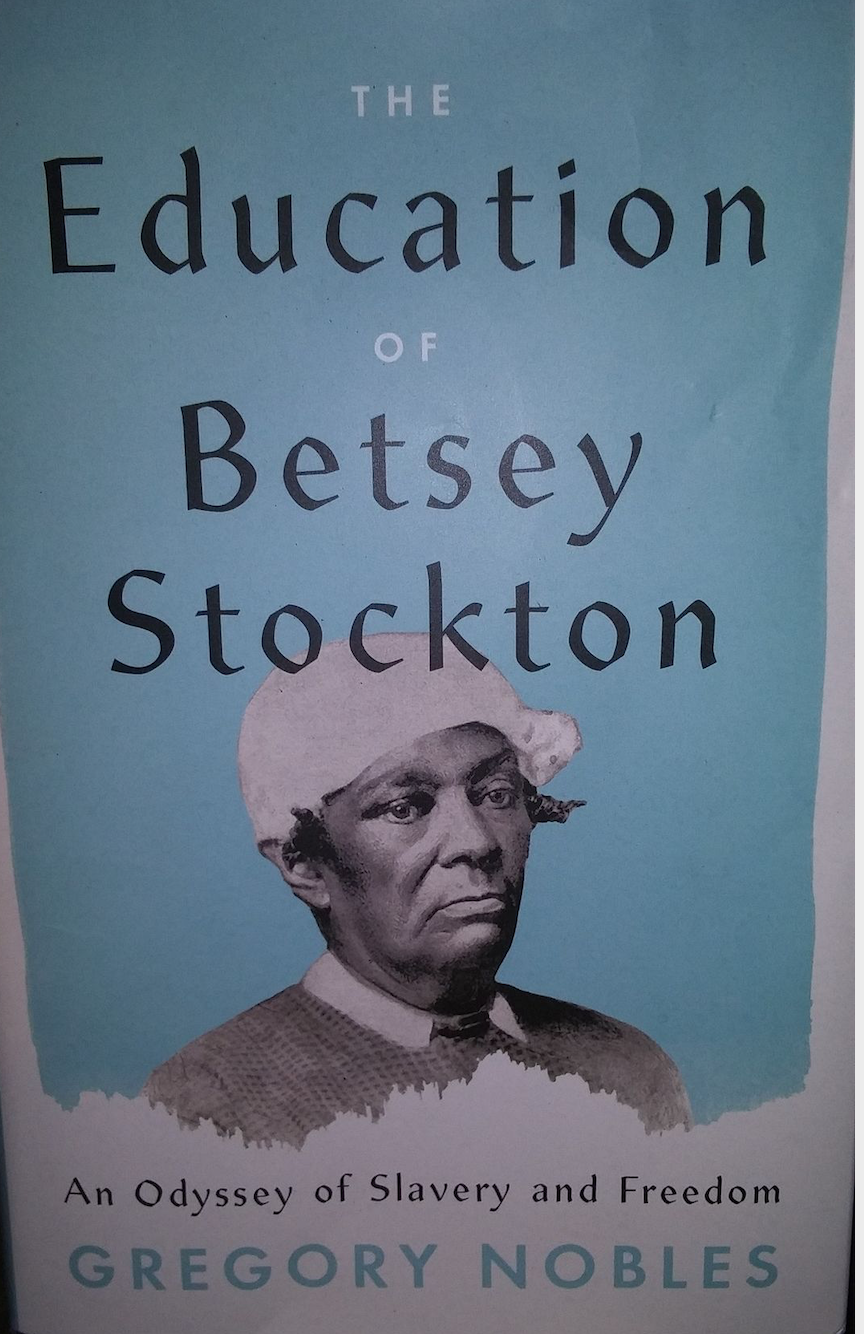
Throughout The Education of Betsey Stockton, the main subject herself never appears fully in sharp focus and technicolor, but that is not the fault of the author. Nobles could have written a novel and invented a character and put words in her mouth but chose not to do so, determined instead to hunt out “traces” of the real human being wherever he could find them. The Betsey Stockton who emerges from his research, though there is only a single photograph to give us some idea of her appearance, was a woman who “knew her own mind,” was “‘deliberate and dignified,” “certainly not weak willed,” someone who educated herself throughout her life and was respected by all who knew her. Given her intelligence, her sense of calling, and the racist environment in which she lived, it is hardly surprising that throughout her life Stockton knew occasional “low spirits.” In the end, however, more important than her spells of depression or discouraging events was her strength to go on doing good work, teaching children who might well never have had an education without her efforts.


Learning about one of the many “ordinary people doing extraordinary work” behind the grand stage of historical events is sufficient reason to read this book; another,  however, is to examine in a different time period the racism that is such a deep stain on our country’s history and a painful legacy continuing in our own day. Political divisions, too, are nothing new to the never fully united United States, as this story shows so clearly, so in learning about Betsey Stockton’s life and work and the times she lived through we have yet another lens through which to examine our past – and we can never have too many of those.


Greg Nobles will give a presentation at the summer library series on Tuesday, July 19.


The Education of Betsey Stockton: An Odyssey of Slavery and Freedom

by Gregory Nobles

University of Chicago Press

Hardcover, 292pp with notes and index

$25


Read since last listing:


56. Rumi, trans. by Kabir Helminski & Ahmad Rezwani. Love’s Ripening: Rumi on the Heart’s Journey (poetry)

57. Bowen, Rhys. The Venice Sketchbook (fiction)

58. Ashenburg, Katherine. The Mourner’s Dance: What We Do When People Die (nonfiction)

59. Davenport-Hines, Richard. Proust at the Majestic: The Last Days of the Author Whose Book Changed Paris (nonfiction) 

60. Buzzelli, Elizabeth Kane. She Stopped for Death (fiction)

61. McMorris, Kristina. The Ways We Hide (fiction)

62. Nobles, Gregory. The Education of Betsey Stockton: An Odyssey of Slavery and Freedom (nonfiction)


Wednesday, July 17, 2019

Whose “Good Old Days” Are You Talking About?


“History is a nightmare from which I am trying to awake,” said the character Stephen Daedalus in the novel Ulysses, by James Joyce. True for the Irish, and it should have been true for the English, also, but was it? An Indigenous Peoples’ History of the United States is a difficult book to read, because the facts themselves are brutal, but for that very reason it is also an important corrective to U.S. history as generally taught. I’ve made my way through it slowly so as not to skip over any of the unbelievably horrible but horribly real — and horribly repetitive — details. The awful repetition of horrors is important because it shows that, rather than being something that can be brushed aside today as anomalies, all were part of systematic, government-sanctioned and often (though not always) government-led racism and genocide in our country’s history. 

Roxanne Dunbar-Ortiz did not grow up on a reservation but “in the midst of,” as she puts it, Native communities in rural Oklahoma, her father a cowboy, her mother “ashamed of being part Indian.” She became involved in political movements in the Sixties — antiwar, civil rights, anti-apartheid, women’s lib — and eventually with the American Indian Movement (AIM) and the International Indian Treaty Council. She earned her doctorate in 1974 with a dissertation on land tenure in New Mexico. It’s easier to tell you about the author’s background than about what’s in her book, though, because even white people know, after all, that the history of the frontier was not a happy one for Native Americans. We have all heard and read that the westward movement was made possible by a series of broken treaties and bloody encounters. But what about colonial days? Weren’t we taught in grade school about a peaceful “First Thanksgiving” between Native Americans and English colonists?

One point the author makes repeatedly is that the “Indian Wars” did not begin in the Wild West but right there in the beginning on the Atlantic Coast. From England’s invasion and subjugation of Ireland (that nightmare history) came the practice of scalping, with bounties paid and few if any questions asked about sex or age of the murdered and mutilated. Thus immigrant men without property in the colonies and new United States, organized into volunteer militias, might better themselves financially as scalping and land-taking practices accompanied immigration to the North America.

European justification for seizure of Native lands can be traced back to the 15th century, when the pope promulgated and clarified the Doctrine of Discovery, cited in 1792 by Thomas Jefferson and reaffirmed by the U.S. Supreme Court in 1823. According to this doctrine, which came to be enshrined in international law, “discoverers” of a land could claim it as territory for their own country, thus jumping the property rights claims of all other European countries. Prior inhabitants (called “First Nations” in Canada) were not considered to have any property rights in their own homeland. In their religion, land was too sacred to be bought and sold — and so they were sold out by invaders with a different set of values and customs.

Another theme Dunbar-Ortiz presents is the idea that “total war” — i.e., war fought not only between armies but waged against an entire population, with villages and crops burned and game slaughtered so that, facing starvation and “scorched earth,” no choice is left but to take to what was called, in the case of the Cherokees, the “Trail of Tears” — is nothing new to the U.S. military. Used first against Native Americans, it was national and military policy at the highest levels of American government, as the author demonstrates with quotations from governors, generals, and U.S. presidents. Military experience in dealing with Native Americans was subsequently taken overseas to the Philippines and, later, to Vietnam. The first U.S. invasion of Iraq was promised to bring speedy victory of U.S. forces over Iraqi “Indian country.” The phrase “Indian country” came from the Vietnam era but has come to be abbreviated as “In Country,” disguising the origins of the term designating “behind enemy lines,” the change, though at best only cosmetic, perhaps due in part to a protest from the National Congress of American Indians in 1991.

I’m refraining from incorporating very many quoted passages, but here’s one that encapsulates all the rest. The author writes that Dee Brown’s 1970 account of a 19th-century massacre, Bury My Heart at Wounded Knee, became a “surprise best seller,

so the name Wounded Knee resonated with a broad public by 1973. On the front page of one newspaper, editors placed two photographs side by side, each of a pile of bloody, mutilated bodies in a ditch. One was from My Lai in 1968, the other from the Wounded Knee army massacre of the Lakota in 1890. Had they not been captioned, it would have been impossible to tell the difference in time and place.  
- Roxanne Dunbar-Ortiz, An Indigenous Peoples’ History of the United States
Dunbar-Ortiz, however, does more than bust myths and document genocide. Equally important to her story is Indigenous resistance and survival, from the beginning to modern times, including legal battles ongoing today. Here’s one that may surprise you:

…In the first land restitution to any Indigenous nation, President Richard M. Nixon signed into effect Public Law 91-550, which had been approved with bipartisan majorities in Congress [my amazed emphasis added]. President Nixon stated, “This is a bill that represents justice, because in 1906 an injustice was done, in which land involved in this bill — 48,000 acres — was taken from the Taos Pueblo Indians. The Congress of the United States now returns that land to whom it belongs.”
Yet today, even as I was working on this expanded version of my review of the Dunbar-Ortiz book (a shorter version was written for another publication), a young man from Leelanau County, Zhaabadiis Biidaasige, whom I knew when he was a little boy as Johnny Petoskey, was standing before the United Nations Expert Mechanism on the Rights of Indigenous People, representing the Grand Traverse Band of Ottawa and Chippewa Indians, Kitchiwikwedongsing Anishinaabak, and speaking to the issue of unfulfilled treaty promises made by the State of Michigan to the Anishnabe people. 

Survival. Resistance. Renewal.

A special edition for young people of this book is due for release in late July. How will the story be told there? And what do we want American children of any skin color or ethnic background to know about American history? How do we tell them the truth and still inculcate in them a love of their country? Perhaps that depends not only on how we teach about the past but even more on how we conduct ourselves in the present and into the future. 


An Indigenous Peoples’ History of the United States, by Roxanne Dunbar-Ortiz (Boston: Beacon Press, 2014), paperback, 296 pages with index, $16

Saturday, October 22, 2016

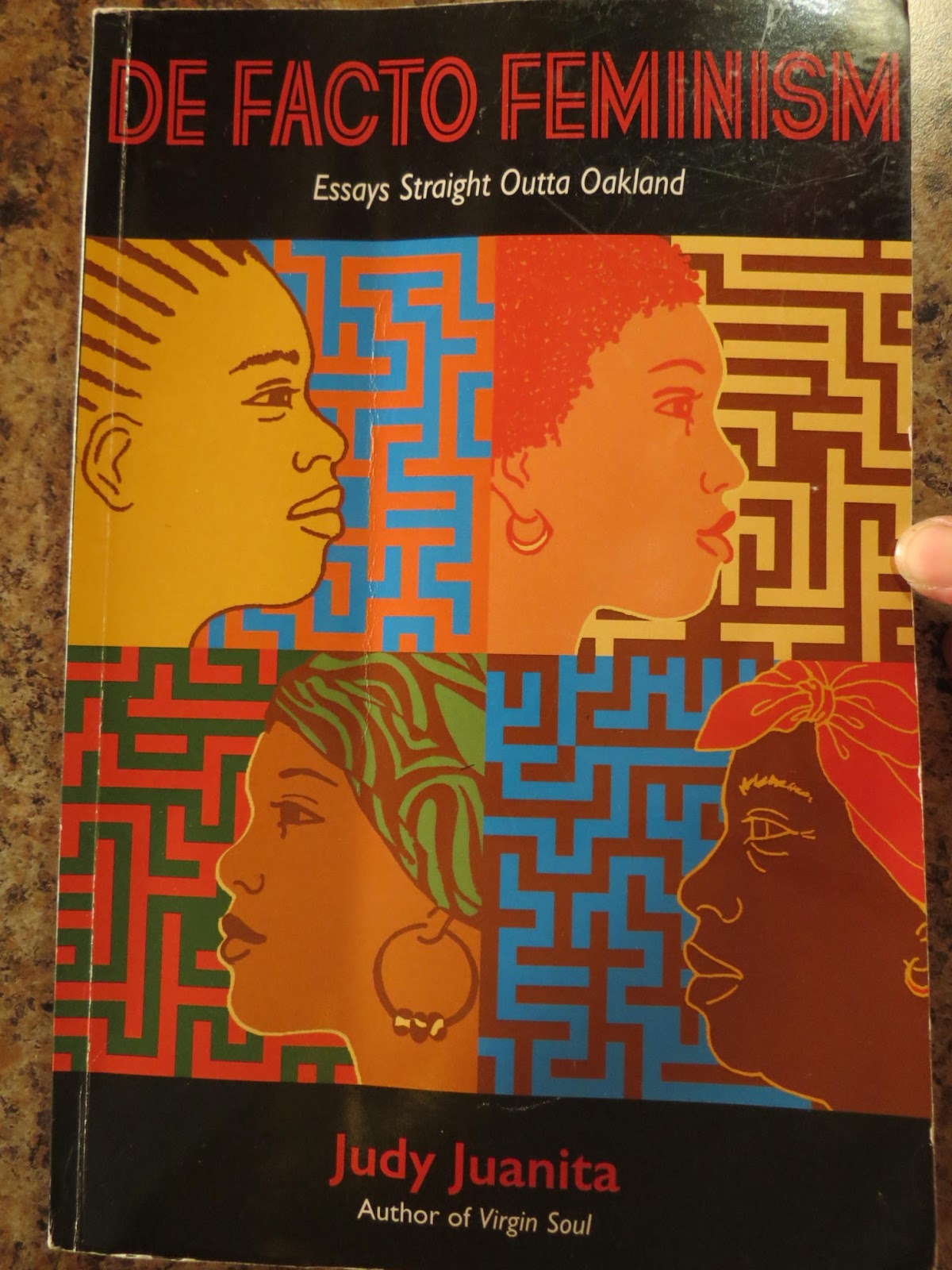
Book Review: DE FACTO FEMINISM


De Facto Feminism: Essays Straight Outta Oakland
by Judy Juanita
Paper, 227pp, $19.95


In Virgin Soul, a novel set in the 1960s, the protagonist shared many of the author’s own experiences in terms of family, education, participation in the Black Party Party, and social activism in general. But a novel, even as it draws on an author’s own background, is fiction. De Facto Feminism: Essays Straight Outta Oakland is something different. This time we met Judy Juanita directly, face to face.

The essays in this book span the time period from the late Sixties to the present and include stories from Juanita’s life, her hopes and dreams, her strong opinions, and her unstoppable determination. There is honesty and humor here, along with bits of polemic, making for a complex mix that deserves to be read through more than once. Here are the first lines of Juanita’s introduction:
I’m a woman. POW! Black. BAM! Outspoken. STOMP! Don’t fit in. OUCH!
That tells a reader right from the get-go that no punches will be pulled in what follows, and no punches are pulled.

Juanita begins, easily enough, by recounting her growing-up years in East Oakland, a safe, friendly, middle-class neighborhood of unlocked houses inhabited by Portuguese immigrants, Mexicans, Mormons, and two black families, of which hers was the second on the block. (Her family was first on the block, however, to visit Disneyland.) Her parents were both readers, and her childhood world was a quite ordinary one of household chores, TV (all white faces, though, in those days), comic books, music, hide-and-seek, and backyard camping sleepovers, with occasional family expeditions to San Francisco. Despite the little heartbreaks that come to most young people in time, these memories read like a fairly idyllic American childhood, although as a child she took her family and neighborhood completely for granted, as fortunate children usually do.
I would not realize how fully, peculiarly and tightly loved I was until I left California – the state and the state of mind.
Growing up, of course, is only the beginning. There followed heady days of student radicalism and Juanita’s membership in the Black Panther Party. She served as editor-in-chief of their newspaper when Eldridge Cleaver went to jail.
My friends and I dropped out and worked in the BPP full time. We eventually returned to campus too, armed, not only with actual weapons, but with a new consciousness about education, service, the poor, the police and the military, oppression, and civil and human rights.

Along the way, Juanita had begun to write poetry, and when she quit a New Jersey job in straight journalism, she says, “I came to poetry when I was out on a limb.” She joined a group of others poetry writers and soon found herself reading in public and having work published. “Through contemplating my navel,” as she puts it with self-deprecating sarcasm, she won a fellowship and then, over a period of six years, enjoyed a series of short-term funded gigs teaching writing in New Jersey public schools. It was a stop-gap solution. But the inclusion of some of her poetry enriches this book of essays and helps us follow her development as a writer.

For a time, Juanita took on a job offered by a friend, cleaning condos, although her initial response to the friend’s offer had been,
Moi? A black woman with degrees, fellowships, travels abroad, a library of dictionaries within my library – a cleaning woman?
At one point she quit and took a temporary office job (for one-third the pay), but after four days she went back to cleaning, “where nobody called me Bertha, Beulah or Bessie,” and began to see her life and her strength more clearly than she ever had before.

Juanita’s evolution as a writer is an important theme developed in these essays. Through the years she pursued poetry, drama, and fiction, and when her agent asked why the humor he found in her conversation wasn’t evident in the novel she was writing, she decided to try for “funny” by attempting stand-up comedy. Approaching her comedy club gigs with the same strong work ethic she brought to writing classes, she learned what worked and how, but most importantly she learned about herself and the place of humor in her life and her writing. I’m not going to put a spoiler in here, though, to tell you what she learned! It’s in the essay, “Putting the Funny in the Novel.”

Blackness is another important theme. “The Gun as Ultimate Performance Poem” is guaranteed to stop readers in their tracks. Juanita had liked guns, she tells us, but “The Gun” is something else. Another no-holds-barred essay, “Report from The Front, i.e. Berkeley, CA,” makes clear the great racial divide all-too-alive, recounted in a series of maddening incidents.

The last ‘essay’ in the book stretches the meaning of the term pretty far, but by then I found myself going right along with it, in spite of the subject matter (Ghosts? Really?), thanks to the author’s dramatic skill in telling her story.

As I said in the beginning of my earlier review of the novel, Judy Juanita and I are of the same era. We both came from middle-class backgrounds, were both spelling champions -- and also suffered social trauma that same sixth-grade year. Inevitably, our paths diverged, as Illinois has never been California, and white and black Americans live in two different countries, anyway, in a lot of ways.

Personal essays, however, by writers of any era in any country, can invite readers into a writer’s life as effectively as autobiography or memoir. Temporarily inhabiting other lives is part of the magic of reading. That magic also, one hopes, can build bridges of understanding between people whose experiences of the world have been dissimilar.

Having read this book, I now want to read Judy Juanita’s plays, and I also want to read Carolyn Rodgers and Ishmael Reed. Multiple doorways beckon.

Another thing. I’m thinking of my own grandmother, my mother’s mother, in a slightly different way. Wasn’t she a de facto feminist, too? I feel strongly that she was, and I thank you, Judy Juanita, for coming up with this term. I hope you don’t object to my applying it to a dead white woman. Believe me, if you’d known my grandmother's life, you would agree that she deserved the title!