Search This Blog

Showing posts with label Black Panthers. Show all posts

Saturday, October 22, 2016

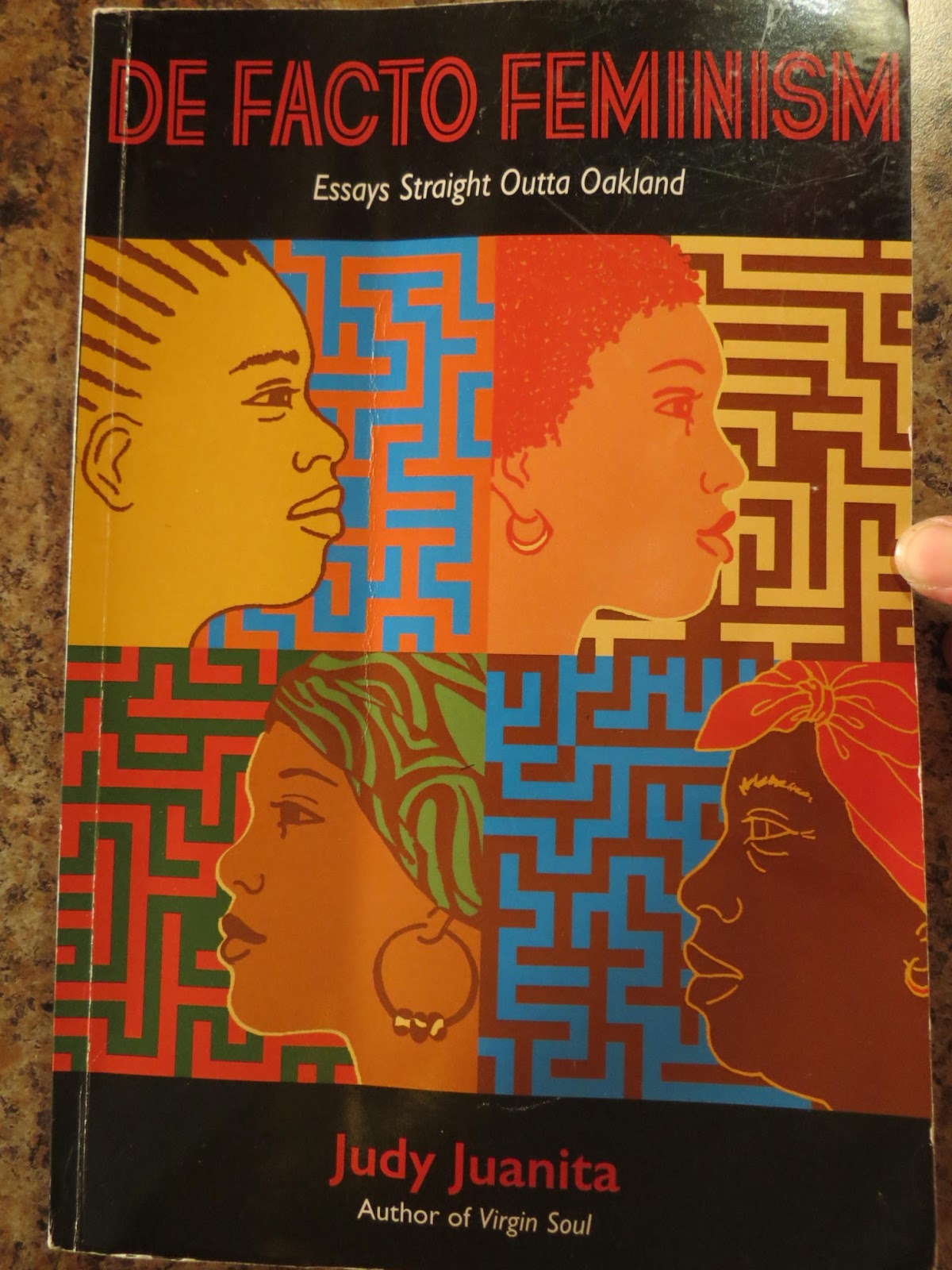
Book Review: DE FACTO FEMINISM


De Facto Feminism: Essays Straight Outta Oakland
by Judy Juanita
Paper, 227pp, $19.95


In Virgin Soul, a novel set in the 1960s, the protagonist shared many of the author’s own experiences in terms of family, education, participation in the Black Party Party, and social activism in general. But a novel, even as it draws on an author’s own background, is fiction. De Facto Feminism: Essays Straight Outta Oakland is something different. This time we met Judy Juanita directly, face to face.

The essays in this book span the time period from the late Sixties to the present and include stories from Juanita’s life, her hopes and dreams, her strong opinions, and her unstoppable determination. There is honesty and humor here, along with bits of polemic, making for a complex mix that deserves to be read through more than once. Here are the first lines of Juanita’s introduction:
I’m a woman. POW! Black. BAM! Outspoken. STOMP! Don’t fit in. OUCH!
That tells a reader right from the get-go that no punches will be pulled in what follows, and no punches are pulled.

Juanita begins, easily enough, by recounting her growing-up years in East Oakland, a safe, friendly, middle-class neighborhood of unlocked houses inhabited by Portuguese immigrants, Mexicans, Mormons, and two black families, of which hers was the second on the block. (Her family was first on the block, however, to visit Disneyland.) Her parents were both readers, and her childhood world was a quite ordinary one of household chores, TV (all white faces, though, in those days), comic books, music, hide-and-seek, and backyard camping sleepovers, with occasional family expeditions to San Francisco. Despite the little heartbreaks that come to most young people in time, these memories read like a fairly idyllic American childhood, although as a child she took her family and neighborhood completely for granted, as fortunate children usually do.
I would not realize how fully, peculiarly and tightly loved I was until I left California – the state and the state of mind.
Growing up, of course, is only the beginning. There followed heady days of student radicalism and Juanita’s membership in the Black Panther Party. She served as editor-in-chief of their newspaper when Eldridge Cleaver went to jail.
My friends and I dropped out and worked in the BPP full time. We eventually returned to campus too, armed, not only with actual weapons, but with a new consciousness about education, service, the poor, the police and the military, oppression, and civil and human rights.

Along the way, Juanita had begun to write poetry, and when she quit a New Jersey job in straight journalism, she says, “I came to poetry when I was out on a limb.” She joined a group of others poetry writers and soon found herself reading in public and having work published. “Through contemplating my navel,” as she puts it with self-deprecating sarcasm, she won a fellowship and then, over a period of six years, enjoyed a series of short-term funded gigs teaching writing in New Jersey public schools. It was a stop-gap solution. But the inclusion of some of her poetry enriches this book of essays and helps us follow her development as a writer.

For a time, Juanita took on a job offered by a friend, cleaning condos, although her initial response to the friend’s offer had been,
Moi? A black woman with degrees, fellowships, travels abroad, a library of dictionaries within my library – a cleaning woman?
At one point she quit and took a temporary office job (for one-third the pay), but after four days she went back to cleaning, “where nobody called me Bertha, Beulah or Bessie,” and began to see her life and her strength more clearly than she ever had before.

Juanita’s evolution as a writer is an important theme developed in these essays. Through the years she pursued poetry, drama, and fiction, and when her agent asked why the humor he found in her conversation wasn’t evident in the novel she was writing, she decided to try for “funny” by attempting stand-up comedy. Approaching her comedy club gigs with the same strong work ethic she brought to writing classes, she learned what worked and how, but most importantly she learned about herself and the place of humor in her life and her writing. I’m not going to put a spoiler in here, though, to tell you what she learned! It’s in the essay, “Putting the Funny in the Novel.”

Blackness is another important theme. “The Gun as Ultimate Performance Poem” is guaranteed to stop readers in their tracks. Juanita had liked guns, she tells us, but “The Gun” is something else. Another no-holds-barred essay, “Report from The Front, i.e. Berkeley, CA,” makes clear the great racial divide all-too-alive, recounted in a series of maddening incidents.

The last ‘essay’ in the book stretches the meaning of the term pretty far, but by then I found myself going right along with it, in spite of the subject matter (Ghosts? Really?), thanks to the author’s dramatic skill in telling her story.

As I said in the beginning of my earlier review of the novel, Judy Juanita and I are of the same era. We both came from middle-class backgrounds, were both spelling champions -- and also suffered social trauma that same sixth-grade year. Inevitably, our paths diverged, as Illinois has never been California, and white and black Americans live in two different countries, anyway, in a lot of ways.

Personal essays, however, by writers of any era in any country, can invite readers into a writer’s life as effectively as autobiography or memoir. Temporarily inhabiting other lives is part of the magic of reading. That magic also, one hopes, can build bridges of understanding between people whose experiences of the world have been dissimilar.

Having read this book, I now want to read Judy Juanita’s plays, and I also want to read Carolyn Rodgers and Ishmael Reed. Multiple doorways beckon.

Another thing. I’m thinking of my own grandmother, my mother’s mother, in a slightly different way. Wasn’t she a de facto feminist, too? I feel strongly that she was, and I thank you, Judy Juanita, for coming up with this term. I hope you don’t object to my applying it to a dead white woman. Believe me, if you’d known my grandmother's life, you would agree that she deserved the title!


Thursday, April 4, 2013

Book Review: VIRGIN SOUL (or, "What were the Sixties really like?")


“What were the Sixties really like?” When a younger friend asked me this question, in a moment I suddenly felt many years older, realizing that what was “just yesterday” to me was a historical period to my youthful friend. But how to answer her question? I’ve been thinking about it for years now (haunted by the question still, obviously), as another two decades have slipped past. Here's an overview from Wikipedia to get you started, if you were "born too late" to be one of us, but --

There can be no single answer to what the Sixties were like, because they were different for everyone who lived through them, even if only American experience is considered. How old were you in the Sixties, for starters? A little child, a college student, part of the workforce, or someone “over 30,” one of those the young were told not to trust? Male or female, black or white or yellow or red or brown? Living in San Francisco or Chicago; Selma, Alabama; Aberdeen, South Dakota; or in the wilds of Maine? Rich or poor or in-between?

Student, lawyer, secretary, grocery store cashier, factory line worker, teacher, or Peace Corps volunteer? A draftee in Vietnam, conscientious objector in El Paso, refugee in Toronto, or a protestor at Berkeley? Singing and playing in a rock-and-roll band? Member of the Black Panthers or Students for a Democratic Society, or Young Republicans, or the Country Club?

There were peaceful demonstrations, and there was violence, and there was the undeclared war, and there were drugs, and there was also the continuation of American suburban life, with big weddings and brides in white. Toward the end of the Sixties there was the Pill, but all along there were pregnancies (planned and unplanned), abortions, and young families, some hippies, others mainstream. And for those in their ‘teens and 20s, there was exciting music, poetry everywhere, plenty of available sex and drugs, a lot of lofty ideals, and a minefield of dangerous pitfalls.

That's why I say there is no telling what the decade was “really like,” except in terms of individual lives, but if you weren't there and want a close-up view I just read a new novel that presents a convincing picture through one particular window.

Virgin Soul
by Judy Juanita
NY: Viking, 2013
$26.95

We meet the novel's protagonist, Geniece Hightower, in Oakland, California, in the summer of 1964. Just out of high school, she enrolls in Oakland City College, “City,”
. . . a raggedy, in-the-flatlands, couldn’t-pass-the-earthquake-code, stimulating, politically popping repository of blacks who couldn’t get to college any other way, whites who had flunked out of the University of California, and anybody else shrewd enough to go for free for two years and transfer to Berkeley, prereqs zapped.
Geniece is a journalism major. Right away meets Huey Newton. Right away she loves sitting on the campus lawn, listening to the “black intellectuals and the white boys from the W.E.B. Du Bois Club talk.” Quickly she learns that light-skinned black students (“yellow, high yellow, sandy yellow, mellow yellow, sandy mariney, light brown, peach, or caramel skin; the line stopped there”) had one hangout, darker-skinned blacks like herself another. She lives at the Y (10 p.m. curfew) and works 20 hours a week at the county welfare department in Oakland. She’s launched into life but still has her aunt and uncle’s warning in her head:
“We want you to be a virgin until you graduate from college. If you’re not a virgin, you won’t graduate. Once you have sex, you can’t think about anything else.”
Judy Juanita’s novel is divided into four main sections, one for each of Geniece’s four years of college. Sophomore year she is introduced to Black Muslims and has her hair cut into a natural: “Sleek, short, very African.” She wonders what “being in love” feels like and if she is in love. No longer living at the Y, she allows a boyfriend to hold political education classes in her apartment, and she cleans and cooks for those who attend.
I knew I was becoming militant. I just didn’t know if I wanted to become a militant. Malcolm X, Betty Shabazz, the protesters, the sit-in demonstrators down south were my heroes. I loved them from a distance and on paper. But the militants I met, mostly the guys on the soapbox on Grove Street, were harsh and abrasive and condescending to everyone, not just white people. And they made people do things. . . . I didn’t want that kind of power over people. I just wanted it over myself.
Huey Newton isn’t the only real person readers encounter in the pages of this work of fiction. Bobby Seale is there, and Stokeley Carmichael, too. The war in Vietnam is audible always in the background.

Junior year is a turning point for Geniece, as one black group goes one way and the Black Panther Party (BPP) for Self-Defense another. She enrolls at State and lands a work-study job in Admissions, date-stamping application entries from all over the world.
Lives came out of the words: how little money one’s father made; the off-the-wall place one had traveled to; family crises; serious illness defeated; political activity noted like a badge of honor – “I belong to the W. E. B. Du Bois Club.” They weren’t afraid: “I participated in the freedom rides.” Stuff I never mentioned: “The protest changed my whole life.” State was a destination for radical students: “I’m a child of a union family.” Dissidents. The streets of Berkeley were the pull for people bucking the system. Nonconformists. State was pulling people like me. I was not an in-between. I was a junior facing a cast of thousands wanting to be right where I was, a part of something big, essential, swimming in the big ocean.
In the course of her college career, it is not until her junior year that Geniece sees herself at the center of social change taking place across the country. Before that she felt like “an in-between”; now she is, as people said in the Sixties, “where it’s at.” But she is not yet where she will be at the end of her senior year. . . .

I don’t want to give away too many details of this story, because it’s the details that make the central character’s life a real one and make that time period come alive. Her social and sexual and romantic relationships are important to her development as an adult. Her feelings for journalism wax and wane, but editing the Panthers’ newspaper is an important job she takes very seriously. Also with the BPP, she confronts the question of guns for self-defense, and a volunteer job through the Tutorial Center introduces her to two young, self-sufficient black girls neglected by their battered mother. Education is not limited to the classroom. (It never should be.)

But Geniece Hightower is determined to graduate in four years, so she wisely avoids serious involvement with drugs. While music is part of her life, it also remains, like Vietnam, in the background. Race, class, and gender relationships – politics within and beyond the university – the future she will have as a Black American woman – this young woman maintains ties to her family at the same time she is finding her own way in the world.

Personal, political – political, personal – yes, this was the Sixties. Judy Juanita gives readers a very real look at that exciting and turbulent time through the eyes of her strong, questing protagonist. There are pages when the prose lifts into lyricism, so it should be no surprise that the author’s writing has for years encompassed poetry as well as reporting. This is her first novel. I’m glad she wrote it and hope it won’t be her last.