Search This Blog

Showing posts with label biography. Show all posts

Wednesday, March 12, 2025

In My Little Corner of the World


She was a glamorous librarian, whose image lends panache to an often undervalued profession, an astute collector who shaped an internationally renowned library of rare written and artistic treasures from around the world. 

-      Heidi Ardizzone, An Illuminated Life: Belle da Costa Greene’s Journey from Prejudice to Privilege (2007)


This is the second book about the life of Belle Greene that I have read since the beginning of the year. The first was a novel, The Personal Librarian (2021), by Marie Benedict & Victoria Christopher Murray, a fictionalized account of the famous librarian’s life and career. Both books spent considerable time dwelling on Greene’s racial heritage, her lengthy, on-again-off-again affair with Bernard Berenson, and her many other flirtations and possible affairs. I turned to the biography after the novel in hopes of learning more about the bookish aspects of Belle’s life.


She worked in the Princeton library and pursued “informal studies of rare books and illuminated manuscripts,” as well as taking a few classes there and elsewhere along the way, and then Greene, who acquired no degree and had no academic standing, was hired as J. Pierpont’s “personal librarian” at the age of 26 and remained with the library through the death of its founder and on throughout the life and death of the founder’s son, retiring only shortly before her own death that same year (1950). What I wanted to know was more about how she acquired and built on her knowledge of rare books and manuscripts, and while much of that remains a matter of mystery and speculation, I found hints in Ardizzone’s biography, most tellingly perhaps this one: In April of 1949, when the Morgan Library mounted an exhibit in her honor, Lawrence Wroth (historian, author, and John Carter Brown librarian at Brown University) gave a speech in which he “likened her ability to recognize quality to the gift of perfect pitch in a musician, and noted that her ‘inherent taste’ had been molded ‘through years of association with great men, great books, and great productions of artist and craftsman’” [quoted in Ardizzone, 2007].


Certainly Greene took advantage of every opportunity to learn from those with whom she came in contact—scholars, collectors, and dealers—but I believe, from what I have read, that her “inherent taste” and natural “ability to recognize quality” formed the basis on which all subsequent learning was built. Knowledge can be passed from one person to another, insatiable curiosity can reap much from books and experience, but what the Artist and I called “the eye” seems to be much more a matter of natural gift. Some people never develop “the eye” (or, in music, “the ear”), despite years of study.


Benedict and Murray’s novel was my first encounter with Belle da Costa Greene, but once on my radar she started to turn up again and again. Shortly after the novel, I read Timothy Egan’s Short Nights of the Shadow Catcher: The Epic Life and Immortal Photographs of Edward Curtis, and there again was Belle da Costa Greene, receiving letters from Curtis asking for her intercession with his patron, J.P. Morgan, so that now I can hardly look at one of Curtis’s magnificent portraits without thinking of Greene and Morgan and how Curtis was so determined to publish his 20-volume great work that he agreed to take no salary for himself but only use Morgan’s money for expenses. Belle Greene did not always reply to his letters; Curtis must have seemed very much the uncivilized frontiersman in sophisticated New York.


How fascinating it is to assemble even a few pieces of the enormous jigsaw puzzle of the turn of the 19th century to the 20th, and to learn something of how great names of the past weathered earlier wars and economic crises in our country! Greene was far from destitute, thanks to her position at the Morgan Library, but the stock market crash of 1929 pretty wiped out what she had been saving for her retirement. As it turned out, however, retirement played almost no part whatsoever in her life. 


Then, reading the acknowledgements at the end of Ardizzone’s book, I came upon this surprise: 


…Conrad Rader wisely refused all offers to become my full-time unpaid personal assistant, but he kept the cats out of the office and the dishes washed, dragged me out to Warren Dunes at least once a week, and provided a calm center in my life. For that and so much more, I dedicate this book to him. 


Warren Dunes? Sure enough, I see now on the jacket, the author (who teaches at Notre Dame) lives in Niles, Michigan. She is a Michigan author!


As for the rest of my recent reading, I binged through seven books of a detective series (it was not the complete series), books about The Sanibel Sunset Detective, by Ron Base, given to me by a friend, and then I boxed them up to send to my baby sister, who is recovering from a broken leg. She will pass them on to our other sister, and I wouldn’t be surprised if they are back in Northport sometime this summer. The stories are action-packed but also include more than a few laughs. True escape reading!


And now it’s back to Robert Reich’s Aftershock; Yvonne Sherratt’s Hitler’s Philosophers; etc. The serious stuff.


Dog and Yard Notes


Difficult to get much in the way of decent photographs at the dog park, even with a phone, but Sunny and I managed to get there to see friends both Sunday and Monday of the last two weeks. Rapidly disappearing snow in our yard makes tennis ball play and Frisbee a lot easier at home; however, socializing is as important as exercise—for both of us.


In general, my yard is in great need of attention—raking, mostly, at this stage of the season—and yet it’s encouraging already to see bright green hellebore leaves, now that the snow covering them is gone. I absolutely love hellebore and thank my friend Susan every time I look at the ones she gave me. Stay posted for the lovely blooms. On the other hand, if you were looking for one of my inimitable political rants, see here and/or here. No need to wait for that stuff!


Tuesday, May 31, 2022

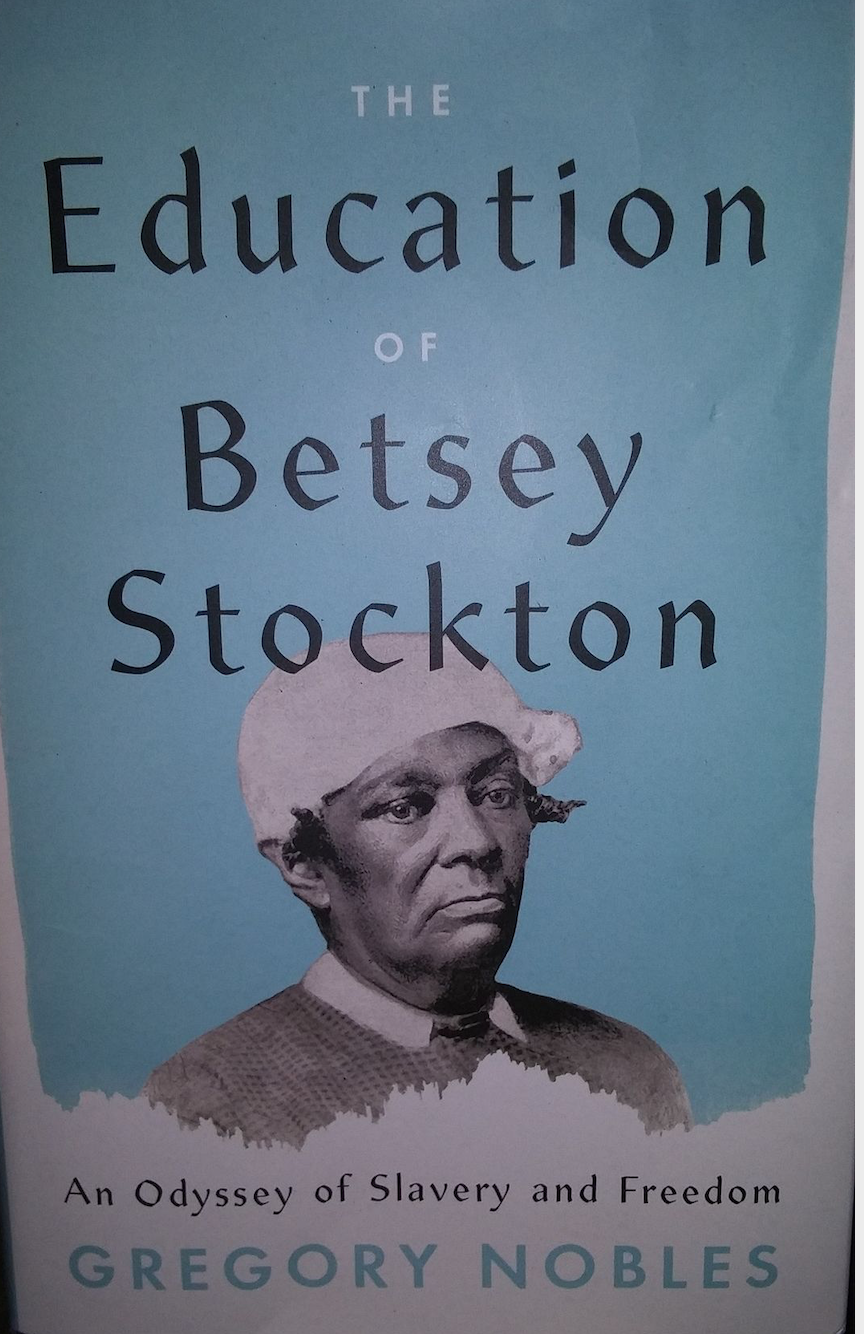
Book Review: THE EDUCATION OF BETSEY STOCKTON: AN ODYSSEY OF SLAVERY AND FREEDOM


As was true of his biography of John James Audubon, Gregory Nobles, in his new book, The Education of Betsey Stockton: An Odyssey of Slavery and Freedom, gives readers broad and deep insights into the time period of his subject and those parts of the United States in which she lived and worked. In a way, this approach was more necessary in writing of Stockton than of Audubon, since information about Stockton's life and work is fragmentary, and most of what survives was written by other people, but what it means for a reader is that we have a chance to be fully immersed in events and beliefs of our own American past while the author pieces together, like a quilt, the life of a specific historical human being.  


Nobles as historian specializes in 19th-century America. In going beyond the life of his subject, his earlier biography of Audubon explored in detail the business practices and economics of that time, what it took to be considered a serious artist then, and the state of American art and science with relation to England and the European continent, as all these larger issues bore directly on the life of Audubon, who lived from 1785 to 1851. 


Betsy Stockton, born into slavery, lived from around 1800 (exact date not known) to 1865. Given the color of her skin and the circumstances of her birth (the identity of her father can only be speculated), as well as her foreign missionary experience, long career as a teacher, and the fact that she lived through the Civil War and President Abraham Lincoln’s assassination, larger national issues explored in relation to her life are slavery, racism, public education, 19th-century American politics, and the Civil War, along with the missionary movement of the time and the role of the town of Princeton, the College of New Jersey (now Princeton University), and Princeton Theological Seminary in spearheading and shaping that movement for the Presbyterian church.


Since Stockton's unedited manuscript journal either did not survive her or has not yet come to light, only the published installments of her journal as edited by the Reverend Ashbel Green are available to account for her missionary travel to Hawaii in 1824-25, and while Green assured readers of the Christian Advocate that he made “very few corrections” to the letters before publication, there is no way of knowing to what extent he may have altered her original writing. Sadly, not many of her letters to Charles Samuel Stewart survive, either. But Nobles has brought together what scattered pieces of documentary evidence do exist, as well as the well-established basic facts of her life.


Stockton had been “given,” as an enslaved child, to Green’s wife, and it was Green himself, years later (Stockton was emancipated as an adolescent and afterward worked for wages in the household), who wrote a letter of recommendation for Stockton to Stewart. The latter was forming up a foreign mission to what were then known as the Sandwich Islands, and thus it was, author Nobles tells us, that Betsey Stockton was


…the first Black person, the first former enslaved person, the first single woman to serve as a missionary in Hawai‘i, and the first missionary to start an infant school for Black children in Philadelphia, the first name on the list of Black people leaving the main Presbyterian Church in Princeton to form a separate congregation, the first teacher in the only school for Black school in Princeton. Betsey Stockton lived a life of firsts, all of them in service to people of color. 


Racism endemic to 19th-century, pre-Civil War Princeton, both the town and the college, should not be surprising but reads as shocking nonetheless. Black men defending their own wives from harassment were set upon by groups of rowdy white students, and Black parishioners of the Princeton Presbyterian Church were denied even their traditional separate gallery seating when a new building was constructed after the old church burned, as “the white Presbyterians pressed for separation,” and Black members were “dismissed” from membership. It was at that point in history that the First Presbyterian Church of Colour of Princeton was formed. 


The College of New Jersey, with a high percentage of students from the South, attempted to remain “neutral” on the questions of slavery and secession right up to the Confederate attack on Fort Sumter, when


…several students climbed to the top of Nassau Hall to hoist an American flag, shout out some rooftop speeches, and fire a few old muskets as a show of support for the national government. This display was also an act of defiance toward the faculty, and particularly President John Maclean, Jr., who had sought to remain officially on the fence in the run-up to the rebellion. …His sympathy for southern boys led him to order the flag taken down, so as not to offend anyone who might see it as an institutional political statement. But in the context of open conflict, Maclean’s moderation had lost traction among northern students, and the flag went back up – and stayed there.


To read that the president of Princeton feared the American flag might offend some of his students and ordered it taken down astounded me. Those most likely to be offended would have been the Copperheads.  (I would say that the Princeton & Slavery Project, so recently begun, is both long overdue and a good start.) And to think there are people in our country today who consider themselves patriots and fly the Confederate flag without fear of causing offense! Or perhaps they hope to offend? But let me not get sidetracked....


Throughout The Education of Betsey Stockton, the main subject herself never appears fully in sharp focus and technicolor, but that is not the fault of the author. Nobles could have written a novel and invented a character and put words in her mouth but chose not to do so, determined instead to hunt out “traces” of the real human being wherever he could find them. The Betsey Stockton who emerges from his research, though there is only a single photograph to give us some idea of her appearance, was a woman who “knew her own mind,” was “‘deliberate and dignified,” “certainly not weak willed,” someone who educated herself throughout her life and was respected by all who knew her. Given her intelligence, her sense of calling, and the racist environment in which she lived, it is hardly surprising that throughout her life Stockton knew occasional “low spirits.” In the end, however, more important than her spells of depression or discouraging events was her strength to go on doing good work, teaching children who might well never have had an education without her efforts.


Learning about one of the many “ordinary people doing extraordinary work” behind the grand stage of historical events is sufficient reason to read this book; another,  however, is to examine in a different time period the racism that is such a deep stain on our country’s history and a painful legacy continuing in our own day. Political divisions, too, are nothing new to the never fully united United States, as this story shows so clearly, so in learning about Betsey Stockton’s life and work and the times she lived through we have yet another lens through which to examine our past – and we can never have too many of those.


Greg Nobles will give a presentation at the summer library series on Tuesday, July 19.


The Education of Betsey Stockton: An Odyssey of Slavery and Freedom

by Gregory Nobles

University of Chicago Press

Hardcover, 292pp with notes and index

$25


Read since last listing:


56. Rumi, trans. by Kabir Helminski & Ahmad Rezwani. Love’s Ripening: Rumi on the Heart’s Journey (poetry)

57. Bowen, Rhys. The Venice Sketchbook (fiction)

58. Ashenburg, Katherine. The Mourner’s Dance: What We Do When People Die (nonfiction)

59. Davenport-Hines, Richard. Proust at the Majestic: The Last Days of the Author Whose Book Changed Paris (nonfiction) 

60. Buzzelli, Elizabeth Kane. She Stopped for Death (fiction)

61. McMorris, Kristina. The Ways We Hide (fiction)

62. Nobles, Gregory. The Education of Betsey Stockton: An Odyssey of Slavery and Freedom (nonfiction)


Monday, December 10, 2018

Reading Other People’s Lives

Playing in the snow with the first dog of my life
As years go by, more and more older browsers in my bookshop tell me they love reading biographies. Is it more true of women than men? Maybe so, and probably more men read straight history than women. Across the gender gap, however, it seems that many of us, as we get up in years, turn increasing to nonfiction. 

In girlhood, I read nonfiction very sparingly. I found most history and biography written for young people too much like school lessons. What I looked for when reading for pleasure (which I did voraciously) was to be transported to other worlds, to be able to slip out of my own skin and away from my family and to live vicariously a very different life. Peter Pan, Alice in Wonderland, The Borrowers — early on, fantasy worked for me better than true-facts kinds of books.

My break-through, the first nonfiction story that succeeded in unlocking another real person’s life was — and the simple title emphasizes my point — The Story of My Life, by Helen Keller. Another girl-child, but with such a different beginning! Almost unimaginable obstacles between that young girl and the larger world! Her curiosity, her frustrations, her hunger, and the unfolding of the world around her, as she explored and discovered it, held my young inquisitive reading self in thrall. Later would come The Diary of Anne Frank, which I read at about the age she had been when writing it. 

The magic of a story well told and of a reader entering into that story is that we readers do take on, vicariously, the experiences of a character or narrator while we read. We leave ourselves behind, in one sense. — In another, of course, we remain ourselves and can only “have” the other’s experiences in translation, as interpreted by our own more familiar experiences, experience remaining, always, a subjective, first-person phenomenon, which is why I used those scare quotes around “have” earlier in this sentence. But really, what is it like to be someone else? Don't we all wish we knew?

And so, autobiography and memoir stand out for me against the more objective biographies written by someone other than the person who lived the life that is the subject of the book. The best biographies, of necessity, must be filled with speculation. Even if the subject told the story to the writer, another layer of translation has be added between subject and reader. Writers of memoir and autobiography are translating their lives for us, too — that I admit. Whether years afterward or in daily writing sessions as life is being lived, what is written is a matter of perspective, selection of facts to be reported, varying emphases, and interpretation of the world (including other people) that formed the environment for that life. Die lebenswelt, phenomenologists call it. But I feel closer when the subject is the writer.

And here my own bias deepens: I am generally more interested in writers’ accounts of childhood than in their stories of later life. Alfred Kazin’s A Walker in the City moves me much more than his later New York Jew, and Simone de Beauvoir’s Memoirs of a Dutiful Daughter has for me an immediacy I don’t find in her later autobiographical books. I could go on and on listing examples, but the question is, why would it be? Why do I prefer — and find more interesting — the stories of childhood?

When famous people write autobiographies or memoirs, accounts of their later lives tend to be filled with other famous people, and too often whole pages come across, for me, as tedious name-dropping. Well, aren’t those other people interesting (even fascinating!), also? Perhaps so, but often the mention of them and their intrusion into the story gets in the way of the reading experience I want to be having. 

Here we might digress to ask the question I already set up above: What is interesting? Who is interesting? 

Well, whatever you take an interest in is, for that very reason, interesting to you. Just so, what I take an interest in is interesting to me. So as I see it, being “interesting” is not a quality of an object or a body of knowledge or any particular field of inquiry or individual human beings.  Some people have more obviously exciting lives than others, but what makes the story of a life interesting is not the plot line but how the story is told — and, for me, how much room the memoirist manages to make for me, the reader, to get inside his or her experience. 

I’ve never pushed my inquiry further until this morning, but now what I’m thinking is that “how I saw and discovered the world” is the story of every childhood, and for me that story is subject to as many variations as there are human beings in the world, so it can never not interest me, while the story of famous adulthoods, on the other hand, tends more toward “how the world saw me,” a very kettle of literary fish. The childhood story lets me, the reader, inside the writer’s life — we see the world together — while the adult story keeps me at a distance (“Look at me!”), relegating me to spectator status. 

Spectator. Audience. There are occasions when that position is both necessary sufficient. Reading history that covers decades or centuries, a reader necessarily views the pageant from a distance. The Frontier in American History does not invite me into any particular individual’s life experience but captivates by its broad sweep and by the development of an argument that engages me as I read. I do not slip into that writer’s experience. That is not the point at all. Instead my relationship is with the writer, not exactly as a partner in conversation, because he is the one onstage, giving a lecture, but I can question and disagree in my mind, as one may press a speaker after a talk in Q&A. If, however, I were reading the story of the author’s life, the life of Frederick Jackson Turner, as told by himself, I suspect I would find my interest lessening as he neared the ripe old age of 30. Just so, when reading Alfred Kazin on literature or Simone de Beauvoir on philosophy, I do not expect to inhabit their skins and lives, only their minds! And that only in a limited sense. But when they are writing of their own lives, I feel closest to them when they were discovering the world rather than being concerned with their own places in it.

As readers, we all have idiosyncratic biases that influence how certain books attract us and hold us through numerous re-readings and how others put us to sleep. What are yours?


Tuesday, August 25, 2015

Not Too Late to Read the Book -- Either One


Two days after finishing my reading of Uncle Tom’s Cabin for our August reading group discussion, it was my privilege and pleasure to meet (in my very own bookstore, no less) Joan D. Hedrick, the Pulitzer-winning biographer of Harriet Beecher Stowe: A Life. Here is an interview with Hedrick on Stowe from the Library of America that provides a short introduction to the iconic American writer’s life and work.

My conversations with Joan, following my evening bookstore event featuring Barbara Stark-Nemon, left me eager to read the biography, and I finished it this morning, having devoured the story morning and night, compelled from the first page.
In the northwestern corner of Connecticut the roads rise gradually through heavily forested hills toward the town of Litchfield, Harriet Beecher Stowe’s birthplace. Like much of her writing, Litchfield bears the strong stamp of geography and local culture. This is emphatically a New England town.
I’m hooked. I appreciate a “strong stamp of geography and local culture.”

But no, I should be more honest. I was hooked before I even got the book, by Joan’s telling me (and this is a strong thesis running through the biography) that it was largely owing to the rise of American literary critics like Henry James – actually, pretty specifically Henry James – that Uncle Tom’s Cabin was demoted to something less than literature, making it now one of the least-read of famous American novels. Everyone knows the title, some characters' names ("Uncle Tom" in a stereotype that hardly begins to do justice to his character in the book), and a few scraps of the story, but it’s presumed to be “old-fashioned," rather than a classic novel. Joan asked me how our reading group happened to choose Stowe’s book to read. Well, one person suggested it, and we all agreed.

And so, owing to a fortuitous coincidence, I moved quickly from the novel to the biography.

In the New England and the West (i.e., Ohio) of Stowe’s young womanhood, writing had not yet become professionalized but was practiced by both men and women, often as what Hedrick calls “parlor literature,” read aloud to groups gathered in the parlor, groups not yet separated by gender as they would be in the later Victorian age. This was an important formative element in the making of Harriet Beecher Stowe the writer.

Stowe’s years in Cincinnati, on the Ohio side of the river dividing a free from a slave state, gave her an orchestra seat on the fugitive slave issue, and passage of the Fugitive Slave Law in 1850, signed into law by President Millard Fillmore, tipped her once and for all into the antislavery camp. The death of her beloved Charley, perhaps the most dearly loved of her seven children, was a profound grief, inspiring Stowe’s descriptions of a slave mother like Eliza threatened with the loss of her child.

Uncle Tom’s Cabin, published in March of 1852, “sold 10,000 copies within the first week and 300,000 by the end of the first year.” Hedrick quotes from a review in the London Times, later reprinted in the New York Daily Times, that the $10,000 the author received in the first three months of sales was
...the largest sum of money ever received by any author, either American or European, from the sale of a single work in so short a period of time.
One of Stowe’s gifts as a writer, Hedrick says, was her ability to address readers in an intimate voice. Another was her ability to introduce characters with distinctive regional voices of their own. Subsequent developments in American literature, however, made of professional writers’ clubs an entirely male affair, and reviews by Henry James in the Nation took a “professional approach to book reviewing” went several steps further: Books, to be considered literature, or art, now had to abjure anything the critic might label sentimentality, earnestness, and moralism. Strangely, for someone priding himself on “objectivity,” James apparently found it possible to pass judgment on a book, if written by a woman, without reading it: “It was a woman’s book and he knew the type,” Hedrick comments dryly.

As the mother of seven living children who also suffered numerous miscarriages, and as a daughter and sister often drawn into family schemes for setting up schools, it is amazing that Harriet Beecher Stowe managed to write Uncle Tom’s Cabin at all, let alone other books and numerous published articles and private letters. She did, of course, have servants. And, crucially, her husband and children depended on her income to keep the household out of debt.

In her later work, Hedrick notes that Stowe had recourse to a male narrator’s voice, losing in the process her own natural advantages as a writer. She was also prone to rushing into print without taking the time to revise and rewrite that even her husband counseled her would help her work. So it is likely that the obscurity of Stowe’s other novels today (“Did she write anything else?” is a frequent question when one mentions her or UTC) is an accurate measure of their worth. But the same cannot be said of Uncle Tom’s Cabin.

Yes, parts of Uncle Tom’s Cabin reflect the author’s prejudices, but the same might be said of the majority of novelists who hide their bias in the voice of an omniscient narrator. And yes, the author makes religious appeals to the reader. But how does either of these features of her writing affect a reader’s sense of her characters as living, breathing human beings? Can anyone read this novel and not be caught up in the characters’ lives, their hopes and joys and fears and sorrows?

Hedrick neither romanticizes her subject nor tears an idol to shreds. She does not oversimplify the personality of Stowe or her culture and time. What emerges from this history of Harriet Beecher Stowe is the complicated portrait of a complex woman, determined to exercise her gifts but often blown off-course by the winds of personal conflict, social fads, finances, criticism (whether deserved or otherwise), and, as is true of almost all of us, contradictions within her own character.

If you read the novel first, you will want to read the biography, of which I barely began to scratch the surface in this post. If you begin with the biography, on the other hand, you will quickly reach for the novel. 

Don't forget: this Thursday our guest at Dog Ears Books will be Luisa Lang Owen, reading from Casualty of War: A Childhood Remembered. We will convene at 7 p.m. in David Grath's gallery, but enter please through the bookstore.


Saturday, June 21, 2014

In Which I Meet a Family of Long, Long Ago


Silas Durand, the eleventh of fourteen children, was born in Herrick Township, Bradford County, Pennsylvania, on June 5, 1833. He began teaching at age 18 and then went on to read law in Wilkes-Barre, PA, thinking to make the law his career, but after being “received” into the fellowship of the Old School Baptist Church of Middletown and Wallkill in 1864 his sense of calling grew so rapidly that by December of that year he was ordained a preacher. After traveling for three years as an evangelist, he settled down to a succession of churches, wrote sermons, published a book with his sister, edited a hymnal, and died in 1919. All of this information and more can be found online, where the brief sketch of his life closes with the following words:
Elder Durand was a lovely man, an able preacher, fluent writer and bold defender of salvation by grace. He was a highly esteemed gift to his church, and his labor of love and devotion to the cause of truth was appreciated by his brethren.
The story of his early years told by himself can also be found online but with one serious error: in it the date of his birth is given as 1855 rather than 1833. But I have to be somewhat sympathetic to the person transcribing Silas Durand’s work for online publication, however, because the numeral ‘3’ was written very differently in the nineteenth century and gives me trouble myself at times.

In “Early Life of Silas Durand,” the writer tells us that the ancestor of his family in America was John Durand, who came over from France in 1685 to escape the persecution of the Huguenots pursuant to the revocation of the Edict of NantesThis interests me because the Hudson River School painter, Asher Brown Durand, claimed the same founding ancestor in America.

But what do I care at all about this family? I am not related to them in any fashion, nor do I personally know anyone who is.

Diary of Silas Durand
You will not be surprised to learn that it all began with a book, but in this case it was a particular kind of book, and, within its kind, unique. It is, you see, a handwritten diary, and the diarist was none other than Silas Durand, beginning his journal in 1853. During the years he kept this journal, he taught school and then went to H. P. Wright’s office in Wilkes-Barre to read law. I am reading my way slowly through the diary, learning to distinguish ‘3’ from ‘5’ and to recognize the double-s (as in ‘passenger’), which was also written very differently in the 1850s from the way we are used to seeing it now, and other handwriting puzzles. The last entry of the diary is Christmas, 1858, but I’m not going to cheat and read that far ahead yet. I’ll get to it in time. I look forward to an hour or so in the evening with Silas.

The youthful, idealistic Silas joined a debating society and took up writing and giving speeches. He seemed surprised at himself for doing it, but it must have been good preparation for his later career as a preacher. He had an active social life, too. Much of it involved going to hear preaching (he visited churches of various denominations to hear noted preachers of the time), along with political lectures, but there were also dinners and sleigh rides, and even an excursion to an “ice cream saloon.” And there were mentions of young ladies, too, mostly Miss This and Miss That, but a few named by their first names only. One “Cassie,” in particular, came in for high praise, and I can’t help wondering (despite a Miss Andrews he liked and others who figure in his sketchy journal entries) if Clarice E. Pusey, whom he eventually married, was the wondrous “Cassie”! On Saturday, the 30th of October, 1858, the brief diary entry reads:
Bought a coat for nine dollars, to be paid in 4 weeks. Also pair of drawers for $1.25. In the evening I went over to Mr. Church’s. Cassie was there and Miss Munson. Cassie is one of the best girls I know and I am almost in love with her.
Oh, I do hope Cassie was Clarice! “Why?” David asked. “They’re all dead now.” “Really? Do you think they are?” They don’t feel dead to me.

sample diary page, partly pencil, partly ink

In his diary, Silas often mentions receiving letters from his brother James, who was in a law office in New Orleans at this time, and tucked into the diary I found a letter from James to Silas, along with another from James to their younger sister, Rosina. I read the letters aloud to David, and they held his interest. “That’s 160 years ago!” he exclaimed. The style was somewhat old-fashioned but very lively, not stuffy at all, and it was almost as if the letters had arrived in yesterday’s mail.

Silas began his journal entries at one end of the little book, and he flipped it over to record daily expenses beginning at the other end. Thus I know that he paid twenty-five cents for the blank, lined book. It’s held up remarkably well. I only wish he had written always with a pen and not, as he frequently did, sometimes with a very soft pencil.

He struggled at times with depression, this teacher turned lawyer turned preacher of the mid-to late 19th century, and other times experienced what sounds like elation. In fact, he wrote often of what he was feeling from one day to the next. Here is one descriptive entry:
I haven’t any very clearly defined feelings today. The outward world looks somewhat dreary – and as for the inner world – there are times when a veil seems thrown over every bright prospect, a general veil like the gloom of a November sky – and this is such a time.
He says following these sentences that he “doesn’t feel bad,” so this particular day was not one of the gloomiest, but not “fine” or (his word for the best days) “glorious,” either. On the “glorious” days, his enthusiasm knew no bounds. It must have been in reply to a letter written from a “glorious” mood that James cautioned Silas very directly:
If you are crazy, tell me so – if you are in love tell me so – and if you are both (which I fear is the case, for the two diseases generally go together) tell me so. – Oh, Miss Jenny! Miss Jenny! Thou art the syren whose enchanting spells have nearly put at nought the man of philosophy, as the Syrens of old nearly decoyed Ulysses on his return to Ithica, and would have done it, if they had been permitted by the gods! 
 ...I meet with those every day whom I might “make love to” with all the pleasure in the world. I meet with those who are full of “spiritual influences” and who imbue one with “electrical sympathies.” But I look ahead, and in the mist I see shadowy forms of little flaxen headed urchins, munching bread and butter, and I cannot discover the “great loaf and the cow.” I see the outline of a beautiful figure, and the features of a pleasant face, but I cannot see the hearth, the parlor, the generous table. Call me “calculating” if you please. I am calculating, and I calculate to have the wherewithal to procure me a “cottage in this wilderness” before I take any gentle creature from the comforts of a father’s house to share life with me.
Closing signature, James to Silas
It’s clear the two brothers were on intimate and confiding terms and that James took his role of older brother very seriously, even if the last line in his letter to Rosina did say, when Silas was visiting him in New Orleans, “I am going out with Silas to see three very interesting young ladies tonight.” Safety in numbers, perhaps?

The diary and letters and what information I could find online inspired me to order a couple more books. The first is an account of Asher B. Durand’s life and work, written by his son, another John Durand, who died in Paris in 1908. Almost as fascinating as the account of his father’s life is John Durand’s description of the little New Jersey country community into which Asher was born.
The house in which my father was born was built midway up the mountain; below it, on the opposite side of the road, came the barn, an apple orchard, cherry and other fruit trees, corn and wheat fields, meadow land, and a stretch of woods beyond.; behind it were the sheds covering the oven and wash-house. The woods reached to the top of the mountain, where the eye ranged over a vast expanse of lowland, consisting of nearly unbroken forest; a spire on the horizon beyond a blue expanse of water indicated the site of New York City. - John Durand, The Life and Times of Asher B. Durand. Hensonville, NY: Black Dome, 2007; orig. pub. By Charles Scribner’s Sons, 1894.
As interesting to me as the geographic description is the way the artist’s son described American society of his father’s childhood era.
American villages in colonial times resembled each other in one particular – every man was obliged to get his living according to his aptitudes; the chief end of man in all was to ensure the welfare of himself and family to the best of his ability or opportunity. Nobody profited by inherited capital or superior rank; if anybody possessed money enough to buy the land he cultivated – he was comparatively rich, and that was all; but he had to labour like the rest, and derive his support, as well as added wealth, mainly from the crops he raised.
This was the agrarian society beloved of Thomas Jefferson, an 18th-century ideal that seems to have persisted in our country through much of the 19th century. No wide extremes of income inequality in those days, according to John Durand.

Since Asher Brown Durand was a descendant of the first John Durand in America, as were James B., Silas, Rosina, Bessie, and the rest of that sibship, there must be a cousin relationship of some kind between the two branches of the family. I am not rabid on the genealogy aspects, however; I’m simply pressing my nose up against the windows into the past. David says I have become as obsessed with the Durands as Sarah is with chipmunks.

Sarah's latest obsession
Asher, the artist, was apprenticed to an engraver and did so well that by age 26 he was commissioned to copy a painting of a group of patriots from the signing of the Declaration of Independence. It was through engraving, and only through engraving, that copies -- prints -- of paintings could be copied and made available in the early United States. Engraving was also, at that time, the only branch of art that provided a livelihood for American artists.

Silas was keeping the diary I have before the Civil War, his brother James was living in New Orleans, and Silas visited him there at least once, but there are no rumblings of approaching war in the diary. Neither are there any abolitionist sentiments expressed by the preacher-to-be, who doesn’t even mention slavery in the daily record of his thoughts and feelings. They must have spoken of these things, and one wonders what their thoughts and feelings were on the subject.

James to Rosina
The Durand women are even more elusive, though Silas wrote affectionately in his diary of both Rosina and Bessie, and James wrote charmingly to his sister Rosina. Here is a passage from a letter James wrote to Rosina on May 30, 1856, from New Orleans:
I have fitted you out with a Papier Maché Desk with every thing necessary to carry on your correspondence, and I think you will discover the hint which I wish to convey by such a present. You will find in it all kinds of letter and note paper and envelopes, besides transparent wafers [?], sealing wax, a box of pens, pencils, paper knife, visiting cards etc. I want it particularly understood that the small sheets are not intended for you to write to me on. I have put into the desk plenty of such paper as this one sheet of which I expect to see again almost every week. You must not let Silas have it for his ordinary writing speeches etc. Foolscap is good enough for such purposes. You will also find postage stamps for the use of you and Bessie. Besides the desk I send you a light silk dress, which I hope will please you.
When the second book I have ordered arrives, I may be able to share more information about Bessie Durand, another sister. For now I have many diary pages yet to decipher. Ah, yes, I am as intrigued by the Durands as Sarah is by chipmunks, and the obsession is already taking me on many interesting pathways into American history. Who knows where it will lead me next?


Tuesday, June 3, 2014

Life in My Book-Lined World


The Adams Family

Any reading life is marked from time to time by unexpected coincidence. I have been reading The Adams Family, by James Truslow Adams (no relation to the others, he says), published in 1930. The book deals with four generations: John Adams, b. 1740, one of America’s Founding Fathers and second President of the United States; his son, John Quincy Adams, b. 1768, our sixth president; JQ's son, Charles Francis Adams, b. 1886, U.S. Minister to England under Lincoln; and finally Henry Adams, who, unlike the three generations before him, never really seemed to “find himself” but who did write The Education of Henry Adams, not at all the book one might expect from its dry title and deserving of its place on Modern Library’s Top 100 books list. 

The descriptions of the first two generations of Adamses (I’m almost more than halfway through the JTA book), both as they describe themselves and as the author and others describe them, are frank and occasionally startling. John was generally seen as jealous and vain, mistrustful to the point of near-paranoia. John Quincy, a skilled diplomat (a quality that did not come down to him from his father), was nevertheless cold, overbearing and harsh. But as much as the personalities of John and John Quincy, I have been fascinated by the picture of American politics during the Revolutionary Period and the first decades of the new country.

Well, now (this is the coincidence) I pick up the current New York Review of Books (June 5, 2014) and find reviewed three new books on the Adams family, one on John Quincy and two focused on his wife, the first a biography, the second her own writings. The last of the three I will definitely have to read!

Not the Book I Expected

Impatiently as I awaited Men Explain Things to Me, by Rebecca Solnit, I admit that I anticipated a funnier book. The first, the title essay, is as funny entertaining now as when I read it online (and David laughed aloud when I read it to him), but the second chapter essay is all about violence against women, worldwide, from rape to murder. Very serious, very well done – not what I’d expected at all, but I couldn’t put the book down without reading it cover to cover. The essay (the chapters are essays, written at different times and collected in this book for the first time) on Virginia Woolf was particularly insightful, lovely and haunting. And “Grandmother Spider”! Well, you know I would be taken by the image of hanging laundry on the line:

To spin the web and not be caught in it, to create the world, to create your own life, to rule your own fate, to name the grandmothers as well as the fathers, to draw nets and not just straight lines, to be a maker as well as a cleaner, to be able to sing and not be silenced, to take down the veil and appear: all these are the banners on the laundry line I hang out.

So now I am recommending Men Explain Things to Me and looking forward to reading other books by Rebecca Solnit.

Notes and Reminders

As for Ice Caves of Leelanau, I should note here that every copy I have on hand is spoken for (I won’t have more until July) and I’m not taking any more names for reservations (for fear of having more reservations than books and because I really need to have a few books available for people who walk in the door asking for them), but I have many other wonderful, beautiful, fascinating books worth attention and deserving homes! An entire bookstore full of them!

Also, please don’t forget that Dog Ears will be celebrating its 21st birthday three weeks early (so as not to conflict with the 4th of July), on Friday, June 13, with readings by eleven poets from the beautiful new Poetry in Michigan/Michigan in Poetry book from New Issues Poetry & Prose in Kalamazoo. Michigan art and poetry in gorgeous anthology published in Michigan – this one is a lifetime keeper, for sure.

Confession (or Resolution, or Warning)

I am carrying out a plan this season to be more selfish. As a child, I was tagged the "selfish one" of the three (I was also the oldest), but in my adult struggle to overcome that quality, I sometimes feel I've gone too far. My business -- and you know I love my bookshop! -- doesn't give me much time off in the summer, and summer (the Up North reward for surviving winter) is also the time when social engagements and yard chores also kick into high gear. So I'm taking a stand: no more summer meetings for me. I have to draw a line somewhere, and that's where I'm drawing it. No more meetings! It's more important for me to set aside time to draw something besides lines....