Search This Blog

Showing posts with label economy. Show all posts

Wednesday, November 7, 2018

How Are Things in Stinking Creek?

Northport Creek does NOT stink!
Election Day — both long anticipated and long dreaded. It will be so good to have the landscape cleared of campaign signs, won’t it? However things turn out, we have all (I trust!) done our civic duty. Not that it’s “over,” by any means. The work goes on. But at least we can put this decisive aspect of it behind us for a while. 

Both the day before and the day of voting, I did what I had to do but also found time to immers myself in other worlds, that of Thomas Mann’s The Magic Mountain, seeking some organization for themes and corresponding page numbers before our reading circle gets together on Wednesday, and also re-reading a little sociological treatise (from back when sociology was qualitative, i.e., interesting, rather than quantitative, i.e., boring), namely, Stinking Creek: The Portrait of a Small Mountain Community in Appalachia, by John Fetterman. Stinking Creek the book (the place is in Kentucky, and it’s a real place) was first published in 1970, the author having copyrighted it in 1967, so descriptions of people and place are outdated, but you know I am hardly averse to slipping the bonds of time, especially in times of mental crisis (see first paragraph of this post).
There were several things I noted in the Appalachia of the 1960s. People had lost jobs in the coal mine already back then — not because coal wasn’t being mined. The locals hadn’t lost their jobs to immigrants providing cheaper labor or to newer alternative energy sources, either. No, it was machinery doing the work previously done by men. Bulldozers, power shovels, augers. “Automation has made the miner jobless.” Lumbering jobs were nearly nonexistent by the 1960s, too, because good timber had all been removed. Living off the land was no longer possible, either, as creeks in which fish had formerly been plentiful were now so polluted by acid from old coal mines that even traditional baptizing holes had been abandoned. With trees gone and soil washing away comes also flooding — yet another hardship for those at the bottom of life’s heap.
To reach the coal seams now, a bulldozer strips the earth from the seam…. Power shovels scoop up the coal that lies exposed. Augers … bore into the mountain to bring out the remainder of the seam….
The resulting tons of waste — earth, slate, and slag — are hurled over the mountainside in an orgy of monstrous ruin. 
Sulfur, associated with coal-bearing formations, enters the streams, and a solution of sulfuric acid results. This silt washes down the mountainsides to fill the stream beds, and during heavy rains the valleys act as huge funnels, hurling the unchecked waters along to inundate town after town.

Timber, fish, game gone, along with mining jobs and logging jobs — their homes periodically flooded out — nothing was as good as it had been for the earliest settlers. “‘There ain’t even a crawdad around here,’ an old-timer observed.” There were jobs in Cincinnati, Chicago, and Detroit, but who wanted to leave the freedom and quiet of the mountains for noisy, expensive, hemmed-in city life? Stinking Creek folk much preferred to stay where they were, if they possibly could.


Distrustful of the “govmint” as most of them were, those disabled by accident or illness were happy to “draw” welfare checks and receive free “commodities” — and let’s remember that those free commodities were as much subsidies to overproducing farmers as they were benefit to the hungry poor, something people who rail against “handouts” often forget — while the chance of “project work” gave hope to young men, hope that they could stay on the mountain and get paying work, rather than having either to leave home or stay and “draw” [welfare checks]. 

Farming had never been a path to prosperity in this hard, rocky country of thin, poor soil, but in the 1960s most families still had their own garden plots and raised corn, beans, tomatoes and such for their families, while those who could afford to keep a cow had fresh milk. The boys hanging out at Ellis Messner’s store drank much more “pop” than a dietician would recommend, and boys and girls both took to chewing tobacco at a young age. There was, however, no “opioid crisis” back then. Church attendance might not be regular among all residents of the various hollows, but religion had a hold on many, nonetheless, and even adolescents who quit school before the eighth grade showed respect for their elders, Fetterman observed. Although there was almost nothing in the way of recreation for young people, Fetterman says this of the community where he spent time getting to know the inhabitants one by one and family by family:
On Stinking Creek there are no muggings, robberies, stabbings, rapes. Yet every boy carries a pocket knife — not as a weapon, but as a symbol of responsible manhood. On Stinking Creek you can leave your car unlocked with its load of cameras, typewriter, and personal belongings without fear. Where else can you do this?
This is certainly not the Appalachia one encounters in recent books. It was poor then, too, most families living in two rooms, the young not all that optimistic, and yet —?

What makes the difference between then and now? Not unemployment, my liberal friends, because jobs had already been long lost. Nor welfare, my conservative friends, because they already had that, too. Intrusion from the outside world, however, was still minimal: Television sets were just reaching Stinking Creek but were not in every home, and the one fuzzy channel pulled in would not have brought anything like the mayhem available on cable today. Moonshine could be a tempting danger, but it wasn’t cheap, and international pharmaceutical companies had not yet realized what a lucrative, captive market the poor could be. Degraded popular culture and aggressive marketing? You tell me. 

Thinking now of the dusty road in front of my grandmother’s little house outside Springfield, Ohio — barefoot children, lack of indoor plumbing, but neighborly, with plenty of room and freedom for those barefoot children at play — I realize my grandmother’s neighborhood was a suburban version of Stinking Creek. Some of her neighbors might even have come from those very Kentucky hollows. There was a kind of dignity to poverty in those times, in those places. If such exists yet today, it must be where the poor are fortunate enough not to be victims of addiction or famine or war.

One final note from Stinking Creek in the Sixties, relevant this week when Americans are going to the polls once again: Though many were illiterate and almost no one trusted politicians, residents of Stinking Creek were still eager to vote. On the fourth Tuesday in May, the author tells us, there was no school, because the school building served that day as the polling place for the Sixth Precinct.
The crowds came early. They stood on a rocky point up on the road and looked solemnly down at the ancient school; they gathered in knots in the few shady places down by the creek and stared up at the school…
Democrats and Republicans alike were determined that the fiasco of four years ago would not be repeated. In that earlier election, Democrats were elected, then unseated after a court battle. It all came about over a Kentucky law that decrees that voters who cannot read and who require assistance to flip the levers of the voting machine must sign an oath that “by inability to read English … he is unable to vote without assistance.”
In that election four years before, half of all Stinking Creek voters had been assisted, and 68 of them had “signed” the oath only with an X. And because their precinct could turn the entire county one way or another, on this fateful Tuesday evryone is watching Stinking Creek. And Stinking Creek people knew they were being watched.
Voter after voter cautiously approached the door, as though fully expecting to be turned away. Every eye was on that door, and each voter came out into the blazing glare of the sun and the more penetrating glare of his fellow citizens. And each voter shielded his own reactions from this intense scrutiny with an expressionless mask he draws over his face at such times.  

The linking of the ability to read and the right to vote is an annoyance of great proportion to the people of Stinking Creek. The ability to read has little to do with a man’s ability to fell a tree, move a stone, or decide whom he wants to dabble in the public funds as his duly elected servant.

Over the past year, 2018, gerrymandering (on the ballot in Michigan) and accusations of voter suppression have been big topics across the United States. What faith even those skeptical, suspicious Appalachian voters had to have to get out and cast their votes! For most of us today it is so easy! Most, that is, not all, and the attempts to make voting more difficult for whole blocks of Americans is nothing short of shameful. But we keep trying to figure out this democratic process, and God forbid we should ever stop trying!

And now, back to The Magic Mountain I go.


P.S. the day after drafting post: Election results are mostly in by now, and the only thing I’ll say here is that in Leelanau County 65% of eligible voters cast votes in this election. Sadly, 65% is considered a “massive” turnout. Too many Americans are still all too prone to take rights and freedoms for granted or think one person can’t possibly make a difference, when the truth is that every election (leaving out presidential races and the Electoral College) is won and lost by an aggregate of individual votes. So whether your preferred candidates won or lost in this midterm, f you voted yesterday — or earlier — you counted. 


Tuesday, January 27, 2015

Dreamers, Wherever We Go


Peak hidden in clouds


The desert invites meditation or communing with God. It invites visions. Since the same is true of mountains, it is hardly surprising that the Dos Cabezas Mountains and the Chihuahuan Desert set me to dreaming the first day I saw them, long before we reached our ultimate destination, stopped moving, turned off the car ignition, and put our feet down at last on solid ground. Very solid. Rock solid.

Because of the three-day holiday weekend commemorating the life of Martin Luther King, Jr., it was Tuesday before we were able to visit the community library in Willcox and establish ourselves with a temporary borrowing card. While David was signing us up, I went straight to the Arizona shelves and made my first selections from the subsection on nature: The Mountains Next Door, by Janice Emily Bowers; A Field Guide to the Plants of Arizona, by Anne Orth Epple (photography by Lewis E. Epple); and Geology of Arizona, by Dale Nations & Edmund Stump. Already I’d found at the Friend Bookstore an old copy of Cactus, by Laura Adams Armer (illustrations by Sidney Armer).


One of my desert dreams is to make at least a rudimentary beginning at learning the plants of this high, arid region, all the more challenging in January when almost nothing has leaves and absolutely nothing at all is flowering. Most tree guides show me leaves; wildflower guides flowers. That doesn’t help much in the winter desert. I was able to identify prickly pear (pretty easy) before looking in the books. I’m still sorting out varieties of Yucca and other members of the Agave family. For Whipple cholla (which I think should be Whipple’s cholla), a specimen found out back of the cabin, books were necessary. And here below is – ta-da! --the first cactus I have “learned” this winter:


The Bowers book is marvelous for dreaming and learning and finding inspiration. “This is the perfect book!” I exclaimed to David after I’d read only the first few pages. “Another perfect book?” he asked, adding somewhat dubiously, “How many perfect books can there be?” I explained that The Mountains Next Door is the perfect book for me, for where we are, for here and now. (And there’s another wonderful thing about books in general: so many can come to hand at just the right moment and be the “perfect” book for a reader at that time. They don’t have to come by sheer luck, either. We’re allowed to search them out.) The author of The Mountains Next Door is a botanist, and her “mountains next door” are the Rincons east of Tucson, not all that far from “my” (or “our”) mountains, the Dos Cabezas, here in our ghost town backyard. She begins by describing the Olympic Mountains in the Pacific Northwest, which to her, for a long time, were the “Delectable Mountains” of Pilgrim’s Progress. They were “real” mountains, she felt, and because she could only visit them from time to time,
Their remoteness let me romanticize them as I could not romanticize the mountains I saw from my own front yard. 
 ...Because the Rincons have never felt the sculpturing hand of glaciers, they have no looming, snowy peaks, no bowl-shaped tarns, no knife-edge ridges. Dryness is their characteristic. Clouds skim high overhead, untouchable, unknowable. Most days, rainfall is a mere rumor, a phenomenon read of in books.
The Dos Cabezas, like the Rincons, are not magnificent enough to be famous far from home, and if I can romanticize the modest mountains in my winter backyard, no doubt it is because I do not have a lifetime familiarity with them, only a scant few days’ sketchy acquaintance. But the truth is that as soon as our winter plans began to take shape, back in Michigan, the words “high desert” were dream words for me, words I could hardly pronounce without a shiver, and the same was true of the place name Dos Cabezas. How can a ghost town with adobe ruins not invite dreams?


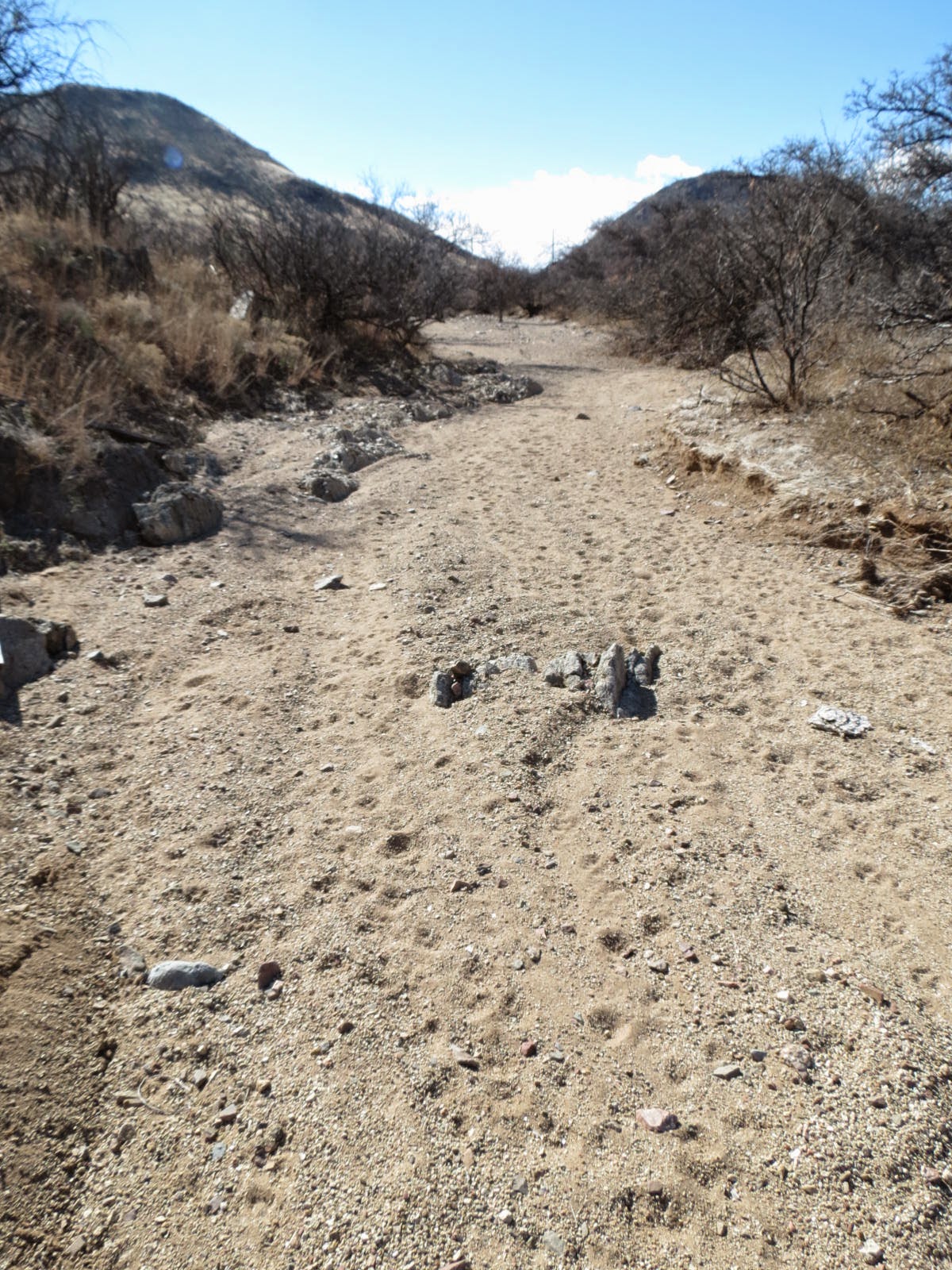
Even streams and rivers in this part of the country are ghostly most of the year. I was amused, at first, to learn that the dry washes have names, but quickly I realized that it is no stranger than our little Leelanau County creeks having names. The difference is that our northern Michigan creeks hold water (or ice) year-round, while here the washes contain only sand and gravel and rocks (and a few plants and birds and lizards and javelina and ranging cattle and such) until the rains come. (If they come.) Then, briefly, the washes are roaring creeks.


It seems, according to my reading of Bowers, that the flowering of desert wildflowers is uncertain in somewhat the way of the cherry orchard bloom in northern Michigan.
To be aware of wildflowers is to be keenly aware of time’s passing. Every January photographer friends in Illinois call to ask whether the desert will bloom this spring. Not being God, I have no absolute knowledge....
If the desert is going to bloom, when will the bloom begin, when will it be at its peak, and when should visitors time their arrival in the desert? We have similar questions at home, with everyone wanting to be on hand for peak cherry bloom, which varies from one year to the next. It’s rare year when we don’t have any blossoms, though. The desert is different. In a year of no rainfall or too little for dormant seeds to germinate (if need be, desert seeds can wait decades for enough rain to assure the continuation of their species), there may be no spring blooming other than cactus (which it seems never disappoints), and in that way the flowering of the desert is more like Michigan snowfall: some years are spectacular and memorable, record years; most are average; while a horrid few are pallid, brown, and muddy.

The natural world and visible traces of history are obvious dream sources, but David and I also dream alternative realities in – and for -- more contemporary urban scenes. Willcox shares the fate of many small towns across the country, that of vacant buildings and boarded-up windows along a stretch that was obviously once the liveliest part of the town. Nowadays an expressway bypasses the town, so most of the heavy traffic is out by the main expressway interchange, where new motels and fast food chain restaurants and gas stations give tourists and travelers a chance to stop for the night and never see the town at all. It’s too bad, I think.


The charming Old Town stretch along Railroad Street houses several businesses, as does a row of sweet little bungalows facing Railroad Street from the other side of the tracks, but even here there are vacancies. Other parts of downtown hold other handsome buildings, some with prospering businesses, others vacant.


Willcox is a friendly town, easy to get around in. I like it a lot. Uncrowded and easy to navigate, on foot or by vehicle, for my sake it doesn’t have to change at all, but since I have had a business for many years in a village that has only recently begun climbing out of a long decline, I can’t help wishing for residents and business people in Willcox a little new development, some new investment. Not too much! Not enough to turn it into a gaudy tourist trap! Just enough to make use of existing buildings and provide a few more jobs.

Chief among vacant buildings (this was true in the bypassed towns on old Route 66, also) are old motels, and one of them in particular set us to dreaming. What would be the best, highest use of this old sweetie? Low-cost studio apartments? Seasonal condos? An artist colony? Retail “picker” businesses, with an open-air flea market in the central courtyard? Assisted living units? Does a place like this ignite dreams in you? What would you do with it?


As for Dos Cabezas, I wish no change whatsoever, no development at all. It’s just fine as a ghost town. Fourteen miles to Willcox for library, post office, and groceries is a fair trade for black velvet night skies and still, quiet days.


Postscript: My book recommendation for this week, in case you couldn’t tell, is The Mountains Next Door, by Janice Emily Bowers, not only for its scientific information and the local interest (for me, here, now), but because it is beautifully written. The second chapter (or essay), “Collections,” reminded me very much of Gaston Bachelard:
We collect in order to possess: Seashells, pine cones, minerals, butterflies.... We can never have enough ...; in fact, the more we have, the more we need. They anchor us, somehow – connect us to the past or fill the empty spaces in our lives.  
We collect in order to prolong the present, as though by saving this particular leopard-spotted cowry we could hang on forever to that day on the beach....  
We collect in order to partake of something larger than ourselves....
As I wander the parched ground around the cabin here in Dos Cabezas, I pick up rocks of all kinds and sizes, dry animal bones, and worn pieces of colored glass, very much in an attempt to feel part of the vast surrounding landscape and to prolong the present moments I am enjoying here. I am reading The Mountains Next Door in the same way that I walk out into the desert – eagerly, greedily and with a deep sense of happiness.


Thursday, June 26, 2014

Time for a Downtown Update

Tucker's of Northport
Let's start as you enter town, making that left turn onto Waukazoo Street. Whoa! What's that enormous new building?

Looking north on Waukazoo Street
Tucker's of Northport is a boutique bowling alley and entertainment center with restaurant and bar, and yes, it's open, with lots of new jobs for local kids. Just to the north there will soon be a new village parking lot (with bike racks, too, I hope and pray). Across from Tucker's (not pictured), the building with the blue awnings is the restaurant now called, as of last year, the Soggy Dollar, with bar and full dinner menu.

Parking lot-to-be
On last year's map, the next commercial building north would have been Motovino, but that great little wine-tasting and gourmet shop has moved over to the Big Store on the opposite corner, the building that also houses Northport Fitness and Lelu Cafe (Lelu now thoroughly remodeled and open again for dinner), and where Motovino used to be you'll find Dorothy Irvine's antique shop. Below is the west side of the north end of our block of Waukazoo Street.

My end of the block!
New Motovino/Lelu entrances on Nagonaba Street
Garage Bar Grill is still going strong, and George is doing lots of gumbo this year -- don't miss it! Then come Red Mullein, Dog Ears Books, and the David Grath Gallery. Eighth year already in this location for the bookstore. (Where have the years gone?) And across Nagonaba from Deep's Store (gas & sundries) is Mary Kent's well-known clothing boutique.

Up on the north side of the T-intersection of Waukazoo and Nagonaba, there have been teasing signs for weeks that Northport Brewing was getting ready to open very soon, and finally word came out: 5 o'clock on Wednesday, June 25th! It's quiet again this morning, Thursday, but all that outdoor seating signals more fun in the offing.

Northport Brewing Co.
Turn right on Nagonaba and just past Tom's Market you'll see a beautiful renovation taking place, as the old Ship's Galley is transformed into the Tribune Cafe, a nod to newspaper history in Northport. This place is going to be so cool!

Front seen from east
Back deck in the making


All the way down by the marina parking lot, the old Depot building and caboose have gotten more than a facelift. They are beautiful! And from the looks of things, the Depot shop will be open very soon. Many new and interesting features have been added (while retaining historic charm), and the antique gas pump and Little Free Library are a couple of them, but I want to call special attention to the solar panels behind the caboose.

Caboose behind Depot

Solar panels behind caboose
Ours is, there's no denying, a small village, dependent on summer tourism, with a shrinking school population and a growing number of retirees. But Northport is hardly asleep at the switch, as this investment in solar power demonstrates.

Other big news is the new golf course (not opened yet) and clubhouse (ditto) north of town, out past the cemetery -- look for those to welcome you in July -- and get a load of what else is out there: more solar panels and in the background (difficult to see on this slightly overcast morning) a wind generator tower.

Golf course clubhouse is moving forward
More alternative energy investment

North End is still serving great meals; Kampgrounds Kreamery and the Willowbrook and Pennington Collection going strong, along with Dolls and More, Barb's Bakery, Nature Gems, and Here Shops the Bride. You'll remember the Wright Gallery and Joppich's Bayside Gallery: they're still here, too. Idyll Farms out on Peterson Park Road is very lively, with not only goats (for the cheese) but also chickens and miniature horses.

I think I've figured out that morning traffic concentrates on Mill Street and the post office block of Nagonaba, while later in the day the crowds shift a block west on Nagonaba and all along Waukazoo. Friday morning crowds concentrate down by the marina, as farm market day in Northport is on Friday, beginning at 9 a.m. Rain or shine, the vendors are there, and they love coming to our village because, as one told me, "Whatever the weather, Northport shows up!"

Music in the Park begins this Friday, June 27th, also, with the Ron Getz Quartet. Summer in Northport wouldn't be summer without music down in the marina park on Friday evenings. Bring a picnic and a blanket. The concerts are free, but donations are appreciated and help keep this tradition alive.

Gardens around the village deserve a post all their own, and as for all the activity in the countryside, there'd be no keeping up with that, so I'll simply close for today with this old, quiet photo from last year about this time. The Feast of St. John, like the summer solstice, is already past, but the St. Johns-wort is just now coming into glorious bloom. There are dasies and coreopsis, too, along with the less colorful but fascinating blooms of bladder campion, visible in this little picture if you look hard enough and featured over on my drawing blog, also. Long before the roses bloom, there are reasons to slow down and appreciate our surroundings.


Thursday, May 17, 2012

Guest Blogger: Laurie Attends a Video Conference in Spain

My friend Laurie in Kalamazoo writes as follows:

All--

Here are notes I took on a video of an excellent Master Class speech given by Chilean economist and environmentalist Manfred Max Neef.  The talk was given at the International University of Andalucía (Huelva, Spain), on December 1, 2009. Says Wikipedia,  
Max Neef, in 1982, won the Right Livelihood Award, known as the Alternative Nobel Prize, for his work in poverty-stricken areas of developing countries. He has worked with the problem of development in the Third World, describing the inappropriateness of conventional models of development that have contributed to poverty, debt and ecological disasters for Third World communities.

Below are the notes I jotted. (I apologize for any glaring errors – I was listening in Spanish and jotting in English.) Well worth reading. 
Laurie Kaniarz
THE WORLD ON A COLLISION COURSE

Manfred Max Neef

(Laurie’s Notes)


When FAO (Food & Agriculture Organization) announced in October [2009] that 1 billion people around the world are hungry, and it would take $30 billion in aid annually to save these lives, at the same time, 6 Central Banks (US, EU, Japan, Canada, England, Switzerland) injected $180 billion into financial markets to save private banks, and have continued to do so, so that, as of September 2009, they’ve injected $17 trillion into the private banks.  $17 trillion is enough to save the world from hunger for 600 years. Where is that money now?

(Regarding the law of supply and demand: there’s much more demand for bread than plastic surgery, more need for a cure for malaria than haute couture dresses.  We need a referendum: do we want to save lives or banks? There’s never enough for those who have nothing.  Always enough for those who have everything.)
This is the most repugnant news I’ve ever heard.
There’s a 4-way convergence:

1. Exponential climate change

2. The end of cheap fuel

3. Diminishment of genetic natural resources: fresh water, energy, forests, fishing, wildlife, subsoil, coral reefs

4. Gigantic speculative bubble – 50 times greater than the real economy (interchange of goods and services)


The causes of this convergence:

1. The predominant paradigm of present-day economics is that we tend toward economic development at any cost, and this stimulates corporate greed.

2. Devouring fossil fuels propels that economic greed

3. Promotion of consumerism as the road to happiness

4. Destruction of traditional cultures and values to improve the industrial economic model

5. Scorn for the planet with the production of waste


There is danger in this for the environment and society.  Global warming implies the loss of productive soils, storms, hurricanes, desertification – all having implications for the poorest people on the planet. All systems are dependent on fuels.  There will be a further diminishment of species by 50% in the next decades.

 We have to accept the limits of what the earth can handle.

 We must move from “efficiency” to “sufficiency,” and solve inequality, because without equality, peaceful solutions are not possible.  We must replace the dominant values of greed, competition and accumulation with solidarity, cooperation and compassion.  Adjust ourselves to lower levels of production/consumption, favoring local economies. LOOK WITHIN once again, rather than outward.


We’re in the 21st century, trying to solve our problems with 19th century economics, even though we no longer use 19th century physics, biology, anthropology, medicine, etc.

 Economic “neo-liberalism” is a pseudo religion.  It conquered the world in a few decades, which religion [Christianity, Laurie?] couldn’t do in 2000 years.


Myth 1: Globalization is the only way to development.  Between 1960-1980, “don’t import what you can produce at home.” Between 1980-2000 this was replaced by deregulation, privatization, elimination of international trade barriers, and full openness to foreign investment.  Between ’60-’80, the poorest developing countries grew 2%.  Between ’80-’00, they had declined 0.5%.


Myth 2: Greater integration in the global economy is good for the poor. But it causes the poor countries to look outward rather than at their own people’s needs.  The 7 richest countries are 50 times richer now than the poorest 7.


Myth 3: Comparative advantage is the best way to ensure prosperity – “free world trade.” Prices can be lower, but 
costs to society & environment are enormous.


Myth 4: More globalization + more jobs. There are fewer jobs in countries of origin, more sub-employment in the outsourcing countries.


Myth #5: Globalization is democratic and transparent. Decisions about world commerce are made by unelected bureaucrats who work behind closed doors in Geneva [World Monetary Fund - WMF].  Their decisions cannot be appealed.  If a country that receiving translational investment has an inconvenient law, it must abolish the law. This affects the very idea of democracy if it has to adapt to the interests of the corporation. 
The WMF has no rules about child labor or labor rights.  All rules benefit the corporations.  Poor countries are prohibited from producing their own generic drugs, for example: they’re obligated to buy from transnationals. Africa has the resources, but can’t produce its own drugs.  The WMF is dedicated to ensuring that corporations govern the world.  Imports and exports are not between countries but between corporations.
Myth #6:  Globalization is unavoidable. ANYTHING arising from politics is reversible. What needs to be done is to take back local decisions that bring consumption back to the local market.  A human-scale economy.
New rules could be: 

- Profits flow back as much as possible to their place of origin.  Unsustainable – taking up huge amounts of resources – is transport over huge distances. In Chile, in the huge, state-of-the-art dairy producing region of the country, I unwrapped a butter packet that came from New Zealand.  It’s cheaper if you look at it from the point of view of an economist, but prices never tell the truth.  The cost of the environmental impact of shipping, to economists, has a value of “0.” Plus, the shipping was subsidized by New Zealand – also a value of “0.” The fact that local producers will go bankrupt – “0.” Same with energy: “This type of [alternative] energy is more expensive.” End of story.
But it’s only “more expensive” depending on how you make the calculation.  If you give value to the impacts, that which is deemed “more expensive” becomes cheaper. 
- Bring back safeguards to local economies with tariffs and quotas to avoid monopolies.
- Ecological taxes.  Taxes on energy use that causes pollution and negative impacts.  We’ve created a “fun” society and we pay taxes on that.  We should pay taxes on the bad, too. They tax you for working, for investing, but not for dirtying, polluting, destroying – you get to do that for free. You should be taxed for how many kilowatts you use rather than on how much you earn.  This would have a formidable impact on world economy.  They are doing this in Scandinavian countries.

- In Sweden, eco-municipalities receive the benefits of income tax, not the State.  You pay your tax and immediately see – and have influence on – how it’s used, in the place where you live.


I propose this new economy for the 21st Century, with 5 principal postulates:


1.  The economy should serve the people – the people should not serve the economy.

2. Development has to be with/for people, not objects

3. Growth is not the same as development, and development does not necessarily need growth.

4. No economy is possible at the exclusion of the services provided by ecosystems.

5. Economy is a subsystem of a great system – the biosphere – and so permanent growth is impossible.


A fundamental principle value I propose to sustain the new economy:

 No economic interest, under any circumstance, should ever be held above the reverence for life on the planet.

 But what we have today is exactly the opposite of what I have postulated:


- We’re in a world in which each of us is at the service of economic interests, not the opposite.

- We identify economic development as who has the most cellphones, computers, etc.  The human being disappears in the process.

- There is an obsession with growth as the only measure, but growth is a quantitative measure, and development is a liberation of creative potentials.

 All living systems grow until they stop growing, but they don’t stop developing. We’ve all stopped growing, but we’re in this room [at the conference] because we haven’t stopped developing – more ideas, more information.  Growth has limits, development doesn’t.


My hero, a man I consider the greatest thinker, Kenneth Boulding, said, “Anyone who thinks permanent growth is possible on a finite planet is either crazy or an economist.” [Kenneth Ewart Boulding (January 18, 1910 – March 18, 1993) was an economist, educator, peace activist, poet, religious mystic, devoted Quaker, systems scientist, and interdisciplinary philosopher. He was cofounder of General Systems Theory and founder of numerous ongoing intellectual projects in economics and social science. - Wikipedia]
No economy is possible at the exclusion of the services provided by the ecosystem.  The economy is a closed system that doesn’t relate to families or nature.  Economists think they don’t need to know about pollination.
 Growth can’t be infinite on a finite planet.  If I want to blow up a big balloon, I can’t blow it up bigger than the room I’m in.

There is a need for reverence for life. Too many people say, “Life doesn’t mean anything … as long as I can do business.” Millions of children are slaves. According to UNICEF and other organizations, in the 21st century, there are more slaves in the world than when slavery was abolished in the 19th century. Tens of millions of slaves, two-thirds of them children.  It doesn’t show up in the news.  “With so many kids in the world, who cares?”  Why doesn’t it show up?  SLAVERY IS GOOD BUSINESS – YOU CAN MAKE GOOD MONEY AT IT.
Don’t expect the solution to come down from Mt. Sinai.  It’s up to us.  It starts with each one acting according to his/her belief system and loves.  Don’t ask yourself, “But what can I do?”  That’s defeatist.  ANY ONE OF US can do something at any moment that could change history.

 Examples:  Gandhi got sick of being discriminated against as “colored.” He started out being a nobody, a lawyer, but defeated the most powerful nation on earth. Rosa Parks sat in the white section of a bus and said, “I’m too tired to move.” She was [considered] less than nobody, but sparked the civil rights movement.  They both acted according to their beliefs. 

This won’t happen to you if you always adapt to what you don’t believe in.  Don’t act according to what’s best for you – advice we all get – but what’s best for all.  We all get this bad advice – I’ve given it myself, and I apologize to anyone I’ve ever given it to: “You’ve got to see your goals clearly to know where you want to go.” If you look toward one fixed goal, you won’t see the people you trample on to get there.  It’s a miserable life if you do what you “should” rather than what you MUST do.  The way you can have a happy life is living according to your beliefs.


Here’s some better advice: Drift and steer in a state of alert/attention.  This doesn’t mean you’re at the mercy of the current.  Life is like surfing: you can’t decide where you’re going to end up on the beach because you can’t predict what the waves will do.  But if you’ve got all your antennae up, if you make judgments about what to do as each condition comes up, you’ll end up somewhere along the beach. 

Creativity encourages us to create a world in which we are all relatively happy.
People who know where they’re going never discover anything because they’re obsessed with where they’re going.  But “obstacles” are all the adventure.

Manfred Max Neef’s bibliography includes:
0.Max-Neef, Manfred A; Antonio Elizalde, Martin Hopenhayn (1991) (pdf). Human Scale Development. The Apex Press. pp. 114. ISBN 0-945257-35-X. http://www.max-neef.cl/download/Max neef_Human_Scale_development.pdf. Retrieved 2011-02-15.
Laurie Kaniarz is a graduate of Kalamazoo College. She has lived and traveled in Spain and South America and is currently employed by Foods Resource Bank in Kalamazoo. FRB is not an emergency aid organization but works to move people in poor countries toward long-term, sustainable food security.


...old photo of Laurie and me in Leland's historic Fishtown....