| That green pointillist flush I love! |
Season’s Progress
| Black cherry at the edge of the woods |
| Looking up through its crown |
| Blossom cluster |
| Changing the subject: Isn't my hellebore beautiful? |
| I highly recommend this brilliant first novel! |
Please remember, if you find something meaningful here in Books in Northport, share a link with your friends. Sharing is good! Pass it along! Your readership means the world to me.
| That green pointillist flush I love! |
Season’s Progress
| Black cherry at the edge of the woods |
| Looking up through its crown |
| Blossom cluster |
| Changing the subject: Isn't my hellebore beautiful? |
| I highly recommend this brilliant first novel! |
These things are no more, and the feeling I am telling here … may have perished, too. It felt like the tide had gone out and taken all the ships with it, and you were left on a shore, a debris.
- Niall Williams, This is Happiness
I had no celebratory plans for St. Patrick’s Day, either for the day itself or for the preceding weekend. Saturday would see me in my bookshop, and maybe Sunny and I would get up to the dog park on Sunday, if the weather didn’t turn wretched, but forebodings were somewhat against us. Ay, that’s March!
Without thinking, anyway, of St. Paddy on—was it Thursday or Friday? No matter—I picked up a paperback novel with blurbs on the back cover looking good enough that I thought I’d give it a try. I needed a new bedtime book, having stretched Olive Cook’s Breckland out about as long as possible, setting it aside repeatedly, both to read other books (both fiction and nonfiction) and also to make it last, then returning to it time and time again when sleep eluded me in the wee small hours, until finally, against my will, I reluctantly reached the last page.
So now I would read Niall Williams’s This Is Happiness. At least, I would begin the novel and see if it held me. And now, to say that it did hold me did is to make a massive understatement.
The fact is, I did not appreciate until much later in my life what subterfuge and sacrifice it took to be independent and undefeated by the pressures of reality.
The narrator, an old man—well, exactly my own age!—is recounting a time much earlier in his life when, as a lad of seventeen years, he left the seminary in Dublin with lost faith and went to live for a while with his grandparents in a remote Irish village during the time that electricity, long promised to the village, came at last. The manner of its coming is not incidental to the story but woven into its essence. Here is the man who has come to the village of Faha to supervise the installation of poles and lines:
Everybody carries a world. But some people change the air about them. That’s the best I can say. It can’t be explained, only felt. He was easy in himself. Maybe that was the first thing. He didn’t feel the need to fill the quiet and had the confidence of the storyteller when the story is still unpacked, its snaps not yet released.
And here are the strains of music woven into the story:
The quiet of country life can sit on your heart like a stone. To lift it, to escape the boundaries of myself awhile, I took down the fiddle.
One of the things about Irish music is how one tune can enter another. You begin with one reel, and with no clear intention of where you will be going after that, but halfway through it will sort of call up the next so that one reel becomes another and another after that, and unlike the clear-edged definitions of songs, the music keeps linking, making this sound-map even as it travels it, so player and listener are taken away and time and space are defeated. You’re in an elsewhere. Something like that.
So now, thoroughly charmed and engaged, I read myself to sleep on Friday evening and again when I woke in the dark hours of Saturday morning, but only when dashing off an e-mail to my sisters on Saturday afternoon from the shop and mentioning the book did I realize what a timely choice I had made. Irish! How appropriate!
![]() |
| Woolly bear woke up on Friday! |
The temperature rose to 70 degrees in Northport on Saturday, and the sun shone bright, but the wind blew like the devil, gusting up to 50 mph. (So much for my having swept the sidewalk with the push broom two days before!) Sunshine brought people out of their houses, and the wind in Traverse City—worse than we had in Northport, I was told—sent some of them clear up to Northport, so it was a fairly lively bookshop day, and only late in the afternoon, while a couple from Ann Arbor were happily browsing, did the power go out on Waukazoo Street. First the lights flickered, then went out briefly and came back on again, that happening two or three times, until finally they stayed off for good. Luckily, my happy customers were undeterred. We had a meeting of hearts and minds as their choices were books by Wendell Berry and Robert Reich. Closing up then, I only hoped the power would still be on at my house when I got home.
It was not. No lights. No furnace. No pump.
But I was prepared for a power outage with two deep stockpots filled with water and a brand-new, long-handled lighter so I wouldn’t need to risk fingers by lighting the stove with a match. Right away I lit my two fat candles and sorted through the collection of oil lamps for one with a good wick, cleaned the glass chimney, and filled the reservoir with oil. Success! The power company thought electricity would be back on by 3 a.m., I was at first dubious, but a look at the overnight forecast showed the winds gradually dying down, so maybe….
But we would be fine, Sunny and I, and now my reading choice struck me as even more appropriate. I had only reached Chapter 18, not even the halfway point of the novel, and while Noel’s grandparents had a crank telephone, the only one in the village, no one yet had the promised electricity. That was the fiction. Meanwhile, here in my “real” world I was all set with candles and oil lamps and a cell phone with 80% of its charge. Wind blowing demonically around my old farmhouse, dog lying across my feet, I felt a strong sense of kinship to the people of my own grandfather’s native land, back in times that were difficult and challenging in many ways but much simpler and probably more satisfying in others.
I haven’t said a word about the slowly unwinding plot of Williams’s novel and won’t get into that now. For me, it is the world of the story that matters. Early in my reading of it, I snapped a photo of the cover to send to my stepdaughter and texted her this brief message: “I am elsewhere. It is beautiful and restful.” So then, continuing my reading, I was struck by the passage quoted above about the Irish reels defeating time and space. Elsewhere! Yes!
Another of my Saturday customers was a young woman who said that if she could have a superpower, it would be to travel back in time for a day, not to intervene in history but simply to be there in that time. She agreed with me when I remarked that such is the magic of books.
Friday and Saturday nights, Sunday morning in the United States in the year 2025: Snow sifts in shifting veils from the barn roof. I am elsewhere, elsewhen.
Happy St. Patrick's Day to you all, Irish or otherwise.
![]() |
| Sunday morning... |
![]() |
| ...snow in Leelanau. |
| Old school, Empire, Michigan |
“Old School”
Yes, I am “Old School,” as the phrase is used nowadays – as an adjective for someone who clings to old ways rather than leaping (blindly, I would say) into every new technology that comes along and leaving the tried-and-true behind. Recently a friend told me about a family whose expensive home is completely “paperless,” and I was, frankly, appalled. Family members read books and magazines but don’t keep them when they have finished reading. Out they go!
My first thought was, how terrible that would be for babysitters!
I was remembering a family I babysat for regularly in my old home neighborhood, a young couple who had only two printed items in their home, the current TV Guide and a tattered Frederick’s of Hollywood catalog. The parents stayed out late when they went out, there was only one child, and the parents paid well, but the barrenness of their home environment made the hours heavy going. These days, though, I suppose babysitters are simply glued to their phones after the children go to sleep. It’s a different world….
![]() |
| Three letters went out in the mail to friends this morning. |
Someone who is “Old School” writes letters on paper, buys stamps for the envelopes, and trusts to the United States Postal Service to deliver. (Thank you, Benjamin Franklin and USPS!) One day last week I hit the jackpot and found four letters from friends waiting in my post office box. Jackpot!!! Letter-writing is not about immediate gratification but about taking time, “spending time” with absent friends, anticipation, and so much more. Follow this link to Leelanau Letter Writers and see if you might want to join a slow movement.
![]() |
| Well-used and well-loved road atlases from my home shelves -- |
![]() |
| A road taken.... |
Someone who is “Old School” loves maps – maps on paper! Yes, everyone can access maps on their phones and, in newer model cars, on screens built into the dashboard, but when you zoom in for detail, you lose the big picture, and I want both at once! I also want to make notes on the pages. A 2015 atlas is not “outdated” for me; it is redolent of trips taken and sights seen, possible roads as well as those remembered, because dreaming over maps is also another form of armchair travel. There are places I have never been, except through books and movies and maps.

The ivy isn't plastic, either.
Writing checks is really “Old School,” and I make no apology for paying my bills with checks. How many companies do I want to have access to my bank account to grab what they say I owe? How large a balance do I want on my credit card to pay off every month? Fewer and fewer people bring either cash or checks to my bookstore, and I’ve adjusted to the changing times in that regard (there’s no staying in business without adaptation to change), but I prefer to pay my own business expenses and home bills by check. When told by another business a few days ago that they have “no way to process checks,” I was more than a little annoyed by that flimsy excuse. They had no problem “processing” the cash I handed over, and the “process” is the same: check or cash, deposit it in your business account! I have not stayed in business for over three decades by passing bad checks and do not care for the implied – though carefully disguised – insinuation.
![]() |
| Home library bookshelves reflected on glass of photograph |
Finally, being “Old School” means loving books!!! Printed books, bound books, books on paper – the descendants of the 4th century Greek Codex Sinaiticus. Handier than scrolls, much lighter in weight than stone tablets, books properly bound and cared for can outlast the civilizations that produce them. Take a look at the Florentine Codex, a 12-volume work on the Nahua culture in Mexico, before and during colonization by Spain, with a general explanation of what constitutes a codex. A proud tradition of literacy.
For me, having my own home library is essential to feeling at home at all. Besides books, I also have many physical albums of photographs. Although more modern people (more modern than I will ever be) are content to store their “books” and “photographs” in a “cloud,” make no mistake about it: A cloud isn’t some physical warehouse in the sky; it’s just someone else’s bigger computer somewhere else, and that’s not good enough for me. I want to know that my photographs will be in my albums every time I open the covers, just as I want to know that the books in my home library will contain the same words, in the same order, every time I open to see and read those pages. No one is going to hack into some distant computer and alter my favorite histories, novels, essays, or poetry books!
(I don’t want “virtual nature,” either. I want nature, the real thing. What is the point of living on earth if we have to live as if we’re on a space station?)
As I say, if you know me, none of this is news to you, and if we’ve never met you might guess at some of it because, after all, I have been a bookseller, with an open shop, i.e., a “bricks & mortar” location for over 30 years. Are independent bookstores all disappearing? The people who think so are not regular bookstore customers. Does nobody read any more? The people who ask the question are not readers.
![]() |
| Aviation had to move over in the bookcase with military history ... |
![]() |
| to make room for more boating books, with more in the way. |
![]() |
| Philosophy got a complete reorganization ... |
![]() |
| from A to Z. |
Audiobooks
Now, before anyone takes me to task for my old-fashioned ways, let me say that I understand perfectly well that as we age, there can be problems with eyesight or even trouble with hands, either making the holding and reading of physical books difficult -- or maybe you just want to listen to a book while on your stationary bicycle --- so this “Old School” bookseller has jumped on a modern bandwagon with libro.fm for your listening pleasure. Your audiobooks won’t cost you any more on libro.fm than you would pay the online behemoth, you can choose an independent bookstore to support, and naturally I will be happy to have you choose Dog Ears Books. Thank you!!!
![]() |
| Old school, Maple City, Michigan |
![]() |
| WHAT month is it??? |
In northern Michigan there are, besides weekend tourists and short-term vacationers, summer people and “year-round” people. The year-rounders who can afford to make a getaway in late winter or early spring, though, are not shy about doing so, and who can blame them? Some take February or March in Florida or Mexico or the Caribbean. For years, before and between the Florida and Arizona winters, the Artist and I made more modest forays to Lake Huron on early spring weekends when March rolled around, because cabin fever isn’t just about getting to an exotic location. It’s more about seeing different scenery and different people.
“But we didn’t even have winter this year.”
“We had a month of winter (January).”
“No, we had ten days. That’s all!”
Okay, and now February, typically the coldest month in northern Michigan, has been bringing us daytime temperatures in the 40s! Along with many others, I feel a lot of ambivalence about this month’s weather. It isn’t right, isn’t normal, it bodes ill for the future – and yet, in the present, it makes life easier and certainly (because of lower fuel bills and no plow bills at all) less expensive, which is hard not to appreciate. And who can complain about blue skies? Besides that, for me (and I know I’m not the only one) this time of year is a minefield of associations. Anniversaries after loss are ambushes along life’s road, in that you know they’re coming – looming inexorably -- but not the moment or hour or the manner they will hit. So with all of the financial and emotional possibilities threatening, I found unseasonable February warmth and sunshine more than helpful.
![]() |
| While we still had snow -- |
| Blue view -- |
Thanks to books, I’ve also been spending a lot of time in Ireland and Scotland, France and Italy, some of it over a hundred years ago and some in more recent times. Fiction, nonfiction – one is as dreamy as the other, when it comes to exploring mountain villages, river sources, stone ruins, and local stories from local folks in faraway places. When March arrives, I’ll post my “Books Read” list for the month of February, with enough annotation to give an idea of each title’s contents for anyone who might be curious.
Leelanau County itself, though, provided me with antidotes to cabin fever. Monday, Presidents Day, was a bank holiday, so I had to go to Traverse City on Tuesday instead to take care of banking errands. By noon, though, I was already zipping out of town when the beautiful sunshine inspired me to detour to Good Harbor Bay, where Sunny and I walked on the beach! As close as I live to Lake Michigan, you would think beach-walking would be a frequent life activity for me, but somehow, unless I have company, time just seems to slip away. Well, not that day! I seized it!
![]() |
| Good Harbor, Tuesday, February 20, 2024 |
Again, the following day, Wednesday, the Artist’s birthday (he would have been 87, if still living), when I felt the need to do something special, Good Harbor was my choice. I'd first contemplated a stop at the Happy Hour for a beer on the way home, maybe even buying for whoever might happen to be sitting at the bar in the middle of the afternoon, but there was no way to include Sunny Juliet in that plan. And as it had on Tuesday, the sun was shining, the sky blue, so with sunset later and later every day, Sunny J. and I had plenty of time after I closed the bookstore at 3 o’clock to drive down to Good Harbor again, scenes of many memories and associations over the years.
![]() |
| Lake Michigan, Wednesday afternoon |
![]() |
| Calm water |
This is how I am traveling in February now. Books take me to other countries, and I take mini-vacations close to home with my dog, because, as the Artist loved to say, so often, “We live in a beautiful place,” and whatever the weather, every road of my county is saturated with memories, making it all the more beautiful. Travel time in my home county is any time, and any county drive is also time travel, my present brimming over with the past.
| Thursday morning fog -- beautiful! |
Today’s postscript:
If audiobooks are your thing, please consider signing up to get yours from libro.fm – and choose Dog Ears Books as your bookstore. Your audiobooks won’t cost any more than they do if you buy from the online behemoth, but you will be supporting a small indie bookstore in northern Michigan. Thank you! And special thanks to those of you already ordering from libro.fm via Dog Ears Books!!!
![]() |
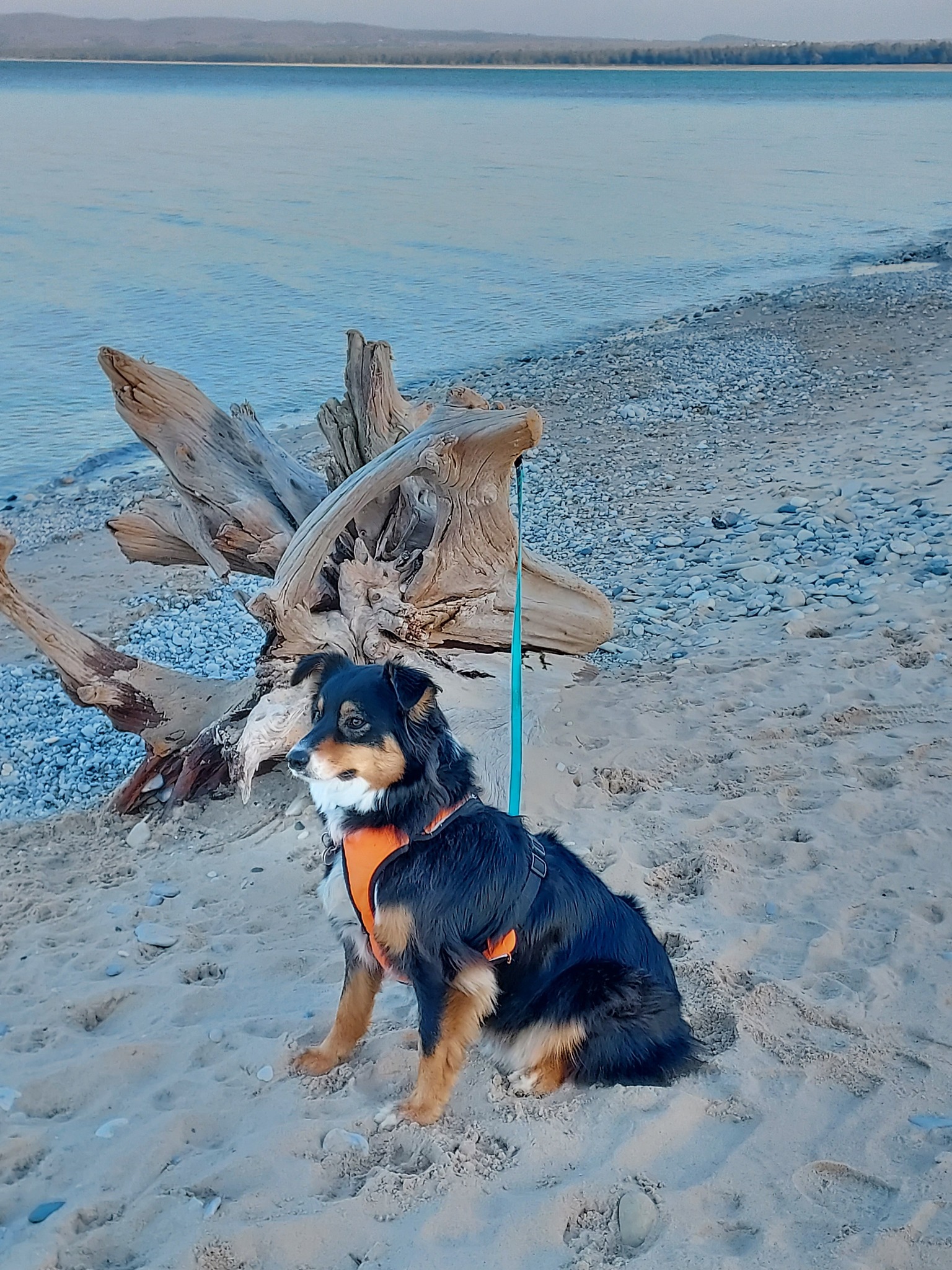
| (Random photo of mine. When taken? Why?) |
My visits to Italy happened through the magic of books, of course, and here are three that transported me to places I’ve never been before.
(1) Spender, Matthew. Within Tuscany: Reflections on a Time and Place
As potters are often secretly obsessed not by ceramics but by fire, so sculptors are sometimes obsessed not by carvings but by stone. And the craftsmen who work in quarries do not think about stone, they think of the mountain. In all three cases it is a question of sublimating a mean passion for a grand one. Man makes his little artefacts, but it is the live material as nature brought it forth that remains the challenge.
Anyone who has ever traveled or lived in Tuscany or dreamed of so doing will want to read this book, but it will have special meaning for artists (as the quote above makes clear), horticulturists (olive harvesting and oil processing are described in great detail), historians and lovers of ancient history (the author is fairly obsessed, to use his word, with the elusive Etruscans), and anyone who has ever read Dante at all seriously.
Sculptor and painter, as well as writer, Matthew Spender and his wife, Maro, came from London to Siena in 1967, intending to live there for “a year or two,” but life had other ideas in store, and before they knew it they had established an Italian life. With their two little girls in school, Spender joined a community band (a clarinetist, he says unkind things about violins) and researched several aspects of Tuscan history, along with pursuing his art. Matthew Spender is the son of poet Stephen Spender. Maro, an artist herself, is the daughter of painter Ashile Gorkey, whose biography Matthew Spender authored. The family backgrounds of both Maro and Matthew are complicated by dysfunction and sparkling with famous friends, but if a reader knew nothing at all about the author or his family, Within Tuscany would still be fascinating and beautiful reading.
It is a somewhat strange book. Part memoir, part historical commentary, the author reveals his own occasional awkwardness pitilessly more than once. His lens is at other times a long one, focused on previous centuries, before turning back on himself in close-up. But always, the writing intoxicates. Musing on Bruce Chatwin’s dream of death and how not even the art we make, though it outlives us, is destined to be immortal, Spender writes of these art objects:
For a while they can act as shields against total annihilation, our death first, their death and the eventual death of the planet as it whirls around an exhausted sun, awaiting its own eventual extinction, each finality fitting in the other like Chinesse boxes. For me, the outstretched hand of painted flesh from a painted sleeve will do, stretching to support me as I approach the tunnel, before the blinding light.
I don’t fit into any of the categories of readers I said would love this book, but I did love it and highly recommend it.
![]() |
(2) Leon, Donna. My Venice and Other Essays
Donna Leon is an American writer who has lived for many years in Italy. She writes murder mysteries set in Venice. That’s all I knew when I picked up this book.
My dream city is Paris, although more than one friend feels the same way about Venice, which has never been on my short list at all. But reading about Venice? I’ll do that.
What a surprise this book was! I adored and delighted in this opinionated group of essays and how the author does not pull a single punch! She says she will never live in the U.S. again, but she does not see her adopted home city or country through rose-colored glasses.
It is difficult, even in the midst of my thirty-year love affair with them, to say that Italians have anything that could even vaguely be called a civic sense.
Much as I loved this book and highly recommend it, however, I’m finding I don’t want to say too much about it or quote too heavily, because you need to discover it for yourself: Some of you will love it, some might outright hate it. (This I infer from the review I read after writing how I loved it. Not everyone did.) I’ll warn you that Donna Leon calls dogshit shit, not poo, and when one of her essays is titled, “It’s a Dick Thing,” she means just that, but she doesn’t hate dogs or men, never fear. Give it a try -- and get back to me with your impressions, please!
Inspired by her essays, I’m now reading one of her murder mysteries now, Doctored Evidence, which in turn was inspired by an annoying neighbor, in real-life Venice, who kept her television at an unbearably high volume, night and day, despite repeated complaints….
(3) Smith, Mark Gordon. Tuscan Echoes: A Season in Italy
Mark Smith’s story is closer to that of most American visitors than the two foregoing books, in that he did not make a long-time home in Italy. That is, he had lived in Italy as a child, with his family, in the 1950s, but only after many all-too-brief visits as an adult was he able to arrange to live in Florence for 18 precious weeks, beginning on the first of May.
Time became the gift that provided opportunities to take in quiet moments and places, to capture the special essence of Italian life. Even now, I need only close my eyes to feel the heat of that Tuscan season. There were days when an infinite clear blue sky soared overhead, hot breezes shrilled the cypresses of cloisters, olive trees shaded fields of straw punctuated by bright red poppies, and aisles of Chianti grapes marched forever up every hill. On every day, in every corner turned, a new discovery was made; with every museum entered or church visited, there were thousands of other events that reached out to be remembered. As the seasons turned, leaves blew at my feet and, eventually, the rains of fall arrived.
I don’t know how to interpret breezes that “shrilled the cypresses” and can’t help wondering if he was really looking at “fields of straw” (perhaps some grain?). I do recognize that sense of discovery, every day, around every corner, familiar to me from my own first month in a rented room in Paris, venturing out every morning safeguarded by talismans from friends, armed with maps and high school French, coming “home” at night to sit at the dining table with my landlady, each of us with paper and pens and dictionaries at the ready in case of a communication puzzle. One month for me, eighteen weeks for him – time enough to settle in and feel deliciously at home, reveling in the “gift of time.”
And yet -- I was disappointed in Smith’s book. To me it read like letters written to family back home rather than personal diary entries or letters to a close friend. Also, all three of today’s books were written in the first person, so why did only this one strike me as relentlessly “I, I, I”? There were too many unnecessary details about “heading” here and “heading” there and turning corners and sitting down and not nearly enough detail about, for instance, what he had for dinner at the fabulous restaurant mentioned. And while I wouldn’t have wanted him to be curmudgeonly or dissatisfied, was every single moment of those eighteen weeks golden? Unlike Spender and Leon, a reader has little sense, from his writing, of this author's character or idiosyncrasies or his life apart from these eighteen weeks.
My advice: If you want a happy tour guide, take Smith; if you want opinionated irreverence from an insider, Leon is your woman; and artists, you will definitely find Spender the most revealing of what concerns you most. But perhaps you have favorite books on Italy to recommend yourself. Or another part of the world.
Where have you traveled lately through the magic of books?
Meanwhile, as we ease into spring here in southeast Arizona, this is right where I am when I leave the books behind and step out my door.