Search This Blog

Showing posts with label road trip. Show all posts

Sunday, May 24, 2026

Back For the Holiday


Welcome to Hell!!!


Since my last post, I have been through Hell. Literally. The little stop in the road in southeast Michigan, that is, on what was a purely delightful road trip down to Vicksburg and Kalamazoo, over to Ann Arbor, and north through the Pinckney area. But let's backtrack a bit. 

My companion on the trail, Tree Guy, had a medical appointment in Ann Arbor that served as our excuse for the trip. I drove the first stretch, taking my one of my old favorite two-lane roads, M-37, which allowed a pause in Newaygo at the River Stop Cafe.

River Stop Cafe, Newaygo

Good place to take a break

River Stop hasn't changed its look since my last visit, but they now have menus and table service, even to the outdoor tables. (We sat at the back table inside.) Sadly, the bookstore I visited last spring was no longer in operation, and a nearby business that had some used books was not yet open, but we admired a couple of giant sycamores that made the stop memorable.

Giant sycamore in Newaygo, Michigan

Tree Guy had friends in Vicksburg we could stay with for two nights, and then a friend of mine in Ann Arbor invited us for our third night away from home, so we were all set. We were extremely lucky with the weather, too. We dodged all downpours, possible tornadoes did not materialize, and though many trees had come down in high winds, none fell on us or on the homes of our hosts. Sunrise the day after our arrival in Vicksburg was over a lovely pond, a pond large enough to hold an island, a dock, and a couple of pontoon boats.


On the other side of the island live the family's momma pig and her little ones. I did not venture too close, as the quick, unpredictable movements of pigs make me nervous, so none of my pig photos are going to win any prizes, but if you look closely you can see them. The momma weighs 600 lbs. Reason not to get too close! 

Look closely to see the pigs.

There were many other animals I didn't mind approaching. I missed Sunny, so dogs Miles and Louie kept me on an even keel.


There were also ducks and geese and hens and chicks and even duck eggs incubating in the guest bathroom. 

Ducks

Hens

Young poultry

On our one full day in Kalamazoo County, we were able to see grandson Jack's show at the Kalamazoo Institute of Arts, paintings done during his past year's residency there. Jack, as well as my son, Ian, met us at the KIA for a tour of the show.


Self-portrait by artist Jackson Willits

It was impossible to see all friends and family members in a single day, although I managed phone conversations with a couple more, and then we were off to Ann Arbor, Tree Guy at the wheel on I-94 and around that fascinating but (to me) very confusing town. It was a relief to get the medical appointment behind (after three hours at the clinic, mostly waiting for the doctor) and relax with delicious take-out Moroccan food at the home of a dear friend I've known since our kids were in grade school together.

The next morning we drove through Hell and stopped for a brief visit with my former Arizona hiking partner, who now lives in southeast Michigan after 20 years in the Cochise County ghost town where we met and spent so much time together with our dogs. We missed the excitement of the Memorial Day weekend in Hell by going through on Thursday, but that was fine with me. One of the reasons I love rural two-lane roads is that they are generally quiet. We did not visit the Hell Saloon. Stopped for photo opp and continued on our way.


Because the shop in Newaygo was closed and time did not permit exploring Ann Arbor, I did not visit a single bookstore on this road trip, and yet I came home with my car loaded with books--backseat and way-back full!--thanks to friends who remodeled their home and thanks to my son who been storing their de-acquisitioned personal library items for me.  I did some reading on the trip, too, finishing up a Charles Baxter novel, First Light, interesting in its structure, as the story begins at the end and goes backward, step by step, to the beginning of the brother-sister relationship. That might not sound like a novel with a satisfying finish, but I appreciated it more and more as it went along, and closed it with a sigh of satisfaction. And now I'm halfway through Gerald Green's To Brooklyn With Love and enjoying the writing immensely.

Back home in Northport shop, with my newly organized section of Michigan used books (among many other treasures), I was happy to have done the reorganization before the busy weekend.

Used Michigan books, on table and on shelves

Books and dogs: That's my life. So here are the friendly Vicksburg dogs again, one more time. Miles and his antler reminded me of Sunny with the deer legs (bones) she brings home, and Louie, a tidy little Lab-beagle mix, had a head that put me in mind of James Thurber's dog cartoons. Both were very sweet, laid-back company.

Miles

Louie

And what, you may wonder, was Sunny Juliet doing while her momma was away from home for four days? No cold, lonely kennel time for my girl! She had the constant companionship of her Auntie Deborah, who spoiled her rotten with attention and tennis ball play. Sunny is a lucky, lucky dog!


HAVE A SAFE MEMORIAL DAY!!!

Wednesday, May 15, 2024

Where did we go? What did we do? Whom did we see?


Do you know where Sunny Juliet was on Monday?
 

First, a little book stuff --


My Sunday evening bedtime book was America for Beginners, by Leah Franqui, a fairly light-hearted fictional tale of multicultural America that manages to address some heavy themes in an entertaining manner. It is a make-you-laugh, make-you-cry novel with a road trip as its centerpiecer, and what could be better to read the night before I embarked (“Sunny, stop that barking!”) on an ambitious one-day road trip of my own? I came back to it Monday evening, at home again, and reached the last page Tuesday morning. I loved the book, the characters, and the way they learned about each other almost in spite of themselves.


Here's the thing: Unless it is a review that leads me to a book, I don’t read reviews until after reading the book and forming my own opinion. Then sometimes I’m curious and wonder if other people found the same delights or food for thought or glaring faux pas – whatever I found in a particular book – that I did, and that’s when I search out reviews.


From Goodreads, I more or less expect mostly personal and subjective responses, although at times there is a deeper take, but whatever different readers have to say, it’s always interesting to see what they liked and disliked, what they found to admire or criticize. If a review is badly written there, I take it with a grain of salt, not having had high expectations.


It's different when I look to Kirkus reviews. Kirkus has been around since 1933 and has always had a high reputation. If you look up ‘Kirkus’ on your phone, you’ll see a list of questions “People also ask” about it, one of them “Is Kirkus reputable?” The online answer is “Kirkus is a credible, industry-renowned resource among authors, publishers, the media, booksellers, and readers.” A Kirkus review is a Very Big Deal for an author.


Since 2005 Kirkus has been reviewing self-published books but only if paid by the author to do so. Established publishing houses that send books to be reviewed do not pay a fee. Neither the paid nor the unpaid reviews are guaranteed to be positive. Well, sure – they wouldn’t be reviews otherwise.


The Kirkus review of this book I found delightful was not itself delightful at all. The reviewer had not been charmed, as I had been by the novel. Fair enough. But why? The reviewer called the book “tolerable, if not utterly original,” certainly deserving some kind of “damning with faint praise” award. -- But was the reviewer saying the book is “utterly original”? I doubt that was the intention, and yet the effect points in that direction, so my suspicions were aroused by the reviewer's misuse of "if not." The author is accused of “road trip-novel cliches.” Such as? An example is given for the criticism that the author over-explains characters’ inner lives. Okay, I guess the reviewer and I simply disagree on that one. 


Let me be clear. My big problem with the Kirkus review wasn’t that the reviewer and I disagreed. It was that the review itself seemed amateurishly written, no better than anything any random reader might post on Goodreads and not as good as some to be found there. This is a Kirkus review? I read a few more Kirkus reviews of other books and found all too many of them disappointingly brief and lacking textual support for opinions rendered. 


Foreword magazine, published nearby in Traverse City, Michigan, also reviews books, many from small presses, some by self-published authors. Reviewers’ names are attached to the reviews, which are generally longer and, I find, more in-depth than what I’m seeing on Kirkus these days. While applauding Foreword (and yes, I do know the publishers), I have to wonder if anyone else has noticed a decline in the quality of Kirkus reviews. Is something going on there? I asked a published author this morning (Wednesday) what he thought of Kirkus reviews, and his answer was, "Not much." 


The foregoing discussion, you will have noted, is more a review of reviews than of the novel that kicked off my musings, but feel free to comment on either. For myself, I am eager to read more of Leah Franqui. 


So yes, Sunny Juliet and I went on a road trip.


I hope you recognize this.


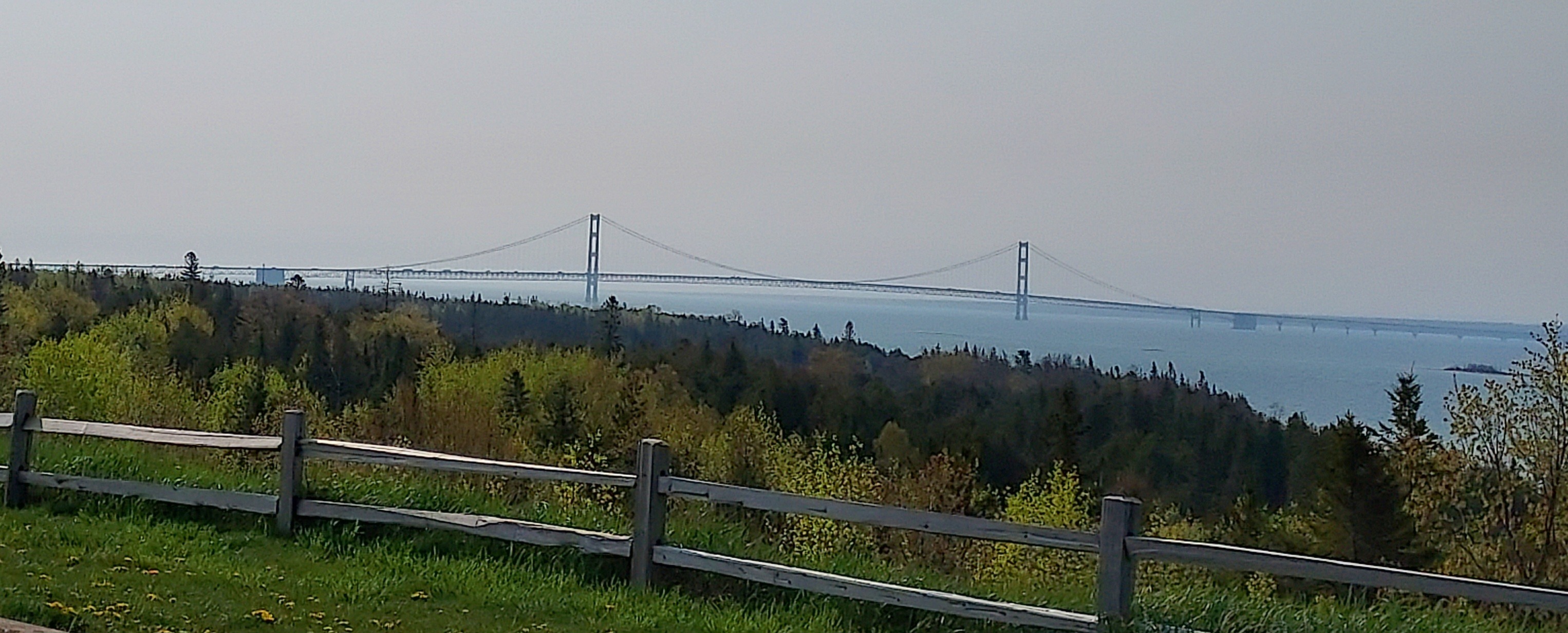
Somewhere near the approach to the Mackinac Bridge from the south is a big billboard that reads, “Same state. Different state of mind.” Rarely have I driven across the Mackinac Bridge without the Artist, and almost always there was a dog with us. First Nikki, then Sarah, except for that one post-Nikki, pre-Sarah trip when we took the ferry from St. Ignace to Mackinac Island. All of which is only to say that the entire U.P. is as saturated with memories for me as Leelanau County, where I live. 


A MUST stop for me

Sunny's first visit


A pause along U.S. 2...

...for sharing time.


The pickle barrel! Grand Marais!


I parked Sunny in the shade in Grand Marais and quickly took care of my town errand, then drove us out to Coast Guard Point, where I let my girl get her paws wet in Lake Superior water while I relived memories of picnics, naps, reading, and conversations in our folding chairs -- days of contentment the Artist and I shared with first-Nikki-then-Sarah at that dear spot. 


Some things in Grand Marais are the same, others different. The Lickety-Split ice cream place is now the Sherpa Shack, but Arbutus is still where it was the last time the Artist walked around it, dreaming boat dreams.


Then it was east on H-58, past the old two-track (entrance now so grown over!) to Jim Harrison’s writing cabin on the Sucker River, past the old fisheries building on the other side of the road, past School Forest, past this, past that…. Reaching the end of the pavement, I was surprised not to encounter washboard. Ellen had told me the road was “pretty good” (my next destination was the Uglyfish Baking Company, latest joint endeavor of author Ellen Airgood and her husband, Rick Guth, both formerly of the West Bay Diner in Grand Marais and before that, for Rick, as the Earl of Sandwich), and indeed the drive had never been so easy, but I wasn’t sure what to make of that. It didn’t feel or look familiar at all. Like the paved portion west to Munising, road long more of a safari track than anything else, this segment to the east now seemed almost – to me – dismayingly civilized.


Can this be H58?

Ah, yes!

THIS is the U.P.!


You can't miss it!

I had no trouble at all spotting Ellen and Rick’s little trailers on the other side of Muskallonge Lake State Park. How wonderful to see these dear people and to catch up on each other’s lives! Other than being much too short (there is never enough time with friends!), our visit was lovely, and I was very glad to have made the quick trip north. It’s good to talk Michigan, talk outdoor life, talk books and business, even to talk ticks with good friends.


Ellen!

Remembering the beginning: the Earl of Sandwich!

Today's kitchen

Me and Rick, photographed by Ellen


My new cap!

Note to readers: If you find yourself north of the bridge and west of Newberry, stop for coffee and a brownie with Ellen and Rick. Visit the gift shop in the smaller of the two trailers (the larger is the Uglyfish kitchen) and buy a mug, t-shirt, billed or knitted cap to take home with a bag of cookies and jar of maple syrup. And Ellen’s books, for sure – for yourself, if you haven’t had the treat of reading them yet, otherwise for someone you love. Ellen will be happy to write a dedication to you or your favorite reader.


Life Up North


Back home in Leelanau well before dark, I was happy to see my little apple trees blossoming. Same state, different state of mind. Two beautiful peninsulas. Michigan! Isn’t it wonderful?


My little blooming apple tree at home

Sunday, June 30, 2019

Allow Me to Recommend a Book For Your Consideration


I have never asked a bookseller for a book recommendation. Disclosing desires and expectations to a stranger whose only connection to me is, in abstract, the book, seems too much like Catholic confession, if only a more intellectualized version of it. Dear bookseller, I would like to read a novel about the banal pursuit of carnal desire, which ultimately brings unhappiness to the ones who pursue it, and to everyone else around them. A novel about a couple trying to rid themselves of each other, and at the same time trying to save the little tribe they have so carefully, lovingly, and painstakingly created. They are desperate and confused, dear bookseller; don’t judge them. I need a novel about two people who simply stop understanding each other…. 
- Valerie Luiselli, Lost Children Archive

As a bookseller myself, I am perhaps oddly cautious about recommending books. I absolutely never tell anyone they should or, worse — God forbid! must read something, but my reticence goes further than that. Even when directly asked for to make a recommendation, I counter gently with a general question of my own, such as, “What kind of books do you like to read?” Because there’s no point in recommending a tome on history or economics to someone looking for light fiction or vice versa. And I cannot think of a single book, no matter how extraordinarily wonderful, that would do as a recommendation for anyone and everyone. Often I’ll go so far as to say that I enjoyed or even loved a particular book and to suggest that the person looking for something to read might also enjoy or even love it because..., giving a few of my reasons, which might or not be reasons for that other person, but I never insist. There is no better way, I believe, to put someone off a book by trying to trap or shame them into reading it. Years ago, a man visiting my bookstore who learned I had not, at that time, yet read Kristin Lavransdatter told me, in these very words, actually (I kid you not!) shaking his finger as he scolded, “You should be ashamed of yourself!” Rather than rushing to mend this fault in my character, I avoided reading the book for years, seeing that horrible man’s scolding face whenever the title came up in conversation or a copy of the novel came, briefly, into my hands. 

No, no, there are books I wish more people would read, but I refuse to present reading them as a duty.

I will, however, if asked — and occasionally without being asked, as I do in today’s post — recommend a book for someone’s consideration on the basis of my own fascination with it. So if your interests and reading tastes and preferences are similar to mine, you might be moved to try it, and if it’s not up your alley at all, for whatever reason, you’ve saved time by finding that out, too. Although I’m not sure, now that I think about that…. Maybe if it sounds like something you wouldn’t care for, I’ve somehow misrepresented it? I certainly hope that won’t be the case today!

…We order four hamburgers and four pink lemonades and spread our map out on the table while we wait for the food. We follow yellow and red highway lines with the tips of our index fingers, like a troupe of gypsies reading an enormous open palm. We look into our past and future: a departure, a change, long life, short life, hard circumstances, here you will head south, here you will encounter doubt and uncertainty, a crossroads ahead.

Brief digression: Years ago I sat at a table in a bar with a group of other graduate students in philosophy, and one of the group, a student from another country (the young man from Spain or Otto from Finland?) asked innocently, of a song playing on the jukebox just then, what "City of New Orleans" was about. Well, ask eight philosophers what anything in this world is about and prepare yourself for a perfect storm of disputation! 

I think of that evening and the philosophical discussion that ensued because Lost Children Archive could be characterized in so many ways. In the most basic and simple sense, it is the story of a road trip, as a couple married for four years, his young son, and her even younger daughter set out on a cross-country road trip from New York to the American Southwest. They travel first in a southerly direction, then in South Carolina begin their westward trek. Their progress is unhurried, as they take time to sight-see along the way. In the car they listen to audiobooks and music but always remain attuned to towns and landscapes they are passing through, parts of the country they have never seen before. Road trip. That’s the simplest, shortest way to describe the book.

Of course, there’s much, much more to it.

Right at the beginning we learn that the man and woman share an unusual career. She is a sound “documentarian” (her word), he a “documentarist” (his word). Both record and assemble documentary soundscapes. They first met on a project in New York, where their assignment was to go about the city and record as many of the world’s spoken languages as they could find. The different names they give to what they do, however, indicate differences in both background experience and what kind of projects they want to take on in the future, differences that put their future as a couple in doubt. Will they remain together or part to go in different directions? That is one of the relationship questions posed by the novel.

At Chiricahua National Monument
Their travel destination is one the man has chosen for a new project he has conceived on “echoes” of the Apaches who lived in the Chiricahua Mountains in southeast Arizona, and the woman has realized that she can expand new work she began with immigrant children in New York to an exploration of the situation of undocumented children along the border with Mexico. In that way, their separate projects can be pursued in parallel, at least for a while, once the family reaches the Southwest. As they makes its way toward what they mistakenly believe to be Fort Still, Oklahoma — learning of their error only when they arrive, which seems strange, because wouldn’t they have seen it written as Fort Sill on their maps? Yet we often see what we expect to see rather than what is before our eyes — the woman begins to see a way in which the separate projects may actually overlap, at least for her. As the man tells the children about the Indian Removal Act,
I don’t interrupt his story to say so out loud, but the word “removal” is still used today as a euphemism for “deportation.” I read somewhere, though I don’t remember where, that removal is to deportation what sex is to rape. When an “illegal” immigrant is deported nowadays, he or she is, in written history, “removed.” I take my recorder from the glove compartment and start recording my husband, without him or anyone noticing. His stories are not directly linked to the piece I’m working on, but the more I listen to the stories he tells about this country’s past, the more it seems like he’s talking about the present. 

art on border wall at Douglas, AZ
And so, the novel is also about American history and American current events, Apache history, history of the Western frontier (and the myth of the frontier and the vanished frontier), about U.S.-Mexican history, the current situation on the border, immigration, and more. With makers of sound documentaries at its center, documents and documentation and archives form another general theme of the book, specific needed documents also being what the immigrant children, at risk of being “removed,” too often lack. And it is about what makes families and what holds them together. There are also two very specific "lost children," two girls, undocumented, that the woman has been asked by their mother to look for in New Mexico or Arizona. 

The main characters are referred to simply as “the man,” “the woman,” “the boy,” and “the girl” throughout the novel. We are never given their names. The woman tells the story -- thus we have more physical descriptions of the other three, more of the woman’s thoughts as they travel -- but we see and hear them all as they interact. The boy, ten years old, is learning to use a camera, undertaking his own documentation of their trip. The five-year-old girl, full of life, brings a fresh perspective to many moments. [Later note: Halfway through the book, the boy takes over for a while as narrator, and later still voices mingle, in ways and for reasons I leave you to discover for yourself.]

All this “about” talk, though, tells you nothing of the spellbinding narrator’s voice. Indeed, it tells you nothing of the spell cast by the the story of the trip itself, deepening with every mile as we learn more of what has brought these people to where they are and what propels them forward into their uncertain future, as we share their experiences along the road. 

For a reader without deep concerns about immigration or border security or lost children (though I ask myself, who could that reader possibly be?), Luiselli’s novel can/could be read for the innovative and yet somehow timeless beauty of the writing. That would be reading at the level of enjoyment. Deeper still, one can read the story (as I’m sure most will) for both its contemporary and historical context. 

Finally, then, a personal note, one that comes very early on in the novel:

Finally, one night, my husband spread the big map out on our bed and called the children and me into our room. He swiped the tip of his index finger from New York all the way down to Arizona, and then tapped twice on a point, a tiny dot in the southeastern corner of the state. He said:
Here. 
Here, what? the boy asked.
Here are the Chiricahua Mountains, he said.
And? the boy asked.
And that is the heart of Apacheria, he answered.

There it is, you see, for me. It all comes together for me, as it seems to be coming together (I am as yet not halfway through the novel) for the woman telling the story: the Chiricahuas (Echo Canyon), the Dos Cabezas, the Dragoons (Cochise Stronghold); Cochise and Geronimo and Lozen and U.S. policy with Native Americans from the beginning of our country's history; the U.S. border with Mexico; immigration and immigrants without documents and the lost immigrant children; where we’ve been as a nation, where we are now, and where we’re going; the sights and sounds and roads and small towns and big cities across this land. It’s all here. It’s all in this book.

north of border

south of border

You might want to think about reading Lost Children Archive. If you love it only half as much as I do, it will be well worth your time.


July 1 postscript: The only part of the book that really bothered me was reading about Cochise being buried at Fort Sill. He wasn't. His grave is not there and never was. Cochise died in Arizona and was buried somewhere in the Stronghold, by Apaches, in an unmarked grave. When the fictional family in the book is on the road, on their way west, they think they are going to Fort Still — they have the name wrong — and that took me aback, but it’s their mistake, and when they see the sign they realize their error, so I kept thinking they would correct the part about where Cochise was buried, too, but apparently the author is the one who misinformed her characters on that score. Did she visit Fort Sill? I’d say not. There is so much Apache history in the book, how did she miss the fact that Cochise died before Geronimo and the others were “relocated” by train to Florida? In biographical/historical terms, it’s a serious error. In literary terms, in terms of the length of a book’s life span, maybe it doesn’t matter quite as much. Who am I to say? Historians, as well as living descendants of Cochise today, cannot have the viewpoint of possible heirs of world literature centuries in the future — if civilization lasts that long.

The thing is, I haven't even begun to describe for you the lyrical beauty and the interweaving of life, literature, and documentation that make this book worth your consideration. Please give it a try!

Monday, September 5, 2016

Takin' a Break


Bruce Viger takes Labor Day seriously. His restaurant, the Garage Bar & Grill, is closed for the day while he serves up a big picnic at home for his employees. Since our break involves getting beyond the township boundaries, David and I are here in Northport today (see picture below: OPEN), ready for whatever business may come our way but also anticipating a fairly slow and easy day of it.


Here at the frayed end of summer, my reading train went completely off the rails. First I was reading a fascinating book about dogs but in jumping between that book and a couple of others I managed to mislay the dog book. When I’m engaged in yet another futile search at home, I think the book must be at the shop; when I come to Northport and look again, unsuccessfully, I’m sure it must be at home. So far, though, no luck either place. And it was, as a say, a fascinating book! Another one I picked up one day was a memoir, and I continued reading for many chapters even after realizing I’d read it before, but after a while my hilarity subsided, and I decided to set it aside.

So that made two books started and not finished, two books that I cannot legitimately add to my “Books Read” list for the year. I did better with Kwame Anthony Appiah’s book, Cosmopolitanism. Dealing largely in abstractions (the author is a philosopher, after all), Cosmopolitanism was most interesting to me in (1) the sections dealing with examples from Ghana and (2) Appiah’s chapter on “Cosmopolitan Contamination.” The latter resonated with me because the arguments against “purity” reminded me of Nietzsche’s, and the arguments for “contamination” – which might as well be called cultural enrichment or cross-cultural fertilization – were similar to those I employed against Nietzsche in one chapter of my doctoral dissertation, winding up that chapter with one of my favorite poems, “Pied Beauty,” by Gerard Manley Hopkins. As Appiah observes,
We do not need, have never needed, settled community, a homogeneous system of values, in order to have a home. Cultural purity is an oxymoron. The odds are that, culturally speaking, you already live a cosmopolitan life, enriched by literature, art, and film that come from many places, and that contain influences from many more.
Ah, yes, dappled things!


There is dappling in summer’s ubiquitous green these days, errant patches of yellow and orange, hints of the season to come, and with these tiny previews of fall comes the time that David and I take a little time off from work, the “summer” vacation (in September) that we begin to anticipate as early as mid-August. While we’re gone – for an indeterminate length of time – our businesses will also be, basically, “on vacation,” although there is an exciting chance that Bookstore Bruce, my helper of many years, will open up on Friday and Saturday to test the September water. And if having the bookstore open then seems worthwhile, he may come back and do it again the following week. I would suggest calling first if you would be making a long trip solely on the chance of finding Dog Ears Books open, but then, isn’t any Michigan cruise a pleasure regardless of destination? That’s certainly how we feel as we look forward to some time on the road.


If not back earlier, we will definitely be on hand for Leelanau UnCaged, the fourth annual Northport street fair with arts and crafts and live music and fun galore! That is Saturday, September 24, so mark your calendar now and plan to be here with us!