Search This Blog

Showing posts with label Lake Huron. Show all posts

Thursday, September 19, 2019

Part III and the End of Our Wandering (For the Time Being)

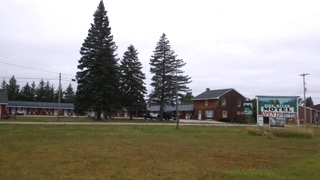
Pine River Motel, Cheboygan, Michigan
Cheboygan with a ‘c’ is in Michigan, Sheboygan with an ’s’ in Wisconsin. Both are white European spellings of an Ojibway word, but which one? Does the name come the word for "passage between lakes," "sewing needle," or "place of ore"?

The Artist’s memories of a long-ago night spent on the edge of Cheboygan were unlovely, and so when the two of us had subsequently passed the same way we did so quickly. This time was different. To begin with (and it was a happy beginning), we found the motel pictured at the top of this post, where we had a clean, comfortable, roomy but cozy room and there was plenty of space outside, well off the highway, to walk a dog. We had our choice of restaurants in close range. If only we’d had in-room coffee, I could have stayed for a week, before even seeing the town itself. Initially the Artist was not so sure. He didn’t remember there being “much to see” in Cheboygan. But he agreed to give it a chance. 


We found a long Main Street lined with businesses, many of them open even on a quiet September morning. Alice’s Restaurant fell somewhat short on its “best coffee” claim; breakfast, however, was nothing short of delicious. You already know we visited the bookstore, because I gave that away in Part I of my story. What really captured our hearts, though, was the Lake Huron shoreline at Cheboygan — like a shoreline in a dream, it was, all reedy and undulating, with parks and open space and a long boardwalk out to a viewing platform.


Cheboygan, like Alpena, is confusing to navigate, since its shoreline and river mouth conspire to make a regular prairie grid impossible for more than a few blocks. For true wanderers, of course, irregularity of layout adds interest. So did the town’s houses, churches, and other buildings, both historic and modern. We were glad to see the original Carnegie Library now being used for cultural events and to find a big new library not far away.


Old Carnegie Library

New public library

warning!
My guess is that the old church now called “Huron Street Tabernacle” is the old St. Charles Catholic Church. Just a guess, but an active Catholic Church we saw as we were coming into town, with the name St. Mary’s above the door, is now St. Mary’s/St. Charles, so — . In any case, the Tabernacle is in rough shape.


Huron Street Tabernacle

St. Mary/St. Charles
I did not photograph any of the old mansions or the fabulous old horse chestnut trees we found. Sometimes I need to let my eyes and mind make their memories unaided. But we wandered and circled and poked around until we found ourselves on a road leading out of town, past what looked like an old schoolhouse.


Outside town --
When I consulted the map, I saw that we could stay on that road south until we reached an east-west road that would take us over to Alanson, so that’s what we decided to do. Back on familiar territory, we were happy to stop for coffee at the Dutch Oven Bakery in Alanson (now that was the best coffee anywhere on our trip), and I went a little nuts making purchases before we left — bread (David’s choice), plum bread (out of this world!), jams, and a terrific little spice cookie made there called dry bones, which are very delicious and quite addictive. Beware!


Dry Bones from Dutch Oven Bakery, Allison, Michigan
We made one last exploratory stop down the road at King Orchards for apples, and if I hadn’t been so unrestrained at the Dutch Oven Bakery I could have spent much more than three dollars at the orchard store. There’s not much better than a Michigan apple, though, unless it’s a whole bag of apples, and that bag was all we needed to get through the rest of our last day of travel.

Small glimpse of all that's outside

Little taste of what's inside
So we did not get over the Bridge this time. But getting away doesn’t have to mean going terribly far or staying away for a long time. Four days can suffice and did for us this September. Besides, close to home, a couple of hours are often enough to refresh our spirits….


Road to Cedar -- always a good county cruise....


Thursday, September 22, 2016

In Which We Explore the Other Side


Sign encountered in our travels to the Other Side

Other Side, yes, but not at all the Dark Side. Hardly that! Our annual U.P. getaway, lovely as it was in so many ways, had been just too short after a summer of retail captivity, and while I was hungry for more time out in the world, David had been thinking about the area where his grandfather had farmed and where his grandparents are buried. We had not made an expedition over to the Michigan’s Lake Huron shore, the “Sunrise Side,” for about fifteen years, and it’s not much over 200 miles from Traverse City, easily close enough to make the trip with a single overnight.

And so we started out on a Monday morning.

When we drive up to the U.P., we take either 31 or 131, so neither of us had been east of Kalkaska for a long time. On the west edge of Luzerne, stopping to let Sarah have a run and do a little exploring of her own, I found the first discovery of the day’s explorations, a mysterious and fragrant green plant co-existing with patches of wild blueberries and lichen. This is what sweet fern looks like. Its fragrance, however, is the real excitement, and I was holding and smelling it for the first time in my life. Unbelievable!

The next surprise was no farther down the road than Mio.


You don’t have to be Catholic to explore and be impressed by the Our Lady of the Woods Shrine (“a Pilgrimage with Mary”). The inspiration for the shrine came to a young priest in 1945, and work was begun in 1953, “without a penny to spend and two borrowed shovels,” says the free brochure. My first question on seeing the very large and complex structure had been how a little parish in Mio, Michigan, had ever raised the money for such an ambitious construction. The brochure’s answer:
Much of the work was done by hand with the aid of a huge scaffold, a homemade elevator, shovels and wheelbarrows. It is estimated that 25,000 tons of native Onaway stone and an equal amount of cement were used to construct the shrine. The Shrine rests on footings that are 8 feet deep and 4 feet wide. The finished product is filled with spiritual and natural symbolism of Michigan.
Indeed, Mary has a lot of company. We approached the Shrine from the back, pulled off the road by the sight of it, and so we came around to the front by the right wing, that part dedicated to Michigan – the Upper Peninsula, Tahquamenon Falls, Father Jacques Marquette, and the deer of the Lower Peninsula. Have you ever heard of St. Hubert? He is the patron saint of hunters. My artist husband appreciated the wildlife sculpture as much if not more than the statue of the saint.


Built into the towering, curving stone wall are many niches and grottoes, and more statues stand in the gardens, as well. There is Our Lady of Guadalupe from Mexico, Our Lady of Fatima from Portugal, from France Our Lady of LaSalette and of Lourdes, and Our Lady of Mt. Carmel from England. I was especially charmed by the colorful Our Lady of Czestochowa, an image that owns a most colorful history, which I quote here only in part:
In the 14th century, the painting was sent to Poland in response to a dream had by Prince Ladislaus of Opola. An attack by the Tartars prompted the Prince to flee with the painting. He stopped in the town of Czestochowa. The painting was installed in a monastery and church there that the prince built for its protection. The monastery was overrun by the Hussites in 1430, but they were unable to remove the painting. 
 In 1655, Poland was overrun, leaving only the area around the monastery remained unconquered [sic]. After those remarkable events, Our Lady of Czestochowa became the symbol of the Polish National Unity and was crowned the Queen of Poland.


Russian troops in 1920, we are told, withdrew when they saw an image of the Virgin Mary in the clouds.

The Shrine is worth traveling to see. It is beautiful, both in itself and in the work and faith it represents. On October 9 a Year of Mercy Mass with Bishop Raica will be held at 11 a.m., outdoors, weather permitting. In case of inclement weather, the mass will be celebrated in adjacent St. Mary’s church.


Moving right along....

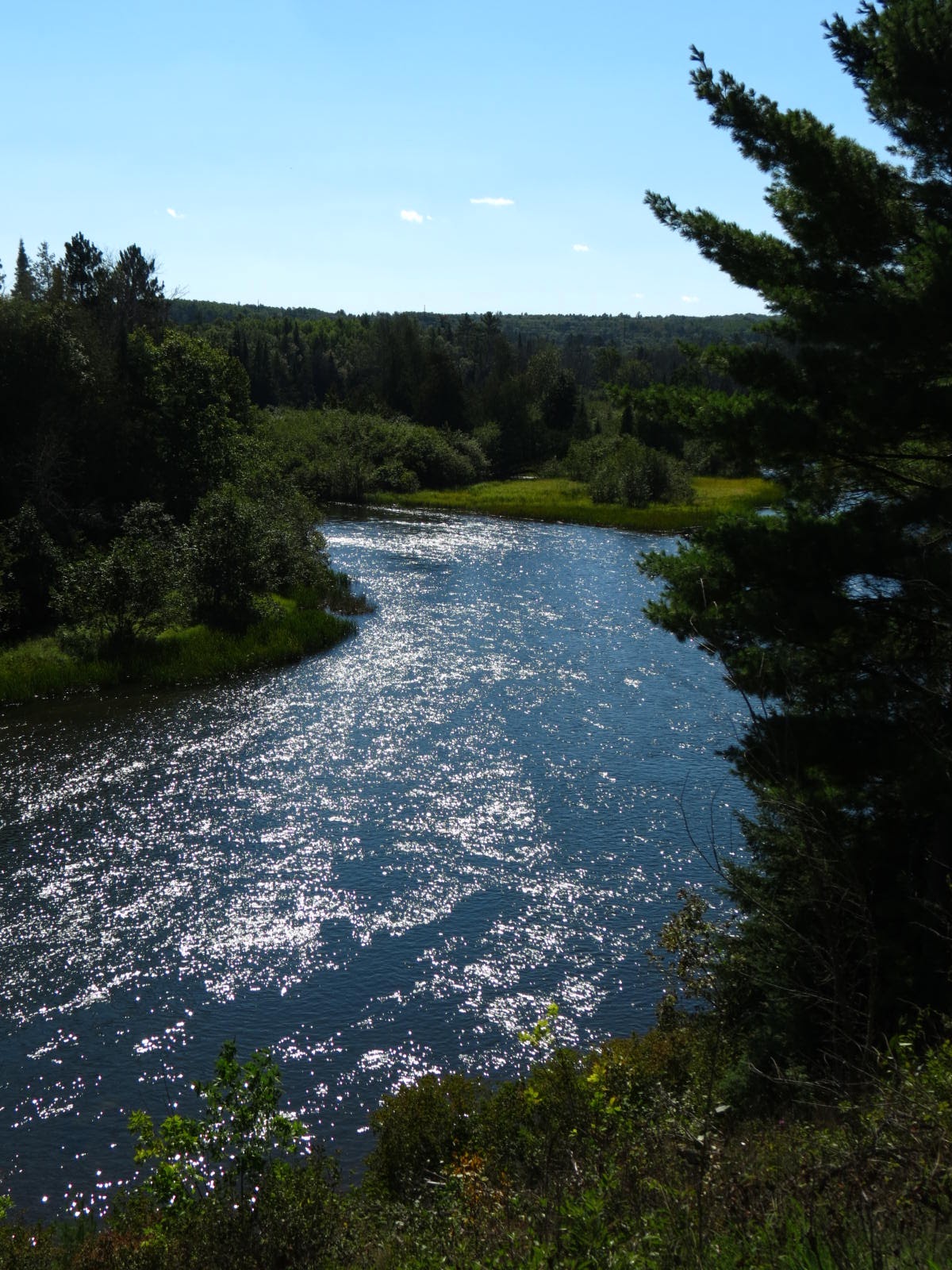
David and I cannot claim to have discovered the Au Sable River, but we did manage on this trip to find many beautiful little county roads, giving onto even smaller access roads that allowed us appreciate the river from uncrowded, tucked-away vantage points. “This is great!” David exclaimed joyously. “I don’t have any idea where I am!” To which I responded with matching happiness, “I’m not even looking at the map any more!” 

On one tiny dirt trail when we had to pull over to let a vehicle pass in the opposite direction, David and the other driver stopped to exchange a few brief, friendly words. In parting, David said, as he often does to gallery visitors in Northport, “Enjoy the day!” and the other fellow replied, “Keep ‘er watered down!”


From the Lumberman's Monument overlook

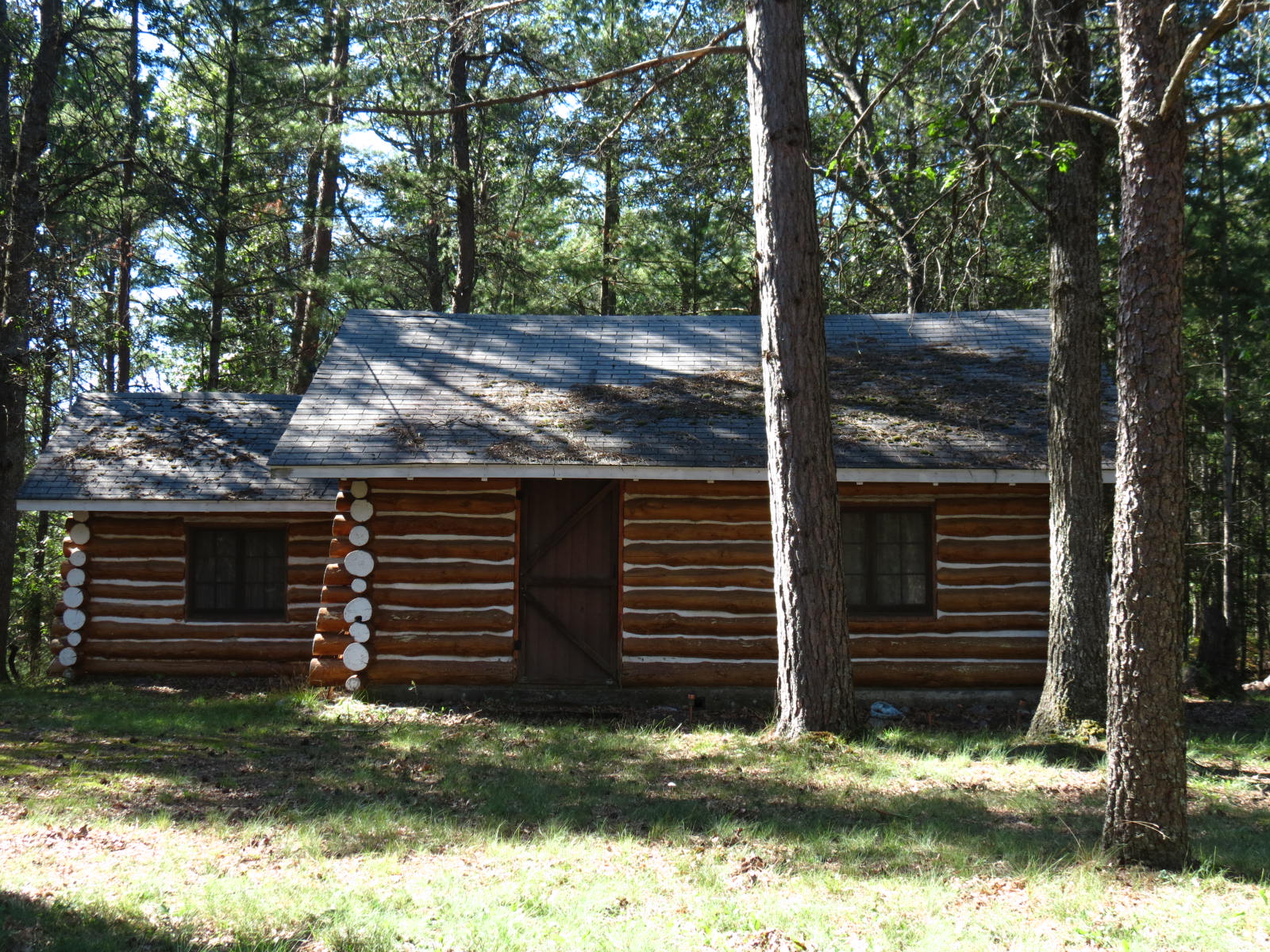
The little crossroads of McKinley was almost nothing but wonderful old log cabins. Log and stone – the vernacular architecture of northern Michigan. Not a starter chateau in sight!


Much of what we traveled over to Tawas to see would not be interesting to other people – a house and barn here, there an empty country corner filled with goldenrod where the primary family farm once stood, a peaceful country cemetery, and the framed photograph of a now-deceased old-timer, one of David’s shirttail cousins, in the restaurant where we ran into the cousin in person fifteen years before. That was the personal part of our pilgrimage, a kind of family time travel.


But we also experienced time travel of a different kind in the sweetly unspoiled nature of the Lake Huron shoreline. Do you remember Traverse City’s East Bay in the middle of the 20th century? The little mom-and-pop motels and tourist cabins ringing the beaches? That is Lake Huron still today, from Tawas north to Alpena. The place we stayed had modern siding, but the line of little cabins looked like Monopoly houses (only white instead of green), and inside the knotty pine walls had that rich patina only time can bestow.


Door hardware and wall decor were many decades old, as well. The floor had a few perceptible slopes and dips, but that is all part of the charm of time travel.

I did not realize until morning that our road had curved around the shore as far as it had to reach East Tawas, and so the sun rose up the shoreline, rather than straight out across Lake Huron where I had expected it.


Downtown Tawas is lovely. It's also full of little surprises if you look more closely.


Carved wooden door


Lighthouse at Tawas Point


Farther north, little, hidden-away Harrisville was delightful!


Lovely lakeside park and marina (out of camera range) in Harrisville

Old historic train depot, Harrisville

We used to travel over to Alpena every spring when end-of-winter cabin fever got too fierce, and in those old days our destination was a marvelous old used bookstore and antique shop that reliably yielded up treasures. The bookseller has been up in Calumet for years now, but Alpena’s lovely old buildings are still there, and the town has a more prosperous atmosphere than we remembered from years ago. For instance, we had lunch in a hip little bar/restaurant that would have been unimaginable in Alpena’s old days. The front opened to the street, and there were tables out on the sidewalk. How Parisian!



All in all, we felt we had been away from home much longer than two days. We had seen so much! We saw old sights and new sights ... old places we’d seen before but didn’t remember ... things we thought were new that probably weren’t ... new places that will be new to us again the next time. All that was and will be fine. What I do hope is that the modest, unpretentious, friendly and welcoming atmosphere of the Sunrise Coast won’t change too, too much by the time we see it again. Maybe we shouldn’t wait too long? We definitely need to plan for a longer stay the next time.


Michigan! How fortunate we are to live in such a varied and beautiful state!


Friday, February 7, 2014

Vacation on Manitoulin Island (with the Old Dog)


On September 21, 2006, we crossed the bridge from Espanola, Ontario, to the town of Little Current on Manitoulin Island, where we had reserved a cabin (#4) for four days on the shore of Lake Manitou, outside the village of Manitowaning, at an old-fashioned resort called Wee Point. Here are a few selected travel notes from that Canadian vacation seven years ago.
9/12/2006  
Down the road [I explore with my dog], clambering over hills and dips in tree-surrounded, rock-strewn pasture, where lifeless black surfaces break through the earth’s skin blossom with lichens, mosses, grass, wildflowers, and seedlings. From somewhere off in the trees comes a loud “HONK!” low and singular. Cow? Moose? Nikki is excited and wants to run [but must stay on leash because of cattle]. ...  
David puts up with the absence of television. I put up with radio news and music. He misses movies, and I plot to escape current events. I only want Little Current! And cattle. And the heartaching colors of fall. The idea of lynx and moose and bear. 
 .... 
I read to David in bed from Hamlin Garland’s Son of the Middle Border, and the passage of Garland’s first trip “to see the world” (Minnesota and Wisconsin and South Dakota), traveling by train, staying in hotels, and writing letters to friends back home in Iowa, reminds me of myself and my continuing excitement over the myriad small novelties discovered away from home: “A landscape is precisely as great as the impression it makes upon the perceiving mind. I was a traveller at last! – That seemed to be my chiefest joy and I extracted from each day all the ecstasy it contained.” 
 9/13/2006  
I had to carry Nikki over the cattle guards at the gates, but she was interested in the smells and eager to explore. Out at the main road I went left (north?), and there they were, a long line of them, different ages and different colors (grade cows?), passing through a gate in single file and dispersing into the rocky woods. Along the fence was sumac halfway gone from green to red, dry seedheads of teasel, a volunteer apple seedling amid a riot of fall flowers, mostly asters and goldenrod. Sumac “on fire” warms the soul on a chilly morning. So do lowing cattle in an orderly procession, all on their own with no need to be driven.
Coming back from another dog walk later in the day I met Pat, who owns Wee Point along with her husband, Jim.
As I’d imagined, Jim did paint the resort signs and lawn furniture and shutters on the cabins. Made them, too. From Manitowaning, he sailed the Great Lakes for 17 years, then got a license and ran an auto shop. Pat grew up in Little Current. They married in 1967.  
Pat thinks the cattle are particularly noisy because calves have been taken recently from their mothers, but she also says there was no big annual auction this year in Little Current. [Historically, the economic base of the island has always been feeder cattle and tourism.] The tornado in July (talked of in South Baymouth today when I was buying postcards) damaged the auction buildings too badly, and also the organizer of many years died.
  
A woodpecker landed on a tree behind Pat. She said a recent guest had asked if one woodpecker were a pet, saying, “It seemed to want its picture taken.” A farmer owns the land between the gate at the road and the gate into the resort. ... The painting on the outdoor chairs and tables, as well as a small coffee table inside, is bright and gypsy-like. “Diamond Jim,” he was called, and the shutters (each cottage with its own motif) all have a diamond somewhere in the design.
On 9/14, after a day of exploring to Kagawong and back, I write:
Still here, I anticipate already my future longing for this island. It’s hard to believe that two days [spent here] two years ago produced such an attachment that I felt wrenched away when we reached the swing bridge at Little Current and I had to say a very unwilling good-by. 
 9/15/2006  
“Burnt” bacon for breakfast, per David’s request, fills the cabin with smoke, and we take our plates outside to the lakeside picnic table. On our way out the drive later, going to town on errands, David starts in explaining cross-ventilation to me for the millionth time, and I interrupt to tell him I already know, and we both start laughing so hard he has to stop the car.  
In Manitowaning, what we had taken to be a bank turns out to be the Liquor Control Board of Ontario. We find a Bank of Montreal sharing a building with the post office, and there I change $50 before doing a small shopping at the Fresh-Mart. Because the used bookstore at Burns Harbor doesn’t open until noon, we find ourselves back at the Muskie Widows Tavern for coffee out on the deck, to the accompaniment of a welder roar and rumble from a construction site across the street, where a metal pole barn is being added to a lovely old limestone block building. The welder noise bothers David not at all. “This is perfect,” he says contentedly. “Cooling our heels here, waiting for the bookstore to open.”
Can this be called “travel”? It’s the way we like it – not doing anything special, just hanging out and feeling at home in a place far from home. No plot, no conflict, no suspense.

On our last Manitoulin morning, cattle appeared to bid us farewell.
One beautiful, big, cream-colored cow stretches her neck up gracefully to reach and nibble popple leaves. Her ears hang down sweetly. She walks off into the trees and emerges on the road in front of us, then strolls down the road, free of all concern.
Later, on the mainland, looking north at a low cloudbank that rests over the LaCloche Mountains (the La = the the?), I notice that the mountain rock has the same color range as the cattle we have left behind – white and cream and gold and brick red.
In the sunlight, the same colors as the cattle, the rocks look warm, not cold. Like animals, they invite the human hand.
Sorry for lack of photographs. I searched high and low and found many other files from 2006 but nothing from September.

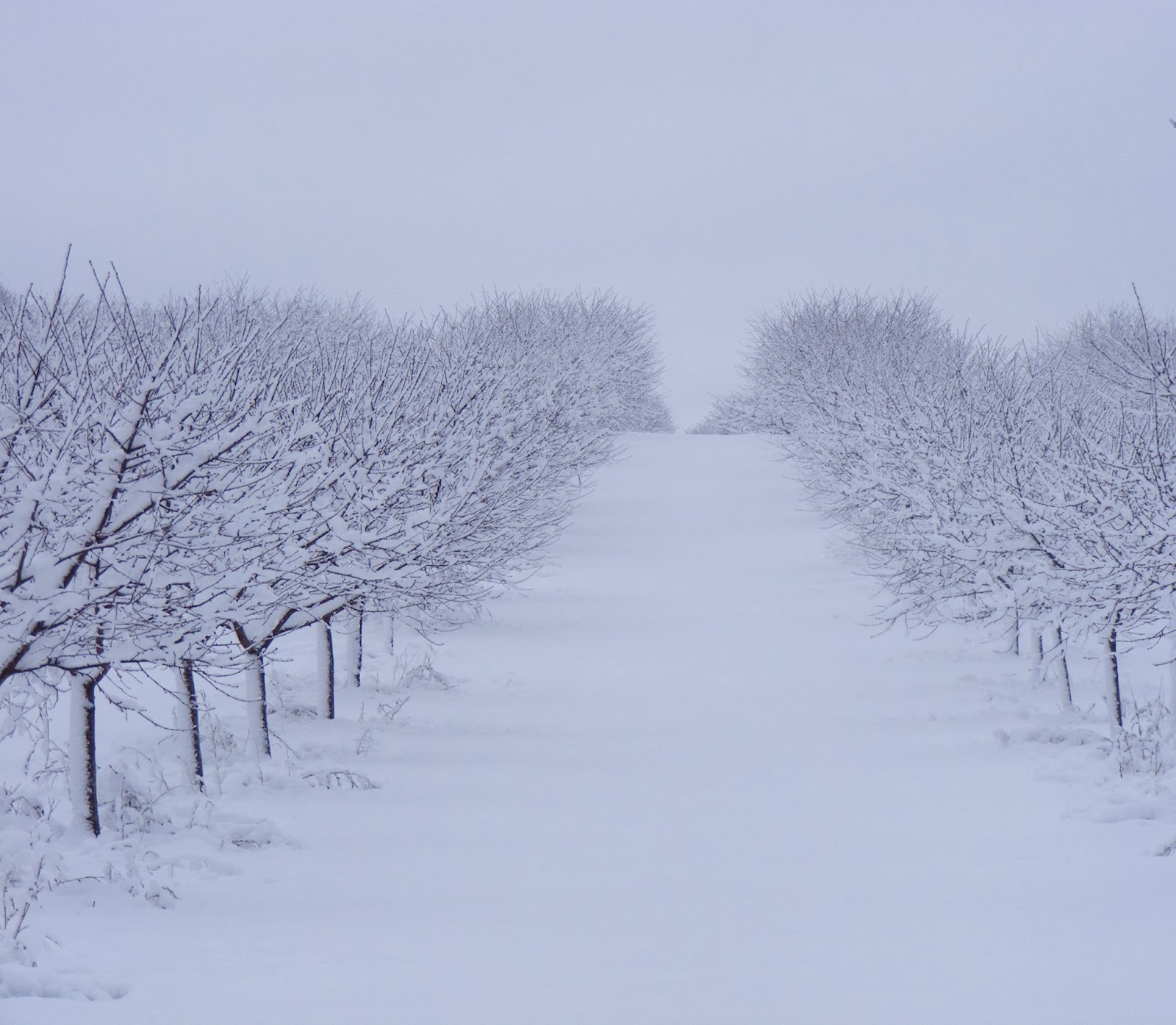
My search through old photo files did, however, turn up beautiful, sobering images of Up North spring that counter a claim made by one of our friends the other day that we are “halfway through winter.” Here are a couple reminders of winter-spring not long ago. First, here's March of 2012:


Then, late April of 2011:


On the other side of the coin is that four days after the four snowy photographs above were taken, the snow was gone, and I found these little flowers in the woods, Sunday (Easter Sunday), April 24, 2011:


 Now, wouldn't you rather look at those woodland wildflowers than at more pictures of snowdrifts today in my farmyard driveway?

4:15 p.m. Coming back to add a p.s. to say that I have updated my other blogs today, also -- the photography blog, the drawing blog, and the one where I rant about all kinds of miscellaneous stuff. Warning: If you read the last one linked there, it may blow the top off your head!