Search This Blog

Sunday, February 18, 2018

Fresh, Cool Mountain — Snow?

Intersection lake (temporary)

Almost three weeks ago, when we first crossed the state line from New Mexico into Arizona, my searching eyes were disappointed not to see snow on the high peaks of the Pinalenos to the north, but I accepted the evidence of a warm, dry winter. What choice was there? Then the rains came to southeast Arizona, three solid days of soaking rain. There was standing water on the previously dusty land, and in the town of Willcox entire streets and intersections had become temporary lakes. Water, water, everywhere! Well, that was exciting!

Standing water!

We elected to make another trip up to Safford in Graham County, only this time taking the straight highway route north and coming back through the mountain pass, a reverse of our usual path. As we came closer to the Pinalenos, I couldn’t believe my eyes, but I couldn’t disbelieve them, either. 

What to my wondering eyes should appear?


Clouds and fog notwithstanding, that white on the mountaintop did not look like a cloud at all. Could it be — snow?

Clouds

Clouds closer, snow farther back?

In southern Arizona, altitude is more a factor in climate than latitude. If you travel only 15 miles but gain 1,000 feet in elevation, the difference in climate is as if you had traveled 300 miles north from one part of Michigan to another. Years ago (about 120 years ago, actually), a naturalist named C. Hart Merriam came up with the idea of “life zones” to describe the difference in flora and fauna at successive altitudes in Arizona. He called the lowest zone Tropical and the highest Arctic-Alpine. His system is no longer used by scientists, but I like it, and the white peak I saw on Saturday reminded me that the Pinalenos, like the Chiricahuas, are the only mountains in our “neighborhood” with climate variations ranging from the Lower Sonoran to the Canadian, lacking only the very lowest and highest of Merriam’s life zones. That would put the high regions in the Pinalenos in the Canadian life zone, and since the highest peak in that range is over 10,000 feet, wouldn’t it make sense that rain in Will-cox could be snow 6,000 feet higher, remembering that 6,000 feet is the equivalent of 1800 miles of latitude?

Brought to you by the miracle of ZOOM!

Well, that’s it for me. Until someone convinces me I’m wrong, that was snow we saw on Saturday! I was also thrilled to see rushing water, at last, in almost half a dozen formerly dry streambeds and washes as we entered the town of Safford, and after lunch, as we turned back to the south, I anticipated eagerly our route through Stockton Pass. 

A favorite stop along the way

Between Safford and the turnoff for the mountain road, the landscape is dominated by cactus — prickly pear and cholla, some of the latter as large as small trees. This is what characterizes Merriam’s Lower Sonoran life zone. The road up to and through the Stockton Pass takes us into an Upper Sonoran landscape. Here our Michigan eyes delight in trees along creeks and dotting high, open areas of grassland. There are beautiful alligator junipers, familiar to us from the Chiricahuas, and small oaks, too. (The oak is such an adaptable genus, I reflect, recalling oaks of various species in Florida scrub all the way to northern Michigan.) Although not on the highest mountain peaks or slopes, not even as high as Merriam’s “Transition” zone, we don jackets for comfort.


Surrounded by natural beauty, it is difficult to know where to look. Close at hand are fascinating rocks, one with blue-green lichen, another stained blood-red, while in the middle distance handsome trees demand their due, and always, as far as the eye can see, there are beautiful mountain views. The solution, of course, is not to choose but to take it all in.


Sarah, true to her nature, relies heavily on her sense of smell. Eagerly she sniffs the cool, fresh mountain air and investigates twigs and ground and blades of grass. 


“It’s easy to imagine living here,” comments the Artist. Yes, all three of us find our hearts responding to this beautiful place along our life’s trail.

Not forbidding in all aspects....

Friday, February 16, 2018

At Last, Comes the Rain!

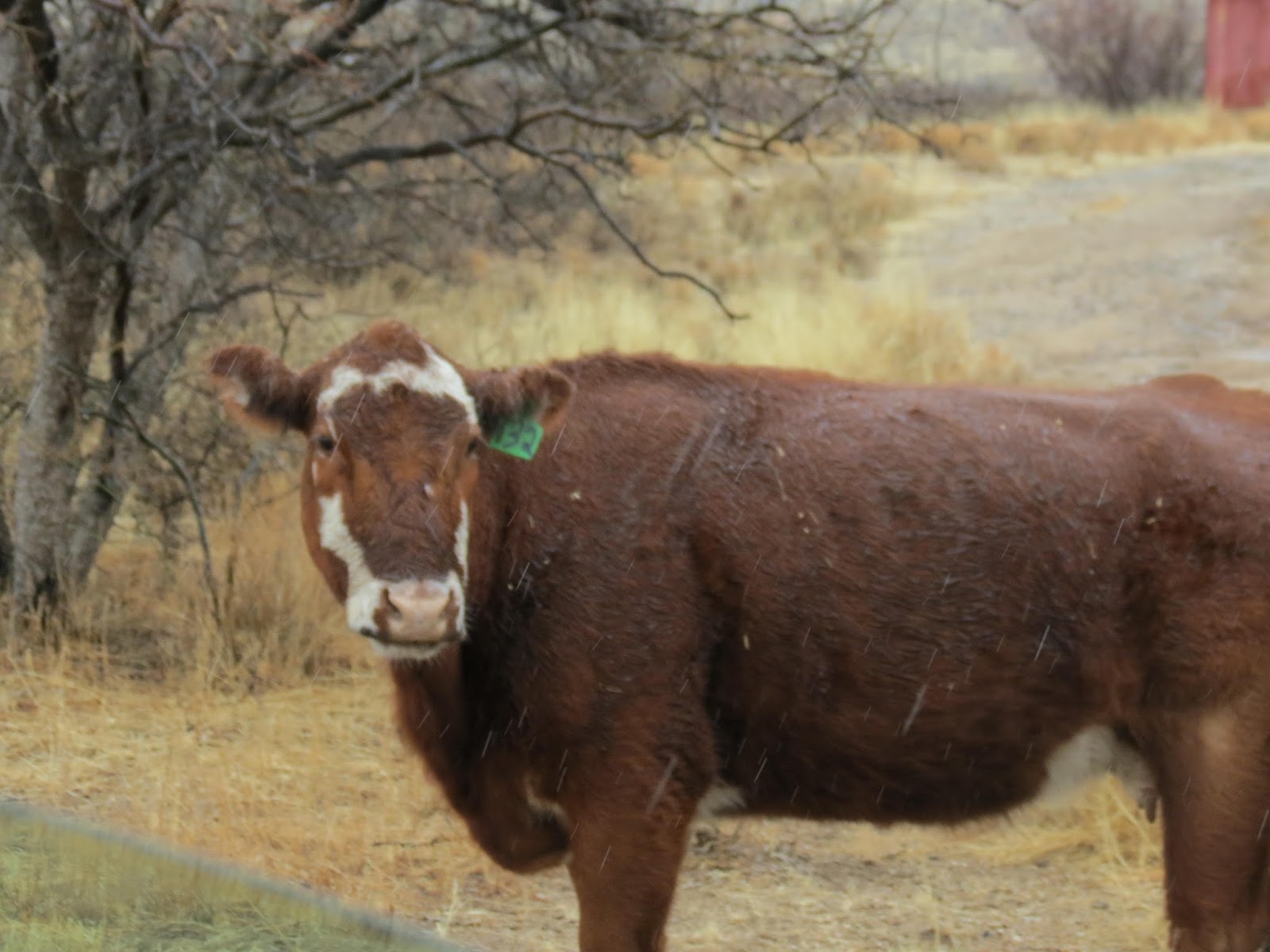
Cow does not hurry, even in the rain
Since the desert always smells like dust, after a while one stops noticing. Then come the first scattered raindrops after weeks of drought, and their spattering on the dust intensifies its smell, brings it to the fore and thickens it, as if the dust both underfoot and in the air wants to turn to mud. Do the cows notice the rain? Their behavior is unchanged. We come home on the first rainy day to find a bovine mother and child in our driveway, and as we turn in the little one gives an awkward little calf jump sideways, while his mother moves more placidly out of the way. 

A day without sunshine means none of the usual warming of the cabin that we help along by opening blinds as the sun climbs higher in the sky. On a rainy day, with colder temperatures outside, it makes sense to keep the blinds closed to hold onto the cabin’s stored night warmth. Late in the afternoon, for the first time this winter we light the gas heater for an hour. It doesn’t take long to make a small living space toasty warm and cozy.

Back in Michigan, we sometimes sit out on our enclosed front porch during a summer storm and marvel at the deafening sound of rain on the metal roof. Our winter ghost town cabin is, in that sense, like one big enclosed porch: the combination of metal roof and uninsulated walls magnifies the sound of the rain. It goes on all night, nonstop, but at last, despite the noisy symphony, we fall asleep.

Where did the mountain go?

In the morning on the second day of rain, we awake to a world transformed. Mountaintops have disappeared into low-lying clouds, and we look out onto the desert landscape gleaming wet and fading away into mist. As the steady rain continues, there are no long distances AND no “big sky,” either. As much of the ghost town as is visible is a flying machine we sail, lost in the clouds.


Later, on the road to town, the clouds have lifted somewhat, revealing some of our familiar neighborhood peaks. Others remain shrouded — and the rain continues to fall. There are actual patches of standing water on the land in places. Intersections in town are flooded. We feel as if we are somewhere entirely different and foreign and strange. Nothing feels the same in the rain in the desert.


A letter from a friend, waiting for me in the post office box in Willcox, includes part of an article on “healing places,” with mention of the positive way human brains respond to “sweeping vistas.” In the midst of this much-needed desert rain, we have lost our sweeping vistas and are enveloped in moist cotton batting. During three days of rain, we retreat into books and movies and the comforts of soup. Not only chicken soup but any hearth, homemade soup has healing qualities of its own, I truly believe, as the rain heals the parched land.


Wednesday, February 14, 2018

Dear Reader, Whoever You May Be


Enter ghost town!

One windy afternoon here in the high desert, while removing membrane from sections of grapefruit for a citrus-based salad, I fell to musing about friendships in my life that have been nurtured by the exchange of handwritten letters. The thought was not unusual, since I am far, far from my Michigan home. Laurie, Ellen, and Leonore, all back in Michigan, came first to mind, friends very much still in my life. 

Laurie and I met on her return from a year in Spain and saw each other occasionally in Kalamazoo, since our husbands were old friends, but only when she left to live in South America and we began writing one another leisurely epistles recounting events in our respective lives did we begin truly to know each other. It was different with Ellen. She and I had worked together before she and her husband moved to Arizona for a year, and writing letters seemed natural to us both. Leonore and I were friends in Kalamazoo, where our children were in school together, but letters between Michigan and Colorado when she and her family were living out West brought us close in a new way. With all three of these friendships, someone I knew in one context went to live far away from the place where we first knew each other, so perhaps part of my interest in writing and being written to was a desire to enlarge my own world.

Sarah investigates cattle path

There is something intimate about a handwritten letter, too, and no doubt some of its value comes from the rarity of such communication in our modern lives. We have no need to write letters, buy stamps, and delay the gratification of knowing our efforts have been received and appreciated, when it is so simple to make a phone call or send a text or an e-mail. Because letters are not necessary, and time to write a letter must be intentionally carved out of a busy life, the friend who takes the time to write adds something valuable to the friendship. 

But — a confession! At least one of my friends understands that my letters to her are just as much self-indulgence as they are gifts to her! In one letter to her years back I quoted from M.F.K. Fisher, writing to one of her correspondents, the passage an admission on Fisher’s part that letter-writing, for her, took the form of an addiction. Yes, there is that, too! So the friends who receive my letters are doing me a great kindness, indulging me for having given way to an overwhelming compulsion.

Ed and I began writing letters to one another in French but have fallen off lately. I remember how long I would labor over letters to my friend Helene in Paris and how pleased I was when she complimented my efforts. Something new this year: thrilled that I am now working too learn Spanish, my friend Laurie encourages me to write to her in Spanish. These missives in other languages lack the spontaneity and ease I feel with English, but writing them affords me a particular sense of accomplishment — and I love the letters I get in return, too.

For many years I had a couple of good friends who never answered my letters in kind but would pick up the phone from time to time, and that worked for us in those relationships. I was uncomfortable making phone calls, and they were not good at writing letters. I still miss the surprise of a call from M., whose present whereabouts are unknown to me, though I have tried repeatedly to locate her. And I cherish the memory of an actual letter from L., the first and last I ever had from her, written in the winter before she died. We were looking forward to a spring visit in Arizona, and when she wrote she recalled our first Arizona visit twenty-three years before. Well, we did have the anticipated second Southwest visit, a lovely time of reconnection. I thought there would be many more to come, but though I can see her no longer, her letter assures me still that our meeting was as important to her as it was to me.

I miss my letters from Helene, another friend whose death hurt my heart, and I miss letters from Annie, too, mon amie philosophe fauve, her ashes now sprinkled at the site of the ancient stone circle of Avebury. What joy it was to find their letters waiting for me in the post office box!

Naturally, I have e-mail correspondence, too. In fact, e-mail letters are already an almost obsolete form, aren’t they? Old-fashioned! But the friends with whom I exchange e-mail messages are mostly of my generation (or are understanding family members a generation younger), and we compose our messages in the manner and with the care we would take to write letters on paper. “Dear Kathy,” I begin, and she begins “Dear Pamela.” Kathy and I pay attention to paragraphs and spelling, and we try to entertain each other with lively description. 

Recently a friend on Facebook sent me a link to a feature article about writers and their diaries and journals. Of all the writers appearing in the story, the one that meant the most to me, the only one that brought a catch to my throat, was Anne Frank. She had never kept a diary before and probably never would have except in hiding; in her normal, prewar life, she was a sociable, outgoing young girl, and had her family been able to escape altogether lands occupied by Nazis, I can easily imagine her writing letters to real living friends back in Holland, not to the imaginary friend “Kitty” she had to invent. When I first read her diary, I was the same age she had been when writing it, and I longed to have been able to exchange letters with the living Anne….

A diary may be hidden away or published in multiple volumes. Writers of private journals intend different ends for them, and it seems to me that the future a writer imagines for his or her diary — whether forever private or completely public — must affect the writing. Some writers wanted their private writings destroyed, but posterity decided otherwise. What would those writers think now, could they return and see their most personal and heartfelt struggles printed and bound and offered for sale in the marketplace?

I have never kept copies of my letters written to friends, and Books in Northport, this blog, now in its eleventh year and public though it is, is the closest I have ever come to keeping a journal of my life with any discipline. My letters, it should surprise no one, often contain more personal thoughts, but the images in this public log give it a dimension the letters lack. 

And what occurred to me over the citrus bowl — the goad to my sitting down and writing this post at all — is that every post published here is like a letter in a bottle, tossed out onto the waves, to be found and read by anyone or no one. When I release it to the world, it is out of my control. Sometimes, as was the case when I was 17 and went with a friend one night a week to a local radio station to take call-in song requests, I wonder if there’s anyone out there in the dark at all. Other times I am surprised to learn how far a specific letter has traveled, on what shore that bottle washed up. 

“Dear reader” is an old-fashioned literary conceit, but I am an old-fashioned person — a bookseller, a reader of print books, and a handwriter of letters to friends. I don’t even have a “smart” phone! All of which is to say, as I struggle for a way to bring this post to a graceful close, that when you read Books in Northport, you are reading as much of a diary as I will ever write, and you are also reading a letter from a friend, whether or not we ever meet face to face. And I do thank you, once again, for indulging me as you do in this strange compulsion.

Sincerely yours, 

P.J.


Simple materials

Sunday, February 11, 2018

Of Wind and Drought and History


“The air is harsh in its dryness, gentle in its movement — most of the time. Naturally, high winds that trigger dust storms are the exception. Most mornings, however, the air is quite still, a gentle breeze developing as the sun rises higher in the sky and dying away with sunset.”

No sooner do I compose such lines, fondly believing I have captured an important regional truth, than the wind kicks up in the morning, maddeningly putting me in my place. “You presume to think you know me?” the high desert seems to say. “We have only begun to get acquainted, and already you have forgotten the extremes of which I am capable!” If the winter sun of the Southwest is drying (as indeed it is), the sun’s drying quality is nothing compared to that of the wind. Winter, moreover, already the dry season, is also the windy season, making for a dangerous situation, particularly in a drought year. The wind is so strong that the Saturday “swap meet” (what in Michigan we would call a flea market) falls apart almost as soon as it gets underway, vendors packing up and going home before noon.

In the overgrazed grasslands, and across the ancient dry lakebed known as the Willcox Playa, wind also means dust, and the dust gets into everything, which is point #2 against the wind. Point #3 is the noise, the constant rattling of blinds and any loose metal anywhere. When the wind blows all night, it seems as if it would lift the roof clean off the cabin and open our living space to the stars. The wind chases away sleep.

The stars, however, regardless of what poets and songwriters say, do not blow around in the wind and neither do the mountains give way. Is that where unchanging truth lies? Hardly.

This land has been covered by ocean and uncovered and then covered and uncovered again. I lose track of how many “transgressions” and “regressions” of the sea have taken place in geologic time. Just now the landforms seem stable, but that is stability as seen by the human eye, in the context of a human lifetime. Presumably, erosion of the mountains continues, albeit at a rate slower than the movement of glaciers. Change, I remember from the first day of my freshman high school earth science class, is the one geographic and geologic constant, though from one day to the next we cannot mark its transformations.


Harsh in its dryness, in stirring up dust, in the nonstop and enervating noise it makes, the wind bears us no ill will. It is impersonal, not malicious or vindictive. We watch the clouds and hope for rain.

*****

My reading so far this year, beginning with the upheaval of packing up our Michigan life, followed by a week on the road accompanied by a wretched cold, and continuing with our days of settling in here for the winter, has had a flighty quality, to say the least. I pick up a book and read a few chapters — sometimes, with even less discipline, turn pages in a constant search for who-knows-what, looking for something to stay my mind. Beginning a novel on the Columbia River, I find it is not what I expected and for several evenings pick it up only reluctantly, making slow progress. I find a book on Arizona geology at the library but am vexed by the multitude of examples drawn from the Grand Canyon (so far from my ghost town cabin home), a complete absence of reference to “sky islands” in general and Chiricahua in particular, and the inexcusable lack of an index. One of Chiang Lee’s delightful “Silent Traveler” books comes to my hand at the Friendly Bookstore in Willcox, and I purchase it happily but then find it difficult to lose myself in the traveler’s gentle prose and reflections from the mid-twentieth century. 

My mind is too full of urgent questions! How were these mountains formed? When will the drought end? What is a reasonable solution to the maintenance of national borders? How did we, as individuals and as groups of people, come to be where we are now? I need to find a book that sets my hair on fire!

William H. McNeill’s The Global Condition: Conquerors, Catastrophes, & Community may turn out to be the book. It's off to a fiery start! 

The underlying question in all McNeil’s researches and speculations is not simply “what happened” at any given time but “what really matters in human history,” and his way of trying to get at an answer is to look carefully at purposes and processes. Human beings, as individuals and as groups up to the level of nations, have purposes and act to achieve them. We are intentional beings. And yet again and again, not only do our diverse purposes clash with those of others, but larger processes — biological, cultural, economic  evolutionary, meteorological, etc. — interact and distort and often completely derail the plans of mice and men. In terms of our judgments, we assign praise and blame within the context of purposes, conveniently (for the purposes of our judgments!) ignoring larger global processes within individuals and nations are caught up and tossed around like playthings of the gods. — I am mixing my own concerns and observations here with exposition of McNeill’s lectures, so do not judge his work by this paragraph, please....

Thus far I have read only the few pages of preface to a collection of five lectures McNeill gave over the course of seven years. In the lectures he explores the question of how historians should address the relationship of purposes and processes and how they can decide “what really matters” in clarifying this relationship and the course of human events. He says in his preface,

History as a course of study cannot be exhaustive: too much is knowable. What should be left out to make the past intelligible?

He argues for history to be expanded beyond national borders, for the study of world history, and the development of a global consciousness, because only that larger perspective can take account of the processes that work upon our lives. He also insists that “history” must include physico-chemical, biological, and semiotic systems, noting that the more skillful human beings become in carrying out their purposes on earth, “the greater the potential for tragedy.” He does a quick sketch of the history of his purposes-and-processes question as it was treated from Ancient Greece down to the present, and it is in coming to the end of the twentieth century that he finds “scientific” national histories — a notable nineteenth-century achievement — inadequate. Remarks on a “global economy” have become commonplace in the transition to the twenty-first century, but McNeill goes further.

In particular, I have become far more aware since 1963, when my major effort at a history of the world was first published, that what happens among humankind is embedded within events affecting  the biosphere as a whole. 

Finally, he admits the enormity and impossibility of the task he sets for himself.

No one is ever likely to put all knowledge together in a way that will command the assent of all reasonable persons, yet trying to understand is irresistible. 

The historical question of purposes and processes reminds me of the philosophical question of the one and the many that crops all over the place. How can many birds, for example, all be the same thing, ‘bird’, and how can a collection of individuals become one polity, act as one person, e pluribus unum? The great philosophical systematizers sought to explain the whole dizzying plurality and diversity of existence in terms of a single system, each one criticizing and rejecting the system preceding his own and being critiized and rejected in turn. But I digress....

I will never know all there is to know. I will never put together enough to see more than a vague, very likely mistaken, whole. And long before I can even begin to satisfy my craving for understanding, my time on earth will be over, while impersonal processes continue and human purposes intelligent and ignorant, collaborative and conflicting, go on being enacted. In short, the party will go on, and I will never see what happens next, let alone how it all turns out. 

But I am here now, and just as I take my primary task in the world to be paying attention, I also feel a corollary duty in the search for understanding, and it wouldn’t matter to me if the entire rest of the world were to see (were they to look at) my self-assigned work as a ridiculous waste of time. These are the purposes I set myself.

So I am quite pleased and very excited at having fallen serendipitously on this little book by an author whose name is entirely new to me. The richness of the nine pages of McNeill's preface have admirably prepared my appetite for the lectures to come, and I predict I will stick to the last page. 

*****


Will I finally finish an entire book? Will rain come to the high desert at last? Such are the ephemeral concerns of Books in Northport today. According to the Sunday morning weather forecast, there is a possibility of rain by the end of the coming week, and while another week's end seems very far off, I know it will arrive quickly. For now, we can only hope the rain will come with it. 


Thursday, February 8, 2018

Not a Serious Birder (But a Serious Reader)


No excuses. I lay it up to personality. Serious birders, like serious collectors, possess a compulsive gene that I lack, so when it comes to birding (as, I fear, many other life activities), I will never be more than a dilettante. Life holds forth too many other compelling distractions. 

But birds themselves often serve to distract us from other concerns, bless their tiny hearts! The Artist, famously an aviphobe from childhood, was delighted to see a pair of northern cardinals near the ghost town cabin, the male a striking patch of color against the winter-dull high desert background, and I was thrilled when we were visited by a roadrunner, right in our own backyard. But no, I have no photo of the latter. He disappeared into the dry grass like a ghost, and I think he will be my ghost town ghost from now on: I'll go on looking for him every day and probably never see him again, though he will haunt my winter.


On our first visit to the library in Willcox, I went immediately to the Arizona section to find Birds of Southeast Arizona, by Richard Cachor Taylor. That afternoon, using my camera as both binoculars and recording device, and then consulting Taylor's book, I sighted and identified a northern mockingbird and a canyon towhee. The mockingbird is beautiful -- so elegant! 


The towhee, on the other hand, is a drab little bird and spends a lot of its time on the ground and blends in with its surroundings that it is hard to see at all. But the canyon towhee is handsome in his own quiet way once you pay attention to him. Taylor says of him,"Forages for seeds and insects on the ground," and that fit. Another comment I find utterly charming is this characterization: "This is the most confiding towhee...." Oh, sweet! A little ghost town confidante!


Two other birds had me flipping pages back and forth and reading descriptions carefully, over and over. Was the flicker I photographed a gilded or a red-shafted northern? At last (somewhat regretfully, I admit) I decided it was the latter, owing to the bit of salmon-pink visible under the wings.


Then the sparrows! Oh, lord, the sparrows! I think it was sparrows that discouraged my girlhood birding so long ago -- so many of them, and so similar, with males, females, and immature birds all different, plus differences in summer and winter coloration. And they are so small, and they never seem to hold still for two minutes! Not holding still, in general, is my biggest complaint against birds and probably why I have always found wildflowers more congenial.

But how about these sparrows (and are they all even the same species)? My best guesses are that they are either chipping sparrows or rufous-crowned sparrows. 


The white eye ring I think I detect by zooming in on one bird leads me to say rufous-crowned, but the photograph of that species in the Taylor book does not show back or wings at all. The rufous-crowned sparrow is common around here, and a common species is usually a good guess, but then chipping sparrows have been common in many places I have lived. Here is one noteworthy bit of minutae on the chipping sparrow: "In SE Arizona, Chipping Sparrows breed regularly only in the Chiricahua Mountains." That means they would not have far to fly from Dos Cabezasto to reach their breeding grounds. But how far does a little sparrow fly in a day?

There is a lot of bird activity around the cabin in the mornings, but in the afternoons the birds seem to go elsewhere, and that gave me time yesterday to complete the tenth lesson in Ultimate Spanish, the first chapter in the book to finish off with a short (two-paragraph) reading. As is customary with learning another language, I am much better at reading comprehension than at originating sentences of my own, and the reading exercise gave me no trouble at all. Listening comprehension -- to native speakers -- is something else again! I can read at my own speed but have to try to listen at a speaker's speed! Need I say more? But there is no point in becoming discouraged. Practice, review, immersion, perseverance -- repeat, repeat, repeat. No other way.

Ultimate Spanish is a book I brought with me from Michigan, a book my friend and I had with us in the Yucatan and which she generously said I could keep. The other two books I checked out of the library were Sky Island, by Weldon F. Heald, and Old Southwest New Southwest: Essays on a Region and Its Literature, edited by Judy Nolte Lensink and published by the Tucson Public Library in 1987. I recommend the latter to all my friends and readers who are students of American literature, noting to general readers that it is a collection of essays on literature and not a literary anthology.

I was particularly struck by "The Other American Literatures," by Rolando Hinojosa-Smith. He sets the stage by citing a brouhaha at Harvard University in 1896 when one of the professors set out to teach the writings of Hawthorne, Poe, Melville, Whitman, and Dickinson as "American literature." Threatened with dismissal the following semester, he caved in and went back to teaching standard English writers. Writers from England were established and recognized; American writers at that time were not. 

Another important point Hinojosa-Smith makes is that all writers in the United States are American writers, regardless of their ethnicity or birthplace or place of residence. I am reminded of Jim Harrison's complaints at being labeled a "regional" writer, and I know other Michigan writers who still find it difficult to be recognized simply as "American," a label that somehow gets assigned to those from the East and West Coasts.* Even the term "local writer" can be a double-edged sword, as I have found in my bookselling life: sometimes tourists are looking for "local color" and hope to find it in a book by a "local writer," while other times the tag "local" seems to put a book down the ladder from national bestsellers presumed to be of greater significance. 

I am with Hinojosa-Smith on this matter. Writing quality is not dependent on region or writer's background.** Writing deserves to be judged on its own merits. 

--------

*Is the Midwest (let's say Minnesota, Wisconsin, Michigan, Iowa, Illinois, Indiana) a region? (Does Chicago stand out from its Midwest background as more cosmopoligan, more like New York?) Does the Midwest, like the West, the Southwest, the South, have a recognizable literature? Should we expect and look for such a category? 

**What are the purposes of dividing American writing and writers into regions? What are the pros and cons of categorizing writers by ethnicity? How do you see it?