Search This Blog

Sunday, August 14, 2016

We Talk to the Artists – Then Go to the Dogs

Kaye, Ken, Kaye's painting, their book

Not knowing until the day of the event whether Ken Scott and Kay Krapohl planned to give a formal presentation or sign books, I advertised their appearance as “Conversation with the Artists,” and that’s exactly what it turned out to be. Ken’s message on Thursday was that they would do a Q&A if anyone who came to buy a book had questions, so I set up a few chairs in the front of the bookstore, with a signing table for the photographer and the painter. People came. They had questions. They had really good questions. The answers were fascinating. I didn’t write down everything that was said but did take a few notes.

What gave rise to the idea of two people trekking the Leelanau shoreline together. Ken cited the safety factor first and stressed that safety was particularly an issue in winter cold and on winter ice. Two people also meant two cars, one that could be left at the take-out point while the other (to be retrieved later) could be driven with both trekkers to their put-in location. Ken was also interested in what it would be like to work alongside another artist, especially one working in a different medium.

As a photographer and a painter, it was a given that the two of them would work differently. Ken Scott composes his frames onsite and does not manipulate images later, so his premise is “You get what you get,” in the moment. Very different, of necessity, was Kaye Krapohl’s way of working. She could not afford to stand in one place long enough to complete a painting and keep up with her trekking partner, too, so she made many studies (“scribbles,” she calls them) and photographs and notes for later use in her studio. There were also days when her usual “big picture” vision did not fit the weather, and then she learned to focus on small details she would not otherwise looked down to see.

I have a bit in my notes about an event Kaye and Ken did, sponsored by Inland Seas. It involved an exhibit, mostly of Ken’s photographs, and people with science backgrounds were invited to this free forum that gave the artists an opportunity to point to aspects of what they saw and ask the science people, “What’s going on here?” Sometimes it was sand structures, other times zebra mussels or something very different. Kaye was intrigued to find that environmentalists are not always opposed to docks, in that docks can provide habitat.

Live wire painter and Zen photographer
There were many more questions and answers and discussion, and altogether the conversation was fascinating. Somehow I prevailed upon both artists to stay long enough to sign most of the rest of my books, too, although Ken Scott was in a hurry to get outdoors with his camera, not wanting to miss “the light” as skies cleared after the rain and rainbows appeared. I’m sure he will have gotten some fantastic shots. [Have seen one of them since! Beyond belief gorgeous!] Mine from the front door of the bookstore leave a lot to be desired, but you may get a little feel for the evening.


I’d had our reading circle over for a picnic on Wednesday, but although a camera was mentioned early on, somehow we all forgot about it later, so – no pictures! We had not all read a book to discuss together, but each of us reported on what we have been reading, and there were several recommendations for a group read. I’m not sure which books fall into which category (reports/recommendations/group recommendations), but some titles mentioned were: Independent People, the Icelandic classic by Laxness; something by Hemingway; Huckleberry Finn; Madame Bovary; McTeague; John Le Carre’s A Perfect Spy; The Way Things Are, by Lucretius (translation by Humphries); The Way of All Flesh; and All the Light We Cannot See, which two people reported they had tried to read and couldn’t get into, though everyone else who has told me (in the bookstore) that they read it loved the book. One group member has decided she will read one short story a day for 365 days. A noble goal! I want to introduce her to the stories of Valerie Trueblood.

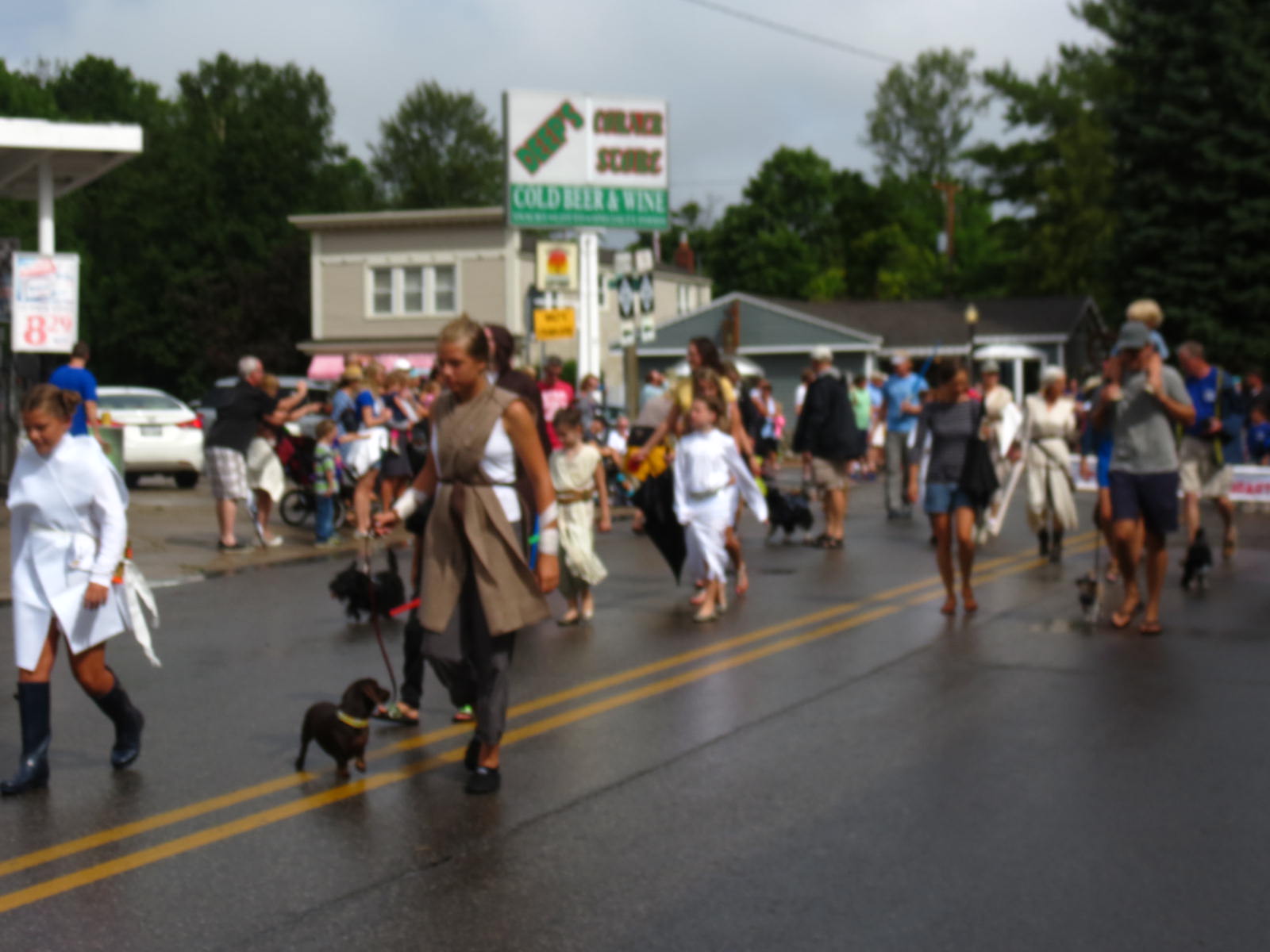
So, Wednesday was the picnic; Thursday, conversation with artists; Friday, farm market; and then Saturday – dog parade and presentation by veterinarian Mike Petty, author of Dr. Petty’s Pain Relief for Dogs! You have to understand that “going to the dogs,” in Northport, is a good thing. Maybe you already know this, having read in the Leelanau Enterprise that the Northport Dog Parade began 20 years ago. (Yes, once again, time flies.) David Chrobak, then-owner of the Old Millpond Inn, was the instigator and force behind the parade, which quickly won the hearts of locals and visitors alike.

Ready and waiting -- early!


Hi, Chris!


The gap -- as we wait for the second half of the parade to catch up
Rudy #1
Rudy @2

Rudy #3


There he is! Dr. Mike Petty!


Like Thanksgiving dinner, the dog parade is long anticipated, planned for all year, and over in a trice. 


One major dog parade sponsor this year was Dr. Michael Petty, my guest author for Saturday afternoon following the parade. Mike’s book is Dr. Petty’s Pain Relief for Dogs, which I read and reviewed and highly recommend. As David Chrobak noted in last Thursday’s Enterprise, our pets grow old just as we do and, sadly, actually overtake us in their aging. As long as their quality of life can be maintained, however, Dr. Petty’s dog parade banner, on the trailer carrying his old dog (and other dogs with age and mobility issues), was “You’re never too old!” 

Dr. Petty's dog was pretty tired when they showed up at the bookstore for the signing, but one thing is sure: no one is too young or too old to enjoy the Northport dog parade! A limited number signed copies of Dr. Petty’s Pain Relief for Dogs available now at Dog Ears Books -- a reference book for your dog’s aging future and for all the dogs of your life! 


Sunday morning calm after storms


Tuesday, August 9, 2016

Coming Back to Tell You More

My Bohemian Neighborhood

On Monday evening, out in the shade of a basswood tree, I finished Karel Capek's War With the Newts. When I first picked it up and began reading, I skipped the introduction to go straight to the story, and so I was expecting something other than what I found in the book's pages. Finally, about halfway through the book, I turned back to read the introduction. What I'd expected, you see, was some kind of roman à clef, a fictionalized account of political events of the post-WWI period in Czechoslovakia, and I wondered how much, if anything, I would understand of the story. Well, it isn't that at all.

Capek's scope is broader, his vision wider, and both plot and characters are much more original (I'm guessing) than any thinly disguised series of events between the two world wars would exhibit. I mean, a colony of surviving prehistoric newt-like creatures bred as cheap labor that eventually become "civilized" enough to overtake the world? Really?

Given that Capek was of the same generation as Kafka, it is astonishing how well the warnings of this very innovative novel speak to our twenty-first century world. Suspicion and fear of the Other, of course, are nothing new in human life. Today's unblinking focus on globalization, however -- the insatiable hunger for global markets, ruthless competition for faster, higher profits and ever-cheaper labor, the resulting instability and upheaval and terror in one part of the world after another -- all these facets of our world today can be found in The War with the Newts.

The story begins with a Dutch ship's captain who encounters the "creatures" off a South Seas island. Natives are afraid of them and call them "devils," but the captain sees possibilities in their ability to dive for pearl-bearing oysters, and especially in the little value the creatures place on the pearls. He trades them knives for pearls, after a while other tools for pearls, and the newts (not yet called 'newts' in the story) quickly gain an advantage over their one natural enemy, sharks.

It is the sea captain's meeting with a "captain of industry" that unleashes the eventual Newt Age upon the world. At first all is positive, everyone seeing nothing but an enlargement of prosperity -- for humans, anyway, if not for enslaved newts:
Real self-respecting men of the Newt Age will no longer waste their time pondering about the substance of things [questions of religion and philosophy]; they will only be concerned with their quantity and mass production. The whole future of the world lies in the continuous increase in production and consumption; therefore there must be still more Newts to produce and to devour still more.
Shallow-water, ocean-living creatures, the newts' special skill is in constructing dams offshore, and so they are shipped around the world and set to work building land, so that countries with ocean shoreline might increase their territory. Worldwide trade in newts is big money, uncomfortably like slave trade. Although of course those trading in newts and buying them as laborers insist that the newts are very well treated, groups form to agitate for newts' education (they quickly acquire languages) and rights. International conferences are held, international agreements hammered out by nation-states, but the newts are citizens of no state, and so no state feels obliged to negotiate with them directly. The newts, however, multiply much more quickly than the humans....

When Captain Van Toch first comes to the door of G. H. Bondy to discuss the opportunity awaiting anyone with the foresight to exploit the clever newts, Bondy's doorman, or porter, Mr. Povondra, might have turned him away. Van Toch was not known to Mr. Povondra and had no appointment. But for some reason he sees the visitor in, a very small decision that has very large consequences for the entire world and the future of the human race. And so, for several years, Mr. Povondra is an avid reader of newspapers and collector of clippings about the newts.
Mr. Povondra received day by day whole bales of documents in all the languages of the world, of which especially the papers printed in Cyrillic or in the Greek alphabet, in the Hebrew, Arabic, Chinese, Bengali, Tamil, Javanese, Burmese or Taalik script filled him with pious respect. "When I only realize," he used to murmur over them, "that all this would not have been without me!"
He is proud to have had, though a person very modestly placed, nowhere near centers of political power, a pivotal role in world history. With later events, his pride becomes regret, but there is no going back.

Capek's manner of telling his story borrows generously from nonfiction. He uses the format of newspaper articles in some sections, quotes from propaganda, scientific papers and presentation, and he makes extensive and occasionally hilarious use of footnotes. Some footnotes go on for several pages and take on the feel of short pieces of fiction in themselves.

Why is Capek's novel (he also wrote plays) nowhere near as famous as the works of Kafka? In the final chapter of The War with the Newts, the author argues with himself:
"...Listen, do you really want to let the whole of mankind perish?" 

The author frowned. "Don't ask me what I want. Do you think that through my will human continents are falling to bits, do you think that I wanted this to happen? It is simply the logic of events; as if I could intervene. I did what I could; I warned them in time.... I preached, don't let the Newts have arms and explosives, stop that hideous trade in Salamanders, well--you know what happened. They all had a thousand absolutely sound economical and political reasons why it's impossible. I'm not a politician or an economist; I can't change their opinions, can I? What is one to do? The earth will probably sink and drown; but at least it will be the result of generally acknowledged political and economic ideas, at least it will be accomplished with the help of the science, industry, and public opinion, with the application of all human ingenuity! No cosmic catastrophe, nothing but state, official, economic, and other causes. Nothing can be done to prevent it."
In Capek's novel the humans, by using newts to enlarge land for nations, diminished the shallow seas necessary for the newts' survival. It was only a matter of time before the exploding newt population demanded their seas back. The humans had dug their own grave.

Science fiction, political satire, dark humor, fanciful dystopia, innovative literature. War With the Newts is all that and deserves to be better known and widely read. If you don't believe me, here is someone else's pitch for the book.


*  *  *  *  *


In a much happier frame of mind, we will visit freshwater shoreline on Thursday evening, beginning at 7 o’clock, when photographer Ken Scott and painter Kaye Krapohl come to Dog Ears Books to share their stories behind the beautiful book featuring their work, Leelanau Trek: One Shoreline, Two Visions. Please join us!


Sunday, August 7, 2016

Recently: Eastern Europe and Me


Kathleen Stocking’s essay about her Peace Corps teaching experience in Romania probably kicked it off. “Something Else Week” is the title of one of the essays in Kathleen’s new book, The Long Arc of the Universe: Travels Beyond the Pale.  Then, can Russia be considered Eastern Europe in some sense? Letters from Russia, by a Frenchman who traveled to Russia in 1839, surprised me by how much 19th-century czarist Russia sounded like things I’d read and heard about life in the U.S.S.R. in the 20th century.


The late Tony Judt wrote of past and present all over the world, but one of his special areas of interest and expertise was Eastern Europe, a geographic area he felt had been sorely neglected by Western historians. While I may never make my war entirely through Postwar, many of Judt’s essays posthumously edited by his widow and published under the title When the Facts Change: Essays 1995-2010 either focus on or somehow make reference to Eastern Europe.


Halfway through my reading of the Judt collection, I plucked from my bookstore shelves Cafe Europa: Life After Communism, by Slavenka Dakulic, and took it home to read. Cafe Europa is a book that’s been in the shop for a while now, without anyone buying it and carrying it off – luckily for me, or I might have missed reading it. The author, born in Croatia in 1949, writes of the changes her native land has seen in her lifetime and the difficulty of shaking habits, mental and social, that may be holding back the arrival of truly responsible democratic citizens. Again and again in Drakulic’s essays comes the theme of the rewriting of history, still going on in Eastern Europe although Communism is gone.

Tony Judt was concerned with rewritten history, also, as was the Marquis de Custine when trying to understand Russia under the czars and where it might go from there. You might say that an interest in Eastern Europe leads naturally to a concern for honest history, given the way the subject has been mistreated in that part of the world. Not only there, of course, but to an important and serious extent, beginning in the past and continuing in the present. Another feature common to Judt’s and Drakulic’s essays is the idea that “Europe,” as a unitary place, the salvation of smaller countries from Russia to the Atlantic and the Arctic Circle to the Mediterranean, is itself a myth, a vague article of faith with little correspondence to reality.


Time for a switch to fiction – and what jumped out at me? War with the Newts, by Karel Capek, with a little upside-down caret over the ‘C’ that I can’t find in my “insert symbol” menu. This novel, “considered by many to be Capek’s greatest book,” is in the “satiric tradition of Wells, Orwell, and Vonnegut,” according to the blurb on the back. I also find there this account of the author:
Karel Capek (1890-1928) earned recognition as a journalist, playwright, and novelist in Prague before and just after the First World War. In the Czech Republic of the 1920s, his reputation was broadened by the international acclaim that greeted his play R.U.R. as well as subsequent novels and stories....
What did I expect? Whatever it was, it wasn’t what I found inside the covers of this paperback novel. This “Eastern European” novel, at least as far as I’ve read so far, is set mainly in the South Seas, where the captain of a freight-carrying and pearl-fishing expedition boat encounters a colony of – well, we are not sure yet what they are. Newts? Lizards? Tritons? They live in the ocean but are very dexterous and quick verbal learners. Preyed upon by sharks, the tapas (as the narrator calls them, following local native practice) bring up pearl-bearing oysters to the captain subsequently trade him pearls for knives, and eventually learn not only how to open oysters with the knives but how to use them to kill sharks. The plot has thickened considerably! What next? I’ll let you know how it goes. The real question will be how much of the political satire I am able to decode from the story.

And in my Bohemian country neighborhood, as you can see, the farms are doing well. 


Friday, August 5, 2016

Summer’s Busy, Warm, and Swiftly Moving Days


Bookseller Pamela Grath introducing author Kathleen Stocking

There you have it! Another author event, and for a change I got into a picture with my guest speaker for the evening, Kathleen Stocking, thanks to friend and customer Kirk O’Green.

Last time around, I wrote of the difficulty of scheduling summer events. So much is going on, every week of the season, that it is impossible to find a date that won’t conflict with something else. Kathleen and I chose our date before realizing we would conflict with the annual Leelanau Conservancy picnic. Then I found out it was also the first night of “The Music Man” and, if that weren’t enough, also Northport Village Council meeting night. Another spell of warm days, what people elsewhere might term a “heat wave,” was somewhat discouraging, also, to a bookseller without air conditioning (although I always think A/C for one or two weeks a year is plain silly, so I don’t want it). Would it be just the two of us?

One by one and two by two, e-mail and Facebook acceptances trickled in. Then I would see someone on the street who said, “I’ll be coming on Thursday for Kathleen’s talk!” So I assured my guest she would have an audience. “At least nine people,” I told her.

So David and I set up chairs, as usual. I mixed punch. We kept most of the gallery lights off to avoid excess heat, and people began to arrive. I introduced Kathleen, as you saw above, and she began to tell her story. Meanwhile, people kept arriving, and I kept squeezing more chairs into the gallery until, all told, we had at least twenty-five people in the audience, an amazing outcome on a warm evening with so much else going on throughout the village and township.

Lights off so as not to increase heat in gallery

And the audience loved her! I thought they would never let her go, even after she moved out of the gallery and into the bookstore, preparatory to saying good-night. If there is anything as gratifying to a bookseller as having a gracious writer as guest, it is having a warm (you should excuse the adjective), appreciative audience for that writer.

Kathleen Stocking
An author event is like a holiday, long anticipated and then, unbelievably, a past event. Kathleen Stocking’s books, however, I will be re-reading, as well as selling, for a long time to come, from Letters From the Leelanau through Lake Country to her latest, The Long Arc of the Universe.

Water in sunlight
“Possible thunderstorms after eight p.m.” or even “after midnight” never did materialize. The orchard workers, out shaking cherry trees long after midnight, were no doubt glad the rain held off, but my little home boardwalk garden was thirsty on Friday morning. Out came the hose! And then there was farm market, and then another bookstore weekend began.

Summer! Swiftly flow the days! There are only momentary pauses in which we catch our breath before plunging on to the next summer event. At Dog Ears Books, that will be another Thursday evening, August 10, with photographer Ken Scott and painter Kaye Krapohl sharing stories from their adventurous series of hikes around our beautiful Leelanau peninsula, memorialized in Leelanau Trek: One Shoreline, Two Visions. Hope you can join us again next week!

Momentary pause