Search This Blog

Friday, April 10, 2015

Adios, Dos Cabezas – Hola, El Camino

Morning hits the mountain


How do you feel about saying good-by to Baja Arizona? I feel sad to be leaving the scene of so many happy recent memories but eager to see friends and family along the way home. I’m curious to know what home will look like and feel like when we get there, too. Will there still be snow? Will our old things and haunts and loved ones greet us with gladness and not reproach us for the long absence? My emotions are in turmoil, mind jumping back and forth across the continent. So much to remember, so much to anticipate! Our old farmhouse, my dear bookstore, our beloved back country Michigan roads! But I won’t deny it’s hard to leave here.
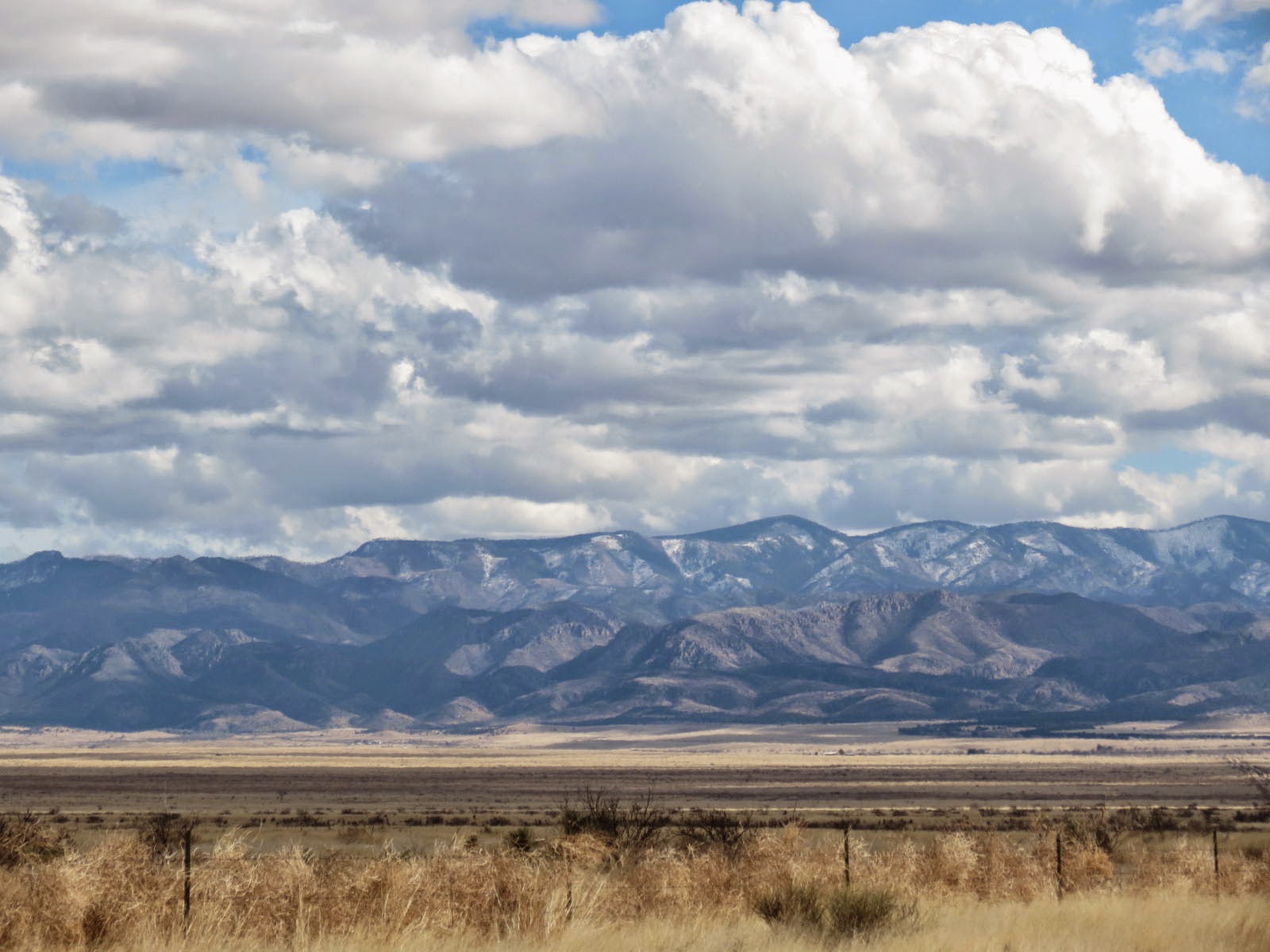


What will you miss most about Dos Cabezas and Willcox? I will miss, in general, the austerity and vastness of the mountains and desert, and the way this Western land, dry and barren in its superficial appearance, holds so many secrets and so much life – the wonderful, tiny details in the vastness. And while we did not forge deep relationships, I’ll miss the easy friendliness of strangers, the open smiles of greeting, the helpfulness we encountered everywhere we went. 

Our coffee place on Railroad Street in Willcox

More specifically, I’ll miss the characteristic Dos Cabezas smell of dust and cows, the daily sight of horse trailers on the streets of Willcox, the whole ranch and cowboy culture. It isn’t empty legend out here: it’s real life. And horses and dogs are very much a part of it all, I’m pleased to report.


To focus for a moment on the sabbatical aspect, how did your writing go? I’m happy with what I’ve done and with where I am now, despite having scrapped the 17,000-word beginning from a month ago and started over almost from scratch. I can’t even call the new version rewriting, because other than keeping a couple of good sections, I truly began anew. So “happy with  ... where I am now,” in terms of word count, is barely at the 6,000 mark, which may not sound like much to show for three months, but it feels very satisfying, because I like those 6,000 words. As I put it to David, my story is no longer wandering around looking for itself. Instead of filling in some conventional form called ‘novel,’ it has found its own shape. Better to make slow progress on the right road than push ahead on a wrong road until a dead end is reached. I’ve found the right road and have started down it.

So you would call the sabbatical a success and you’re glad to have spent the time where and how you did? There is a line in one of Wilfred Thesiger’s books that I used to know by heart and can only paraphrase now, something about how he was never happier in his life than riding the train from Djibouti to Addis Ababa. The other evening, when David and I were riding in the car between Dos Cabezas and the Chiricahua Mountains, taking in the beautiful scenery we have both come to love on a heartbreakingly lovely spring evening, I told him I felt like Thesiger in the train on the way to Addis. But the truth is I have felt equally happy on countless occasions during our stay here – at the livestock auction, at the junior rodeo, visiting our old friends in Patagonia, having the cows lowing around the house at night, exploring the environs with Sarah, sitting on Beverly’s old front porch in the shade with David and watching trains go by or sitting quietly behind the cabin, watching birds and lizards, looking off at distant horses and up to the mountains -- and on and on and on.

What have you learned from your time in Arizona? Well, for someone often more attuned to impressions than facts, I’ll be taking a lot of new information home with me. First there was the Cactus and Succulent Phase, then the Geology Phase, followed by the Bird Phase, and finally the General Botany Phase. In each phase, I read hungrily for knowledge of an environment entirely new to me. Also, from the very beginning, there was a hunger for history – first, for 19th- and 20th-century regional Arizona history, and now, more recently, for the entire long history of the borderland, la frontera, the area along the border between the United States and Mexico. That last, I’m sure, will be an ongoing area of study.


Any more personal learning? Finding that wannabe-cowgirl left behind at age 12 has been an important revelation. What it has to do with the rest of my life at this stage, I cannot say, but it feels right and good to come back to my girlish love of horses. Sometimes simply being around them makes me think my whole life from the age of 12 until now has been one long detour, but that cannot be true. Each life begins, I’m sure, without a destination, and only as we live do we create our path. I am just grateful that mine brought me to a little Arizona ghost town for this past winter. And now the time has come to leave. Volver? Espero que sí, pero no sé. “The future’s not ours to see....”

El camino


Wednesday, April 8, 2015

A Beautiful Farewell Evening Ride


The beautiful light of late afternoon and early evening pulled us out of the cabin and down the road toward the Chiricahuas. It was a beautiful, memorable ride.


As familiar as the landscape and scenery have become in the past three months, they are still new to us every day. You can see why.


Monday, April 6, 2015

A Star in the Western Tradition


Railroad Street, Willcox, Arizona

I vowed not to leave the Willcox, Arizona, area without paying a visit to the Rex Allen Museum, and now I can highly recommend it! Here’s how to get there:

To reach old historic Willcox from I-10, take the middle of three available exits and you’ll find yourself on Rex Allen Drive. Follow that to Haskell and turn right. (On Haskell you’ll pass the Motel 8, which occupies the site of the old house where Rex Allen was born, contrary to what you might read in Wikipedia about his being born 40 miles to the north where, it’s true, his parents did live before moving to Willcox.) At the intersection of Haskell and Maley, turn left, then turn left again at Railroad Street, and you’re right there, with a couple of museums and wine-tasting rooms on your left in the Old Town buildings and a beautiful park on your right. (Across the railroad tracks are yet more wine-tasting rooms. Willcox wineries outnumber those of Sonoita.) In the park is a bronze sculpture of Rex Allen himself.

Those approaching from Chiricahua National Monument on Hwy 186 have only to cross the railroad tracks and turn right, and there you are.

Intersection of Willcox and Railroad streets

 Before we came to Willcox, David and I were not familiar with the name Rex Allen, but since the name is everywhere in town, with “Rex Allen Days” the well-publicized high point of the summer season, we asked one of the first residents we spoke with and were told that he was one of the mid-century singing cowboys, along with Roy Rogers and Gene Autry. Well, those names we knew, but the name Rex Allen still didn’t ring a bell with us.

Admission to the Rex Allen Museum, which also includes the Cowboy Hall of Fame, is only two dollars. I want to emphasize this: it only costs two dollars to tour this museum! And so, friends and other readers, if you’re traveling west to Tucson, take the time to get off the expressway and detour through the old town of Willcox, because you are in for a big surprise!


When Roy and Gene read the writing on the wall and saw that television was the up-and-coming entertainment venue, they started making their own TV shows, the ones I grew up with in the 1950s. Who else remembers? Besides Roy Rodgers and Dale Evans and Gene Autry, Hopalong Cassidy and the Lone Ranger were favorites of mine. Who else am I forgetting? My point here is that when Roy Rogers stopped making films, an opening was created, and it was Rex Allen who filled it. Between 1950 and 1954 he made 19 feature films, all with cowboy themes. The advantage to the studio was that no one had to teach him how to ride. 

his first guitar
He was not an actor needing cowboy lessons. Starting out from Willcox after high school graduation (“Willcox, Home of the Cowboys”), he went to Tucson with dreams of being a rodeo bull rider. He’d worked cows before. His first ride on a Brahma bull, however, persuaded him to concentrate on his music instead. That’s another thing. Rex Allen wrote the “Arizona Waltz” when he was only 14 years old, and his recording of “Crying in the Chapel,” long before Elvis touched the song, went gold. He recorded “Frankie and Johnny.” He had his own long-running regular radio show on WLS in Chicago. His recording career with Decca spanned 35 years!

And as for the movies, even after Western films faded away Rex Allen kept working in the film world. Have you seen “Charlotte’s Web”? That narrator’s voice is Rex Allen’s. He also narrated “The Incredible Journey” and many other Disney nature documentaries. “So,” as the volunteer museum host for the day put it, “even if you’ve never heard of Rex Allen, you’ve heard Rex Allen.”


David wasn’t sure he needed the Rex Allen Museum experience, so he strolled around in the park across the street, admiring the sculpture and looking it over carefully while I went in to begin my tour. But there in the museum I found a different, smaller, limited edition sculpture David just had to see ... an exhibit on the making of the large outdoor sculpture ... and then, capping it all, a photograph with accompanying note to Rex Allen from the Lucchese boot people! “Oh, my god!” escaped me at that last one. David could not miss this museum!

(David's boots, not Rex's)

Lucky for me, too, that I got David into the museum, or I might have missed, in my hurrying to rejoin him outside, the Cowboy Hall of Fame. 


In the parlance of baja Arizona, a “cowboy” isn’t only a lariat-slingin’ vaquero (although he can be that): he’s any horse-riding, cow-working rancher or ranch employee. Naturally, I am especially interested in the women ranchers, and in the book of “cowboy” mini-biographies, the only one I was in its entirety, with pleasure, was of a “cowgirl.” The guys and gals pictured here in the Hall of Fame are all the real deal.


When Rex Allen’s horse died, Koko’s ashes were buried in the park in Willcox. Rex himself, with failing health, spent his last days in Tucson, but he never forgot his hometown. “He’s the reason we have a hospital,” the museum volunteer told us. While still alive, Mr. Allen often came to sit in the front window of the museum bearing his name and chat with visitors.

I didn’t get the name of that volunteer at the museum, but he and his spiel were memorable. Born in Tucson himself, he came to Willcox and taught for 28 years in the public school, and when he retired, he stayed, because, “Where am I gonna go?” Small town life and higher elevation climate had spoiled him for city life. When I told him where we had spent the winter, he told me a personal story, about singing for a burial at the cemetery in Dos Cabezas. His speaking voice was gorgeous, and I can only imagine how thrilling his singing voice would have been, out there under the open sky. Here is a rendition by Vince Gill of “Go Rest High on That Mountain” to give you a taste of the goosebumps I felt hearing the story.

Even when you feel very much at home somewhere, it's worth taking a day to play tourist. I wouldn't have missed this for the world.


Friday, April 3, 2015

Cowgirl-in-My-Dreams Getaway Rating System

Cow at foot of driveway, morning light


Someone long ago – so long, long ago that who it was no longer matters – introduced me to a rating system for Caribbean resorts that took me quite by surprise. When this person said he would never stay in a hotel with less than a 4T rating, a T being the system’s equivalent to a star, I was curious and, thinking about the old lumberjack hotel my husband and I love in the U.P., where we have stayed for so many years, I asked what sort of primitive accommodations one might expect with a single T. “For instance, would you have to share a bathroom? Would you not have air conditioning or TV?”

He looked at me as if I had suddenly gone insane and then, realizing my questions were serious, stated emphatically (with a still-scandalized expression) that all of the T resorts had private bathrooms, color TV, air conditioning, etc.

“So what do you get with more T’s?” I asked, lack of experience with Caribbean resort hotels severely limiting my imagination.

He rolled his eyes and sighed patiently as he began to tick off desirable amenities. “Private beach. Golf on the premises. Shopping on the premises. Gambling on the premises.”

Indeed! It was an entirely new concept to me, and, I admit, one I did not find appealing – that of flying to a foreign country and spending an entire vacation in a commercial compound, never exploring the country or mixing with the indigenous population, seeing nothing outside of the hotel property. Realizing that people do this – and enjoy it -- was a startling revelation to me, but chacun à son gout, as the old lady said when she kissed the pig. To each his own. Just so I don’t have to do it.

Sabbatical involves work, while vacation leaves work behind, but change of scenery is key to both, along with getting away from routine, freedom from daily job or business and social commitments, and luxuriating in unstructured time, all of which I have found this winter in Dos Cabezas, Arizona. I could not have asked for more.

Morning over the mountains

Thursday morning, a calm, quiet, sunny, beautiful morning, when I ventured outdoors, there were cows down by the road, cows in the side yard, and more cows wandering peacefully through the dry wash behind the cabin. Their presence made me very happy. “How many places could we have gone this winter,” I asked David with a blissful sigh, “where cows would come right up to the house?” He pointed out that most people would not put “cows in the yard” (much less cow pies in the yard, which charm both of us) on their list of priorities for a seasonal rental, that most people would be more likely to look for a golf course or swimming pool. But I know what I like, and this is it!

So here, presented for the first time ever, is the Cowgirl-in-my-Dreams (CD) getaway rating system, applicable to sabbatical or vacation. The lowest number is a minimal amenity, with each successively higher number including and building on lower numbers by offering greater pleasure and satisfaction. My priorities would not be everyone’s, but I offer them from a full and grateful heart, happy to have found such peace and beauty here in the high desert.

Willcox across the railroad tracks

CD1: Friendly nearby town with basic necessities – post office, groceries, hardware, mechanic, library, etc. Don’t need or want to be necessarily in the town, but having it within daily reach is good. It doesn’t have to be fancy. It’s better if it isn’t fancy.

Field of blue toadflax

CD2: Open range or (in a different climate and habitat) otherwise open, undeveloped space where the CD and her dog can enjoy walks in a natural setting, i.e., “Nature in Abundance” (to steal the motto of Grand Marais, Michigan).

Last light of afternoon, Philadelphia Wash

CD3: Hardworking, unpretentious, friendly but unintrusive neighbors within walking distance and not too close for comfort. Handyman? Check! Mechanic? Check! Sources of neighborhood and historical information? Check! Happy, happy, happy!

CD4: Working ranch or farm environment, with cattle and horses part of everyday life – the closer, the better. Cows in the yard a definite plus. Horses in the yard would be a cup-overfloweth situation, but even seeing them at a distance from the back porch is pretty darn good, and having more down the road in either direction is very good, too.


CD5: Absence of Internet or cell phone signal to reinforce solitude and peace. Love it!!!

I could make a longer list, but those are my ghost town basics, and you get the picture.

Now that we have made exploratory day trips throughout most of Cochise County and forays up into Graham County (Safford) and over to Santa Cruz County (Patagonia), David and I find ourselves, as “the days dwindle down to a precious few,” spending more and more time sitting quietly in the shade behind the cabin, looking back at our “home” mountains, drinking iced tea, reading and writing, and watching cattle and wildlife. One little lizard entertained us for many hours. The lizard comes out to sun itself every afternoon; the rock squirrel was a fun surprise. “Do you think we’re finally settling in?” my darling asked with a smile.


Having begun again at the beginning with my novel-in-progress, I am no longer counting words written and have cast off that horrid Big Bird fussiness of overworked transitions (“He went here and he went there and he walked and he walked and he walked”), concentrating instead on key scenes in my characters’ development. “What are they up to now, these people you hang out with?” David asks after I’ve been writing for two or three hours in the morning. I am “hanging out” with them. They are always on my mind, wherever we go, in foreground or background, and the hardest part about going home is knowing that they will be pushed more and more to the background as normal working life makes incessant demands. But I have had this time, and I am immensely, deeply grateful for it.


More and more green comes to the high desert every day. There are so many things we will not be around to see, since we leave in a week, and so my desire to identify what is happening now grows more urgent with each passing day. Two small former botanical mysteries gave up their secrets recently, thanks to a beautiful book David bought for me, The Audubon Society Field Guide to North American Wildflowers, Western Region, my camera, and clues from the plants themselves. I can now say with confidence that the white flower from Patagonia Lake (my photograph of it more artistic portrait than clear representative of the species) was desert chicory, and that the charming tiny flowers in the yard here in Dos Cabezas (the fruits were my clue) are Dove’s Foot Geranium, a close relative of crane’s bill.

desert chicory

dove's-foot geranium

I cannot say why this knowledge is important to me; I only know that it is.

No, wait. Maybe it’s this:

I did not simply pass through this place. I did not just touch down and bounce away again. I was here. I was really here. And David was right beside me.


Click here for more new photographs of neighborhood horses.