Search This Blog

Showing posts with label women authors. Show all posts

Thursday, November 2, 2023

Repeats and First Times: These Are Mine; What Are Yours?

Last week in Traverse City --

Morning sunshine brought out orchard gold in Leelanau, as those cherry trees not yet bare of leaf burst into song. I burst into smiles myself when the sun came out, feeling as if an old friend not seen in ages had suddenly called my name from across the road. While the gold of the tamarack seems tarnished now, dulled from its brightness of only days ago, there is still a lot of yellow and orange and warm burnt umber in the landscape. I’ll add a few more end-of-October images as I go along so you can see what I mean.


Morning sun on Leelanau cherry orchard --


Tuesday of last week Sunny and I got to our new agility class for the first time, passing through a torrential downpour to get there. This week we had sunshine for the drive but a little scare with the tire pressure warning light in my car, necessitating an unscheduled stop at the tire shop. Sunny behaved beautifully! Not a single bark! I was so proud of her. When we got to class, though, my confidence for the sport was low, Sunny’s energy much too high, and she was so wild on our first turn through the course that she had to be put on-leash. By our third turn, however, she acquitted herself well, so I felt better driving home through snow squalls. Typical Michigan Halloween weather!


Sunny at Juniors -- being a good dog!

Halloween snow!


Seasons are repeats, though never identical from one year to the next. When I re-read a book, as I often do, each reading differs slightly from previous experiences, so that re-reading favorite books is always for me a rich experience. My focus for today, however, is on novels I read this year for the first time and thus, those at the top of my recommended fiction list from 2023.


What order should I use to present them? Alphabetical by author? By title? Chronological in the order read? In the order published? Considering and rejecting all these possibilities but also thinking that the order of presentation really doesn’t matter at all, I decided to be whimsical and list in reverse alphabetical order of author’s last name.


Asparagus in autumn is beautiful.

Yourcenar, Marguerite. Memoirs of Hadrian. I wrote a bit about this historical novel back in August, somewhat amazed at myself for reading it at all. In the past, I was not much of a reader of historical novels: I thought of them as genre fiction, somehow less than literary, but such certainly cannot be said of Yourcenar’s fiction (nor of many of the other historical novels I have recently found so engrossing). Nor was I ever drawn to the Roman Empire. But Memoirs of Hadrian captivated me. I read it in French and intend to read it again in English translation – and then probably again in both languages in my future re-reading.


Straight, Susan. I Been in Sorrow’s Kitchen and Licked Out All the Pots. This is an amazing novel. ‘Amazing’ is one of those words I seldom use, as it seems used far too often for books, movies, ideas, events, etc. that are far from amazing, but Sorrow’s Kitchen, like Memoirs of Hadrian, is a tour de force. The main character, Marietta, is like no other fictional woman I’ve ever met before. Born into an isolated Gullah community in South Carolina, Marietta is physically and imposingly large, “blue-black” like her father, silently observant, and self-reliant. The course of her life, as is true of every human life, is in part self-chosen and in part shaped by circumstance, but Marietta’s response to circumstance is all her own. Many reviews describe as “lyrical” books that do not seem that to me at all. Straight’s novel is lyrical. It also rings true. Marietta is not an easy character to know, but as her essence slowly unfolds every reader will want a happy ending for her. Read this book!


Gloss, Molly. The Hearts of Horses. Back at the beginning of August, I wrote that The Hearts of Horses was the horsiest novel I had ever read. In that earlier post I also wrote of the Gloss novel (repeating myself here for those who don’t follow links), that The Hearts of Horses takes place in the period of World War I: “Although far from the fighting, some of the farmers and ranchers in Gloss’s novel are swept up in a jingoism that puts their German immigrant neighbors in peril. There is also discussion between the characters of the fates of the thousands of horses shipped over to Europe to become cannon fodder or shell-shocked survivors right along with the soldiers. The main story, however, takes place out West. It is no longer open, fenceless rangeland, but big-boned teenager Martha Lessen is determined to lead as free a cowboy life as she can and rides away from home to offer her services 'breaking' horses. Martha does not have much in the way of social graces, but, perhaps because she was so sensitive to the feelings of horses, she wasn’t bad at picking up cues about people’s feelings without having to have everything spelled out for her.” Like Marietta in Sorrow’s Kitchen, Gloss’s Martha is atypical of her gender, but she makes her own way, as does Marietta, and I loved this story, too.


Dorris, Michael. Yellow Raft in Blue Water. Why had I never read this novel before? When I look online now, I find that it is taught in university classes all across the country. Dorris was the first chair of Native American Studies at Dartmouth College but perhaps remembered most these days for having been the husband of Louise Erdrich. I won’t comment on any of that. I only want to say that this novel is beautiful and surprising. It could almost be described as three novellas, the first with a young woman as the main character, the second focused on the mother of the first, and the third going back to the Horse mother’s mother. Three generations, the youngest of mixed race, her father Black, mother Native American. Now there’s a problem, and I don’t have the book here to refresh my memory and can’t find the answer online: Is “Native American” as close as we get to First  Nation affiliation? Online search turns up the idea, sometimes in question, that Dorris was “part Modoc” on his father’s side. All we know of the three fictional characters in Yellow Raft is that their reservation is in Montana. But the novel can be looked at on its own, apart from all that (and the author’s suicide and so much that preceded it in his personal life), and my opinion of this book is that it holds up well as powerful fiction, each earlier generation shedding light on where the more recent finds itself. 


Brooks, Geraldine. Horse. Yes, another book of historical fiction, yet another horsey novel, but it wouldn’t get on my top fiction picks for 2023 for those reasons alone. Set partly in 19th-century America (the novels jumps back and forth between time periods), Horse tells the story of real-life Lexington, adding for the purposes of fiction an enslaved Black character and his free Black father, as well as a young mixed-race man in the sections of the book set closer to our own time. Brooks and Gloss write knowledgeably and convincingly about horses and no less so when it comes to their human characters. If you want a second opinion, one of my good friends here in Northport (an accomplished author herself) said that Horse was “the best book” she read this year! If you missed and want to read what I had to say about this novel in August, here is the link. 


And finally – 


Atwood, Margaret. Hag-Seed. First a confession: I have yet to read The Handmaid’s Tale, though every year I swear that this winter I’ll finally get to it. It is not a matter of avoidance. Just hasn’t happened. But a friend brought me Hag-Seed, and because I have respect for her recommendations I sat down to read the book. Reading on the back of the book that the main character was reduced to a hut in the – was it woods? country? Whatever it was, that pulled me in, and I was immediately hooked. If you are a Shakespeare reader, if you have any experience with or love for live theatre, if you relish literary themes of betrayal and revenge, magic and illusion, you will be delighted with this story. About the title: "Hag-seed" is one of the epithets spat at Caliban in Shakespeare's "The Tempest," the play which forms the background and structure of Atwood's novel, life mirroring drama and containing drama of its own, of course. Absolutely brilliant. And entertaining!


There you have it, my top read-for-the-first-time novels of 2023, so far! There are two months left in the year, and more books await my first reading (including an ARC from an author who never disappoints), so I may be adding a couple works to this list before New Year’s is upon us. And really -- it is only coincidence that two of my top novels read this year could be called "horse books," given that very, very few novels for adults feature horses, let alone novels this good. It's also only coincidence that all but one book on this short list are by women authors. Another year it would have been different. 


Just because --

Next I suppose it would only be fair to name my top nonfiction picks. For now, though, what are your favorite novels from this year’s first-time reading? Note that they need not be newly published this year. Maybe you finally read a modern classic for the first time and would put that on your top picks list. Whatever your top recommendations are in fiction from your reading this year – that’s all I’m asking for today. 


Tamarack on All Saints' Day


Wednesday, August 18, 2021

An Important Book Surprise from Korea


If women have one lesson to teach about social change, it is this: where there has been a culture of oppression, there have always been custodians of hope. You only have to find them and let them speak.


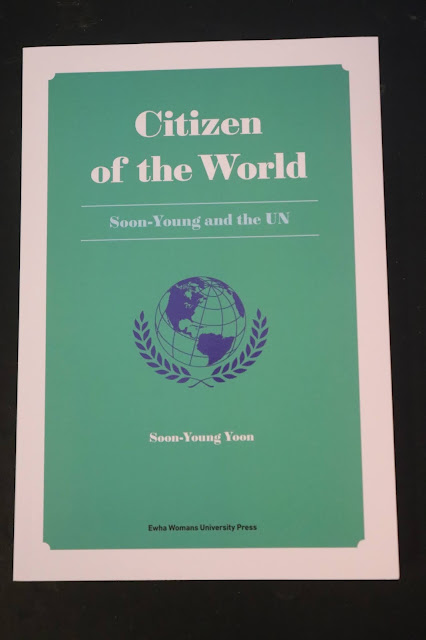
- Soon-Young Yoon, Citizen of the World: Soon-Young Yoon and the UNSeoul: Ewha Womans University Press, 2021. Paper, 327pp.

$25


Soon-Young Yoon grew up summers here in Northport, Michigan, so we can claim her as a local author. She is truly, however, what she calls herself in the title: a citizen of the world. 


Yoon came to the U.S. as a child refugee from North Korea and has worked with the United Nations and with NGOs, as well as universities. (Her Ph.D. is in anthropology.) But despite her cosmopolitan career -- or maybe because of it -- American-ness shines forth in her can-do attitude toward the world’s most pressing social and environmental problems. 


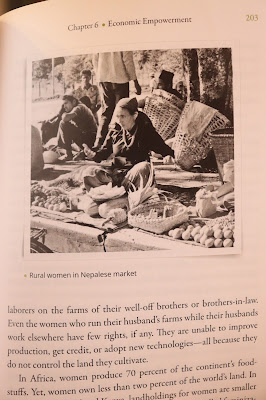
Each small section of this book (I would think of these as chapters, but the table of contents calls the larger sections chapters) is a short, self-contained essay, typically three to five pages, usually with a photograph, each focusing (beyond the introductory autobiographical pieces) on a serious global issue. Despite many acronyms and dates, the author’s style remains simple, conversational, and highly readable, always engaging the reader on a personal level. Beginning with her own United Nations experiences, she cites initiatives taken by other individuals and groups around the world to deal with the specific problem that is the chapter’s focus. There are problems here but no helplessness or hopelessness. 


Sample page with photograph


Yoon is a strong advocate for women around the world, especially in too-often overlooked poor and/or indigenous populations, and she is a staunch believer in motivation and action to make positive change. For example, she tells an inspiring story from Burkino Faso, where one woman’s determination to move forward from complaints to positive action made all the difference in a local meeting. Dying cattle, deforestation, and the exodus of youth from the region all stemmed, this woman believed, from the disappearance of the area water supply, so she organized other women into groups to build traditional earth dams, to plant trees and gardens around them, and to feed the cattle. Men eventually became involved, also, and life changed for the better for everyone. 


Since indigenous women are always involved with agriculture at the ground level, Yoon says it is imperative that their voices be heard and their knowledge brought to the table whenever solutions are sought to environmental problems. 


While deeply concerned with improving the lives of women and girls, from working for gender equality to ending all kinds of violence against women, Yoon realizes and emphasizes that boys and men cannot be left behind. Even public clinics open to all, she writes, benefit girls whose mothers bring them in to be seen by doctors, but too often boys do not want to come with mothers. Their fathers do not bring them. “We cannot assume that backward traditions affect only girls,” she writes. “Sometimes, boys are also the losers.”


And although the book is divided into sections – “About Me”; “Navigating the Boundaries of Identities”; “Violence Against Women”; “Finding the Earth’s Balance”; “Claiming the Right to Health”; “Economic Empowerment”; “Collective Voices”; “Circle of Women: Portraits” – again and again the author reiterates her truth about connections linking all social and environmental issues. Her image is that of a spiderweb, a web of life that includes everything on earth, animal, vegetable, and mineral, and she insists that those who want to help others need to listen to what those others say about what they need, because the people of a culture are the ones who know that culture. Those in technologically “advanced” countries, she speculates, may even have much to learn from peoples with simpler ways of living, those from cultures that have not created the problems of pollution and waste we face in, for instance, the United States.


Citizen of the World: Soon-Young and the UN is published, in English, by the Ewha Womans University Press in Seoul, Korea. (Yoon tells us that Ewha Womans University is the largest women’s university in the world, with 25,000 students. Did you know that? I did not.) In this highly readable volume, focused on important world issues, with serious problems never oversimplified or minimized, the author manages to give inspiring and encouraging anecdotes and observations. 


My hope is that this book will become easily available in the United States (at present it is not) and read by as many Americans as possible, men as well as women. For this to happen, there needs to be a groundswell of demand, from book clubs and libraries, as well as colleges and universities, and this post is my little push in that direction. This is crucial because, as the author notes in an online interview, the changes that are necessary in today’s world must necessarily happen fast. 


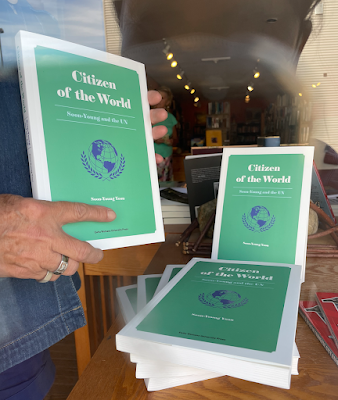
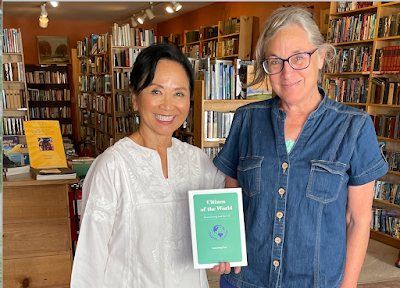
I am so proud to be the first bookseller in the world to offer this book to the public! Thank you, Dr. Yoon!


Saturday, November 25, 2017

Wild Children in the Woods


[Reminder: Tonight is the tree-lighting in Northport, after a day of merchant open houses and caroling. The horses will be pulling a decorated wagon through town, giving free rides, beginning at 3 p.m. Come and join us all day long!]


When Emily St. John Mandel wrote a post-apocalyptic novel, Station Eleven, she presented readers neither with a totalitarian, police-run urban world nor a barren desert in which gangs of young men, all looking like pirates, miraculously found fuel enough to roar endlessly through empty lands on fantastic vehicles powered by internal combustion engines. Instead, when the infrastructure of civilization collapses in Station Eleven (subsequent to a global pandemic), survivors, of necessity, fall back on old ways. A troupe of Shakespearean players, for instance, roves from one isolated rural community to another (cities having become uninhabitable), hunting and foraging and preparing food over open fires. 

In two more recent novels, also by women — one set in England and the other in the Upper Peninsula of Michigan — the modern world has not (yet) collapsed but is seen by pivotal characters as something to escape. 

Fiona Mozley’s Elmet tells of a father who moves his two motherless children to the woods, where he builds a house intended to last forever, long after he himself is gone, although they are only squatters on the land. His children are a boyish adolescent girl, given to brooding silences like his own, and a fey, girlish boy, the narrator of the story. 
We kept on with our silly childhood games long after we were much too old. Our copse provided the materials we needed and an undulant terrain in which to run and hide. In another world we might have grown up faster, but this was our strange, sylvan otherworld, so we did not. And that, after all, was why Daddy had moved us here. He wanted to keep us separate, in ourselves, apart from the world. He wished to give us a chance of living our own lives, he said. 
Fiona Mosley, Elmet

The father hitherto had made his living with muscles and intimidating size. He fought with bare knuckles in illegal bouts “far from gymnasiums and auditoriums where the money could be big…,” bouts arranged by toughs and travelers (gypsies). The money stakes ran high, and other stakes were even higher: sometimes his opponent did not survive. Thanks to his reputation, he was also hired from time to time by men with great wealth and few scruples to intimidate debtors slow in settling up. But he longs to escape a life of crime and fighting, a life he can live without having to grub for money, and in the woods is the freedom he covets for himself and wants to provide for his children. 

We realize early in the story — not only from the confusing, dreamlike opening scene, from which the rest of the story is told as flashback, but also from interactions between characters and our own knowledge of the greater world — that the father’s hopes for the family’s future are destined to fail. The question is only when and how and how spectacularly the failure will come upon them. 

The Marsh King’s Daughter, by Karen Dionne, is a survivalist tale set in motion by violent crime. The father of the narrator has abducted a 14-year-old girl, subsequently his captive for years in wilderness isolation. When she becomes pregnant and gives birth, their daughter is thus a product of rape, and even as the kidnapped adolescent grows older, with a child of her own to protect, fear of her captor’s mercurial temper and sadistic nature keeps her submissive to him. 
I can see now that the reason my mother was indifferent toward me is because she never bonded with me. She was too young, too sick in the days immediately after I was born, too scared and lonely and collapsed in on herself from her own pain and misery to see me. Sometimes when a baby is born in similar circumstances, she gives her mother a reason to keep going. This wasn’t true of me. Thank God I had my father.
- Karen Dionne, The Marsh King’s Daughter

The daughter’s relationship to her father is complex. She both fears and adores him. She hates his brutality toward her mother (whose small lapses in judgment or skill are rewarded with beatings) and is terrified of the punishments she herself sometimes receives (often when least expected), but at the same time she cannot get enough time outdoors with him, learning wilderness survival skills while her silent, distant cipher of a mother stays in the cabin cooking or sewing. The father is an unpredictable and sometimes punishing idol. Nevertheless, her life depends on what he can teach her, and being with him is an escape from the claustrophobic cabin. 
He’d lay out a trail for me while I was off playing or exploring, and then it would be up to me to find it and follow it while my father walked beside me and showed me all the signs I’d missed. Other times we’d walk wherever our feet took us and he’d point out interesting things as we went along. Drifts of scat. A red squirrel’s distinctive tracks. The entrance to a wood rat’s den littered with feathers and owl pellets. My father would point to a pile of droppings and ask, “Opossum or porcupine?” It’s not easy to tell the difference.


And so, long after she and her mother escape and return to “normal” life, after her father is finally captured and tried and sent to prison, after she changes her last name to escape the curiosity of anyone connecting her old name to her criminal father, and even after she marries, hiding her past from her own husband, and has two little daughters of her own — after all those years in which she realized very clearly what a cruel and crazy man her father truly was all along — when he finally escapes from prison after thirteen years, killing two guards in the process and launching a manhunt along the U.P.’s Seney Stretch, a question in her heart pushes Helena to track him down herself, as much as does her knowledge of the man and her need to keep her own daughters safe. She knows he has only laid a false trail to lead police into the Seney Wildlife Refuge, that he has undoubtedly gone in another direction. But as she tracks she can’t help also looking for signs that her father, for all his evil, loved her all along.  


Three novels by three different women, two with Michigan settings and one with a story spooling out in England, all of them taking place, for different reasons, in wilderness. In Station Eleven and The Marsh King’s Daughter, survivalism has been imposed on the characters, in one case by global apocalypse and in the other by the crime of one man. The wanderers in Station Eleven are not fleeing civilization but hoping to find remnants of it, while Helena in The Marsh King’s Daughter comes to see her U.P. wilderness isolation itself as the trap she would escape, despite her love of the woods and its creatures and the pride she takes in knowing her way around trackless land. Helena tells us that there is plenty in civilization she could live without but that she loves electricity. Characters in Station Eleven also have nostalgia for electricity’s gifts. And yet in both cases the world of nature is described in loving detail, as something not to be entirely left behind, and it is clear that these two authors value both wilderness and civilization, seeing the drawbacks either presents in a “pure” state.

Only Elmet seems to present a desire for off-the-grid living as longing to return to the Garden. If only the world will leave them alone, we want to believe, father and children can be happy in their isolated Eden. But how likely is the world to leave them alone? Is it the very lack of ambivalence in this story that leads to the most hopeless final pages of any of the three novels?

I began writing this post wondering if women writers, if women in general, are more drawn to recreating wilderness lives. While reading The Marsh King’s Daughter, for example, I could not help thinking of Bonnie Jo Campbell’s Once Upon a River, in which a young girl sets off alone to search for her mother, living off land and water, hunting and foraging — and, again, in Michigan.  Michigan. Its very name, Michigamme, conjures up grandeur and mystery. Among those who long to retire “Up North” (or, in England, “to the country”), is it men who would bring high-tech loud toys and women who would go back to an earlier era, and is that reflected in fiction by men and women? 

Or is that, as I’m sure it is, an overly simplistic binary gender division?

Certain it is, however, that men have produced reams of commentary and analysis on works by those of their gender and have developed countless theories on works written by male writers,  ignoring works of women, as if only a male sensibility could have produced those novels, so why should not women have their turn? Today, on Books in Northport, they do.


Wednesday, November 8, 2017

Norwegian Women

For December our little reading circle chose to read the first volume of Sigrid Undset’s Kristin Lavransdatter trilogy, The Bridal Wreath. Unset was the first woman to win the Nobel Prize for Literature, which was the reason given by a horrid little man in my bookstore years ago why I should be ashamed of myself — he actually shook a finger at me and said, “You should be ashamed of yourself!” —for not having read it. His angry, scolding tone put me off the book for years. Note to others: Telling someone to be ashamed of not having read something does not encourage that person to pick up the book. More to the point is to say, as my friend Trudy did when Kristin Lavransdatter came up in conversation, “For me that book was transformational!” Trudy made me want to read (rather than avoid) the work!

The Kristin Lavransdatter trilogy is set in fourteenth-century Norway, so that’s where I’ll be going a little later this month. Meanwhile, by chance, I happened upon another fictional work by a Norwegian woman, Cora Sandel. Coincidentally, Alberta & Jacob, Alberta & Freedom, and Alberta Alone also form a trilogySandel was born in 1880, and much in these novels is autobiographical, set just after the turn of the nineteenth into the twentieth century.


The first volume is set in a small town in the far north of Norway, north of the Arctic Circle, where we find young Alberta feeling trapped in almost every way imaginable — by a stultifying home life, her parents’ unhappy marriage, family financial worries that necessitated her leaving school, bourgeois expectations facing her, the perpetually cold climate (accentuating her mother’s coldness), and the long darkness of the Arctic winter. Cora is considered unattractive and considers herself such, as well; although her parents and brother keep assuring her that she might be presentable if she would only make a little effort, she avoids social situations whenever possible and welcomes the returning light of spring that allows her to run out into the countryside and be alone.  

As winter approaches in northern Michigan, Alberta & Jacob is not the cheeriest of reading. The only time Alberta is not cold in winter is when she first wakes in the morning. After that, from the time she gets out of bed until the wonderful warmth of morning in bed, she is miserably cold.
At night she would lie huddled and trembling beneath the blanket for hours, chilled to the marrow. She made herself as small as she could, drawing her legs up under her and hugging herself. The cold would sit between her shoulder-blades gnawing like pain. She carried it in her body all day, and it accompanied her to bed. Her feet, like blocks of ice, seemed not to belong to her, and she became cramped and sore from her huddled position. 
Summer brings light, warmth, and hours of freedom but also tourists and visits of those fortunate enough to have escaped to life in Kristiana or study in Paris. Picnic expeditions to the mountains last all through the night, taking advantage of summer’s midnight sun, and yet this is a painful time too for Alberta, who is not pretty, does not have pretty clothes, blushes too easily, cannot bring herself to speak her thoughts, and compares herself unfavorably to the carefree seasonal visitors. 

In her immediate family, only her brother Jacob has managed to escape. In spite of parental disappointment, he managed to gain his father’s permission to go to sea. 
It occurred to Alberta that ultimately Jacob was the only one who turned his true face out to the world, a face full of undaunted confidence in his own two strong arms.
And at the end of this first book, with this realization in mind, Alberta trudges up to her cold bedroom, with hope of nothing but “another day” on the morrow. Another day without her mother’s approval or understanding, another day of being trapped by bitter cold and hateful expectations.

So what a surprise to begin the second volume, Alberta & Freedom, and find Alberta living in Paris! With little if any idea what to do with her “freedom,” she is modeling for a dilettante painter in order to buy food and pay rent. Winter continues to be a time of terrible cold for her, and now summer is a season of unbearable heat. But she is in Paris, free to roam and explore, to drift aimlessly and take in the city’s sights and sounds and smells, to scribble and throw her scribbles in a trunk to be retrieved later and perhaps made into something.

Her life goes from difficult to desperate, both financially and emotionally. An unexpected August relationship, begun when other friends were all out of town on vacation, blossoms and unaccountably dies, for reasons she will only learn much later. But throughout hardship and heartache, there is the life in her Paris neighborhood and in the streets and in the parks, and by the end of this second volume, along with an extremely challenging development in her life, Alberta has an epiphany.
And something dawned on her. All the pain, all the vain longing, all the disappointed hope, all the anxiety and privation, the sudden numbing blows that result in years going by before one understands what happened — all this was knowledge of life. Bitter and difficult, exhausting to live through, but the only way to knowledge of herself and others. … It was painful, but a kind of liberation all the same; a rent in my ignorance, a membrane split before my eyes.
Where will the third volume take Alberta, and what kind of life will she put together? The author left her home in Norway in 1905 and lived in Paris for 15 years. She married there in 1913 and had a son with her husband, a Swedish sculptor, from whom she was divorced in 1926. A Swedish citizen by marriage, she settled and lived the rest of her life in Sweden, first with a friend and then finally, at the age of 65, for the first time in an apartment of her own. Will Alberta’s years alone mirror those of Cora Sandel?

When Sandel’s novels appeared, critics acclaimed Alberta “one of the truly great characters in contemporary Scandinavian fiction,” and near the end of Alberta & Freedom there is the strong suggestion that Alberta is seeing a way to do with her “scraps” of writing what she tells her lover, a painter, what she would attempt on canvas if she were a visual artist, to paint life.
“I would put in people I knew, Alphonsine and Madame Boudarias and you, Sivert, painting artichokes.” 

And so I will read Alberta Alone (not pictured above) before turning to The Bridal Wreath, which in turn will probably lead me into the second and third books of yet another fictional trilogy by a Norwegian woman author. It is only fitting, with so many Norwegian families having settled in and around Northport one hundred and more years ago. And what with winter coming on and all....


Thursday, August 20, 2015

Three Light Meals


  • Recipes for a Beautiful Life (nonfiction), by Rebecca Barry
  • Encyclopedia of an Ordinary Life (nonfiction), by Amy Krouse Rosenthal
  • The Readers of Broken Wheel Recommend (fiction), by Katarina Bivald


I don’t think it’s too much of an exaggeration for me to claim that my reading in general is catholic. Catholic: “broad or wide-ranging in tastes, interests, or the like; having sympathies with all; broad-minded; liberal” (Webster’s New Universal Unabridged Dictionary, Fully Revised and Updated, 1996). A tiny exaggeration, maybe, that “all” part. You’d have to look through several years of my lists of books read to find much if any science fiction or fantasy, and a lot of bestsellers never make it to my nightstand, either. But “wide-ranging” seems a fair claim.

What the three books I’m putting together in this post have in common is that all are (1) light reading and (2) written by women. (Clive Cussler fans, be forewarned!) One was sent to me as an Advance Reading Copies (ARC), another the final published version, and the third (not in the order they are listed above) I initially opened only to see where to shelve it in my bookstore.

Here’s how I’ll refer to them: Recipes; Encyclopedia; Broken Wheel.

(1) Recipes confounded me. The author and her husband decide to move their family from New York City to a small town upstate. With a much smaller income, they become owners of an old building that needs major repair and renovation. The “simple life” is never simple except when looked at from the outside. The author’s proposal for a novel is accepted, however, and if she can get it written in a year they’ll have enough to live on until the money starts rolling in.

This is an entertaining book. The children, as children will, say lots of funny things. (Very funny. I was reminded of Jean Kerr's The Snake Has All the Lines.) Rebecca and her sisters have that sister thing going on, and I relate to that, of course. Friends share meals and wine and worries and laughs. The writer tries to find time to write and struggles to find inspiration, while children and small town life keep catching her up in a giddy swirl.

Some of the “recipes” in the title are things to fix for meals, but most are fixes of a different kind: “Recipe: How to Heal Your Heart,” for example, or “Recipe: Get Kids to Listen to You.” Like most of us, the writer of this books “learns” a few lessons, passes them along to us – then forgets them and has to re-learn them a few days and a few pages later.

Most baffling to me, though, is that this book is basically a book about how the author did not get her book written. The novel proposal? Advance spent, but author and editor agree the draft of the novel is, in the author’s own (unspoken) words, “unpublishable.” So Simon & Schuster published this story from her real life instead? From diary, blog, whatever? Well, clearly she had to work to give it a shape, but all I could think was that writers who spend their advances and fail to meet their deadlines are very seldom so fortunate! I didn’t know what to think, in the end. I still don’t.

(Am I simply blinded by envy? Not completely, I don’t think. I want to get my novel written!)

(2) Encyclopedia is the book I picked up to figure out where to shelve it. Glancing at a few pages, I was slightly annoyed at first. Is a collection of slightly quirky lists worthy of being a book? I was dubious, resistant, but the book pulled me in. Finally I sat down with it and kept reading. Soon I was smiling – and then laughing out loud, to the alarm of a few silent browsers in the stacks.

We are warned on the cover that the author of this memoir has “not survived against all odds” or “witnessed the extraordinary.” This is an ordinary life. Here, under H, is a typical entry:
HAPPINESS  
I’m turning left. Look, everyone, my blinker is on, and I’m turning left. I am so happy to be alive, driving along, making a left turn. I’m serious. I am doing exactly what I want to be doing at this moment: existing on a Tuesday, going about my business, on my way somewhere, turning left. There is nothing disconcerting or unpleasant or unfortunate about this moment. It is exceptionally nice, plain, and perfect.
Not everything is perfect, even in an ordinary life. There are ordinary annoyances and ordinary worries. But Amy has a way of dealing with those, too:

RETURNING TO LIFE AFTER BEING DEAD  
When I am feeling dreary, annoyed, and generally unimpressed by life, I imagine what it would be like to come back to this world for just a day after having been dead. I imagine how sentimental I would feel about the very things I once found stupid, hateful, or mundane. Oh, there’s a light switch! I haven’t seen a light switch in so long! I didn’t realize how much I missed light switches! Oh! Oh! And look—the stairs up to our front porch are still completely cracked! Hello, cracks! Let me get a good look at you. And there’s my neighbor, standing there, fantastically alive, just the same, still punctuating her sentences with you know what I’m saying? Why did that used to bother me? It’s so . . . endearing.
This is a charming book! Well, I found it so, anyway. I finished the last page wishing the author would walk in my bookstore door so we could meet. But then -- quite honestly, I am nowhere near as light-hearted and fun as she is. No, I’m sure it’s best to keep our friendship one-sided, within the covers of her book.

(3) Finally, the ARC of Broken Wheel. How can a bookseller resist a book about a bookstore? How can a bookseller in a small town in the northern Midwest resist a story about a bookstore in a dying town in the cornbelt? Can a bookstore “save” the town?

Despite the hope and excitement I felt when opening to the first page, it took me a long time to enter fully the world of Broken Wheel. I kept turning back to the author’s name on the cover, wondering if English might be her second language and why, even so, no one in the publishing house had corrected sentence moods that so obviously should have been in the subjective, e.g.,
There were only two other customers in the entire bar. One looked as though he was sleeping....
Well, was he sleeping, or did he simply look as though [counterfactual] he were? I did not keep track of how many times this error found its way into the book – and I know it is a small nit to pick – but it happened over and over again, and every time it distracted me, my inner editor pulling me out of the story where I wanted to lose myself, so I was halfway through the book before being finally able to stop obsessing over was/were. I hate when that happens! I don't want my inner editor springing into action when all I want to do is immerse myself in a story.

Back to the novel --

A stranger comes to town. It’s a classic setup. In this case, the stranger is Sara, come from Sweden to visit Amy, who has just died. The town itself seems very near a final death gasp. So....

Will Sara get together in the end with Tom, the character so obviously meant for her? That’s one question we ask as we read this novel, though we’re pretty sure what the answer will be, given the kind of book it clearly is. Will the townspeople ever go in the bookstore? Will they ever buy books? Will they read books? Most importantly, for all concerned, will people’s lives change because Sara came to Broken Wheel and opened a bookstore? You can pretty much guess the answers, but that doesn’t take away the pleasure of the story. This book is one Sara herself would have shelved under “Happy Ending Guaranteed.”

Hot, humid, busy summer days call out for the relief of light reading. Chick-lit fiction and humorous memoir can be very healthy choices for the sun- or work-addled summer brain. The perfect prescription, however, must be tailored to the individual, so the final choice, as always, is up to you.