Search This Blog

Showing posts with label romanticism. Show all posts

Tuesday, October 22, 2024

Are You a Romantic?


Every business day, I get a newsletter called “Shelf Awareness” in my e-mail, delivering the latest news from the world of books, bookshops, booksellers, libraries, writers, and publishers. When owner-booksellers retire, a shop either closes or comes under new ownership. Sometimes, beforehand, there’s an announcement of a shop for sale. 


I’ve always kind of wondered how the numbers compare, old shops closing vs. new shops opening. It’s hard for me to tell, because I get both kinds of news. Also, shops like mine, selling majority of used books -- or some may sell no new books at all -- often don't get counted. But I can’t help noticing lately how many new shops are opening with a plan to specialize in romance books. 


Romance readers are coming out of the closet, no longer hiding their reading preference as a guilty pleasure. According to the New York Times, print sales of romance books almost doubled in only three years, from “18 million copies in 2020 to 39 million in 2023,” and specialty bookshops have boomed along with the books. 


When it comes to genre fiction, I generally reach for mysteries. Although now and then I yield to the temptations of potato chips and “chick lit” (usually stories featuring bookshops or set in Michigan), in general science fiction, fantasy, horror, and romance do not usually appeal to me. Don’t get me wrong! I have no quarrel with the readers of these genres. (Some order their books through my shop!) When it comes to escape reading or what I call “comfort books,” there are different roads for different tastes. 


My taste: A country road


My own choices in comfort books tend more in the direction of children’s or teen novels I remember loving years ago (Palmer Brown’s The Silver Nutmeg; Maud Hart Lovelace’s Betsy-Tacy series; Anne of Green Gables and the sequels; or Farley’s The Black Stallion or Marguerite Henry’s wonderful horse stories) – or, other times, novels or memoirs set in the past (most recently, Mary Webb’s enchanting Precious Bane). Little Women is a book I still find romantic, despite its formulaic construction. When Jo and the professor finally kiss under the umbrella (absolutely NOT in the balcony of a theatre, as one modern film version has it!) and speak their simple words of love to each other, how could any love scene be more moving than that?


At Dog Ears Books TODAY!

Years ago, as the young, stay-at-home mother of a toddler, I fell briefly into a romance habit at an old bookstore in Traverse City, Arnold’s on Union Street. Many will remember the place. Mrs. Arnold had an almost unlimited stock, it seemed, of paperback novels featuring young women in love and newly wed, all written by a writer named Kathleen Norris – not the Kathleen Norris (b. 1947) of Dakota but an earlier KN (b.1880). Those books were definitely like potato chips: always another! After a while, though, I started to become annoyed. All the young, beautiful heroines grew ever younger-looking and more beautiful in their times of trial and poverty! How, I wondered, did that work? But a much more annoying trick of the author’s was her repeated reach for a deus ex machina to dissolve the heroine’s deepest existential problems.


Let’s say (as often happened) that the main character married a handsome ne’er-do-well who could not support a family, perhaps even turned out to be an alcoholic. Divorce was unthinkable in the Kathleen Norris code of morals! No, her heroine could absolutely not choose divorce, even with a “Mr. Right” standing in the wings! That left the novelist two possibilities for reaching a happy ending: either the inconvenient husband could die, or it could be discovered that the marriage, for whatever reason, had never been valid in the first place. Either way, the beautiful, long-suffering protagonist was set free to marry the loyal, upstanding man who had loved her so chastely all along. Mighty handy! Perhaps a little too handy?


Also available -- and only $9 each!


(One of the charming side features of Ms. Norris's novels was the California setting. The main character always had a garden and always made wonderful little suppers of fresh vegetables.)


Such were the romance novels of the early 20thcentury. (When I reluctantly confessed this stretch of my reading life to my mother, she shrugged and said airily that she had read many Kathleen Norris books. I had no idea!) Romance readers now expect more in the way of “sizzle,” it seems. A very different, protofeminist view of romance, broadly understood (see below), can be found in the sometimes-strange novels of the sometimes-anonymous Elizabeth von Arnim


Years ago, when I announced myself to the world as a romantic pragmatist, a fellow philosopher friend said divorce had cured her of romance, but by romantic I didn’t mean hearts and flowers and Valentine’s Day dinners. I had in mind the older, broader sense, that of the Romantic period in art and literature: a return to nature, valuing feelings along with facts, even striving toward “impossible” goals. 


My romantic meadow: native grasses, wildflowers


The Artist understood. Once he and I talked about the most romantic books we’d each read, both having in mind a novel clothed in mystery and something like fantasy (though not ‘fantasy’ as the genre called that is understood today). His was Hudson’s Green Mansions; mine was (I’ll give the English title) The Wanderer, by Alain-Fournier. When I described the French novel to David, it reminded him of Hudson’s book, and when I read Hudson’s Green Mansions for myself, I could see a similarity with The Wanderer, a similarity not in the stories or settings but in a dreamlike mood the two books shared.


What does the word ‘romance’ mean to you, and what do you think of as a ‘romance' -- or a 'romantic' novel? Is romance in your mind a narrow genre – and if so, does it appeal to you? If you read in the genre, who is your favorite author, and why? Or do you look for romance in the classics – say, Jane Eyre? Or maybe you see 'romance' as I do, following the period of art and literature known as Romanticism. There are no wrong answers!


But heavens! So many questions! Will anyone be brave enough to answer any? I only have one friend who says she never reads fiction, so I won’t expect a comment from her....


Next question: What do you think explains this surge in romance reading? I’ll tell you what I think one reason is (not that anyone asked). I think the gruesomeness of American politics at this juncture in our history is sending people of all ages, more and more, to romance and fantasy and all manner of speculative fiction. The real world is too much with us! How can we even sleep at night? As for me, I have now hit my bottom line, and I’m digging in my heels, and here it is: 


I’ve refrained from name-calling, treated those whose views oppose mine with respect, sent love to all, but now I’ve reached the end of my rope, because the bottom line as I see it is that no matter what anyone’s most dearly held opinions are about the economy, about immigration, about abortion, about the war in Gaza or the war in Ukraine or equal rights for all Americans, about minimum wage or social security or the cost of health care, affordable housing or the border with Mexico, the composition of the Supreme Court, the existence of the Electoral College, space travel or cryogenics — whatever anyone’s views about any of these or any other issues may be, putting a sociopath in the White House (for the second time!) is not the answer. Crazy is not the solution to a single problem. Crazy rights no wrongs. And if you vote for crazy, you cannot, in truth, call yourself sane or good or righteous, regardless of how often you go to church or pray over your dinner table. 


Should I have thought longer about making such a public statement? Crawled back in the closet and prayed about it some more? Kept quiet lest I hurt someone’s feelings or lose a friend or put my business in jeopardy? There is too much at stake.


(And by the way, if you vote third party or don’t plan to vote at all — because you think the Democrats’ candidate is “just as bad” or you see her as a warmonger — the effect will be just as if you had voted for crazy, and you know it, so don’t pretend otherwise. You’ll be putting crazy back in the White House, so don’t expect “policies” of any kind.) 


So I'll say it again. Crazy is a solution to nothing. Crazy rights no wrongs. Crazy is what the rule of law, with all its human flaws and shortcomings, is designed to prevent. And I am enough of a romantic that I have not given up hope for this country – my country! – that I love and for our beautiful world.


To my Republican friends


If your biggest concern is eliminating abortions, and you don’t care about anything else if only you can accomplish it, work toward that end. Devote your money and time and energy to providing pregnant women with support. If you’re most worried about the gun industry's being allowed to continue to market and sell military-style assault weapons to civilians (whether you own stock in the industry or believe you would be able to defend yourself against the U.S. army and U.S. Navy and Air Force if you and the government disagreed — whatever!), spend your time and energy and hard-earned income on that issue. But don’t vote for a lying sociopath and trust him to make your dearest dreams come true. That has never been his mission. It’s HIS dearest dreams that matter to him, and nothing else, and there is more honor among thieves than there is in DJT’s promises.


"Donald Trump is not cognitively fit to be president. The presidency is a position that requires an occupant able to act strategically and carefully. That Trump is not such a person is obvious if you watch the man. And so, for years, his supporters have said: Don’t watch the man. Don’t listen to what he says. Look at the results. But those results reflected the power and ability of others to check Trump, to inhibit him when he could not inhibit himself. It is not just the man who is now unfit; it is the people and institutions that surround him.” - Ezra Klein, “What’s Wrong with Donald Trump?” 10/22/2024


It’s worth looking up and taking the time to read or listen to Ezra Klein’s whole piece. It’s in the New York Times but also available as a podcast from many, many online sites you probably use. His basic point (for those who will not follow through on my suggestion) is that Trump isn’t any different from what he ever was, so it’s not senility we should worry about. The reason there weren’t more disasters during his presidency was that there were people holding him in check and, when necessary, not acting on his orders (e.g., to cut FEMA funds to California because Californians were not his diehard supporters), whereas this time around, should he be elected again, he will be surrounded only by loyalists and sycophants, and there will be little restraint on his impulses. 


To all:


You didn’t expect this abrupt change of course in today’s post? Neither did I when I set out to write about the surge in romance novels and bookshops. But here it is, all of it, and there’s a little more on one of my other blogs, “Without a Clear Focus,” a piece on my #1 most beloved philosopher, Henri Bergson, whose birthday was October 18 and someone I take as an exemplar.


There. I've said my piece. Bye-bye for today.

Wednesday, June 28, 2017

Do We Romanticize the Lives of Others?


Bookstore dream come true
It’s happened more than once, and I’ve written about it before. Someone walks into my bookstore, realizes the art gallery next door is my husband’s, and exclaims, “You’re living my dream!” (Pretty funny coincidence: I hadn't looked over yet my draft of this post before uploading it when a woman from New Jersey, who yesterday bought Nuts to You, by Lynne Rae Perkins, came back today for Criss Cross and told me, "This is my dream!" I told her I'd just been writing about that for my blog.)

Gallery dream come true
I’ve also said – again, more than once – that having a dream is very different from living it, the difference one between pleasant, idle daydreaming and making something happen and working year after year to keep it alive. Which doesn’t mean it isn’t a dream come true, only that it didn’t come about with a lottery ticket or because a fairy godmother waved a magic wand. Of course I have my own unrealized dream lives, the selves I call my “inner cowgirl” and my “inner farmer” -- sigh -- but it’s hard to live more than one life at a time. I guess many of us have "roads not taken" in the progress of our lives.

Hurry! Time to make hay before it rains!
A friend whose parents moved the family to a 120-acre farm when she, the friend, was about 12 years old commented to me recently, “I don’t romanticize farming. It’s hard work! I couldn’t wait to leave the farm! I felt like the farm was my prison.” I told her that in my younger years I held a series of low-level office positions, and those offices definitely felt like prison cells to me. On a farm, there are seasonal demands and the unpredictability of nature – not to make light of them, but they are impersonal constraints. The real nightmare, to my mind, would be clashes with threatening and unreasonable authorities, encounters such as the growers in the documentary film “Farmageddon” suffered. (Surprise!) I don’t have the energy I had even five years ago, but I still enjoy working hard outdoors.

Well, instead I spend hours indoors in my bookstore (and often long to be outdoors at home), but it is my bookstore, and I am the boss! so it is not the prison those deadly old offices were. I drive myself pretty hard sometimes but am not subject to the arbitrary will of another, one of the most difficult features of clerical work. Lots of responsibility coupled with little if any authority is not a recipe for happiness! Nowadays I have both the authority and the responsibility, and the one makes the other much more pleasant.

I don’t think I romanticize farming, any more than I romanticize my own life, but sometimes I do romanticize the life David and I lead -- in a sense -- and I’m the first to admit it. (As I like to say, if I don't romanticize my life, who will? Oh, wait! I just said many people do. Hmm.) That doesn't mean, however, that I'm just daydreaming about a hazy possibility and seeing it in a rosy, soft-focus glow. I live the reality along with the dream. The bookseller’s life? More than just sitting around reading books! The artist’s life? Not all wine and roses, either! Hard work and financial sacrifice, like farming. Also, like farming, unpredictable income. Not everyone would choose to live as we do. Where the romantic part comes in, for me, is not in an avoidance of hard work, not in living the life of Riley or counting on "easy money," but in loving one’s work and being grateful not to be working against one's own nature. So I like to think if I'd taken a different road that I would feel the same way about farming. But who knows, right?

Well, when a friend had a garden business some years back -- design, installation, maintenance -- I worked with her on the installation and maintenance, and we worked hard! But we enjoyed working outdoors, enjoyed working together, and were happy to be strong and healthy enough (in late middle age) to engage in hard physical labor. Also, she was her own boss and treated me, her employee, like a respected colleague (though some of her clients saw me as the "yard girl"). So we were both happy.

And yes, David and I, the artist and the bookseller, are happy now in our hardworking life. Isn’t it romantic? Not every single minute, but often!


They are weeds, but I adore them!


Wednesday, June 3, 2015

What is "Unreachable"?


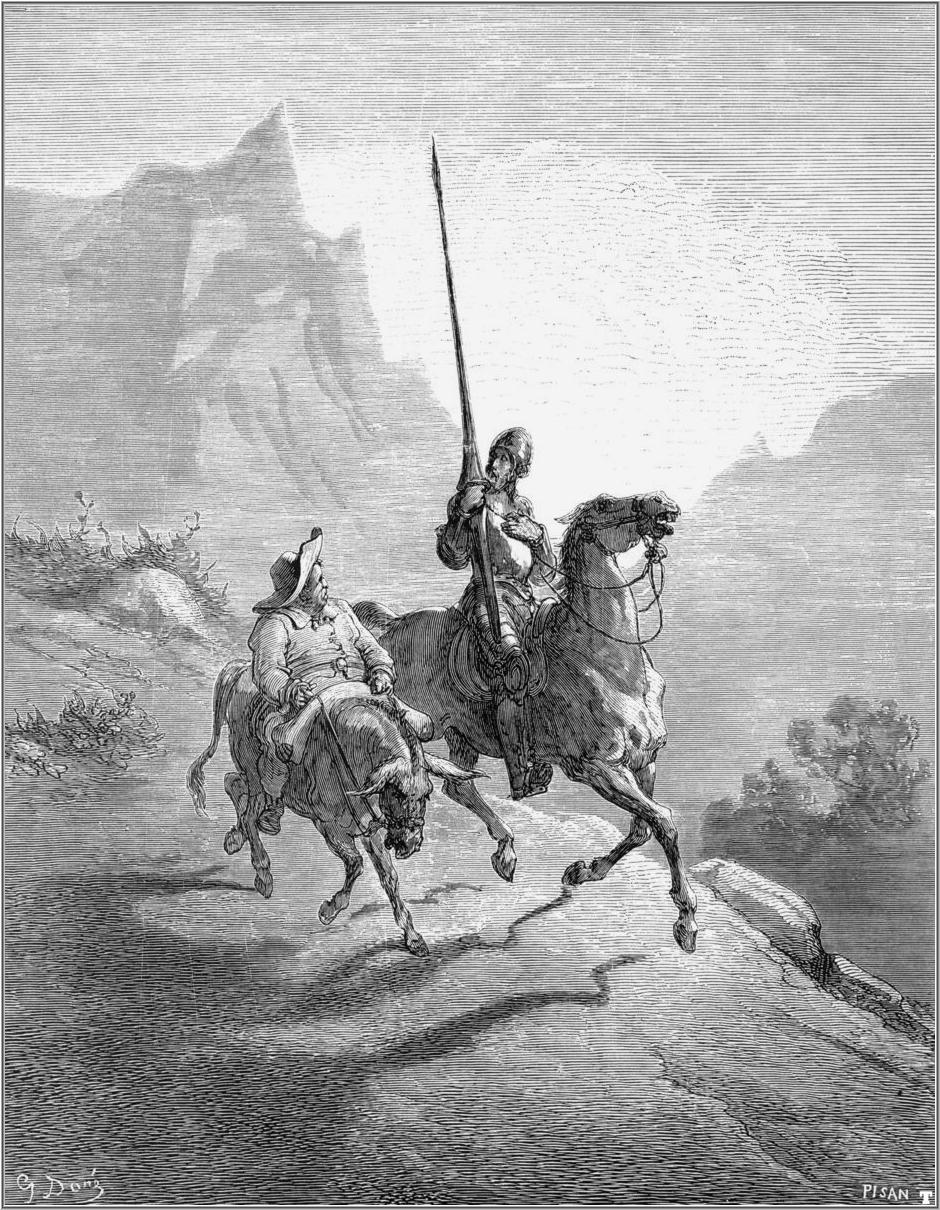
Our intrepid “Ulysses” reading group met three times to discuss the classic novel Don Quixote, by Miguel de Cervantes. We read Edith Grossman’s recent and highly readable translation. Opinions on the work varied, but we were all glad we had made the glorious effort to reach that star of sixteenth/seventeenth-century Spain.

Don Quixote did not make its author rich. He was buried in an unmarked grave after a life of military service, injury and disability, years of imprisonment and slavery, extreme poverty, and a childless marriage. But he wrote Don Quixote, a work still read over 400 years later. Little satisfaction to him that people in the 21st century, all over the world, are reading and laughing and being moved to tears by the tale, but, as we say in our house, “He got his work done. He paid his rent in the universe.”

On the morning after our final DQ discussion meeting, I came to the last page of a much duller book, Beyond Life, by James Branch Cabell, a strange story – more lecture, or at least essay, than story – in which one “character” (Bartleby identifies “Charteris” as the author’s alter ego) supposedly talks all night long to a friend who has dropped in to sit by his fireside. When morning comes, the talker is dismayed to realize that his listener has missed the entire point: the listener thinks Charteris has been talking about how to write books, when all the while his real point was about life itself. Charteris evinces, if you accept his point of view a thoroughly gloomy assessment of life. All of us, beggar and pharaoh, are doomed to dust and oblivion. Nothing will last. Thus, life is pointless. All our strivings, even all our achievements. Pointless. Since life is pointless, however, we need a vision of life where what we do makes sense, where our lives take on purpose, where the “glorious quest” does have some point. This vision is the Romantic, and Charteris finds it not only in literature but also in religion.

Chivalry (to return to Don Quixote) was nothing if not romantic. Many claim that romantic love was first conceptualized – even that it first began – with the courtly love of the Middle Ages. Certainly in the novel it is clear that Don Quixote has invented Dulcinea. Don Quixote’s devotion to his ideal woman was founded on nothing more than his imagination but gave him the necessary motivation to seek adventures and strive to be, himself, a hero for the ages. In the end, he regains his senses and dies sane, Dulcinea dropping out of the picture completely. Is all romantic love and all striving to make the world better nothing more than self-deception? Is this the message we are to take away from Cervantes?

I was once accused, by a thorough-going skeptic, of “romanticizing my life.” My country life, my old farmhouse, my romantic partner of decades (the love of my life), my dream-come-true bookstore – all of it, the skeptic suggested, was nothing more than a run-of-the-mill existence. Perhaps he even saw it as somewhat shabby. James Branch Cabell, a.k.a. Charteris, would certainly see it as pointless. My reply was that I had (and have) nothing to gain by giving up my romanticism. Why would I want to look objectively and cold-bloodedly on my one unique passage through what others choose to see as a “vale of tears”?

There were years, decades ago, when I despaired of making my dreams come true. Poorer then than now, locked (or so it seemed) into a series of confining and unsatisfying jobs that had nothing to do with the potential I felt within myself, dissatisfaction making cruel inroads into the thrills of romance – those were difficult times. I could not then imagine the life that lay ahead of me: happy marriage, doctoral degree, literary life, country home. What seemed impossible came to pass – certainly not without effort, but then, Don Quixote did not sit home and wait for adventures to come to him, either.

The thing is, if my romanticism is madness (as I put it to the skeptic), what have I to gain by sanity? I still have unrealized dreams – literary and pastoral -- and am still reaching for them. “Crazy, he calls me. Sure, I’m crazy.” What else would you have me be?


But now I come back again to Don Quixote and Cervantes, the author of the famous knight-errant’s being. Don Quixote, dies “sane” at the end after his long madness, renouncing chivalry and its impossible, bookish ideals. It would hardly be surprising if Cervantes underwent a similar change of heart. After all, what did he get for his life of service to king and country?

Ah, but there is his glorious book! There is that wonderful figure of a skinny, aging, deluded seeker of not only fame and glory but also just causes and victory over cruelty and evil. A man with a noble quest!

Cervantes knew whereof he wrote. What Don Quixote suffers in the legend, Cervantes suffered in life, and yet he managed (pace Vladimir Nabokov, who was as squeamish and offended by the novel’s violence as a Puritan would be over modern passages of sexual content in literature) to make an amusing and entertaining tale of it all. More importantly, we do not simply laugh at the deluded would-be knight. We admire him. He lifts our spirits. Cervantes may have been laid to rest feeling his life had been wasted, and that would be sadder than the fictional knight’s return to sanity, because Cervantes was, after all, a real man, but from our point of view he did not waste his time on earth at all. He bequeathed to the entire world Don Quixote, a gentle, noble soul, and thus he more than paid his rent in the universe.

I am thinking about Cervantes and his gentle knight and remembering a teacher of philosophy who spent his last days feeling he had wasted his life. Depressed in his final illness, he refused visitors and died, it would seem, an unhappy man. And yet his students, of whom he had hundreds over the years, adored him! He taught them how to think, how to question, how to value, and many looked back on their classes with him as the most important of their time spent in college.

Maybe it is not for anyone on earth to be the final judge of his or her own life. Surely religion would remind us that we are not to be. But even the nonreligious would perhaps do well to live as if their lives mattered, as if what they do made a difference in the world – because it just very well might, whether for one other person or for millions.