Our intrepid “Ulysses” reading group met three times to discuss the classic novel Don Quixote, by Miguel de Cervantes. We read Edith Grossman’s recent and highly readable translation. Opinions on the work varied, but we were all glad we had made the glorious effort to reach that star of sixteenth/seventeenth-century Spain.
Don
Quixote
did not make its author rich. He was buried in an unmarked grave after a life
of military service, injury and disability, years of imprisonment and slavery,
extreme poverty, and a childless marriage. But he wrote Don Quixote, a work still read
over 400 years later. Little satisfaction to him that people in the 21st century, all over the world, are reading and laughing and being moved to tears by the tale, but, as we
say in our house, “He got his work done. He paid his rent in the universe.”
On
the morning after our final DQ discussion meeting, I came to the last page of a
much duller book, Beyond Life, by James Branch Cabell, a strange story –
more lecture, or at least essay, than story – in which one “character”
(Bartleby identifies “Charteris” as the author’s alter ego) supposedly
talks all night long to a friend who has dropped in to sit by his fireside.
When morning comes, the talker is dismayed to realize that his listener has
missed the entire point: the listener thinks Charteris has been talking about
how to write books, when all the while his real point was about life itself.
Charteris evinces, if you accept his point of view a thoroughly gloomy
assessment of life. All of us, beggar and pharaoh, are doomed to dust and
oblivion. Nothing will last. Thus, life is pointless. All our strivings, even
all our achievements. Pointless. Since life is pointless, however, we need a vision of life where what
we do makes sense, where our lives take on purpose, where the “glorious quest” does have some point.
This vision is the Romantic, and Charteris finds it not only in literature but
also in religion.
Chivalry
(to return to Don Quixote) was nothing if not romantic. Many claim
that romantic love was first conceptualized – even that it first began – with
the courtly love of the Middle Ages. Certainly
in the novel it is clear that Don Quixote has invented Dulcinea. Don Quixote’s
devotion to his ideal woman was founded on nothing more than his imagination
but gave him the necessary motivation to seek adventures and strive to be,
himself, a hero for the ages. In the end, he regains his senses and dies sane,
Dulcinea dropping out of the picture completely. Is all romantic love and all
striving to make the world better nothing more than self-deception? Is this the
message we are to take away from Cervantes?
I
was once accused, by a thorough-going skeptic, of “romanticizing my life.” My
country life, my old farmhouse, my romantic partner of decades (the love of my
life), my dream-come-true bookstore – all of it, the skeptic suggested, was
nothing more than a run-of-the-mill existence. Perhaps he even saw it as
somewhat shabby. James Branch Cabell, a.k.a. Charteris, would certainly see it
as pointless. My reply was that I had (and have) nothing to gain by giving
up my romanticism.
Why would I want to look objectively and cold-bloodedly on my one unique
passage through what others choose to see as a “vale of tears”?
There
were years, decades ago, when I despaired of making my dreams come true. Poorer
then than now, locked (or so it seemed) into a series of confining and
unsatisfying jobs that had nothing to do with the potential I felt within
myself, dissatisfaction making cruel inroads into the thrills of romance –
those were difficult times. I could not then imagine the life that lay ahead of
me: happy marriage, doctoral degree, literary life, country home. What seemed
impossible came to pass – certainly not without effort, but then, Don Quixote
did not sit home and wait for adventures to come to him, either.
The
thing is, if my romanticism is madness (as I put it to the skeptic), what have
I to gain by sanity? I still have unrealized dreams – literary and pastoral --
and am still reaching for them. “Crazy, he calls me. Sure, I’m crazy.” What else would you have me be?
But
now I come back again to Don Quixote and Cervantes, the author of the famous
knight-errant’s being. Don Quixote, dies “sane” at the end after his long
madness, renouncing chivalry and its impossible, bookish ideals. It would
hardly be surprising if Cervantes underwent a similar change of heart. After
all, what did he get for his life of service to king and country?
Ah,
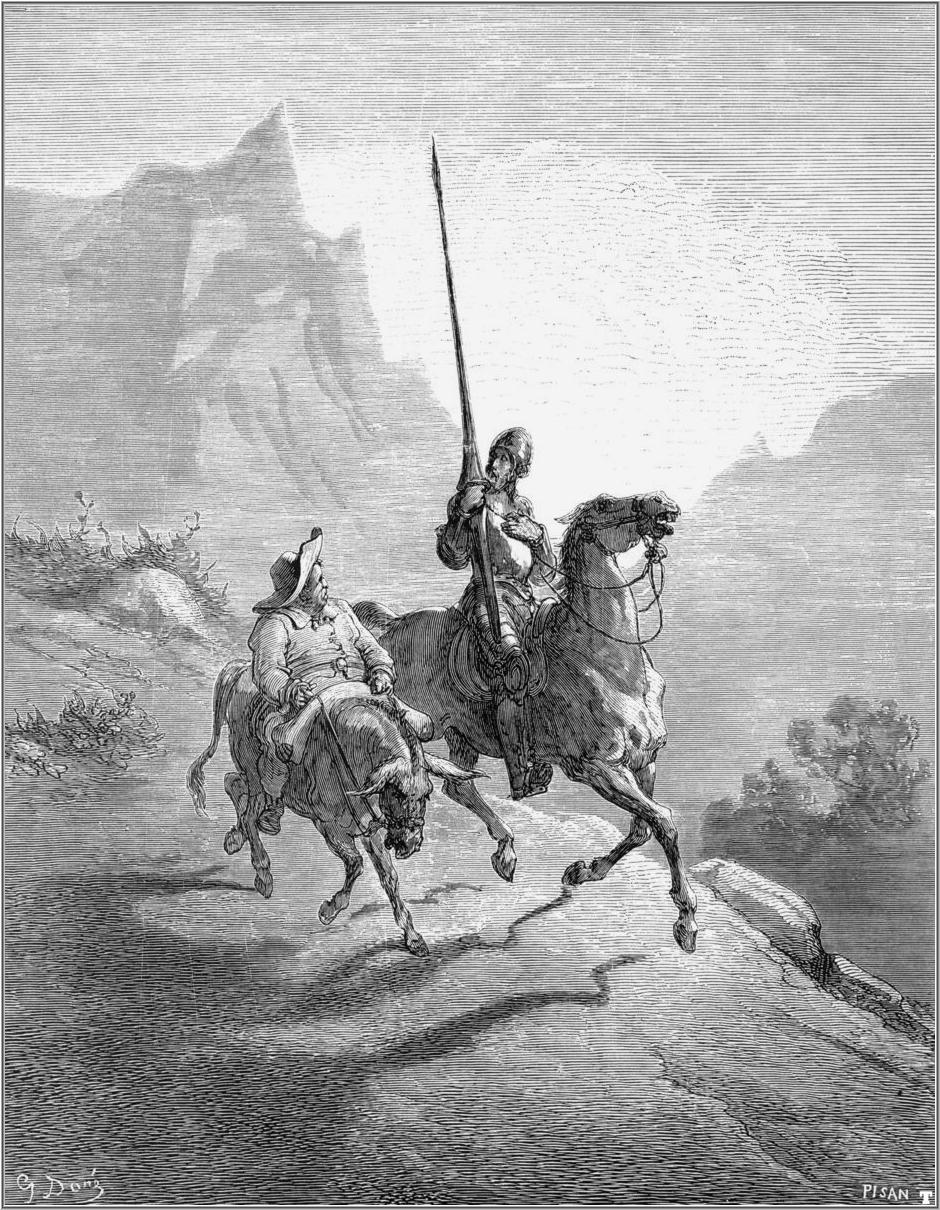
but there is his glorious book! There is that wonderful figure of a skinny,
aging, deluded seeker of not only fame and glory but also just causes and
victory over cruelty and evil. A man with a noble quest!
Cervantes
knew whereof he wrote. What Don Quixote suffers in the legend, Cervantes
suffered in life, and yet he managed (pace Vladimir Nabokov, who was as
squeamish and offended by the novel’s violence as a Puritan would be over
modern passages of sexual content in literature) to make an amusing and
entertaining tale of it all. More importantly, we do not simply laugh at the
deluded would-be knight. We admire him. He lifts our spirits. Cervantes may
have been laid to rest feeling his life had been wasted, and that would be
sadder than the fictional knight’s return to sanity, because Cervantes was,
after all, a real man, but from our point of view he did not waste his time on
earth at all. He bequeathed to the entire world Don Quixote, a gentle, noble
soul, and thus he more than paid his rent in the universe.
I
am thinking about Cervantes and his gentle knight and remembering a teacher of
philosophy who spent his last days feeling he had wasted his life. Depressed in his final illness, he refused visitors and died, it would seem, an unhappy man.
And yet his students, of whom he had hundreds over the years, adored him! He
taught them how to think, how to question, how to value, and many looked back on
their classes with him as the most important of their time spent in college.
Maybe
it is not for anyone on earth to be the final judge of his or her own life.
Surely religion would remind us that we are not to be. But even the
nonreligious would perhaps do well to live as if their lives mattered, as if
what they do made a difference in the world – because it just very well might,
whether for one other person or for millions.