Search This Blog

Showing posts with label crises. Show all posts

Wednesday, May 24, 2023

Now, WHAT was that new subject I had in mind? (Ah, yes! “Work and Play”!!!)

Smoke from distant fires --

A few disparate items had been tumbling around in my head, and for a few moments they seemed to come together under a topic heading. What was that heading, though, and what were the thoughts I hoped to connect? I’ll just start tapping away while waiting for a return phone call or e-mail and see if anything thoughts fly back….


-- I’ve got it! I’ve got it! (So I went back and added it into today’s post’s subject heading.) Work and Play!!! That will, I hope, tie together some thoughts on dogs, art, me, women in general, jobs, and business. The return e-mail came, too, so everything is back on track for the moment. Remember, though, that the moment is always fleeting....


Work and Play: Dogs


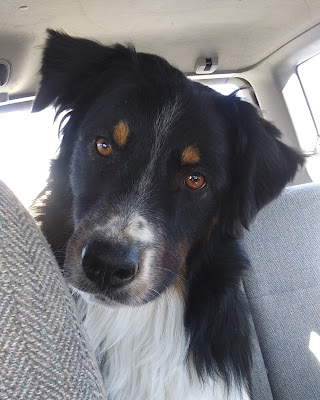
Sunny Juliet is an Australian shepherd, and many friends assumed (and still do) that her breed is the only explanation needed for her demanding puppyhood, but Sunny was something else! Yet, “She needs a job,” people kept telling me. 


The idea that herding dogs “need a job” has entered the general American consciousness and is wisdom now repeated even by people who have no dogs of any breed. But practically perfect Sarah, hybrid border-Aussie, was “something else” in the opposite direction of Sunny, laid back and easy going almost from the day she came home with us at four months of age. Peasy, that beautiful Aussie boy with his tragic issues, learned quickly and was compliant in ordinary matters; his problems flashed out as unforeseeable exceptions. Sunny Juliet? I have never had such an opinionated dog in my life! She has settled down hugely in the past year, however, and we now live together in harmony most of the time.


Sunny loves to be outdoors. She loves to go rambling with me, exploring the world, and she loves to play, chasing tennis balls or a Frisbee or a stick or anything else I throw for her. We have yet to get back to the agility lessons, but she remembers “Jump!” and “Tunnel!” and does them beautifully on command. 


The question is, does Sunny need a job? That is, does she need sheep or cattle or, at the very least, a flock of ducks to move around? 


Here’s my answer: What Sunny needs -- probably what any herding dog needs and no doubt what most dogs need – is mental stimulation combined with physical exertion. 


It doesn’t matter at all to Sunny if she “accomplishes" anything or not by chasing a tennis ball (or jumping a hurdle). Her little mind goes on high alert when she sees me preparing to launch the ball, and she readies her muscles to spring, run, and catch -- or run, chase, and retrieve. Which way will the ball go? Where can she interrupt its trajectory? Will there be a bounce first, or will she catch it in flight? This is more than a game to her. It is an opportunity to use her skills, and she loves it. Her eyes tell the story. If she were herding sheep, the same mental calculations and decisions about speed and direction would come into play. “Into play” = working. 


You see my point? I absolutely believe that herding dogs do not differentiate work from play. They love activity and problem-solving, and they seem to love doing things with their humans. Right now Sunny is lying at my feet, waiting patiently for something to happen, some move on my part that gives her a reason to follow me curiously wherever I might go next. 


Work and Play: Art


Marsh marigolds, just because.


Many years ago, a guitarist in my life noted, “Other people work. Musicians play.” We do use those words. (“I have to go to work in the morning.” “Our band is playing at Music in the Park.”) And yet a musician, every bit as much as a carpenter or a nurse, has to learn and practice to acquire skills and keep them sharp. 


Is it society’s failure to value musicians and other artists sufficiently that their work is seen as play? Or is seeing art as play a good thing, reminding the rest of us to find joy in our daily lives?


“How long did it take you to paint that?” someone would ask the Artist from time to time, and he would answer, “My whole life,” and when we were in the car, slowly driving our favorite county back roads, he was always “working,” in that he was taking in the colors and lines and shapes and richness of the land. When sitting quietly, he might be thinking through an idea for a painting, but when standing at the easel, he would tell me, “You can talk to me. I’m painting, not thinking.”


Photograph of David Grath by David Brigham


Work and Play: Me


Someone at the recycling center north of Northport saw me the other day and asked, “What are you doing now that you’re not doing?” I was nonplussed. “Not doing”? It’s true that I took six months of seasonal retirement (maybe for the last time!), but I’m certainly doing plenty now! Cleaning and organizing my house after having to empty out the Artist’s studio last fall before I left; getting my yard and gardens in order; preparing to open my bookstore for the season – and that’s only a general outline, with none of the myriad details. 


And now we have a couple more cold nights coming....


Do I differentiate between work and play, or am I more like a herding dog, needing physical and mental activity but not separating it into work/play categories? That’s my question here.


Cleaning is definitely work. I won’t say that no thought and planning goes into it or that there’s no satisfaction in seeing the fruits of my labor, but I only engage in it as a necessity. Yard and garden tasks are different. Definitely work (my muscles make sure I get that straight!), but my outdoor projects are ones I choose, not burdens imposed on me, and even mowing grass is work I enjoy. 


I will be open as soon as possible -- but when? When the Fates allow!


My bookstore is chosen work, too (though not the cleaning part: that’s imposed by entropy, a fact of life). No one would start a bookstore and run it for thirty years without a love of books, and my bookstore is a world I have created over time, but it’s certainly more than play. I’m not “playing store.” Bookselling is my livelihood. 


Robert Gray wrote a piece recently in the e-mailed book business newsletter, “Shelf Awareness,” about how annoyed he gets when anyone thinks booksellers just sit around and play with their cats all day. You can follow this link and look for the last article in the issue if you’re interested in what what else he had to say. 


Work and Play: Women


I’ve often noticed that women tend to characterize their experiments and trials in the fields of arts and crafts or gardening as “playing around,” in situations where a man would never use such language. Do women (in general) take their activities less seriously than men? Are men (in general) more concerned with having their activities respected? Is “playing around” – with ideas, concepts, designs, arrangements – a belittling and overly modest way of speaking, or does it connote a joyful, playful, open approach to life?


Just because I love them!


Work and Play: Jobs and Business


A job, even when a necessity, can be chosen work, and a business had better be chosen if the business owner is going to be happy in it!


While either jobs or business can involve pleasure and even love, though, they generally need to be taken seriously, and I’d say this is especially true of a business. A job you can quit. Give notice, turn in your keys, and hit the road. Closing and then dismantling or selling a business isn’t so simple. It's more like giving up a home. – And before I am besieged with questions, No, I am not thinking of closing or selling my bookstore! I’m just thinking of ways that a starting a business and keeping it going are a pretty serious commitment.


So what is my ‘play’?


If my business is my work, and this blog is related to my work (sometimes very peripherally, I admit), and if the outdoor jobs I love are work (albeit happily chosen), and since I don’t play bridge or softball, do I not play at all? That would be pretty pitiful, wouldn’t it? 


Walking in the woods with Sunny, exploring and observing the natural world, my country drives and photography –all those I experience as play, so much so that I often feel as if I’m “playing hooky” from all work that awaits me in my house and my bookstore. 


But no – you know what? Learning and appreciating the natural world is something I feel a joyful obligation to do -- as if it is, more than anything else, my life’s most important work. My way of practicing gratitude for the gift of the world. So I guess, in the way I approach life, I’m quite a bit like Sunny Juliet!


Informational Postscript: You wouldn’t guess from the foregoing that I am in the middle of an infrastructure disaster at home, a combination electrical/plumbing crisis. If my bookstore isn’t open on Friday, as I’d hoped, this is the reason. Wish me luck, send good vibes, don’t ask questions! My plate is full enough as it is! Thanks --


Fleeting May! These blossoms are already gone!


Tuesday, January 18, 2022

Companions of Time’s Short Day

Too soon, too soon, the sunset!


When I came across this quotation in a volume on book collecting, “The night of time far surpasses the day…,” my first literal association was with the psychological slowing of time during what someone else has called “dark nights of the soul.” Yes, those nights are long, and the coming of daylight a blessed relief. The quoted sentence, however, doesn’t stop there, and I had to search out the larger context to discover the meaning and how it might relate to the matter of rarity in old books. Here are two consecutive sentences that begin to shed light:


The number of the dead long exceeds all that shall live. The night of time far surpasses the day, and who knows when was the equinox?


There, we see, the “night of time” holds all the dead, remembered and nameless, that have gone before us, and the ancient and forgotten “equinox” would have been early in human prehistory, when the dead and the living were equal in number – if we can even imagine such a moment as real, given evolution and all. Where might a meditation on this idea take us? Seventeenth-century English writer Sir Thomas Browne began his own meditation inspired by the discovery of ancient Roman burial urns in the Norfolk countryside, and the quoted passage above appears in his Chapter V. 


Perhaps the most educated man of his time, Browne was not content to say merely that life is short and that almost everyone who lives is forgotten in time … or at most remembered as a name only or for some particular aspect or some act perhaps not essential to the living being who once walked the earth … and his “Hydriotaphia” is certainly worth reading and re-reading – which I shall do! -- but this morning I’ll return first to John Carter’s Taste & Technique in Book Collecting, because many other books await me, as well as letters deserving replies.  


Bookman’s (Brief) Holiday

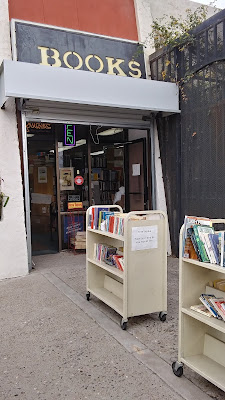
Anyone who has read previous posts on this blog, the farewell to Peasy followed by the Artist’s medical crisis and its resolution, knows that seasonal retirement has not been exactly a picnic this time around but that we have been abundantly blessed with family and friends and good fortune. Postponing our return to Dos Cabezas until Sunday morning, we were enjoying such a relaxed Saturday at the Artist’s cousin’s Phoenix home, in fact, that I decided to steal away by myself for an hour to Books on 7th Avenue.


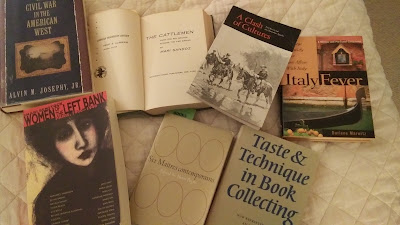
Whenever I first find my way to a treasure island of used books, it takes a while for my initial excitement to subside into the calmer mood necessary for discovery. Excitement in this case was heightened before I even made my way through the door, as there on the FREE cart outside I found a book for my Western collection, a public library discard copy of The Civil War in the American West, by Alvin M. Josephy, Jr. Once indoors, I quickly came upon A Clash of Cultures: Fort Bowie and the Chiricahua Apaches, a tragic story set in Cochise County, and The Cattlemen, by Mari Sandoz, the latter without a dust jacket but definitely important enough in my eyes to purchase.


Happy with three additions to my growing home library on the West and Southwest, I explored other aisles and found other treasures, including a book for the Artist, one for our host, one for a friend back in Michigan, and two on French literary history for myself. Reluctantly but happily, I stopped with those eight and felt amply rewarded. 


What was it that the Chinese fortune cookie foretold for me back in 1986? “Your path will be arduous but amply rewarded.” I carried the little slip of paper with me for years and carry it still in memory.


We Get Letters – and Books!

We returned to the ghost town on Sunday, January 16. The Artist had not seen the cabin since January 5, and I had left it on the morning of the 8th. Expecting mail and not knowing how long we would be absent, I imposed on a neighbor to collect mail from our box down the road, and on Monday morning she brought the week’s haul. (Another neighbor brought food enough to take care of us for days!)


I love mail!!!

Almost all the letters included condolences for loss of Peasy but had been written before anyone had heard of our subsequent trials. Still, how good to get news from faraway friends and to be assured of their love and good wishes for us.


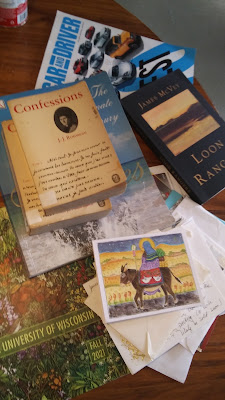
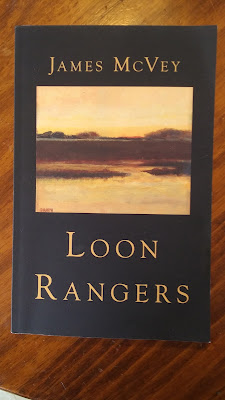
A friend in Kalamazoo sent me books, a large one on horses (!) and two paperback volumes of Rousseau’s Confessions. I have already dipped into Volume I of Rousseau, but the Artist and I are both more than eager to read the novel (copy inscribed to the Artist) by a writer we met years ago, when I copyedited his first book, a volume of short stories called The Wild Upriver. Jim McVey’s new book, Loon Rangers, like the first, is graced by a David Grath image on its cover, and I am confident that the story will transport us to the wild outdoors that Jim knows so well. Anticipation is yet another delight in the life of readers.


Thoughts of Peasy

One friend wrote that it seemed we had “found peace” with our decision to bid farewell to Peasy. Another hoped we were not “harboring guilt.” Most all understood the difficulty of the decision. At least one sent hugs. 


When I first posted about little Pea’s leave-taking and wrote about how much we had given him and the gift I felt he was in our lives, I meant every word, but I must say that I have yet to “find peace” with the decision or the good-by. It was, I know, the most “responsible” decision. And yet – our little dog boy was so full of life and joy, and the house and car and the vast range around the cabin are resoundingly empty without his presence. Despite all the anxiety he caused us, he was also a comfort in many ways. The other day I said to David that if by some miracle (and it would be, too!) we could have our practically perfect Sarah back with us, my heart would still ache for Peasy. Bless him -- he understood.


 And Yet, Gratitude, Of Course!


We two could not be more blessed with family and friends and, as I said above, good fortune. We have each other – certainly not anything to take for granted after the past week and a half! Out of medical limbo, we are once again looking forward, and that feels good.


We are alive and together!!!

But also, not to trivialize human life, there is that ever-present absence these days. The Artist and I have been fortunate in having had the opportunity to love and be loved by three dogs in the past three decades [I had to correct the time period there!], each with a different personality and all with permanent places in our hearts, so I’m sure the heartache I feel now for Peasy will subside in time to something gentler and happier. Just now, though, in the light of life’s brief candle, I am grateful for the understanding of anyone who has ever known and loved a difficult dog, because even a “dog with issues” is so much more than his issues and the difficulties he presents. 


Our sweet, clueless little Pea


Finally, Books Read Since January 1, 2022


1. Burke, Shannon. Into the Savage Country (fiction)

2. Flaubert, Gustave. Un Coeur Simple (fiction)

3. Paley, Grace. Fidelity (poetry)

4. Qoyawayma, Polingaysi (Elizabeth Q. White), as told to Vada F. Carlson. No Turning Back: A Hopi Indian Woman’s Struggle to Live in Two Worlds (nonfiction)

5. Green, Ben K. A Thousand Miles of Mustangin’ (nonfiction)

6. Doerr, Anthony. Cloud Cuckoo Land (fiction)


Tuesday, June 1, 2021

You probably don't want to read this.


Academic Camelot "moment" -- having a real office!

Once long ago (in April 2009) I introduced my personal philosophy in the form of an interview with myself but never went back to do the threatened second interview. In 2011 I introduced as “Part I” the beginning of the story of my relationship with the philosophy of Freidrich Nietzsche, and again did not follow through with a second part. What does it matter? I never received a single complaint about my lack of follow-through and doubt whether anyone has been awaiting Part II of either my personal philosophy or the story of my Nietzsche crisis.  Whenever I do get onto philosophical topics, on a blog or in a crowd, I generally lose most of my audience. Recently, however,  reading a book by one of my graduate school cohort has brought back pieces of those days, and so this morning, if only to provide myself with some sense of closure (wishful thinking?), here it is, the story of a philosophical crisis in the life of one middle-aged graduate student. 


Me and Philosophy, Part II of My Nietzsche Crisis


In my long-ago Part I to this story, I gave skipped over my crisis to the solution I cobbled together, which essentially was an evasion of the problem. In Part I, I wrote (quoting myself here -- ahem!):


The supposedly objective, unbiased and fair way to read Nietzsche is—well, first we set aside The Will to Power, an abortion of a book heavily edited by the philosopher’s sister, whose agenda was to make her brother’s work not only accessible but also of service to the Nazis. Ugh! Okay, so we’re not going to give any credence to that! But then (getting back to academic “fairness”), we “bracket” all those pesky, troublesome remarks about Jews, women, blacks and others said to share a “slave mentality.” Nietzsche was only using the terms metaphorically, we are told, and we are not to “paw at them” with clumsy, literal hooves. Only metaphorically? This is a defense of one of metaphor’s strongest philosophical advocates? Well, okay, I thought, I’ll bend over backward in the spirit of the so-called principle of charity (usually applied upward to Big Names but not downward to unknowns), and I’ll focus exclusively on language claims and not deal with statements about morality or about superior and inferior types of human beings except as these illustrate the philosopher’s views on meaning and metaphor. That should be fair enough. 


That is the background. Today’s post is my account of the crisis itself. 


Curtain goes up: There I was, pre-crisis, struggling to give Nietzsche every benefit of the doubt, looking at only the least objectionable linguistic claims and trying to keep the rest in a locked cupboard. Well, as any writer will tell you, to get your writing done you need to sit down and do it, but I will tell you that it is also necessary, very often, to get up and move around, even leave your work space entirely for an hour or a day to recharge your mental energy. Sometimes a long walk is in order. Other times a shower will suffice. On the day my crisis erupted, full-blown, I had roamed only as far from my desk as the living room bookshelves, where seemingly at random (was it?) I plucked a book from a shelf. It was a fateful selection.


Now, this is terrible to admit, but I cannot dredge the title of the book or the author’s name from memory’s recesses. The author was a woman – that’s all I remember. It was a serious work, but what was the overall theme? Was it a book on psychology, literature, what? I have tried and tried to remember. Perhaps someday the book will find me again. Whatever the details, I was skimming through the book's pages, giving my brain a rest from Nietzsche, when I came upon a chapter (this may or may not have been the chapter title; I don’t know) on a personality type the author called “the Narcissist,” and I went into shock.


The name Nietzsche appeared nowhere in either the “Narcissist” chapter or book’s index, but it was all I could see in every line of that chapter. Everything that had ever troubled me in Nietzsche’s writings, everything I had tried to “bracket” and ignore as I bent over backward to extend the principle of charity, came pouring through the pages before my wide, panic-stricken eyes. Nietzsche’s most superficially innocuous linguistic claims, I saw suddenly – and once I saw could not stop seeing -- were hardly free of the prejudices that tainted his written views on women and dark-skinned races. It all went together without contradiction in his obsession with purity. An overriding obsession. The shock to my system was physical, a paralyzing lightning strike.


I have recounted the eruption of the crisis in the above paragraph without italics or underlining or exclamation marks because such emphasis or punctuation could add nothing to my story. Most of my blog readers (if any have stayed with me in this post), even close friends, will shrug and think the term “crisis” either misapplied or, if accurate, denoting an overreaction on my part. I can only report that for me the revelation brought on full-blown panic. Free-falling through  space, I could barely focus on my immediate surroundings. 


But who understands the existential crises and panic attacks of graduate students in philosophy, other than another graduate student in the same department? I managed to get to the phone (a kitchen wall phone in those long-ago times) and in desperation called my metalogic study partner, J., to tell him what I’d read and what I’d seen in what I’d read. Bless his heart! He too was horrified! He understood instantly not only what I was saying about Nietzsche but also what it meant for me in our department, the chasm that had opened in front of me: the professor of the class for whom I was writing the paper was also my advisor, and he and the department chairman had both built their reputations on Nietzsche. J. saw it all. I was doomed! “Oh, my god, Pamela!” he exclaimed. “What are you going to do?”


If you read my Part I, you know that my solution to the immediate problem was to move from the one long paper to the two short papers option for that particular class. Rather than hanging myself on a Nietzschean noose, I shifted to Scheler in my second paper. Scheler was someone I found more compatible. Nietzsche had now become my nemesis.


In the end – or rather, to reach my academic end, the Ph.D. -- I changed advisors (which was not a piece of cake), and neither the chairman nor my former advisor attended my dissertation defense, although one entire chapter was devoted to Nietzsche, in which I wrote what I had seen and what I understood as gently as possible but standing by my revelation. And in the yet larger end it didn’t matter much, as I never did go on the national job market. By the time of my dissertation defense, I was already living Up North and was already started down the bookselling path, on which I have found also a life of the mind and the freedom to think and to hold to my own views. I am happy for those of my cohort who found academic positions and have been happy in their classroom lives, but I feel no envy and would not change places.


As for the crisis, I’ve had a handful of others since, but what I learned that day in Urbana was that they are survivable. Hideous and even fatal as they can feel at the time, they are like hurricanes that eventually blow themselves out. And an intelligent, sympathetic, understanding friend in the hours of existential darkness is priceless and unforgettable.


Thursday, November 21, 2019

Pollyanna, Mr. Rogers, and the Trials of November

And so it began....

November so far has been a rough month, starting with the weather. Unusually early snow, unexpected in its quantity as well as its timing (calendar winter not yet arrived), was a trial to all of northern Michigan. Even the business provided to the guys who do the plowing was not an unalloyed cause for rejoicing on their part, because many of those same guys do lawn maintenance and hadn’t yet gotten up all the fall leaves. In fact, many of the leaves had not yet fallen and are even now coming down on top of the snow and making a real mess of things. 


Autumn storms also brought additional shorline erosion, not as gradual loss but overnight disappearance. 

Well, what would Pollyanna say, that character in the novel by Eleanor Porter (1868-1920)? Pollyanna was a little World War I-era orphan who pulled crutches as her gift from the Christmas barrel instead of the doll she wanted. Well, she got through the trials of her life by playing the “glad game,” finding something to be glad about in every situation. The good thing about the crutches was — she didn’t need them! So if we apply the glad game to a blizzard that kept people home from work and school on one November Monday, we see how lucky we were. Spared forest fire, hurricane, and tornado, most of us were able to take refuge in place rather than being forced to flee our homes. And while we may not have chosen to have it in early November, who doesn’t love a snow day?

And there's no denying it was beautiful.

Trial #2, the impeachment hearings, is more of a challenge to a player of the glad game. The president, of course, feels persecuted, but the whole country is suffering, and the suffering goes back to the campaign that led to the 2016 election, when partisan divisions became more than acrimonious and turned downright nasty. Also, unlike a snow day, we can’t turn the impeachment hearings into fun by baking muffins and making hot chocolate. 

Impeachment is always regrettable. Whatever anyone’s feelings and opinions about whatever president it involves, the impeachment process is an attempt to solve a worst-case scenario -- or what we have come to hope is the worst that can happen. And what if it isn’t? If things got worse? Much worse has happened in many countries around the world over the course of human history. And so even sleep provides no surefire escape: “Perchance to dream! Ay, there’s the rub!” To have the country’s leadership invade our hours of sleep seems a most egregious violation, does it not?

As a nation, though, we have suffered and survived periods of horrible political division before this. Without harking back as far as the Civil War, I think back to violent protests over desegregation in the 1950s, Vietnam in the 1960s, and the rash of nightmare assassinations then, too. Surely, in those times as well as these, lies were spread, friendships destroyed, families torn apart. 

But it does seem that lies travel faster in these times — almost at the speed of light. “Misinformation,” as it’s called, has become an industry, prolific and profitable. So it’s hard to find anything to be glad about in our present whole situation, isn’t it? 

And yet — as I must remind myself almost hourly — we can be glad that the situation is being addressed by hearings in Congress rather than by military coup; that men and women of courage and principle are willing to put their devotion to country above political expediency; and that we still have reliable sources of news and can hear testimony for ourselves rather than having it filtered and presented in Newspeak.

Overwhelmed, we have to carry on.

Well, the blizzard was regional. The hearings are national, with international implications. But of course each of us has, besides, always, our personal trials. I will not go into mine, because it’s an old story — the behemoth in the room — and I would be either preaching to the (tiny) choir or beating my head pointlessly against the wall. 

What I can be and am glad of in the current global retail situation are those individuals, both the ones who saw the writing on the wall from the start and those only belatedly seeing where present trends would take us all, if continued — that small but perhaps expanding contingent — the people who value and support real bookstores. I’m glad of every visitor to my bookstore who doesn’t waste my time with idle questions about business but asks instead about books and takes the time to browse seriously. I'm glad of the many wonderful authors I've met over the years. And I am especially glad of and thankful for every single customer, neighbor or stranger, who leaves with a purchased book (or more than one), because that’s what it means to “love bookstores.”

Strange as it may seem, then, when I take the time to dig down under what I can’t help perceiving at times as the “slings and arrows of outrageous fortune,” I’m still glad to have chosen this life in the slow, challenging, difficult lane strewn with trials and tribulations. Not giving thanks for the hardships, you understand, but grateful for the opportunity to scratch out a living without compromising my principles and extraordinarily grateful for having a coterie of loyal supporters in that endeavor. 

I’m so glad my goal is not now, never was, and never will be world domination and expansion into outer space! What could be better than our green planet? I’m glad to be able to say that I have invested instead in myself and my own small-town vision.

Now, as for that small-town angle, a couple paragraphs above I used the phrase “neighbor or stranger,” but I’ve been reading quite a bit lately (as have you, perhaps, the new Tom Hanks film getting quite a lot of press) about the late Fred Rogers, who so famously and unforgettably asked on his television show, "Won't you be my neighbor?" And reading about Mr. Rogers, I can't help looking into the way I live my life and asking myself some pretty hard questions. 

Mr. Rogers spoke directly to children, to all of their fears and confusions, and also to the confused and frightened children inside every adult. I wish I could say that I always do the same, but that wouldn't be true. More often than I want to admit, I respond too quickly (even when I attempt to hide that response) from a feeling that I have been attacked or insulted or dismissed as inconsequential when there was no such intention in the words that wounded me. 

And what if there really had been an intention to inflict pain? 

I think the possibility of intention to hurt is much rarer than our almost automatic response of self-defense, actually: my personal concerns are not the center of anyone else’s consciousness, and so what other people find important to say, whatever the context of our conversation, will seldom address my core concerns but simply express their own. But whether the words of another came from ignorance, thoughtlessness, or what looks like plain meanness do not matter at all if I think of them as the words of a child, which is how Mr. Rogers counseled us to respond to one another. 

Years ago I did substitute teaching and regular tutoring up at Northport School (one of many “side jobs” undertaken over time in order that my bookstore might survive). Teaching children wasn’t what I had been educated to do, and I quickly realized that subject matter (math or spelling or whatever) is only part of the job. Kids don’t leave their personal lives and feelings in their lockers when they come into the classroom, and sometimes they can say or even do hurtful to one another or even to their teachers. They can behave destructively. And if the behavior is not somehow checked they can be dangerous to themselves and others. 

My big take-away from those experiences was this: I never encountered a child I felt was really malicious. Bad behavior might result from frustration or hurt or embarrassment or fear or confusion, but it was always a reaction to something, never sui generis meanness. 

American society in our time has taken on a pretty mean look. Movies, “reality” television, business, politics — in all these realms, it seems that dirty tricks and name-calling are held up to us as behavior to emulate. Even “Pollyanna,” the name of the character in the old story, is generally used as a derogatory term, like Goody Two-Shoes. It’s like calling somebody “Stupid!” Kind of a dispiriting picture of twenty-first American culture, isn’t it?

A year or so ago I asked someone I don’t know all that well how she maintained her positive attitude. I really wanted to know. I needed her answer. Didn’t she sometimes feel overwhelmed by threats to free speech, truth, democracy, and the natural world (of which we’re all part, even when we forget the fact)? Didn’t she ever feel downright hopeless? I cannot quote her response exactly, but it was something like “Lead from your strength.” When speaking or writing, putting her words out in the world, she wanted those words to be encouraging and hopeful. 

We need those words.

Because we can all see the negative. What we need from each other are reminders that good things are true, too, maybe something we’ve overlooked or forgotten or just temporarily lost sight of, something good we can build on. I don’t know how many times I have sat down to write in a terrible mood but managed to find some small kernel of gratitude and hope, a kernel that grew as my sentences proliferated, and that's because I am aware of writing for a community and trying -- honestly! -- to draw and lead from my strength, although I may have to dig pretty deep some days to find it!

More than one good friend has told me in person or has written to me that they appreciate my ability to find joy in small, everyday sights and events. Whenever anyone says or writes something so complimentary, I feel compelled to tell them not to give me too much credit, because it can often be a huge effort for me to seek out those small joys, and that's true despite the fact that my life in general is really quite blessed. So if you're struggling, you're not alone. Many of us can slip all too easily into feeling overwhelmed and despondent, particularly in November. 


Even that lucky dog, Sarah, is not always wagging her tail.

But who wants or needs to hear the sob story of a fortunate person? The old Eric Berne book on transactional analysis, Games People Play, called that game “Ain’t It Awful?” Ick! Who wants to be invited to that party? Besides, commiseration even with real tragedy can be best in small doses, or it risks being counter-productive and exacerbating the misery.


And we all need the gift of light.

Pollyanna’s game was one she played to keep herself cheerful in trying situations and times. Fred Rogers went deeper, inviting everyone to be his neighbor. The two messages are different but compatible. Don’t we enjoy neighbors who bring cheer rather than gloom into our lives? And aren’t we better neighbors when we look for the good in others, wherever we meet them?

Neither path is always easy, and most of us will fall down over and over, but we can get up and try again each time. As little children must.

One word of caution to neighbors in northern Michigan: what looks like wet pavement these days can sometimes hide — yes, in plain sight! — a thin coating of ice, so step carefully! My own Wednesday morning fall on an icy sidewalk brought no terrible consequences, but not falling must be the standard for which we aim.

Namaste, as neighbor Paul says. Thanks, Paul! You are a good neighbor! And thank you, Maureen, for starting my bookstore Thursday off with your smiling face, and Karin, for the beautiful journal you made for me out of that old, falling-apart school book from Quebec, and all the rest of you who buy your books from me in Northport. And please, I urge you all, while I'm gone this winter, to take your custom down the road a piece to Leelanau Books in Leland and/or Bay Books in Suttons Bay. We will keep getting each other through, one day at a time.

Love to all,
Pamela