regionalism. Emphasis on regional locale and characteristics in art
or literature. Regionalism was a significant movement in Canadian literature
early in the 20th century. Other national literatures also had periods
in which regionalism was emphasized.
Midwestern Regionalism. American literary movement of the late 19th
century that is characterized by the realistic depiction of Midwestern
small-town and rural life. The movement was an early stage in the development
of American realistic writing.
- Merriam Webster’s Encyclopedia of
Literature, 1995
[Don’t
ask me why the EOL capitalizes Midwestern Regionalism and not regionalism. I
have no idea.]
In
the last couple of decades, the term sense of place has become ubiquitous
in American discourse; whether the topic is fiction or the visual arts, sense
of place
is often highlighted and extolled. It is a sensibility that has come to pass
over and against an earlier aesthetic, in which historical period dictated what
was considered important or beautiful. And yet, oddly, while sense of place has
become a dominant theme, the label “regional” tends to limit the audience for
arts or books. Why this disconnect? Given the definitions above, situating
regionalism in the historical past, the view from the critic’s chair is
clearer.
But
where does that leave us? The sense of place aesthetic is at odds with
postmodern criticisms that locates regionalism in the been-there, done-that
category. We live in a “global” world, we’re told. Is our fascination with
sense of place, then, nothing more than nostalgia?
I’m
not setting out today to advocate for or against regionalism but to explore
what this sense of place discourse means to us, as Americans, and what place place holds in our
individual life stories. What is the place of place in your consciousness
or mine? In the arc of our personal narratives?
Re-reading
some of Jim Harrison’s essays from over two decades ago, I am struck not only
by the way he responds to various places – to Leelanau County, the U.P., New
York, France, Montana, and Arizona – but also by a general question he poses as
it relates to food, a question that could also, easily, relate to geography –
or anything else: Is it more desirable to climb a hundred mountains in a
lifetime or to climb one mountain a hundred times? Being a man, Jim
naturally sees a parallel in the question of marriage vs. the life of a
libertine. Surely he has also thought about the parallel question of where one
makes a home, where one spends one’s life, given that his own life has been
lived in multiple places but also, in each of those places, on terms of
intimate knowledge of each place.
As
I reflect on that, already I am seeing “100 mountains” or “one mountain 100
times,” even as an analogy, to be a false dilemma. I’m seeing a wide and
fertile middle ground. But I don’t want to assume it from the outset and have
not yet explored far enough to have made a case for its existence.
For
many writers, one particular part of the world or of their native country
remains home
for all their lives, whether they remain in that place or leave it and never
return, and all of their important writing lives there, in that place where it
is at home. For Sarah Orne Jewett, “the country of the pointed firs,” rural New
England seacoast whose name she gave to her most important writing, was that
place. For Ernest Gaines, home is Louisiana, the part where country people
live. Eudora Welty’s world was Mississippi. Ivan Bunin’s fiction is set in the
Russia of his childhood. We associate so many writers with New York City that
the list would take more room than I want to give to it – but for some reason,
fiction set in New York and infused with its streets and sights and smells and
patterns of speech is not considered provincial. Why not? Surely the locale and
characteristics of the city are vital to many New York stories. Well, I’ve
always wondered but don’t want to follow that side road today.
One
of my favorite writers who has chosen to climb the same mountain over and over
is Wendell Berry. His poetry and essays and fiction are unimaginable apart from
his life as a Kentucky farmer, and in choosing that life he also advocates for
it.
And the world cannot be discovered by a journey of miles, no matter
how long, but only by a spiritual journey, a journey of one inch, very arduous
and humbling and joyful, by which we arrive at the ground at our own feet, and
learn to be at home.
― Wendell Berry, The Unforeseen Wilderness: Kentucky's Red River Gorge
This
past week I read a book that came to my attention because the author is from
Kalamazoo, Michigan, where I lived for many years. In fact, before my years in
Leelanau County accumulated, I had lived longer in Kalamazoo than anywhere
else, from South Dakota to Illinois to Michigan and beyond. So, not surprisingly,
here is the passage that struck me on Thursday evening:
Evolutionary cul-de-sac. That was how I thought of the
streets of Kalamazoo. There were a lot of good things about Kalamazoo, and even
some great things, like my family. But I’d already lived 19 years of my life
there, which was too long to spend in any one place. And when I went to the
grocery store or to work, I ran into people who’d known me since I was a kid,
and most of them still applied their old knowledge of me. Even though everything
was different now, it was hard to escape the powerful orbit of history, the
inertia of the past.
-
Joelle Renstrom, Closing the Book: Travels in Life, Loss, and
Literature
Wendell
Berry finds a meaningful life only in returning and staying in the country where
he grew up, the country of his family history, whereas Joelle Renstrom’s
return, initially necessitated by her father’s fatal illness, becomes
problematic after his death. As she puts it, “I needed to continue evolving.”
She sees staying in Kalamazoo as the end of her personal growth.
This
is where I need to address the question of my own life, if only because my life
is the reason the question arises for me at all.
Wendell
Berry has his answer: his part of rural Kentucky is his place in the world. He
belongs there, his life and work and art inseparable from the place. Joelle
Renstrom’s answer, insofar as she has formulated it at this stage of her life,
seems to be that each place she lives has a certain expiration date. Vancouver
was home for a while, and then its time was over. She had a New York era. She
came back to Kalamazoo but needed to move on.
I
have a dream life akin to Wendell Berry’s, but my actual life has been much
more like that of Joelle Renstrom. There were 17 adult years for me in
Kalamazoo (I arrived at age 22), and there have now been 24 years in Leelanau
County, but I grew up in neither place, and no earlier generation of my family
called either place home. And what to say of two years in Cincinnati? Repeated
returns to Paris, France? Or winters on Florida’s Gulf Coast, or, more
recently, last winter in the high desert of southeast Arizona? Is northern
Michigan less important to my life because I have loved other places? Is loving
more than one place some kind of disloyalty? And if I say no, have I begged the
question from the start, doing nothing other than try to justify my own life?
Some
ways of life have little to do with the place in which they are conducted.
Someone can move to a strange city and spend all day at work or (if a student)
in classroom and library, go home after a few beers, and collapse in an
apartment. I knew people who lived like that in graduate school, but it was not
my way. On foot, on public transportation, in a borrowed car, I ranged as far
afield as possible – other parts of town, public parks, surrounding
countryside, and beyond. Those habits had been strengthened by a month alone in
Paris the preceding spring, but even in Kalamazoo, my long-time home previous
to graduate school, I never tired of exploring. Back in Michigan now for a long
time now, out in the woods with my dog is one of my favorite places to be, but
the truth is that many roads continue to becon.
Here
I go back to Jim Harrison. No one who knows Jim or his work could deny that he
has always had both a very active life of the mind and an insatiable
appetite for the outdoors. When Jim lived in Michigan, he was connected to
Michigan, engaged with it, eager learn all he could about it by intimate
acquaintance. Later he approached Arizona and Montana the same way. He would
probably be the first to admit he will never know the mountains or the desert
as does someone who has lived an entire lifetime in mountains or desert and
nowhere else. But as for those multiple places, truly being, as fully as
possible, where he was when he was there – that has been his way of life.
Down
on the Illinois prairie, post-Cincinnati, my yearning for the woods and waters
of Michigan practically made me ill with longing. “In the abstract, then, you
could be happy living in Wisconsin,” someone told me. In the abstract? Home is not an abstract
question! Place
is not abstract space! Nothing against Wisconsin, you understand, but my
overflowing treasure chest of northern memories is full of time in Michigan.
On
the other hand (and back and forth I swing!), my love of place is not singular
but is, rather, a love of places. There must be, as I mused
earlier, a middle ground between commitment to one place and promiscuous serial
residences without attachment. A place can be a beloved lifetime friend without
being a spouse. It cannot be disloyalty to love more than one place, can it?
What
of Renstrom’s question of personal growth or evolution?
Here
too I must insist upon more than one answer and say the answer will vary from
one person to another. Born in South Dakota, which I only recall from a family
vacation there years later, I could not wait to leave Joliet, Illinois, at the
age of 18 and could never imagine living there again, yet my youngest sister
has made a very full and rich and satisfying life and career without ever
leaving the town in which she was born. The third sister has a life history of
cities: New York, New Orleans, Chicago. “San Francisco,” she told me once when
there on a business trip, “is your kind of place!” But I’ve never seen
California.
In
Leelanau County and its small villages, clear labels are given to differentiate
“natives,” “locals,” “summer people,” and “tourists.” Those who move here from
somewhere else are questioned closely about where they grew up and just how
many years they have been here (or, for summer people, “coming up here”). It
would be hard to find someone here who doesn’t love this place, but who is
entitled to claim it as home? Home, here in the county, often seems a
vigorously contested category.
Some
people live entire lifetimes in one place. Others return later to childhood
homes. Still others lead ex-patriate lives until they die, perhaps in one
place, perhaps in a series of places. But how can anyone think the quality of a
life is determined by the number of places one lives?
--
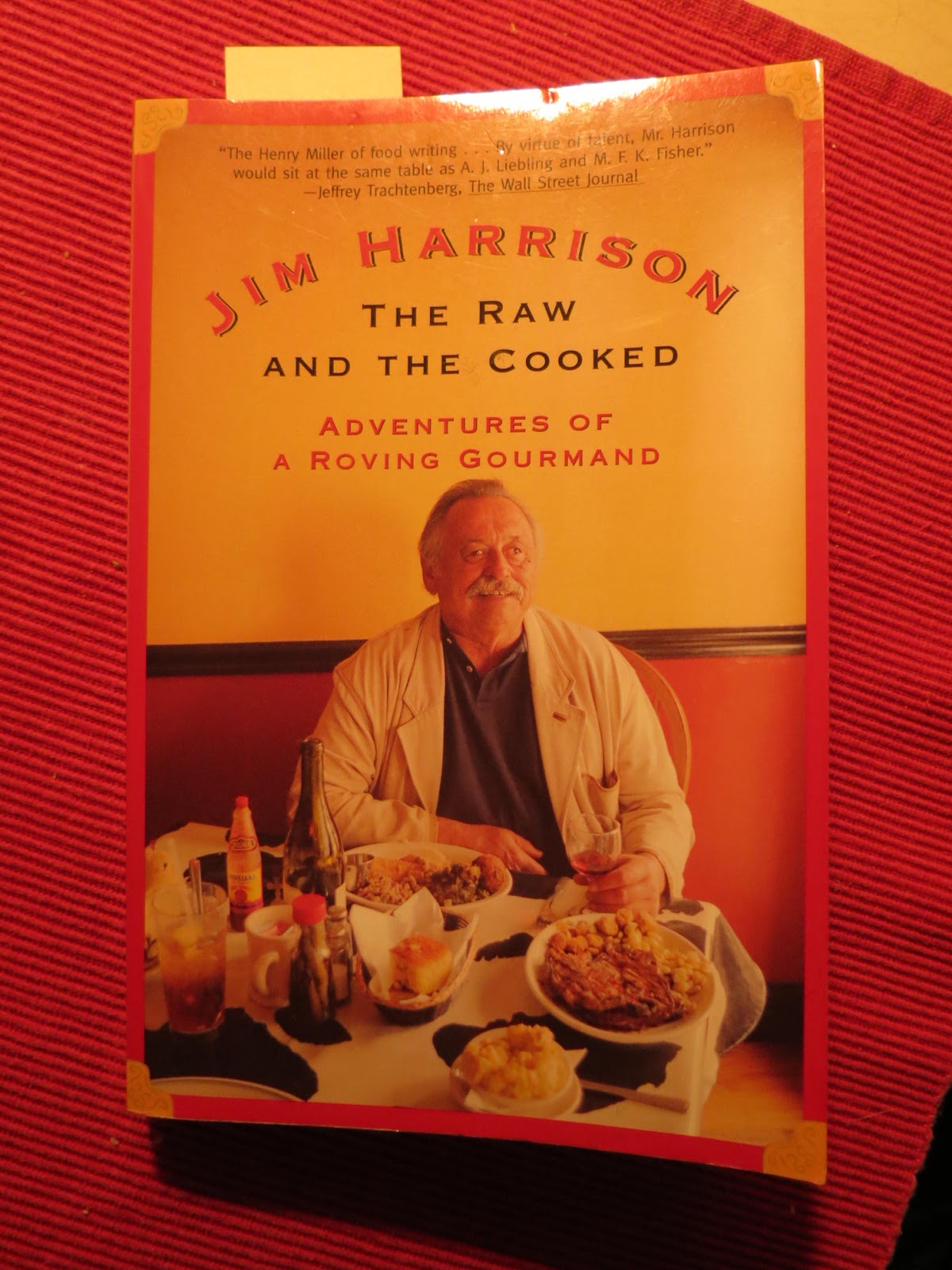
Serendipity has come to my rescue once again! Searching back through pages of The
Raw and the Cooked,
looking for the essay in which Harrison put forth the mountain/mountains
dilemma, I happened on this:
The wilderness does not make you forget your normal life so much as
it removes the distractions for proper remembering. -
“Just Before Dark,” 1991
It’s
worth taking time to read that sentence more than once and to think about it
for a while. It took me several readings to think about the part played by the
difference of the urban world and the natural world in the place or places we
choose to call home.
One
of the most jarring things about returning to a city or town where one grew up
or lived long ago – for me, Joliet, Lansing, or Cincinnati would be examples --
is the disorientation brought about by changes in the landscape. An old city
hall is gone, along with the old movie theatre and bowling alley. An entire
neighborhood was demolished for a freeway. One’s memories have been erased from
the material world. And it’s no better out in the suburbs, where subdivisions
and malls have replaced farms. What has become of one’s old landmarks? They are
all gone. And so, while the city is full of ghosts from your past, many of them
waft about unanchored. All these changes, along with busy traffic, distract
from “proper remembering.”
True,
deeply rural landscapes change, too, of course, but usually not so abruptly,
and even where there is abrupt change it somehow feels different. You drive an
old logging trail in the U.P. and see where forest fire swept through the year
before, a fire you heard about on the news. Now you see miles of charred trees.
It’s shocking, yes, but somehow it makes sense in a way that miles and miles of
big new houses where you used to build tree forts with childhood playmates can
never make sense.

Climbing
one mountain over and over, whether for years (as Wendell Berry has done) or
only for a matter of weeks (as I did on each visit to Paris or as David and I
did every day we drove from our high desert ghost town to the little cow town
14 miles away), if one is living in a place and paying attention to it, brings
the realization that it is never the same mountain two days in a row. You
cannot step into the same river twice? Neither can you visit any natural
setting more than once, because the woods, the lakeshore, mountains and desert, the playa
– all are different every day. And because they are, they compel attention and
at the same time leave room for “proper remembering” of one’s “normal life.” In
the wild, we are able to look at our own life as another part of nature, rather
than seeing it – no, feeling it -- as the center of the universe.
This
post is far too long. I doubt I have held a single reader through every
paragraph from the long-ago beginning to the (blessedly) now-approaching end.
I
cannot see either staying forever or forever moving on as contrary and
exclusive possibilities for personal growth. We can surely stay and stagnate,
but it is closing down or failing to move forward, not staying, that determines
stagnation. Just so, I’m sure that moving on can be either embrace of adventure
or flight from self, thus growth or the inhibition of growth. Or, in both
cases, I suspect (staying or moving), something in between. Periods of growth
and periods of stasis. Life’s rhythms.
“Oh,
the places you’ll see!” promised Dr. Seuss. We will none of us see them all.
What counts, I do believe, is not flitting from one to another and vying to
have the longest list but being as completely as possible in whatever place you
find yourself in, at least long enough to know if it can be home for you or if
you need to move on.
No
one else can make the decision for you. And you yourself will make it over and
over again, as long as you live.