Living deep in the country, under a blessedly dark night sky, out where coyotes carol nightly outside our farmhouse windows, and then commuting to my little bookstore in a small, quiet Up North village—well, I don’t always feel like part of the larger world of books, even with a blog that is theoretically (the key word: “theoretically”) accessible to readers around the globe. So it means a lot to me when I hear from other book people far from my home ground.
On Friday morning, the day my letter appeared in the daily e-mail newsletter “Shelf Awareness,” the phone rang at Dog Ears, and the caller ID said “Partners Book Dist.” One of my new book suppliers, Partners, down in Holt, Michigan, is a wholesaler for the Great Lakes region. (They also have a Western division.) My first quick thought was, “Oh, no! Am I late paying a bill?” But that’s only happened once in all the years I’ve been buying books from them—an oversight in a busy season--so I knew almost instantly that this call wasn’t about late payment. And no, Mick was just calling to say he’d read my letter that morning and that while he considers himself rabidly anti-censorship, he wholeheartedly agreed with everything I said. We chatted a while and traded stories, me smiling the whole time at my end, feeling both visible and vindicated.
Ron Jolly, author of Northern Michigan Almanac and Michigan's Upper Peninsula Almanac and morning talk show host at WTCM in Traverse City, called last week, too, wanting information about Ellen Airgood’s forthcoming novel, South of Superior. Ron knows that I know Ellen, that David and I regularly visit Grand Marais in the Upper Peninsula where Ellen and her husband, Rick, work themselves to the bone at the wonderful West Bay Diner, and the question of her book had come up in a conversation he’d just had at the radio studio with writers Doug Stanton and Phil Caputo. I checked again, for myself as well as for Ron, and discovered the release date for South of Superior is now set for June 2011. Sigh! We all have to wait! “Well, let me know when you have it,” Ron requested, “because I want to buy it from you.” Another reason for me to smile!
Then, as I was figuratively pawing through old e-mails, deleting messages by the dozen, I came upon an e-mail from Ellen. So I did have her address! Zoom! I zipped off a message, and her quick reply filled me in with details of her Great Adventure as a Newly Published Novelist. In a couple of weeks she’s on her way to New York City—the contrast to Up North as in Upper Peninsula is so great that I can’t just say New York, much less the “Big Apple” in this context—to meet with marketing and publicity people at Penguin Books. She’ll also meet the new editor of a YA novel that’s also on the burner. How unbelievably exciting must that prospect be?
People call on the phone. People send e-mail. Northport really exists, and I must really be here and not only a figment of my own imagination. But I imagine, therefore I am, so it works either way.
Monday, November 15, 2010


Book Review: MARRY OR BURN: STORIES
“When she was twenty, Francie Madden shot and killed her husband Gary.”
That’s the first sentence of the first story (“Amends”) in Valerie Trueblood’s new collection, Marry or Burn: Stories, so fasten your seatbelt and take a deep breath, because it’s going to be a rollercoaster of a ride. What can the rest of life possibly hold for a young woman after she goes to prison for murdering her husband? Other stories pose other questions: What does it mean to say that one man or woman is “the love of someone’s life”? How do some people “get over” losses and betrayals, and, if some do, why doesn’t everyone? Have you ever loved anyone enough to kill a bear with your own hands and an ax to save your beloved’s life?
Each story brings a new cast of characters to the book’s theme, each character contributing a complete new history. Marry or Burn is not a one-family house of a book but a multi-generational country, the author a Scheherazade whose powers of invention never falter.
For example, there is a doctor who began an affair with one of his patients, a Russian violinist, only to find his life reshaped by her values and history, so very foreign to his own:
And then, unexpectedly, she dies.
What will Stark do now with the rest of his life? In this story, “Trespass,” as in all the rest, there is no map for the road ahead, and we never know where Trueblood is taking us until we arrive.
Some moments are heart-stabbing.
Others are small and light.
I don’t know how to convey accurately a sense of the stories in this book, since excerpts taken out of context, however magical, can be only a pale shadow of those same words encountered in their organic home. Having so recently read a novel with one of the characters on death row (The Crying Tree), the first sentence of the first story, the one I opened this post with, caught me up instantly. As I read from one story to the next, however, it was the same with each one, with all the men, women and children, all the stories within stories, all the mysteries and surprises, the trajectories, reversals, new beginnings.
Here’s the bad part: Trueblood is such a masterful story-teller that I ask myself why I ever sit down at a keyboard myself. Really, who am I kidding?
All right, so I read the whole book, wrote up what you just read, and then I thought, I'd better go back and re-read one of the stories to make sure the writing is really that good, and to be fair about it, rather than page through looking for one I might call one of my "favorites," I opened the book at random and landed by chance on the story called "Luck." Okay, that would be my test case. The young male protagonist is returning home after what seems to have been a psychotic break sent him to a mental hospital or clinic far from home. While he was away, his widowed mother gave birth to a baby whose father, a married man, was the boy's high school coach. --But you see, I'm explaining all this in a very dull, expository way, and that is not at all the way Trueblood gives her characters' backgrounds. She does it lightly, deftly, with a sentence here, a word or a phrase there, so that the past is revealed to us in the same way as the present, with nothing overworked or overdescribed. We don't get the whole picture all at once (but we wouldn't get it all at once, anyway); by the end of the story, however, all the pieces have dropped quietly into place. There is no confusion. Instead, the questions we do have are ones we would have about people in our own lives because, in the space of only a few pages, the world of these characters has been made fully real to our imagination.
From the fiction writer's mind to the reader's mind. This is powerful magic.
I come back to this post on Wednesday morning, November 17, to make an addition. It concerns me that at least one person was frightened away from the book by my review, when I wrote only to encourage readers for Trueblood’s work. But then another person, who saw the book at Dog Ears, was frightened off by the title of the collection, and I realized I should have included something about the title in my review. There it was, on my mind at 5 a.m., so I got up to search the house for my old Lutheran confirmation Bible (closer at hand is the French Bible my father gave me) and quickly found the passage I was looking for. It’s in I Corinthians, and the passage is Chapter 7, verse 9. Paul has been writing to his distant flock, taking them to task for the sin of fornication and urging them to be celibate, as he is, but he realizes this is a hard sell. Speaking to the unmarried and the widowed, then, he counsels, “But if they cannot contain, let them marry: for it is better to marry than burn.” To be human is to have passions, and it is better for these passions to find lawful expression than to be perverted.
Ironic that Paul—St. Paul, if you will--wrote as he did in the belief that he was living in the “last days,” that the world was to end so soon that it should not be impossible for true believers to hold out and deny their passions for the little time remaining. He was a harsh judge, too. It was Paul, not Jesus, who urged believers to put sinners away from them. (Jesus, you will recall, reminded his listeners that none of them were without sin.) Paul’s opinion of women—well, I won’t let myself get sidetracked into that!
Here’s what Paul was saying. The best course is to “contain,” to control your passions by denying them (“For I would that all men were even as I myself” [verse 7]: i.e., You should all be like me and do as I do!), but the worst course is to be led by the passions into the sin of fornication, aince fornicators, like all sinners, will burn in hell. For the unsaintly, therefore, those who can’t measure up to Paul’s example, the choices come down to two: Marry or burn.
I’m willing to lay odds that Valerie Trueblood doesn’t see the dilemma as that simple. Part of what these stories reveal is what most adults have already learned: one may marry and still burn with passion.
That’s the first sentence of the first story (“Amends”) in Valerie Trueblood’s new collection, Marry or Burn: Stories, so fasten your seatbelt and take a deep breath, because it’s going to be a rollercoaster of a ride. What can the rest of life possibly hold for a young woman after she goes to prison for murdering her husband? Other stories pose other questions: What does it mean to say that one man or woman is “the love of someone’s life”? How do some people “get over” losses and betrayals, and, if some do, why doesn’t everyone? Have you ever loved anyone enough to kill a bear with your own hands and an ax to save your beloved’s life?
Each story brings a new cast of characters to the book’s theme, each character contributing a complete new history. Marry or Burn is not a one-family house of a book but a multi-generational country, the author a Scheherazade whose powers of invention never falter.
For example, there is a doctor who began an affair with one of his patients, a Russian violinist, only to find his life reshaped by her values and history, so very foreign to his own:
After two years of a dizzying rhythm of jealousy and reconciliation, Stark had arrived at a new stage with her, in which the baring of reasons for their trespasses against each other went on in a kind of calm. His, now, were merely rote flirtation, undertaken more to retaliate than for any interest another woman could have for him; hers had more weight: confessed cravings, late-night phone calls, disappearances. He was outdone in what his ex-wife had called his ‘ways.’ Now he had no ways, only the relics of an old habit.
And then, unexpectedly, she dies.
A shame came over him. In her harshness, her casual insults, Katya had been right: to be an American was to be a fool. To hear no warning. To have no idea what was wrong with you. To be overtaken by events you had never foreseen, and to smile. Others in the world did not smile.
What will Stark do now with the rest of his life? In this story, “Trespass,” as in all the rest, there is no map for the road ahead, and we never know where Trueblood is taking us until we arrive.
Some moments are heart-stabbing.
What is love? What is it? What is it? How can it be what it seems to be, nothing? A vacancy, an invisibility, a configuration of the mind. But with a weight, perceptible to the body.
Others are small and light.
The way Becca swung the car seat it could have held the groceries [rather than a baby]. ... “This is Justin,” Becca said solemnly, like a child introducing a doll that you will have to pretend is real.
I don’t know how to convey accurately a sense of the stories in this book, since excerpts taken out of context, however magical, can be only a pale shadow of those same words encountered in their organic home. Having so recently read a novel with one of the characters on death row (The Crying Tree), the first sentence of the first story, the one I opened this post with, caught me up instantly. As I read from one story to the next, however, it was the same with each one, with all the men, women and children, all the stories within stories, all the mysteries and surprises, the trajectories, reversals, new beginnings.
Here’s the bad part: Trueblood is such a masterful story-teller that I ask myself why I ever sit down at a keyboard myself. Really, who am I kidding?
All right, so I read the whole book, wrote up what you just read, and then I thought, I'd better go back and re-read one of the stories to make sure the writing is really that good, and to be fair about it, rather than page through looking for one I might call one of my "favorites," I opened the book at random and landed by chance on the story called "Luck." Okay, that would be my test case. The young male protagonist is returning home after what seems to have been a psychotic break sent him to a mental hospital or clinic far from home. While he was away, his widowed mother gave birth to a baby whose father, a married man, was the boy's high school coach. --But you see, I'm explaining all this in a very dull, expository way, and that is not at all the way Trueblood gives her characters' backgrounds. She does it lightly, deftly, with a sentence here, a word or a phrase there, so that the past is revealed to us in the same way as the present, with nothing overworked or overdescribed. We don't get the whole picture all at once (but we wouldn't get it all at once, anyway); by the end of the story, however, all the pieces have dropped quietly into place. There is no confusion. Instead, the questions we do have are ones we would have about people in our own lives because, in the space of only a few pages, the world of these characters has been made fully real to our imagination.
From the fiction writer's mind to the reader's mind. This is powerful magic.
I come back to this post on Wednesday morning, November 17, to make an addition. It concerns me that at least one person was frightened away from the book by my review, when I wrote only to encourage readers for Trueblood’s work. But then another person, who saw the book at Dog Ears, was frightened off by the title of the collection, and I realized I should have included something about the title in my review. There it was, on my mind at 5 a.m., so I got up to search the house for my old Lutheran confirmation Bible (closer at hand is the French Bible my father gave me) and quickly found the passage I was looking for. It’s in I Corinthians, and the passage is Chapter 7, verse 9. Paul has been writing to his distant flock, taking them to task for the sin of fornication and urging them to be celibate, as he is, but he realizes this is a hard sell. Speaking to the unmarried and the widowed, then, he counsels, “But if they cannot contain, let them marry: for it is better to marry than burn.” To be human is to have passions, and it is better for these passions to find lawful expression than to be perverted.
Ironic that Paul—St. Paul, if you will--wrote as he did in the belief that he was living in the “last days,” that the world was to end so soon that it should not be impossible for true believers to hold out and deny their passions for the little time remaining. He was a harsh judge, too. It was Paul, not Jesus, who urged believers to put sinners away from them. (Jesus, you will recall, reminded his listeners that none of them were without sin.) Paul’s opinion of women—well, I won’t let myself get sidetracked into that!
Here’s what Paul was saying. The best course is to “contain,” to control your passions by denying them (“For I would that all men were even as I myself” [verse 7]: i.e., You should all be like me and do as I do!), but the worst course is to be led by the passions into the sin of fornication, aince fornicators, like all sinners, will burn in hell. For the unsaintly, therefore, those who can’t measure up to Paul’s example, the choices come down to two: Marry or burn.
I’m willing to lay odds that Valerie Trueblood doesn’t see the dilemma as that simple. Part of what these stories reveal is what most adults have already learned: one may marry and still burn with passion.
Sunday, November 14, 2010
Sunday Quotation Potluck

(Many more images at end of post)
“Good work uses no thing without respect, both for what it is in itself and for its origin. It uses neither tool nor material that it does not respect and that it does not love. It honors nature as a great mystery and power, as an indispensable teacher, and as the inescapable judge of all work of human hands.”
- Wendell Berry
“When I go to the woods, what I am seeking and what I experience, when I am truly aware of my mind and not preoccupied with its contents, isn’t just the wind through the pine boughs and the croak of the raven....
“I need to know there is wildness in the world, even if I were to never see it. Even if I were confined to a cell, I would need to know it was out there.”
“Man is only an element within nature, but he is within it and not a separate order. If he despoils the natural world, it isn’t the assault of an enemy; it is the disease of a body attacking itself.”
- Dan Gerber
“Walking through the woods, I am reminded that there is as much death as there is life. It is a mistake to think the word forest refers only to the living, for equally it refers to the incessant dying. It is a mistake to speak of preserving forests as preventing the death of trees. Forests live out of the depths of toppled giants across the decades, as well as the incessant dying of microscopic beings. Without death, the forest would die.”
- Mary Catherine Bateson
The quoted material above is taken from Sacred Trusts: Essays on Stewardship and Responsibility, an anthology edited by Michael Katakis.

Below is a string of late additions to the post, images gathered this afternoon at Houdek Dunes.


Friday, November 12, 2010
When Do You Call It Censorship?

Suppose an author walks into my bookstore and asks that I carry his book on instructions for do-it-yourself weapons of mass destruction or her diatribe against an ethnic group not her own. Suppose I decline. Am I practicing censorship?
Let’s consider some different examples. Suppose another author drops by with her novel and I judge the writing as substandard. Or a writer brings me a self-published book with poorly reproduced illustrations and an absurdly high retail price. Or maybe the book someone hopes I will carry as inventory in my bookshop is something I judge to be without a market in my area. Suppose I decline to stock any of these books. Am I practicing censorship?

If you answered yes to the first question and no to the second, what difference do you see? Why would you allow me the use of my judgment in the second case and not the first? Why do you believe my powers of discrimination illegitimate if brought to bear for reasons of principle rather than reasons of profit?
I would argue that the charge of censorship is inappropriate in all of these cases. More dangerously, calling these bookseller decisions censorship clouds moral waters and silences legal, legitimate and principled expressions of freedom.
Try it from another direction. Give a definition of freedom of expression for writers and buyers in any marketplace. Now examine your definition in light of this question: Do sellers also have freedom? If not, your definition is hollow.

The issue of “censorship” comes up often with regard to the selling of books. Unfortunately, most discussions of the subject lack any initial definition. Either/or logic is called into play from the start, with those who quake at the slightest whiff of suppression of opinion or expression lining up against those with (usually religious) principles that would allow for broad and possibly legal restrictions on the same. So it wasn’t surprising to me that the usual uproar ensued the other day when the world’s largest online bookselling behemoth offered an e-reader version of a self-published book on a subject usually (I’m guessing here) sold under the counter in a brown wrapper. The seller’s spokesperson responded to the furor by saying that the seller “believes it is censorship not to sell certain books simply because we or others believe their message is objectionable.” Well, is it? I contend that it is not, and when the story appeared in the “Shelf Awareness” newsletter on Thursday, this is the letter I sent in response:
On the Subject of Censorship
If a governmental authority tells me I can't sell something, threatening me with punishment under the law if I go against the authority, that is censorship. If I as a bookseller choose not to sell something, I am exercising my own judgment and freedom of speech and expressing my own values. It doesn't matter how large the business it is: it always retains the right to say no, even when it is not forbidden to say yes. This is not censorship. It is fundamental to freedom.
Refusal to discriminate is another way to exercise freedom and a way to announce to the world that your company has no values beyond the marketplace. There will always be people who will admire that and see it as the ultimate expression of freedom, but the freedom of those of us who discriminate on the basis of value, choosing not to sell books with content we find reprehensible, deserves at least as much recognition under freedom's flag.
Discrimination. The word has taken on negative connotations in our country’s history, and yes, some kinds of discrimination are and should be illegal. Others are stupid and irrational. But discrimination in general falls under the heading of judgment, so it follows that there are kinds of discrimination that are absolutely integral to living any kind of life with value. If we as writers, readers, booksellers or buyers, ordinary American citizens from whatever walk of life give up the right to judge for ourselves that certain actions are reprehensible, we are asking to have our hands tied behind our backs. There is no freedom of expression without freedom to judge and choose.
Bottom line: Free to sell or not. It isn’t freedom without the second half of the disjunct.

Thursday, November 11, 2010
Salute to a Giant
Image of the Day: Picture for an Exhibition
(Sorry! You have to click on the link to see painter Max Ferguson taking a photo of Strand co-owner Fred Bass holding Ferguson's painting "Strand Book Store, 2010," which will appear in an exhibition called "Urban Intimacy" at the Gallery Henoch in New York City.)
When the Strand Book Store opened in 1927 on New York City’s “Book Row,” it made the 48th bookshop in that famous lineup where the first had opened in the 1890s. “Today, the Strand is the sole survivor.” This information comes from their website, and you can read more there.
What made the difference? The Strand is a family operation, but surely among the other 47 bookstores they were other families. Besides, family can be the kiss of death as easily as a guarantee of success in business. It wasn’t location, either, because all 48 bookstores were on 4th Avenue back in 1927. Whatever the secret to their survival and flourishing, today the store is at 828 Broadway in lower Manhattan, a comfortable walk from the Staten Island Ferry.
I remember my first visit and the sensation I had, somewhere between being at the world’s best county fair (that would be the St. Joseph County Fair in Centreville, Michigan) and right up close to a force of nature, Niagara Falls or the Grand Canyon. The enormity! The numbers! The sheer impossibility of taking it all in coupled to a almost blinding excitement at the prospect of trying! The Strand had shopping carts and multiple checkout lanes, like a grocery store! “I’m from Philadelphia,” Annie Hall kept saying in the movie, as if that should be sufficient to explain her responses to anything in New York. Well, I’m from the Midwest, and my experiences up to that time (I was 19 years old) had not prepared me for a bookstore like the Strand.
The Strand is still there today, over 80 years old and still going strong. New York would not be New York without it.
(Sorry! You have to click on the link to see painter Max Ferguson taking a photo of Strand co-owner Fred Bass holding Ferguson's painting "Strand Book Store, 2010," which will appear in an exhibition called "Urban Intimacy" at the Gallery Henoch in New York City.)
When the Strand Book Store opened in 1927 on New York City’s “Book Row,” it made the 48th bookshop in that famous lineup where the first had opened in the 1890s. “Today, the Strand is the sole survivor.” This information comes from their website, and you can read more there.
What made the difference? The Strand is a family operation, but surely among the other 47 bookstores they were other families. Besides, family can be the kiss of death as easily as a guarantee of success in business. It wasn’t location, either, because all 48 bookstores were on 4th Avenue back in 1927. Whatever the secret to their survival and flourishing, today the store is at 828 Broadway in lower Manhattan, a comfortable walk from the Staten Island Ferry.
I remember my first visit and the sensation I had, somewhere between being at the world’s best county fair (that would be the St. Joseph County Fair in Centreville, Michigan) and right up close to a force of nature, Niagara Falls or the Grand Canyon. The enormity! The numbers! The sheer impossibility of taking it all in coupled to a almost blinding excitement at the prospect of trying! The Strand had shopping carts and multiple checkout lanes, like a grocery store! “I’m from Philadelphia,” Annie Hall kept saying in the movie, as if that should be sufficient to explain her responses to anything in New York. Well, I’m from the Midwest, and my experiences up to that time (I was 19 years old) had not prepared me for a bookstore like the Strand.
The Strand is still there today, over 80 years old and still going strong. New York would not be New York without it.
Wednesday, November 10, 2010
Post #800: The Fat Lady Has Not Yet Sung

 No, my friends both near and far away, it is not yet winter in northern Michigan. That season may well be right around the corner, but for now fall lingers on. In some ways lately, it seems that even summer has not completely left us.
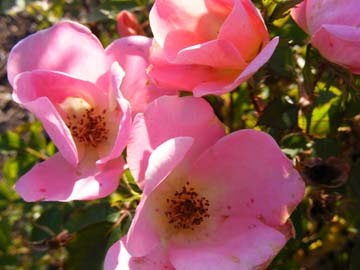
Not only are roses still blooming, but Dog Ears Books on Waukazoo Street is still open. Yes, the lights are on Tuesday through Saturday, 10 a.m. to 4 p.m. Sometimes Mondays, too, but that’s iffier. Special orders still welcome, as always.

After all those Wendell Berry poems read at John Brabanec’s memorial service, I had to replenish Berry titles in the shop and found, to my great delight, that his only children’s book, Whitefoot, is once again available. Who can resist a mouse story? David was captivated. The illustrations are charming, too.
I must confess that I can’t hear the question “Is the bookstore still open?” without having to suppress a very heavy sigh. If it came by e-mail or telephone from someone in another state, I would understand, but Northporters? People who leave their homes to meet for coffee on Mill Street? Don’t they ever drive down Waukazoo and see that OPEN flag waving in the breeze at 106?
No, friends [SIGH!], the bookstore year ends with the calendar year and not before. Dog Ears will be open through the holidays, as always. The bookstore has never closed for the winter before January, and I fully expect to re-open in April—again, as usual.
Autumn won’t last forever, and Dog Ears Books is hardly immortal. Someday, sooner or later, the Fat Lady sings for each of us. But not yet, friends. Not yet, not yet, though the sun kiss the horizon an hour earlier now and November darkness fall without pity on readers, writers and booksellers!


Tuesday, November 9, 2010
What’s Happening In and Around Town and Country, Indoors and Out?

As mentioned in yesterday’s postscript, Sarah and I went to Peterson Park on Monday afternoon. The images today are from my time on the beach. I’ll intersperse them with unrelated text, if you don’t mind.
 I’m reading (devouring!) Marry or Burn, having set aside Deeply Rooted to dive into the long-awaited (by me and others) Valerie Trueblood story collection. I’ll have a lot to say about both of these books in the near future, but I was so confident about Trueblood’s work, after Seven Loves, that I chose her for this week’s recommendation before even opening to the first page, something I’ve never done before. I can say now, several stories in, that my confidence was fully warranted. More on this later. And more on the various books related to agriculture I’ve been reading. Another that might go into the to-read-soon pile is Sacred Trusts: Essays on Stewardship and Responsibility, ed. by Michael Katakis, with illustrations by Russell Chatham.
Pictures immediately below:
Petoskey stones come in rock size, too.
Land and water forms join.
Other rocks present alluring colors.


We finally got to set our clocks back on Sunday, and Northerners now have another hour of sunlight in the mornings. I suppose Southerners do, too, but can it possibly mean as much to them as it does to us? I love having a wider window of opportunity for morning dog walk/runs. (I walk, she runs.) Some people are grumpy about losing light in the evenings, but the home fireplace takes the pain out of dark evenings for me, and it’s a good excuse to stop yard work and come into the house, too.

With the sun so low, the shadows of even tiny creatures stretch to great lengths.
Bless my neglected garden! Yesterday I wanted carrots for soup but didn’t want California carrots (Sorry, California, we have plenty of carrots in Michigan!), so the grocery store in Northport wasn’t going to help me, but riding through the countryside with Sarah after our expedition to Lake Michigan I remembered that I hadn’t dug the carrots from my garden yet. Went home. Got out the spading fork. Sure enough, beautiful and fresh and crisp and sweet! There are enough for a few more diggings, too. Very satisfying!
Here is a plant from the beach, kinnikinnick, or bearberry, Arctostaphylos uva-ursi. Not much from a distance, but up close the berries are bright, cheery red.


My calendar has suddenly spouted another exciting holiday event. Well, the date isn’t certain yet, but I’ll keep everyone posted and add it to the calendar as soon as possible. Marjorie Farrell, whose mother-in-law lives here in Northport, will be visiting from Woodstock, New York, in December and will be bringing her new line of beautiful, stylish, reusable, eco-friendly wrapping cloths. They are perfect for books (I love how easy books are to wrap, anyway), and lucky recipients can use the wrappings afterward as scarves, small table covers, art for the wall—or as wrapping for gifts to pass along to friends. “The medium is the message”? In this case, “The wrapping is [part of] the gift”! We’ll have a party at Dog Ears Books, with refreshments, Marjorie will give a demonstration, and we will banish the winter blues, if anyone already has them in December, which I hope will not be the case.
For now, anyway, it's still November with balmy October weather.

P.S. Please take time to read Sharon Astyk's post today on the "love economy."
Sunday, November 7, 2010
Walking on Beach, Soaking Up Sun, Seeing Dead Birds


Sorry about dead birds below, but they were there. Actually, there were many more that looked much worse.


Still, Lake Michigan can hardly look bad, can it? Especially on a sunny, brisk day in fall.


Monday evening postscript: The pictures in this post were taken on Sunday afternoon. Today Sarah and I visited the beach at Peterson Park, and it too was littered with dead birds. We did not walk as far south on the beach as Barb Livingston, whom we met on her way back. She had found a very freshly dead loon. Very sad. What gives?
November Visit to Wisconsin
Two Rivers, Wisconsin, with a population of 13,000 was hit hard by the economic downturn. A “stop on the way to Door County,” what does the town has to offer that is uniquely its own, besides their claim to be the original home of the ice cream sundae? Well, there is the Hamilton Wood Type Museum, housed in the old factory building that manufactured wood type for so long, and it’s the only wood type museum in the entire world.
Five years ago, returning through Wisconsin to Michigan after my father’s funeral in Illinois, David and I stopped overnight in Two Rivers. It was late, we had dinner at a Chinese restaurant, and in the morning, poking around the older parts of town, we happened on the Wood Type Museum. Never having heard of it before, I was enthralled by the very idea, but it was Sunday, and the museum wouldn’t be open for several hours, and we had many miles to travel.
Thus I must admit that my visit this November (2010) was made via a DVD called “Typeface,” brought back by friends who made the trip and did not miss the museum. It isn’t the same as being there and having an opportunity to run my hands over the carved blocks, but it’s better than nothing.
Wood type was the first Hamilton product, and it was their only product for the first ten years. With a quality product and a lower price than anyone else in the business, Hamilton was able to put its largest competitors in New York and Chicago out of business (and then, naturally, doubled their own prices). In the hey-day of letterpress printing, big posters and billboards demanded wood type, as very large letters could not be cast in metal. It was a marriage of machine work and handcraft.
Then in the 1960s came offset lithography, and out went letterpress printing. Mountains of type must have been discarded all over the world. What was it good for? Who needed it? And then came computer graphics and printing.
Now letterpress printing is making a comeback for the same reasons that other “outdated” crafts and ways of doing things are returning. There is something beautiful and real about it that can’t be duplicated by a computer. The Hamilton Wood Type Museum offers workshops year-round by print artists from all over the world. Poetry and letterpress are a heavenly partnership made right here on earth. Letterpress books and letterpress wedding invitations carry high value and cachet in niche markets.
It’s strange, really, that this way of printing, which has little to do with the majority of books, should fascinate me so. It’s stranger still that I learned what goes on in the museum and elsewhere in the letterpress world by watching a DVD on my computer. I would rather have been there. I’d like to go back to Two Rivers and spend time in that museum. I’d like to visit that Chinese restaurant again, too, and spend more time along the old docks and check out the farm museum and have an ice cream sundae. Can’t believe how much I missed in that little town the only time I was there....
Five years ago, returning through Wisconsin to Michigan after my father’s funeral in Illinois, David and I stopped overnight in Two Rivers. It was late, we had dinner at a Chinese restaurant, and in the morning, poking around the older parts of town, we happened on the Wood Type Museum. Never having heard of it before, I was enthralled by the very idea, but it was Sunday, and the museum wouldn’t be open for several hours, and we had many miles to travel.
Thus I must admit that my visit this November (2010) was made via a DVD called “Typeface,” brought back by friends who made the trip and did not miss the museum. It isn’t the same as being there and having an opportunity to run my hands over the carved blocks, but it’s better than nothing.
Wood type was the first Hamilton product, and it was their only product for the first ten years. With a quality product and a lower price than anyone else in the business, Hamilton was able to put its largest competitors in New York and Chicago out of business (and then, naturally, doubled their own prices). In the hey-day of letterpress printing, big posters and billboards demanded wood type, as very large letters could not be cast in metal. It was a marriage of machine work and handcraft.
Then in the 1960s came offset lithography, and out went letterpress printing. Mountains of type must have been discarded all over the world. What was it good for? Who needed it? And then came computer graphics and printing.
Now letterpress printing is making a comeback for the same reasons that other “outdated” crafts and ways of doing things are returning. There is something beautiful and real about it that can’t be duplicated by a computer. The Hamilton Wood Type Museum offers workshops year-round by print artists from all over the world. Poetry and letterpress are a heavenly partnership made right here on earth. Letterpress books and letterpress wedding invitations carry high value and cachet in niche markets.
It’s strange, really, that this way of printing, which has little to do with the majority of books, should fascinate me so. It’s stranger still that I learned what goes on in the museum and elsewhere in the letterpress world by watching a DVD on my computer. I would rather have been there. I’d like to go back to Two Rivers and spend time in that museum. I’d like to visit that Chinese restaurant again, too, and spend more time along the old docks and check out the farm museum and have an ice cream sundae. Can’t believe how much I missed in that little town the only time I was there....
Saturday, November 6, 2010
En cherchant Neige en Chine
Blogs come and blogs go. There’s nothing strange or worrisome in that, generally speaking. But when a friend vanishes without a trace, c'est inquiètant. It’s disturbing. So no, it isn’t snow-capped mountains I want to see in China, it’s the smiling face of a blogger whose life I used to follow on a daily basis, not the abstract “snows of yesterday” I seek but a young Chinese woman, a teacher of French, thoughtful, lively, outspoken, sensitive to earth’s beauties and literature’s mysteries. She blogged under the name Neige.
The first blog Neige wrote was blocked by the Chinese government shortly before the anniversary of the 1989 demonstrations in Tiananmen Square. All access to Blogger sites were blocked, presumably because the government feared discussion of the historic event. Undaunted, the intrepid blogger (and it seems strange to describe her that way, as her blog was, in general, not at all political in nature but much more a personal vision of her everyday world) moved to another site. But you see what happens when you attempt to access the more recent blog: “La page demandée n’existe pas.” The page you asked for does not exist. Et alors? Où est-elle, la jeune femme charmante?
Neige blogged in French, I in English. When we commented on each other’s blogs, we used sometimes one language, sometimes the other. The other evening, watching a documentary on China, the sight of a canal through a Chinese town brought Neige to mind. She had completed her master’s in French, and the town where she had gone to teach had canals. I don’t remember its name. I don’t know hers. I do know that she had regular readers in France, in Canada and in the United States. I know that her birthday is December 25. I know that her smile brightened our days and that the images of her daily life were windows for us into another world. It brought that world to us as a friendly, inviting, neighborly kind of place.
Neige, I miss you. This post is a message in a bottle, flung into Lake Michigan in hopes it will find its way to the ocean and around the world to wherever you are. David sends greetings, too. Tu nous manques.
The first blog Neige wrote was blocked by the Chinese government shortly before the anniversary of the 1989 demonstrations in Tiananmen Square. All access to Blogger sites were blocked, presumably because the government feared discussion of the historic event. Undaunted, the intrepid blogger (and it seems strange to describe her that way, as her blog was, in general, not at all political in nature but much more a personal vision of her everyday world) moved to another site. But you see what happens when you attempt to access the more recent blog: “La page demandée n’existe pas.” The page you asked for does not exist. Et alors? Où est-elle, la jeune femme charmante?
Neige blogged in French, I in English. When we commented on each other’s blogs, we used sometimes one language, sometimes the other. The other evening, watching a documentary on China, the sight of a canal through a Chinese town brought Neige to mind. She had completed her master’s in French, and the town where she had gone to teach had canals. I don’t remember its name. I don’t know hers. I do know that she had regular readers in France, in Canada and in the United States. I know that her birthday is December 25. I know that her smile brightened our days and that the images of her daily life were windows for us into another world. It brought that world to us as a friendly, inviting, neighborly kind of place.
Neige, I miss you. This post is a message in a bottle, flung into Lake Michigan in hopes it will find its way to the ocean and around the world to wherever you are. David sends greetings, too. Tu nous manques.
Subscribe to:
Posts (Atom)