Search This Blog

Thursday, April 4, 2019

Paper Pages, Dusty Mountain Trails


It was now late afternoon and the sun had passed over the far side of the long cut. The rocks in the pass rose almost perpendicularly on either side of the narrow trail; several of the boulders seemed to be far off balance, past the point where they should fall off and roll down into the pass.
- Elliott Arnold, Blood Brother 

It was not late but early afternoon as our party of four approached Apache Pass on Wednesday, as we had set out from Dos Cabezas right after lunch, and the road to old Fort Bowie is not many miles past our winter ghost town cabin. I’d spent time that morning with Elliott Arnold’s novel, a fictionalized account of regional history, with much background and detail focused on Cochise, chief of the Chiricahua Apaches during the period covered in the novel, and Tom Jeffords, who eventually became the Indian agent for the Chiricahuas following a treaty made between Cochise and General O. O. Howard. A few sentences stray into New Mexico from time to time, but most of the encounters and incidents in the book take place between the Dragoon Mountains and the Chiricahua range, my winter stomping grounds. 
In December, 1858, Cochise received an invitation from the station agent at the Apache Pass depot to bring his entire tribe to the station, with its newly completed store, to receive presents as a gesture of good will from the Butterfield [Stage] people, who had by then on numerous occasions felt the power of the friendly hand of the Chiricahua chief. 
Remains of Butterfield Stage Station

Old stage route
Cochise had realized that his people could not survive forever if they continued to war against the ever-increasing number of whites pouring through Apacheria, so he had promised safe passage to the Butterfield stages, and he kept his promise. He even went so far as to punish Apaches from other groups who trespassed on his territory and violated his agreement with the whites. Cochise made these choices for the good of his people. For a while most of the whites were content merely to pass through on their way to California; even then, however, all was not well for the people of Cochise, and it much became worse as the numbers of whites increased and not all were transients. 
While most continued on their way to California, many were settling in the great valleys. Whether they remained or moved on, their passage was a noisy one. Their transit was emptying the countryside of game far more rapidly than Cochise had thought possible. Ranchers and farmers appropriated water holes and caused the game animals who used to come to those holes to move elsewhere. 

Within the space of months the numbers of deer and elk diminished speedily…. The mountain sheep found new summits to roam. There had been wild turkey, not in great amounts, but enough to fill the larder of the Indians who hunted silently and did not cause entire flocks of birds to fly away over noisy gunfire.
Apache wickiup

Eventually — and it did not take long — 
The deer and the elk were gone, and without them there was nothing to provide the shirts and trousers, the hip-moccasins. There was grain from the government store, but there was no fresh meat.  
A few of the Apaches had look around and had found some more of the yellow nuggets and had got white men’s clothing in exchange. But the clothing was designed for the cattlemen and farmers in the lowlands and offered little protection against the cold [of the mountains]. Besides, no Chiricahua Apache, no matter how much he tried, could accustom himself to white man’s shoes.
Chiricahua women repaired moccasins as well and for as long as possible, but without the deer and elk both clothing and sustenance were harder and harder to come by. Would the situation have been less dire if it hadn’t been for gold fever? It made no sense to the Apaches, how silly and excited and childish the whites became over gold. It could not be eaten, and the metal was too soft to be used to make tools or weapons.
… The Americans lost the dignity of their manhood when they saw the yellow iron. They gushed and became effusive and uncovered their emotions as no Indian ever would under any circumstances. They had no restraint. 
Ironic, I can’t help thinking, the coincidence of sound between the English words gold and greed

We all know how it ends. The story of Cochise and Tom Jeffords is told in books and movies, embellished fiction and straight nonfiction, and I’ve made mention of it before in other posts. Besides, the general story was repeated from New England to California as the “manifest destiny” of the young United States was achieved. Cochise was fortunate enough to die a natural death in his beloved mountains, but after his death, the fate of his tribe took a turn for the worse. Americans in barrooms and Congress, living rooms and offices, argued the relative merits of competing policies regarding Native Americans — concentration vs. extermination — but in practice, both policies were pursued. The Apache chapter of American expansion eventually culminated in the removal of all “hostiles” from southeast Arizona, including women and children and the very Apache scouts who had fought with the U.S. Army, to concentration camps in Florida. According to the government’s story, these Apaches were prisoners-of-war. Even the women and children? Even the scouts who had been their own fellow soldiers? For shame!

Remains of Indian agency, where Jeffords was agent

My sister had not been eager to hike the 1.5-mile trail from the trailhead parking lot to the old fort ruins, where we would meet our husbands, but she did it for me, and I was grateful — all the more so when we came upon points of interest long before we reached the old fort. The most moving to me, for some reason, was not any of the old building sites but Apache Springs itself. Water is life. I had not imagined we would see the spring, coming upon it after our trail skirted high ground above another surprise, a deep, wooded canyon.

Apache Springs
Wherever on the earth one occurs, there is something holy about a spring. I felt as pilgrims must feel when visiting the grotto where St. Theresa is supposed to have had a vision of the Virgin Mary, gods and ghosts all around me. 

Brother-in-law and Artist at ruins of Fort Bowie
While the women had been hiking the trail, the men had been exploring the remains of the old fort. After a rendez-vous and some modest purchases at the visitor center, we retraced our steps by vehicle and went “around the block” — the long one — down along the mountains and around to the Mustang Mall and back up the Kansas Settlement Road for supper at the cabin. If we could see a composite picture of all our party’s thoughts and impressions after the day’s expedition, two white American men and two white American women, all born in the mid-20th century and doing our best to adjust to the 21st, what would be revealed? Nothing simple, I’m sure of that.
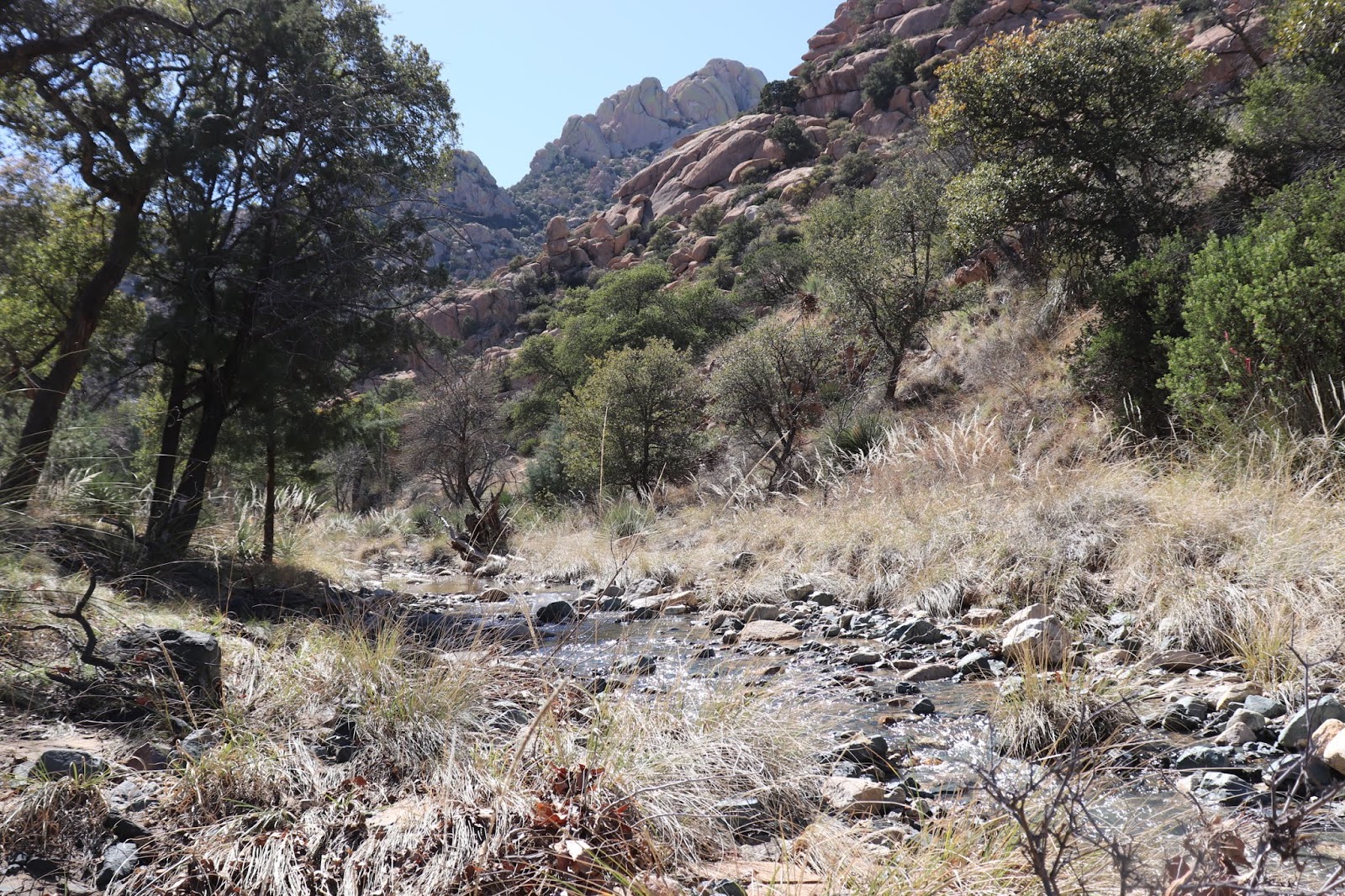
Cochise Stronghold in Dragoon Mountains


Saturday, March 30, 2019

You Probably Think He Was On YOUR Side, Don't You?


It will never be possible to get a completely accurate and unbiased account of the Barcelona fighting, because the necessary records do not exist. Future historians will have nothing to go upon except a mass of accusations and party propaganda. I myself have little data beyond what I saw with my own eyes and what I have learned from other eye-witnesses whom I believe to be reliable . . .  

This kind of thing is frightening to me, because it often gives me the feeling that the very concept of objective truth is fading out of the world. After all, the chances are that those lies, or at any rate similar lies, will pass into history . . . The implied objective of this line of thought is a nightmare world in which the Leader, or some ruling clique, controls not only the future but the past. If the Leader says of such and such, “It never happened” — well, it never happened. If he says that two and two are five — well, two and two are five.
 
George Orwell, Homage to Catalonia, quoted in Why Orwell Matters, by Christopher Hitchens
Christopher Hitchens says of Orwell’s Homage to Catalonia that it remained “an obscure collector’s item of a book throughout Orwell’s lifetime.” Not, in other words, a bestseller or anywhere close. Why would this be so? The answer given by Hitchens, one that makes complete sense to me, is that both the official and the popular views of the war in Spain relied on what I call a “two sides” formula. You know, the way we are told and so often tell each other that it’s so important to hear both sides of any issue or story? As if there are only two versions, the two clearly distinct from each other? That’s certainly the way the war in Spain was framed — as a conflict between conservatives (Catholic Nationalists, they called themselves; others called them Fascists) and communists (although some were grassroots socialists and others Stalin’s forces). Given the frame, which side any particular person saw as good and which as bad depended on that person’s ideological commitments rather than on more complicated facts, let alone whole truth. 

One must close one’s eyes to the virtues of one’s opposition in order to construct an inhuman enemy. 

Orwell was on the ground in Spain, an active fighter on the Left but also a man who saw clearly, first-hand, the way the anti-fascist revolution was betrayed by Stalin’s ruthless subversion of forces fighting for Catalonian independence. What were his options when he realized what was really going on? Stay with a local, independent Left and be tortured, even murdered by Stalinists for not being a loyal Communist? That happened to others he knew. Go with the Stalinists, the internationally recognized Communists, and betray the revolution or switch sides and become a Fascist? Neither of those would have been Eric Arthur Blair, a.k.a. George Orwell.

He chose to escape and tell the story, but it fell on deaf ears. The world had chosen sides, each one saying, “With us or against us!” Thus, one could only be seen — by the “other side” — as Fascist or Communist.

Sound familiar? 

Here’s an irony for you: not only did Orwell back then have those on both the Left and Right who hated him — he also has admirers on both sides today. Today’s liberals are sure he was warning against the dangers of fascism, now imminent, while today’s conservatives say he warned against socialism, their especial bugaboo. Everyone wants to think Orwell was singing their song. Hitchens takes a chapter each show that both groups are wrong and can only turn Orwell into their saint by cherry-picking their quotes, but that’s all more than I am going to try to summarize here. You’ll have to read Why Orwell Matters for yourself— and then go back and read Animal Farm and 1984 again. One thing is certain: Orwell was warning the world about future dystopian possibilities.

One of several things that frustrates me about debate, in general (consequently, also about the adversarial American justice system), is the usually unquestioned assumption that there are always and only two sides to a question and that one one of them — and only one — is true, thus the other false. From the assumption, it follows that positions taken must possess the form of affirmation/negation: I’m right, you’re wrong. To acknowledge that there is anything to be said for one’s opposition is seen as weakening one’s own case, giving “comfort to the enemy. 

Recognizing a much more complicated truth, Orwell in his day was caught in the crossfire. The same thing happens today in our country to many politicians who don’t adhere to a strict party line. Determined to vilify those with whom they disagree, Americans seem willing to give up truth. Why?

"Power is not a means; it is an end. 
"… The object of power is power." 
- George Orwell, 1984
I once had lively discussions on ethics and politics with a graduate school friend who had been the first woman in Ethiopia to graduate from university with a B.A. in philosophy. Our very different undergraduate educations, as well as wildly divergent life experiences, inevitably resulted in very different views at the opening of each discussion. But it was, each time I looked back afterward on the course of our conversation, energizing and delightful to realize what had taken place as we argued. I cannot remember a single time when one of us claimed victory and the other admitted defeat. Instead, by the time we had hashed through our subject for several hours, we always came to a more nuanced understanding of the issue at hand, an acknowledgement that black-and-white could not contain it at all, with the result that the two of us, together, now agreed on and occupied a new, third position not envisioned in our initial disagreement. Such a result would fall far outside the parameters of the rules of debate. It would not have made, for either of us, a big splash in professional academic philosophy circles, either. But we felt satisfied that we had both advanced toward truth in those discussions, as well as finding common ground. While it should not be impossible, in principle, to achieve similar results in the halls of Congress — if Congress were actually functional and all members focused on getting work done — it seems to have become nearly so in recent years. 

Future historians will have nothing to go upon except a mass of accusations and party propaganda.  
- George Orwell, Homage to Catalonia

As far as I’m concerned, that single sentence from the passage that Hitchens quotes is sufficient to establish that Orwell still matters today. His is a warning we would do well to understand and heed.


Tuesday, March 26, 2019

What More Could Anyone Ask?

Before sunrise
Warning: Today is a day of small thoughts. Proceed with low expectations. 

Morning came early. No earlier than usual, but warm enough that I was outdoors before sunrise, smiling at a mockingbird singing down in the wash. When the sun breaks over the horizon, deep shadows give sharp definition to the mountains behind the cabin, and my cup overflows. 


At last I have a teapot! We were getting along without one, pouring boiling water from a saucepan (not kettle) directly into cups or mugs, but there is something indescribably homelike about a teapot, something that says, “You’re not just camping — you live here.” It makes me happy to look at it, even when it isn’t in use. My new bookcase is working out great, too. With shelf space to spare now, our other horizontal surfaces (“We can’t be trusted with horizontal surfaces,” the Artist once observed) are much cleaner and available for other uses. 

Book Dog in Arizona
I look around at our limited living space and no longer see anything missing. As for outdoor space, it stretches out and up in ways that fill my heart with joy, fill my lungs with deep draughts of mountain air, and bring a smile to my face.

Monday evening view from friends' porch


We had dinner with friends the other evening, and I wore my “new” cowgirl boots for the first time. The little painting I bought at an estate sale is still without a frame and will be for the foreseeable future, because of its odd size, but I’m glad I have it. The subject matter is a little white calf, very appropriate for a high desert cabin in cattle country. We have friends and neighbors. Familiar faces greet us at the library or in the grocery store. I have a hiking partner. Even Sarah has friends in Dos Cabezas. Icing on the cake: it was a beautifully wet winter, bringing lots of rain and snow, enough so that many usually dry creeks are now running cool and sweet.
Sarah, Mollie, Buddy

A teapot, of course, is not one of life’s necessities. I didn’t need it, only wanted it. And so it has always been with me and horses; however, “If I were to get a weanling now,” I told the Artist, “I could have it for the rest of my life.” Trouble-shooting, he immediately speculated that the horse might outlive me, and then what would become of it? But I can’t worry that far ahead, even in my fantasies. 

Little Dream Boy!


Saturday, March 23, 2019

Climbing Back in Time -- Again


Cows and horses are by instinct expert engineers and will always find the easiest way through a mountainous country. Goblin detoured from the river on the eastern side. He had stiff climbing to do but there were breaks in the river-walls and running with the brood mares on the Saddle Back had made him as sure-footed as a goat. Hours of hard going brought him at length to the last grassy terrace before the rocks shot up in an almost sheer cliff. The place was like a park with clumps of pine and rock, little dells and groves; and, scattered at the base of the cliff and on its summit, numbers of the huge smooth-surfaced stones like the one balanced on the top of Castle Rock on the Goose Bar ranch. 
Some of them as large as houses and perfectly smooth and spherical, these boulders are to be found all through the country of the Continental Divide, creating a wonder in the mind of any beholder….
- Mary O’Hara, Thunderhead
The Artist and I are not the sort of adventurers who have continual need of new destinations. Places we have loved once call us back again and again, and often, as has been true of Trinity Monastery south of St. David, Arizona, we find more to explore on subsequent visits.  That being true of a few acres or a small town, imagine how it applies to mountains! Chiricahuas, Pinaleños, Dragoons — it would take a lifetime to know any one of these ranges thoroughly, so is it any wonder we set out for the mountains over and over? 

Let me say right here and now how glad I am that Cochise County takes its name from the Apache chief. Cochise was a truly stand-up individual, a man of integrity and deserves to be remembered and honored. Sometimes it seems his name is almost used in vain, applied to all kinds of commercial ventures, but as the name of a county once thoroughly part of Apacheria, the tribute is recognition of this country's deep local history, history that goes back to before mining, saloon fights, ranch wars, and tourism. It is a proud name, Cochise.

You may recall that our first attempt to reach the Cochise Stronghold in the Dragoon Mountains, on the west side — our side — of our Sulphur Springs Valley, met with failure, due to road conditions. Having successfully navigated fords of various depths four times, we had to turn back at the fifth, vowing to return when waters went down. And let me say here that anyone who thinks government never does anything right has not taken the time to explore land managed by the U.S. Forest Service. We have been to at least three sections of the Coronado National Forest and are thrilled to be able to encounter unspoiled wilderness. The absence of “amenities” (picnic tables, restrooms) goes in the plus column, as far as we are concerned.

For our second attempt, instead of approaching directly via 191 to Ironwood Road, we took191 to Dragoon Road to Cochise Stronghold Road to Ironwood Road — not that there is much if any difference in distance between the two routes, and all are paved roads (with fording challenges yet to come once the mountains are reached), but we welcome any opportunity to take a road we haven’t traveled before. Cochise Stronghold Road was a good road. We liked it. It almost seemed that we reached Ironwood Road too quickly, but that feeling lasted only a brief moment, because then, turning west, we had the mountains before us, and who, approaching the mountains and the Stronghold, could wish for anything to be different?

At the first ford, a car and two or three motorcycles were pulled over, driver and riders hesitating, unsure about proceeding on. We walked to the water’s edge to reconnoitre. The flow was configured differently from our previous crossing (strange how even with less water a ford can manage to look deeper when it has cut a slightly new course) but looked doable. It was. We forged ahead. Subsequent fords also were no worse than what we had managed before. 

Artist at the wheel!
The fifth ford! Yes! A sixth! Yes! Nothing could stop us now!

There is something soul-stirring about this road and these mountains. Basically, the road follows the creek, though (obviously) the creek crosses back and forth across the road, too. Trees include not only the oaks and conifers of the Stockton Pass but also incredibly beautiful sycamores, their bare white trunks like the bones of some prehistoric giants. Rocks rear up on all sides, magnificent, and human eyes are drawn skyward again and again. I am never far from tears when we travel this road. The beauty and the history together bring every sense to new, quivering heights.

Well, we drove as far as it’s possible to drive, through the organized campground to the trailhead. Camping is allowed in other parts of this section of Coronado National Forest, but the organized campground at the trailhead is a fee area. More significantly, from our viewpoint and for our purposes, the hike by trail to reach the actual Stronghold, the secret meadow fastness high and deep in the mountains, is four and a half miles. That means the aller et retour would be nine miles. And we didn't dare attempt it. I had managed a 4-1/2-mile round trip hike in the Chiricahuas, but barely, and the Artist has done no serious hiking here in Arizona. We had Sarah with us, too. (Hiking with dog on leash: no-no.) So it was unanimous: we would turn back from the trailhead and retrace our steps instead of going forward on foot.


The first small party of two white officers guided to the Stronghold in 1872 by Tom Jeffords, trusted friend of Cochise, went on horseback. The U.S. Army had never managed to breach the Stronghold in the mountain maze on their own, and only with Jeffords as guide and Cochise as their guarantor were General Howard and Lieutenant Sladen able to reach Cochise. This is what they found:
Winding about among the foothills, we at last struck the bed of a crooked stream, and following it back, up a moderate ascent, through a narrow pass, rock bound on either hand, we entered a gradually broadening valley in the very heart of the mountains. … The place seemed the center of a natural fortification. In extent it seemed some 40 or 50 acres, flanked on either hand with precipitous bluffs, 300 or 400 feet in height. Through the center ran a stream of water coming from a large spring near by.  
- from the 1872 journal of Captain Joseph Alton Sladen, M.D., assistant to Brigadier General Oliver Otis Howard, edited by Edwin R. Sweeney and published as Making Peace With Cochise (University of Oklahoma Press, 1997)
If I am never able to enter the valley in the heart of the mountains, I see it clearly in my mind’s eye, with Cochise and his people still there, proudly at home. Back down the road and across the first fords, we  deployed lightweight canvas folding chairs along the bank of the stream and set up a little temporary meal camp in the shade. The creek made heavenly music beside us, and the setting along with our hunger made ham and cheese sandwiches taste like a gourmet meal. 

"Thou, beside me in the wilderness...."


flowing water...

fine-grained sand!


After lunch we had planned a quiet reading session and had brought our books with us from the car, but the Artist said he couldn’t bear to read Machiavelli in such a setting — and it was certainly no place for Machiavelli! No problem. I was happy to read a bit of the O’Hara novel, Thunderhead, aloud and share that pulse-stirring story. For that book, the setting was imminently suitable. My only challenge was keeping my voice steady, there in the exquisitely beautiful and history-saturated mountains all around us.

…And in front of him was a mass of the great boulders which seemed to have been rolled down the sides, choking the chasm completely.  
But there was still the smell of horses—Goblin went on. And a turn showed him an open way through—a sort of keyhole, roofed with a single great boulder which hung on slight unevenness on the side walls. Beyond, Goblin glimpsed blue sky and green grass. Galloping through, he came out into brilliant sunlight and a far vista of valley and mountain. 
…Two miles or so across and of an irregular oblong shape, the valley was belly-deep in the finest mountain grass. Here and there, rocky or tree-covered hills rose from the valley floor, reaching as high as the jagged and perpendicular cliff which ringed it and shut it in…. 
- Mary O’Hara, Thunderhead
It is always hard to leave the mountains, and I am deeply grateful to whatever fates or gods there be that Cochise himself never had to leave his homeland and that the peace he made with the U.S. government lasted until after his death. And for all the mistakes that our government, like every government of men and women on earth, has made in the past and continues to make in the present, I am grateful as well that so much mountain wilderness remains today as public land, managed for all American people to enjoy.


Friday, March 22, 2019

Balm to the Soul, Piscean or Otherwise

On bank of San Pedro River
Philadelphia Wash
 The Artist is a Pisces, the fish loves water, and Arizona is, as its very name suggests, a pretty dry state, an arid zone. Outside our ghost town cabin, the Philadelphia Wash (named for the defunct Philadelphia Mine back in the Dos Cabezas Mountains) is a dry wash for all the months we’re in residence. When summer thunderstorms arrive, the wash will rage with flash flood torrents, but we won’t be here to see it. And so we plot expeditions — you might even say we make pilgrimages — to places with water. And we visit an old monastery over on the other side of the Dragoon Mountains so often we might be mistaken for postulants. 

Trinity Monastery, a Benedictine establishment, in recent years saw its last four monks moved elsewhere, but the property is still managed as a retreat center and spiritual refuge. As for the monastery waters, when we visited in previous years the Artist and I knew only the small pond in the meditation garden, with the spring (we assumed it was a spring) that fed the pond from higher ground, but the garden was a jewel we cherished, because as much as the Artist’s soul is fed by water, mine is nourished by trees. A friend of mine from Tucson was also charmed by the monastery when she and I visited it together last year, and she and I made a return visit, also, earlier this year. The gated garden surrounding the pond is provided with benches, facilitating meditation, prayer, reading, or quiet conversation, but this year my friend and I explored instead the birding trail along the San Pedro River. As spring came near, the Artist and I returned to do the same, grateful for a narrow channel of running water sparkling in the sun. Our monasterial (my word) horizons were widening.

Sargent Cypress from California?

There is a little thrift shop on the monastery grounds and another, smaller building announcing with a simple sign “USED BOOKS.” From the beginning, we have been patrons of both. My Tucson friend and I also find treasures in the official “Bookstore” and office building, the first encountered on entrance, where pecans grown on the property are for sale, as well as bread baked on the premises, honey, pistachios, religious books, cards, medals, and beautiful notecards with watercolor scenes. 


And this year the Artist and I happily made a new discovery. Up a short path from the parking area is a sanctuary within a sanctuary, consisting basically of a much larger, more open pond set aside especially for birds. (Did St. Francis whisper this idea to st. Benedict?) Giant cottonwoods stand at the far end, their great size and huge missing limbs giving them an ancient look, with plenty of shade along one side and benches strategically placed to take advantage of it. Here, besides all the reasons one might seek repose in the meditation garden, birds are a major attraction. American coots glide and dive for food. A great white egret often shares a small island with a statue of the Blessed Mother. Smaller birds flit and call and sing among the greenery. Also, up a slope from the pond, hidden from the parking lot by a beautiful chapel, is a sweet little cemetery. In a turbulent world, every aspect of the monastery grounds exudes peace and soothes the soul.


Walking around the pond for the first time on our most recent visit, we were delighted to discover Asian carp, “just like the ones at Versailles!” Now the Piscean soul really came alive! Actually, both of us were energized and at the same time calmed by the sight of these graceful beauties. We watched them for quite a long time. I also watched reflections of clouds on the surface of the pond.


On the sunny side of the pond is a beautiful building in Southwest style that we approached for the first time on our most recent visit, having previously only admired it across the water. The Artist wanted to explore at closer range. I hung back at first, employing my camera from below, but when he assured me the building was not currently in use I joined him on the patio. How lovely! 


The individual doors on the right leading to — cells? Was this the monks’ residence? Left of the open-air corridor is a courtyard. Is the building now used for retreats or not at all? “Wouldn’t this be just perfect?” I couldn’t help exclaiming. Everything was there — sunny Mediterranean warmth, beautiful water reflecting trees and clouds, the birds, the fish — surely there would be room for a couple of horses somewhere on the grounds!


We really could live there, the Artist and I. Not “could” in the sense that there is any possibility of it, but in the sense that it would be a dream come true, yes, that’s what I mean. Luckily for us, we have always had a rich fantasy life, and we return to our simpler life not discontented with it but all the more richly satisfied with our lot for having briefly imagined another life.