Search This Blog

Showing posts with label rationality. Show all posts

Tuesday, November 23, 2021

Our Long, Long Trail, Part I


It was Sunday morning in Tucumcari, New Mexico, when that old song started playing in my head. I think it was Sunday morning, anyway. The days tend to jumble together at times on the road. 


We don’t try to make a lot of miles on our first two days, because on Day 1 and Day 2 we have family destinations, and once we reach those towns, we go no farther. Arriving in midafternoon daylight, we settle into our temporary digs at leisure and meet family in the evenings.


Day 3, however, is different. And as the Artist wanted to cross the Mississippi at St. Louis (ugh!) rather than Hannibal this time, so that we could grab an expressway (ugh!) angling southwest, it was not my favorite day of the trip. All I can say is that if you mustcross at St. Louis, where the tangled knot of criss-crossing high-speed roads makes going around Chicago look like child’s play, doing so early on a weekend morning (Saturday, in our case) is probably as good as it can get, and it would also be much more difficult if the driver were alone and had no navigator. The rolling pastures of Missouri are beautiful, but my eye was drawn continually to the old road paralleling the expressway. On expressway, I always feel as if I’m on a conveyor belt: there is no slowing down or stopping to, for instance, photograph an interesting sight. Of course, that is the whole point of expressways. Keep rolling nonstop!


Here is a further thought I had about expressways. They are, in the best designs, thoroughly rational. Logical and rational from an engineering point of view, that is, which is another part of the problem (for me), related to but distinct from their nonstop nature. Threading the convoluted knot of St. Louis, for instance, one loses any sense of direction. Where is east, and where is west? North, south? These interchanges did not grow organically from earlier roads that took the place of footpaths that developed along animal trails, and the gap between the organic and the rational is enormous, a difference of kind rather than degree. They are really two different worlds, one we follow with our body’s animal senses, the other a system our minds must bend and twist to follow, ignoring those same animal senses.


I am a book person. Life in the slow lane is my preferred mode. The trail from Michigan to Arizona is a long one, however, and we were not traveling as tourists. In Illinois there was no time to visit the shrine (as I think of it) to the memory of Mother Jones or to explore the Cahokia Mounds, and speeding through Missouri the whole point was to reach Tulsa by nightfall. As I say, it was the most difficult day on the road for me.


Our view of Tulsa


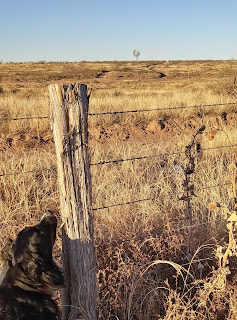
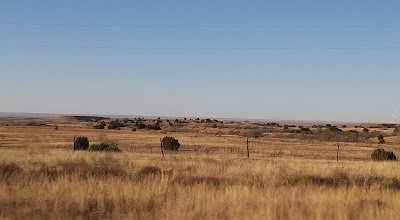
Day 4 arrived. We departed Tulsa. By the time we reached western Oklahoma, the land began to open out to wide, long horizons, and my heart began to lighten and lift and expand. Forget about right and left brains. For me it is my heart that has at least two different homelands, Michigan Great Lakes and Western rangeland and mountains. There in western Oklahoma and on into and across the Texas panhandle, we were on the high plains. I always think of a friend who lived for years in South America and shared with me her romantic notion of the altiplano. Shoulders straighten, eyes search the horizon, lungs expand and take in great gulps of air. 


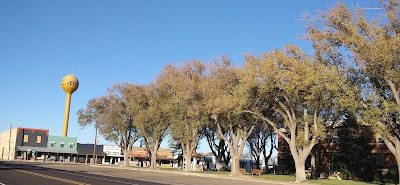
Despite the Artist’s dedication to expressway speed, he was happy to detour off the road so we could revisit Vega, Texas. Years before we had had a pleasant lunch at the little bakery café across from the courthouse square, where the rancher husband was filling in for his baker wife, who was off on a catering job elsewhere. Then the stop got lost in memory’s shuffle, and search the map as we might, we could never remember the name of the town or find it again on our travels. But that was because we had developed a different route, one that took us through Kansas and down through only the smallest slivers of the panhandles of Oklahoma and Texas. But this time, on the road first taken, we found Vega again. It was Sunday evening, so not surprising that the café was not open, but it was satisfying to see the little town again and remember our earlier encounter and a walk with Sarah after that lunch. Memories don’t have to be spectacular and full of fireworks to be important.



Night found us in Tucumcari, New Mexico, with the moon rising huge and burnt orange as we ventured out for a bite of supper. 


Day 5. The burnt orange moon of the night before was pale white in the morning. “It’s a long, long trail a winding,” sang my heart. We were not yet in Arizona, but my heart felt it had reached its Southwestern home, and the Artist too was relaxed now and felt we could afford time to look around a little before pushing on. I asked only that we find the train station, since my only photograph of it the year before had not satisfied me at all. I also spotted an intriguing building that the Artist turned back cheerfully for me to photograph, agreeing that it was worth taking time to see. Those scenes are here.


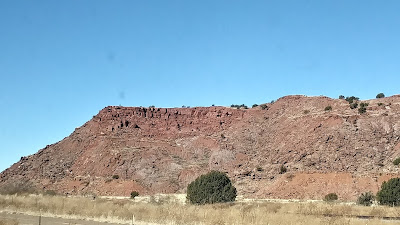
Mesalands! Need I say more?


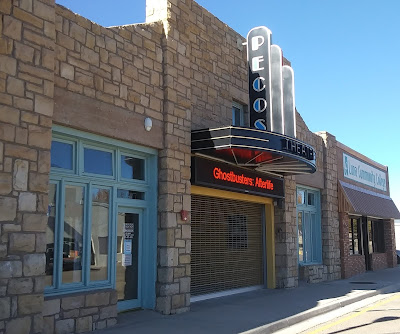
Then breakfast in Santa Rosa – dear little Santa Rosa! I am always happy in that little town. There are still many sad relics from the vanished glory of Route 66, but I was thrilled to see the movie theatre on the courthouse square showing films and looking all spruced up and lovely. The grocery store, too, seemed to boast a new and cleaner look. “You see? It’s coming back!” The Artist finds me “something else” in my love for Santa Rosa. 



And by the way, should you happen on an onsite notice that the Santa Fe Grill in Santa Rosa is “permanently closed,” please note that it is NOT. The owner died, and the restaurant was closed for a time, but heirs have now re-opened for business. Good news for travelers and locals alike!
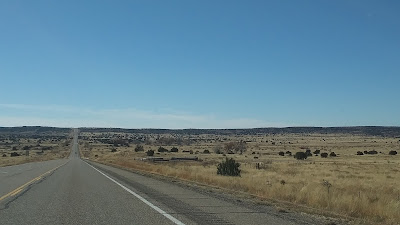


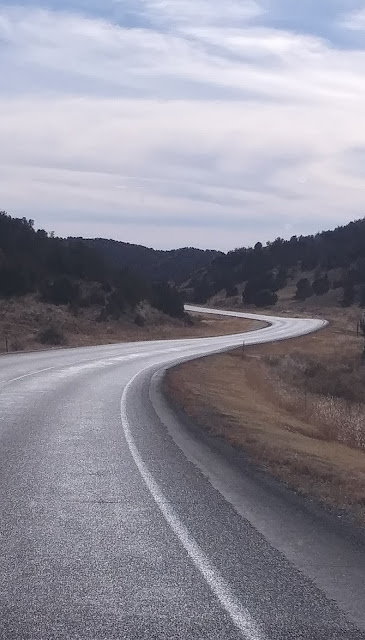
And oh, from Santa Rosa – no more expressway but the old, long road (one white-knuckled experience was enough to teach us to fill the gas tank before taking the road south) through beautiful open country dotted with dark green one-seed juniper and dusty cholla. Through Vaughn and Corona and Duran. On our last pass through Duran, we explored one side of the highway, promising ourselves to explore the other the next time. And it turns out there is much more to Duran than we had realized. We explored all the way back to the three cemeteries (two ranch families each have cemeteries of their own), and I searched on my phone for some of the history of Duran -- very interesting! 
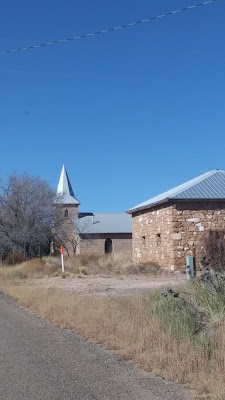


Tularosa, Alamagordo, through the mountain pass, and on through Las Cruces and Mesilla. Had we not lingered to poke around in Tucumcari and Santa Rosa and Duran, we might have completed the trip on Day 5, but the slower pace was rewarding, our fifth day a happy day of relaxed driving, and it felt fine to stop for the night in Deming, knowing we would arrive in Dos Cabezas with plenty of daylight for our settling in.



Friday, April 14, 2017

Why Don't All Americans Trust Science?


The end of a robin's life -- why?


What Is Science?

The scare quotes around “science” are intentional, because – think about it – it’s such a vague term, isn’t it? What’s behind it, or, to use a different image, under its umbrella? I thought I’d start by doing a search for “what is science” and see what popped up, and this is the first site my search yielded: “Understanding How Science Really Works.”

The first screen begins with a broad statement: “Science is both a body of knowledge and a process.” Okay, good beginning. Facts and a way of gathering them? The site goes on to say that science is “exciting,” “useful,” “ongoing,” and “a global human endeavor,” but we could say that about many human activities, couldn’t we? We have to click to get to other screens and more specific answers to the original question. Pursuing the question, then, we are told that scientists seek explanations of phenomena in the natural world by means of observation, analysis of evidence, and the testing of hypotheses.

I appreciate the way this site lays out the limits of science, acknowledging that science cannot make moral or aesthetic judgments, cannot deal with the “supernatural” (not a big concern of mine), nor can it tell human beings how scientific knowledge should be used. The first and third limitations are ones I take very seriously. As philosophers say, “‘Should’ implies ‘can,’ but ‘can’ does not imply ‘should,’” i.e., we are not obligated beyond what is possible for us but just any possible course of action isn’t necessarily one that’s good to follow. And while we may look to science for certain relevant facts, we can’t turn to it for decisions about how we should live.

For a shorter definition of science, look here. What do you think of the definition? Did you read what is included under “methodology”? I’ll come back to this shortly, but first there is the question of public fear and mistrust of science.


So What’s the Problem?

Is it only ignorance and superstition that explain so many people these days backing away from science like nervous, trailer-shy horses? Many scientific issues are so complex, it’s true, that only the most advanced practitioners in their very narrow fields even understand the questions posed. I once worked in an office that had a “Science for Citizens” program among its many projects, but there is a limit to how far such a program can go.

Does human irrationality come into the picture? Doubtless, on some issues. Give me statistics until the cows come home about how much safer I am in an airplane than in a car, and I’ll continue to approach commercial flight with trepidation that rarely assails me on the road.

The way we’ve always done things, what we’re used to, what we learned back in school, etc. can all get in the way of our accepting new scientific knowledge, but I can’t help thinking there’s a lot more than that going on and that “science” and its staunchest defenders sometimes make serious public relations problems for themselves. Claiming intellectual superiority over the whole world is not a way to win hearts and minds.

For some people, “science” has become a religion. Again I use scare quotes intentionally, because if there’s anything science should never be, it’s religion. When “science” is used to cut questions short rather than to respond respectfuly, it comes off as dogma.

Science gives provisional truths, not eternal verities, and received scientific knowledge must always be open to question, but all too often doubts and arguments are dismissed if and when they contradict scientific research. Please, tell me more! Who funded the research? Over what length of time was it conducted? Has it been replicated? What long-term consequences might we expect? People for whom “science” is a religion have a tendency to speak and behave as if anything coming out of a laboratory is above and beyond question. In fact, it is scientific to question it further.

I want to go back now and pick up the Science Council’s definition of science, for which I only gave the link above. For those who didn’t follow the link, here's the definition:
Science is the pursuit and application of knowledge and understanding of the natural and social world following a systematic methodology based on evidence.
Further down the screen, the first item included in scientific methodology is objective observation. Repetition, verification, testing, peer review and assessment are also included. (Follow the link for the entire list.)

It is no secret any longer that conflicts of interest rage in academic and medical circles and infect much that is published in the most respected journals. This is not trivial. Read about it if you haven’t already.

Conflicts of interest, fueled by financial considerations or career advancement or both, easily lead to bad “research.”  How can a researcher be objective if his or her income or career hangs in the balance? For example, what kind of studies would be necessary to demonstrate safety for human beings of a given drug (or herbicide or hormone or industrial process)? One corporate-funded study? Six weeks of unaffected health in a couple hundred mice?

Here’s something else that has become common knowledge: all human beings are prone to a host of irrational biases. Note that uneducated lay people are not the only human beings to be so afflicted. Scientists are human, too. Go down the list of biases and see how many might affect scientific research, not forgetting for a minute that big money is usually involved, too. Once you get started, it’s pretty easy to see where problems can arise. 

A surgeon naturally looks for surgical solutions. A researcher funded by a pharmaceutical company is going to see big benefits in prescription drugs, probably the ones the funding company makes. Engineers seek to solve problems within their realm of expertise; they don't look to other fields. Confirmation bias assures each expert of the superiority of her or his professional approach; ingroup bias strengthens that conviction; etc., etc.

When an established researcher writes a paper on how published research findings are more likely to be false than true, is it any wonder the public doubts the latest pronouncements of scientific truth?


Science in a World Where Everything Is For Sale

Oddly, perhaps, it was a book on economics that put the question of scientific objectivity in my head again this morning--that and (here I digress briefly) the fact that I posted a link on Facebook and got jumped on because not because of the information given (at least not directly) but because of the source of the information. The criticism was legitimate and prompted me to seek out better sources (which are easily found), but once again the question that emerged, for me, was: Who gets to wear the mantle of “science,” and who doesn’t? And the corollary question: How much respect should the mantle confer?

Joseph Schumpeter’s thesis back in 1942 was that capitalism was not headed for failure but that its very successes would be the death of it. I’m only about a third of the way through Capitalism, Socialism and Democracy but find it fascinating. Here, for instance, is a very strong, unqualified statement:
I have no hesitation in saying that all logic is derived from the pattern of the economic decision or, to use a pet phrase of mine, that the economic pattern is the matrix of logic.
Economic logic, he goes on, beats magic in being both definite and quantitative, and due to its successes it readily spreads,
...spreads under the pedagogic influence of favorable experiences to other spheres and there also opens eyes to that amazing thing, the Fact.
Human beings were self-interested, even greedy, before capitalism, Schumpeter says, but capitalism exalted the unit of money, leading the way to cost-profit calculations (what we know as cost/benefit analysis), and that attitude, or method—well, let him tell you in his own words—
...this type of logic or attitude or method then starts upon its conqueror’s career, subjugating—rationalizing—man’s tools and philosophies, his medical practice, his picture of the cosmos, his outlook on life, everything in fact including his concepts of beauty and justice and his spiritual ambitions.

[Facts! I am reminded of the Gradgrinds in the novel by Charles Dickens, Hard Times. Wealth and poverty feature in most, if not all, of the Dickens oeuvre, but in Hard Times, Schumpeter’s “matrix of logic” really comes to the foreground.]

Schumpeter thinks capitalism destroys its own support system. As capitalism “chases away” metaphysical beliefs and all kinds of mystic and romantic ideas, and as the capitalist world becomes more and more depersonalized and automated (what would he say in 2017!), and nothing is any longer sacred, everything can be questioned and held up for criticism, including capitalism itself. Rationalism, then, capitalism's motive force, is also its undoing.

If he is right—and his argument stretches over 400-plus closely argued pages, to which I have by no means even begun to do justice—then science too, as a natural outgrowth of capitalistic logic, is a self-cannibalizing proposition. Teach people to reject undemonstrated truths, and they will have no truck with your new shibboleths. Tell them to question authority, and they will question yours. Start down this road, and there is no turning back. But it was--and here's the paradox--the only road along which science could develop!

What about the money that built the road? When the project of “science” seems to have become primarily, in far too many cases, only another avenue for seeking profit at the expense of truth, when it comes to be seen, along with politics, as simply a tool to deliver increased wealth to those at the top by denying self-determination* to those at the bottom, is it any wonder there is growing public mistrust? Science, like politics, has sold out too many times to expect universal unquestioning admiration.

[* "For mankind is not free to choose. ... Things economic and social move by their own momentum and the ensuing situations compel individuals and groups to behave in certain ways whatever they may wish to do—not indeed by destroying their freedom of choice but by shaping the choosing mentalities and by narrowing the list of possibilities from which to choose."]

Here I would close with the old saw, “Lie down with dogs, get up with fleas,” except that that would be a terrible libel on dogs. Also, I probably need to say straight out that I am not taking an anti-science stance, nor am I opposing rationality. It's simply that I don’t regard scientists as gods, nor do I trust blindly in “scientific” pronouncements that come from behind locked doors of corporate secrecy. If you do, then in my opinion you are being neither “scientific” nor “rational.”

Returning to earth


Tuesday, February 4, 2014

Book Review: THE UP SIDE OF DOWN


THE UP SIDE OF DOWN: WHY FAILING WELL IS THE KEY TO SUCCESS, by Megan McArdle
NY: Viking, 2014
(On sale February 11, 2014)
Hardcover $27.95

When teaching philosophy, I used to tell my students that getting a concept wrong, being confused, misunderstanding or misstating an idea or position were all positive signs. “It means you’re thinking, not just memorizing and regurgitating.” This is a lot of the message of Megan McArdle’s new book: failure can lead to learning, which can lead to growth and success.

One thing you should know, however, is that this is not a self-help book. You and your problems and issues (or me and mine) are not McArdle’s focus. Her canvas is much broader. And that broader vision is both the book’s strength and its weakness.

The big picture approach helps to situate personal experience and individual concerns in a broadly psychological and social context that allows the author to commend or criticize government and corporate policies and programs, as well as the aims and strategies of individuals. On the other hand, it is a weakness when examples drawn from disparate realms are tossed in with insufficient discussion (“punish” puppies to house-train them? How? “spank ... immediately” to discipline children? For what range of offenses, one instantly wonders with some alarm) or when huge global issues such as poverty are brought in for a brief paragraph, acknowledged with a nod, and then left by the side of the road.

Those are my caveats. Having issued them, I want to assure my readers that this book is well worth their attention, for as many reasons as the topics it addresses.

McArdle presents fascinating information from diverse disciplines and draws from it her own conclusions. She writes engagingly not only when recounting very personal experiences (the kind that don't usually make it into books on economics) but also because she brings an open mind to national debates, debates often rigidly polarized in American society at large and treated superficially in familiar sound bytes. The publisher identifies her as “an outspoken Libertarian,” yet time and time again McArdle acknowledges an active role for government, and never does she seem to be hewing to a party line –conservative, liberal, or libertarian. More than once her even-handed discussion reminded me of Aristotle: no one person or group is wrong (or right!) about everything, and she gives every position its due issuing her critique. Then, too, her criticism is based on empirical evidence, not personal opinion or blind ideology. Very refreshing!

What we need, this book implies, is more information, more experiments, and even more gadflies and whistle-blowers. Will that eliminate or even reduce failure?

In your dreams! 

Despite the most thorough market research, scientific research, psychological research -- at the end of the day the market is still made up of human beings, and human beings are and always will be unpredictable.

So why bother? 

Because we can do better. Because we can prevent failure from turning into disaster.

To manage failure and learn fast enough to stay clear of disaster, we must be aware of common errors in the way we process information. Because of the normalcy bias, it’s hard for us to see a crisis if everyone around us is acting as if things are all hunky-dory. (I think of this as the “Emperor’s New Clothes” bias, but really, someone does need to blow the whistle there, wouldn’t you agree?) Then, once we’re all convinced we’re going down the right road, the confirmation bias kicks in to reassure us and will even “bend the map” in order to discount information that would otherwise clue us in to the fact that we are lost. The lesson here, as we used to say to each other in grad school philosophy classes, reading one philosopher after another who started out with what he considered self-evident propositions, “It isn’t always obvious what’s obvious.” Too often we just see what we look for. And then there’s risk aversion, or what I always think of as the why-we-are-in-Vietnam syndrome: We’ve put too much into this! We can’t get out now! Throwing good money after bad makes for disastrous gambling, with ever-mounting losses. Excuse all my Memory Lane quotations today, but it’s true that “You gotta know when to hold ‘em, know when to fold ‘em, know when to walk away, know when to run.”

To anyone familiar with the work of Tversky and Kahnemann or Dan Ariely, news of the ways in which our reason is contaminated by irrationality is no news at all. The thing is, “knowing” as in “being able to choose the correct answer on a test asking about risk aversion facts or statistics" is not at all the same thing as knowing how to avoid the pitfalls, so any book that reminds us to double-check our thinking is probably a book we need to read. In one book I recently read but did not review, Alex Stone’s Fooling Houdini: Magicians, Mentalists, Math Geeks, and the Hidden Powers of the Mind, the author, who never believed in fortune-telling in the first place visits a fortune-teller, focuses on how she’s doing what she’s doing, sees clearly what’s going on – and yet
Later that day, I caught myself brooding over what Stephanie said – that is, until I remembered the source and pushed these thoughts aside. And yet, no matter how hard I tried to dislodge them, they had a stubborn way of creeping back into my consciousness....  
One of the scariest things about mentalism is that even after you understand how it works, it still feels believable.  
- Alex Stone, Fooling Houdini (2012)

How scary is that?

Okay, I said that The Up Side of Down isn’t a self-help book, but McArdle does have a few words of advice for unemployed job-seekers, most of them good. Her take on why the long-term unemployed slack off on the searching is that the longer they have to look, the more anxiety and unhappiness they experience and that discussions on unemployment benefits should take this into account, to reduce job-seekers’ anxiety and keep them moving – presumably to wherever there are jobs. This was basically a good discussion, as far as it went, but the number of jobs that have gone overseas is left unaddressed, and the advice to spend time with others in the same boat, other unemployed people, for “support” didn’t convince me. After all, you won’t get job leads hanging out with other people who are out of work, and you might just get more depressed and feel more hopeless. I wonder if McArdle has read Barbara Ehrenreich’s Bait and Switch. I’d love to see Ehrenreich and McArdle onstage together, not debating, per se, but conversing these important issues at a deep and meaningful level.

There’s much more in this book than what I’ve covered here. For instance, Chapter 8, “Blame,” begins with the way human brains work, brains looking for patterns, causes, and agency – brains jumping, therefore, from accident to intent, positing intention and design to what may be random events, assigning blame where there may not even be responsibility. Just as having control reduces stress, so believing we have control reduces stress. -- But if we’re all in control, designing events to conform to our intentions, isn’t someone always guilty? -- Not so fast!!! We may have only imagined the intention....

The following chapter, “Punishment,” may surprise many readers (and I know from teaching undergraduates that there will be strong resistance here), because in it the author lays out the well-supported claim that visiting vengeance on criminals (‘vengeance’ usually called in this context by the milder term ‘retribution’) is usually counterproductive. She does not argue against punishment in general but says that the consequences, to be both effective and cost-effective, must be immediate and inevitable. No letting small violations slide and then, unpredictably, crashing down with harsh verdicts. Actually, the harsher the verdicts, the more 3-strikes-you’re-out, “the higher the incarceration rate, the less it discourages....” The probation program she introduces to us mainlanders is from Hawaii, called HOPE, and the judge’s message to his probationers, people who have failed usually several times in many different ways, is that everyone wants them to succeed, that the focus from here on in will on the future, not the past.

Closely monitoring probationers costs less than keeping criminals in prison. Likewise, providing free housing to homeless people, even if they are alcoholics and/or drug addicts, is cheaper than the myriad costs to society of homelessness.

With bankruptcy, as with criminals and homelessness, this libertarian author takes a surprising position, namely that choosing bankruptcy can make much more sense than remaining under the crippling burden of debt year after year. Bankruptcy lets people start over. And since so many entrepreneurial endeavors fail, it’s important that people willing to take the risks of starting new businesses should have the opportunity to try again after failing.

In so many ways, in so many realms, forgiveness costs much less than punishment. This should be a wake-up call to individuals, voters, and government officials.

Realizing that McArdle's book originated as essentially ten separate magazine features (the author is a long-time blogger and a writer for Bloomberg View, The Atlantic, The Economist, and Newsweek) helped me make sense of the variety of topics brought together in a single book under one umbrella title. It isn’t the book I expected, but it brought together many intriguing issues, and I look forward to future books from Megan McArdle.


Tuesday, February 14, 2012

Who Wants to Read About Habermas?


Sorry, I can’t help it, even though I know from experience how my readership plummets whenever philosophy shows its stern face. But it’s part of my life, and part of who I am, and that’s that. You are forewarned! Actually--please give this a chance, because my conclusion is that philosophy should be part of everyone's lives, and if it isn't, it's philosophy's fault. There--conclusion first, now back to the beginning.

Recently one of my old graduate school friends made a reference on Facebook to a Habermas essay, “An Awareness of What Is Missing.” The essay begins with a reflection on a friend’s memorial service, held in a church but with no religious expression—no prayers, no blessing, no liturgy--so the first natural interpretation of the title is that religious content is what’s missing from a memorial service. But this is Habermas, and he has another point to make, more distant and complicated. His concern is not with funerals but with the chasm between science and religion.

Across this chasm, he notes, as have many of us, there is little communication or respect. Tolerance, or the politically guaranteed freedom of noncoercion that we enjoy in the West, is an insufficient support for meaningful dialogue, and thus freedom itself lacks solidarity. In a different tradition of discourse, one might identify the lack of solidarity as the contradiction to be resolved if freedom is to survive.

Habermas says explicitly that “what is missing” is a common normative foundation shared by both science and religion. A positive foundation? (Noncoercion is negative, an absence.) A substantive foundation? What would it look like? What would be involved?

Here are the moves I see in the brief essay:

(1)      It is not enough for the liberal state to be neutral (noncoercive) toward science and religion.
(2)      Legal protection of different views is not enough.
(3)      The legitimacy of the liberal state itself demands normative foundations justifiable by various world-views within a pluralistic society, from within those world-views.
(4)      Both religion and science, therefore, must “open up” to recognition, for reasons of their own, to equal freedom for the other.
(5)      Neither religion nor science should be claiming an exclusive rational or revelatory perspective.

As far as I can see, that does not answer but brings us back to the question of what normative foundation the liberal state can and should provide as common ground for opposing points of view. The essay hints at a Kantian solution, with each participant acknowledging the equality and rationality of every other.

The very large question is important, as is, for many of us, the small, original question of how to pay recognition to the ending of an individual life. And yet—I am so unsatisfied with the essay. When philosophy (much poetry condemns itself to the same fate and in the same way) sidelines itself, relegates itself to academic-only arenas, what contribution does it make to the rest of the world? Very little that I can see.

I am not asking for a “dumbing-down” of the conversation, but I don’t see any reason why it cannot be conducted in ordinary language, either. Rene Descartes, David Hume, and Henri Bergson (Bergson in the 20th century!) spoke to everyone, not simply to lecture halls of academics. (Bergson spoke in lecture halls, but when he lectured the hall was crammed to overflowing with non-academic crowds.) For me, this is what is missing. What is missing is language that speaks directly and comprehensibly so that nonphilosophers will listen and read and feel welcome in the conversation. When philosophy sits on its academic “high horse,” neither theologians nor scientists, neither people of faith nor atheists give it two seconds’ attention.

Is it any wonder that the most vibrant philosophical activity these days is taking place in the intersection of ethics, economics, and psychology? Writers at that intersection speak to us where we live.

Not long ago—perhaps in the New Yorker—I read an article about women on opposite sides of the legality of abortion question coming together in an exchange of views and a search for mutual understanding. As I recall the story, the women quickly put aside epithets when they met face to face. Speaking together, they came to respect one another. A fascinating outcome of the conversations was that very few of them changed their opinions: most, in fact, were more firmly convinced after the encounter of their original positions. Organizers, however, regarded the entire event as a success, since the aim was not to win converts to one side or the other but to find understanding and common ground. It seems...that the common ground the women discovered was mutual respect and humanity.

So might it be that mutual respect is an outcome of conversation rather than a necessary condition for the beginning of conversation? Or is neither a “beginning”? Perhaps, like thought and language, the two co-evolve?

If anyone has read to the end of this post, I would be delighted to have partners in this conversation. And please note that today's offering has not been proof-read for error. My battery recharging problem was not solved by a new power unit....


Wednesday, February 8, 2012

Are Some of Us Just Plain Crazy?


Reality can be cold!
Have you ever dreamed of opening your own little bookshop? How about a restaurant or even a small coffee house? How would you rate your chances of success?

This is only one of many, many fascinating topics in Daniel Kahneman’s new book, Thinking, Fast and Slow. (Here is a synopsis by Jason Gots.) Time and time again, his research demonstrates that human beings do not make decisions by accurately assessing probabilities or even forecasting with reliability their own future satisfactions. Instead, we decide on courses of action and choose among alternatives with unwarranted confidence in our own judgment. Going into new projects, we overestimate our own abilities and skills and underestimate those of others. We have little idea what gives us a day-to-day sense of well-being. Our minds take the easy way out, retrieving easily available information and leaping to hasty conclusions; even in reflective mode, what Kahneman calls the “System 2” mind is generally only analyzing what the impulsive, get-‘er’done “System 1” mind came up with in the first place.

Let’s take just one of those weaknesses in our reasoning, overconfidence, and apply it to the business of business.
The chances that a small business will survive for five years in the United States are about 35%. But the individuals who open such businesses do not believe that the statistics apply to them. A survey found that American entrepreneurs tend to believe they are in a promising ine of business: their average estimate of the chances of success for “any business like yours” was 60% -- almost double the true value. The bias was more glaring when people assessed the odds of their own venture. Fully 81% of the entrepreneurs put their personal odds of success at 7 out of 10 or higher, and 33% said their chance of failing was zero [my emphasis added].
A third of the entrepreneurs said they could not fail, despite the fact that over two-thirds of the group will fail! Here it may be tempting to think that the failures were all in the two-thirds who admitted that failure was a possibility, but statistics do not bear this out. A very real advantage of optimism, on the other hand, is that an entrepreneur can survive repeated failure, always believing that he or she will be successful the next time around!

The 65% failure rate within five years is given for small businesses in general. What is the failure rate for independent bookstores? For restaurants (another dream business), 60% are out of business after only three years, and yet new restaurants open much oftener than new bookstores, a triumph of hope over—something! (Experience--that's the word I couldn't think of yesterday.)

Is overconfidence alone at work here? Kahneman says there is more to this failure of objective reasoning than emotion, that cognitive biases are at work, too. We focus on our own goals and plans, ignoring the base rate of success (he calls this the “planning fallacy”); focus on what we ourselves want to and can do, “ignoring the plans and skills of others”; think more about skill than about luck, so that we have the “illusion of control”; and, finally, we are overconfident because we focus on what we know and don’t take into account what we don’t know.

One of the charming traits of Daniel Kahneman as a writer and as a psychologist is that he is more than willing to tell stories on himself to make his points. Leading a group on a long-term education project in Israel, he began to wonder how long it had taken other groups to achieve their goals. (The goal was a textbook in the field.) His group thought they could complete their work in two to three years, but when Kahneman asked how other groups had fared, he was told that similar groups, when they had completed their work at all, had taken from seven to ten years. So what happened? His group stayed at their project without altering their time estimate. They took eight years to complete their project, which was never used.

For years, Kahneman says, when he told this story he was the hero, the only one who had thought to ask the question about other groups’ results. It took him a long time to see that he had failed in his leadership role, because having the facts changed no one’s beliefs, and the facts were not incorporated into the plan. “We should have quit that day,” he says now. Everyone on the project, he says, was taking the “inside” view, biased in their group’s favor; the “outside” view that showed a very different picture was ignored. All group members, including the leader, had the information, and all failed to process it.

Of course there is more to life than applying statistical algorithms, and the latter chapters of Kahneman’s book discuss happiness research: what makes people happy vs. what they think will make them happy, the surprising effects of the tiniest piece of luck (e.g., finding a mere dime planted by the researchers!) on mood and outlook, and how much our day-t0-day sense of well-being depends on where we focus our attention. How much money people need to be happy--barring poverty that makes every other crisis more difficult and dims ordinary pleasures—depends on individuals’ financial goals and how important money is to them, but even then, beyond a certain point (he says $75,000) happiness does not increase with income.

How much of any person’s day is spent in pleasurable, rewarding activities? How much time must be spent handling annoyances or crises? Are the surroundings harmonious or stimulating, confining or irritating? Much is in the eye of the beholder, but certain factors detract from anyone’s happiness—loud noise, pain and depression.

In one of Jane Austen’s novels, Northanger Abbey, the unlikely heroine (for so the author describes her) remarks that she has “learnt to love a daffodil,” and the hero’s response (I paraphrase) is that “It is well to have as many holds on happiness as possible.” The latest psychological findings support Henry’s view.

Kahneman denies that his research shows human beings to be “irrational.” All that it shows, in his opinion, is that there is more to us than machine-like computation. That old model of “rational man” was pure invention, and now that we’re getting closer to reality and learning who we really are, we can also learn to make better choices and decisions.

I don’t know any bookseller who went into the business expecting to become rich. Everyone knows that bookstores close every day and that “bigness” is no guarantee of success. I’ve been lucky. Dog Ears Books, now in its nineteenth year, has beaten the odds. I’ve been happy, too, and continue to be so. Even during the quiet days of winter in a little summer resort town, I am surrounded by books. I am in a little world of my own designing. I am my own boss. My dog comes to work with me. Reading and writing are part of the job description I give myself! And whatever the future brings, I have had this life for almost nineteen years!

Crazy? Irrational? Do you think so?

Spring will come again to Northport

Tuesday, June 8, 2010

Up North Identities


First it must be noted that “Up North” depends on your starting point. For some the North begins at Clare or White Cloud, while for others anyone south of the Mackinac Bridge is a troll, and I don’t really know the distinctions used by the central part of the state or the northern Lake Huron shore. Here in the greater Grand Traverse region, the following terminology applies:

Fudgies are people here on vacation, either camping or staying in motels or with relatives or renting cottages. They watch fudge being made, buy it, eat it and take it home to friends. This term also applies on Mackinac Island. The local economy depends heavily on this group.

Summer people are those who have second homes here. In addition to spending summers Up North, they may also come for fall and winter holidays and Memorial Day weekend. This is another group that contributes mightily to northern livelihoods. Many summer people are city people in their other lives, hailing from Chicago, Detroit, Cincinnati or even New York.

Permafudge used to be fudgies. Then they moved up here to live fulltime. They do not have second homes elsewhere.

Locals, whether permafudge or native, live here fulltime. Locals can go on vacation elsewhere, for long stretches of time, as many do several times a year, without ceasing to be locals.

Snowbirds claim a primary Up North residence but leave to spend the winter in second homes, most of these located in Florida, Arizona or Mexico. A few Northport summer residents only go “south” as far as Traverse City and are not called snowbirds, because, well, Traverse City gets plenty of snow and is definitely still Up North.

Natives were born here. A Traverse City native was born in one of two Traverse City hospitals or at home. A Northport native may have been born at home, in the hospital in Northport or in a hospital in Traverse City.

Native Americans have tribal affiliation, genealogical and usually official, most often with the Grand Traverse Band of Ottawa and Chippewa Indians.

There is room in the Up North identification system for some movement from one group to another. One might, for instance, start out as a fudgie, move to permafudge status (hence becoming local) and later become a snowbird. Summer people, too, have been known to retire to live Up North fulltime. Not every category wall is permeable, though. As should be obvious, you can’t move into the Native or Native American category by changing your address.

The category of Americans, however, embraces most of us, and those who visit from other countries deserve a warm welcome Up North, too. After all, unless they came from Canada (and we love our Canadian visitors), they’ve come a long way to get to Leelanau County, and every group contributes something to making this place what it is for all of us.

Good news on a becoming-cloudy Up North day: The Girl Who Kicked the Hornet’s Nest, by Stieg Larsson, arrived today. I also have now in paperback Dan Ariely’s Predictably Irrational: The Hidden Forces That Shape Our Decisions, along with his new title (hardcover only at this point), The Upside of Irrationality: The Unexpected Benefits of Defying Logic at Work and at Home in hardcover. You’ve heard Ariely on NPR; if you haven’t read him yet, you have a treat in store. How rational do you think you are, and how important do you think rationality is? Interesting questions at any time of year.