Search This Blog

Showing posts with label necessity. Show all posts

Wednesday, October 12, 2022

Challenges

Tunnel, teeter-totter, and hurdles that Sunny is learning to master


Some are born great, some achieve greatness, and some have greatness thrust upon them.


-      William Shakespeare, Twelfth Night


This particular truth of Shakespeare’s is so often quoted out of context (almost always!) that we easily forget its role in the play and poor Malvolio as the victim of a humiliating practical joke, but just so, in the usual fashion, I too intend to shove Malvolio offstage and use Shakespeare’s words to introduce my own topic:


Some challenges we choose, others are thrust upon us.


I’ll begin with myself (since this is my blog). In my own quite ordinary life, a new puppy was a challenge I chose (not anticipating quite how much of a challenge she would be, but that’s a common story, too, I’m sure), while being transported to Widowland was a challenge life thrust upon me, for sure. Certain aspects of this truth doubtless apply to your life, as well, in that some challenges you would have avoided if possible, and others you probably went out of your way to embrace.


Some human beings are born into the world challenged, with physical handicaps or poverty thrust upon them from the very beginning. I can’t say I was “born on third base,” but I was born in the United States, broadly speaking into the middle class, of educated parents, and all that was a head start that I didn’t have to earn.


Books


All these thoughts ran through my mind this morning as I was reading Jacob Wheeler’s new nonfiction book, Angel of the Garbage Dump: How Hanley Denning Changed the World One Child at a Time. Hanley Denning was a young woman from a comfortable American background whose life trajectory changed dramatically when she saw children living in extreme poverty in a garbage dump outside Guatemala City. Hearing the subject of this book, you might shudder and want to back away, fearing it would be too “depressing” to read, but such is far from the case, because Hanley’s determination to help the children was matched by her love for them and her ability to connect not only with children in Guatemala but with wealthy American donors to make a difference. Given all that, the story of the growth of Hanley’s nonprofit, Camino Seguro, or Safe Passage, is inspiring and uplifting. As I read this book, my head and heart are filled with images of children – and their parents – who find safety, joy, love, and learning in their challenging present, as well as hope for a better future. A wonderful story, well told by the publisher of Leelanau County’s Glen Arbor Sun.


An inspiring story!


Hanley Denning chose early on in life on the challenge of long-distance running, and she went on to choose the almost superhuman challenges of changing the lives of some of the poorest children in the Western hemisphere. Most of our lives are much tamer, but no life is immune to challenging situations.


Anne-Marie Ooman’s book, As Long As I Know You: The Mom Book, recounts challenges of a different kind. For most of Anne-Marie’s life, her own mother’s example was one she was determined not to follow. With five children born in six and a half years, both Oomen parents had to work hard to feed and clothe them all in rural northern Michigan, and the children had to work, too. Anne-Marie wanted a different kind of life -- and she wanted it away from the farm. Signing up for a college semester abroad, against her mother’s wishes, was one early blow she struck for her own freedom, determined to become a writer, not a housewife. While writing, however, was something Oomen chose, different challenges awaited her with the coming of her widowed mother’s old age. 


We can all learn from Anne-Marie's honest true tale.


When a parent can no longer live alone safely, how do adult children deal with the problem? Where does the money come from for increasing levels of care? What kinds of conversation are possible between unhappy aged parents and confused, guilt-ridden adult children? Are there ways to avoid the unhappy feelings of the two generations?


No one chooses old age. Inevitable it is, however, for those who live long -- the price of long life -- and however well prepared we may try to be, it cannot be otherwise than challenging. 


Where Jacob Wheeler’s book about Hanley Denning is inspiring for the enormous challenges his subject took upon herself, Anne-Marie Oomen writes of challenges more of us are likely to face, whether we want to or not. We can learn, though, from both books. From Wheeler’s, we see the enormous difference that one very other-directed person can make in the world. Yes, it can be done! From Oomen’s, looking ahead to very probable situations in our own lives, we can perhaps avoid some -- not all! -- of the problems she and her mother and siblings experienced, profiting by what the author would have liked to know and understand earlier. 


We will not all move to Guatemala, after all, but we are all getting older every day of our lives. 


Dogs


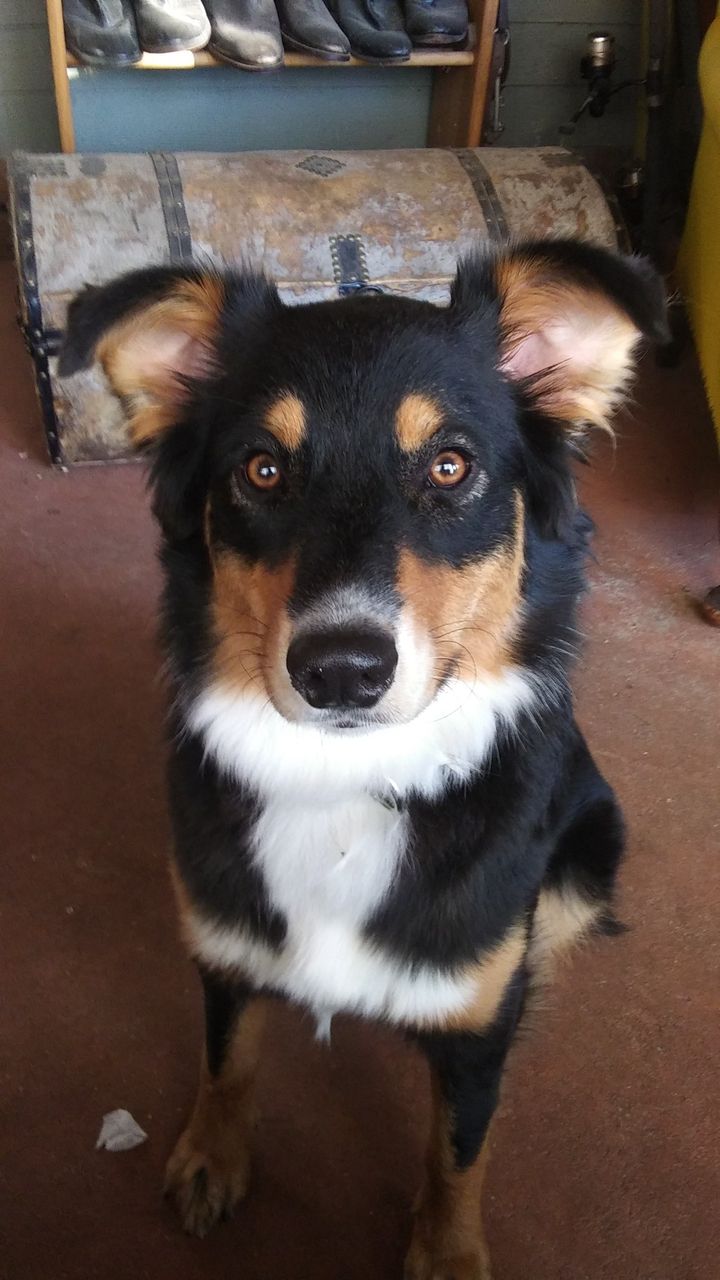
One of the many wonderful things about dogs is that they don’t compare the lives they have to other possible lives. When a dog is sick or hurt, the dog doesn’t cry, “Why me?” and in a household with only one often boring adult, the dog doesn’t say, “I never asked to be born! I wish I had a different family!” I am the one who chose the challenges of learning agility work for Sunny Juliet, not Sunny herself, but she is responding whole-heartedly! The work exercises her mind along with her muscles. It requires her full attention, and her attention channels otherwise wild energy into focused energy. The payoff (besides generous treats throughout the exercises) is that after a lesson she and her classmate get to run around and play off-leash. Social time! Happy dogs! 


May we all meet the challenges of the day with courage and cheerful spirits --. 


Monday, December 31, 2018

What Might You Love?

Mountains at last!

Arizona is not all desert, because so much of it is mountain. Scores of separate ranges, each with a name of its own, are sprinkled here and there, and in the southern part of the state they often rise abruptly from the desert floor itself. In fact it is impossible to move anywhere so far away from them that the horizon is not ringed around with peaks. 

- Joseph Wood Krutch, The Voice of the Desert: A Naturalist’s Interpretation

In Jane Austen’s Northanger Abbey, Catherine, the naive young heroine of the novel, has an opportunity to travel far from her small home circle for the first time and to meet people with views and experiences wider than her own. She is introduced to new kinds of reading and also new ways of looking at the world. Her impressionability is not lost on Henry, at first a chance acquaintance who very soon becomes a major figure in Catherine’s mental and emotional world. 

Older and more sophisticated, Henry is also possessed of a subtle, teasing nature not always understood by Catherine and only held partially in check by his more gentle sister. Though their conversation often leaves her uncomprehending, Catherine is enchanted by both siblings and begins to look at the world through their eyes, finding beauty where she had never previously looked for it, in small, easily overlooked details — for example, a blooming hyacinth. Henry is amused but does not taunt, instead saying approvingly, if tongue-in-cheek, “It is good to have as many holds on happiness as possible.”

Henry might have been teasing Catherine, but I think he was absolutely right to say that about happiness — though as I reflect for a moment I can see that a Buddhist might disagree, for is love not attachment? Never. mind, though. I am not going down that road this morning. Neither the Buddhist path nor that of philosophical debate. Love and the holds it gives us on happiness are my theme this morning.

Thrilling mountains in New Mexico!

On our way west, as we crossed the panhandles of Oklahoma and Texas and the first, flat stretch of New Mexico, I was impatient for mountains. Finally, in New Mexico, seeing our first mountain of the trip in the distance. it, I couldn’t help smiling happily. Soon, larger ones appeared. Now, surrounded by mountains every day, I wake in the dark eager for dawn to light up my high desert neighborhood. Though the sky was cloudy for our first couple of days here, there was sufficient daylight to show the contours of the slopes, and as we made the first drive from Dos Cabezas to Willcox I began mentally drawing the mountains on the other side of the playa in soft pencil, a very sketchy mental drawing, mostly broken planes of light and dark, and I felt that smile again on my face.


“I guess I love mountains,” I mused aloud, wonderingly, to the Artist. 

“I guess you do,” he agreed.

“It’s something I never would have known about myself if we’d never come out here.” I went on, enlarging upon  my theme, the strangeness of surprises lying in wait in the self. “It’s like being predisposed to be allergic to something,” I went on, groping for expression. “If you’re never exposed to it, the allergy doesn’t get triggered. It never manifests.” Then my epiphany burst full-blown: “Love is like an allergy in reverse!” 

Strange notion, is it not? My darling might have argued with me, citing counterexamples to my claim,  different kinds of love and different ways of looking at love, but instead he agreed, understanding me instantly and perfectly, and I sighed and thought contentedly how fortunate he and I were to encounter one another so many years ago, giving our love a chance to be born when we might easily have gone a lifetime without it.

A more conventional way of expressing my idea, I realized a few days later, is to say that there is a contingency to falling in love, and I’ve known that for a long time. That which comes, over time, to feel necessary to our happiness — a partner, a child, certain places and activities — was not always so, pre-ordained by the stars. If we had never met … if we had not found Sarah that day at the Humane Society shelter … if my father had not studied French in high school and been stationed in France after the Liberation … if I had not been born to literate parents, with books and music in our house for as long as I can remember … if I had never seen a horse … if we had not gone camping on Lake Michigan when I was 12 years old … if, if, if … then I might not have had the opportunity to fall in love with David and Sarah and the French language and books and horses and Michigan. 


My friend and correspondent in New South Wales, Australia, for instance, also loves books and dogs (we share those passions) but has otherwise an entirely different set of loves from mine. She does not love horses and has never seen Michigan — and yet her life, too, is full, with many holds on happiness.


I’ve thought before, many times, of how the contingent in a life becomes necessary, but my thoughts were mostly terms of specific persons and places or, if in categories, familiar ones one might encounter anywhere, such as books and horses. Discovering in myself a love of mountains surprises me. For most of my life, I looked at photographs and paintings of mountains and remained unmoved, even while recognizing their beauty. It was beauty that had nothing to do with me, I felt. Really. I could look objectively at the most impressive mountain image and turn away with a shrug. It was not Michigan, after all. Perhaps the landscape of Mars is beautiful, too, but what has it to do with me? Surely no one can expect me to feel love for it.

And yet, somehow, where I least expected it, a new love has crept upon me, so gradually that I can hardly say when it began. I have learnt (as Henry put it) to love mountains. Mountains in general. The sight of them now makes my heart glad. I love that wherever we go in our winter neighborhood, we are surrounded by mountains — the Dos Cabezas, the Chiricahuas, the Pinaleños, and the Dragoons that separate our Sulphur Springs Valley from the San Pedro Valley to the west.


That is the generality of my new love, but the particular is even stronger. When, three miles or so from the New Mexico-Arizona state line, I discern for the first time the twin peaks of Dos Cabezas, then I have a feeling of coming home similar to what I feel when crossing from Indiana into Michigan. Closer to home in Michigan is catching the first sight of Grand Traverse Bay and what my friend Laura calls “the coming home tree,” that beautiful old willow standing against the water at the T intersection, and then turning left to re-enter Leelanau County. Similarly, here in Cochise County there is one long curve at last, my "coming home curve," the sight of my mountain and the land opening out below it, exposed rocks along the side of the road with prickly pear cactus and century plants against the rock face, and then a reverse curve as Highway 186 climbs up again, and there it is — the cemetery, the Dos Cabezas sign, the cattle guard, and the sign with the image of a horned cow, while up and to the left is the single cabeza that presides over the ghost town, over the Philadelphia Wash, and over our little winter cabin. 


Yes, I now love mountains in general, but these mountains — this range, its distinctive twin peaks, and my peak in particular — are special. Not the tallest mountains in the Southwest, they are the mountains where my heart now feels at home. 


What will you open your heart to and fall in love with in 2019? A world of possibilities awaits....

Thursday, October 16, 2014

“We Must Cultivate Our Garden”


The latest self-assigned reading project for our intrepid Ulysses group was a double-header: Candide and Zadig, by François-Marie Arouet, known to the world as Voltaire. Comparing notes when we met to discuss Voltaire, we learned that all of us had read Candide first. It is, after all, Voltaire’s most famous work, and in the Signet Classic paperback edition we read (translated by Daniel M. Frame, with introduction by John Iverson and afterword by Thaisa Frank), Candide gets top billing on the cover and is the first work in the book, Zadig and Selected Stories trailing after.

Voltaire was no stodgy writer. When one member of our group observed, a trifle disparagingly, “He’s no Proust,” another agreed enthusiastically and gratefully. (Only five of the nine of us will meet in November to discuss Swann’s Way, the others begging off.) Voltaire’s outlandish adventure tales move right along, calamities and reversals of fortune piling up so fast it makes a reader’s head spin. This is not ‘realism,’ magic or otherwise, but sharp satire.

So, like the others in the group, I read Candide first, and when I reached the last page and the final words, I was overcome with deep satisfaction. Candide’s teacher, Pangloss, having learned nothing from all his experiences, is still holding forth with his metaphysics of optimism:
“All events are linked together in the best of all possible worlds; for after all, if you had not been expelled from a fine castle with great kicks in the backside for love of Mademoiselle Cunégonde, if you had not been subjected to the Inquisition, if you had not traveled about America on foot, if you had not given the Baron a great blow with your sword, if you had not lost all your sheep from the good country of Eldorado, you would not be here eating candied citrons and pistachios.”  
“That is very well said,” replied Candide, “but we must cultivate our garden.”
I loved that, and the morning I finished Candide, I posted a line or two on Facebook about how satisfying I found the protagonist’s final words. One of my friends objected. He felt the end of the book counseled withdrawal from the world and a retreat from action. (What is the word I’m forgetting here? The entire Fb exchange appears to have vanished into thin air, including the message I sent my friend.) I hadn’t read it that way at all! Metaphorical, yes, but meaning -- ???

Set that aside for a moment. I'll come back to it.

Turning to Zadig felt like coming down a few steps on the literary-historical ladder. The character Zadig was nearly perfect in the beginning – not only handsome and rich but also wise, generous, etc., etc., etc. – and rewarded in the end. He had a hero’s challenges (ho-hum) but not much to learn. Well, he did have a little something to learn, not in how to behave or how to live or how to counsel others but how to view the world. The most intriguing and bothersome passage to me in all of Zadig was his conversation with the hermit who transformed into an angel, come to enlighten him.

Immediately before the following exchange, the old hermit threw a widow’s nephew into the river, where he drowned. When Zadig protested, the hermit said that the young man “whose neck Providence has wrung would have murdered his aunt in a year and you in two.” The hermit then sprouts wings, Zadig falls reverentially to the ground, and the following conversation takes place.
“Men,” said the angel Jesrad, “pass judgment on everything without knowing anything; of all men you were the one who most deserved to be enlightened.” 
Zadig asked his permission to speak. “I mistrust myself,” he said, “but may I venture to ask you to clear up one doubt for me? Would it not have been better to have corrected that child and made him virtuous than to drown him?”  
Jesrad replied, “If he had been virtuous and if he had lived, his destiny was to be assassinated himself, together with the wife he was to marry and the child that was to be born to them.”  
“But,” said Zadig, “what? Then it is necessary that there be crimes and misfortunes? And the misfortunes fall on the good!”  
“The wicked,” replied Jesrad, “are always unhappy. They serve to test a small number of just men scattered over the earth, and there is no evil out of which some good is not born.”  
“But,” said Zadig, “what if there were nothing but good, and no evil?” 
“Then,” replied Jesrad, “this earth would be another earth, the chain of events would be another order of wisdom; and that other order, which would be perfect, can exist only in the eternal abode of the Supreme Being, whom evil cannot approach. He has created millions of worlds, not one of which can resemble another. This immense variety is an attribute of his immense power. There are not two leaves of a tree on earth, or two globes in the infinite fields of the heavens, that are alike; and everything you see on the little atom on which you were born had to be, in its appointed place and time, according to the immutable orders of him who embraces all. Men think that this child who has just perished fell into the water by chance, that it was by a similar chance that that house burned down; but there is no chance; all is test, or punishment, or reward, or foreseeing."
Is the angel Jesrad a precursor of Pangloss? All that is, must be? But Pangloss, for all his contorted reasoning, did not go so far as to see reward and punishment in necessity! Pangloss told Candide, “...private misfortunes make up the general good, so that the more private misfortunes there are, the more all is well.” It is not that those visited by misfortune have been punished. Besides, pointed out a sharp-eyed group member, the angel goes on to say that Zadig has been sent to change the fisherman’s destiny! Change it? Change destiny? Is it destiny, or isn’t it?

John Iverson writes that Voltaire was troubled by the philosophical system of Leibniz, “who reasoned that if God was perfect then He must have created a perfect world.” My French edition of Candide has an introduction (in English) by Julian Eugene White, who claims that Voltaire was better acquainted with Alexander Pope’s “perversion” of the Liebnizian philosophy reconciling the existence of evil with God’s perfect goodness. The general view, at any rate, still assumed everything in nature to have a purpose, or what Aristotle called a “final cause.” This is not ‘cause’ as we understand it today, coming before the effect and bringing it about, but one serving as a goal, a reason “in order to” rather than a reason “because of,” if you will.

At this point, one group member took off after Aristotle, blaming him for centuries of convoluted rationalizations on the part of the Roman Catholic Church, but I’m not going to take up that fight. Instead I’ve looked up birth and death dates for Voltaire, the three giants of European rationalism, and the triumvirate of European empiricists.

Rene Descartes, 1596-1650
Baruch Spinoza, 1632-77
John Locke, 1632-1704
Gottfried Wilhelm Leibniz, 1646-1716
Francois-Marie Arouet de Voltaire, 1694-1778
David Hume, 1711-1835
Jean-Jacques Rousseau, 1712-78

Descartes, Spinoza, and Leibniz are the rationalists, and to understand the world, they simply reasoned about it. No telescopes or microscopes needed – an armchair would do. Descartes, by means of a famous thought experiment, demonstrated to his own satisfaction that he could always trust his own God-given mind to lead him to the truth. Cartesian confidence was clearly at work in the reasonings of Voltaire’s Doctor Pangloss.

But John Locke, the first of the empiricists, was born ahead of Voltaire, and David Hume and Jean-Jacques Rousseau were of Voltaire’s generation. Voltaire, then, is on the cusp. The authority of the rationalists is waning, and scientific experiment and the authority of experience are coming to the fore. Candide, malgré lui, is an empiricist: although his only goal was to be reunited with his beloved Cunégonde, he learns from his travels and his experiences. Interestingly, one of the things he learns is to judge and think for himself, which was a very Cartesian proposition, but let’s not think too much about that....

Here’s something I found myself wondering: How optimistic, really, was the philosophy of Doctor Pangloss or Alexander Pope or Gottfried Wilhelm Leibniz? It was not, surely, the optimism of a happy modern individual, sure that things will always go right in his or her life. The optimism, if one wants to continue calling it that, was instead a faith that the clockwork of the world was running on some rational basis. Thus, early in the story, when Pangloss reappears exhibiting all the ravages of venereal disease, he reasons that his personal sufferings are all necessary to go into making up the general good. Punishment? No, simple necessity! – So what I wonder is, why could we not call this fatalism?

And now, looking back at Zadig (1748), don’t the angel’s pronouncements – pronouncements the author seemed to endorse at the time of writing that work – seem only ever so slightly improved upon in the philosophy of Pangloss, the latter philosophy one that the author at the time of writing Candide (1759) clearly rejected? Pangloss may have thought it “not fitting” for a philosopher to recant an earlier opinion, but the philosophe Voltaire, it seems, was not ashamed to learn and move forward.

The group member who noted the inconsistency in the angel’s lesson on destiny was concerned with Voltaire’s opinion of his imaginary Eldorado, the land where all goods were freely shared, no courts of law needed, and God only thanked, never petitioned. This was the only place Candide visited, she observed, that the author never seemed to mock. Was this, then, his Utopia, his ideal society? Was it a possible society? I asked. Wouldn’t it get boring? a couple others wondered. We left the question unresolved.

But now, let's come back to our sheep. For me, the most burning question was the meaning of “Il faut cultiver notre jardin,” or, “We must cultivate our garden.” Admitting the phrase to be ambiguous, White nevertheless chooses what he calls “the more optimistic interpretation” (!), which he articulates in the following proposition: “Practical action should be substituted for ... vain speculation.” White argues passionately that in the latter part of Voltaire’s life, “cultivating his garden” took the form of unremitting battle for humanitarian causes, unceasingly writing pamphlets against all manner of intolerance and injustice. Écrasons l’infâme (“Let us crush infamy!”) is hardly the slogan of a man who has retreated from the world to live complacently behind his garden walls! Thus the author’s life supports the pragmatist interpretation.

Il faut cultiver notre jardin.
Écrasons l’infâme!

If not identical, the two phrases are certainly compatible, n'est-ce pas? I would even say quite compatible.

Voltaire’s garden was the world. It was not that of Eden, where no work was necessary. And as for Voltaire, so for us: our garden is the world we have, it admits of improvement, and it is up to us to do the work. At least, that is the lesson I take from Candide. And to my mind, he could not have chosen a happier metaphor.

This past year I have cultivated my bookstore garden very well, I think. Dog Ears Books hosted fewer events, but every single one of them was a roaring success. I have used this blog, at least from time to time, as a platform for important social and environmental causes. My vegetable garden, on the other hand, the literal garden in my life, was the victim of shameful neglect. I’m not happy about that. I can’t do everything, but I hope to have a real garden again next year -- even with the realization that, for my bookstore customers and guest authors, the metaphorical garden of my bookstore is undoubtedly the more important ground to be worked.