Search This Blog

Showing posts with label Diane Seuss. Show all posts

Friday, May 13, 2022

Good and Exciting Things Still Happen

Sunny Juliet post-paddle


The puppy and I are home. SJ loves the yard at the farm, and she had her first dog paddle in Lake Leelanau. We are still adjusting, but in time what I call her “good girl potential” is going to come shining through, and we will be fine. Meanwhile, the world has gone on turning – and besides all the bad news and my personal grief, there are some wonderful and exciting things happening, too.


A Pulitzer Winner


For instance? Well, someone I know won a Pulitzer Prize. And she’s a Michigan poet, too. 


Originally from Niles, Diane Seuss (cousin of a friend so dear he and his wife and kids are like family) first appeared on Grath radar when she was one of a number of women poets (the event was billed as “women poets”) reading their work in a classroom setting at Western Michigan University in Kalamazoo. (Yes, there really is a Kalamazoo, but there is only one.) It was a small event that the Artist and I attended together, at the suggestion of our friend, Michael, the poet’s cousin.


Diane, as I recall her on that long-ago day, was young, barefoot, and wore a long cotton hippie sort of skirt. Instead of standing behind the desk and reading from the small lectern, she sat on the desk, bare feet swinging. I remember being somewhat dubious and not expecting much. 


Then she read.


At the end of her first poem, the Artist and I looked at each other in amazement. Had we really heard what we thought we heard? I wish now that I had made notes (and kept them) of the pieces that made our hair stand on end that day. I do remember going to see our friend, her cousin, Michael, soon afterward to tell him that I would be more than happy to type Diane’s manuscript for free if she needed a typist, so that her work could be published with the least possible delay. 


But her career did all right without my help. A Guggenheim Fellow in 2020, she received the John Updike Award from the American Academy of Arts and Letters in 2021. And now, for her frank: sonnets, she has won the Pulitzer Prize for Poetry. The Pulitzer committee said of this book that it is “a virtuosic collection that inventively expands the sonnet form….” Wow. I mean -- wow! A Pulitzer!!!


Coming From Way Behind


Then there was another winner, the long shot, come-from-behind winner of the 2022 the Kentucky Derby, which I was unable to watch as I was on the road that day, traveling the last stretch of my cross-country odyssey home to Michigan from Arizona. I had no idea of the horses running that day, and the names would have meant nothing to me, but someone posted a link on Facebook, I watched it a couple days later, and -- Oh my God, I have never seen such a race! Has there ever been such a race? The announcer himself, focused on the front runners, never saw the upset coming, even as Rich Strike was coming up through the field, passing every horse in sight.


What a horse! What a race! Nunca te rindas! Never give up! 80 to 1 odds! Beautiful, beautiful, beautiful! It is an exciting race every time I re-watch it!


Life Is Hard, Driving Is Easy


How many of my friends offered to fly out to Tucson and drive back with me across the country to Michigan? I lost count. There were a lot, and quite honestly, not to sound churlish or ungrateful, I had a few moments of annoyance at all the concern. Did my husband’s death render me suddenly incompetent and/or foolish? And how could I even begin to imagine making that long, familiar, cross-country drive David and I had made together so many times with anyone who wasn’t David? The very idea, so popular among my friends, I found unthinkable. 


I wrote recently, “This trip was, for me, a kind of pilgrimage but not to one particular destination: the entire length of the journey was its point.” It was, if you will, a kind of secular-marital Camino de Santiago, driven rather than walked, and I had to do it alone. We walked around the square in this little town. It was on this stretch of country two-lane road that we saw the armadillo. My memories would mean nothing to anyone else.


The other thing is that since the Artist died, missing him so terribly, I do a lot of crying in the car. A second person would have constrained that tearful freedom, conversation would have impinged on my memories, pushing them aside, and silence would not have been the comfortable kind that comes about in a marriage after decades of crazy passion, sturm und drang, quiet, mundane happiness, and all the rest, whereas alone on the road, I had no need to respond except to my puppy, and while Sunny Juliet occasionally makes demands (she is both vocal and physical in making her needs known), she never asks questions. 


“But who will help you with the driving?” people frequently asked. At the end of my odyssey, I was able to put into words what I had known intuitively from the beginning, which is, as the heading of this section of my post puts succinctly, “Life is hard (well, it can be), but driving is easy.” Driving for days requires focus on the task at hand, but except for puppy needs I had no other responsibilities. All I had to do was cover miles. I could take the roads I wanted to take – roads the Artist and I had traveled before – and stop when I wanted to or keep going if I didn’t need or want to stop, consulting only Sunny’s requirements and my own inclination. The hardest part of the odyssey had nothing to do with driving. It was that Sunny slept so much in the car that she wasn’t tired at the end of the day, and I had to amuse and entertain her for three or four hours in the motel when all I really wanted to do was fall asleep over a book or in front of a movie.
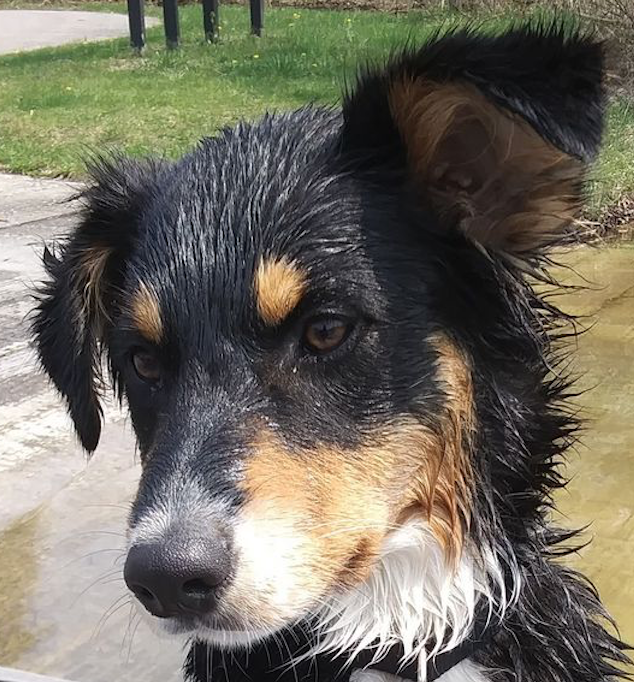

One ear up and one ear down


But, as I said up there at the beginning today, we made it, and now we go on from here, day by day. Thanks to David’s gift of a puppy and Sunny Juliet’s presence, I am not alone. Then, too, there are all our friends! 


I'm not alone


So feel free to quote me: "Life is hard, driving is easy."


And then, the other evening in Leland –


Summer art classes in Leland, Michigan, began in 1922, a century ago, thanks to Allie Mae Best. Fifty years ago Michigan State University began offering six-week, for-credit art classes every summer in Leland. My late husband, David Grath, a.k.a. “the Artist” here on Books in Northport, came to Leland to study as a master’s student from MSU (having discovered Leland somewhat earlier, but that’s another story), and so for the 100th anniversary celebration I was asked to loan one of his paintings for the show, which opened Thursday evening, May 12, and runs through May 18 (open 11-3 daily). The show included works by students and instructors from as long ago as the 1960s.


I wasn’t sure I was up for a big public event. What would it feel like to be there, in the building where the Artist had so many one-man shows over the years and where so many friends and acquaintances would be gathered? Could I handle it? I just didn’t know, but a friend said she and her husband would meet me outside and we could go in together. 


It was a lovely, lovely evening! I was so, so glad to be there and was so glad in retrospect that I didn’t miss it that I had to stop by again to photograph a couple things I missed on Thursday evening. Here, then, are a few of the images that touched my heart. 


"Every Day You're Getting Prettier and Prettier"
and 
"Tricoastal"
by David Grath


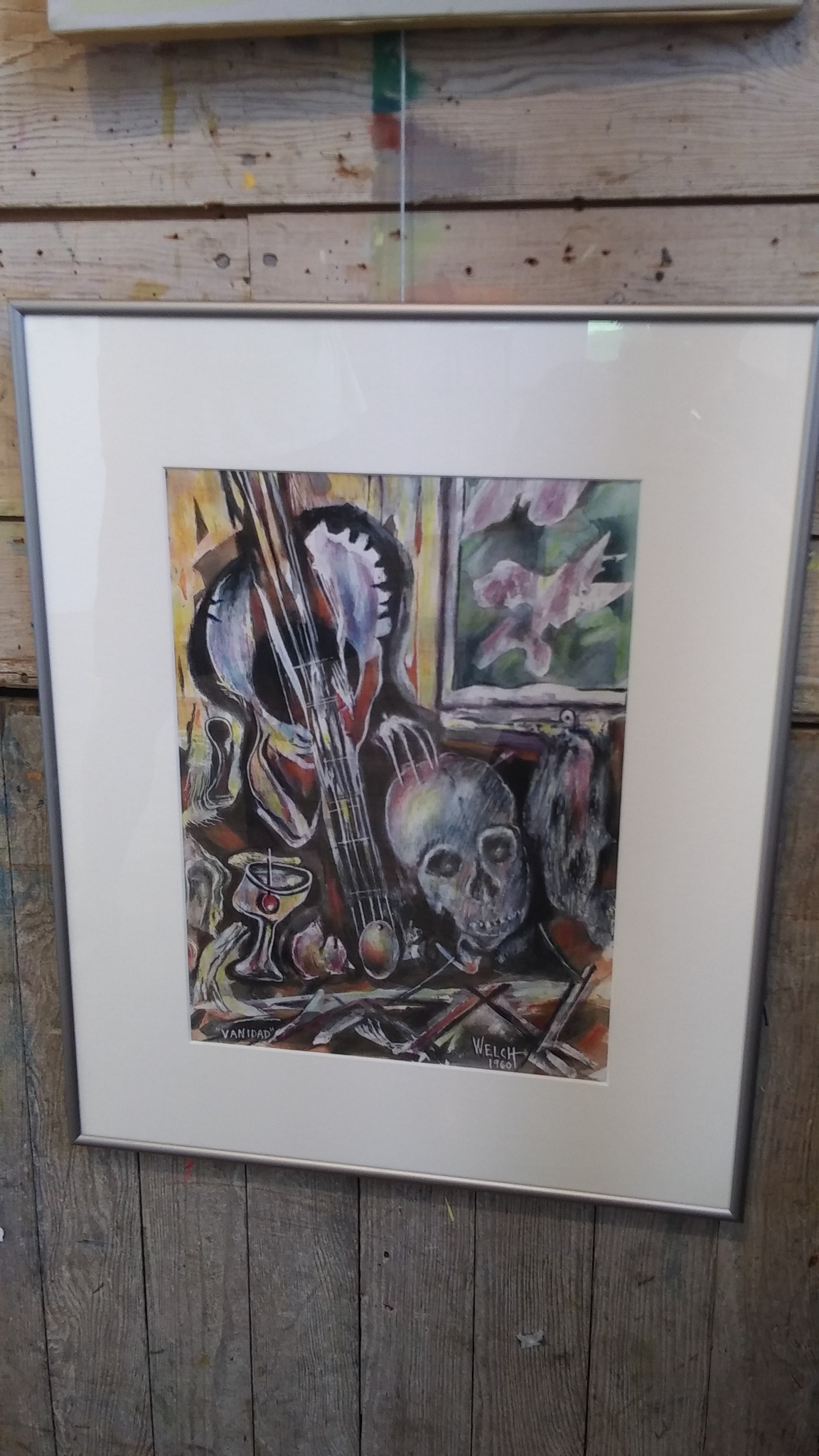
Paul Welch


"Painting of Portrait," by Paul Welch

"Vanitas," by Paul Welch


"Gauntlet," by Janine Germaine

"Cat? What Cat?" (from the Monster series), by Janine Germaine


screen by Jane McChesney


"Eden," by Cliff McChesney (typical large work of his)


"Soul Catcher," by Cliff McChesney (atypically small for Cliff)


You must forgive me some sentimentality in these choices. I was never a student in the summer art classes but fell under the spell of Cliff and Jane McChesney (as had all their summer art students) when I met them at a dinner party at the home of Jim and Linda Harrison. They were truly lovely people. So while I have no personal memories of the summer art classes, I have my own set of memories, and many of the names invoked on Thursday evening were names I recognized, calling up fond thoughts of years past. 


Wednesday, June 14, 2017

Managing My Blood Pressure


Warning: My post today may be like a confusing tennis match, back and forth between economics and poetry, my blood pressure rising perilously and being brought back to the level. But if you can't be dragged kicking and screaming into a discussion on economics, just scroll past those parts and take in the poetry breaks. They are the real meat, anyway.

The Perils of Economic Realism

Not for the world would I give up reading serious nonfiction, but sometimes the difficulty is as much -- or more -- in the effect of the reading on my nerves, shall we say, as in comprehending the ideas. For instance, recently I’ve been reading a book that sends my blood pressure soaring. It was published in 2012, and I can only imagine what the author, Hedrick Smith, would say if he were writing Who Stole the American Dream today. What do YOU think is responsible for the enormous and widening chasm between the growing pool of Americans in poverty and the hyper-rich at the top of the heap? Is it simply the result of technological growth and “progress,” the “Invisible Hand” of classical economics at work? Do differences in education across socioeconomic strata account for the gap? How about financial irresponsibility at the bottom and deep wisdom at the apex of the social pyramid?

Hedrick Smith believes it’s none of the above. He points to 1978 as the turning point, for it was then, he says, that large corporations across America joined forces and began their own very interested political activism, pouring money into campaigns and subsequently, with their successes, reversing the growth of the middle class seen in the previous three decades. A secondary cause, in Hedrick’s view, was a new corporate ethos. No longer were business and workers seen as having common interests. Now a CEO was focused (and continues to focus) almost exclusively on short-term gains for shareholders. In the glorification of predatory capitalism, ruthlessness is admired as strength, and it pays off in CEO pay, bonuses, and “golden parachutes.”

It makes sense that a CEO would be compensated at a higher rate than a worker on the line. Of course. The boss gets paid the most. Who would argue? From 1978 to 2013, however, inflation-adjusted compensation for CEOs increased 937 percent, double the gains in the stock market for the same period and in marked contrast to wages, which gained only 10.2 percent. Contrast this to 1965, when the CEO to worker pay ratio stood at 20:1.

The standard argument for colossal CEO compensation packages is that a CEO is responsible for the growth and success of his or her (usually his) corporation. Nonsense, says Hedrick Smith. First of all, they receive the same compensation whether they succeed or fail to enhance the price of stock. Second, compensation packages are awarded by boards generally composed of other CEOs and former CEOs. Third, every company wants to look good, and if their CEO’s pay is below average, they believe their company image will suffer, so for corporate image’s sake a CEO must be richly rewarded. Cutting jobs, closing plants, shipping those jobs and facilities overseas where costs are lower – all cut costs in the short term and fuel the vicious cycle of increased unemployment and poverty at the bottom of the pyramid at the same time that the apex ascends ever higher.

Take a Break for Poetry!

But I can only read a few pages at a time and take some sketchy notes before I need a break. It is just so discouraging, the power of money to pound everyone else into the ground! I spent Sunday like an invalid, relaxing with a couple of totally “fluffy” novels (between yard work sessions) but began the new week stronger, with poems and essays of Philip Levine, Detroit native and U.S. poet laureate in 2011. Oh, heaven, this Michigan voice! I stretch out on the front porch after supper with The Last Shift and read and breathe. And it is enough.

Nose Back to the Grindstone

Okay, but what about tax cuts for the wealthy? What do you make of the claim that such tax cuts will translate into business investment and new startups, creating jobs and lifting all boats? Experience, history, and numerous economic studies fail to support the claim. More money left in the pockets of the rich does not trickle down. Hedrick cites analysts who agree that “high concentrations of wealth correlate with poor economic performance in the long run,” and he writes of the years “2009 to 2012 as evidence that offering low tax rates to promote investment did not work.”
Even former Fed chairman Alan Greenspan was moved to comment in 2011 that Corporate America was sitting on nearly $2 trillion in idle capital. Greenspan asserted that the reluctance of business leaders to spend on new plants and equipment and on hiring more workers “accounted for almost all of the rise in unemployment” from 2007 to 2011.
Go back and re-read that quote above, after reminding yourself that Alan Greenspan was the darling economist of Ayn Rand, hardly a friend to taxes on wealth. There is a radio announcement these days for a firm specializing in “wealth management.” The firm promises to keep and grow your family wealth, and whenever I hear it, I think of the old ads for Stop-Leak. Know what I mean? Why would the wealthy want their fortunes trickling down?

A Poet’s Life

Time for another cooling-down period. Reading an entire volume of Philip Levine’s poetry, cover to cover, I knew I would be coming back to it in quiet moments and savoring more slowly the individual poems, but for now, my busy season of the year heating up faster than expected (and my blood pressure soaring from that economics reading), I turn to Levine’s memoir essays, My Lost Poets: A Life in Poetry. The first line of the title essay, for me, instantly stops the rush of time. “I composed my first poems in the dark.” Isn’t that wonderful? That sentence is a poem. I smile and breathe and continue.

The poet-to-be was fourteen years old, a Detroit boy, son of immigrants, and he did not yet know poetry, but it had already found him.
In truth I never thought of these early compositions as poems: I never thought of them as anything but what they were: secret little speeches addressed to the moon when the moon was visible and when the moon was not visible to all those parts of creation that crowded around and above me as well as those parts that eluded me, the parts I had no name for, no notion of except for the fact they were listening.
What Levine writes of his first attempts at writing poetry, without having a name to give to his “speeches addressed to the moon,” instantly made me think of another Michigan poet, Diane Seuss. She too – and this was years ago, long before My Lost Poets would be published – said that she didn’t know, when young, that the pieces she was writing were poems. She had no name for them, either. It’s a different way of coming to poetry, very different from growing up in a home filled with serious literature and wanting to do what the writers in those books did.

A high school teacher introduced Philip Levine to “Arms and the Boy,” by Wilfrid Owen and loaned him a collection of Owen’s work.
I could lie and say those poems changed my attitude toward and my understanding of the importance of poetry. No, what it changed was my attitude toward myself.
And isn’t that a great and important gift to receive from poetry, a gift from a poet who had more to give than his own reflection?

At the first poetry reading young Philip Levine attended, in Webster Hall at Wayne University [not yet called Wayne State], he was bowled over by the first line read by a fellow student, Bernard Strempek. Strempek was one of Levine’s “lost poets” in that he died young, leaving only “enough poetry for one tiny, posthumous collection of satiric, hard-edged poems....”The line that so dazzled Levine on that first reading, “When in a mirror love redeems my eyes,” did not appear in the posthumous volume and may “live now only in this essay.” Stop and think what that means: a young, aspiring poet reads his work to a small audience, and another young, aspiring poet is so struck by the first line that he never forgets it, and later, in an essay, he shares the line with the world, crediting the friend of his youth, now deceased, whose name we would not otherwise know.

Shakespeare wrote, “So long lives this, and this gives life to thee.” How much more fitting for a poet than a graveyard tombstone, to be immortalized in the written word!

Gathering Up My Courage Again...

The picture of a CEO sending manufacturing jobs overseas (while his own personal wealth skyrockets) is already a somewhat old-fashioned figure, because today’s American economy is not all that focused on making anything. Financial markets are the big thing now, finance overtaking manufacturing in the late 1980s, its profits accounting for 46 percent of total U.S. corporate profits in 2005. And this making of money is built on – can you guess? Debt. There are huge profits to be made by servicing debt, as we are all becoming more and more aware. Glass-Steagall (the Banking Act of 1933, inspired by the Crash of 1929) was repealed in 1999. We all know what happened in 2008. Now Congress is poised to repeal the Dodd-Frank Wall Street Reform and Consumer Protection Act of 2010. It seems our memories grow ever shorter as time goes on....

Better Late Than Never to Meet a Poet

My husband knew poet Philip Levine slightly. I wish I’d known him. From what little I’ve read, he sounds like a wonderful guy. A Michigan poet, Detroit native, poet laureate (2011), and David knew – how could I have missed reading him for so long, only to “discover” him now, after his death?

It’s all right. Many a reader is unknown to a poet whose works the reader loves, and many a time it is just that, the time, when a poet’s work enters one’s life that matters deeply. And poetry, my friends, is the real world, too. The money runs out, the poets and the financiers die, but the poems live on.