Search This Blog

Showing posts with label struggle. Show all posts

Tuesday, October 8, 2024

Figuring Things Out


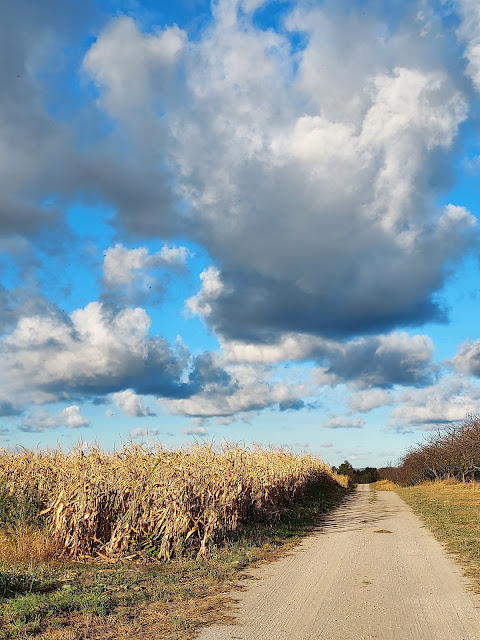
Morning clouds, October


This could be a short post. We'll see! If I were writing about all the things I have not figured out, it would be long, but I’m taking the easy way out. 


Happy girl!

First (because I know that’s why many of you tune in), Sunny and I are making great strides in our agility sessions with Coach Mike. I’m able to keep more of the course in my head at once, and our race from one station to the next is becoming smoother all the time. If there were an indoor agility course in Leelanau Township, I would be more than willing to continue through the winter. 


Scene of someone's adventure glimpsed on our way to agility --

(Parenthetically, in answer to the often-asked question, “How late in the season will you keep the bookstore open?” the answer is that Dog Ears Books will be open all winter. Come November, weeks will be shorter [Wednesday through Saturday], and days will be shorter, too [11 to 3], but weather and roads permitting, the shop will be open four days a week.)


I’m pretty sure I have the answer now to why Albert Murray is not better known as a writer of fiction. By now well into the fourth of his semi-autobiographical novels, more and more I realize that while his characters and settings are vivid, the world large and complex (from Alabama to Hollywood to Paris and back to New York), there is simply no conflict. The narrator makes a single mistake as a boy, is saved from the consequences by one of his boyhood idols (an understanding and sympathetic character with the wonderful name of Luzanna Cholly), and from there on there are no obstacles in Scooter's life path. When he learns a secret about his parentage, he takes in the new knowledge without a moment’s angst, and it never troubles him later, either. He is given a string bass and within months is touring the country and the world with one of America’s top dance bands. All women want him, no men are ever jealous, and the woman he wants to marry waits contentedly for his return. Marked out from the beginning for great things, he is the golden boy from start to finish, with everything falling into place for him. 


Just as Murray decried interpretations of the blues as music of suffering, he had little patience for stories of Black victimhood. He heard the blues as celebratory, not moans of misery, and he wrote his hero’s progress through the world as a story of success, and that’s great – except that we don’t see Scooter triumphing over anything, because nothing ever blocks his way. There is no agon to make him a protagonist. 


I say all this more as explanation than critique because I am still very much enjoying these books and looking forward to rereading them in years ahead. Any one of so many little vignettes, e.g., a scene in a barbershop, is as delightful as many a short story from a less-skilled writer, and discussions between characters about history, literature, and music are endlessly fascinating. I’m no longer troubled by neglect of Murray as a novelist, though, because I see what’s missing in his books as fiction: there is no tension, conflict, struggle, and so no real drama. 


It’s hard to believe that Murray’s own life was as velvet-smooth and free of difficulty as Scooter’s road. Life is never that easy for anyone! But he apparently felt free to leave out the bumps in the road, thoroughly covered as they had been by other Black writers. I’ll be interested to read this author’s nonfiction work and see how it compares to the fiction: Next up on my Murray agenda is The Omni-Americans: Black Experience & American Culture.


An already colorful curve in the road --

We should have peak color here in Leelanau by next weekend, although I almost hate to see it build to a climax, knowing that the gales of November will soon follow. And we still need rain! But who can argue with blue skies and the warm, albeit temporary, palette of our upper Midwest trees in autumn? 

So here it is for today – dog, books, outdoors. Because that’s my life. 

Wait for it...


...to turn blue!

Friday, October 6, 2023

Please forgive me for going on and on about this.

Call this a spoonful of sugar.
 

Someone who read my previous blog post said that current political conflicts are nothing new and that they are “nothing that a simple healing patch of behavior can end.” Whoever suggested the divisions in our country could be ended with a Bandaid? Not I. There is no magic pill or, God forbid, silver bullet, either.


The hate-filled divisions are real and heartbreaking. The cruelty is heartbreaking. And yes, the seeds of division and hate have always been there, from the beginning of our history, and – let’s admit it – there is no way for all Americans to come together completely and permanently


Storm clouds!

Where does that leave us, though? Having faced that reality, what are our choices? What do we do now? 


- Continue to scream at each other and escalate the domestic arms race – until what happens? 


- Or give up and retreat into bitterness, each of us, for the rest of our lives? 


Please forgive me if I reject those as viable options. 


Let’s me make the question personal for myself. Who am I going to be for the remainder of my life on earth? Do I want, while alive, to add to the world’s storehouse of love or to its arsenal of hate? Will I be grateful for my life or choose to be miserable and blame my misery on evolution and world history? Take the most selfish view possible, if you like: As far as I see, it points in the same direction as altruism. 


Both sides now --


This morning (still dark, these long mornings of autumn’s waning daylight, and I am in the autumn of my life, too, my time growing ever shorter), it occurred to me that America’s present crisis is deepened, if not entirely driven, by grief. We have all experienced loss, and it hurts, and we don’t know what to do with that pain. Readers of this blog, as well as my close friends, know that personal grief has been with me for a while now. Grief. Shock. Paralysis. Disbelief. Mourning. Life torn apart, never again to be a shining whole, the companion of my days and nights forever gone. 


“He was my North, my South, my East and West,” wrote the poet Auden in his own grief. He ends his poem with, “For nothing now can ever come to any good.” Is that what you feel about your country? The world? Your life? 


(Had Auden been wrong, as he writes in this poem, to think that love would last forever? What do you think?)


For myself, I can’t afford to let myself feel that “nothing now can ever come to any good.” Two seven-year-old boys, great-grandsons of the man I loved, are at the beginning of their lives, as are so many little children whose lives are only now beginning. It’s too big a job, yes – I can’t control the course of the future, true – but I can’t give up and crawl into a hole and die, either.


I live in a beautiful place.


I realize that I am a lucky woman, spared the anger that many people suffer in the throes of grief. My husband was 85 years old and had followed his passion and found success as an artist. The beauty of his work lives on. The two of us had a second chance to make a rich life together, to make our dreams come true, even (priceless gift!) to grow old together. And at the end, we had time to say goodbye. So Fate spared me anger and resentment and gave me gratitude, and I am grateful to have had that through the grief his death brought. 


But despair? Heavens, yes! Grief goes on and on, and despair, while it doesn’t fill every hour, lurks around every corner, ready always (especially in those first, early, dark hours of morning) to jeer sarcastically, “What’s the point? Why bother? He is never coming back!” And that, my friends, is hard.


Like a wounded animal, I needed to be alone before I could face the world again, and I still need time alone even now, but already in those first weeks a demanding puppy did not allow me to stay in bed with my head under the covers, and once back in Michigan there was my bookstore to open, David’s gallery to arrange, grass to mow, the puppy to exercise and train. Looking back at May 2022 from October 2023, I see now that it was good for me not to have available the escape of total isolation.


Anger. Despair. Pain. What about exhaustion? Grief is exhausting. So much of life can be exhausting! The ongoing crisis mode of American politics is exhausting. So yes, we all need to take time out when we need to, when we can. 


And then? What?


Even under cloudy skies, with winter coming --

Whatever it takes. Whatever it takes not to give up, to keep living. Whatever it takes not to be cruel, not to be mean, not to seek revenge. A cat to feed, a dog to walk. Grass to mow, books to sell. Books and poems to read and write. Flowers and trees to plant and tend. Other people with their own griefs, who need an understanding listener as they struggle. Whatever it takes. One day, sometimes one hour at a time – which is the only way we ever truly live, anyway.


Not simple. Not easy. Often – let me say a challenge. (Let me say challenge rather than a struggle. Though either word is descriptive, I seek strength in choosing my words.) 


In every era, certain words get overused and lose their power in daily speech, but consider – amazing, awesome. The gift of life is one none of us had to earn. Human beings did not invent or build this glorious planet. Who, reflecting on the gift of life, can see it as anything less than amazing? Who, looking at the beauty and force and age of the universe, can see it as otherwise than awesome?


Unquenchable life!


Let me end today with an idea from my most-beloved philosopher, Henri Bergson. (Here is an interesting take on Bergson that I hadn’t read before but found congenial.) One of Bergson’s most basic and important insights was this: 


The “road ahead” (the future) is not there. 

We build our road as we travel through life.


My images today are from the world around me. Thanks for reading.


Always renewing.


Tuesday, November 3, 2020

Alone and Not Alone, Each and Every One of Us

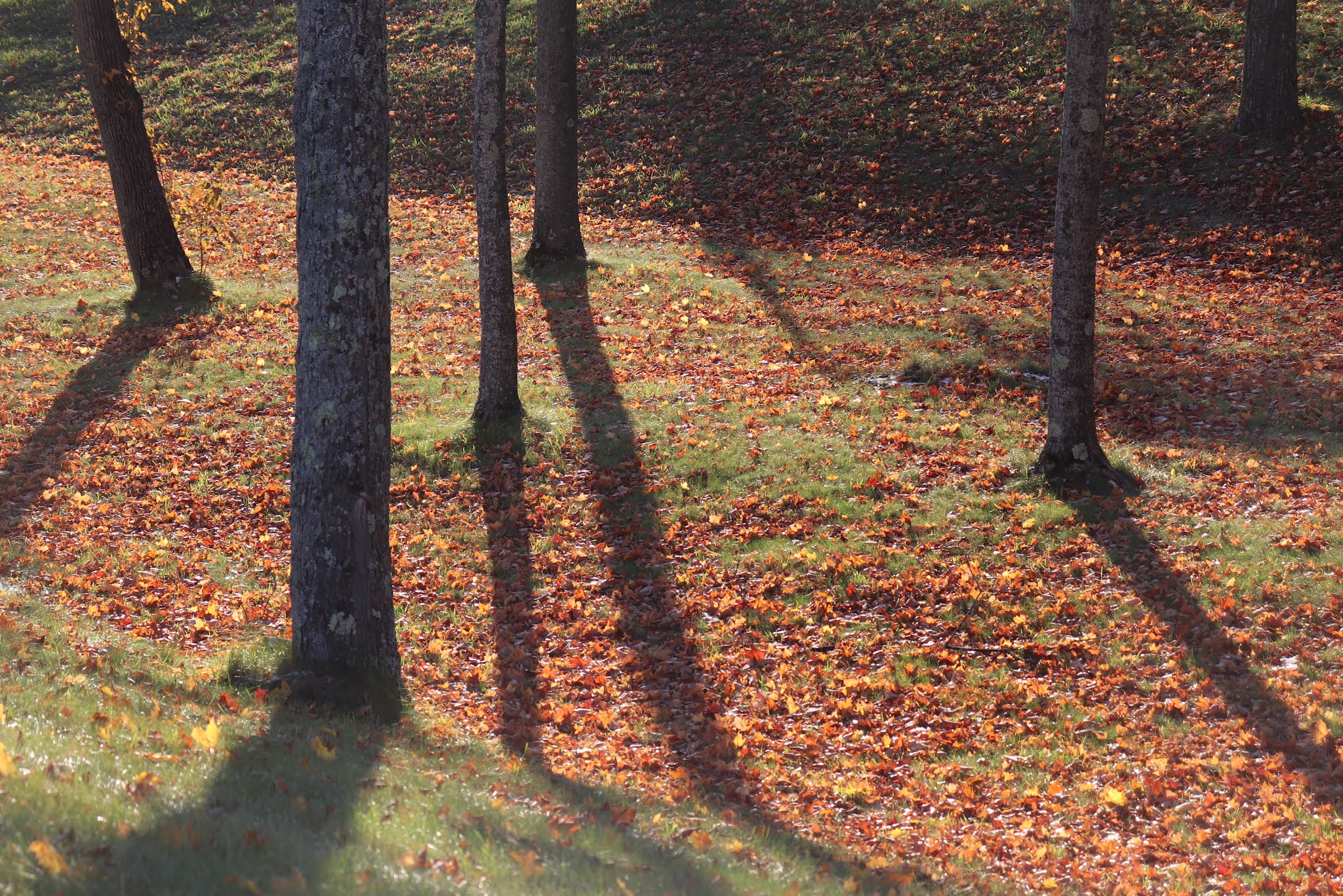
Sunshine and shadows


...Brown eyes stared back at her bleakly. A serviceable, capable person with a heart like a volcano, one that was spewing out a lava of rage and confusion and grief. Oh, no one would ever guess it. Her customers would never believe her capable of such fury and desolation, the unending baffled confusion she felt…. 

-      Ellen Airgood, South of Superior


Our little reading circle, that long-standing, intrepid band that formed lo these many years ago to read James Joyce’s Ulysses together, has chosen Faulkner’s Absalom, Absalom! as November’s discussion group book (meeting via Zoom), so I’ve been plowing, dragging, trudging – picture a tired old mule, legs shaking with fatigue – through that depressing American classic. But last night, the night before Election Day, I needed a break, I needed comfort. And I needed to feel close to my friend, the author. So I fled, in spirit, to the U.P. before falling asleep (and waking at 3 a.m. to read some more, but that’s another story).


Toggling between the near and dear familiar and the difficult long-ago


The thing is (as another friend and I touched on earlier last night, during a phone conversation that we agreed at the beginning could not be long but which somehow kept going irresistibly once underway), we have all endured long years already of painful political and social division in our country, and on top of that came and still continue long months of pandemic restrictions and isolation. And still, on top of all the unusual, long-drawn-out, seemingly endless daily stresses of political and social strife and pandemic, the usual crises and disasters that life brings every year keep coming, too: accidents, unexpected expenses, job losses and business failures, fires, hurricanes, power outages, serious illnesses and hospitalizations and deaths – in other words, trials and losses of all kinds. Even happy events such as weddings and births cannot be celebrated as they would have been in normal times. It’s overwhelming and exhausting, the cumulative toll.


So no one is not exhausted. Which is why the long slog with Faulkner through the South, before, during, and after the Civil War, as we continue to feel nightmare reverberations today from that long-ago time, is not something I can handle nonstop.


Are Faulkner’s long sentences Proustian? One member of the reading circle thinks so, but I’m finding them very different, both in form and mood. A Faulknerian sentence, interrupting itself over and over on the way to each delayed and long-desired period, strikes me as an articulation of bottomless anger and frustration and regret and pain, while Proust’s sentences -- for me -- unfurl voluptuously in slow, bright, festooning ribbons of sensuous detail. Proust wraps a reader in long, luxurious moments, Faulkner withholds and torments. Of course, the respective content of these two brilliant writers cannot be separated from form, and the very different content undoubtedly colors my impressions….


These days many usually soft-spoken friends, feeling powerless and fearful despite their noble and tireless efforts to bring about better times for us all, express themselves privately in loud expletives. One dear friend, overcome by spells of panic that come without warning, bursts into uncontrollable sobs as we speak on the phone. Another loved one sadly expresses the feeling that he is alone in the world. Anger, panic, loneliness. Fear and sadness. Rage, confusion, grief, fury, desolation. Exhaustion.


Do I exaggerate? The basic condition of aloneness – that each of us is born alone, suffers alone, and dies alone – a truth that active, busy people generally manage to keep in the background of consciousness, is in our faces every day now. Giving up is not an option, however, and so we seek calm and comfort in prayer and meditation, long walks outdoors, playtime with children and pets, happy memories and current domestic joys, making art or baking pies -- and calling, texting, writing, making and maintaining connections, that is, to each other and to the precious ordinariness of life. Because joy is, we remind ourselves, as true as pain, loving connection as true as social isolation, every moment of life a precious gift not to be squandered.


Making connections


As Airgood’s character Madeline Stone realized about the U.P., life is “all mixed up, beautiful and bleak, both.” 


Will my friend Ellen be taken aback to find herself in company here with Marcel Proust and William Faulkner? Love you, Ellen and Rick!


I want to send a special “Hello and thank you!” to Margie Burns, also, up in Marquette, whose cheery note in the mail yesterday was such a lovely surprise. Warmest greetings to you and Jackie and all the members of your book club, Margie! I remember your visit to Dog Ears and am touched that you continue to follow my bookstore and life vicariously via this blog – and that you wrote to tell me so is a special gift.


In closing, on this long-awaited Election Day 2020: Better off than four years ago? Hardly! But not giving up, either, not by a long shot, whatever the results! It’s time to call on all our sisu and keep calling on it, daily, one day at a time, the only way life can ever be lived. That is today’s Upper Peninsula lesson, no less applicable here below the Bridge or in any other part of the world.


This tree has sisu!


Thursday, March 26, 2020

Everyday Heroes: Which Books Help in Our Times of Need?

You'll find out why in a minute.

We saw a show on television yesterday (it was a rerun) based on the “Great American Read,” in which different Americans appeared, one after another, to pitch their favorite books to viewers, with the idea that each of the books depicted a character styled as an “everyday hero.” Nominations for heroic stature ranged from Don Quixote to Katniss Everdene, and viewers were urged to vote — by phone or online, I forget which, but it didn’t matter, because a line of text at the bottom of the screen informed us that voting was already closed. Books by James Patterson and Tom Clancy were nominated, their main characters put forward as “ordinary” men who rose (repeatedly) to the occasion, whatever it was, when necessary. But the Artist and I both felt that the most convincing pitch was made by the man whose favorite book was Charlotte’s Web, a book that also won the #1 spot for children’s books. Yes, we nodded, with tears in our eyes over that man’s urging, we would have voted for Charlotte! 

When I was a young girl and a voracious reader, I was also genuinely and completely, through and through, horse-crazy. So while I read Alice’s Adventures Through the Looking Glass, of course, and Little Women and Swiss Family Robinson, my favorite books featured horses at the heart of the stories, and the fictional characters I found heroic grew to be great-hearted in meeting challenges with horses. Sometimes the heroes were the horses! There was Enid Bagnold’s National Velvet, in which a girl dressed as a boy so she could ride her horse in the Grand National … The Black Stallion, by Walter Farley, with a boy shipwrecked on an island with a magnificent and untamed horse … and there was the heroic horse in Black Gold, by Marguerite Henry, a horse that finished his race on “three legs and a heart” when his trainer insisted on racing him despite injury.

I still love a good horse story and always will. But as we watched that program on television, I kept waiting for a fictional hero in everyday situations. That’s what was missing for me in the books and characters put forward to inspire us. Not that they failed on that count. And yet, dystopic novels, action thrillers, and children’s stories were not what came to my mind when I heard “everyday heroes” in connection with fictional characters.

The novel I thought of almost instantly stars as the main character a young woman without parents. She never knew her father, and her mother may not have known who her father was, either. The mother abandons her little girl on the streets of Chicago. Her only living relative, as far as anyone knows, a grandfather back in Michigan, refuses to give the child a home. 

Told that way, the story sounds almost like Dickens, doesn’t it? But South of Superior, by Ellen Airgood, is an American novel of our own times, and everything Madeline Stone goes through is common enough. Madeline is young, in some ways naive. She has a good heart but can’t help bearing grudges against the dead who failed her, and she can’t help the many mistakes she makes along the path to greater understanding, either. 

Madeline had the great good fortune to be adopted by a woman in Chicago who raised her with love, so when her adopted mother was dying, of course Madeline cared for her. The blow, however, was severe. When first we meet her, she is working as a waitress and engaged to be married. Then she gets a letter, inviting her to come work in the home of the woman who was her grandfather’s romantic partner until he died, a woman who now lives with her sister. They could use some help, the letter says. For reasons even she does not completely understand, Madeline Stone decides to drive her old beater car north to Michigan’s Upper Peninsula to share a house with two old women who are complete strangers to her. 

War does not intrude on Madeline Stone’s U.P. life. There are no shoot-‘em-up sequences in the story. The situations and challenges and even the tragedies are definitely the stuff of ordinary, everyday life. 

When household finances look bleak, Madeline takes a job in a pizza restaurant, a job she loses when she borrows and wrecks the owner’s car and, almost worse, doesn’t show up for her shift. Bright spots and dark color her life. She discovers a retarded uncle, her mother’s brother, living in a group home and resents having his existence kept secret from her, but little by little she finds comfort in visits to him. She finds a place to hide away, a secret refuge, a place where she can paint undisturbed — and then almost burns the place down after a foolish night in the local bar. Most movingly, she comes to love dearly a little boy who is, as was she, the child of an irresponsible young single mother, and what nearly breaks her heart is that she knows she can never take his mother’s place in his heart — but she struggles against the urge to try and does everything possible to keep mother and son connected. That was heroic!

Michigan’s Upper Peninsula is not an easy place to live. “Nine months of winter and three months of bad sledding” is one way it’s described. Another saying has “three months of company” as the finish. Keeping warm through the winter is difficult and expensive, let alone keeping a business alive, and life there is not for the faint of heart. But Madeline Stone is not faint of heart, and she finds her place in the world in a small, struggling community on the south shore of Lake Superior. 

I have read South of Superior many times, first in manuscript form, as the Artist and I had come to know the author and her husband on our annual September getaway trips to the U.P. I don’t know if I’ve told you enough of the story so that you can see why I find the book such a comfort or why I have always found Madeline Stone such an inspiring character, but South of Superior has been both comfort and inspiration to me over and over. When I’ve been discouraged by troubles in my own life, I have turned to Ellen Airgood’s novel and put myself vicariously into the life of her fictional protagonist, and by the time I reached the last page, I would always feel stronger and more able to face my own challenges with strength, courage, and hope.

South of Superior is back home on my bookshelf in Michigan right now. Just thinking about it, though, and thinking about the main character, someone I see as a very ordinary, everyday heroine, calms my morning-nervous heart. And I'll bet I'm not the only one who feels that way!

I think about Ellen and Rick, too, how impossibly hard they work at their place of business, the West Bay Diner in Grand Marais. You can look online and see their beautiful, delicious food and the happy customers. None of that happens by accident. Ellen and Rick are some of the hardest-working people I know. You’ll see online also that the diner is “temporarily closed.” Had they not opened yet after the winter? Are they closed because of coronavirus? Are there enough groceries and supplies in that little town, and are Ellen and Rick all right? I trust they will be, because they have Madeline Stone’s sisu — but I sent them love across the continent, and I want them to know that as I think of them with love, and think once again of Ellen’s fictional character, Madeline Stone, I find comfort and inspiration to help me deal with these strange times we find ourselves living.