 |
| Spectacular forsythia this year |
On Saturday, we had a soft rain in the Leelanau, mostly just sprinkles. Monday morning, after a dog walk in real rain (my grandmother used to say, “I’m not sugar; I won’t melt”), I planted collard and arugula seeds in the garden, having gotten peas and spinach in two days earlier, and the timing worked out well, because half an hour later a downpour commenced. Meanwhile, in the house, lettuce has come up in Jiffy pots (the pots are in trays), and the first tiny, brave tomato seedlings have appeared. My only “greenhouse” is a window, so we’ll see how those things do.
 |
| Nothing to see yet |
 |
| Small, hopeful signs here |
Outdoors, spring is popping, and you can follow this link to see a blossoming black cherry, along with the lovely spring ephemerals blooming in the woods last Sunday morning. I want to add “finally,” but the truth is that we are way ahead of the normal spring season. The little plum tree in my yard will be blossoming any minute now.
 |
| Plum blossoms coming soon |
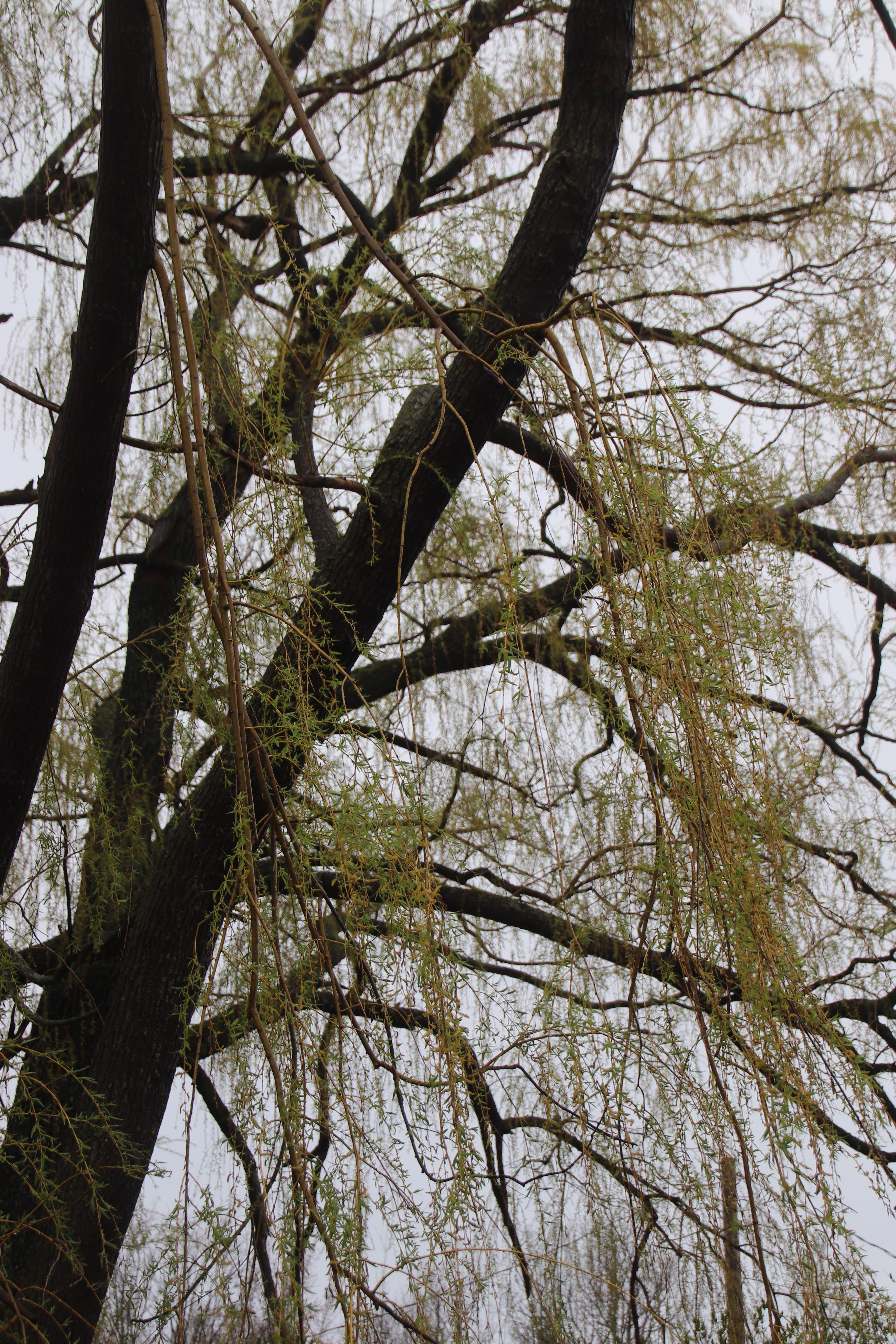
It’s funny, but no matter how impatient I am for spring to get underway, when it all does start to happen I am almost sorry, afraid it will be too soon over! There is a certain moment, the soft, fresh, pointillist impressionism of a few brief days when the first leaves are appearing – a moment when I want to hit a pause button and just sit quietly and gaze for hours, but instead the projectionist speeds up the film and rushes into summer. For a moment, though, the soft green is almost like a haze….



Here's another question for you: When you see a section in a bookstore labeled “Essays,” do you move toward it or away?
I have more people than I can count in recent years who ask me if I have a “Nonfiction” section, and I’m always baffled by the question. I have many nonfiction sections! History, travel, philosophy, religion, economics, biography, memoir, sports, hunting & fishing, health, business, cookbooks, natural science, physical science, building, visual arts, performing arts, etc. None of that is fiction; therefore, it is all nonfiction. So when asked the question, I usually ask a question of my own in return, trying to determine what subject area the person hopes to find.
But now, I think maybe they might be looking for what is nowadays called “creative nonfiction,” books I would generally consider kind of memoir essays. I think of them as memoir because they are usually personal stories from someone’s life, but they can and do overlap into travel and/or nature, sometimes psychology, religion, regional Americana, or the arts. If you hear or see the word essays, though, does it put you off? Answer honestly! Does it remind you of your school days and having to write about “How I Spent My Summer Vacation”? or (worse yet) a compare-and-contrast piece on two writers, neither of whom set your soul on fire?
 |
| My obsession: hawthorn! |
Me, I love essays. I love the form. Tony Judt, Adam Gopnik, nonfiction by our own Leelanau writers Jim Harrison, Anne-Marie Oomen, and Kathleen Stocking – essays range far and wide. They can be humorous or serious but are generally explorations, the writer trying out thoughts and connections. The French verb ‘essayer’ means just that: to try, to attempt, to examine. I think of them as explorations above all, whether of place or thought.
A sermon is a sort of essay, usually built on a bit of scripture, and any essay, like a sermon, usually begins with some small kernel. It can be a quotation, a word, something glimpsed or overheard, a nugget of wonder. Then from that initial seed, the writer grows a world, a forest of trees and ferns and flowers, all spun from that small, simple beginning, and in the most satisfying of essays (as is true only in baseball among team sports), we end by coming home, the writer having taken us far away and then having closed a circle. Poet Fleda Brown is a genius at this: thinking and writing about essays led me to pick up again her collection titled Mortality with Friends. An earlier collection, Driving with Dvorak, is another that wins my highest recommendation.
But the book I want to hold out to you today is Mountain Time: A Field Guide to Astonishment, by Renata Golden. When an ARC (Advance Reading Copy) was offered to me by Columbus State University Press, and I realized that the author had lived and written from, in part, the Chiricahua Mountains of Cochise County, Arizona, I could hardly wait for the book to arrive in my mail.
I climb to the top of the mounds behind the house in Sulphur Canyon where I once lived, more than a decade ago, on and off for three years. … When I return, I hear the mountains speaking to me in a tone I can’t ignore, a voice humming with suggestion.
- Renata Golden, Mountain Time
Full disclosure (for those arriving at this post without having followed the blog for years): My husband (the Artist) and I lived several winters in a rental cabin in the ghost town of Dos Cabezas, just down the road from the Chiricahua National Monument. Renata Golden lived on the other side of the Chiricahuas, the New Mexico side. I found Sulphur Canyon on my Arizona atlas. It is in the San Simon Valley, east of the Chiricahua range, while our side of the mountains (west) was the Sulphur Springs Valley, but Sulphur Valley and Sulphur Springs Valley, though separated by mountains, are both Cochise County, and it’s all Apacheria, so there was no way I would be able to resist this book. And look: right on the cover is the word ESSAYS in a red-outlined rectangle.

How long must we survive in a place before we can say we belong there? How much time passes after we leave a land before it forgets us?
Golden begins her examinations of mountain time by remembering Irish great-grandparents she never knew, a generation that managed to survive the Great Famine but were not allowed to own land in County Kerry, so the next generation, Renata’s grandparents, left Ireland and came to Chicago to make a new life in urban America. The author explores in detail the 19th-century history of the Chiricahua Apaches, an all-too-typical American tale of broken promises and eviction, the latter called “relocation” when applied to Native Americans. (No land in Cochise County has ever been returned to the Apaches, although a tiny reservation in New Mexico was designated “Apache Homelands” in 2011.) She also gives the history of her parents’ purchase of land in New Mexico that they fondly imagined would be their retirement home, a home that was never built, the land so worthless her parents were unable even to sell it.
The book, however, is about more than mountains and the people who live and have lived in them. There is an essay on rodents, one on snakes, one on prairie dogs, and (I’m not listing them all) a personal story of panic in a wild cave, where the writer’s reluctance to ask for help is at odds with her fear.
The passage of time like the passage of water reforms what was once undeniably solid. The river that carved this cave exploited the vulnerability of its limestone walls. The empty places are oblivious to the rock’s former resistance; the water leaves behind only the memory of what has been diminished.
Certain lines brought tears to my eyes – not for the packrat or the rattlesnakes or even the cute little prairie dogs, but for what Golden writes about aging and loss and home. Here is an entry from her “Chiricahua Glossary” –
Home. Where the heart is. Where you hang your hat. Where your family lives. Your natal place. A place you leave. A place I’m still looking for.
My heart is here in Leelanau County, Michigan, but it was also in Cochise County, Arizona, and part of it remains there. I have hung my hats and caps in both places. My family lives elsewhere, though no one related to me lives any longer in South Dakota, where I was born. South Dakota, Illinois, Arizona were all places I left. Must home be singular?
 |
| Mi cabeza |
I have to admit that I missed the high desert ghost town of Dos Cabezas this past winter and early spring: morning hikes with a younger neighbor and our dogs, get-togethers with other dear neighbors (people look out for each other in Dos Cabezas, as they do in Northport), the mountains and birds out my back door, the vast spaces, and Chiricahua only a short drive down the road. I left the ashes of two beloved dogs buried in the wash behind the cabin, and the cabin – so small and so cozy with all our books and other treasures collected over the years – is the last place the Artist and I were at home together on this earth.
 |
| Cabin seen from wash in winter |
But when our grandson asked if I could imagine myself ever living fulltime in Arizona, I had to answer in the negative. Give up my Michigan home? How could I? And now that trees are beginning to leaf out and blossom, as I drive the familiar roads of my township I slow down to stop at favorite spots and say aloud but with quiet astonishment, “I love it! I love it!”
 |
| The wild nearby |
 |
| Indoor refuge |
I don’t need to look for home. I’m here. Still, that other place felt like home, too. The land forgetting us? Mountains are indifferent to our presence, as are lakes and rivers: the love for them is in us.
Do we deserve them? I wonder.


