Search This Blog

Tuesday, October 13, 2020

More on Comfort Books

Thank you for exploring with me again --


And please understand that I am not advocating for ostrich behavior, simply acknowledging today, once again, the very real fact that most of us cannot stare reality full in the face for every waking minute of every day. 


I am frequently asked these days in my bookstore to recommend something light, something cheerful, for someone who needs a break from either dark thoughts or hard, determined work or both, and my bookstore customers have found hope in Emita Hill’s Northern Harvest, smiles in Amy Krause Rosenthal’s Encyclopedia of an Ordinary Life, and respite in the novels of Alexander McCall Smith, particularly those set in Botswana featuring the oh-so-comforting Mma Ramotswe. But now I am casting my mental net wider, and maybe you can help. 


A perennial favorite of mine


Many of us find vicarious adventures as wildly different as Lee Child’s “Jack Reacher” novels to Mary Norton’s “Borrowers” series, and I wish I had all of Chiang Lee’s “Silent Traveler” books on hand, every day, so I could dispense them like multivitamins! Sometimes I am frustrated in my desire to provide the books I find most comforting myself. Either I recommend them so enthusiastically that they fly off the shelves, or they are no longer in print and quickly accessible through my new book distributor. Anyway, here is the beginning of a list of sub-categories of books I find offer respite for the soul:


Long-ago, gently humorous nonfiction: If you can get your hands on Emily Kimbrough or Frank Gilbreth or Clarence Day, you’ll be plunged into pretty innocent representations of the past -- a very narrow, limited perspective but one that can be refreshing at times.


Young people’s books: Here it might be books from your own younger days or new discoveries. For me, the Walter Farley horse stories never fail, but I also love Ellen Airgood’s Prairie Evers and The Education of Ivy Blake. Men, what books carried you away when you were a boy? The Artist recommends – and I include it here, though it is hardly a YA novel -- The Count of Monte Cristo!


Biographies/memoirs “about interesting but not grossly painful lives,” as a friend of mine requested: I have enjoyed so many memoirs and biographies over the years! Right away I thought of Alfred Kazin’s A Walker in the City and Helen Keller’s The Story of My Life, but of course there are many, many more recent possibilities. I love Wallace Stegner’s Wolf Willow; Anne-Marie Oomen’s Love, Sex, & 4-H; and Mardi Link’s Drummond Girls (those last two very much alive and active northern Michigan writers). But of course the list here is practically endless.


Historical Fiction: Don’t get me started! Actually, I have gotten started and finally created a category of HF at Dog Ears Books. 


Books about books: Kathleen Hill’s She Read to Us in the Late Afternoons will start an endless association of memories in lifetime readers. We booksellers, of course, never tire of Christopher Morley’s classic tales.


Dogs and Horses: For me, not only fictional dogs and horses but also memoirs and books about training or (as I prefer to think of it) working towards partnership with dogs and horses. So many could go in this category! I hope my reading friends who live with cats will not feel slighted. There are some good cat memoirs, too, but cats are a whole different ball of yarn, aren’t they? Dogs and horses try to please us. Cats tolerate us. In my opinion.


Books about Food: I’m not talking about cookbooks, though if you find comfort in reading cookbooks, go for it. What I have in mind is more memoir or essay or travel – kind of a grab-bag, I guess. For starters (if you’re going to be really serious), there is, of course, Jean-Anthelme Brillat-Savarin’s The Physiology of Taste, but there are also recent gems that include anything by Ruth Reichl, Anthony Bourdain, M.F.K. Fisher, Calvin Trillin, or Roy Andries de Groot. And count yourself fortunate if you have in hand the utterly charming Clementine in the Kitchen, by Samuel Chamberlain. Who wants to add favorites to this list? Be my guest!


More ideas: 


Anthony Trollope novels


Arctic adventures – or any travel books set in a faraway place you love (for me, Paris; for you???) or someplace that intrigues you that you will probably never visit except in books


First-person back-to-the land tales, if you like those; or city adventures, if you have urban dreams


Poetry – of course!


The Tracker, by Tom Brown, Jr. (one of my favorites)


Long, lose-your-self-in-them novels – Here one friend recently took up Thomas Mann’s Magic Mountain. For me, Proust fills the bill. I’d also include here Seth Vikram’s A Suitable Boy, 1400 pages, even though I’m losing hope of the promised sequel.


On the other hand, short stories – have a selection of different authors for an at-home literary smorgasbord! 


So now, what are your recommendations for the large, lumpy category I’m calling “comfort books”? What works for you when your spirits need a rest?


???


P.S. FOR FALL COLOR IN LEELANAU, SEE HERE. 

Sunday, October 11, 2020

Autumn Vacation Hours


[Late note: This should have been titled "Hours of Autumn Vacation," as the title I gave it sounds like bookstore hours, and that's not what it is. It istime stolen away from bookstore and housework and yard tasks to immerse myself in balmy autumn hours.]


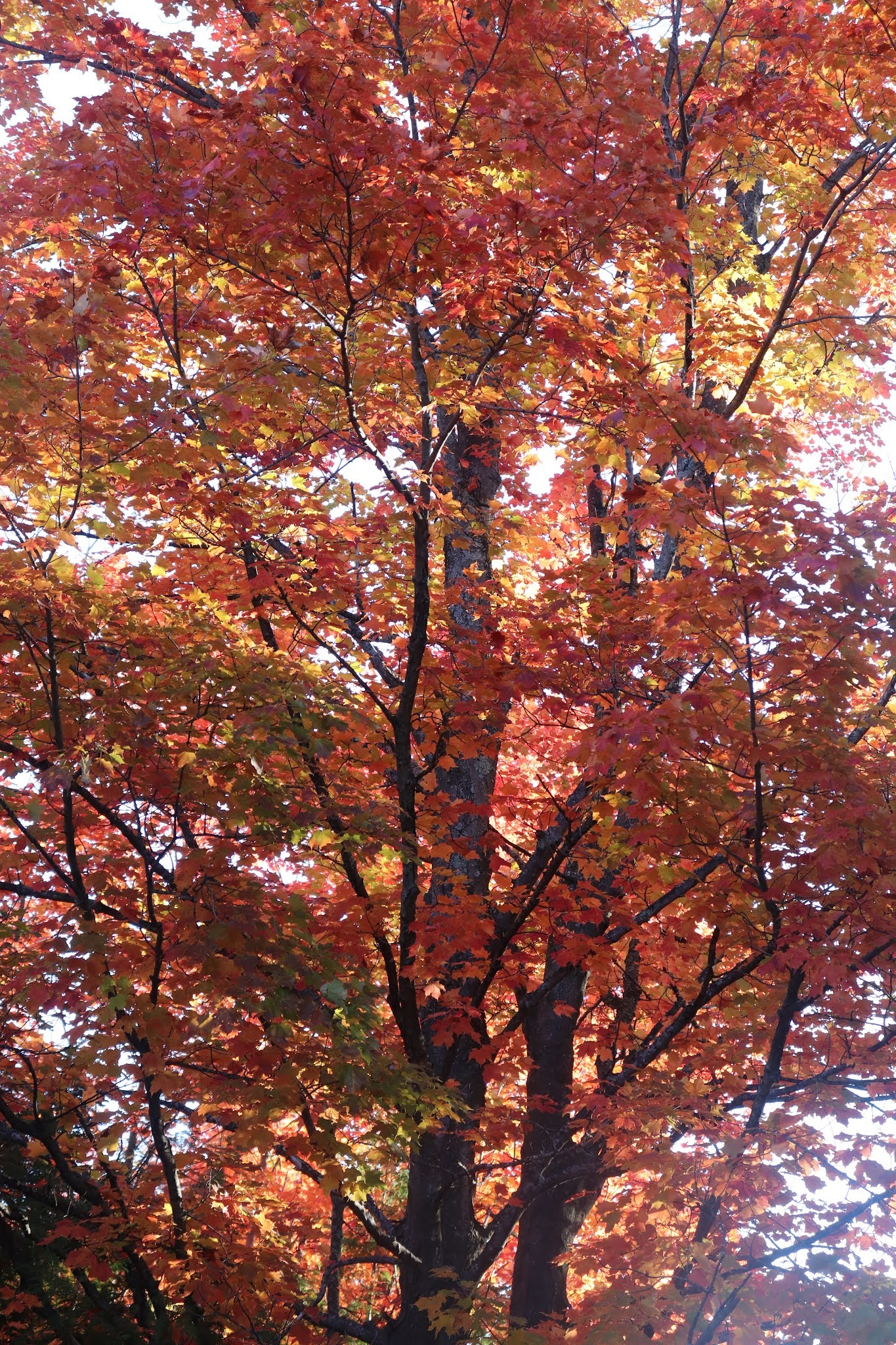
It’s Sunday, and the sun is shining bright, and all over northern Michigan colors are popping. The Artist and I will be working outdoors this afternoon, preparing for a family visit and clearing the deck for visiting on Monday, rain or shine. Actually, the forecast for Monday is rain, with sunshine and clear skies to return on Tuesday. Whatever future days may bring, however, today’s post is a showcase for sunny days and the stunning colors of fall.


Friday, while Bruce manned the bookstore sales counter for me, I took the opportunity to take care of a couple errands down in Suttons Bay and then – oh, sybaritic escape! – took what remained of my New Bohemian CafĂ© chai latte and my dog and the novel I was reading down to the beach just north of the marina and sat there reading and looking up from time to time to note a sailboat out on the water or gulls huddled on the sand. Once in a while a gull would take wing and scream or laugh; other than that, the day was quiet and peaceful. 


I drove south and west in the county to see what I could see. Every prospect pleased. Back around the old homestead, asters in their stunning colors put a song in my heart. I was home, but I felt, just then, for a while, as carefree as if I were on vacation.


Not that my ordinary commute to Northport or time in the bookstore is a hardship. Here is some color from Leelanau Township and Dog Ears Books.


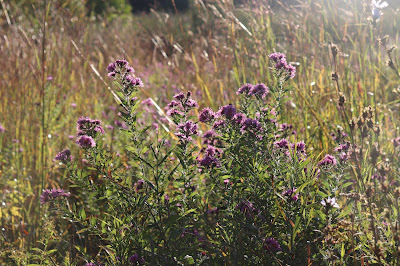
This morning, though, I vowed to pay full homage with my camera to the wonders of green ash leaves in autumn. While we have lost many mature ash trees in Leelanau County (perhaps the majority), enough remain to give some idea of the range of their subtle fall colors.


[Second late note: I haven't given you any idea at all of the range of colors of ash leaves. These all look yellow to brown. Where are the reds and purples?]


Going out to photograph ash leaves, I came upon an oddity that might have puzzled a newbie botanizer looking to identify a wild vine. Here is what I saw, and what do you say about it? 


If you realized that the wild grapevine had twined around the scarlet-leafed Virginia creeper, you are correct.


But pictures above show only the beginning of the northern Michigan fall color palette. Everywhere, overall, there is so much! 


Our eyes drink and drink, and still there is more! Lovely, lovely October in Michigan! What good medicine you are for our weary souls!


On Saturday afternoon a friend who dropped by the bookstore remarked on the soft, mild air we had enjoyed on Friday evening. “It reminded me,” he said, “of when I jumped ship in Caligari, Sardinia.” Oh, yes! Oh, yes! Wonderful, the associative leaps memory can make – and the delightful surprise of such a remark to the ear of a listening friend! 


Thank you, October! We needed you!


Thursday, October 8, 2020

Read What You Need


Note: I wrote this post over the course of a few days, so as to give mini-reports along the way to make my book-hopping lack of pattern more obvious. And then this morning I took long, leisurely outdoor time to walk with Sarah and photograph today’s beautiful Thursday world around me.


Tuesday afternoon


Already I have to resort to paraphrase, because I don’t know what I did with the original quote, but it came from another bookseller in another state, who said, as far as recommending or advising people on what books to read these days, that the thing to do right now is to read whatever it is you need. If you need information, read books of information. If it’s escape you need, read escape. I’d amplify that to say specifically that whether you need poetry or history or religious meditations or humorous essays, science fiction or Victorian gardening texts, whatever books you need are the ones you should be reaching for right now.


For me, once again, it’s sometimes one and sometimes another, and I go from one kind of reading to another, skipping between often totally unrelated books with no apology whatsoever. Crazy Horse, by Mari Sandoz, is both informative and beautifully written, as was Isabel Wilkerson’s The Warmth of Other Suns. Wilkerson’s migrants did not find a perfect society in the North, but for the most part they were glad they had made the move, and I devoured that book to the last page quickly, eager to see how their lives turned out. It’s different with Crazy Horse. Since I know there will be no “happy ending” – and there are plenty of tragedies before the end, also – I keep setting that painful saga aside, taking breaks with something easier on the spirit.


Steve Hamilton’s A Cold Day in Paradise, the first of his Alex McKnight mysteries, was a re-reading experience, a little self-indulgence I frequently give myself in the best of times (which these are not). Even when I remember more of a story than I recalled from my first, long-ago reading of A Cold Day in Paradise (first memorably read in a motel in St. Ignace, cover to cover in one night), there is always a lot that I’ve forgotten and that seems fresh and new, whatever the book. 


The Boy, the Mole, the Fox and the Horse is a children’s book and generously (and beautifully) illustrated, so reading that story took me only very briefly away from the world of challenging reality and challenging reading. Native Tongue, the first volume of Susanne Haden Elgin’s feminist speculative fiction trilogy, interested me without completely fully absorbing my attention. I would call it a novel of ideas rather than a character- or plot-driven work. But it did offer escape from political campaigns and COVID-19 concerns.


Sometimes the way a book falls into my hands is complete serendipity. Such was the case with Jimmy Carter’s Why Not the Best? But I wrote about Why Not the Best? in my last post and won’t repeat myself here.


The Uncalled, by Paul Laurence Dunbar, published over a century ago, was something chosen more deliberately. Familiar with Dunbar’s name because of his poetry (Maya Angelou took her title I Know Why the Caged Bird Sings from a Dunbar poems), I hadn’t realized he also wrote novels. Interestingly, though Dunbar was perhaps the first well-known black American poet, there is nothing of race in the story of The Uncalled – at least, so far. I’m only halfway through this little book.


And now already I’ve found something else that seems worth reading. My Brilliant Career, by Miles Franklin, made a big splash when its teen-aged author published her novel in Australia in 1901, but then it was out of print until 1966. Despite the book’s initial success, Franklin felt there was no place for her in the new, very male, nationalistic Australian literary world; she was also unhappy with some of the interpretations laid upon her work.


Australia – now that’s an escape from my everyday world!


Our brave little reading circle, the one that convened years ago to study James Joyce’s Ulysses together, is now committed to reading and discussing for November William Faulkner’s Absalom, Absalom! Faulkner will be a stretch for me, as I am in general not a fan, but the book covers the same period as Margaret Walker’s Jubilee, so it will be interesting from that standpoint, and I need to challenge myself, anyway, which was this group’s original mission – to read together books we might not have read on our own. 


Some (but not all) of us took on Proust one fall, and I’ve been reading him again recently, in French, a few pages at a time. I’m not sure whether to classify Proust “difficult” or a familiar and comforting refuge. He is probably the latter for me. Not an “easy” read, but his writing is luxurious – especially the opening scenes of childhood, both at the grandparents’ house in Combray and in the parks and streets of Paris. These long-ago, faraway scenes carry me away from the present, away from worry and strife -- and isn’t that how we define escape reading?


Wednesday morning


I finished The Uncalled last night and fell asleep over early pages of My Brilliant Career. Of the former, I can say it is very much a Victorian novel, with only a couple of places that one might, if informed of the author’s life, see something of his own experience as a black man in [that long-ago] turn-of-the-century America. Paul Laurence Dunbar’s parents, I read, were born in slavery, so he and his siblings were the first generation of the family born free, but as the orphan protagonist of The Uncalled, however, realizes so strongly, there is more to freedom than not being held in bondage. The fictional character longs to break away from his guardian’s very strict religious household (where baseball is considered as great a sin as dancing) and her plans to make him a preacher. Like Dunbar himself, young Brent longs for the freedom of the writing life. When a friend in the seminary warns him of that life’s agonies, Frederick Brent listens with no change of heart.


“This is your story,” said Brent; “but men differ and conditions differ. I will accept all the misery, all the pain and defeat you have suffered, to be free to choose my own course.”


Besides several volumes of poetry, for which he is chiefly known, Dunbar’s only other published book was Tales from Dixie, a collection of short stories featuring African-Americans before and after emancipation. This may be his least sentimental, most realistic work, and I would like to read it sometime. Sadly, the writer died young, only 33 years old, but he earned success while he lived, which is more than many poets, black or white, can say.


Not having more Dunbar on hand last night, I curled up in bed with My Brilliant Career but laid it aside to watch “Dark Waters” with the Artist, taking it up again after the movie and falling asleep before getting very far into the story. And earlier this morning, over the first cup of coffee, somehow I became embroiled in old e-mails, clearing out as many as could be deleted, filing others, re-reading and re-living days COVID and pre-COVID.


Here at the bookstore now, I’m pleased to have restocked many of Jim Harrison’s fiction titles; Katey Schultz’s brilliant Still Come Home (which every American should read); and to have some charming new children’s books now in stock. October will be the last full month of the 2020 year for Dog Ears Books (let’s be clear: we do plan to be back in the spring!), but it isn’t too early to get some of that holiday shopping out of the way, and I’ll be glad to help with that. 


Wednesday afternoon


Continuing with My Brilliant Career, I am intrigued by the fact that the adolescent author, while complaining of her own fate when times grew hard for the family, managed to recognize her parents’ difficulties, as well, and even to see their life in the greater national context.


…Household drudgery, woodcutting, milking, and gardening soon roughen the hands and dim the outside polish. When the body is wearied with much toil the desire to cultivate the mind, or the cultivation it has already received, is gradually wiped out. Thus it was with my parents. They had dropped from swelldom to peasantism. They were among and of the peasantry. None of their former acquaintances came within their circle now, for the iron ungodly hand of class distinction has settled surely down upon Australian society – Australia’s democracy is only a tradition of the past. 


I wonder, is My Brilliant Career considered an Australian classic by now – does it still fall short of the Australian male nationalist literary tradition?


Thursday morning


The world forced itself upon me last night. The event was the vice-presidential “debate,” and I steeled myself to listen, confident that it could not sink to the level of the presidential candidates’ horror show circus. Fortunately, I am blessed with generally low blood pressure.


Everyone listening (or watching, as more probably did) will have a different impression of the performances. My impression of Pence – a cipher in my mind beforehand – was that he is a very slippery, sneaky little man. He pretended great politeness and respect at the beginning of each two minutes allotted him (“Thank you, Susan”) but then talked on past his limit again and again, while the moderator tried to stop him with “Thank you, Mr. Vice-President” over and over. He also interrupted Senator Harris more than once. In short, he was as determined as the president not to be hemmed in by the rules but maintained a surface demeanor of civility and normality.


How many questions asked by the moderator were actually answered by either candidate? Once Pence asked that the record show that Harris had not answered a question – this after he, Pence, had evaded countless previous questions! I wish Harris had challenged him on that hypocritical remark, as well as on his repeated admonition to her, “You are entitled to your own opinion, but you are not entitled to your own facts.” This was a fiendish ploy, as the very phrase “alternative facts” was invented in the White House to excuse lies told by the president! The vice-president took the administration’s own guilt and painted the senator with it, and Harris let him get away with it!


I still have no clear answer on the Democratic position on fracking. I believe fracking should be banned, for strong scientific reasons, but now it seems both parties have decided that fracking is something holy -- if anything, more sacred than a fertilized human egg. Will people be talking about fracking today? Will that issue get any attention at all? For me, it was the most worrisome take-away, other than the revelation of the vice-president’s character.


And so this morning, waking once again to the political take-over of my brain, I fled to Australia with Miles Franklin, and during the day I will no doubt read a few more poems by Jane Kenyon (because Lord knows I need poetry right now and will probably need it more and more in the less than four weeks ahead!), but before the bookstore I spent time in the beautiful outdoors with my dear old dog.


I am not, you see, doing a complete ostrich act and avoiding reality or succumbing to an escape addiction, but neither am I willing to let every waking moment be taken over by those aspects of reality that do nothing but heighten anxiety and/or plunge me into depression. I'm no good to anyone like that. Regular reading of other times and places is part of my life, anyway. The difference now is that I do it for sanity’s sake. 


Measured doses – reality, escape – I seek some kind of mental balance. A beautiful, sunny fall morning doesn’t hurt, either.


Sunday, October 4, 2020

The Pages of Time's Book Keep Turning


[Orig. written 10/4, revised & published 10/6.]

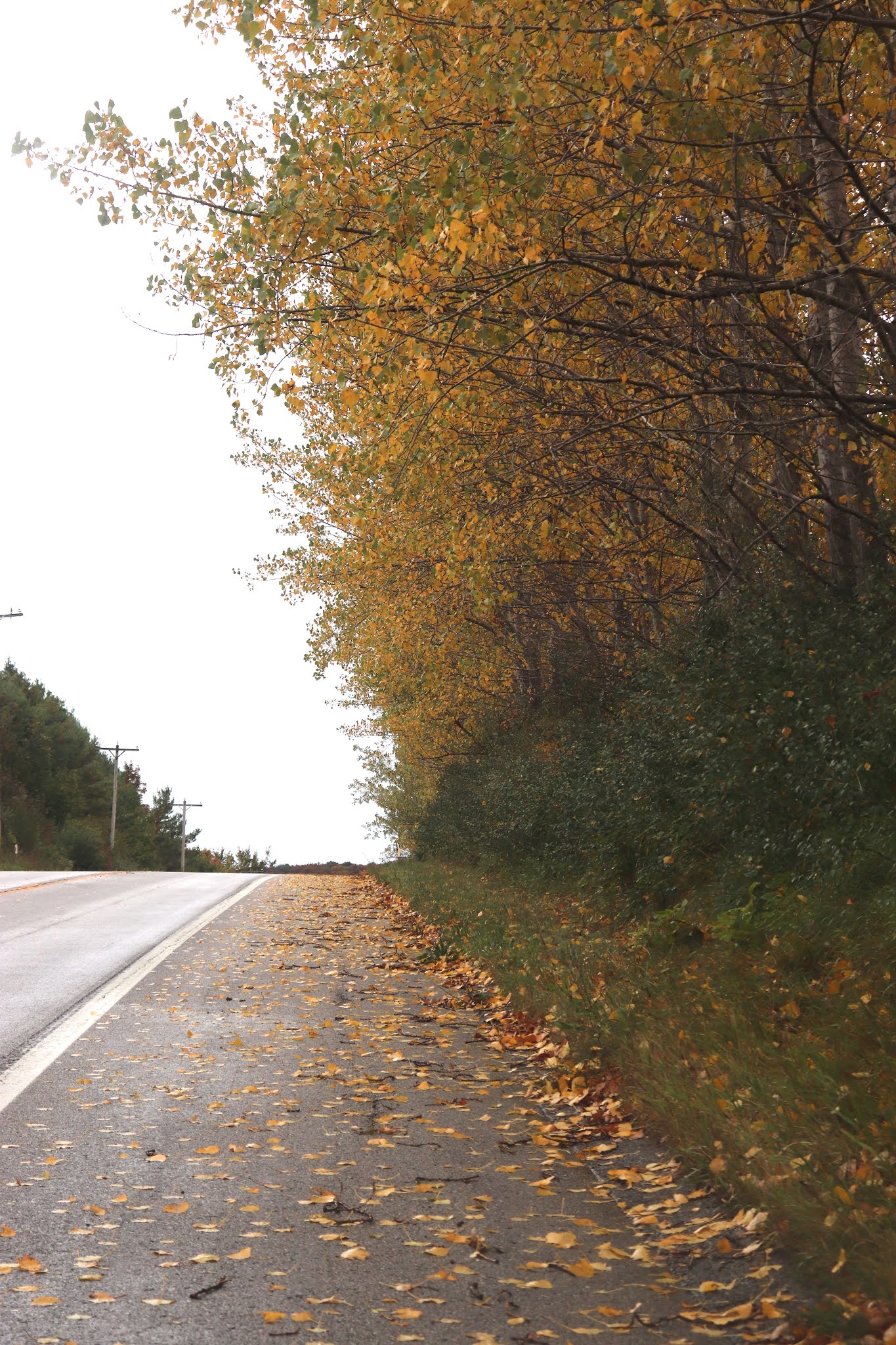
Apple harvest is underway, field corn looks good in the land, and leaves are turning – popples to gold, maples to orange and red, ash to every color from banana-butternut to deep purple. October is here, a month of transition and variability, when any day of any week might steal a march from any other month of the year. What now? What next? In 2020, we ask those questions with more than the usual urgency, not only of the weather and the autumn season but also with respect to COVID-19 and toxic American politics, two parallel pandemics that have converged this week in the nation’s capitol. With more life behind us than ahead of us, the Artist and I wonder what we will see in what time remains to us.


Sunday morning could not have been gloomier: cold, wet, dreary, grey. I forced myself to get up and dressed ... to peel apples ... to cook up a pot of applesauce and get it processed in jars. My other self-assignment for the day was to clean the refrigerator, and I almost cancelled that plan, because -- Who would know? Who would care? But I reminded myself that it takes less time to clean the refrigerator than it does to postpone the job, and after it was done I opened the door a few times to admire my very minor household accomplishment. Sometimes we need to give ourselves positive reinforcement wherever we can find it. I made applesauce! I cleaned the refrigerator! I did not hide my head under the covers all day!


It was a mostly gloomy day, however, certainly not one I'd want to repeat Bill Murray-fashion as Groundhog Day, although that is one of my all-time favorite movies. Could I learn something important by living last Sunday over and over? Maybe "let go" of a friend's comment that disappointed and saddened me? But then, on the other hand, there was a long conversation with another friend, a dear, dear person, and we both felt better after that. [Note to self: call and write to friends more often!]


An inspiring little paperback I read cover to cover over the weekend was Jimmy Carter's Why Not the Best? which takes its title from an encounter young Carter had with Admiral Rickover. Instead of praising the young man for his class standing, the admiral asked if Carter had always done his best, and Carter had to admit that he had not always. "Why not?" the admiral demanded. 


In this 1976 autobiography, Carter writes in detail about his childhood and family, his Navy career, his run for the governorship of Georgia, and finally, as he resolves to make a bid for the presidency, his belief that the American people deserve and will respond to honesty in their political leaders. There is an entire chapter on what was a very crooked election process in part of Georgia and Carter's role in cleaning that up, a volunteer mission he continues around the world to this day, and that was very enlightening, but the thing that impressed me most was how, when he decided to run for elected office -- eventually for the presidency -- he set himself to learn what he would need to know in that office. He read and studied. The energy plan he put forward as president was no half-baked opinion off the top of his head but a comprehensive program carefully formulated after much study and consultation. That is, he took the job of president seriously before he ever ran for the office. He resolved -- I'm saying this; he did not -- to do his best. I think the title of his book was meant to ask why Americans should not demand the best of everyone in government -- and of ourselves.


Carter is often called, by those who find his presidency unimpressive, our best former president. I think history will look upon him more favorably. I make no secret of my admiration for him. 


A black woman being interviewed on the radio (and I'm sorry I did not make a note of her name) referred to "the two pandemics" we are dealing with in the United States right now, and I borrowed her idea for my opening paragraph today. As difficult as it is living with sensible COVID-19 social restrictions, to me the obvious fact that we are not "united" on that or any other question right now feels far worse. Hateful bellows or smirking, snide remarks: neither helps anyone feel better. The friend whose comment knocked me sideways on Sunday thinks I'm too generous in my thoughts and should instead wish bad things on those whose politics and social practices I abhor. Oh, friend, do you think it comes easily to me, not wishing evil on evil-doers, trying not to hate? You little realize how hard I struggle, on a daily basis -- an hourly basis! My sense of outrage is no less keen than yours! And I do hate -- do truly hate -- all appeals to our baser natures and all encouragement to hate! Does that sound like a contradiction?


When it comes right down to it, though, most of us are conservative on some questions and liberal on others. On certain complex issues we may not have reached a settled position but are still trying to sort out everything involved. And that I don’t see as a contradiction. Computer algorithms can afford to be purely rule-driven, because the world of a computer program is limited from the outset, each program modeling a piece or an aspect of the larger world for some specific purpose. Real life is more complicated, because nothing in our many-colored world is left out! 


Moreover, human beings live in a world of contingency. We find ourselves in some situations as a result result of our own prior choices, it’s true, but many situations result from choices other people have made or even from natural processes we could not have foreseen. Partisan, knee-jerk responses, therefore, whether always ‘liberal’ or always ‘conservative,’ too often miss the mark. What good are our own brains, the meaty ones inside our bony skulls, if we are going to run a preset program to yield a programmatic answer to any and every situation? Sometimes – shock! -- it even may even make sense to change our minds! (What a concept, eh?) On some issues both “sides” have important things to say, serious considerations we need to take into account, and there are many issues with more than two “sides,” although our two-party political system has a hard time accommodating and acknowledging that truth.


Here, though, is the bottom line: How should we treat this precious earth we could never ourselves have created? How should we treat one another while we are here? And what kind of country do we want to bequeath to future generations? We Americans are in a pivotal moment right now, one that will all too soon be history and one that the future will judge us by. 


Long after we have returned to dust, the consequences of our decisions will be playing out. We won't see the harvest, but it will come.