A couple of bookstore conversations before Thanksgiving centered on questions of time. The first one had to do with why time seems to pass more quickly as we age. Not far into the second conversation (with different participants), questioning what time might be, in itself, one book-friend became so agitated he took himself right out the door, shouting, “Time does not exist! It’s the reification of an idea!” Our friend would probably not describe himself as a Wittgensteinian, and his language in conversation and argument is certainly more direct than Wittgenstein's, but his position and reason for holding it made me think of that brilliant and enigmatic philosopher. But never mind that now. Or, mind it if you will, but I want to get back to the first conversation.
Older people always say that their days, weeks, months and years fly by, and the middle-aged have intimations of this speed-up when they compare the length of childhood summers to summers of adolescence and adulthood, so let us accept that the experience is universal. The question remains: Why? My own long-held theory is not scientific, as I have no way to test it, but I hold that so much of what is new to us as children, experiencing everything for the first time, is déjà vu in later years. By déjà vu, I don’t mean to imply that we must be jaded or bored or cynical, because while some older people find life’s repetitions boring (Damn! Another spring! Another winter! Another wedding and another funeral!), others find joy and reassurance in cycles of familiar events. (Again the cherry trees bloom! How delightful! Another graduating class--glorious!) No, it isn’t simply the temperament or attitude of the aging person but that, as we grow older, the tiniest events of each day are thickly and deeply layered with memories and associations from earlier days and years. When it’s all for the first time, there is room for time to spread out languorously, but the fiftieth summer has crowded into it all the games and fantasies of childhood, the popular songs and crushes of adolescence, the memories of one’s own small children spending their first days at the beach, and so forth.
While Ken and Bonnie were standing in front of the counter at Dog Ears Books, animatedly throwing thoughts back and forth to one another, I could say none of this, but it stayed in my mind, along with all of the other times I have had similar thoughts, and last night I found a passage in Proust’s Contre Sainte-Beuve that perfectly expresses what I feel and wanted to say. But first let me observe that Marcel Proust could squeeze more experience from thirty seconds than some people manage to find in thirty years! He saw a sunbeam fall on the balcony railing and drew pages and pages of description and meaning from it. Imagine that single, brief sunbeam, before the sky bursts full of sun, and realize the tiny fraction of time that this writer has clarified and made full. Épatant! Well, then, here is the one sentence I want to lift out from its surrounding context:
...Just as in those Celebrity Concerts where the famous singer, whose voice is not as strong as it was, is supported in her rendering of a special item by the voices of a choir off-stage, countless faint memories reaching back one behind another to my earliest childhood received the impression of that sunbeam at the moment when I first saw it with my actual eyes, and imparted to it a sort of volume, to me a sort of depth and plenitude, and reality, made up of all the reality of those days that were loved and mused over and felt in their authenticity, their promise of pleasure, their intimate, uncertain heartbeat.
I have taken the liberty of emphasizing what so struck me in the passage: Yes, that is what I mean! So there it is, not my own original theory at all but expounded 100 years ago by none other than Marcel Proust, but do not mistake me here--I am not claiming Proust as an authority whose opinion must be accepted: “If he wrote it, it must be true.” No, it is my own experience, my own feelings that convince me, his words expressing what I have long felt and believed to be true.
The only way you can verify this theory for yourself is to examine your own responses to passing time. At the Thanksgiving dinner table, were you aware of other, earlier holidays, and did those memories play a part in your experience last week? What is the difference between music you hear for the first time and music you have known since childhood? You can formulate your own questions, and it would probably be helpful to do so. But how often, if at all, do you experience anything that calls forth no memories or associations whatsoever?
 My philosophy in a nutshell (which is all the philosophy most people can bear, so condense yours into a short, pithy sentence if you want to find a hearing for it) is that everything is a double-edged sword, and this is as true for “living in the now” as it is for anything else. Take Sarah, for example. When we are on a trail through the woods, her “now” is thrilling in the extreme, full of new, strange, wonderful scents and broad, complex vistas. Even the “now” of our daily exercise ground is a pleasure to her; she never tires of leaping and running and chasing sticks. The wonderful “now” of STICK PLAY!!! But then we come to work, or we go home, and the hours in the bookstore or in front of the fire stretch out pitilessly, her “now” empty of excitement, her vitality held in suspension for the moment when the chance for activity will again present itself. There are many boring “now” hours in a dog’s life. If only she could revel in the memories of an hour before or anticipation of the hour to come—but no, she is captive to the moment. ("How do you know that?" Bonnie would ask me. I infer it from my dog's expression, her posture, her behavior.) This is the downside of “living in the now” that no one ever talks about. Time for her must pass very slowly.
 David and I, on the other hand, experience Sarah in the same rich, multilayered, past-in-present way we receive our other impressions. We invent diversions for her and laugh happily at her joy, remembering together the pink of her puppy tummy and her warm, sweet puppy breath the first night she came to live with us There are associations with our old dog, Nikki, and the ways in which Sarah is like Nikki, as well as the ways in which she is different. Our “now” is full of past and future, and it rushes like a mountain stream!
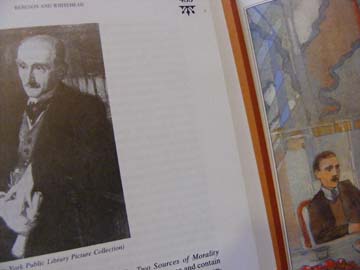
Many Proustian themes are to be found in Henri Bergson’s philosophy. Bergson, the last of the “clear and distinct” French philosophers, saw the future in much the same way as did Proust:
What makes hope such an intense pleasure is the fact that the future, which we dispose of to our liking, appears to us at the same time under a multitude of forms, equally attractive and equally possible. Even if the most coveted of these becomes realized, it will be necessry to give up the others, and we shall have lost a great deal. The idea of the future, pregnant with an infinity of possibilities, is thus more fruitful than the future itself, and this is why we find more charm in hope than in possession, in dreams than in reality.
- Time and Free Will: An Essay on the Immediate Data of Consciousness (1889)
(This Bergsonian thought is echoed in Proust's Contre Sainte-Beuve.)
Perhaps our relationship to the future as well as to the past accounts for the acceleration of time as we grow older? The “infinity of possibilities” is reduced as one reaches life’s end; the future shrinks and withers to a decided finitude. For example, the sad realization of Tony Judt that he would never take another train trip:
Perhaps the most dispiriting consequence of my present disease—more depressing even than its practical, daily manifestations—is the awareness that I shall never again ride the rails. This knowledge weighs on me like a leaden blanket, pressing me ever deeper into that gloom-laden sense of an ending that marks the truly terminal disease: the understanding that some things will never be.
I don’t bring in end-of-life thoughts to be depressing. All I want to do is make a pitch for something other than “living in the now.” As long as we have memories and as long as we believe a future awaits us, living in past, present and future tense at once is a normal and blessed state for human beings. Let’s not sell it short.