Search This Blog

Showing posts with label northern Michigan. Show all posts

Wednesday, August 6, 2025

No Sunrises, No Sunsets, Lots of Changes

Deborah Wesley photograph

Wildfires are currently burning (as of Wednesday morning) in the U.S. states of Alaska, Arizona, California, Colorado, Idaho, Montana, Nevada, New Mexico, Utah, Washington, as well as in western Canadian provinces (from British Columbia to Newfoundland but mostly from western Ontario to the Pacific Ocean). Since prevailing winds blow west to east across North America, air quality in the Midwest and all the way to the eastern seaboard is affected. The only escape is indoors, but who wants to stay indoors all summer? Some people must; others of us are taking our chances, despite the occasional cough. (Don't scold, please! I won't live forever!) My two younger sisters from Illinois came for a visit, and we spent time outdoors each day. 

Three sisters -- yes, styles have changed, too.


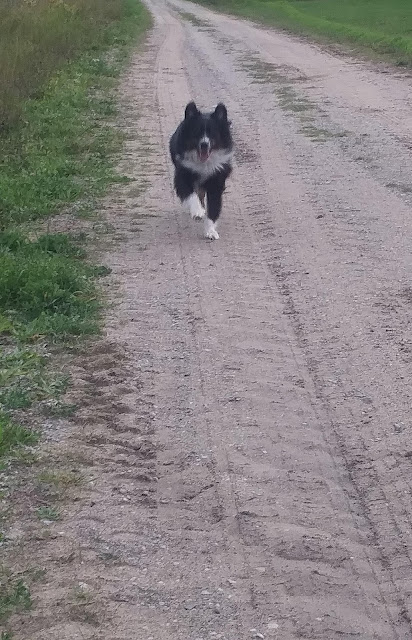
My sister Deborah also spent considerable time spoiling Sunny Juliet—that is, tossing tennis balls out in the yard for a certain lucky dog girl to chase. When all three of us were outside, Sunny still brought her tennis balls to Auntie Deborah rather than to her dog mom. No fool, my Sunny!


I finished In the Merrimack Valley: A Farm Trilogy with a big sigh. Like The Vacation, by Carlos Fuentes, and This Magnetic North, by Tim Mulherin, Jane Brox’s book is a story of change. I guess that is the story of life, isn’t it? Change! I learned a few things in the Brox book, and one of those things is that big bluestem (Andropogon gerardi), a native prairie grass I seeded into the edge of my meadow 25 years ago—a native grass, mind you, not an invasive alien—can nevertheless outcompete other plant species. Now I’m thinking maybe that’s what happened to those purple coneflowers that failed to appear last summer after a quarter-century. The little grey-headed coneflowers are holding their own, so far, but the purple ones have vanished. 

Gone with the wind! Here they were years ago.

These are still with me...


co-existing, for now, with big bluestem.

A meadow, a forest, even a roadside changes from year to year. About three years ago I noticed a little bright yellow flower blooming on the side of M-22 just north of Fischer’s Happy Hour Tavern. Birdsfoot trefoil (Lotus corniculatus) is a nitrogen-fixing legume, but it is invasive and aggressive, forming root mats that crowd out native plant roots, and this year I am noticing it blooming all up and down M-22. Spreading rapidly! So, pretty though it is, I will not be transplanting any to my meadow, which changes just gradually enough (except for the disappearance of purple coneflowers) that I manage to accept the differences from one year to the next. 

Birdsfoot trefoil


This Saturday (already!!!) is Northport’s annual dog parade—and how many does this make? My old Nikki was in the parade back in 1997 ("Mardi Growl”) and again in 1998 (“Treasures of King Mutt”).

Memorabilia! Priceless!

Our Sarah made one parade appearance. That year (2010, and you can find Bettie and Ben and Gracie and Sarah by following this link) my sister and her husband were visiting, along with our mother and their dog, Gracie, so Ben and Bettie each had charge of a dog while I stayed near my shop, watching the parade with our mother. Mother is gone, Gracie and Sarah are gone. More changes…. But the dog parade goes on, this year as “Bone Appétit.” (Note: That final 't' is silent.)


The pretty Bernese below made her first bookstore visit—first time in any bookshop—to Dog Ears! She will have moved on from Northport before parade time, but we commemorated her inaugural bookshop visit with a photo shoot.


My own general view of change (returning to my theme) is that I can handle it better if and when it’s gradual rather than overnight. How about you? 

Please come for guest author Tim Mulherin’s talk at Dog Ears Books on Wednesday, August 13, starting at 7 p.m. The topic will be changes in our own Northern Michigan! 

The book for August 13 event

Author Tim Mulherin


Sunday, February 18, 2024

Bogged Down

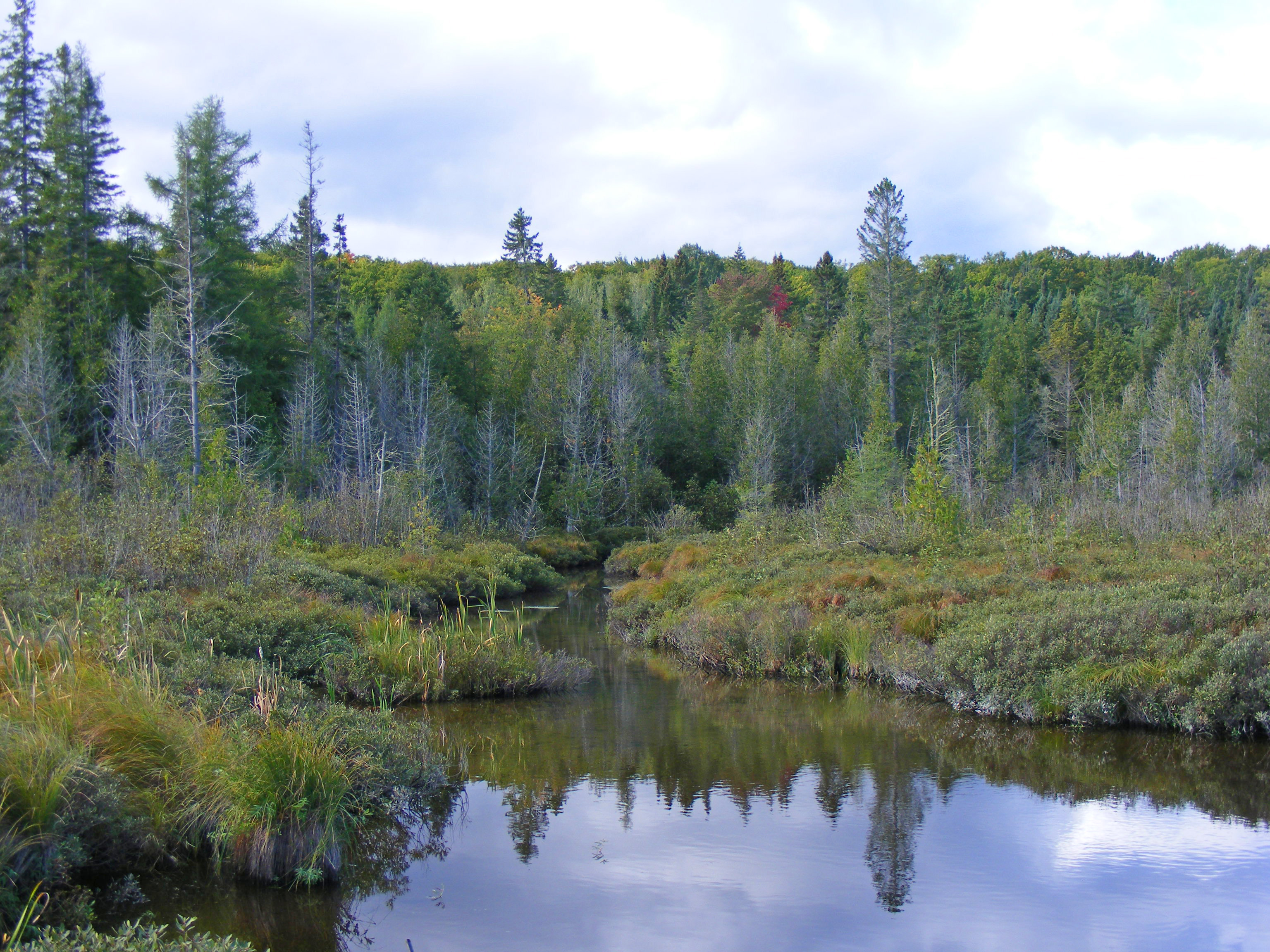
That pond on Alpers Road


 …Northwest Indiana’s Kankakee was an extensive swamp-marsh of more than 500,000 acres on a sandy dune outwash plain, in retrospect [emphasis added] called “one of the great freshwater wetland ecosystems of the world….” 


      The Kankakee River snaked its 250-mile way through the swamp in two thousand twists and bends, a slow absorbent river punctuated with bayous and edged by riverine forests.


-      Annie Proulx, Fen, Bog and Swamp: A Short History of Peatland Destruction and Its Role in the Climate Crisis (Scribner, 2022)


When I was a girl growing up on the Illinois prairie in the 1950s, the term ‘wetland’ was not part of our Midwestern vocabulary, and my fascination with any ‘swamp’-like area that caught my eye was not generally shared by family or friends, but our postwar neighborhood outside the city limits of Joliet, Illinois, was filling in with houses on every 40-ft. lot, and while I appreciated -- for their expansive views of sunset and thunderstorms -- fields of soybeans or corn (in alternating years) across the road from my parents’ older home on the westernmost street of the subdivision, it was wildness I craved. 


What we called “the slough,” down the street, was semi-wild but also stinky and, sadly, forbidden – though if it hadn’t been stinky, its water except in flood barely moving and topped with scum and patches of iridescent oil, I’m sure the prohibition would not have been nearly as effective. As it was, however, most of my hunger for wild wetlands had to be satisfied with sightings from car and train windows. 


Every autumn our mother would take us along on expeditions to gather cattails, milkweed pods and bittersweet for indoor fall arrangements (cattails, common as they are in my northern Michigan life, still hold dreamlike associations for me), and on a long train ride to Florida one spring, unable to stop gazing out the window at the romantic scenery flowing by, I made up a story, mile by mile, to accompany the moving panorama, peopling every hummock with strange, dangerous characters that my sister told me years later had given her nightmares.


A memorable high school biology field trip involved wading in a creek and discovering and collecting caddisfly larvae, but visits to the Kankakee River were an annual occasion for years, with church choir picnics held at the river shack as they called it, belonging to the choir director and his wife. I didn’t know then that the original 250-mile river had once boasted 2,000 “twists and bends” before, beginning in 1902, being dredged and channeled into straight-line segments, such that its length was reduced to 90 miles. I had no idea the Kankakee Marsh, before its trees had been felled and land drained for farmland, had once been called “the Everglades of the North.” Stop and think for a moment: reduced from 250 to 90 miles in length, stripped of its trees (“oaks, walnuts, elms, sycamores”), and natural flood-absorbing marshes filled in to become farm fields.


My strongest memory of the river that flowed past the shack was the sucking, silty, clayey mud that had to be slogged through to reach water deep enough for swimming. When we climbed the ladder to the floating raft, our legs were coated up over the knees in that clinging mud. The water was thick and brown, too, and at the time, and given my age then, I never wondered if the river might once have been different. Now, bit by bit, parcel by parcel, efforts are underway to restore at least pieces of the once extensive wildlife area. Read this to learn more.

In Leelanau

“It is, of course, possible to love a swamp,” writes Proulx, recalling a larch swamp in Vermont that she loved in her early years. And while the fen and bog sections of her book have more to do with peatland destruction, it is the section on swamps that whispers more seductively to my personal experience. Swamp is sometimes a transition zone between higher land and fen or bog, the key difference being that swampland supports trees. There are trees in the Everglades and in the waterlogged wilds along the Suwanee River in Florida, and there are wetlands in northern Michigan where the Artist and I found beavers at work, spied cardinal flower in bloom, or hushed to watch a heron stalking fish or a raccoon washing its hands -- or where a friend and I waded slowly, reverently, into a wonderland of sunlight filtering down through the branches of yet-leafless trees where grassy hummocks held blooming lady’s-slippers as far as our wondering eyes could see. 


Scandinavia and Canada are rich in bogs. Proulx tells us that the word ‘muskeg’ comes from Algonkian and Ojibway words, ‘maskek’ and ‘mashkig.’


Fen peat forms in groundwater locations where reeds, sedges, cattails, rushes and bog beans grow in mineral soils. The plants around the edge and in the water grow, then perish, season after season, gradually filling up the fen with partially decayed vegetable matter that over thousands of years [emphasis added] becomes fen peat. 


-      Proulx, ibid


In the Yoop

On Saturday evening I pulled a comfort book from the shelf at home (for there are comfort books just as there is comfort food – surely, as a reader, you have favorite comfort books of your own?), Lovely Is the Lee, by the same Robert Gibbings whose Coming Down the Seine I so recently enjoyed, and only a few miles inland from Galway, Gibbings is exploring moorland and bogs, where “Black bullocks munch the heather” and “Wild geese rise from the bog.” The year is 1945, and the old ways are still practiced. Turf, Gibbings tells us, 


…is cut with a slane, a narrow spade with an ear at right angles to the blade so that two sides of the sod are cut at the same time from the stepped face of the bog. Each newly cut sod is like a large brick, dark and oily.


-      Gibbings, Robert, Lovely Is the Lee (Dutton, 1945


An experienced slanesman could cut four tons of raw turf in a single day, which then had to be spread to dry, stacked, and finally thatched with straw “against the weather.” Gibbings, as does Proulx, notes that much material culture of previous ages is uncovered in the cutting of bog turf: bronze and obsidian implements, wooden dishes, canoes and paddles, clothing made from wool, skin, or leather. 


The title for today’s post came to me, however, in addition to my reading, by way of a figure of speech. We say we are “bogged down” when we are stuck, as in mire, unable to move forward. The Cambridge dictionary gives examples as examples using the expression “Let’s not get bogged down with individual complaints” and “Try not to get too bogged down in the details.” A related figure of speech is “swamped,” meaning overwhelmed, as if one is flooded. There is also the Slough of Despond, which Proulx mentions, from the classic Pilgrim’s Progress. All felt appropriate in this shortest month of the year.


Because February is a difficult month for me, with day-by-day anniversaries of the Artist’s final weeks of hospitalizations and surgeries, the emotional gamut we ran from confident hope to his final days, his last birthday. Images and sentences and remembered feelings from that time swamp my dreams and solitary hours. I don’t want to say I am permanently bogged down, only that --- what? I don’t want to profane it by trying to put it into words.


As you know, though, I have a dog, and there is no crawling into a hole and playing dead when one has a dog. No, the dog has to go outdoors, and so the dog momma has to get dressed and go out, too, and this discipline my companion imposes on me is a life-saver. 


"Let's get the day started!"

Following springlike days, we had a heavy, wet snow that quickly became slush, only to harden to cement when the temperature dropped. Then the temperature dropped further, and more snow came overnight Friday, this time the light, fluffy stuff beloved of cross-country skiers. Single-digit wind chill. And Sunny Juliet discovered something new in her Michigan world: ice on our little no-name creek. She tried it, but it was not strong enough to hold her weight. Luckily, the creek is shallow. Only her feet got wet. And the dog momma didn’t want to stay outdoors for an hour in the cold wind, anyway.


Sunny exploring frozen creek...

...where she broke through the ice

And yet we went out again in the afternoon and again the next morning and again the following day, morning and afternoon, because this is our life, and it’s what we do. We wake up and get on our feet and go out into the world.


And now, did I write myself out of the swamp? Or was it my HappyLight that did the trick? The patches of blue sky and beautiful cumulus clouds we had before grey skies returned? Or my lovely little companion, always so happy be outdoors with me, whatever the weather, always full of energy and enthusiasm even when I might be short on both? Maybe all of those contributed to an afternoon happier than the dark morning had been. There is no way we can live two different lives at the same time, in some kind of sci-fi controlled experiment, and know for certain which is preferable or better or more true. One life, each moment of it a gift to do with as we will….


She says, "Be happy! We have each other!"


Monday, December 4, 2023

Winter Days Are Here

Clouds delayed sunrise that day.

The sun doesn’t top what I call the Eastern Woods until about 9 o’clock these days, but daylight is sufficient to get me out with my dog an hour before that, and since morning coffee time usually begins for me at 5 a.m., Sunny Juliet is more than ready to go outdoors by 8 o’clock for a good, hard run. She loves to play with frozen apples or -- even more exciting -- the battered, torn remnants of an old boot that still excites her every time she finds it again. 


Sunny practicing her Zen patience --


Between 5 and 7:30 a.m., though, Sunny stretches out long and patient beside me on the bed or draped over my feet (she is on top of the covers) while I read, write in my journal, write a letter, and look at news and Facebook on my phone. Checking in with friends on Facebook reminds me of my mother’s long telephone conversations with friends and neighbors when I was a child, except that she could only talk to one person at a time, and those were the days of “long distance” telephone charges, so her daily chats were confined to nearby friends, whereas I can keep up with loved ones anywhere in the world. Of course, there’s always that book I was reading the night before, too, waiting for me before dawn….


Northport was deadly quiet on Friday, streets empty. Holiday season or not, this is winter in a summer tourist town. Many, many years ago, a successful Leland entrepreneur told me, “People always want to take their businesses year-round, but the key to a successful seasonal business is to keep it seasonal.” I can hardly complain about anyone spending the winter elsewhere, as I have done so myself many times. Staying in place this year, of course I would be happy to have more regular local customers, but I am grateful for those I do have. And having been in business for over 30 years, quiet winter days do not surprise me. It’s an old story.


Saturday was livelier. Even though the horses arrived so late that they kept driving around the village until 9 p.m., I had enough browsers and book buyers to make my day, plus the chance to catch up in person with a local friend whose summers are no doubt as busy as mine. Fun to visit with friends old and new over books!


When I go home to Sunny Juliet after a bookstore day (this works better on the short days when I close at 3 than it does on 11-5 winter Saturdays), she is ecstatic to have me back again – and to get outdoors for another ramble before dark. I’ve put her agility equipment away for the winter, and we won’t be going back to class until spring, either, but we are outdoors every day, whatever the weather. Our most frequent path takes us uphill between woods and orchard, where before the big snow Sunny would run and leap and pounce like a fox on dry, skittering leaves and tease me with apples she dropped as an invitation and then grabbed up again herself. Now even the apples are frozen and mostly buried in snow – but she is a girl who enjoys a challenge! 


Woods on Saturday morning 

Deeper snow on Monday morning 

Beautiful red apples in snow 
 

Foraging dog 

Ordinarily, I wouldn’t come to the bookstore on Mondays, but the last part of my new book order hadn’t arrived on Friday, so here I am until the big brown truck comes. What fun Sunny and I had this morning, though! And how beautiful all the trees looked, both around home and on my drive to Northport, every branch outlined and weighed down by snow! My new snow tires did the job, too, even without the driveway plowed yet.


So let it snow! It is, after all, December in northern Michigan. And I am well supplied with books.


Seen from indoors through window and screen on Sunday 

Up close and personal, outdoors on Monday 


Sunny in the snow 

Wednesday, October 27, 2021

Paying Homage to a Lowly Native Tree


A tree is a place, not an object, it’s an island in the air

where our sight may live awhile, unburdened

and free from this heavy, earthen body.


-      Joseph Stroud, “Homage to the Black Walnut in Downtown Santa Cruz,” in the collection titled Below Cold Mountain


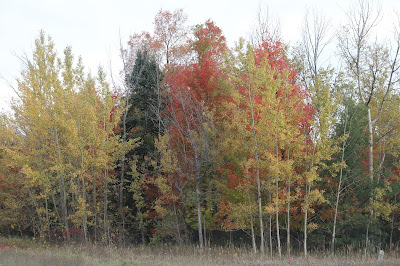
Fall is a good time to pay tribute to trees in general, particularly here in the northern Midwest as tree foliage loses its chlorophyll and blazes with bright colors for a few short weeks. 


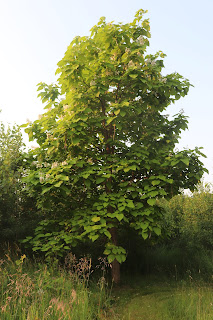
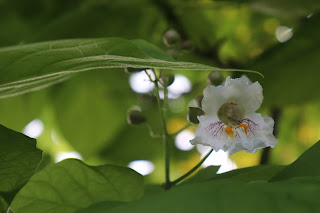
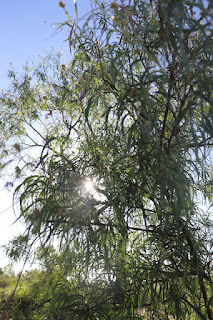
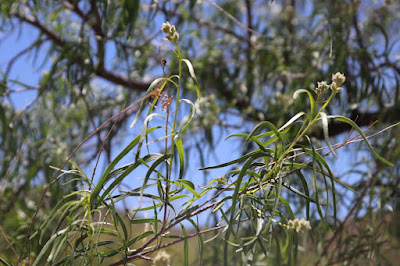
When I look back over the years, I see that many different tree species have obsessed me in different seasons of my life. One year (while reading Swann’s Way) it was hawthorns, in the field and in books. I could think of almost nothing but hawthorns for months on end. Another year it was old apple trees – and everywhere I looked, I saw them. Many autumns have seen me swooning over the varied colors of ash trees, from butterscotch yellow to deep plummy purple, while during many winters in the woods I’ve been entranced by paper-thin, almost transparent beech foliage hanging on against winter’s wind and snow. I love the catalpa that appeared out of nowhere one year as a mere stripling in our backyard, now a stately tall tree that flowers for us each spring, and I also love its modest Arizona cousin, the desert willow, which is not a true willow at all but another member of the small genus Catalpa.


Catalpa in Michigan

Catalpa flower

Desert willow in Arizona

Beginning to flower


Speaking of true willows, the family Salicaceae encompasses the genus Populus, those species I call (after their name) the “people trees,” and this is how Burton V. Barnes and Warren H. Wagner, Jr., introduce them in Michigan Trees: A Guide to the Trees of Michigan and the Great Lakes Region.

The genus Populus belongs to the willow family, and the aspens, cottonwoods, and poplars resemble the willows, especially in flower and fruit characters.


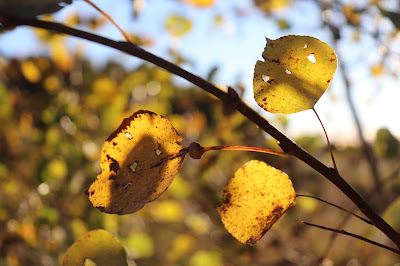
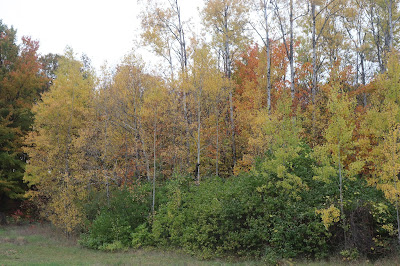
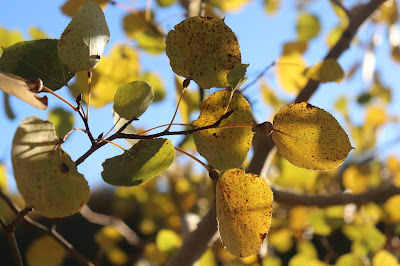
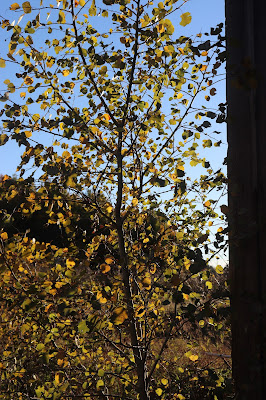
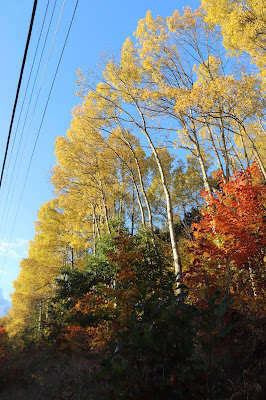
Flowers on pendulous catkins (delicious little word!) are pollinated by the wind, and leaves flutter in the breeze like whispers of a conversation just far enough away that the words cannot be distinguished. Aspens, balsam poplars, and cottonwoods inhabit very different ecosystems, but it is the lowly aspen, known locally in northern Michigan as popple, that occupies my mind this fall. Populus tremuloides, our popple, is Colorado’s aspen. Westerners (without our beautiful maples) rhapsodize over their aspens, while we here pretty much take our popples for granted, but this year I can’t stop thinking about them and combing the Leelanau roadsides with my eyes, hungry for popples.


As 2021 has been a record mushroom year, it seems only fitting to note here that Michigan’s largest living organism is a fungus growing in the Upper Peninsula that covers over 30 acres, but another reason I mention the U.P. fungus is that it has something common with our popple trees. You may think you are looking at a grove of individuals, but it’s far more likely that the trees you see all arise from a common underground, nearly indestructible root system (try to get rid of popples sometime!), which makes the trees genetically identical clones of one another and all physically interconnected. See the explanation and some fabulous photographs of aspen out west here. Within their genus, Barnes and Wagner tell us this about popples: 

…The aspens are boreal and northern species, adapted to a cold climate and either moist or dry soils. They reproduce abundantly by seeds under the right site conditions. Aspens are also adapted to fire and sprout profusely from roots when their trunks are scorched and killed.
 

Is Utah’s Pando aspen grove the largest popple clone in the world? Colorado has challenged the Utah clone, but these things are difficult to measure. 


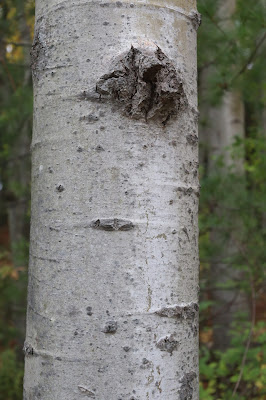
My late Uncle Jim, a veteran of the Civilian Conservation Corps, had my undying admiration for his ability to identify trees in winter, when there were no leaves to match against field guide illustrations. Overall shapes of trees helps (the few remaining elm trees in the landscape stand out easily with their vase shape), and bark is another big help. The bark of Populus tremuloides is 

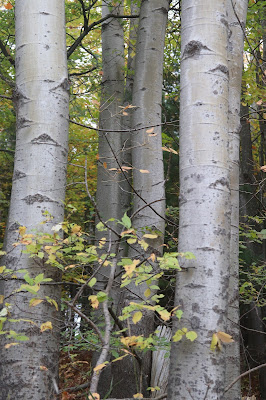
Thin, creamy white to yellowish green [when young], smooth, becoming fissured and gray [with age] with long, flat-topped ridges at the base of old trees or trees in deep shade.


Popples don’t care much for shade (the old ones you'll find there have no doubt been overtaken by other encroaching species), so you’ll often see them at the outer edges of woods and forests, clustered together like a herd of shy young deer, nervous about venturing too far out into the open. My advice today, though, is to take note of them before the wind has completely unclothed them for the winter. Individually they may not look like much, but in groups they are graceful and lovely, especially when the sun catches their dancing leaves, and these sweet little native trees are worthy of our Michigan attention.


Books Read Since Last Listed


148. Rashid, Mark. Lessons From a Ranch Horse (nonfiction)

149. Mosley, Walter. Walkin’ the Dog (fiction)

150. Mowat, Farley. The Dog Who Wouldn't Be (nonfiction)


Currently reading: Things Fall Apart, by Chinua Achebe


Peasy News


Next week, the first week of my annual seasonal retirement (Saturday, October 30, is the last bookstore day of the 2021 season), we are taking Peasy to begin some special professional training (training for all three of us), and I’ll let you know how that develops. Pursuing social skills with our special needs dog, as well as addressing long-postponed household projects and issues, means we won’t be leaving for Arizona much before early December, but what needs doing needs doing, and we must needs get at it.


As always, thanks for supporting Dog Ears Books,  thanks for reading, and please feel welcome to share Books in Northport with your friends and neighbors.


Tuesday, October 12, 2021

My life has changed a lot. (Our lives are always changing.)


School is back in session. The number of boats is thinning in the marina. Playground equipment stands empty in the rain, and leaves are beginning to turn and fall. Autumn is a season of change more obvious than the gradual changes of summer.


The rest of the United States, when it recognizes the name Bruce Catton, thinks “Civil War historian.” Here in Michigan (especially northern Michigan, where Catton spent his boyhood and youth), we know him as one of our own, not only the writer of books about the Civil War but also author of an engaging and moving history of Michigan, as well as his beautiful and much-loved memoir, Waiting for the Morning Train


Catton had a tragic sense of history. His thesis in Michigan: A Centennial History can be stated simply, if metaphorically: “We are all Indians.” With this phrase, the author was not taking on the colors of a wannabe and dressing up in literary pow-wow regalia, pretending to be something he was not. This is not cultural appropriation. What Catton meant is clear to readers of the book: the relentless march of American history, the tide of white Europeans invading and claiming ancestral tribal homelands, which meant cultural destruction to Native American tribes, bringing change faster that the native peoples could adapt to it (had the Europeans even allowed them to adapt, which is another story) – that kind of rapid, destructive cultural change is the fate of us all, whether we realize it or not. One example from Michigan history is the destruction of old-growth white pine forests: in the short term, the timber industry provided jobs locally and lumber to rebuild Chicago after the fire, but the resulting fields of stumps provided nothing for the many young lumber towns that rapidly fell into decay.


Perhaps being overcome and left behind is the fate of the older generations everywhere in the world where change is rapid. In this Western “civilized” world, certainly, we are (and have been for generations) overdriving our headlights – and we are also, simultaneously, the deer in the headlights, those bringing change no more in control of the future than those overwhelmed by changes wrought.


In my own life, for a long time, there were certain things I did every year and naively thought I would always do, and now I find myself falling away from many of what used to be annual personal traditions, while at the same time unforeseen developments have come into my life, complicating and changing it irrevocably. One recent development is the dog we call Peasy.  I knew I was adopting a shy dog, a dog with “issues,” but I had no idea what it meant to live with a “reactive” dog until, as we got to know him better, I began reading more about the special needs this little guy has, which is why I now say that he is “my comfort and my challenge, companion and burden, solution (to some of life’s problems) and problem (on his own, in many ways).” Fortunately, I am not alone in dealing with the challenges Peasy presents, however, because the little dickens has managed somehow to worm his way into the Artist’s heart, as well. How amazing! 


“He’s so full of life! And he’s so grateful to us! It would be churlish not to love him,” says the Artist (who adds that the last thing he wants to be is a churl). When Peasy trots proudly into the bedroom carrying one of his toys to show us, we dissolve in laughter. He plays joyfully and brings his joy to us, another of his treasures and one he shares happily. If only he could spread his joy and love around to other people, as Sarah did! But that, sadly, is not his nature.


Nikki was a shy little plain Jane, “pure mutt,” as I used to say when people asked. Sarah was a beautiful, calm, very sociable Aussie-border collie mix. The world was a scary place for Nikki, but with us she had a good, long life. Sarah was the easiest puppy and dog in the world to live with and loved just about everyone and everything in the world. Neither of those dogs prepared us for Peasy. But although the accommodations necessary for dealing with him and friends and family at the same time are sometimes a real pain in the neck, he loves us so much that we can’t help loving him back.


So that is one big change in our life. Another, creeping on us gradually, but more speedily with each passing year, is that we are getting oldUs! Whoever thought that would happen? It doesn’t mean a thing that it happens to “everyone,” because what has “everyone” to do with us? 


I began this post with Michigan history, zoomed in on my personal life, and now want to pull back again for a wider, longer view. Northport. Leelanau County. Traverse City. Northern Michigan. In Traverse City, change has been bigger and faster than out here in the county, such that if we don’t go to town for a couple of weeks, we hardly recognize the place. Okay, slight exaggeration. But really! High-rise hotels and motels have taken the place of old mom-and-pop tourist cabins, and enormous condominium buildings sprout like giant mushrooms from outer space along the Boardman River and Grand Traverse Bay. We look at what we see there now and recall to each other how the same place used to look forty, fifty, sixty years ago, when Traverse City really was still a small town. 


Well, Northport is still a small town. We have our dog parade in August and homecoming parade in the fall. In the summer, there is the farmers market and, on Friday evenings, Music in the Park. There is a blinking traffic light at the south end of the village, and there are parking lots but no parking meters. Yet change is inevitable everywhere, and Northport is no exception. Will our little village be able to accommodate change and retain its friendly small-town atmosphere, or will the atmosphere itself be changed? No one, I think, wants the latter possibility to be realized. Those of us already here like our town the way it is, and new people come because they like it, too.


When I posted on Facebook that I had a couple copies of the book Limits to Growth: The 30-Year Update, two village council members put dibs on those copies (so I should probably order more). Is it possible to limit growth? How do we do it?


It’s bow season right now for deer, to be followed by firearm deer season, and slowing down on county roads is a good idea. Maybe slowing down in other ways is a good idea, too. Easy for me to recommend slowing down, though: I’m getting old. How do you feel about change and speed?


P.S. Please see here my pitch for the kind of support that counts with booksellers, whether you like life fast or slow. Thanks!